Oil cooler LAND ROVER DISCOVERY 2002 Repair Manual
[x] Cancel search | Manufacturer: LAND ROVER, Model Year: 2002, Model line: DISCOVERY, Model: LAND ROVER DISCOVERY 2002Pages: 1672, PDF Size: 46.1 MB
Page 284 of 1672
ENGINE - V8
REPAIRS 12-2-41
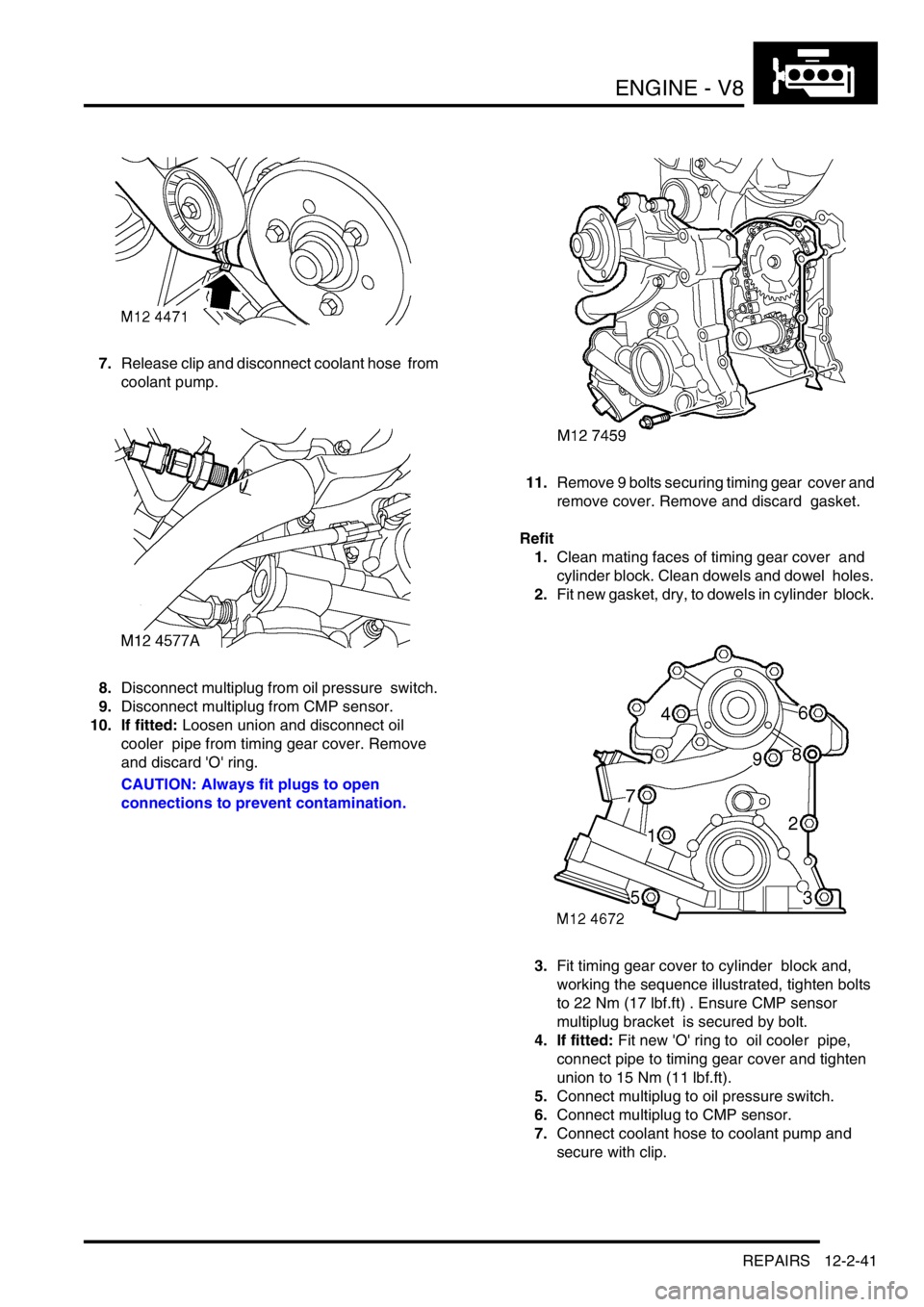
7.Release clip and disconnect coolant hose from
coolant pump.
8.Disconnect multiplug from oil pressure switch.
9.Disconnect multiplug from CMP sensor.
10. If fitted: Loosen union and disconnect oil
cooler pipe from timing gear cover. Remove
and discard 'O' ring.
CAUTION: Always fit plugs to open
connections to prevent contamination.11.Remove 9 bolts securing timing gear cover and
remove cover. Remove and discard gasket.
Refit
1.Clean mating faces of timing gear cover and
cylinder block. Clean dowels and dowel holes.
2.Fit new gasket, dry, to dowels in cylinder block.
3.Fit timing gear cover to cylinder block and,
working the sequence illustrated, tighten bolts
to 22 Nm (17 lbf.ft) . Ensure CMP sensor
multiplug bracket is secured by bolt.
4. If fitted: Fit new 'O' ring to oil cooler pipe,
connect pipe to timing gear cover and tighten
union to 15 Nm (11 lbf.ft).
5.Connect multiplug to oil pressure switch.
6.Connect multiplug to CMP sensor.
7.Connect coolant hose to coolant pump and
secure with clip.
Page 325 of 1672
EMISSION CONTROL - TD5
17-1-4 DESCRIPTION AND OPERATION
Emission Control Systems
Engine design has evolved in order to minimise the emission of harmful by-products. Emission control systems fitted
to Land Rover vehicles are designed to maintain the emission levels within the legal limits pertaining for the specified
market.
Despite the utilisation of specialised emission control equipment, it is still necessary to ensure that the engine is
correctly maintained and is in good mechanical order, so that it operates at its optimum condition.
In addition to emissions improvements through engine design and the application of electronic engine management
systems, special emission control systems are used to limit the pollutant levels developed under certain conditions.
Two main types of additional emission control system are utilised with the Td5 engine to reduce the levels of harmful
emissions released into the atmosphere. These are as follows:
1Crankcase emission control – also known as blow-by gas emissions from the engine crankcase.
2Exhaust gas recirculation – to reduce NO
2 emissions.
Crankcase emission control
All internal combustion engines generate oil vapour and smoke in the crankcase as a result of high crankcase
temperatures and piston ring and valve stem blow-by, a closed crankcase ventilation system is used to vent
crankcase gases back to the air induction system and so reduce the emission of hydrocarbons.
Gases from the crankcase are drawn into the inlet manifold to be burnt in the combustion chambers with the fresh air/
fuel mixture. The system provides effective emission control under all engine operating conditions.
Crankcase gases are drawn through the breather port in the top of the camshaft cover and routed through the breather
hose and breather valve on the flexible air intake duct to be drawn into the turbocharger intake for delivery to the air
inlet manifold via an intercooler.
An oil separator plate is included in the camshaft cover which removes the heavy particles of oil before the crankcase
gas leaves via the camshaft cover port. The rocker cover features circular chambers which promote swirl in the oil
mist emanating from the cylinder head and camshaft carrier. As the mist passes through the series of chambers
between the rocker cover and oil separator plate, oil particles are thrown against the separator walls where they
condense and fall back into the cylinder head via two air inlet holes located at each end of the rocker cover.
The breather valve is a depression limiting valve which progressively closes as engine speed increases, thereby
limiting the depression in the crankcase. The valve is of moulded plastic construction and has a port on the underside
which plugs into a port in the flexible air intake duct. A port on the side of the breather valve connects to the camshaft
cover port by means of a breather hose which is constructed from a heavy-duty braided rubber hose which is held in
place by hose clips. A corrugated plastic sleeve is used to give further protection to the breather hose. The breather
valve is orientation sensitive, and “TOP” is marked on the upper surface to ensure it is mounted correctly.
It is important that the system is airtight so hose connections to ports should be checked and the condition of the
breather hose should be periodically inspected to ensure it is in good condition.
Page 426 of 1672

ENGINE MANAGEMENT SYSTEM - TD5
DESCRIPTION AND OPERATION 18-1-33
The turbocharger is exposed to extremely high operating temperatures (up to 1,000 °C (1832 °F)) because of the hot
exhaust gases and the high speed revolution of the turbine (up to 150,000 rev/min). In order to resist wear of the
turbine bearings a flow of lubrication oil is supplied from the engine lubrication system to keep the bearings cool. Oil
is supplied from a tapping at the front of the full-flow filter adaptor housing via a metal pipe with banjo connections.
Oil is returned to the sump via a metal pipe which connects to the cylinder block at a port below the turbocharger
assembly.
A heatshield is attached to the left hand side of the engine to protect adjacent components from the heat generated
at the turbocharger. The heatshield is attached to the engine by two bolts an additional bolt attaches the heatshield
to the turbocharger casting.
The engine control module controls the amount of boost pressure the engine receives by way of the turbocharger.
When full boost is reached a control signal is sent to the wastegate modulator, and a vacuum is applied to the
wastegate valve. The wastegate valve opens, bypassing some of the exhaust gas away from the turbine to be output
to the exhaust system.
The engine should be allowed to idle for 15 seconds following engine start up and before the engine is switched off
to protect the turbocharger by maintaining oil supply to the turbine bearings.
Intercooler
The intercooler is an air-to-air heat exchanger which lowers the intake air temperature to obtain a higher air density
for better combustion efficiency. The intercooler receives compressed air from the turbocharger via a metal pipe; it
cools the intake air via the intercooler matrix and delivers it to the intake manifold by means of a rubber hose which
connects between the intercooler outlet and the intake manifold outlet. The rubber hose is connected to ports at each
end by metal band clips.
+ COOLING SYSTEM - Td5, DESCRIPTION AND OPERATION, Description.
The intercooler is located at the front of the engine bay, forward of the radiator.
Page 586 of 1672

COOLING SYSTEM - TD5
DESCRIPTION AND OPERATION 26-1-3
1Pressure cap
2Overflow pipe
3Heater return hose
4Heater matrix
5Heater inlet hose
6Oil cooler return pipe — EU3 models
7Connecting hose
8Oil cooler housing assembly
9Heater inlet pipe
10Connecting hose
11Outlet housing
12Engine Coolant Temperature (ECT) sensor
13Bleed screw
14Radiator top hose
15Radiator - upper
16Intercooler
17Gearbox oil cooler
18Radiator - lower
19Viscous fan
20Drain plug21Connecting hose
22Fuel cooler feed hose
23Radiator bottom hose
24Thermostat housing
25Connecting hose
26Coolant pump feed pipe
27Coolant by-pass pipe
28Radiator bleed pipe
29Connecting hose
30Coolant pump
31Fuel cooler
32Heater/expansion tank return hose
33Expansion tank
34EGR Cooler - EU3 models
35Connecting hose - EU3 models
36Connecting hose - EU3 models
37Hose - EGR Cooler to oil cooler return pipe -
EU3 models
38Radiator lower feed hose - Pre EU3 models
39Oil cooler return pipe - Pre EU3 models
Page 589 of 1672

COOLING SYSTEM - TD5
26-1-6 DESCRIPTION AND OPERATION
Outlet housing
A cast aluminium outlet housing is attached to the cylinder head with three bolts and sealed with a gasket. Coolant
leaves the engine through the outlet housing and is directed through a hose to the heater matrix, the radiator or the
by-pass circuit.
An Engine Coolant Temperature (ECT) sensor is installed in a threaded port on the side of the outlet housing. The
sensor monitors coolant temperature emerging from the engine and sends signals to the Engine Control Module
(ECM) for engine management and temperature gauge operation.
+ ENGINE MANAGEMENT SYSTEM - Td5, DESCRIPTION AND OPERATION, Description.
Expansion tank
The expansion tank is located in the engine compartment. The tank is made from moulded plastic and attached to
brackets on the right hand inner wing. A maximum coolant when cold level is moulded onto the tank.
Excess coolant created by heat expansion is returned to the expansion tank from the radiator bleed pipe at the top of
the radiator. An outlet pipe is connected into the coolant pump feed hose and replaces the coolant displaced by heat
expansion into the system when the engine is cool.
The expansion tank is fitted with a sealed pressure cap. The cap contains a pressure relief valve which opens to allow
excessive pressure and coolant to vent through the overflow pipe. The relief valve is open at a pressure of 1.4 bar (20
lbf.in
2) and above.
Heater matrix
The heater matrix is fitted in the heater assembly inside the passenger compartment. Two pipes pass through the
bulkhead into the engine compartment and provide coolant flow to and from the matrix. The pipes from the bulkhead
are connected to the matrix, sealed with 'O' rings and clamped with circular rings.
The matrix is constructed from aluminium with two end tanks interconnected with tubes. Aluminium fins are located
between the tubes and conduct heat from the hot coolant flowing through the tubes. Air from the heater assembly is
warmed as it passes through the matrix fins. The warm air is then distributed in to the passenger compartment as
required.
+ HEATING AND VENTILATION, DESCRIPTION AND OPERATION, Description.
When the engine is running, coolant from the engine is constantly circulated through the heater matrix.
Radiator
The 44 row radiator is located at the front of the vehicle in the engine compartment. The cross flow type radiator is
manufactured from aluminium with moulded plastic end tanks interconnected with tubes. The bottom four rows are
separate from the upper radiator and form the lower radiator for the fuel cooler. Aluminium fins are located between
the tubes and conduct heat from the hot coolant flowing through the tubes, reducing the coolant temperature as it
flows through the radiator. Air intake from the front of the vehicle when moving carries the heat away from the fins.
When the vehicle is stationary, the viscous fan draws air through the radiator fins to prevent the engine from
overheating.
Two connections at the top of the radiator provide for the attachment of the top hose from the outlet housing and bleed
pipe to the expansion tank. Three connections at the bottom of the radiator allow for the attachment of the bottom
hose to the thermostat housing and the return hose from the oil cooler and the feed hose to the fuel cooler.
The bottom four rows of the lower radiator are dedicated to the fuel cooler. The upper of the two connections at the
bottom of the radiator receives coolant from the oil cooler. This is fed through the four rows of the lower radiator in a
dual pass and emerges at the lower connection. The dual pass lowers the coolant temperature by up to 24
°C before
being passed to the fuel cooler.
Two smaller radiators are located in front of the cooling radiator. The upper radiator is the intercooler for the air intake
system and the lower radiator provides cooling of the gearbox oil.
+ EMISSION CONTROL - Td5, DESCRIPTION AND OPERATION, Emission Control Systems.
+ MANUAL GEARBOX - R380, DESCRIPTION AND OPERATION, Description.
+ AUTOMATIC GEARBOX - ZF4HP22 - 24, DESCRIPTION AND OPERATION, Description.
Page 590 of 1672
COOLING SYSTEM - TD5
DESCRIPTION AND OPERATION 26-1-7
Pipes and hoses
The coolant circuit comprises flexible hoses and metal formed pipes which direct the coolant into and out of the
engine, radiator and heater matrix. Plastic pipes are used for the bleed and overflow pipes to the expansion tank.
A bleed screw is installed in the radiator top hose and is used to bleed air during system filling. A drain plug to drain
the heater and cylinder block circuit of coolant is located on the underside of the coolant pump feed pipe.
Oil cooler
The oil cooler is located on the left hand side of the engine block behind the oil centrifuge and oil filter. Oil from the oil
pump is passed through a heat exchanger which is surrounded by coolant in a housing on the side of the engine.
Full water pump flow is directed along the cooler housing which also distributes the flow evenly along the block into
three core holes for cylinder cooling. This cools the engine oil before it is passed into the engine. A small percentage
of the coolant from the oil cooler passes into a metal pipe behind the engine. It then flows into the lower radiator via
a hose.
Fuel cooler
The fuel cooler is located on the right hand side of the engine and is attached to the inlet manifold. The cooler is
cylindrical in design and has a coolant feed connection at its forward end. A 'T' connection at the rear of the cooler
provides a connection for the coolant return from the heater matrix and coolant return from the fuel cooler.
The 'T' connection houses a thermostat which opens at approximately 82
°C. This prevents the cooler operating in
cold climates.
Two quick release couplings on the cooler allow for the connection of the fuel feed from the pressure regulator and
return to the fuel tank. A counter flow system is used within the cooler.
Fuel flows around a coolant jacket within the cooler and flows from the back to the front of the cooler. As the hot fuel
cools travelling slowly forwards it meets progressively colder coolant travelling in the opposite direction maintaining a
differential cooling effect.
EGR Cooler
The EGR Cooler is mounted on the front of the cylinder head. Coolant from the oil cooler flows around the EGR cooler,
cooling the exhaust gas, to improve exhaust emissions, before being returned to the expansion tank.
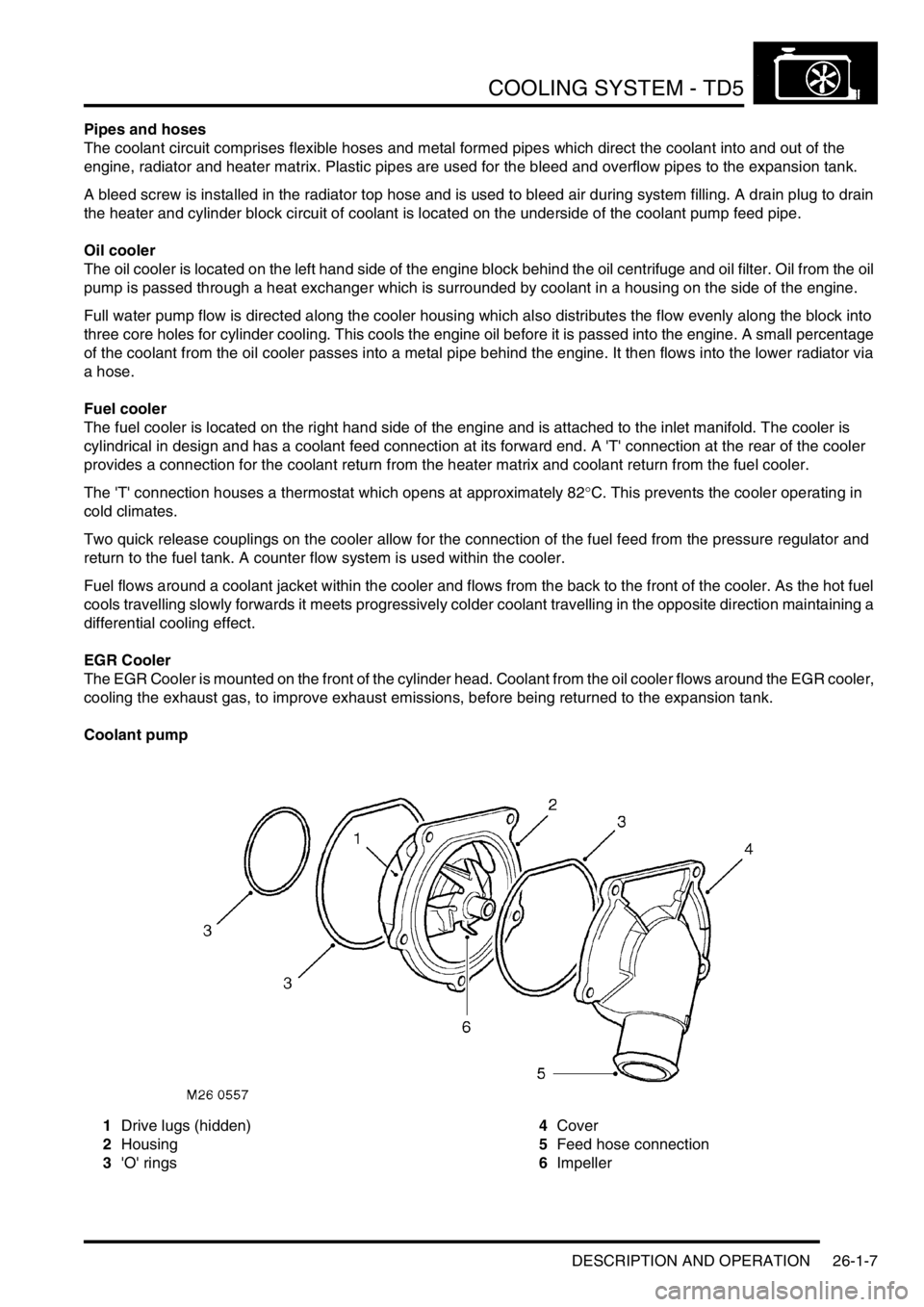
Coolant pump
1Drive lugs (hidden)
2Housing
3'O' rings4Cover
5Feed hose connection
6Impeller
Page 591 of 1672

COOLING SYSTEM - TD5
26-1-8 DESCRIPTION AND OPERATION
The coolant pump is attached on the left hand side of the engine, behind the PAS pump. A cast housing, bolted to the
cylinder block provides a common attachment point for both pumps. The housing has galleries which connect the
coolant pump to the cylinder block and the oil cooler housing. The coolant pump comprises a shaft, a housing and a
cover.
The shaft, which passes through the alloy housing, is supported at each end by bearings. Seals at each end of the
shaft protect the bearings from the coolant. The forward end of the shaft has two lugs which engage with the PAS
pump shaft. The opposite end of the shaft is fitted with an impeller which draws coolant from the feed pipe and
circulates it through galleries in the cylinder block. The shaft is driven by the auxiliary drive belt at the same rotational
speed as the crankshaft by a pulley attached to the PAS pump.
The pump is sealed in the cast housing with two 'O' rings. An outer cover is positioned over the pump and secured
with six bolts and sealed to the pump with an 'O' ring. The cover provides the attachment for the feed pipe connecting
hose.
Page 593 of 1672

COOLING SYSTEM - TD5
26-1-10 DESCRIPTION AND OPERATION
Operation
Coolant flow - Engine warm up
Refer to illustration.
+ COOLING SYSTEM - Td5, DESCRIPTION AND OPERATION, Cooling system coolant flow.
During warm up the coolant pump moves fluid through the cylinder block and it emerges from the outlet housing. From
the outlet housing, the warm coolant flow is prevented from flowing through the upper and lower radiators because
both thermostats are closed. The coolant is directed into the heater circuit.
Some coolant from the by-pass pipe can pass through small sensing holes in the flow valve. The warm coolant enters
a tube in the thermostat housing and surrounds 90% of the thermostat sensitive area. Cold coolant returning from the
radiator bottom hose conducts through 10% of the thermostat sensitive area. In cold ambient temperatures the engine
temperature can be raised by up to 10
°C (50°F) to compensate for the heat loss of the 10% exposure to the cold
coolant return from the radiator bottom hose.
At engine speeds below 1500 rev/min, the by-pass valve is closed only allowing the small flow through the sensing
holes. As the engine speed increases above 1500 rev/min, the greater flow and pressure from pump overcomes the
light spring and opens the by-pass flow valve. The flow valve opens to meet the engine's cooling needs at higher
engine speeds and prevents excess pressure in the cooling system. With both thermostats closed, maximum flow is
directed through the heater circuit.
The heater matrix acts as a heat exchanger reducing the coolant temperature as it passes through the matrix. Coolant
emerges from the heater matrix and flows to the fuel cooler 'T' connection via the heater return hose. From the fuel
cooler the coolant is directed into the coolant pump feed pipe and recirculated around the heater circuit. In this
condition the cooling system is operating at maximum heater performance.
Coolant flow - Engine hot
As the coolant temperature increases the main thermostat opens. This allows some coolant from the outlet housing
to flow through the top hose and into the radiator to be cooled. The hot coolant flows from the left tank in the radiator,
along the tubes to the right tank. The air flowing through the fins between the tubes cools the coolant as it passes
through the radiator.
A controlled flow of the lower temperature coolant is drawn by the pump and blended with hot coolant from the by-
pass and the heater return pipes in the pump feed pipe. The pump then passes this coolant, via the cylinder block, to
the oil cooler housing, cooling the engine oil before entering the block to cool the cylinders.
When the fuel temperature increases, the heat from the fuel conducts through the fuel cooler 'T' connection and
causes the fuel thermostat to open.
Pre EU3 models: Coolant from the cylinder block flows through the oil cooler and via a pipe and hose enters the
lower radiator. The coolant in the lower radiator is subjected to an additional two passes through the lower radiator to
further reduce the coolant temperature. From the lower radiator the coolant flows , via a hose, to the fuel cooler.
As the hot fuel cools, travelling slowly forwards through the cooler, it meets the progressively colder coolant travelling
in the opposite direction from the lower radiator.
EU3 models: Coolant from the cylinder block flows through the oil cooler to the EGR cooler and then back to the
expansion tank. and via a pipe and hose enters the lower radiator. The lower temperature coolant from the oil cooler
housing is subjected to an additional two passes through the lower radiator to further reduce the coolant temperature.
From the lower radiator the coolant flows , via a hose, to the fuel cooler.
As the hot fuel cools, travelling slowly forwards through the cooler, it meets the progressively colder coolant travelling
in the opposite direction from the lower radiator.
Page 598 of 1672

COOLING SYSTEM - TD5
REPAIRS 26-1-15
REPAIRS
Fan - viscous
$% 26.25.19
Remove
1.Release fixings and remove battery cover.
2.Disconnect battery earth lead.
3.Remove 3 bolts and remove engine acoustic
cover.
4.Remove upper fan cowl.
5.Remove viscous fan using tool LRT-12-093
and tool LRT-12-094.
RH thread.
Refit
1.Position viscous fan and tighten using tool
LRT-12-093 and tool LRT-12-094.
2.Fit upper fan cowl.
3. Fit engine acoustic cover and tighten bolts.
4.Connect battery earth lead.
5.Fit battery cover and secure with fixings.
Radiator
$% 26.40.01
Remove
1.Drain cooling system.
+ COOLING SYSTEM - Td5,
ADJUSTMENTS, Drain and refill.
2.Remove intercooler.
+ ENGINE MANAGEMENT SYSTEM -
Td5, REPAIRS, Intercooler.
3.Remove clip and disconnect bleed hose from
radiator.
4.Release clip and disconnect top hose from
radiator.
5.Release clip and disconnect bottom hose from
radiator.
6.Release clip and disconnect engine oil cooler
hose from radiator.
7.Release clip and disconnect fuel cooler hose
from radiator.
Page 599 of 1672

COOLING SYSTEM - TD5
26-1-16 REPAIRS
8.Remove securing screw and release gearbox
oil cooler from radiator.
9.Remove radiator.
10.Remove rubber mountings from base of
radiator.
11.Remove 2 captive nuts from radiator.
12.Remove sealing strip from radiator.
13.Remove cowl retaining clips from radiator. Refit
1.Fit cowl retaining clips to radiator.
2.Fit sealing strip to radiator.
3.Fit nuts and rubber mountings to new radiator.
4.Fit radiator.
5.Fit gearbox oil cooler to radiator and secure
with screw.
6.Connect fuel and engine oil cooler hoses to
radiator and secure with clips.
7.Connect bottom and top hoses to radiator
secure with clips.
8.Connect bleed hose to radiator and fit clip.
9.Fit intercooler.
+ ENGINE MANAGEMENT SYSTEM -
Td5, REPAIRS, Intercooler.
10.Refill cooling system.
+ COOLING SYSTEM - Td5,
ADJUSTMENTS, Drain and refill.