fuel pump LAND ROVER DISCOVERY 2002 Repair Manual
[x] Cancel search | Manufacturer: LAND ROVER, Model Year: 2002, Model line: DISCOVERY, Model: LAND ROVER DISCOVERY 2002Pages: 1672, PDF Size: 46.1 MB
Page 487 of 1672

ENGINE MANAGEMENT SYSTEM - V8
18-2-30 DESCRIPTION AND OPERATION
There are eight fuel injectors one per cylinder that the ECM operates sequentially. All the injectors are fed from a
common fuel rail as part of the returnless fuel system. Fuel pressure is maintained at a constant 3.5 bar (52 lbf.in2) by
a regulator that is integral with the fuel pump.
+ FUEL DELIVERY SYSTEM - V8, DESCRIPTION AND OPERATION, Description.
Input/Output
All eight fuel injectors are supplied with battery voltage via fuse number 1 located in engine compartment fuse box.
The ECM controls the individual earth path for each injector via its own pin at connector C0636 of the ECM multiplug.
This facility allows the ECM to control the fuel injectors so that sequential fuel injection can take place.
Typical hot engine injector pulse width values:
lIdle = 2.5 ms.
lPeak torque (3000 rev/min) = 7 ms The ECM controls injector earth as follows:
lCylinder No 1 - pin 41 of connector C0636 of the ECM multiplug.
lCylinder No 2 - pin 1 of connector C0636 of the ECM multiplug.
lCylinder No 3 - pin 27 of connector C0636 of the ECM multiplug.
lCylinder No 4 - pin 40 of connector C0636 of the ECM multiplug.
lCylinder No 5 - pin 2 of connector C0636 of the ECM multiplug.
lCylinder No 6 - pin 15 of connector C0636 of the ECM multiplug.
lCylinder No 7 - pin 14 of connector C0636 of the ECM multiplug.
lCylinder No 8 - pin 28 of connector C0636 of the ECM multiplug.
Individual injectors can be measured for resistance using a multimeter. An acceptable injector resistance is as follows:
l14.5
± 0.7 ohms at 20 °C (68 °F).
The fuel injectors can fail in the following ways or supply incorrect signal:
lInjector actuator open circuit.
lShort circuit to vehicle supply.
lShort circuit to vehicle earth.
lBlocked injector.
lRestricted injector.
lLow fuel pressure.
In the event of fuel injector signal failure any of the following symptoms may be observed:
lRough running.
lDifficult starting.
lEngine misfire.
lPossible catalyst damage.
lHigh emissions.
lAdaptive fuelling disabled.
lAdaptive idle speed control disabled.
The ECM performs three types of fuel injector diagnostic check:
lOutput short circuit to earth
lOutput short circuit to battery voltage
lOutput open circuit
Should a malfunction of the component occur the following fault codes may be evident and can be retrieved by
TestBook:
P Code J2012 Description Land Rover Description
P0201 Injection circuit malfunction - cylinder 1 Injector 1 open circuit
P0261 Cylinder 1 injector circuit low Injector 1 short circuit to earth
P0262 Cylinder 1 injector circuit high Injector 1 short circuit to battery supply
P0301 Cylinder 1 misfire detected Injector 1 excess emissions/catalyst damaging level of
misfire
P0202 Injection circuit malfunction - cylinder 2 Injector 2 open circuit
P0264 Cylinder 2 injector circuit low Injector 2 short circuit to earth
P0265 Cylinder 2 injector circuit high Injector 2 short circuit to battery supply
Page 490 of 1672
ENGINE MANAGEMENT SYSTEM - V8
DESCRIPTION AND OPERATION 18-2-33
In the event of an IACV signal failure any of the following symptoms may be observed:
lEither low or high idle speed.
lEngine stalls.
lDifficult starting.
lIdle speed in default condition.
There are eight IACV diagnostic checks performed by the ECM:
lOutput short circuit to earth – opening coil
lOutput short circuit to battery supply – opening coil
lOutput open circuit – opening coil
lOutput short circuit to earth – closing coil
lOutput short circuit to battery voltage – closing coil
lOutput open circuit – closing coil
lBlocked IACV – rev/min error low (engine speed must be 100 rev/min less than the target speed, engine load
less than 2.5 and the measured air flow more than 10 kg/h less than the expected air flow for a fault condition to
be flagged).
lBlocked IACV – rev/min error high (the engine speed must be more than 180 rev/min greater than the target
speed and the measured air flow more than 10 kg/h greater than the expected air flow for a fault condition to be
flagged).
Should a malfunction of the component occur, the following fault codes may be evident and can be retrieved by
TestBook.
Fuel pump relay
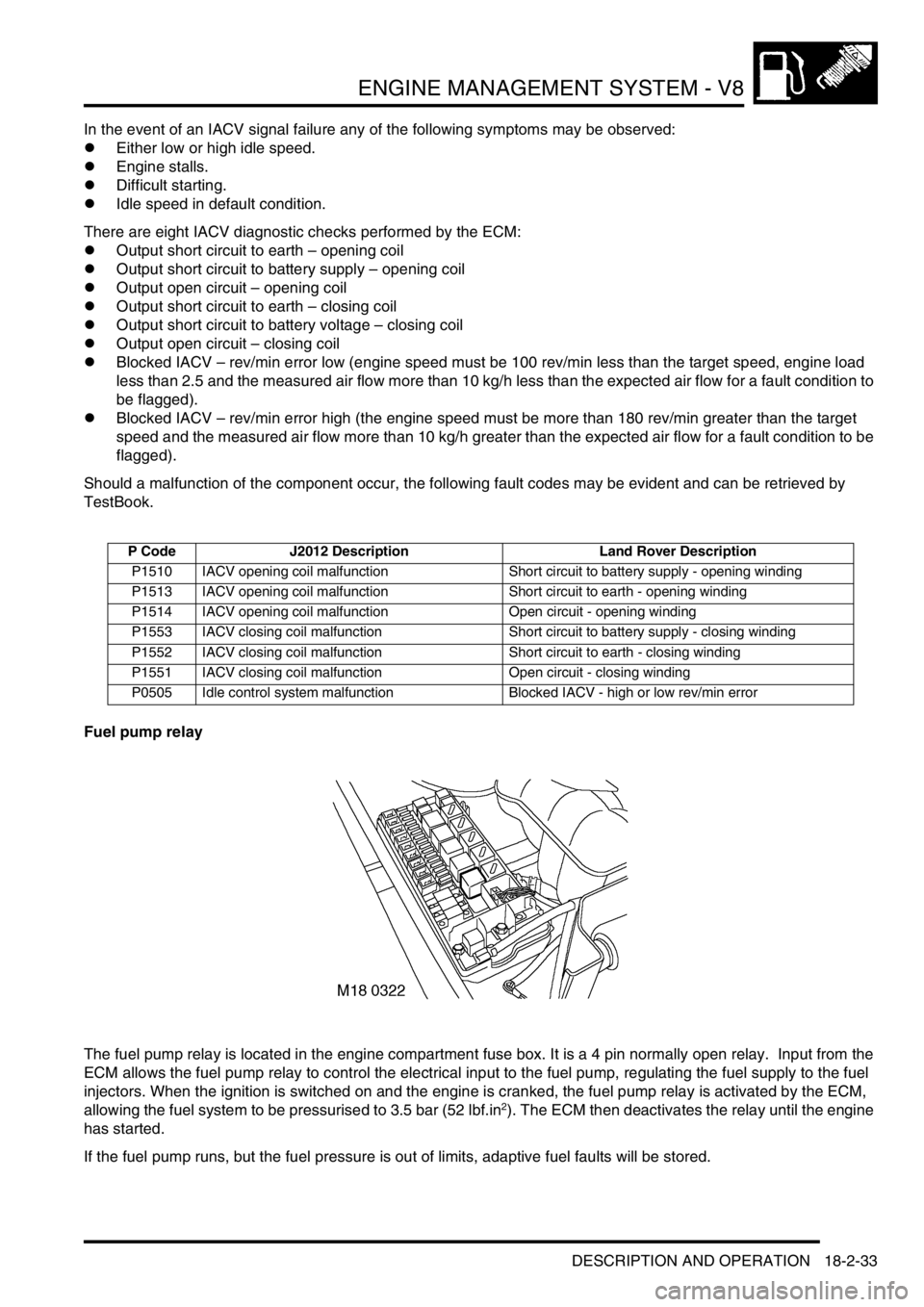
The fuel pump relay is located in the engine compartment fuse box. It is a 4 pin normally open relay. Input from the
ECM allows the fuel pump relay to control the electrical input to the fuel pump, regulating the fuel supply to the fuel
injectors. When the ignition is switched on and the engine is cranked, the fuel pump relay is activated by the ECM,
allowing the fuel system to be pressurised to 3.5 bar (52 lbf.in
2). The ECM then deactivates the relay until the engine
has started.
If the fuel pump runs, but the fuel pressure is out of limits, adaptive fuel faults will be stored.
P Code J2012 Description Land Rover Description
P1510 IACV opening coil malfunction Short circuit to battery supply - opening winding
P1513 IACV opening coil malfunction Short circuit to earth - opening winding
P1514 IACV opening coil malfunction Open circuit - opening winding
P1553 IACV closing coil malfunction Short circuit to battery supply - closing winding
P1552 IACV closing coil malfunction Short circuit to earth - closing winding
P1551 IACV closing coil malfunction Open circuit - closing winding
P0505 Idle control system malfunction Blocked IACV - high or low rev/min error
Page 491 of 1672

ENGINE MANAGEMENT SYSTEM - V8
18-2-34 DESCRIPTION AND OPERATION
Input/Output
The input value for the relay windings is battery voltage, the input value for the switching contacts comes from fuse
10 in the engine compartment fuse box. The output control of the switching contacts is direct to the fuel pump motor,
and the relay windings are controlled by pin number 18 of connector C0635 of the ECM.
At ignition 'on' (position II) the fuel pump relay contacts remain open until the ECM supplies an earth path for the relay
windings via pin number 18 of connector C0635 of the ECM. At this point, the relay windings are energised, drawing
the relay contacts closed. This allows voltage from fuse 10 in the passenger compartment fuse box to pass directly
to the fuel pump.
The fuel pump relay can fail the following ways or supply incorrect signal:
lRelay drive open circuit.
lShort circuit to vehicle earth.
lShort circuit to vehicle supply.
lComponent failure.
In the event of a fuel pump relay failure any of the following symptoms may be observed:
lEngine stalls or will not start.
lNo fuel pressure at the fuel injectors.
The ECM performs three types of diagnostic test to confirm the fuel pump relay integrity:
lOutput short circuit to earth
lOutput short circuit to battery voltage
lOutput open circuit
Should a malfunction of the component occur the following fault codes may be evident and can be retrieved by
TestBook.
Evaporative emissions
Refer to Emissions section for description of the evaporative emissions system components.
+ EMISSION CONTROL - V8, DESCRIPTION AND OPERATION, Evaporative emission control system.
Secondary air injection (NAS only)
Refer to Emissions section for description of the secondary air injection system components.
+ EMISSION CONTROL - V8, DESCRIPTION AND OPERATION, Secondary air injection system.
Fuel tank pressure sensor (NAS only)
Refer to Fuel Delivery section for description of the fuel system components.
+ FUEL DELIVERY SYSTEM - V8, DESCRIPTION AND OPERATION, Description.
Refer to Emissions section for description of the fuel tank pressure sensor.
+ EMISSION CONTROL - V8, DESCRIPTION AND OPERATION, Evaporative emission control system.
P Code J2012 Description Land Rover Description
P1230 Fuel pump relay malfunction Fuel pump relay open circuit - not the fuel pump
P1231 Fuel pump relay circuit low Fuel pump relay short circuit to battery supply - not the
fuel pump
P1232 Fuel pump relay circuit high Fuel pump relay short circuit to earth - not the fuel pump
Page 503 of 1672

ENGINE MANAGEMENT SYSTEM - V8
18-2-46 DESCRIPTION AND OPERATION
Idle speed control
The ECM regulates the engine speed at idling. The ECM uses the idle air control valve (IACV) to compensate for the
idle speed drop that occurs when the engine is placed under greater load than usual. When the throttle is in the rest
position i.e. it has not been pressed, the majority of intake air that the engine consumes comes from the idle air control
valve.
IACV control idle speed
Conditions in which the ECM operates the IACV control idle speed is as follows:
lIf any automatic transmission gears other than P or N are selected.
lIf air conditioning is switched on.
lIf cooling fans are switched on.
lAny electrical loads activated by the driver.
Function
The idle air control valve utilises two coils that use opposing pulse width modulated (PWM) signals to control the
position of a rotary valve. If one of the circuits that supplies the PWM signal fails, the ECM closes down the remaining
signal preventing the idle air control valve from working at its maximum/ minimum setting. If this should occur, the idle
air control valve assumes a default idle position at which the engine idle speed is raised to 1200 rev/min with no load
placed on the engine.
Evaporative emission control
Due to increasing legislation, all new vehicles must be able to limit evaporative emissions (fuel vapour) from the fuel
tank.
The ECM controls the emission control system using the following components:
lEVAP canister.
lPurge valve.
lCanister vent solenoid (CVS) valve – (NAS vehicles with vacuum type EVAP system leak detection capability
only)
lFuel tank pressure sensor – (NAS vehicles with vacuum type EVAP system leak detection capability only)
lFuel leak detection pump – (NAS vehicles with positive pressure type EVAP system leak detection capability
only)
lInterconnecting pipe work.
Refer to Emissions section for operating conditions of evaporative emission systems.
+ EMISSION CONTROL - V8, DESCRIPTION AND OPERATION, Evaporative emission control operation.
On-Board Diagnostics (OBD) - North American Specification vehicles only
The ECM monitors performance of the engine for misfires, catalyst efficiency, exhaust leaks and evaporative control
loss. If a fault occurs, the ECM stores the relevant fault code and warns the driver of component failure by illuminating
the Malfunction Indicator Light in the instrument pack.
On vehicles fitted with automatic gearbox, the ECM combines with the Electronic Automatic Transmission (EAT) ECU
to provide the OBD strategy.
Conditions
If the OBD function of the ECM flags a fault during its operation, it falls into one of the following categories:
lmin = minimum value of the signal exceeded.
lmax = maximum value of the signal exceeded.
lsignal = signal not present.
lplaus = an implausible condition has been diagnosed.
Page 546 of 1672
FUEL DELIVERY SYSTEM - TD5
DESCRIPTION AND OPERATION 19-1-1
FUEL DELIVERY SYST EM - Td5 DESCRIPTION AND OPERAT ION
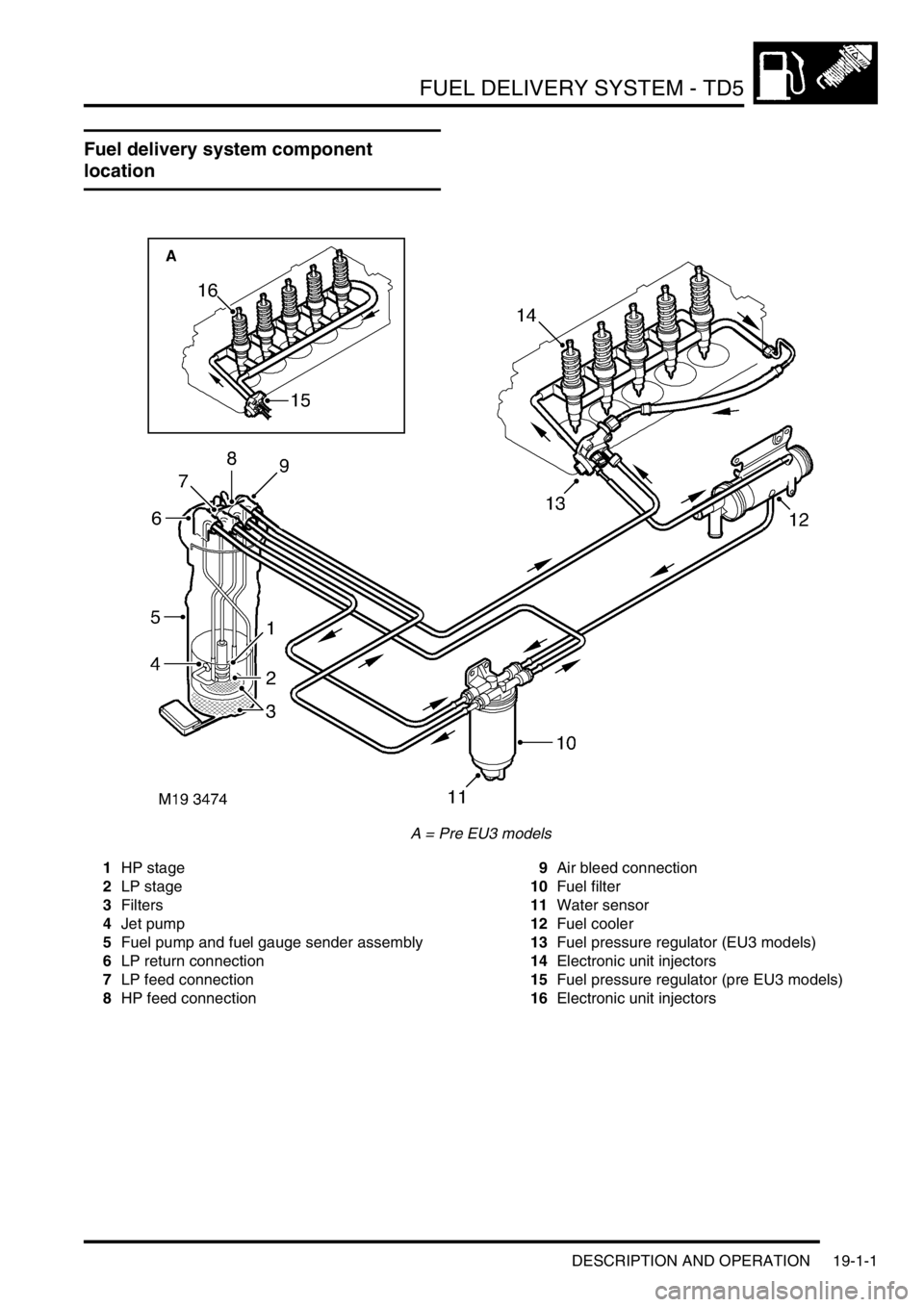
Fuel delivery system component
location
A = Pre EU3 models
1HP stage
2LP stage
3Filters
4Jet pump
5Fuel pump and fuel gauge sender assembly
6LP return connection
7LP feed connection
8HP feed connection9Air bleed connection
10Fuel filter
11Water sensor
12Fuel cooler
13Fuel pressure regulator (EU3 models)
14Electronic unit injectors
15Fuel pressure regulator (pre EU3 models)
16Electronic unit injectors
Page 547 of 1672
FUEL DELIVERY SYSTEM - TD5
19-1-2 DESCRIPTION AND OPERATION
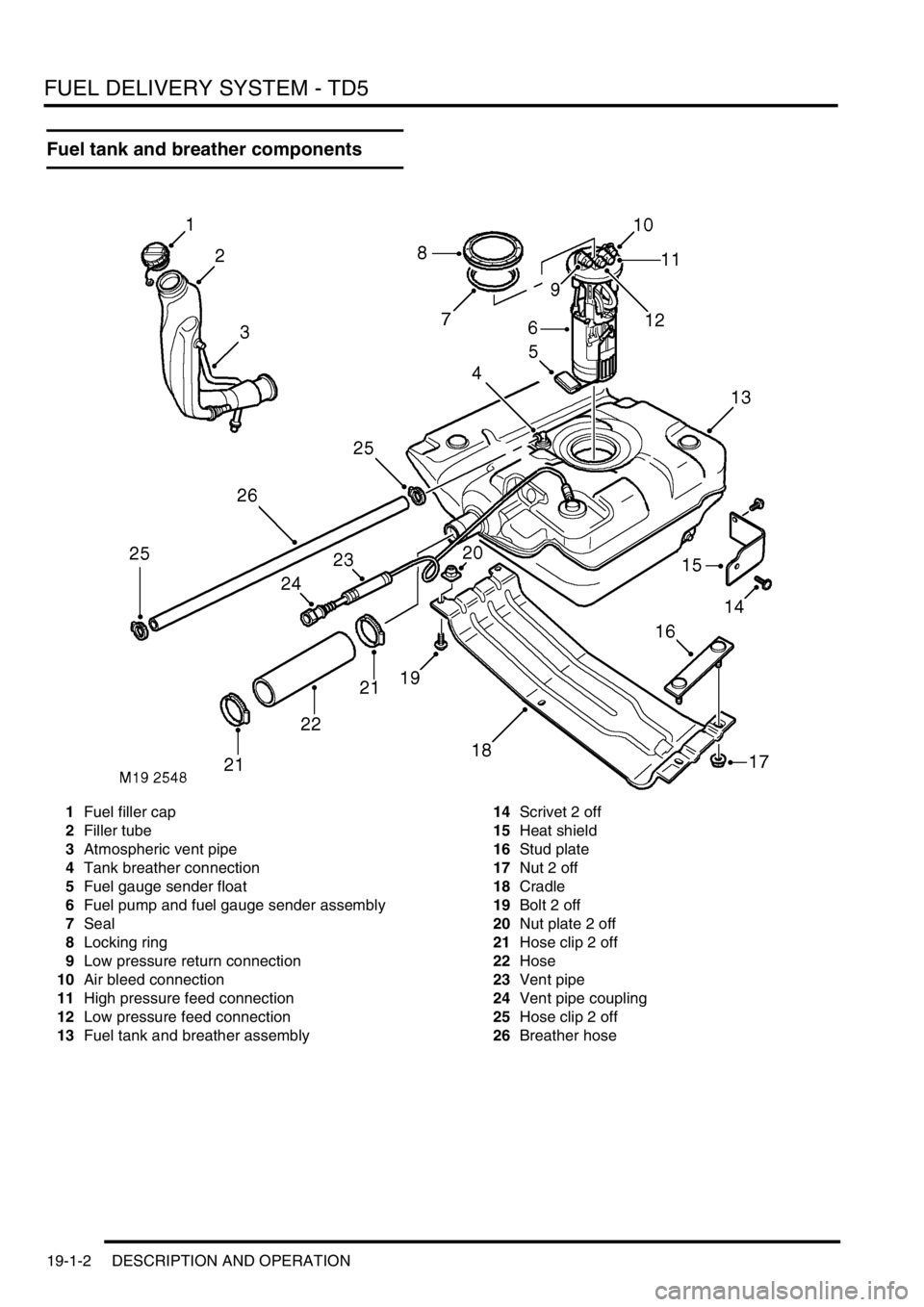
Fuel tank and breather components
1Fuel filler cap
2Filler tube
3Atmospheric vent pipe
4Tank breather connection
5Fuel gauge sender float
6Fuel pump and fuel gauge sender assembly
7Seal
8Locking ring
9Low pressure return connection
10Air bleed connection
11High pressure feed connection
12Low pressure feed connection
13Fuel tank and breather assembly14Scrivet 2 off
15Heat shield
16Stud plate
17Nut 2 off
18Cradle
19Bolt 2 off
20Nut plate 2 off
21Hose clip 2 off
22Hose
23Vent pipe
24Vent pipe coupling
25Hose clip 2 off
26Breather hose
Page 548 of 1672
FUEL DELIVERY SYSTEM - TD5
DESCRIPTION AND OPERATION 19-1-3
Description
General
The fuel delivery system comprises a fuel tank, fuel pump, fuel pressure regulator, five injectors and a fuel filter. The
system is controlled by the Engine Control Module (ECM) which energises the fuel pump relay and controls the
operation and timing of each injector solenoid.
Unlike other Diesel engines, the Td5 engine has no injection pump. The diesel direct injection system receives fuel
at pressure from a two stage fuel pump located in the fuel tank. The system incorporates a fuel return to the fuel pump,
via a fuel cooler attached to the inlet manifold and a fuel filter. A fuel pressure regulator is located in a housing on the
rear of the cylinder head. The regulator maintains the fuel delivered to the injectors at a constant pressure and returns
excess fuel back to the fuel filter and pump via the fuel cooler.
A fuel filter is positioned on the chassis to the right of the fuel tank. The fuel feed and return to and from the engine
passes through the filter. The filter also incorporates a water sensor which illuminates a warning lamp in the
instrument pack.
A moulded fuel tank is located at the rear underside of the vehicle between the chassis longitudinals. The tank
provides the attachment for the fuel pump and fuel gauge sender unit which is located inside the tank.
Fuel tank and breather
The fuel tank and breather system is a major part of the fuel delivery system. The fuel tank and breathers are located
at the rear of the vehicle between the chassis longitudinals.
Fuel tank
The moulded fuel tank is made from High Molecular Weight (HMW) High Density Polyethylene (HDPE). The diesel
tank is manufactured using a proportion of recycled plastic.
The tank is retained in position by a metal cradle which is secured to the chassis with two nut plates and bolts at the
rear and a stud plate and two nuts at the front. A strap above the tank is bolted to the chassis and restrains the tank
from moving upwards. The fuel tank has useable capacity of approximately 95 litres (25 US Gallons).
An aperture in the top surface of the tank allows for the fitment of the fuel pump and fuel gauge sender unit which is
retained with a locking ring.
A reflective metallic covering is attached to the tank with two scrivets to shield the tank from heat generated by the
exhaust system.
The fuel filler is located in the right hand rear quarter panel, behind an access flap. The flap is opened electrically
using a switch on the fascia which operates a release solenoid.
The filler is closed by a threaded plastic cap which screws into the filler neck. The cap has a ratchet mechanism to
prevent overtightening and seals against the filler neck to prevent the escape of fuel vapour. The filler cap has a valve
which relieves fuel pressure to atmosphere at approximately 0.12 to 0.13 bar (1.8 to 2.0 lbf.in
2) and opens in the
opposite direction at approximately 0.04 bar (0.7 lbf.in2) vacuum.
A moulded filler tube, made from HMW HDPE, connects the filler to the tank via a flexible hose. The filler tube is
connected at its top end behind the filler flap.
Page 549 of 1672
FUEL DELIVERY SYSTEM - TD5
19-1-4 DESCRIPTION AND OPERATION
Fuel tank breather system
The filler tube incorporates a tank vent which allows air and fuel vapour displaced from the tank when filling to vent to
atmosphere via the filler neck.
A breather spout within the tank controls the tank 'full' height. When fuel covers the spout it prevents fuel vapour and
air from escaping from the tank. This causes the fuel to 'back-up' in the filler tube and shuts off the filler gun. The
position of the spout ensures that when the filler gun shuts off, a vapour space of approximately 10% of the tanks total
capacity remains. The vapour space ensures that the Roll Over Valve (ROV) is always above the fuel level and vapour
can escape and allow the tank to breathe.
The ROV is welded on the top surface of the tank. The ROV is connected by a tube to the filler tube, which in turn is
connected to the atmospheric vent pipe. The ROV allows fuel vapour to pass through it during normal vehicle
operation. In the event of the vehicle being overturned the valve shuts off, sealing the tank and preventing fuel from
spilling from the atmospheric vent pipe.
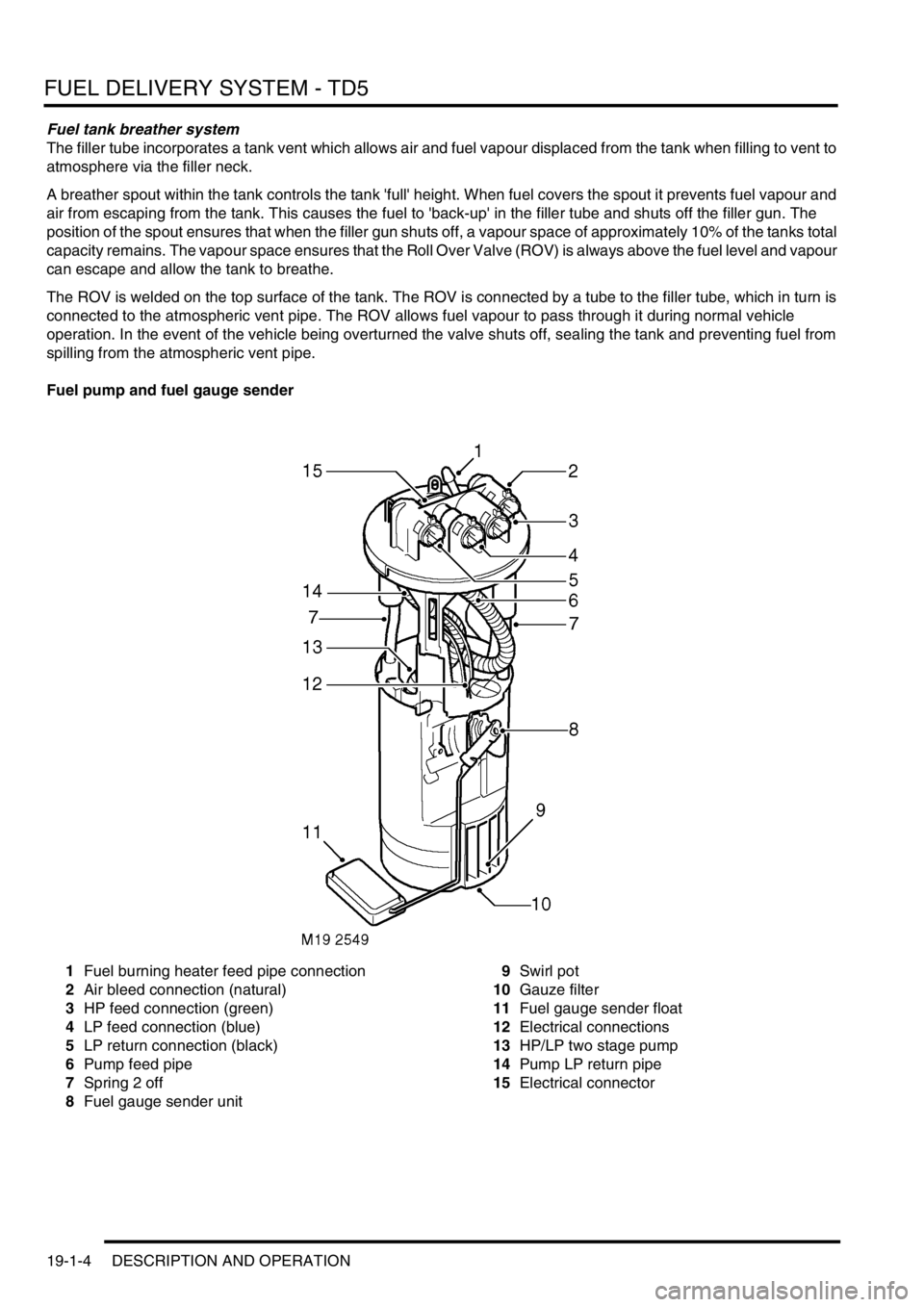
Fuel pump and fuel gauge sender
1Fuel burning heater feed pipe connection
2Air bleed connection (natural)
3HP feed connection (green)
4LP feed connection (blue)
5LP return connection (black)
6Pump feed pipe
7Spring 2 off
8Fuel gauge sender unit9Swirl pot
10Gauze filter
11Fuel gauge sender float
12Electrical connections
13HP/LP two stage pump
14Pump LP return pipe
15Electrical connector
Page 550 of 1672

FUEL DELIVERY SYSTEM - TD5
DESCRIPTION AND OPERATION 19-1-5
The fuel pump is a 'self priming', wet type, two stage pump which is immersed in fuel in the tank and operates at all
times when the ignition switch is in position II. If the engine is not started, the ECU will 'time-out' after three minutes
and de-energise the fuel pump relay. The pump receives a feed from the battery via fuse 10 in the engine
compartment fusebox and the fuel pump relay. The relay is energised by the ECM when the ignition switch is moved
to position II.
The fuel pump assembly is retained with a locking ring and sealed with a rubber seal. The locking ring requires a
special tool for removal and refitment. An access panel for the fuel pump is located in the loadspace floor below the
carpet. The access panel is sealed to the floor with a rubber seal and retained by six self-tapping screws. A four pin
electrical connector is located on the top cover and provides power feed and earth for the fuel pump and also inputs
and outputs for the fuel gauge sender operation.
The fuel gauge sender is integral with the fuel pump. The sender is submerged in the fuel and is operated by a float
which moves with the fuel level in the tank.
Fuel pump
The fuel pump assembly comprises a top cover which locates the electrical connector, fuel burning heater connection
and four fuel pipe couplings. The top cover is attached to a plastic cup shaped housing and retained on three sliding
clips. Two coil springs are located between the cover and the housing and ensure that the fuel pump remains seated
positively at the bottom of the tank when installed.
The housing locates the two stage fuel pump and also the fuel gauge sender unit. The lower part of the housing is the
swirl pot which maintains a constant level of fuel at the fuel pick-up. A coarse filter is located in the base of the housing
and prevents the ingress of contaminants into the pump and the fuel system from the fuel being drawn into the pump.
A fine filter is located in the intake to the low pressure stage to protect the pump from contaminants. Flexible pipes
connect the couplings on the top cover to the pump.
A non-return valve is located in the base of the housing. When the fuel tank is full, fuel pressure keeps the valve lifted
from its seat allowing fuel to flow into the swirl pot. As the tank level reduces, the fuel pressure in the tank reduces
causing the valve to close. When the valve is closed fuel is retained in the swirl pot, ensuring that the swirl pot remains
full and maintains a constant supply to the fuel pump.
The two stage pump comprises a high and a low pressure stage. The low pressure stage draws fuel from the swirl
pot through the filter. The low pressure stage pumps fluid at a pressure of 0.75 bar (10.9 lbf.in
2) and a flow of 30 litres/
hour (8 US Gallons/hour) to the fuel filter. A proportion of the fuel from the low pressure stage also passes, via a
restrictor, through a jet pump which keeps fuel circulating in the swirl pot. The high pressure stage draws the low
pressure fuel from the fuel filter and pressurises it to a pressure of 4.0 bar (58 lbf.in
2). The pressurised fuel is then
passed from the pump to the injectors at a flow of 180 litres/hour (47.6 US Gallons/hour). A fuel pressure regulator is
located at the rear of the engine and ensures that the delivery pressure remains at 4.0 bar (58 lbf.in
2) by controlling
the amount of fuel returning to the fuel tank.
The fuel pump has a maximum current draw of 15 Amps at 12.5 V and is protected by a 20 Amp fuse in the engine
compartment fusebox.
Page 552 of 1672
FUEL DELIVERY SYSTEM - TD5
DESCRIPTION AND OPERATION 19-1-7
The fuel pressure regulator is located in a cast alloy housing which is attached to the rear right hand corner of the
cylinder head with three flanged bolts and sealed with a metal gasket. On pre EU3 models there are two ports in the
housing that connect with ports in the cylinder head for fuel pressure feed and return. On EU3 models there is a port
in the housing that connects with a port in the cylinder head for fuel pressure feed and a single external port for fuel
return. A gauze filter is located in the pressure feed port in the cylinder head and filters the fuel before it reaches the
injectors. The filter is a fit for life item but can be changed if required. An 'O' ring is located in a recess in the cylinder
head and provides additional sealing for the pressure feed port between the gauze filter, the cylinder head and the
housing.
A union and pipe is attached to the feed port in the housing and connects with a quick release coupling to the fuel
pressure feed pipe from the fuel pump. A second union and hose is located in the return port and provides the fuel
return connection to the fuel cooler. A third port provides location for the fuel temperature sensor which is sealed to
the housing with a bonded seal. The fuel temperature sensor is used by the Engine Control Module (ECM) for engine
management.
The fuel pressure regulator is located in a machined port in the lower part of the housing. The regulator is sealed in
the housing with two 'O' rings and secured with an internal circlip.
The regulator maintains the fuel pump delivery pressure at 4 bar (58 lbf.in
2). When the fuel pressure exceeds 4 bar
(58 lbf.in2), the regulator opens and allows fuel to return to the fuel tank via the fuel cooler. The fuel returned from the
regulator is directed back into the fuel filter before being drawn by the high pressure stage of the fuel pump and
directed back to the injectors. A special tool can be attached to the regulator housing fuel feed port and allows for the
fitment of a suitable gauge to measure fuel pump delivery pressure.
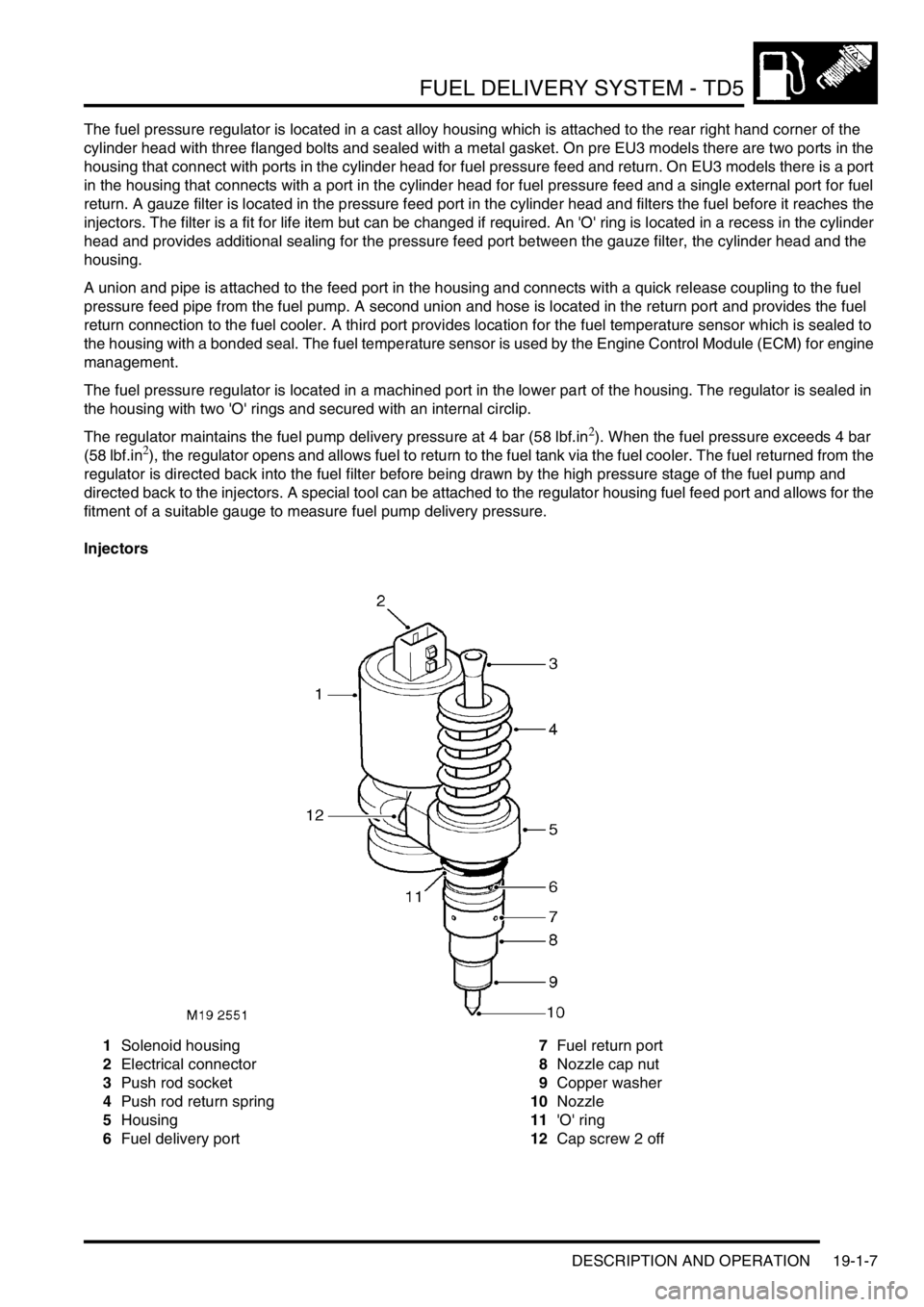
Injectors
1Solenoid housing
2Electrical connector
3Push rod socket
4Push rod return spring
5Housing
6Fuel delivery port7Fuel return port
8Nozzle cap nut
9Copper washer
10Nozzle
11'O' ring
12Cap screw 2 off