battery LAND ROVER DISCOVERY 2002 Repair Manual
[x] Cancel search | Manufacturer: LAND ROVER, Model Year: 2002, Model line: DISCOVERY, Model: LAND ROVER DISCOVERY 2002Pages: 1672, PDF Size: 46.1 MB
Page 448 of 1672

ENGINE MANAGEMENT SYSTEM - TD5
REPAIRS 18-1-55
Turbocharger
$% 19.42.01
Remove
1.Remove 3 bolts and remove engine acoustic
cover.
2.Release fixings and remove battery cover.
3.Disconnect battery earth lead.
4.Remove cooling fan cover.
5.Remove 3 bolts and remove exhaust manifold
heat shield.
6.Release clip and disconnect breather hose
from camshaft cover.
7.Release clip and disconnect vacuum hose from
turbocharger wastegate.
8.Loosen clips and release air intake and outlet
hoses from turbocharger. 9.Remove turbocharger oil feed banjo bolt and
discard sealing washers.
10.Remove 2 bolts and release turbocharger oil
drain pipe and discard gasket.
11.Remove 3 nuts and release exhaust front pipe
from turbocharger and discard gasket.
12.Remove 3 nuts securing turbocharger to
exhaust manifold.
13. Remove turbocharger and discard gasket.
Refit
1.Clean turbocharger and exhaust manifold
mating faces.
2.Using a new gasket, fit turbocharger to exhaust
manifold and tighten nuts to 30 Nm (22 lbf.ft).
3.Using new gasket, align exhaust front pipe and
tighten nuts to 30 Nm (22 lbf.ft).
4.Using new gasket, align turbocharger drain
pipe and tighten bolts to 9 Nm (7 lbf.ft).
5.Fit banjo bolt to oil feed pipe using new sealing
washers and tighten to 25 Nm (18 lbf.ft)..
6.Position air hoses to turbocharger and tighten
clips.
7.Position and secure breather hose to camshaft
cover.
8.Position and secure vacuum hose to
turbocharger wastegate.
9.Position exhaust manifold heat shield and
tighten M6 bolts to 9 Nm (7 lbf.ft) and M8 bolt to
25 Nm (18 lbf.ft).
10.Fit fan cowl and secure fixings.
11.Fit acoustic cover and secure the fixings.
12.Connect battery earth lead.
13.Fit battery cover and secure fixings.
Page 449 of 1672

ENGINE MANAGEMENT SYSTEM - TD5
18-1-56 REPAIRS
Intercooler
$% 19.42.15
Remove
1.Remove cooling fan and coupling.
+ COOLING SYSTEM - Td5, REPAIRS,
Fan - viscous.
2.Remove battery.
3.Remove vehicle jack from battery carrier.
4.Remove screw and release engine control
module (ECM) from battery carrier.
5.Remove 7 bolts and remove battery carrier. 6.Remove 2 screws and remove lower half of fan
cowl.
7.Remove front grille.
+ EXTERIOR FITTINGS, REPAIRS,
Grille - front - up to 03MY.
8.Remove 6 scrivets and remove LH and RH air
deflectors from front panel.
Page 451 of 1672

ENGINE MANAGEMENT SYSTEM - TD5
18-1-58 REPAIRS
3.Fit brackets with rubber mountings to
intercooler and fit and tighten screws securing
brackets to condenser.
4.Fit radiator upper mounting brackets and
tighten bolts.
5.Fit LH horn and secure with nut.
6.Connect inlet and outlet hoses to intercooler
and tighten clips.
7.Fit lower half of fan cowl and secure with
screws.
8.Fit LH and RH air deflectors to front panel and
secure with scrivets.
9.Fit front grille.
10.Fit battery carrier and secure with bolts.
11.Fit ECM and secure with screw.
12.Fit jack to battery carrier.
13.Fit battery.
14.Fit cooling fan and coupling.
+ COOLING SYSTEM - Td5, REPAIRS,
Fan - viscous.
Valve - solenoid boost control
$% 19.42.30
Remove
1.Loosen clip and release air intake hose from
MAF sensor.
2.Release clips and disconnect vacuum hoses
from solenoid valve.
3.Disconnect multiplug from solenoid valve.
4.Remove 2 bolts and remove solenoid valve.
Refit
1.Position solenoid valve and tighten bolts.
2.Connect multiplug to solenoid valve.
3.Connect vacuum hoses and secure with clips.
4.Position air intake hose to MAF sensor and
secure clip.
Page 452 of 1672

ENGINE MANAGEMENT SYSTEM - TD5
REPAIRS 18-1-59
Regulator - fuel pressure
$% 19.45.06
Remove
1.Release turnbuckles and remove battery cover
2.Disconnect battery earth lead.
3.Remove 3 bolts and remove engine acoustic
cover.
4.Remove 2 bolts and remove engine lifting eye.
5.Position cloth to absorb fuel spillage.
6.Release and disconnect hose from fuel cooler. 7.Release and disconnect fuel hose from
pressure regulator.
Always fit plugs to open connections to
prevent contamination.
8.Disconnect multiplug from fuel temperature
sensor.
9.Remove 3 bolts, remove pressure regulator
from cylinder head and collect gasket.
10.Remove and discard 'O' ring and fuel filter.
Page 453 of 1672

ENGINE MANAGEMENT SYSTEM - TD5
18-1-60 REPAIRS
11.Remove fuel temperature sensor and discard
sealing washer.
12.Remove fuel hose and fuel pipe and discard 'O'
rings.
Refit
1.Clean fuel pressure regulator and mating face.
2.Clean fuel pipe unions.
3.Using new 'O' rings, fit fuel pipe and fuel hose
to pressure regulator and tighten unions to 25
Nm (18 lbf.ft).
4.Using new sealing washer, fit fuel temperature
sensor and tighten to 14 Nm (10 lbf.ft).
5.Fit new fuel filter and 'O' ring.
6.Using a new gasket, position pressure
regulator and tighten bolts to 25 Nm (18 lbf.ft).
7.Connect multiplug to fuel temperature sensor.
8.Connect fuel hoses to pressure regulator and
fuel cooler.
9.Fit engine lifting eye and tighten bolts to 25 Nm
(18 lbf.ft).
10.Fit engine acoustic cover and tighten bolts to 10
Nm (6 lbf.ft).
11.Connect battery earth lead.
12.Fit battery cover and secure fixings.
Glow plugs
$% 19.60.31
Remove
1.Remove 3 bolts and remove engine acoustic
cover.
2.Release turnbuckles and remove battery cover.
3.Disconnect battery earth lead.
4.Disconnect 4 glow plug leads.
5.Loosen and remove 4 glow plugs.
Refit
1.Thoroughly clean glow plugs and seating area
in cylinder head.
2.Apply a suitable anti-sieze compound to
threads of glow plugs.
3.Fit glow plugs and tighten to 16 Nm (12 lbf. ft).
4.Connect glow plug leads.
5.Fit engine acoustic cover and secure fixings.
6.Connect battery earth lead.
7.Fit battery cover and secure fixings.
Page 456 of 1672
ENGINE MANAGEMENT SYSTEM - TD5
REPAIRS 18-1-63
Switch - cruise control (set/resume)
$% 19.75.33
Remove
1.Remove the key from the starter switch.
Disconnect both battery leads, negative lead
first. Wait ten minutes before starting work.
2.Remove driver's airbag module.
+ RESTRAINT SYSTEMS, REPAIRS,
Airbag module - drivers.
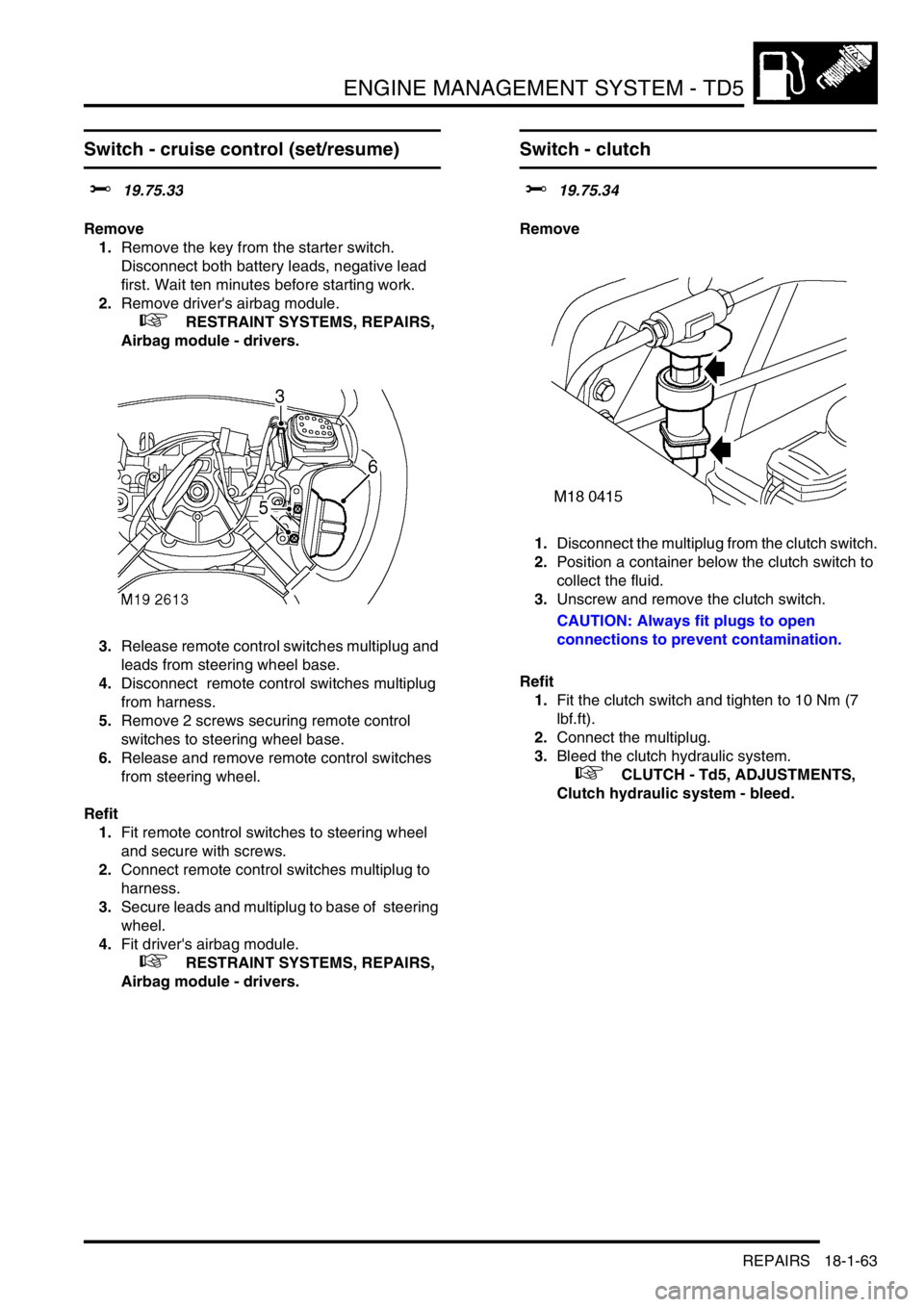
3.Release remote control switches multiplug and
leads from steering wheel base.
4.Disconnect remote control switches multiplug
from harness.
5.Remove 2 screws securing remote control
switches to steering wheel base.
6.Release and remove remote control switches
from steering wheel.
Refit
1.Fit remote control switches to steering wheel
and secure with screws.
2.Connect remote control switches multiplug to
harness.
3.Secure leads and multiplug to base of steering
wheel.
4.Fit driver's airbag module.
+ RESTRAINT SYSTEMS, REPAIRS,
Airbag module - drivers.
Switch - clutch
$% 19.75.34
Remove
1.Disconnect the multiplug from the clutch switch.
2.Position a container below the clutch switch to
collect the fluid.
3.Unscrew and remove the clutch switch.
CAUTION: Always fit plugs to open
connections to prevent contamination.
Refit
1.Fit the clutch switch and tighten to 10 Nm (7
lbf.ft).
2.Connect the multiplug.
3.Bleed the clutch hydraulic system.
+ CLUTCH - Td5, ADJUSTMENTS,
Clutch hydraulic system - bleed.
Page 464 of 1672
ENGINE MANAGEMENT SYSTEM - V8
DESCRIPTION AND OPERATION 18-2-7
The ECM controls the following outputs:
lFuel injectors (1 per cylinder).
lIgnition coils/ high tension leads/ spark plugs.
lFuel pump relay.
lIdle air control valve.
lHeated oxygen sensors.
lEVAP canister purge valve.
lEVAP canister vent solenoid (CVS) valve (where fitted).
lMalfunction Indicator Lamp (MIL)/ service engine soon lamp (where fitted).
lHill descent control (via SLABS interface).
lEVAP system fuel leak detection pump (where fitted)
lSecondary air injection pump (where fitted)
The ECM also interfaces with the following:
lDiagnostics via diagnostic connector with TestBook.
lController Area Network (CAN) link to EAT ECU.
lAir conditioning system.
lSelf Levelling & Anti-lock Braking System (SLABS) ECU.
lImmobilisation system via the body control unit (BCU).
lInstrument cluster.
lCruise control ECU
lActive Cornering Enhancement (ACE) ECU
Engine Control Module (ECM)
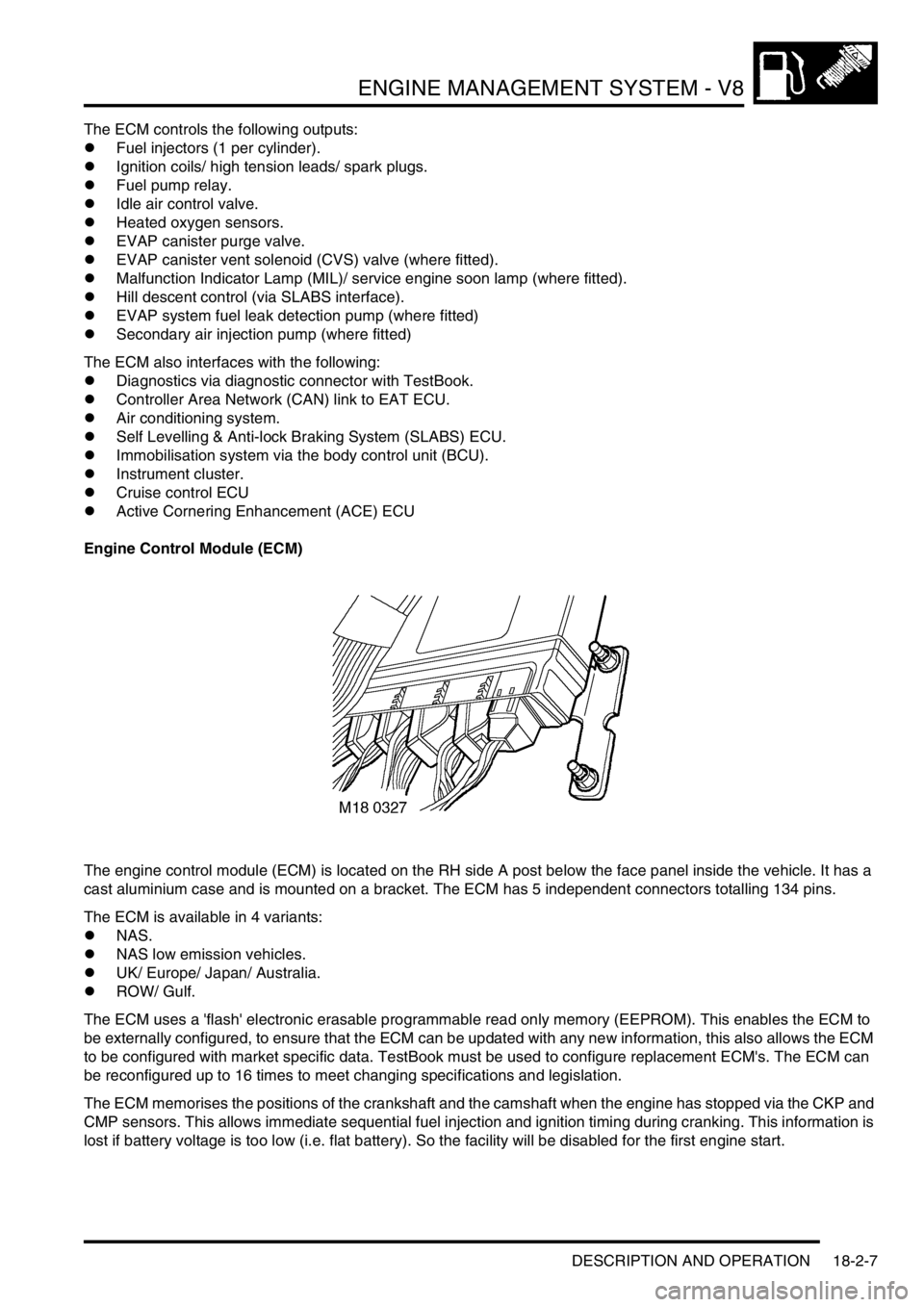
The engine control module (ECM) is located on the RH side A post below the face panel inside the vehicle. It has a
cast aluminium case and is mounted on a bracket. The ECM has 5 independent connectors totalling 134 pins.
The ECM is available in 4 variants:
lNAS.
lNAS low emission vehicles.
lUK/ Europe/ Japan/ Australia.
lROW/ Gulf.
The ECM uses a 'flash' electronic erasable programmable read only memory (EEPROM). This enables the ECM to
be externally configured, to ensure that the ECM can be updated with any new information, this also allows the ECM
to be configured with market specific data. TestBook must be used to configure replacement ECM's. The ECM can
be reconfigured up to 16 times to meet changing specifications and legislation.
The ECM memorises the positions of the crankshaft and the camshaft when the engine has stopped via the CKP and
CMP sensors. This allows immediate sequential fuel injection and ignition timing during cranking. This information is
lost if battery voltage is too low (i.e. flat battery). So the facility will be disabled for the first engine start.
Page 465 of 1672

ENGINE MANAGEMENT SYSTEM - V8
18-2-8 DESCRIPTION AND OPERATION
Input/Output
The ECM has various sensors fitted to the engine to allow it to monitor engine condition. The ECM processes these
signals and decides what actions to carry out to maintain optimum engine operation by comparing the information
from these signals to mapped data within its memory.
Connector 1 (C0634): This connector contains 9 pins and is used primarily for ECM power input and earth. The ECM
requires a permanent battery supply, if this permanent feed is lost i.e. the battery discharges or is disconnected the
ECM will lose its adapted values and its Diagnostic Trouble Codes (DTC). These adapted values are a vital part of
the engine management's rolling adaptive strategy. Without an adaptive strategy, driveability, performance, emission
control, and fuel consumption are adversely affected. The ECM can be damaged by high voltage inputs, so care must
be taken when removing and replacing the ECM.
Pin out details connector C0634
Connector 2 (C0635): This connector contains 24 pins and is primarily used for Heated Oxygen Sensors (HO
2S)
control and earth. The HO
2S sensors require a heater circuit to assist in heating the tip of the sensors to enable closed
loop fuelling to be implemented quickly after cold starting.
Pin out details connector C0635
Pin No. Function Signal type Reading
1 Ignition position II Input 12 V
2 Not used - -
3 Not used - -
4 Chassis earth Earth 0V
5 Fuel injectors earth Earth 0V
6 Power stage earth Earth 0V
7 Permanent battery supply Input battery supply 12V
8 Switched relay positive Input switched 0-12V
9 Not used - -
Pin No. Function Signal type Reading
1HO
2S heater RH bank - downstream Output PWM 12-0V
2 Not used - -
3 Not used - -
4 Not used - -
5 Thermostat monitoring sensor Earth 0V
6 Not used - -
7HO
2S heater LH bank - downstream Output PWM 12-0V
8HO
2S sensor RH bank - downstream Earth/ Signal 0V
9HO
2S sensor LH bank - upstream Earth/ Signal 0V
10 HO
2S sensor RH bank - upstream Earth/ Signal 0V
11 HO
2S sensor LH bank - downstream Earth/ Signal 0V
12 Not used - -
13 HO
2S heater RH bank - upstream Output PWM 12-0V
14 HO
2S sensor RH bank - downstream Input/ Signal Analogue 0-5V
15 HO
2S sensor LH bank - upstream Input/ Signal Analogue 0-5V
16 HO
2S sensor RH bank - upstream Input/ Signal Analogue 0-5V
17 HO
2S sensor LH bank - downstream Input/ Signal Analogue 0-5V
18 Fuel pump relay Output Switch to earth
19 HO
2S heater LH bank - upstream Output PWM 12-0V
20 Not used - -
21 Thermostat monitoring sensor Signal Analogue 0-5V
22 Not used - -
23 Main relay Output Switch to earth
24 EVAP system leak detection pump motor (NAS
vehicles with positive pressure type, EVAP system
leak detection capability only)Output Switch to earth
Page 471 of 1672

ENGINE MANAGEMENT SYSTEM - V8
18-2-14 DESCRIPTION AND OPERATION
In the event of a CKP sensor signal failure any of the following symptoms may be observed:
lEngine cranks but fails to start.
lMIL remains on at all times.
lEngine misfires (CKP sensor incorrectly fitted).
lEngine runs roughly or even stalls (CKP sensor incorrectly fitted).
lTachometer fails to work.
lFlywheel adaption reset – ferrous contamination
If the CKP sensor fails while the engine is running the engine will suddenly stall, this is because the CKP sensor has
no backup strategy. If this happens the ECM will produce a fault code that it can store in its memory. If the engine is
not running when the CKP sensor fails, the vehicle will crank but will be unlikely to start, and no fault code will be
generated. In this instance the MIL lamp will remain illuminated and the tachometer will fail to read.
It is vital that the CKP sensor output wires are not reversed (i.e. the connector is fitted incorrectly) as this will cause
a 3
° advance in ignition timing. This happens because the ECM uses the falling edge of the signal waveform as its
reference or timing point for each passing tooth on the reluctor.
Whenever a new crankshaft position sensor is fitted or the flywheel is removed, the adaptive values will have to be
reset, using TestBook.
Should a malfunction of the component occur, the following fault codes may be evident and can be retrieved by
TestBook:
Camshaft Position (CMP) sensor (C0176)
The CMP sensor is located on the front of the engine, above and behind the crankshaft pulley. The CMP sensor is a
Hall effect sensor producing four pulses for every two crankshaft revolutions. The sensor is positioned close to the
camshaft gear wheel, the gear wheel has four slots machined at 90
° intervals. This allows the ECM to recognise 4
individual cylinders every camshaft revolution or all 8 cylinders every crankshaft revolution.
The CMP sensor Hall effect works as a magnetic switch. It switches battery voltage on or off depending on the position
of the camshaft gear wheel in relationship to the sensor.
The ECM uses this signal for cylinder recognition to control sequential fuel injection, engine knock and diagnostic
purposes.
P Code J2012 description Land Rover description
P0335 Crankshaft position sensor a circuit malfunction Reference mark outside search window for more than
two revs, with engine speed above 500 rev/min
P0336 Crankshaft position sensor a circuit range/
performanceIncorrect number of teeth detected ±1 tooth between
reference marks with engine speed above 500 rpm
Page 472 of 1672
ENGINE MANAGEMENT SYSTEM - V8
DESCRIPTION AND OPERATION 18-2-15
Input/Output
Electrical input to the camshaft position sensor is from fuse 2 located in engine compartment fuse box. One output is
sensor earth, the other is the signal output to the ECM via pin 20 of connector C0636.
The CMP sensor can fail the following ways or supply incorrect signal:
lSensor open circuit.
lShort circuit to vehicle battery supply.
lShort circuit to vehicle earth.
lIncorrect fitting of the sensor.
lExcessive camshaft gear wheel tolerance.
lExcessive camshaft endfloat.
lCamshaft and crankshaft misalignment.
lSpeed signal correlation with CKP sensor signal.
lCam wheel magnetised / residual magnetism
In the event of a CMP sensor signal failure any of the following symptoms may be observed:
lIgnition timing reverts to default values from ECM memory.
lLoss of cylinder correction.
lLoss of active knock control.
lLoss of active knock control diagnostics.
lLoss of cylinder identification for misfire diagnostics.
lLoss of quick synchronisation of crankshaft and camshaft for cranking/ start up.
lFuel injection could be 360
° out of phase.
lFront HO
2S sensor ageing period diagnostic disabled (NAS only)
Should a malfunction of the component occur the following fault code may be evident and can be retrieved by
TestBook:
The fault condition has to be detected for more than 100 cam pulses (25 revolutions) when the engine speed is greater
than 500 rev/min.
Engine Coolant Temperature (ECT) sensor (C0196)
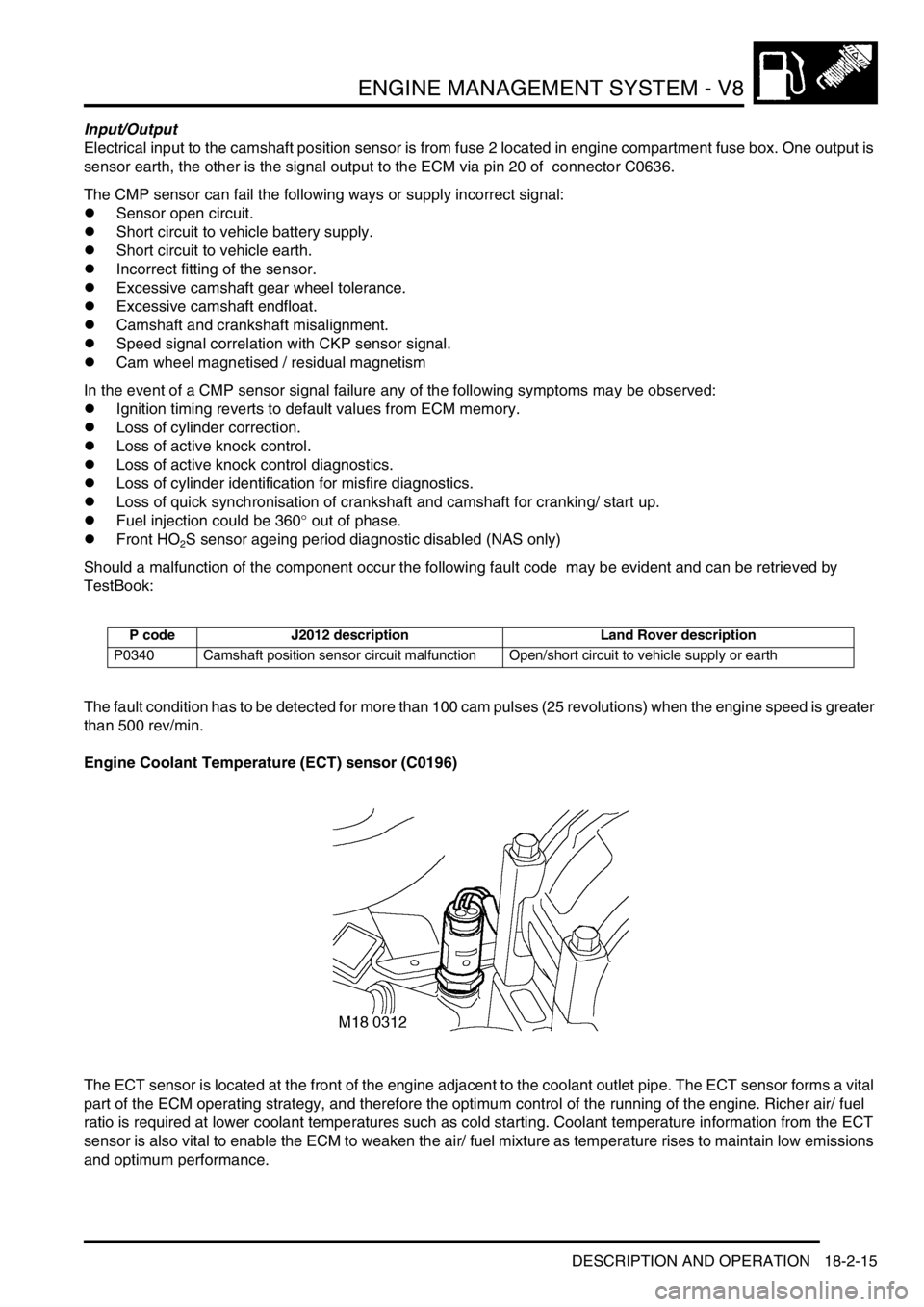
The ECT sensor is located at the front of the engine adjacent to the coolant outlet pipe. The ECT sensor forms a vital
part of the ECM operating strategy, and therefore the optimum control of the running of the engine. Richer air/ fuel
ratio is required at lower coolant temperatures such as cold starting. Coolant temperature information from the ECT
sensor is also vital to enable the ECM to weaken the air/ fuel mixture as temperature rises to maintain low emissions
and optimum performance.
P code J2012 description Land Rover description
P0340 Camshaft position sensor circuit malfunction Open/short circuit to vehicle supply or earth