transmission LAND ROVER FREELANDER 2001 User Guide
[x] Cancel search | Manufacturer: LAND ROVER, Model Year: 2001, Model line: FREELANDER, Model: LAND ROVER FREELANDER 2001Pages: 1007, PDF Size: 23.47 MB
Page 451 of 1007

AUTOMATIC GEARBOX - JATCO
44-16 REPAIRS
35.Remove 2 top bolts securing gearbox to
engine.
36.Release gearbox from 2 dowels.
37.Remove gearbox assembly.
38.Fit converter retaining plate and secure with
bolts.Refit
1.Remove torque converter retaining plate.
2.Ensure converter is fully located in oil pump
drive by checking depth 'A' as illustrated. Depth
A = 4 mm.
3.Clean gearbox to engine mating faces, dowels
and dowel holes.
4.Fit gearbox assembly.
5.Fit bolts securing gearbox and tighten to 85 Nm
(63 lbf.ft).
6.Disconnect lifting equipment.
7.Clean CKP sensor and mating face.
8.Fit CKP sensor, fit bolt and tighten to 9 Nm (7
lbf.ft).
9.Position fluid cooler, tighten M12 bolts to 85 Nm
(63 lbf.ft) and M8 bolt to 25 Nm (18 lbf.ft).
10.Connect hoses to fluid cooler.
11.Clean fluid cooler unions.
12.Lubricate new 'O' rings with clean transmission
fluid and fit 'O' rings to fluid cooler hoses.
+ CAPACITIES, FLUIDS,
LUBRICANTS AND SEALANTS,
Lubrication.
13.Connect fluid cooler hoses to gearbox and
tighten unions to 18 Nm (13 lbf.ft).
14.Clean starter motor mating faces.
15.Position starter motor to gearbox, align CKP
sensor multiplug bracket, fit and tighten bolts to
45 Nm (33 lbf.ft).
16.Using gearbox bracket bolts, secure LRT-44-
026 lifting bracket to gearbox.
17.Position IRD cooling hose retainer, fit bolt and
tighten to 25 Nm (18 lbf.ft).
18.Align marks on drive plate to torque converter.
19.Fit bolts securing drive plate to torque converter
and tighten bolts to 45 Nm (33 lbf.ft).
20.Clean torque converter access plate.
M44 1689
A
M44 1668
Page 458 of 1007
AUTOMATIC GEARBOX - JATCO
REPAIRS 44-23
23.Fit CKP sensor, fit bolt and tighten to 9 Nm (7
lbf.ft).
24.Position fluid cooler, tighten M12 bolts to 85 Nm
(63 lbf.ft) and M8 bolt to 25 Nm (18 lbf.ft).
25.Clean fluid cooler unions.
26.Lubricate new 'O' rings with clean transmission
fluid and fit 'O' rings to fluid cooler hoses.
+ CAPACITIES, FLUIDS,
LUBRICANTS AND SEALANTS,
Lubrication.
27.Connect fluid cooler hoses to gearbox and
tighten unions to 18 Nm (13 lbf.ft).
28.Clean exhaust manifold and mating face on
cylinder head.
29.Fit exhaust manifold gasket.
30.Position exhaust manifold, fit nuts and
progressively tighten, from centre outwards to
45 Nm (33 lbf.ft).
31.Connect HO2S multiplug and secure to support
bracket.
32.Position IRD cooling hose retainer, fit bolt and
tighten to 25 Nm (18 lbf.ft).
33.Align marks on drive plate to torque converter.
34.Fit bolts securing drive plate to torque converter
and tighten bolts to 45 Nm (33 lbf.ft).
35.Clean torque converter access plate.
36.Position access plate, fit bolts and tighten to 9
Nm (7 lbf.ft).
37.Clean end of drive shaft and mating splines in
gearbox.
38.Fit new circlip to LH drive shaft.
39.With assistance pull hub outwards, align drive
shaft and fit to gearbox, taking care not to
damage drive shaft oil seal.
CAUTION: Pull the drive shaft to ensure the
circlip is fully engaged and retains the shaft.
40.Fit splash shield and secure with bolts.
41.Position trunnion to selector lever, locate inner
cable through trunnion, do not tighten nut at this
stage.
42.Position selector cable to gearbox bracket and
secure with clip.
43.Adjust selector cable.
+ AUTOMATIC GEARBOX - JATCO,
ADJUSTMENTS, Selector cable - adjust.
44.Fit IRD.
+ INTERMEDIATE REDUCTION
DRIVE, REPAIRS, Intermediate reduction
drive (IRD) unit - KV6.
45.Connect battery earth lead.
46.Fit engine acoustic cover.
+ ENGINE - K SERIES KV6, REPAIRS,
Cover - engine acoustic.
47.Untie and close bonnet.
Gearbox - Td4
$% 44.20.02.99
Remove
1.Disconnect battery earth lead.
2.Tie bonnet back in upright position.
3.Remove intake ducting assembly.
+ FUEL DELIVERY SYSTEM - DIESEL,
REPAIRS, Ducting - intake assembly.
4.Remove fluid cooler.
+ AUTOMATIC GEARBOX - JATCO,
REPAIRS, Fluid cooler - Td4.
5.Remove starter motor.
+ CHARGING AND STARTING,
REPAIRS, Starter motor - Td4.
6.Remove IRD.
+ INTERMEDIATE REDUCTION
DRIVE, REPAIRS, Intermediate reduction
drive (IRD) unit - Td4.
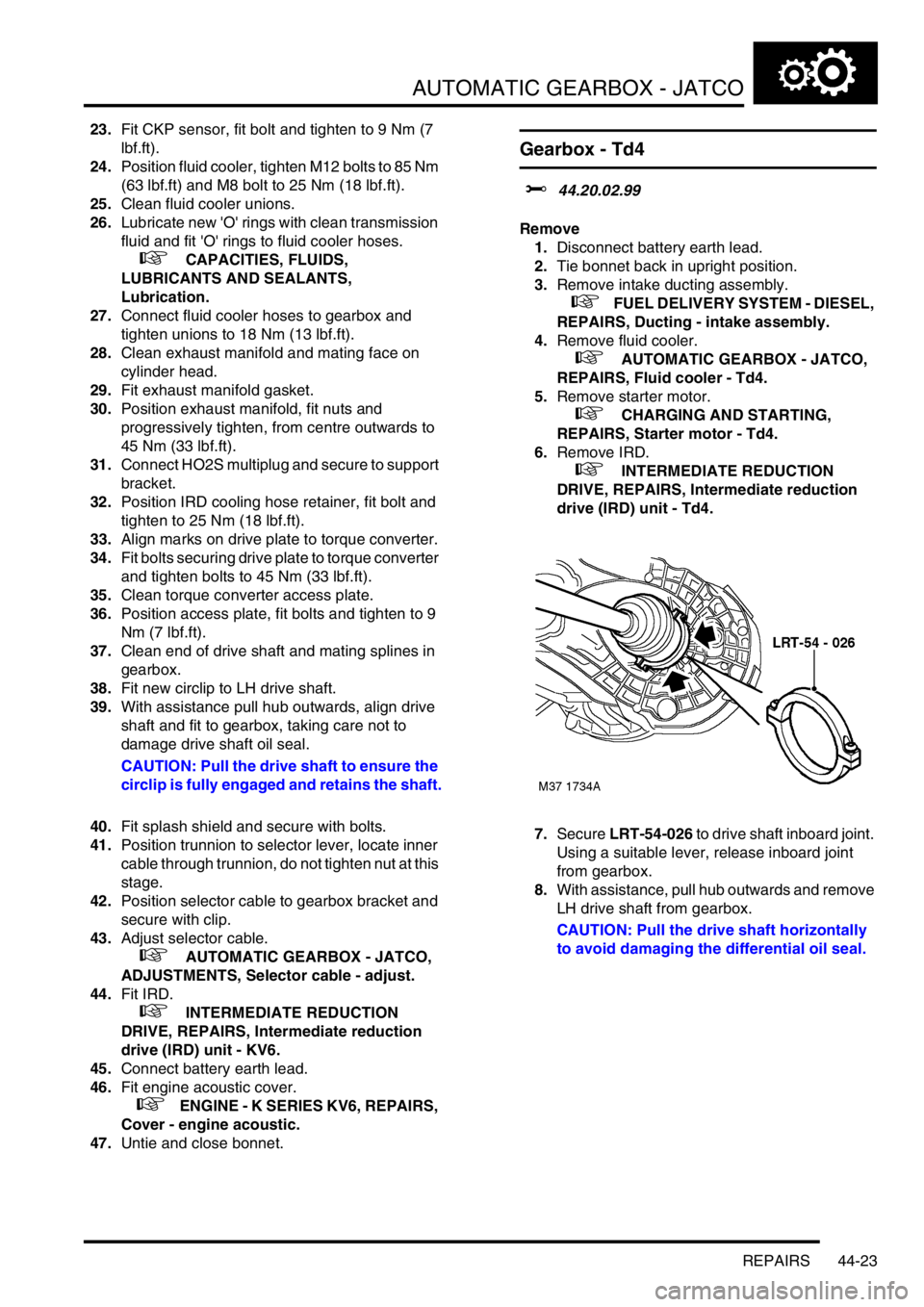
7.Secure LRT-54-026 to drive shaft inboard joint.
Using a suitable lever, release inboard joint
from gearbox.
8.With assistance, pull hub outwards and remove
LH drive shaft from gearbox.
CAUTION: Pull the drive shaft horizontally
to avoid damaging the differential oil seal.
Page 465 of 1007
AUTOMATIC GEARBOX - JATCO
44-30 REPAIRS
Fluid cooler - Td4
$% 44.24.10
Remove
1.Disconnect battery earth lead.
2.Remove underbelly panel.
+ EXTERIOR FITTINGS, REPAIRS,
Panel - underbelly.
3.Position container to collect coolant spillage.
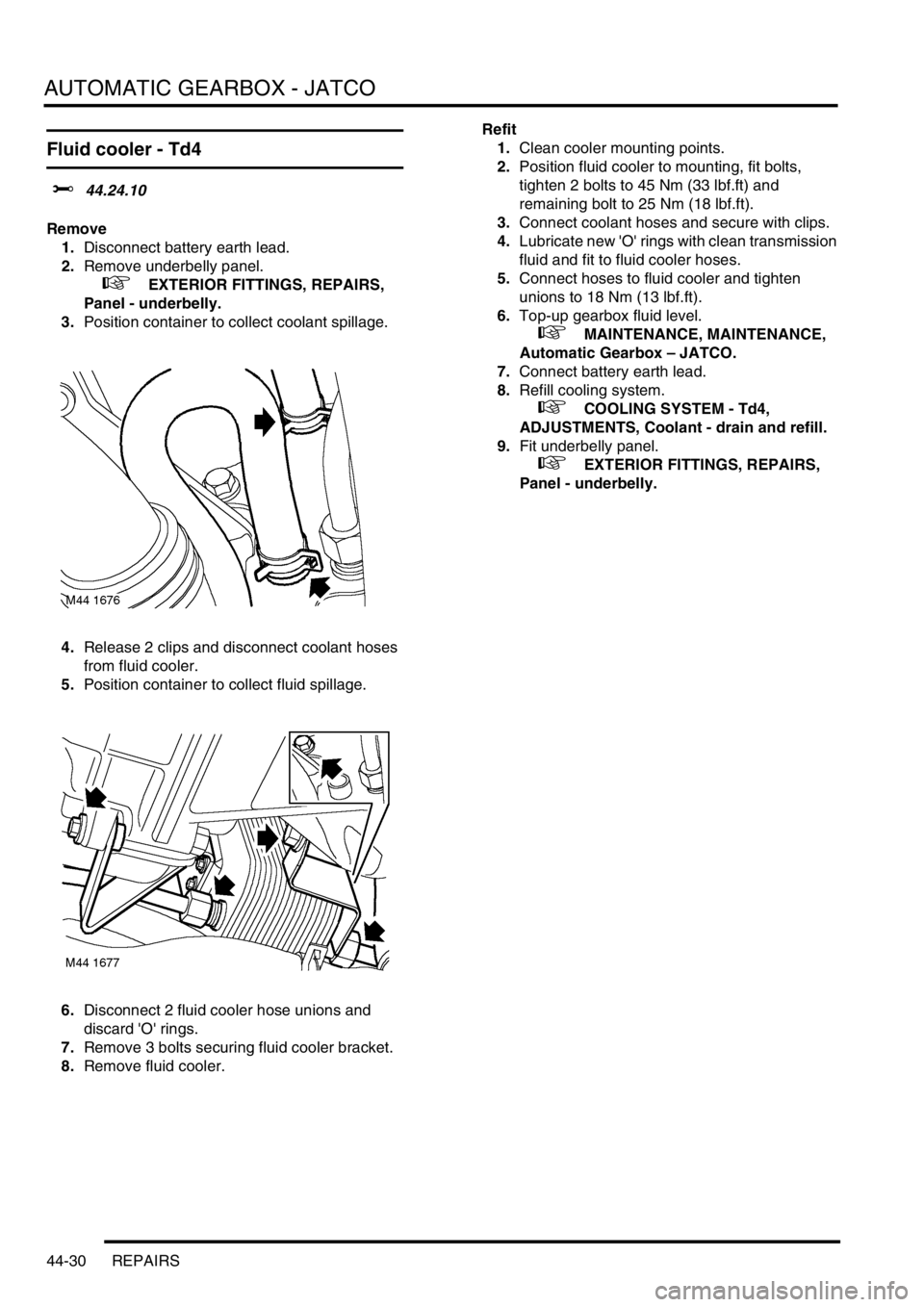
4.Release 2 clips and disconnect coolant hoses
from fluid cooler.
5.Position container to collect fluid spillage.
6.Disconnect 2 fluid cooler hose unions and
discard 'O' rings.
7.Remove 3 bolts securing fluid cooler bracket.
8.Remove fluid cooler.Refit
1.Clean cooler mounting points.
2.Position fluid cooler to mounting, fit bolts,
tighten 2 bolts to 45 Nm (33 lbf.ft) and
remaining bolt to 25 Nm (18 lbf.ft).
3.Connect coolant hoses and secure with clips.
4.Lubricate new 'O' rings with clean transmission
fluid and fit to fluid cooler hoses.
5.Connect hoses to fluid cooler and tighten
unions to 18 Nm (13 lbf.ft).
6.Top-up gearbox fluid level.
+ MAINTENANCE, MAINTENANCE,
Automatic Gearbox – JATCO.
7.Connect battery earth lead.
8.Refill cooling system.
+ COOLING SYSTEM - Td4,
ADJUSTMENTS, Coolant - drain and refill.
9.Fit underbelly panel.
+ EXTERIOR FITTINGS, REPAIRS,
Panel - underbelly.
Page 466 of 1007
AUTOMATIC GEARBOX - JATCO
REPAIRS 44-31
Fluid cooler - KV6
$% 44.24.10
Remove
1.Remove underbelly panel.
+ EXTERIOR FITTINGS, REPAIRS,
Panel - underbelly.
2.Position container to collect fluid spillage.
WARNING: Observe due care when draining
gearbox fluid as the fluid can be very hot.
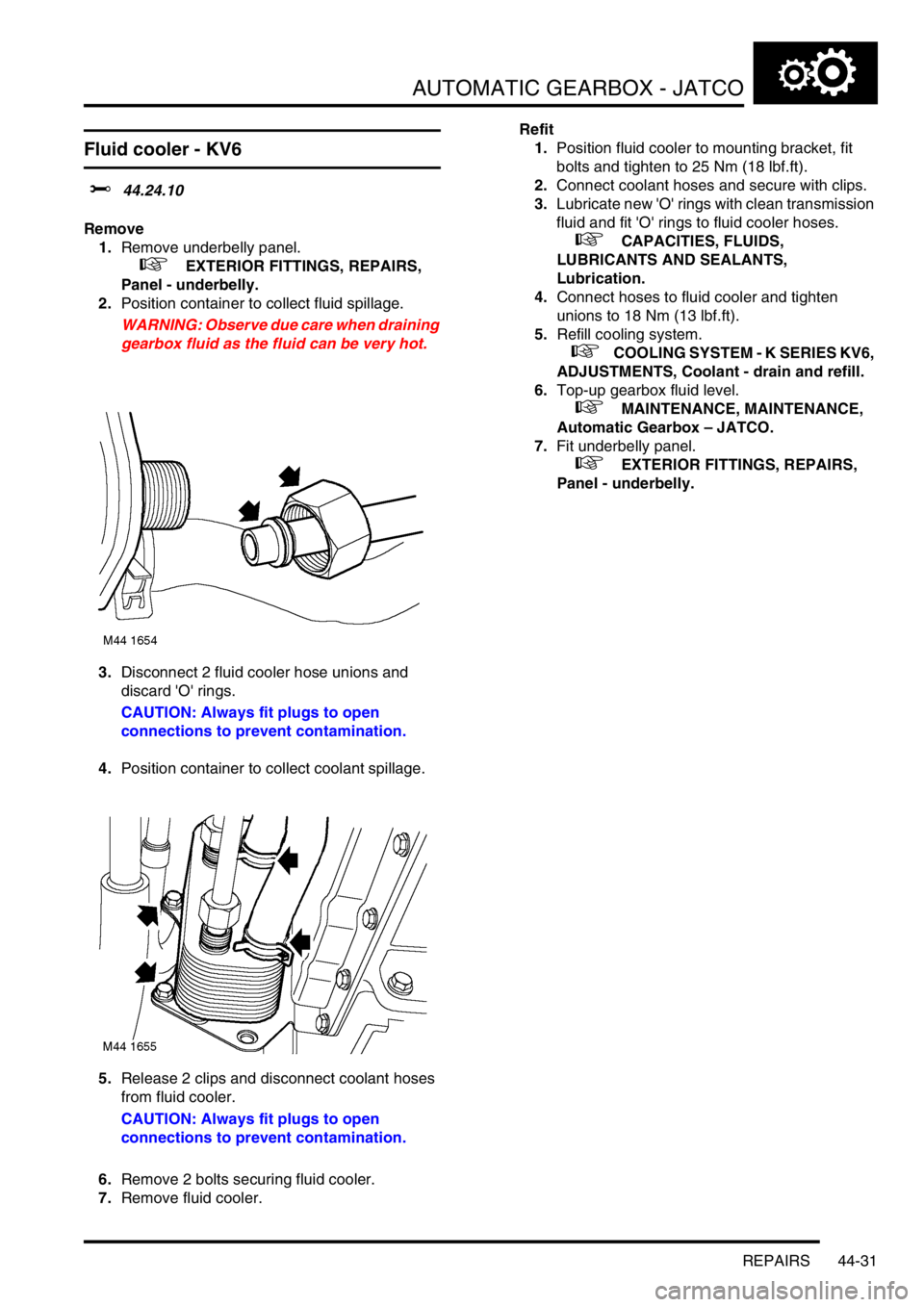
3.Disconnect 2 fluid cooler hose unions and
discard 'O' rings.
CAUTION: Always fit plugs to open
connections to prevent contamination.
4.Position container to collect coolant spillage.
5.Release 2 clips and disconnect coolant hoses
from fluid cooler.
CAUTION: Always fit plugs to open
connections to prevent contamination.
6.Remove 2 bolts securing fluid cooler.
7.Remove fluid cooler.Refit
1.Position fluid cooler to mounting bracket, fit
bolts and tighten to 25 Nm (18 lbf.ft).
2.Connect coolant hoses and secure with clips.
3.Lubricate new 'O' rings with clean transmission
fluid and fit 'O' rings to fluid cooler hoses.
+ CAPACITIES, FLUIDS,
LUBRICANTS AND SEALANTS,
Lubrication.
4.Connect hoses to fluid cooler and tighten
unions to 18 Nm (13 lbf.ft).
5.Refill cooling system.
+ COOLING SYSTEM - K SERIES KV6,
ADJUSTMENTS, Coolant - drain and refill.
6.Top-up gearbox fluid level.
+ MAINTENANCE, MAINTENANCE,
Automatic Gearbox – JATCO.
7.Fit underbelly panel.
+ EXTERIOR FITTINGS, REPAIRS,
Panel - underbelly.
Page 467 of 1007
AUTOMATIC GEARBOX - JATCO
44-32 REPAIRS
Hose - fluid cooler
$% 44.24.13
This procedure is identical for both feed and return
hoses.
Remove
1.Remove underbelly panel.
+ EXTERIOR FITTINGS, REPAIRS,
Panel - underbelly.
2.Position container to collect fluid spillage.
WARNING: Observe due care when draining
gearbox fluid as the fluid can be very hot.
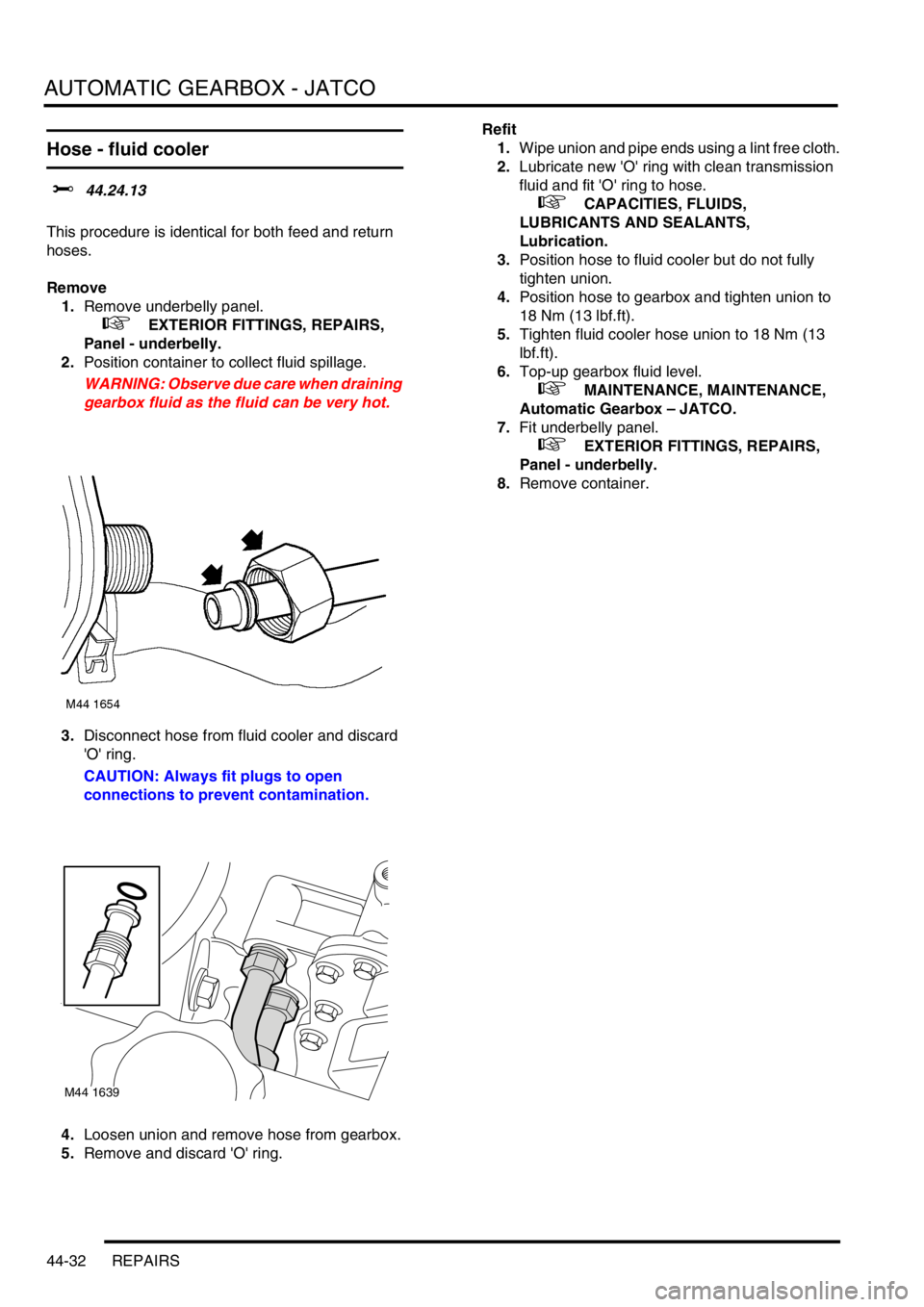
3.Disconnect hose from fluid cooler and discard
'O' ring.
CAUTION: Always fit plugs to open
connections to prevent contamination.
4.Loosen union and remove hose from gearbox.
5.Remove and discard 'O' ring.Refit
1.Wipe union and pipe ends using a lint free cloth.
2.Lubricate new 'O' ring with clean transmission
fluid and fit 'O' ring to hose.
+ CAPACITIES, FLUIDS,
LUBRICANTS AND SEALANTS,
Lubrication.
3.Position hose to fluid cooler but do not fully
tighten union.
4.Position hose to gearbox and tighten union to
18 Nm (13 lbf.ft).
5.Tighten fluid cooler hose union to 18 Nm (13
lbf.ft).
6.Top-up gearbox fluid level.
+ MAINTENANCE, MAINTENANCE,
Automatic Gearbox – JATCO.
7.Fit underbelly panel.
+ EXTERIOR FITTINGS, REPAIRS,
Panel - underbelly.
8.Remove container.
M44 1639
Page 474 of 1007
DRIVESHAFTS
REPAIRS 47-7
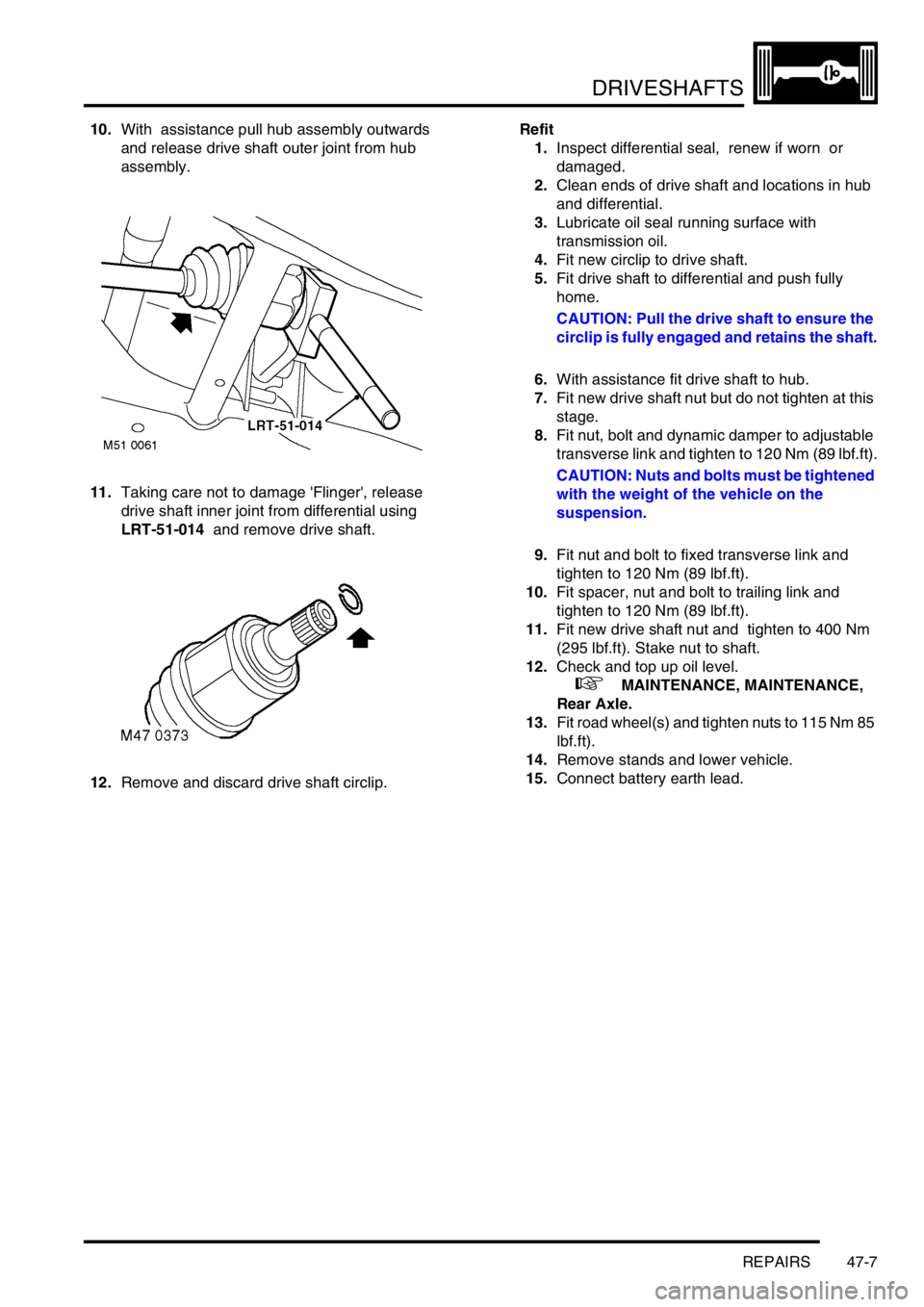
10.With assistance pull hub assembly outwards
and release drive shaft outer joint from hub
assembly.
11.Taking care not to damage 'Flinger', release
drive shaft inner joint from differential using
LRT-51-014 and remove drive shaft.
12.Remove and discard drive shaft circlip.Refit
1.Inspect differential seal, renew if worn or
damaged.
2.Clean ends of drive shaft and locations in hub
and differential.
3.Lubricate oil seal running surface with
transmission oil.
4.Fit new circlip to drive shaft.
5.Fit drive shaft to differential and push fully
home.
CAUTION: Pull the drive shaft to ensure the
circlip is fully engaged and retains the shaft.
6.With assistance fit drive shaft to hub.
7.Fit new drive shaft nut but do not tighten at this
stage.
8.Fit nut, bolt and dynamic damper to adjustable
transverse link and tighten to 120 Nm (89 lbf.ft).
CAUTION: Nuts and bolts must be tightened
with the weight of the vehicle on the
suspension.
9.Fit nut and bolt to fixed transverse link and
tighten to 120 Nm (89 lbf.ft).
10.Fit spacer, nut and bolt to trailing link and
tighten to 120 Nm (89 lbf.ft).
11.Fit new drive shaft nut and tighten to 400 Nm
(295 lbf.ft). Stake nut to shaft.
12.Check and top up oil level.
+ MAINTENANCE, MAINTENANCE,
Rear Axle.
13.Fit road wheel(s) and tighten nuts to 115 Nm 85
lbf.ft).
14.Remove stands and lower vehicle.
15.Connect battery earth lead.
Page 510 of 1007
STEERING
REPAIRS 57-17
Column lock & ignition/starter switch
assembly
$% 57.40.31
Remove
1.Disconnect battery earth lead.
2.Remove starter key from ignition lock.
3.Remove steering column nacelle.
+ STEERING, REPAIRS, Nacelle -
column.
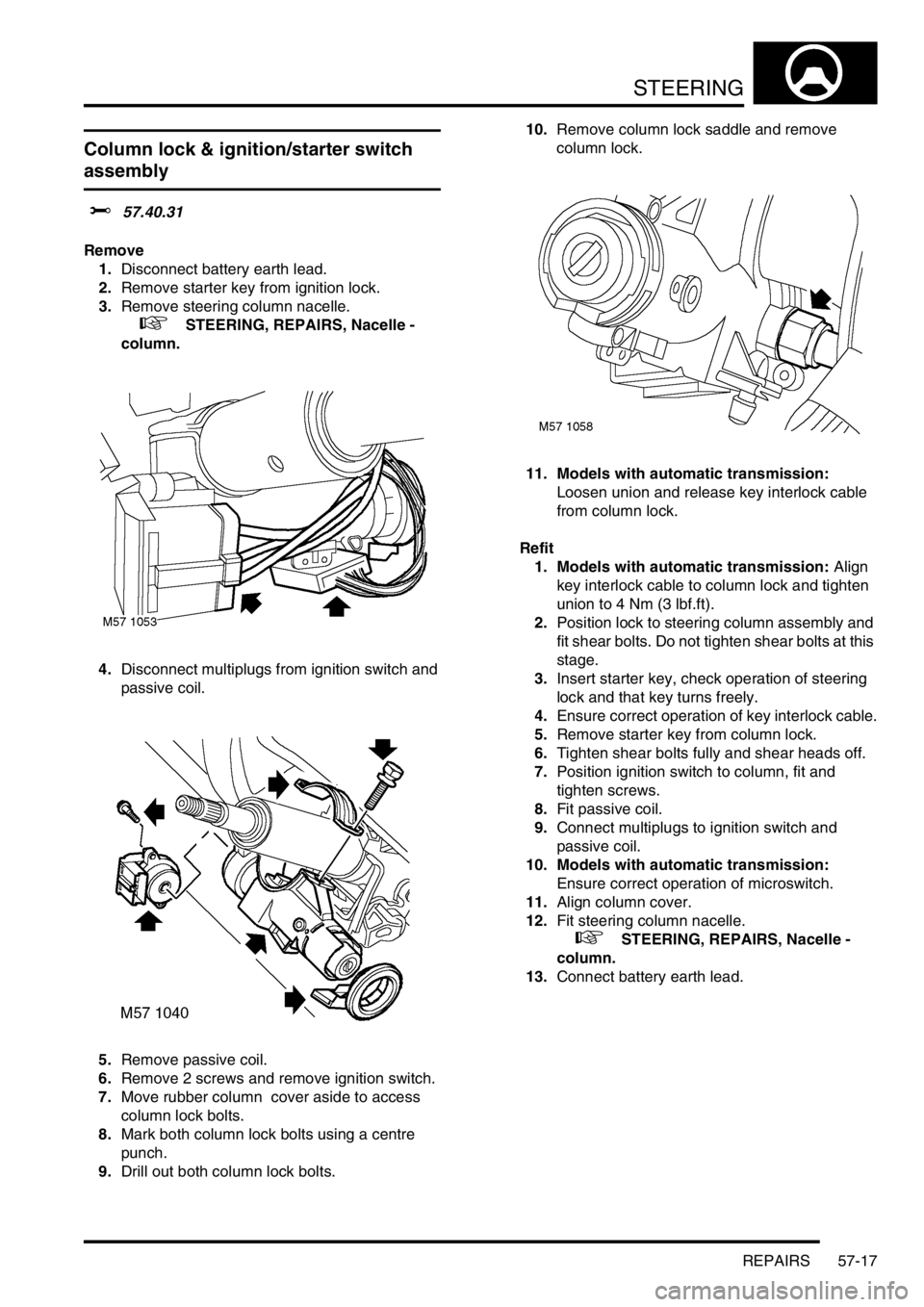
4.Disconnect multiplugs from ignition switch and
passive coil.
5.Remove passive coil.
6.Remove 2 screws and remove ignition switch.
7.Move rubber column cover aside to access
column lock bolts.
8.Mark both column lock bolts using a centre
punch.
9.Drill out both column lock bolts.10.Remove column lock saddle and remove
column lock.
11. Models with automatic transmission:
Loosen union and release key interlock cable
from column lock.
Refit
1. Models with automatic transmission: Align
key interlock cable to column lock and tighten
union to 4 Nm (3 lbf.ft).
2.Position lock to steering column assembly and
fit shear bolts. Do not tighten shear bolts at this
stage.
3.Insert starter key, check operation of steering
lock and that key turns freely.
4.Ensure correct operation of key interlock cable.
5.Remove starter key from column lock.
6.Tighten shear bolts fully and shear heads off.
7.Position ignition switch to column, fit and
tighten screws.
8.Fit passive coil.
9.Connect multiplugs to ignition switch and
passive coil.
10. Models with automatic transmission:
Ensure correct operation of microswitch.
11.Align column cover.
12.Fit steering column nacelle.
+ STEERING, REPAIRS, Nacelle -
column.
13.Connect battery earth lead.
Page 513 of 1007
STEERING
57-20 REPAIRS
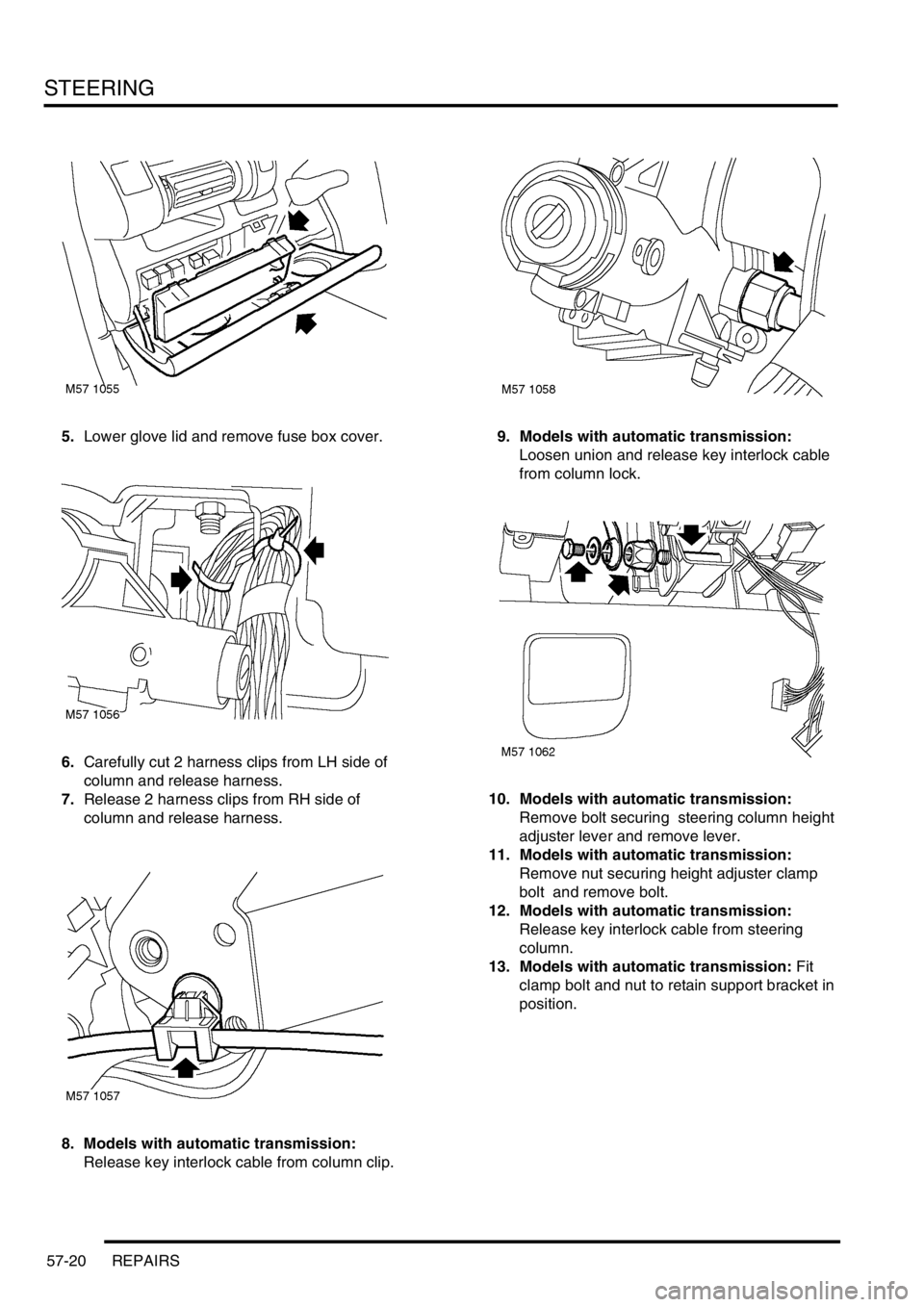
5.Lower glove lid and remove fuse box cover.
6.Carefully cut 2 harness clips from LH side of
column and release harness.
7.Release 2 harness clips from RH side of
column and release harness.
8. Models with automatic transmission:
Release key interlock cable from column clip.9. Models with automatic transmission:
Loosen union and release key interlock cable
from column lock.
10. Models with automatic transmission:
Remove bolt securing steering column height
adjuster lever and remove lever.
11. Models with automatic transmission:
Remove nut securing height adjuster clamp
bolt and remove bolt.
12. Models with automatic transmission:
Release key interlock cable from steering
column.
13. Models with automatic transmission: Fit
clamp bolt and nut to retain support bracket in
position.
Page 515 of 1007

STEERING
57-22 REPAIRS
Refit
1.Remove column from vice.
2.Fit new cable ties to steering column.
3. Models with automatic transmission: Fit key
interlock cable clip.
4.Position steering column to vehicle, locate
steering column on PAS rack, aligning column
coupling with PAS rack input flag.
5.Locate steering column on studs fit nuts but do
not tighten at this stage.
6.Fit bolts and snubber to pivot mountings and
tighten bolts to 14 Nm (10 lbf.ft).
7.Tighten nuts to 14 Nm (10 lbf.ft).
8.Fit and tighten PAS rack pinion clamp bolt to 32
Nm (24 lbf.ft).
CAUTION: Nuts and bolts must be tightened
with weight of vehicle on suspension.
9. Models with automatic transmission:
Remove clamp bolt from height adjuster and
position key interlock cable.
10. Models with automatic transmission: Fit
height adjuster clamp bolt and tighten nut to 10
Nm (7.5 lbf.ft). Ensure bolt and plastic stop are
correctly located in slot in column bracket.
11. Models with automatic transmission: Fit
height adjuster lever and tighten bolt 12 Nm (9
lbf.ft). Ensure lever is in the fully up position
before tightening bolt. Hold clamp bolt nut to
prevent nut rotation.
12. Models with automatic transmission:
Remove starter key from column lock.
13. Models with automatic transmission: Align
key interlock cable to column lock and tighten
union to 4 Nm (3 lbf.ft).
14. Models with automatic
transmission:Position lock to steering column
assembly and fit shear bolts. Do not tighten
shear bolts at this stage.
15. Models with automatic transmission: Insert
starter key, check operation of steering lock
and that key turns freely.
16. Models with automatic transmission:
Ensure correct operation of key interlock cable.
17. Models with automatic transmission:
Remove starter key from column lock.
18. Models with automatic transmission:
Tighten shear bolts fully and shear heads off.
19. Models with automatic transmission: Fit
passive coil.
20. Models with automatic transmission:
Position ignition switch to column, fit and
tighten screws.
21. Models with automatic transmission:
Secure key interlock cable in clip.
22. Models with automatic transmission:
Ensure key interlock cable is correctly fitted.23.Fit side support bolt and tighten to 10 Nm (7.5
lbf.ft).
24.Position harness and secure cable ties.
25.Fit fusebox cover and close glove box lid.
26.Connect multiplugs to column switch and
passive coil.
27.Fit aperture trim and secure with screws.
28. Fit steering column multi purpose switch.
+ LIGHTING, REPAIRS, Switch -
combined direction indicator/headlight/
horn.
29.Connect battery earth lead.
Page 756 of 1007

PANEL REPAIRS
BODY REPAIRS 77-2-1
PANEL REPAIRS
General
Body shells are of monocoque construction. Front and rear sections of the shell are designed as 'energy absorbing'
zones. This means they are designed to deform progressively when subjected to impact in order to minimise the
likelihood of injury to vehicle occupants.
It is essential that design dimensions and strength are restored in accident rectification. It is important that neither
structural weakness nor excessive local stiffness are introduced into the vehicle during body repair.
Repairs usually involve a combination of operations ranging from straightening procedures to renewal of individual
panels or panel assemblies. The repairer will determine the repair method and this decision will take into account a
balance of economics between labour and material costs and the availability of repair facilities in both equipment and
skills. It may also involve considerations of the vehicles' downtime, replacement vehicle availability and repair turn-
around time.
It is expected that a repairer will select the best and most economic repair method possible, making use of the facilities
available. The instructions given are intended to assist a skilled body repairer by expanding approved procedures for
panel replacement. The objective is to restore the vehicle to a safe running condition by carrying out a repair which is
as close as is feasible to original standard. The results should not advertise to the experienced eye that the vehicle
has been damaged, although the repair might not be identical in all respects to the original factory build. Commercial
bodyshop repair facilities cannot always duplicate methods of construction used during production.
Operations covered in this Manual do not include reference to testing the vehicle after repair. It is essential that work
is inspected and suspension geometry checked after completion. Where necessary a road test of the vehicle should
be carried out, particularly where safety-related items are concerned.
Where major units have been disconnected or removed it is necessary to ensure that fluid levels are checked and
topped up where necessary. It is also necessary to ensure that the repaired vehicle is in a roadworthy condition in
respect of tyre pressures, lights, washer fluid etc.
Body repairs often involve the removal of mechanical and electrical units and associated wiring. Where necessary,
refer to the relevant section of the Workshop Manual for removal and refitting instructions.
Body components
Taking into consideration the differences in body styles, suspension systems and engine and transmission layouts,
the location of the following components as applicable to a particular vehicle is critical:
lFront suspension upper damper mountings.
lFront suspension or sub frame mountings.
lRear suspension upper damper mountings.
lRear suspension mountings or lower pivots.
Additional points which can be used to check alignment and assembly are:
lInner holes in crossmember - side - main floor.
lHoles in front longitudinals.
lHoles in side members.
lHoles in rear longitudinals.
lHoles in rear lower panels or extension rear floor.
Apertures for windscreen, backlight, bonnet and doors can be measured and checked using the dimensional
information provided and also by offering up an undamaged component as a gauge.
Straightening
Whenever possible, structural members should be cold straightened under tension. Do not attempt to straighten with
a single pull but rework the damaged area using a series of pulls, releasing tension between each stage and using
the opportunity to check alignment.