maintenance LAND ROVER FREELANDER 2001 Repair Manual
[x] Cancel search | Manufacturer: LAND ROVER, Model Year: 2001, Model line: FREELANDER, Model: LAND ROVER FREELANDER 2001Pages: 1007, PDF Size: 23.47 MB
Page 474 of 1007
DRIVESHAFTS
REPAIRS 47-7
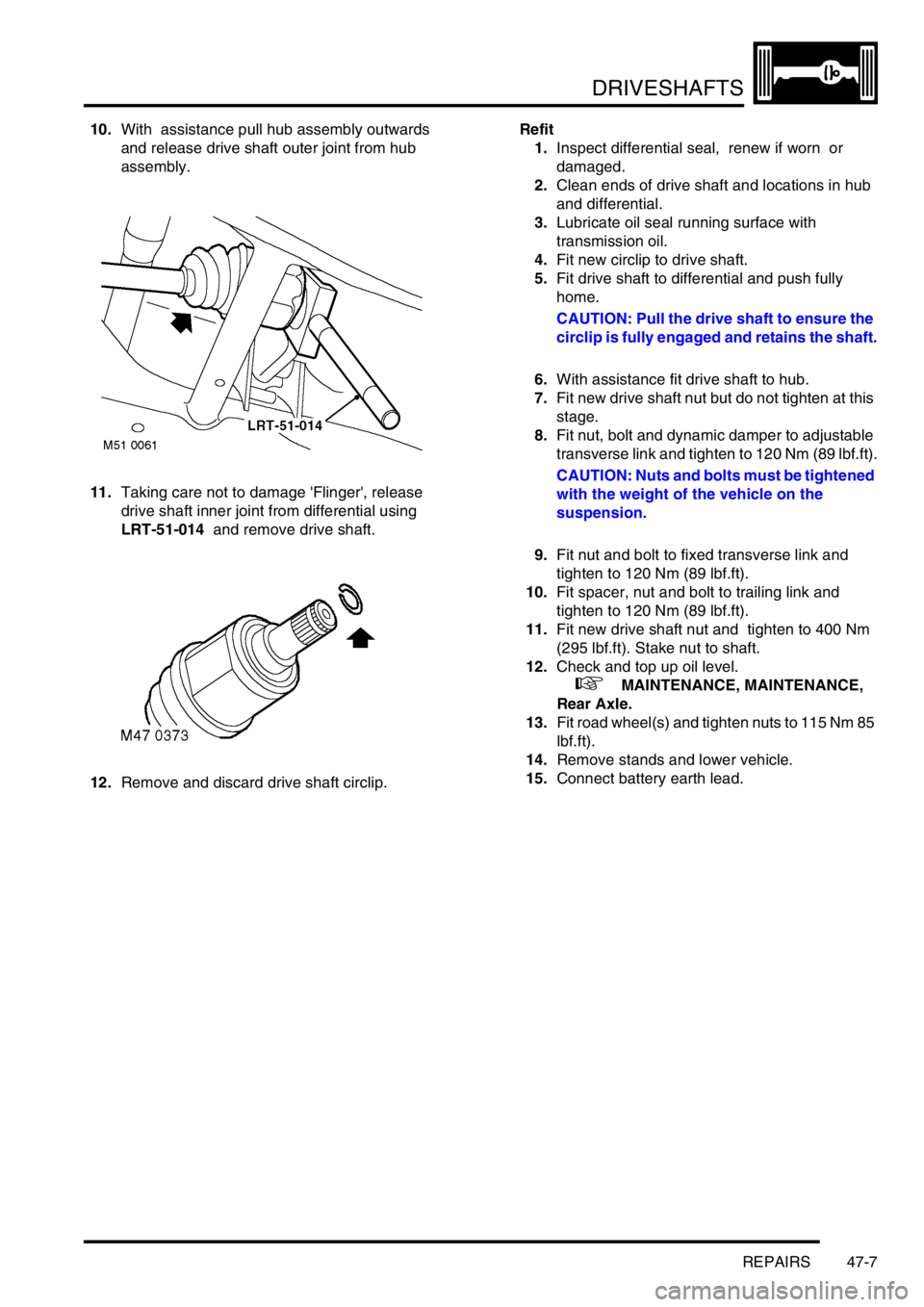
10.With assistance pull hub assembly outwards
and release drive shaft outer joint from hub
assembly.
11.Taking care not to damage 'Flinger', release
drive shaft inner joint from differential using
LRT-51-014 and remove drive shaft.
12.Remove and discard drive shaft circlip.Refit
1.Inspect differential seal, renew if worn or
damaged.
2.Clean ends of drive shaft and locations in hub
and differential.
3.Lubricate oil seal running surface with
transmission oil.
4.Fit new circlip to drive shaft.
5.Fit drive shaft to differential and push fully
home.
CAUTION: Pull the drive shaft to ensure the
circlip is fully engaged and retains the shaft.
6.With assistance fit drive shaft to hub.
7.Fit new drive shaft nut but do not tighten at this
stage.
8.Fit nut, bolt and dynamic damper to adjustable
transverse link and tighten to 120 Nm (89 lbf.ft).
CAUTION: Nuts and bolts must be tightened
with the weight of the vehicle on the
suspension.
9.Fit nut and bolt to fixed transverse link and
tighten to 120 Nm (89 lbf.ft).
10.Fit spacer, nut and bolt to trailing link and
tighten to 120 Nm (89 lbf.ft).
11.Fit new drive shaft nut and tighten to 400 Nm
(295 lbf.ft). Stake nut to shaft.
12.Check and top up oil level.
+ MAINTENANCE, MAINTENANCE,
Rear Axle.
13.Fit road wheel(s) and tighten nuts to 115 Nm 85
lbf.ft).
14.Remove stands and lower vehicle.
15.Connect battery earth lead.
Page 487 of 1007
REAR AXLE & FINAL DRIVE
51-2 REPAIRS
Refit
1.With assistance position differential assembly
to subframe and locate in mountings, fit bolts
but do not tighten at this stage.
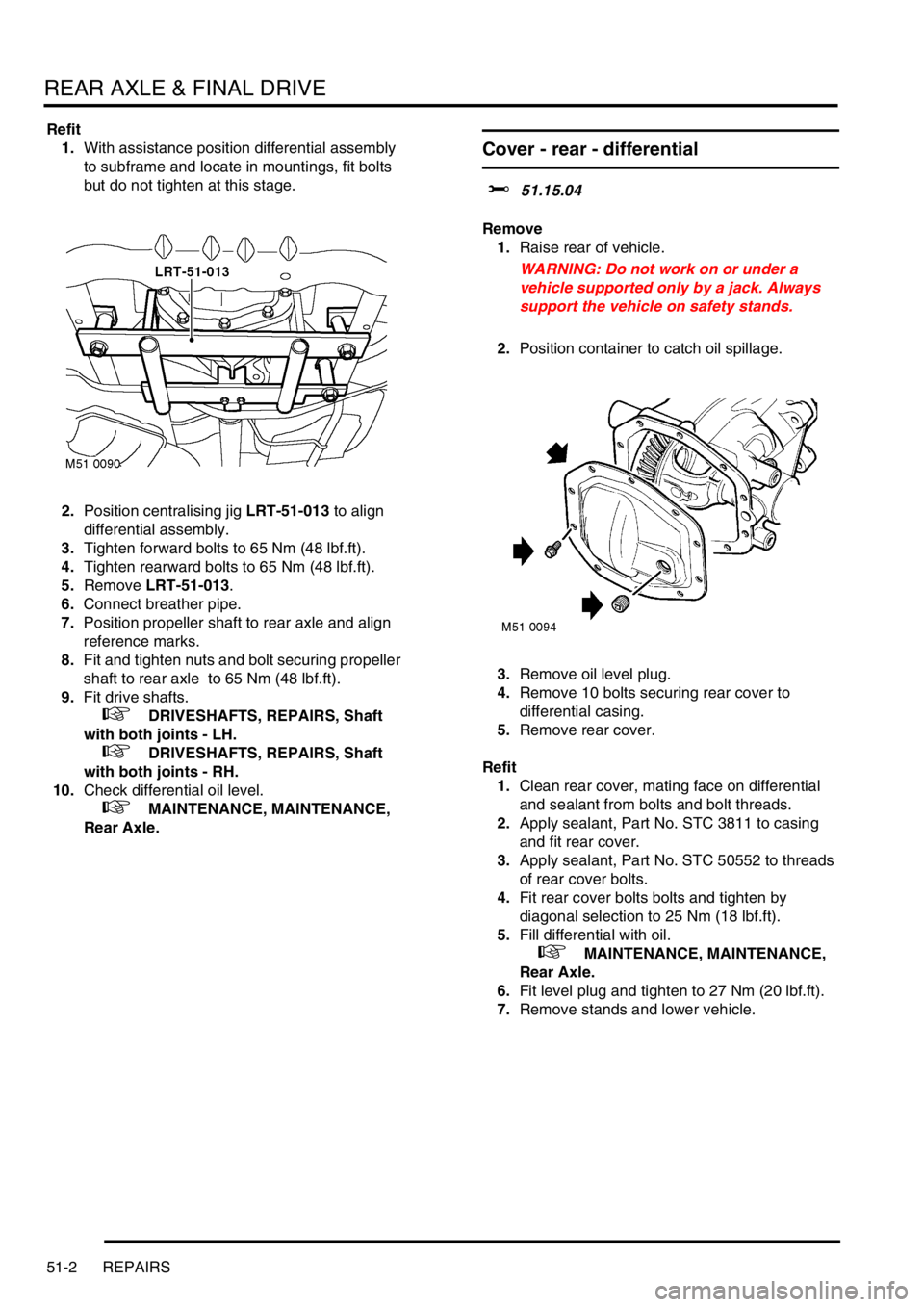
2.Position centralising jig LRT-51-013 to align
differential assembly.
3.Tighten forward bolts to 65 Nm (48 lbf.ft).
4.Tighten rearward bolts to 65 Nm (48 lbf.ft).
5.Remove LRT-51-013.
6.Connect breather pipe.
7.Position propeller shaft to rear axle and align
reference marks.
8.Fit and tighten nuts and bolt securing propeller
shaft to rear axle to 65 Nm (48 lbf.ft).
9.Fit drive shafts.
+ DRIVESHAFTS, REPAIRS, Shaft
with both joints - LH.
+ DRIVESHAFTS, REPAIRS, Shaft
with both joints - RH.
10.Check differential oil level.
+ MAINTENANCE, MAINTENANCE,
Rear Axle.
Cover - rear - differential
$% 51.15.04
Remove
1.Raise rear of vehicle.
WARNING: Do not work on or under a
vehicle supported only by a jack. Always
support the vehicle on safety stands.
2.Position container to catch oil spillage.
3.Remove oil level plug.
4.Remove 10 bolts securing rear cover to
differential casing.
5.Remove rear cover.
Refit
1.Clean rear cover, mating face on differential
and sealant from bolts and bolt threads.
2.Apply sealant, Part No. STC 3811 to casing
and fit rear cover.
3.Apply sealant, Part No. STC 50552 to threads
of rear cover bolts.
4.Fit rear cover bolts bolts and tighten by
diagonal selection to 25 Nm (18 lbf.ft).
5.Fill differential with oil.
+ MAINTENANCE, MAINTENANCE,
Rear Axle.
6.Fit level plug and tighten to 27 Nm (20 lbf.ft).
7.Remove stands and lower vehicle.
Page 491 of 1007
REAR AXLE & FINAL DRIVE
51-6 REPAIRS
Refit
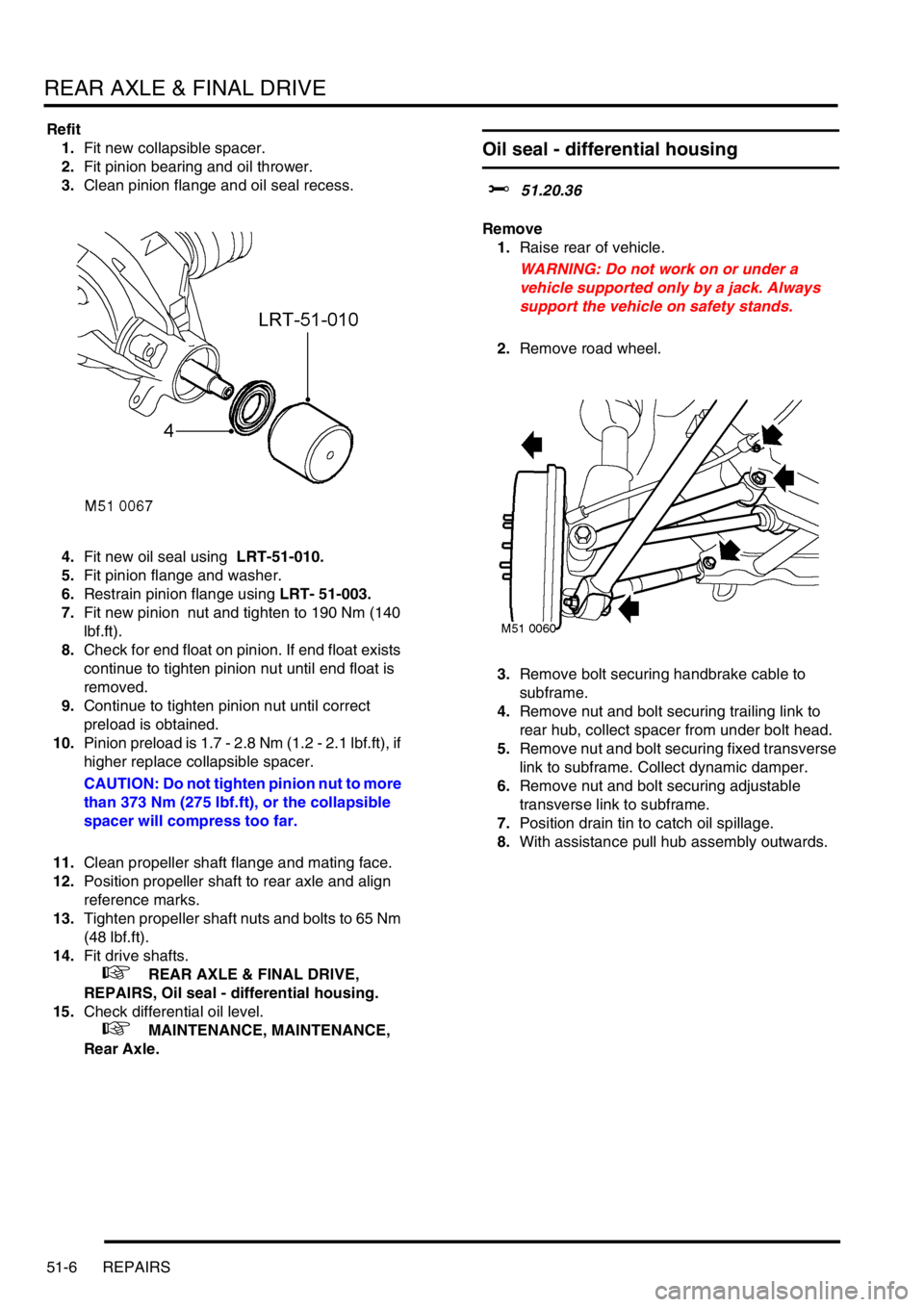
1.Fit new collapsible spacer.
2.Fit pinion bearing and oil thrower.
3.Clean pinion flange and oil seal recess.
4.Fit new oil seal using LRT-51-010.
5.Fit pinion flange and washer.
6.Restrain pinion flange using LRT- 51-003.
7.Fit new pinion nut and tighten to 190 Nm (140
lbf.ft).
8.Check for end float on pinion. If end float exists
continue to tighten pinion nut until end float is
removed.
9.Continue to tighten pinion nut until correct
preload is obtained.
10.Pinion preload is 1.7 - 2.8 Nm (1.2 - 2.1 lbf.ft), if
higher replace collapsible spacer.
CAUTION: Do not tighten pinion nut to more
than 373 Nm (275 lbf.ft), or the collapsible
spacer will compress too far.
11.Clean propeller shaft flange and mating face.
12.Position propeller shaft to rear axle and align
reference marks.
13.Tighten propeller shaft nuts and bolts to 65 Nm
(48 lbf.ft).
14.Fit drive shafts.
+ REAR AXLE & FINAL DRIVE,
REPAIRS, Oil seal - differential housing.
15.Check differential oil level.
+ MAINTENANCE, MAINTENANCE,
Rear Axle.
Oil seal - differential housing
$% 51.20.36
Remove
1.Raise rear of vehicle.
WARNING: Do not work on or under a
vehicle supported only by a jack. Always
support the vehicle on safety stands.
2.Remove road wheel.
3.Remove bolt securing handbrake cable to
subframe.
4.Remove nut and bolt securing trailing link to
rear hub, collect spacer from under bolt head.
5.Remove nut and bolt securing fixed transverse
link to subframe. Collect dynamic damper.
6.Remove nut and bolt securing adjustable
transverse link to subframe.
7.Position drain tin to catch oil spillage.
8.With assistance pull hub assembly outwards.
Page 492 of 1007
REAR AXLE & FINAL DRIVE
REPAIRS 51-7
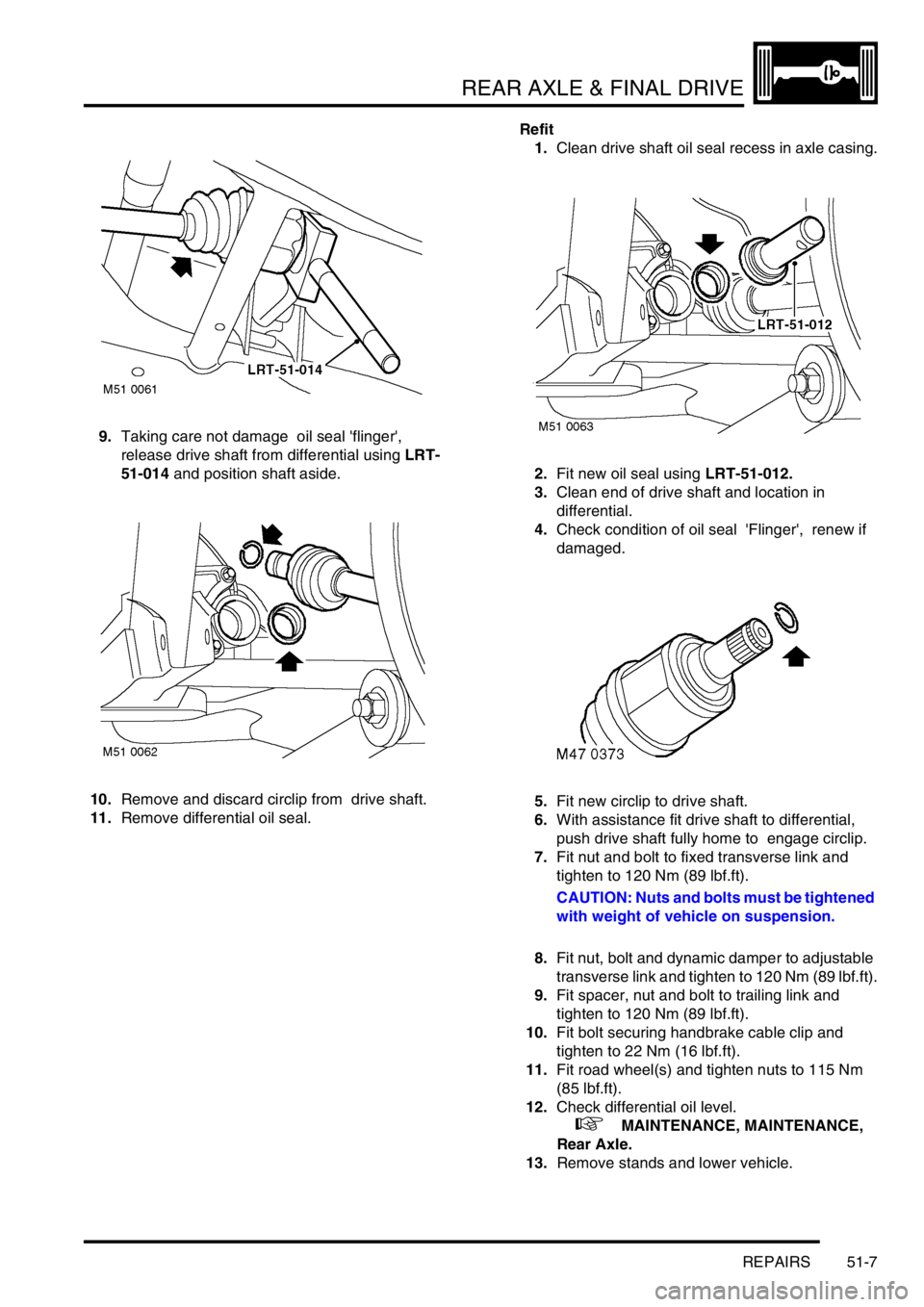
9.Taking care not damage oil seal 'flinger',
release drive shaft from differential using LRT-
51-014 and position shaft aside.
10.Remove and discard circlip from drive shaft.
11.Remove differential oil seal.Refit
1.Clean drive shaft oil seal recess in axle casing.
2.Fit new oil seal using LRT-51-012.
3.Clean end of drive shaft and location in
differential.
4.Check condition of oil seal 'Flinger', renew if
damaged.
5.Fit new circlip to drive shaft.
6.With assistance fit drive shaft to differential,
push drive shaft fully home to engage circlip.
7.Fit nut and bolt to fixed transverse link and
tighten to 120 Nm (89 lbf.ft).
CAUTION: Nuts and bolts must be tightened
with weight of vehicle on suspension.
8.Fit nut, bolt and dynamic damper to adjustable
transverse link and tighten to 120 Nm (89 lbf.ft).
9.Fit spacer, nut and bolt to trailing link and
tighten to 120 Nm (89 lbf.ft).
10.Fit bolt securing handbrake cable clip and
tighten to 22 Nm (16 lbf.ft).
11.Fit road wheel(s) and tighten nuts to 115 Nm
(85 lbf.ft).
12.Check differential oil level.
+ MAINTENANCE, MAINTENANCE,
Rear Axle.
13.Remove stands and lower vehicle.
Page 497 of 1007
STEERING
57-4 ADJUSTMENTS
Power steering - pressure test
$% 57.90.10.01
Check
1.Position absorbent cloth to catch spillage.
2.Remove bolt securing PAS high pressure pipe
clip to PAS pump.
3.Loosen union securing high pressure pipe to
PAS pump and release pipe.
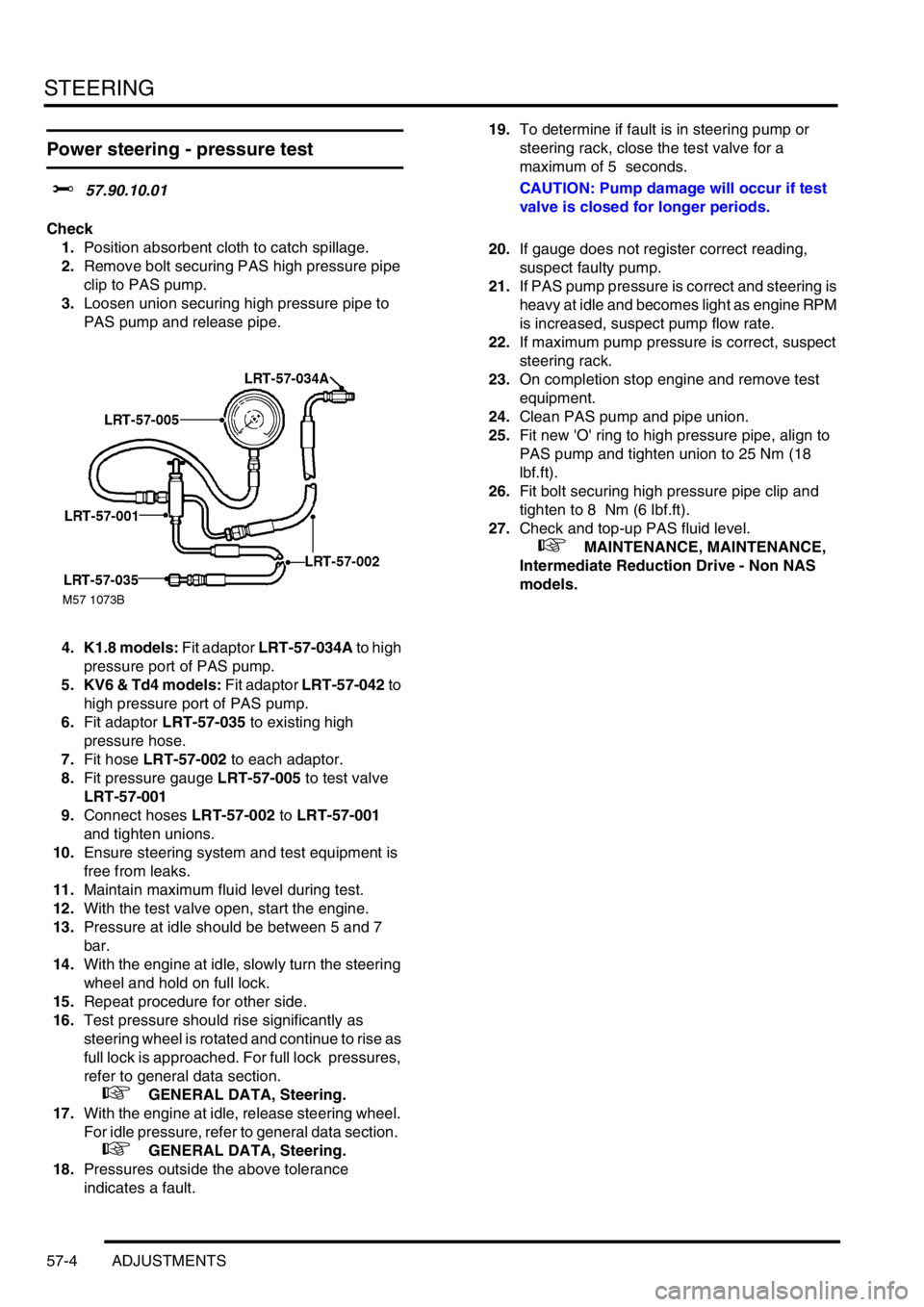
4. K1.8 models: Fit adaptor LRT-57-034A to high
pressure port of PAS pump.
5. KV6 & Td4 models: Fit adaptor LRT-57-042 to
high pressure port of PAS pump.
6.Fit adaptor LRT-57-035 to existing high
pressure hose.
7.Fit hose LRT-57-002 to each adaptor.
8.Fit pressure gauge LRT-57-005 to test valve
LRT-57-001
9.Connect hoses LRT-57-002 to LRT-57-001
and tighten unions.
10.Ensure steering system and test equipment is
free from leaks.
11.Maintain maximum fluid level during test.
12.With the test valve open, start the engine.
13.Pressure at idle should be between 5 and 7
bar.
14.With the engine at idle, slowly turn the steering
wheel and hold on full lock.
15.Repeat procedure for other side.
16.Test pressure should rise significantly as
steering wheel is rotated and continue to rise as
full lock is approached. For full lock pressures,
refer to general data section.
+ GENERAL DATA, Steering.
17.With the engine at idle, release steering wheel.
For idle pressure, refer to general data section.
+ GENERAL DATA, Steering.
18.Pressures outside the above tolerance
indicates a fault.19.To determine if fault is in steering pump or
steering rack, close the test valve for a
maximum of 5 seconds.
CAUTION: Pump damage will occur if test
valve is closed for longer periods.
20.If gauge does not register correct reading,
suspect faulty pump.
21.If PAS pump pressure is correct and steering is
heavy at idle and becomes light as engine RPM
is increased, suspect pump flow rate.
22.If maximum pump pressure is correct, suspect
steering rack.
23.On completion stop engine and remove test
equipment.
24.Clean PAS pump and pipe union.
25.Fit new 'O' ring to high pressure pipe, align to
PAS pump and tighten union to 25 Nm (18
lbf.ft).
26.Fit bolt securing high pressure pipe clip and
tighten to 8 Nm (6 lbf.ft).
27.Check and top-up PAS fluid level.
+ MAINTENANCE, MAINTENANCE,
Intermediate Reduction Drive - Non NAS
models.
Page 550 of 1007
BRAKES
ADJUSTMENTS 70-1
BRAKES ADJUST ME NTS
Brake bleed
$% 70.25.02
Check
1.The following procedure covers bleeding the
complete system but where only the primary or
secondary circuit have been disturbed in
isolation, it should only be necessary to bleed
that system. Partial bleeding of the hydraulic
system is only permissible if a brake pipe or
hose has been disconnected with only minor
loss of fluid.
CAUTION: Ensure the fluid in the reservoir
is maintained between the minimum and
maximum levels throughout the bleed
procedure using new brake fluid.
Adjust
1.Raise front and rear of vehicle.
WARNING: Do not work on or under a
vehicle supported only by a jack. Always
support the vehicle on safety stands.
2.Check all pipe and hose connections are tight
and there are no signs of leakage.
3.Top-up fluid level in brake reservoir to 'MAX'
mark.
+ MAINTENANCE, MAINTENANCE,
Brake Fluid.
CAUTION: Never re-use fluid that has been
bled from the system.
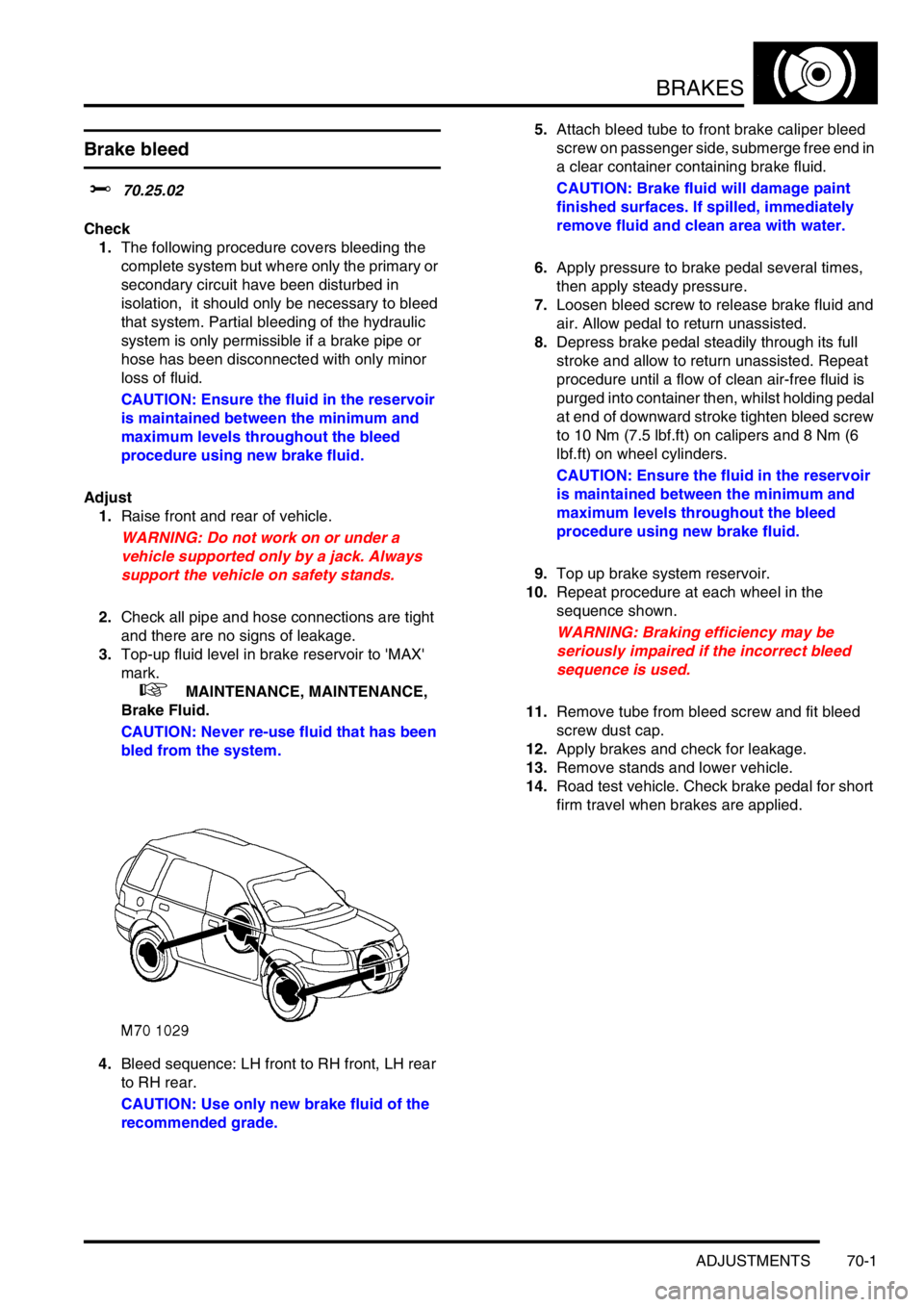
4.Bleed sequence: LH front to RH front, LH rear
to RH rear.
CAUTION: Use only new brake fluid of the
recommended grade.5.Attach bleed tube to front brake caliper bleed
screw on passenger side, submerge free end in
a clear container containing brake fluid.
CAUTION: Brake fluid will damage paint
finished surfaces. If spilled, immediately
remove fluid and clean area with water.
6.Apply pressure to brake pedal several times,
then apply steady pressure.
7.Loosen bleed screw to release brake fluid and
air. Allow pedal to return unassisted.
8.Depress brake pedal steadily through its full
stroke and allow to return unassisted. Repeat
procedure until a flow of clean air-free fluid is
purged into container then, whilst holding pedal
at end of downward stroke tighten bleed screw
to 10 Nm (7.5 lbf.ft) on calipers and 8 Nm (6
lbf.ft) on wheel cylinders.
CAUTION: Ensure the fluid in the reservoir
is maintained between the minimum and
maximum levels throughout the bleed
procedure using new brake fluid.
9.Top up brake system reservoir.
10.Repeat procedure at each wheel in the
sequence shown.
WARNING: Braking efficiency may be
seriously impaired if the incorrect bleed
sequence is used.
11.Remove tube from bleed screw and fit bleed
screw dust cap.
12.Apply brakes and check for leakage.
13.Remove stands and lower vehicle.
14.Road test vehicle. Check brake pedal for short
firm travel when brakes are applied.
Page 829 of 1007

BODY SEALING MATERIALS
77-3-6 APPLICATION EQUIPMENT
Cooper Pegler Falcon Junior Pneumatic Gun (Airless)
Intended primarily for applying transit wax, this pneumatic sprayer has a 5-litre container with integral hand pump and
provides an effective means of wax spraying without the need for compressed air or additional services.
A selection of nozzles, lances, hose lengths and a trigger valve assembly with integral filter allows flexibility in use.
Additional applications include general maintenance, wax injection and paint application. Heavy-bodied materials
may also be applied. All parts are fully replaceable and a wide range of nozzle configurations is available.
SATA Schutz Gun Model UBE
The SATA Schutz Gun is approved for the retreatment of vehicle underbody areas with protective coatings as
supplied in 1 litre, purpose-designed 'one-way' containers. The screw thread fitting (female on the gun) is standard
to most Schutz-type packs.
Full operating details are supplied with the equipment.
SATA HKD1 Wax Injection Injection Equipment
This equipment is approved for carrying out cavity wax re-treatment. The SATA HKD1 set comprises a high quality
forged gun with 1-litre pressure feed container, a flexible nylon lance, a straight 1100mm steel lance and hooked-
wand lance. A quick-change coupling is provided as a standard fitting to allow lances to be easily interchanged. Each
lance has an integral, machined nozzle with specialised spray characteristics to suit the type of box section to be
treated.
Page 840 of 1007
CORROSION PREVENTION AND SEALING
SEALING 77-4-9
Inspections during maintenance servicing
It is a requirement of the Corrosion Warranty that the vehicle body is checked for corrosion by an authorised Land
Rover Dealer at least once a year, to ensure that the factory-applied protection remains effective.
Service Job Sheets include the following operations to check bodywork for corrosion:
lWith the vehicle on a lift, carry out visual check of underbody sealer for damage.
lWith the vehicle lowered, inspect exterior paintwork for damage and body panels for corrosion.
The vehicle must be washed and free from deposits prior to inspection. It is part of the owner's responsibility to ensure
that the vehicle is kept free of accumulations of mud which could accelerate the onset of corrosion. It will be necessary
for the vehicle to be washed by the Dealer prior to inspection of bodywork if the customer has offered the vehicle in
a dirty condition. Particular attention should be paid to areas where access is difficult.
The checks described above are intended to be visual only. It is not intended that the operator should remove trim
panels, finishers, rubbing strips or sound-deadening materials when checking the vehicle for corrosion and paint
damage.
With the vehicle on a lift, and using an inspection or spot lamp, visually check for the following:
lCorrosion damage and damaged paintwork, condition of underbody sealer on front and rear lower panels, sills
and wheel arches.
lDamage to underbody sealer. Corrosion in areas adjacent to suspension mountings and fuel tank fixings.
The presence of small blisters in underbody sealer is acceptable, providing they do not expose bare metal.
Pay special attention to signs of damage caused to panels or corrosion protection material by incorrect jack
positioning.
caut : It is essential to follow the correct jacking and lifting procedures.
With the vehicle lowered, visually check for evidence of damage and corrosion on all visible painted areas, in
particular the following:
lFront edge of bonnet.
lVisible flanges in engine compartment.
lLower body and door panels.
Rectify any bodywork damage or evidence of corrosion found during inspection as soon as is practicable, both to
minimise the extent of the damage and to ensure the long term effectiveness of the factory-applied corrosion
prevention treatment. Where the cost of rectification work is the owner's responsibility, the Dealer must advise the
owner and endorse the relevant documentation accordingly.
Where corrosion has become evident and is emanating from beneath a removable component (e.g. trim panel,
window glass, seat etc.), remove the component as required to permit effective rectification.