air condition Lexus CT200h 2012 (in English) User Guide
[x] Cancel search | Manufacturer: LEXUS, Model Year: 2012, Model line: CT200h, Model: Lexus CT200h 2012Pages: 710
Page 154 of 710

154
1-8. Safety information
CT200h_OM_OM76067E_(EE)
If the SRS airbags deploy (inflate)
Bruising and slight abrasions may result from contact with a deploying
(inflating) SRS airbag.
A loud noise and white powder will be emitted.
Parts of the airbag module (steering wheel hub, airbag cover and infla-
tor) as well as the front seats, parts of the front and rear pillars, and roof
side rails, may be hot for several minutes. The airbag itself may also be
hot.
The windshield may crack.
SRS airbag deployment conditions (SRS front airbags)
The SRS front airbags will deploy in the event of an impact that exceeds
the set threshold level (the level of force corresponding to an approxi-
mately 20-30 km/h [12-18 mph] frontal collision with a fixed wall that
does not move or deform).
However, this threshold velocity will be considerably higher if the vehicle
strikes an object, such as a parked vehicle and sign pole, which can move
or deform on impact, or if the vehicle is involved in an underride collision
(e.g. a collision in which the front of the vehicle “underrides”, or goes
under, the bed of a truck, etc.).
Depending on the type of collision, it is possible that only the seatbelt
pretensioners will activate.
SRS airbag deployment conditions (SRS side and curtain shield airbags)
The SRS side and curtain shield airbags will deploy in the event of an
impact that exceeds the set threshold level (the level of force corresponding
to the impact force produced by an approximately 1500 kg [3300 lb.] vehi-
cle colliding with the vehicle cabin from a direction perpendicular to the
vehicle orientation at an approximate speed of 20 -30 km/h [12 -18 mph]).
Page 155 of 710
155
1-8. Safety information
1
Before driving
CT200h_OM_OM76067E_(EE)
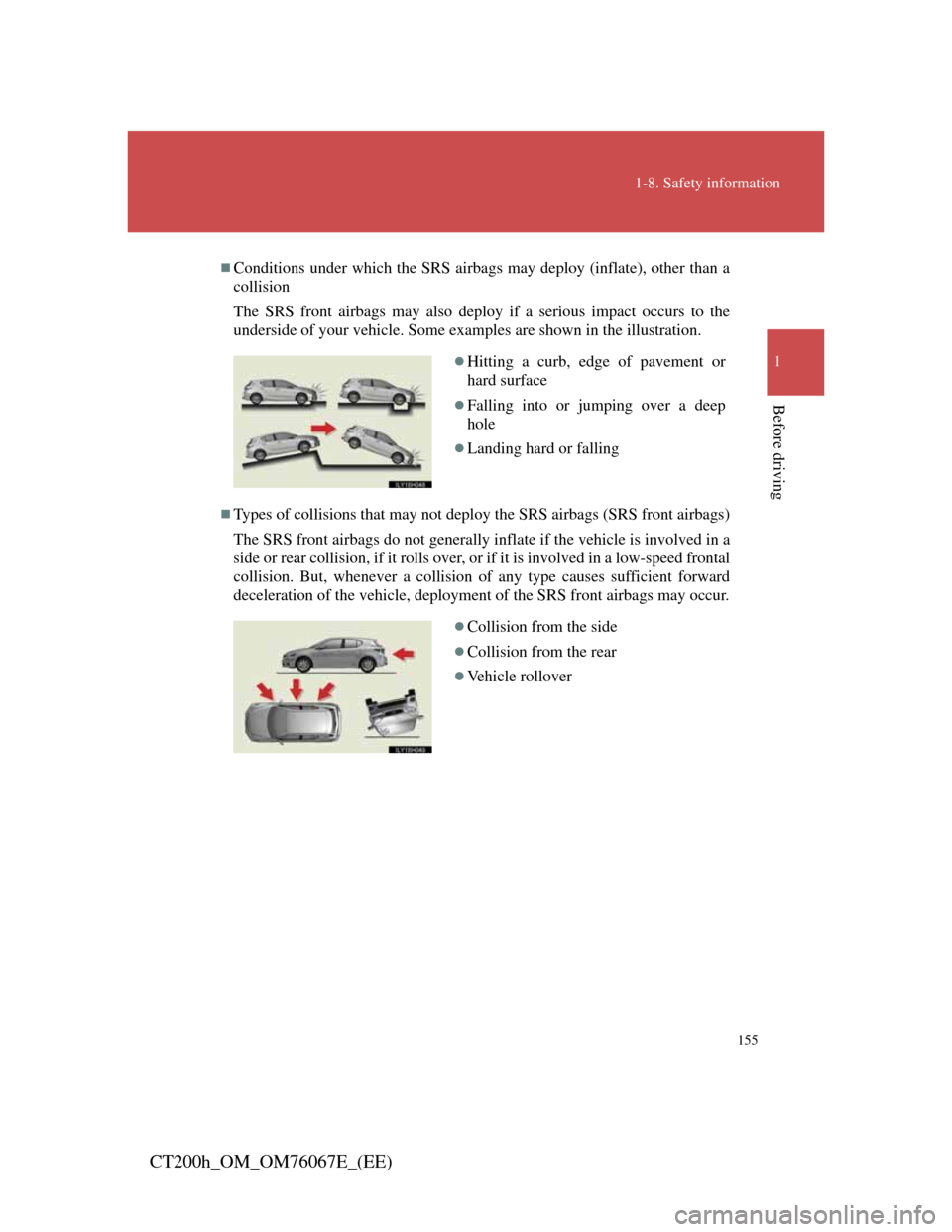
Conditions under which the SRS airbags may deploy (inflate), other than a
collision
The SRS front airbags may also deploy if a serious impact occurs to the
underside of your vehicle. Some examples are shown in the illustration.
Types of collisions that may not deploy the SRS airbags (SRS front airbags)
The SRS front airbags do not generally inflate if the vehicle is involved in a
side or rear collision, if it rolls over, or if it is involved in a low-speed frontal
collision. But, whenever a collision of any type causes sufficient forward
deceleration of the vehicle, deployment of the SRS front airbags may occur.
Hitting a curb, edge of pavement or
hard surface
Falling into or jumping over a deep
hole
Landing hard or falling
Collision from the side
Collision from the rear
Vehicle rollover
Page 156 of 710
156
1-8. Safety information
CT200h_OM_OM76067E_(EE)
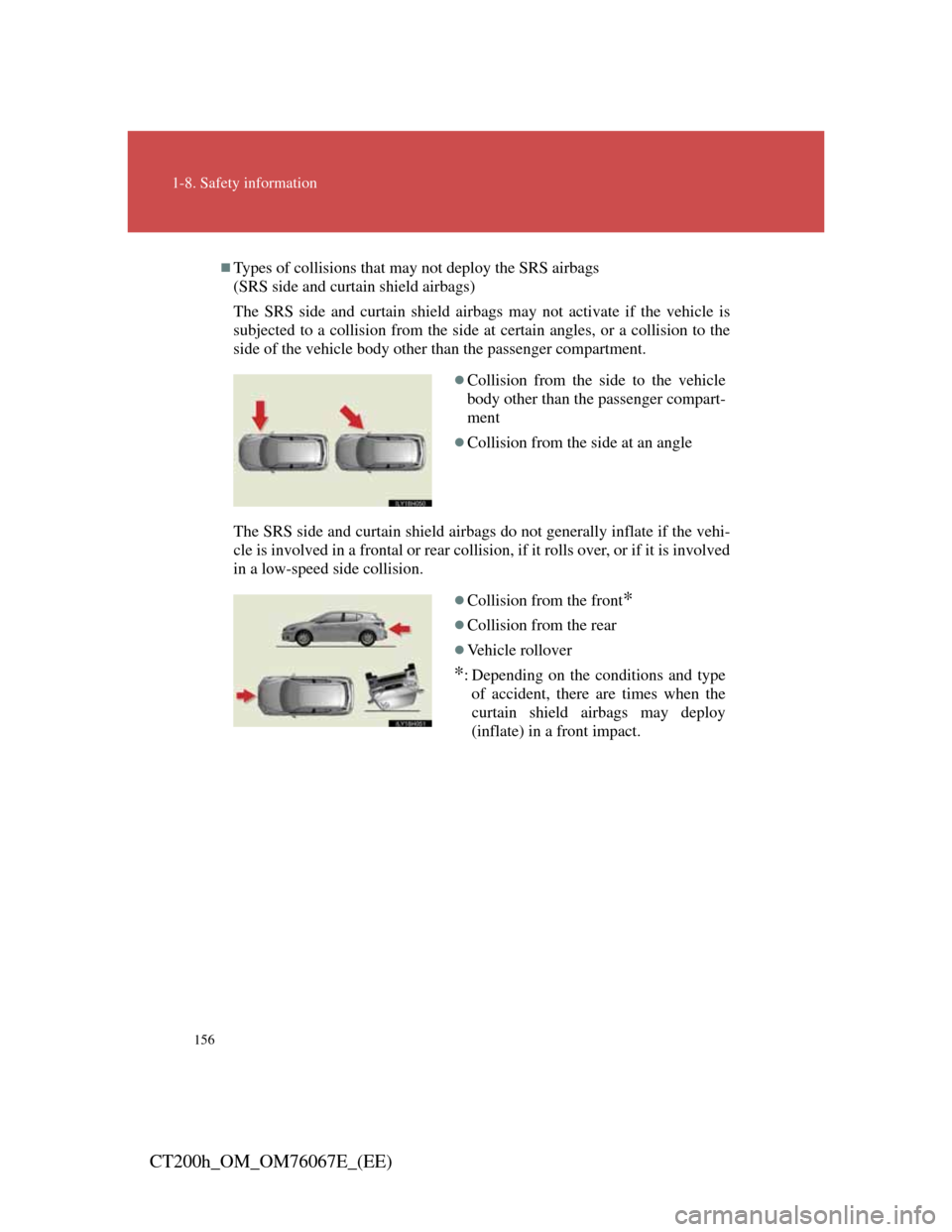
Types of collisions that may not deploy the SRS airbags
(SRS side and curtain shield airbags)
The SRS side and curtain shield airbags may not activate if the vehicle is
subjected to a collision from the side at certain angles, or a collision to the
side of the vehicle body other than the passenger compartment.
The SRS side and curtain shield airbags do not generally inflate if the vehi-
cle is involved in a frontal or rear collision, if it rolls over, or if it is involved
in a low-speed side collision.
Collision from the side to the vehicle
body other than the passenger compart-
ment
Collision from the side at an angle
Collision from the front*
Collision from the rear
Vehicle rollover
*: Depending on the conditions and type
of accident, there are times when the
curtain shield airbags may deploy
(inflate) in a front impact.
Page 197 of 710

197
2-1. Driving procedures
2
When driving
CT200h_OM_OM76067E_(EE)
NOTICE
When encountering flooded roads
Do not drive on a road that has flooded after heavy rain etc. Doing so may
cause the following serious damage to the vehicle:
Engine stalling
Short in electrical components
Engine damage caused by water immersion
In the event that you drive on a flooded road and the vehicle is flooded, be
sure to have any authorized Lexus dealer or repairer, or another duly quali-
fied and equipped professional check the following:
Brake function
Changes in quantity and quality of engine oil, transmission fluid for the
hybrid system etc.
Lubricant condition for the bearings and suspension joints (where possi-
ble), and the function of all joints, bearings, etc.
If the P position control system is damaged by flooding, it may not be possi-
ble to shift the shift position to P, or from P to other positions. When the
shift position cannot be changed from P to any other position, the front
wheels will lock, and you will be unable to tow the vehicle with the front
wheels on the ground, as the front wheels may be locked. In this case, trans-
port the vehicle with both front wheels or all four wheels lifted.
Page 201 of 710

201
2-1. Driving procedures
2
When driving
CT200h_OM_OM76067E_(EE)
Electronic key battery depletion
P. 8 7
When the ambient temperature is low, such as during winter driving condi-
tions
It may take time until the “READY” indicator to come on.
Conditions affecting operation
P. 8 6
Notes for the entry function (vehicles with smart entry & start system)
P. 6 9
Note for the push-button start system (vehicles with push-button start sys-
tem)
P. 8 1
If the hybrid system does not start
The immobilizer system may not have been deactivated. (P. 135)
When the “POWER” switch indicator flashes in amber
The system may be malfunctioning. Have the vehicle inspected by any
authorized Lexus dealer or repairer, or another duly qualified and equipped
professional immediately.
Page 209 of 710
209
2-1. Driving procedures
2
When driving
CT200h_OM_OM76067E_(EE)
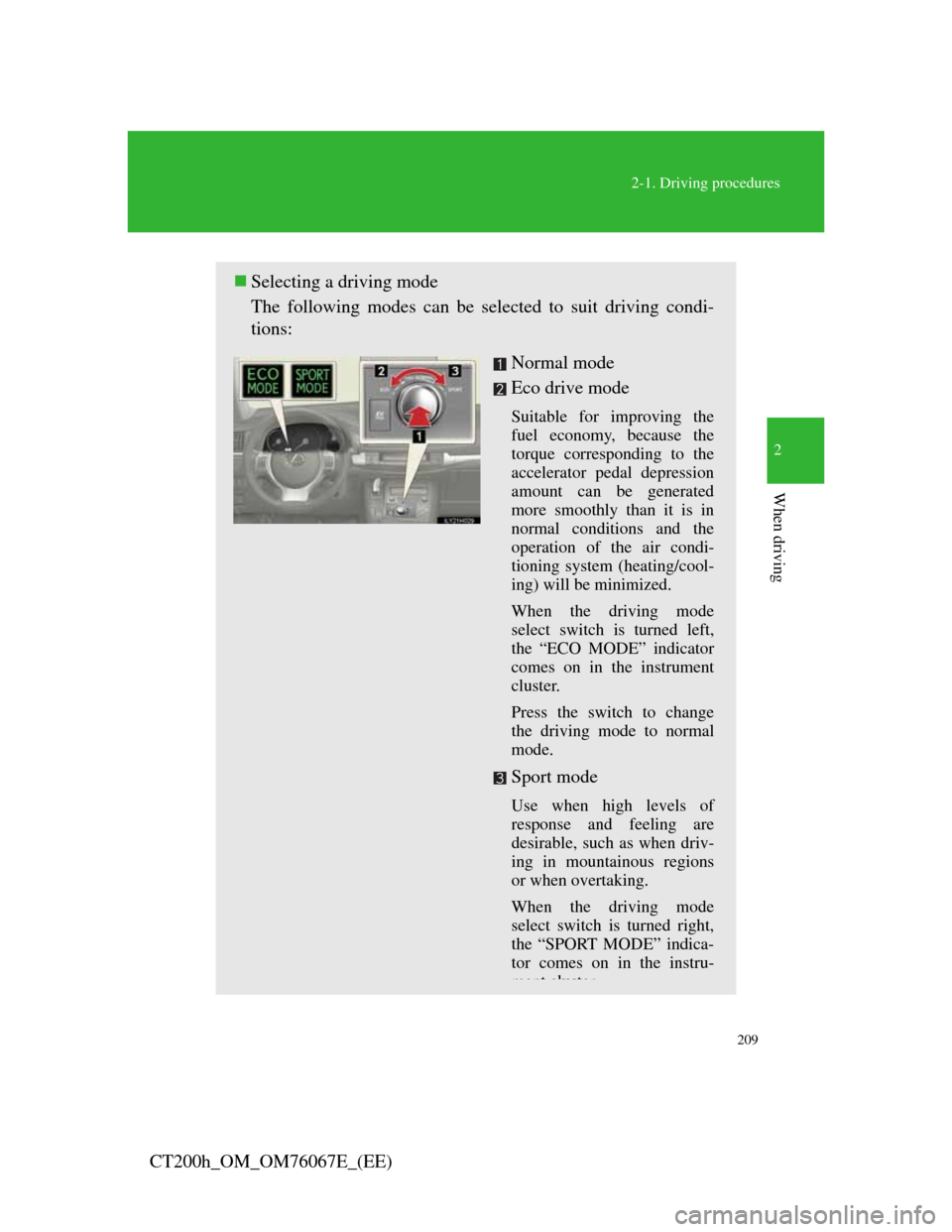
Selecting a driving mode
The following modes can be selected to suit driving condi-
tions:
Normal mode
Eco drive mode
Suitable for improving the
fuel economy, because the
torque corresponding to the
accelerator pedal depression
amount can be generated
more smoothly than it is in
normal conditions and the
operation of the air condi-
tioning system (heating/cool-
ing) will be minimized.
When the driving mode
select switch is turned left,
the “ECO MODE” indicator
comes on in the instrument
cluster.
Press the switch to change
the driving mode to normal
mode.
Sport mode
Use when high levels of
response and feeling are
desirable, such as when driv-
ing in mountainous regions
or when overtaking.
When the driving mode
select switch is turned right,
the “SPORT MODE” indica-
tor comes on in the instru-
ment cluster
Page 211 of 710

211
2-1. Driving procedures
2
When driving
CT200h_OM_OM76067E_(EE)
Operation of the air conditioning system in Eco drive mode (without navi-
gation system)
Eco drive mode controls the heating/ cooling operations and fan speed of
the air conditioning system to enhance fuel efficiency. (P. 326) To
improve air conditioning performance, adjust the fan speed or turn off Eco
drive mode.
Operation of the air conditioning system in Eco drive mode (with navigation
system)
Eco drive mode controls the heating/cooling operations and fan speed of the
air conditioning system to enhance fuel efficiency. To improve air condi-
tioning performance, adjust the fan speed or turn off Eco drive mode. (Refer
to the “Navigation System Owner’s Manual”.)
For the shift positions
When the “POWER” switch is off, the shift position cannot be changed.
When the “POWER” switch is in ON mode (the hybrid system is not
operating), the shift position can only be changed to N. The shift position
will be changed to N even if the shift lever is shifted to D or R and held
in that position.
When the “READY” indicator is on, the shift position can be changed
from P to D, N or R.
When the “READY” indicator is flashing, the shift position cannot be
changed from P to another position even if the shift lever is operated.
Wait until the “READY” indicator changes from a flashing to a solid
light, and then operate the shift lever again.
The shift position can only be changed to B directly from D.
Page 279 of 710

279
2-4. Using other driving systems
2
When driving
CT200h_OM_OM76067E_(EE)
Sensor detection information
Certain vehicle conditions and the surrounding environment may affect
the ability of a sensor to correctly detect an obstacle. Particular instances
where this may occur are listed below.
• There is dirt, snow or ice on a sensor.
• A sensor is frozen.
• A sensor is covered in any way.
• The vehicle is leaning considerably to one side.
• On an extremely bumpy road, on an incline, on gravel, or on grass
• The vicinity of the vehicle is noisy due to vehicle horns, motorcycle
engines, air brakes of large vehicles, or other loud noises producing
ultrasonic waves.
• There is another vehicle equipped with parking assist sensors in the
vicinity.
• A sensor is coated with a sheet of spray or heavy rain.
• The vehicle is equipped with a fender pole or radio antenna.
• Towing eyelets are installed.
• A bumper or sensor receives a strong impact.
• The vehicle is approaching a tall or right-angled curb.
• In harsh sunlight or intense cold weather
• A non-genuine Lexus suspension (lowered suspension etc.) is
installed.
In addition to the examples above, there are instances in which, because of
their shape, signs and other objects may be judged by a sensor to be closer
than they are.
The shape of the obstacle may prevent a sensor from detecting it. Pay
particular attention to the following obstacles:
• Wires, fences, ropes, etc.
• Cotton, snow and other materials that absorb sound waves
• Sharply-angled objects
•Low obstacles
• Tall obstacles with upper sections projecting outwards in the direction
of your vehicle
Page 281 of 710

281
2-4. Using other driving systems
2
When driving
CT200h_OM_OM76067E_(EE)
NOTICE
Notes when washing the vehicle
Do not apply intensive bursts of water or steam to the sensor area.
Doing so may result in the sensor malfunctioning.
Conditions possibly indicating system malfunctions
If any of the following occurs, the system may be malfunctioning due to a
sensor failure etc. Have the vehicle inspected by any authorized Lexus
dealer or repairer, or another duly qualified and equipped professional.
The buzzer does not sound when the Lexus parking assist-sensor mode is
set.
The sensor operation display flashes and the buzzer sounds even when no
obstacle is detected.
An area of the sensors is hit or subjected to a strong impact.
Either bumper is hit.
The sensor operation display remains on even though no buzzer sounds.
Page 290 of 710

290
2-4. Using other driving systems
CT200h_OM_OM76067E_(EE)
CAUTION
Conditions which may affect the rear view monitor system
If the back of the vehicle has been hit, the camera’s position and mounting
angle may have been changed. Have the vehicle inspected by any autho-
rized Lexus dealer or repairer, or another duly qualified and equipped pro-
fessional.
Rapid temperature changes, such as when hot water is poured on the vehi-
cle in cold weather, may cause the system to function abnormally.
If the camera lens is dirty, it cannot transmit a clear image. Rinse with
water and wipe with a soft cloth. If the camera lens is extremely dirty,
wash with a mild cleanser and rinse.
The displayed image may be darker and moving images may be slightly
distorted when the system is cold.
When washing the vehicle, do not apply intensive bursts of water to the
camera or camera area. Doing so may result in the camera malfunctioning.
Do not allow organic solvent, car wax, window cleaner or glass coat to
adhere to the camera. If this happens, wipe it off as soon as possible.
As the camera has a water proof construction, do not detach, disassemble
or modify it. This may cause incorrect operation.
Do not hit the camera or subject it to strong impacts as this may cause its
position and mounting angle to change.
Do not scrub the camera lens roughly or clean it with a hard brush or abra-
sive cleaner. Doing so may damage the lens and adversely affect the
image.