tires Lexus CT200h 2015 (in English) User Guide
[x] Cancel search | Manufacturer: LEXUS, Model Year: 2015, Model line: CT200h, Model: Lexus CT200h 2015Pages: 634
Page 247 of 634

246
CT200h_OM_OM76174U_(U)4-6. Driving tips
Accelerate the vehicle slowly, keep a safe distance between you and the vehicle
ahead, and drive at a reduced speed suitable to road conditions.
Park the vehicle and shift the shift position to P and block the wheel under the
vehicle without setting the parking brake. The parking brake may freeze up, pre-
venting it from being released.
Use the correct tire chain size when mounting the tire chains. Chain size is regu-
lated for each tire size.
Side chain:
0.12 in. (3 mm) in diameter
Cross chain:
0.16 in. (4 mm) in diameter
Regulations regarding the use of tire chains vary depending on location and type
of road. Always check local regulations before installing chains.
■Tire chain installation
Observe the following precautions wh en installing and removing chains:
●Install and remove tire chains in a safe location.
●Install tire chains on the front tires only. Do not install tire chains on the rear tires.
●Install tire chains on front tires as tightly as possible. Retighten chains after driving 1 /4 -
1 /2 mile (0.5 - 1.0 km).
●Install tire chains following the instructions provided with the tire chains.
When driving the vehicle
When parking the vehicle
Selecting tire chains
1
2
Regulations on the use of tire chains
Page 248 of 634
CT200h_OM_OM76174U_(U)
2474-6. Driving tips
4
Driving
WA R N I N G
■Driving with snow tires
Observe the following precautions to reduce the risk of accidents.
Failure to do so may result in a loss of vehicle control and cause death or serious injury.
●Use tires of the specified size.
●Maintain the recommended level of air pressure.
●Do not drive in excess of 75 mph (120 km/h), regardless of the type of snow tires
being used.
●Use snow tires on all, not just some wheels.
■Driving with tire chains
Observe the following precautions to reduce the risk of accidents.
Failure to do so may result in the vehicle being unable to be driven safely, and may
cause death or serious injury.
●Do not drive in excess of the speed limit specified for the tire chains being used, or 30
mph (50 km/h), whichever is lower.
●Avoid driving on bumpy road surfaces or over potholes.
●Avoid sudden acceleration, abrupt steering, sudden braking and shifting operations
that cause sudden engine braking.
●Slow down sufficiently before entering a cu rve to ensure that vehicle control is main-
tained.
■When parking the vehicle
When parking the vehicle without applying the parking brake, make sure to chock the
wheels. If you do not chock the wheels, the vehicle may move unexpectedly, possibly
resulting in an accident.
NOTICE
■Repairing or replacing snow tires
Request repairs or replacement of snow tires from Lexus dealers or legitimate tire
retailers.
This is because the removal and attachment of snow tires affects the operation of the
tire pressure warning valves and transmitters.
■Fitting tire chains
The tire pressure warning valves and transmitters may not function correctly when tire
chains are fitted.
Page 460 of 634
459
CT200h_OM_OM76174U_(U)
7Maintenance and care
7-1. Maintenance and careCleaning and protecting the vehicle exterior.................460
Cleaning and protecting the vehicle interior .................. 463
7-2. Maintenance Maintenance requirements............................. 465
General maintenance .............. 467
Emission inspection and maintenance (I/M)
programs .................................... 470
7-3. Do-it-yourself maintenance Do-it-yourself service precautions.................................. 471
Hood ................................................473
Positioning a floor jack ............. 475
Engine compartment ................ 476
12-volt battery.............................. 484
Tires................................................. 488
Tire inflation pressure ............... 495
Wheels ...........................................498
Air conditioning filter .............. 500
Electronic key battery ..............502
Checking and replacing fuses..............................................504
Light bulbs..................................... 507
Page 470 of 634

CT200h_OM_OM76174U_(U)
4697-2. Maintenance
7
Maintenance and care
Vehicle exterior
ItemsCheck points
Doors• Do the doors operate smoothly?
Engine hood• Does the engine hood lock system work properly?
Fluid leaks• There should not be any signs of fluid leakage afterthe vehicle has been parked.
Ti r e s
• Is the tire inflation pressure correct?
• The tires should not be damaged or excessivelyworn.
• Have the tires been rotated according to the mainte- nance schedule?
• The wheel nuts should not be loose.
Windshield wipers/
rear window wiper
• The wiper blades should not show any signs of crack-
ing, splitting, wear, contamination or deformation.
• The wiper blades should clear the windshield/rear window without streaking or skipping.
WA R N I N G
■If the hybrid system is operating
Turn the hybrid system off and ensure that there is adequate ventilation before per-
forming maintenance checks.
Page 489 of 634
488
CT200h_OM_OM76174U_(U)7-3. Do-it-yourself maintenance
Tires
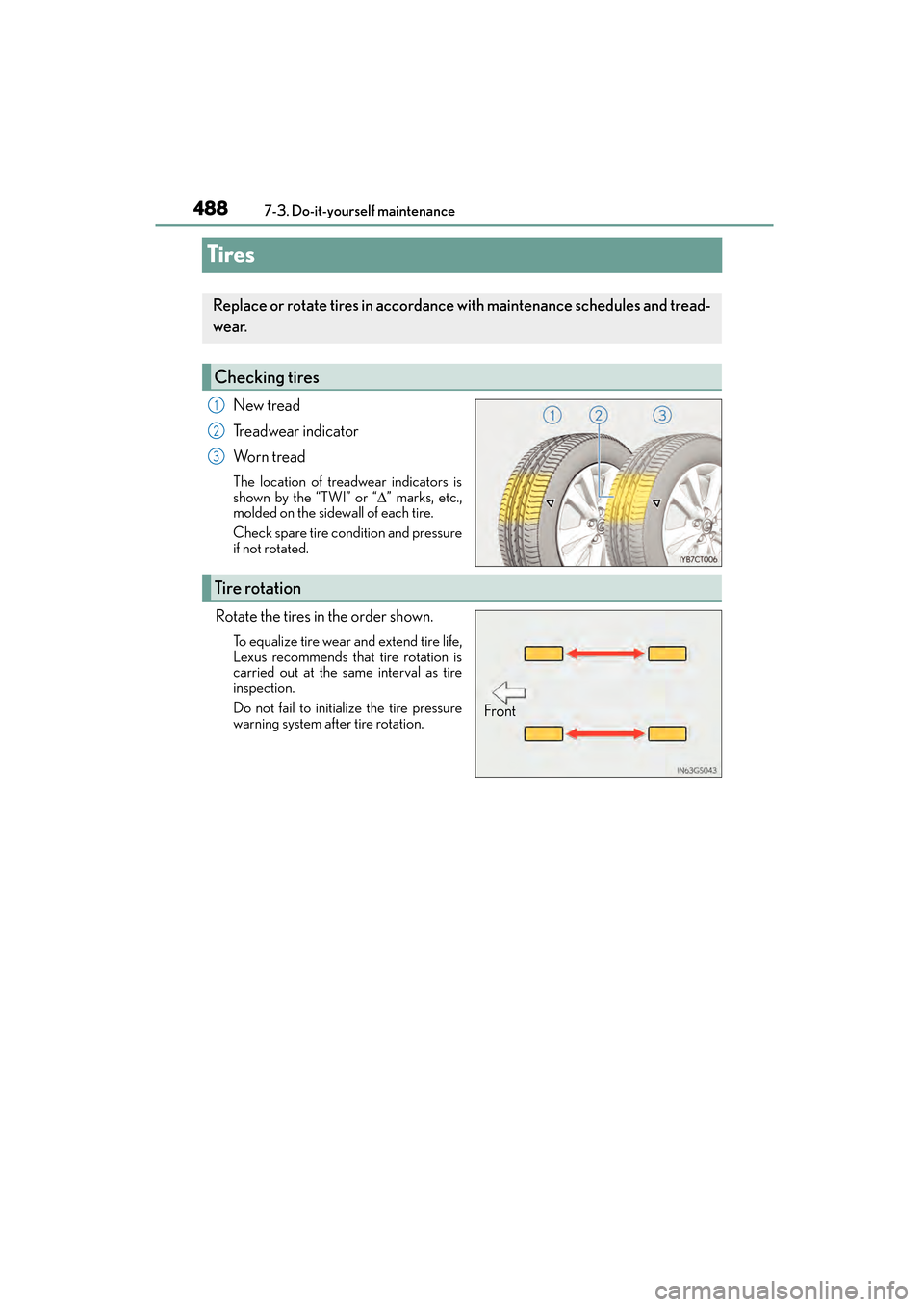
New tread
Treadwear indicator
Wo r n t r e a d
The location of treadwear indicators is
shown by the “TWI” or “
∆” marks, etc.,
molded on the sidewall of each tire.
Check spare tire condition and pressure
if not rotated.
Rotate the tires in the order shown.
To equalize tire wear and extend tire life,
Lexus recommends that tire rotation is
carried out at the same interval as tire
inspection.
Do not fail to initialize the tire pressure
warning system after tire rotation.
Replace or rotate tires in accordance with maintenance schedules and tread-
wear.
Checking tires
1
2
3
Tire rotation
Front
Page 490 of 634
CT200h_OM_OM76174U_(U)
4897-3. Do-it-yourself maintenance
7
Maintenance and care
Your vehicle is equipped with a tire pressure warning system that uses tire pres-
sure warning valves and transmitters to detect low tire inflation pressure before
serious problems arise.
If the tire pressure drops below a predetermined level, the driver is warned by a
warning light. ( →P. 5 2 9 )
◆Installing tire pressure warning valves and transmitters
When replacing tires or wheels, tire pressure warning valves and transmitters
must also be installed.
When new tire pressure warning valves and transmitters are installed, new ID
codes must be registered in the tire pressure warning computer and the tire
pressure warning system must be initiali zed. Have tire pressure warning valve
and transmitter ID codes registered by your Lexus dealer. ( →P. 4 9 0 )
◆Initializing the tire pressure warning system
■The tire pressure warning system must be initialized in the following circum-
stances:
●Vehicles with 17 inch tires: When rotating front and rear tires which have
different tire inflation pressures
●When changing the tire size
When the tire pressure warning system is initialized, the current tire inflation
pressure is set as the benchmark pressure.
■How to initialize the tire pressure warning system
Park the vehicle in a safe plac e and turn the power switch off.
Initialization cannot be performed while the vehicle is moving.
Adjust the tire inflation pressure to the specified cold tire inflation pressure
level. (→P. 577)
Make sure to adjust the tire pressure to the specified cold tire inflation pressure
level. The tire pressure warning system will operate based on this pressure level.
Turn the power switch to ON mode.
Tire pressure warning system
1
2
3
Page 491 of 634
490
CT200h_OM_OM76174U_(U)7-3. Do-it-yourself maintenance
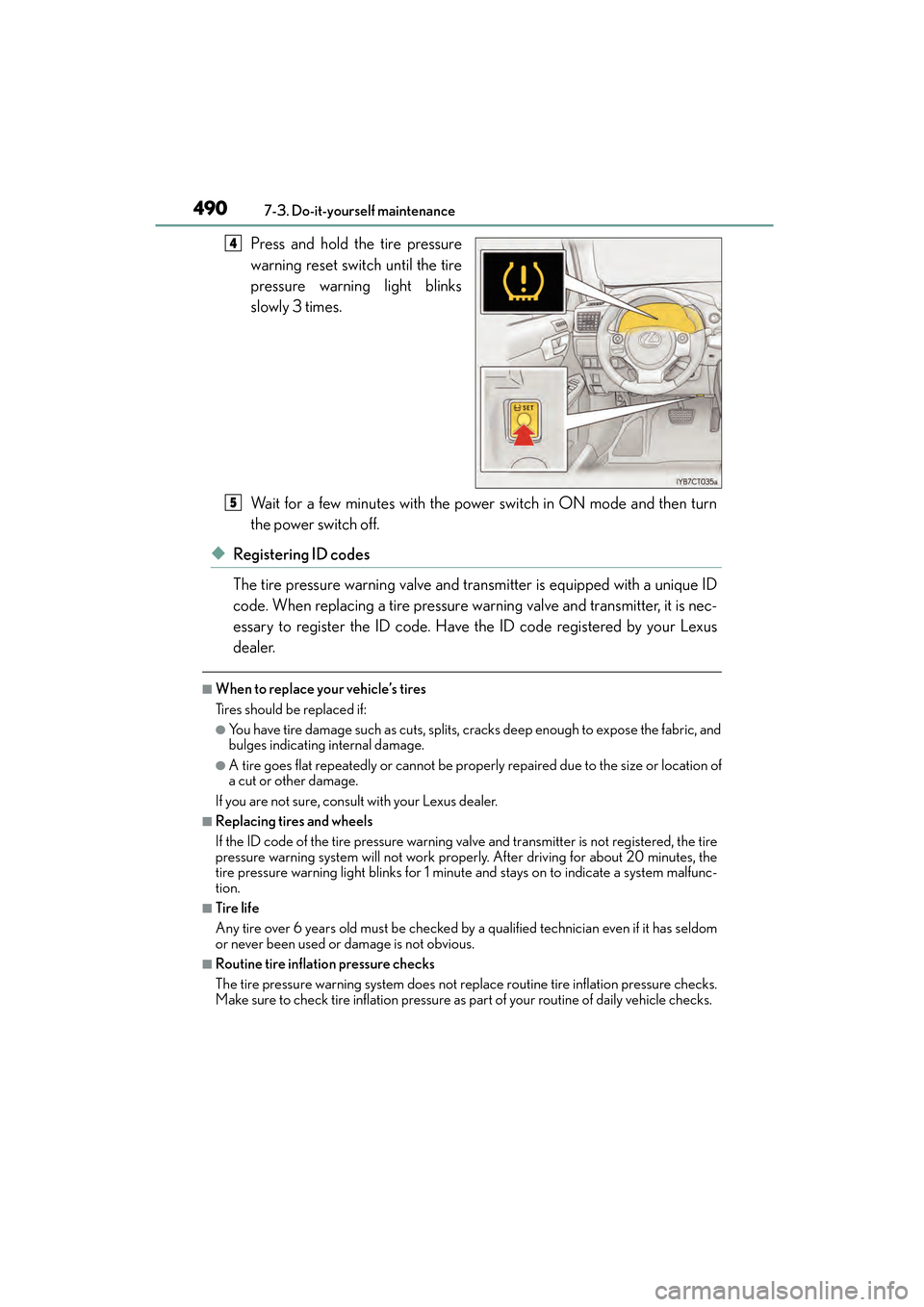
Press and hold the tire pressure
warning reset switch until the tire
pressure warning light blinks
slowly 3 times.
Wait for a few minutes with the power switch in ON mode and then turn
the power switch off.
◆Registering ID codes
The tire pressure warning valve and tr
ansmitter is equipped with a unique ID
code. When replacing a tire pressure warning valve and transmitter, it is nec-
essary to register the ID code. Have the ID code registered by your Lexus
dealer.
■When to replace your vehicle’s tires
Tires should be replaced if:
●You have tire damage such as cuts, splits, cracks deep enough to expose the fabric, and
bulges indicating internal damage.
●A tire goes flat repeatedly or cannot be properly repaired due to the size or location of
a cut or other damage.
If you are not sure, consult with your Lexus dealer.
■Replacing tires and wheels
If the ID code of the tire pressure warning valve and transmitter is not registered, the tire
pressure warning system will not work properly. After driving for about 20 minutes, the
tire pressure warning light blinks for 1 minu te and stays on to indicate a system malfunc-
tion.
■Tire life
Any tire over 6 years old must be checked by a qualified technician even if it has seldom
or never been used or damage is not obvious.
■Routine tire inflation pressure checks
The tire pressure warning system does not replace routine tire inflation pressure checks.
Make sure to check tire inflation pressure as part of your routine of daily vehicle checks.
4
5
Page 492 of 634
CT200h_OM_OM76174U_(U)
4917-3. Do-it-yourself maintenance
7
Maintenance and care
■Low profile tires (vehicles with 17 inch tires)
Generally, low profile tires will wear more rapidly and tire grip performance will be
reduced on snowy and/or icy roads when compared to standard tires. Be sure to use
snow tires or tire chains on snowy and/or icy roads and drive carefully at a speed appro-
priate for road and weather conditions.
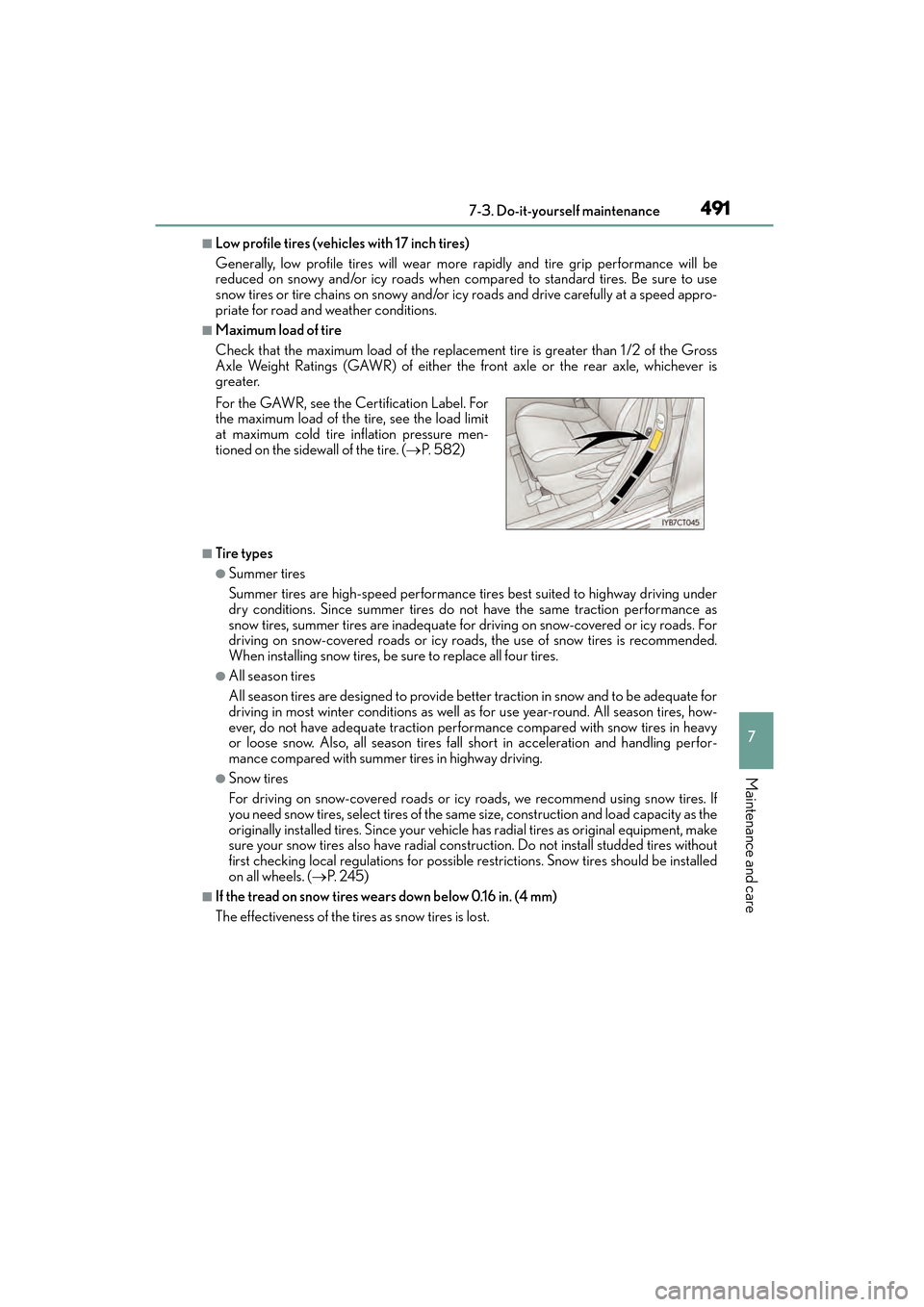
■Maximum load of tire
Check that the maximum load of the replacement tire is greater than 1 /2 of the Gross
Axle Weight Ratings (GAWR) of either the front axle or the rear axle, whichever is
greater.
■Tire types
●Summer tires
Summer tires are high-speed performance tires best suited to highway driving under
dry conditions. Since summer tires do not have the same traction performance as
snow tires, summer tires are inadequate for driving on snow-covered or icy roads. For
driving on snow-covered roads or icy roads, the use of snow tires is recommended.
When installing snow tires, be sure to replace all four tires.
●All season tires
All season tires are designed to provide better traction in snow and to be adequate for
driving in most winter conditions as well as for use year-round. All season tires, how-
ever, do not have adequate traction performance compared with snow tires in heavy
or loose snow. Also, all season tires fall short in acceleration and handling perfor-
mance compared with summer tires in highway driving.
●Snow tires
For driving on snow-covered roads or icy roads, we recommend using snow tires. If
you need snow tires, select tires of the same size, construction and load capacity as the
originally installed tires. Since your vehicle has radial tires as original equipment, make
sure your snow tires also have radial cons truction. Do not install studded tires without
first checking local regulations for possible restrictions. Snow tires should be installed
on all wheels. ( →P. 2 4 5 )
■If the tread on snow tires wears down below 0.16 in. (4 mm)
The effectiveness of the tires as snow tires is lost. For the GAWR, see the Certification Label. For
the maximum load of the tire, see the load limit
at maximum cold tire inflation pressure men-
tioned on the sidewall of the tire. ( →P. 5 8 2 )
Page 493 of 634
492
CT200h_OM_OM76174U_(U)7-3. Do-it-yourself maintenance
■Situations in which the tire pressure warning system may not operate properly
●In the following cases, the tire pressure warning system may not operate properly.
• If non-genuine Lexus wheels are used.
• A tire has been replaced with a tire that is not an OE (Original Equipment) tire.
• A tire has been replaced with a tire that is not of the specified size.
• Tire chains etc. are equipped.
• Lock nuts are equipped.
• An auxiliary-supported run-flat tire is equipped.
• If a window tint that affects the radio wave signals is installed.
• If there is a lot of snow or ice on the vehicle, particularly around the wheels or wheel
housings.
• If the tire inflation pressure is extremely higher than the specified level.
• If wheel without the tire pressure warning valve and transmitter is used.
• If the ID code on the tire pressure warning valves and transmitters is not registered in the tire pressure warning computer.
●Performance may be affected in the following situations.
• Near a TV tower, electric power plant, gas station, radio station, large display, air-
port or other facility that generates st rong radio waves or electrical noise
• When carrying a portable radio, cellular phone, cordless phone or other wireless communication device
●When the vehicle is parked, the time taken for the warning to start or go off could be
extended.
●When tire inflation pressure declines rapidly for example when a tire has burst, the
warning may not function.
■The initialization operation
●Make sure to carry out initialization af ter adjusting the tire inflation pressure.
Also, make sure the tires are cold before carrying out initialization or tire inflation pres-
sure adjustment.
●If you have accidentally turned the power switch off during initialization, it is not neces-
sary to press the reset switch again as init ialization will restart automatically when the
power switch has been turned to ON mode for the next time.
●If you accidentally press the reset switch when initialization is not necessary, adjust the
tire inflation pressure to the specified leve l when the tires are cold, and conduct initial-
ization again.
■When initialization of the tire pressure warning system has failed
Initialization can be completed in a few minute s. However, in the following cases, the set-
tings have not been recorded and the syst em will not operate properly. If repeated
attempts to record tire inflation pressure settings are unsuccessful, have the vehicle
inspected by your Lexus dealer.
●When operating the tire pressure warning re set switch, the tire pressure warning light
does not blink 3 times.
●After carrying out the initialization procedure, the tire pressure warning light blinks for 1
minute then stays on after driving for 20 minutes.
Page 494 of 634
CT200h_OM_OM76174U_(U)
4937-3. Do-it-yourself maintenance
7
Maintenance and care
■Certification for tire pressure warning system
XFor vehicles sold in the U.S.A., Guam and Puerto Rico
FCC ID: PAXPMV107J
FCC ID: HYQ13BDE
NOTE:
This device complies with part 15 of the FCC Rules. Operation is subject to the following
two conditions: (1) This device may not cause harmful interference, and (2) this device
must accept any interference received, including interference that may cause undesired
operation.
FCC WARNING:
Changes or modifications not expressly approved by the party responsible for compli-
ance could void the user’s authority to operate the equipment.
XFor vehicles sold in Canada
NOTE:
Operation is subject to the following two conditions; (1) this device may not cause inter-
ference, and (2) this device must accept any interference, including interference that
may cause undesired operation of the device.
WA R N I N G
■When inspecting or replacing tires
Observe the following precautions to prevent accidents.
Failure to do so may cause damage to parts of the drive train as well as dangerous han-
dling characteristics, which may lead to an a ccident resulting in death or serious injury.
●Do not mix tires of different makes, models or tread patterns.
Also, do not mix tires of remarkably different treadwear.
●Do not use tire sizes other than those recommended by Lexus.
●Do not mix differently constructed tires (radial, bias-belted or bias-ply tires).
●Do not mix summer, all season and snow tires.
●Do not use tires that have been used on another vehicle.
Do not use tires if you do not know how they were used previously.
■When initializing the tire pressure warning system
Do not operate the tire pressure warning reset switch without first adjusting the tire
inflation pressure to the specified level. Otherwise, the tire pressure warning light may
not come on even if the tire inflation pressu re is low, or it may come on when the tire
inflation pressure is actually normal.