inflation pressure Lexus CT200h 2016 Owner's Manual (in English)
[x] Cancel search | Manufacturer: LEXUS, Model Year: 2016, Model line: CT200h, Model: Lexus CT200h 2016Pages: 632, PDF Size: 8.5 MB
Page 7 of 632

7
1
9 8
7
6 4 3
2
CT200h_OM_OM76197U_(U)
10
5
6-3. Using the storage features List of storage features ............ 429
• Glove box ............................... 430
• Console box .......................... 430
•Cup holders/bottle holders/
door pockets.......................... 430
• Auxiliary boxes ..................... 432
Luggage compartment features ....................................... 434
6-4. Using the other interior features Other interior features ............ 439• Sun visors ................................ 439
• Vanity mirrors ........................ 439
• Clock ........................................ 440
• Power outlet ........................... 440
• Assist grips ............................. 442
Garage door opener ............... 443
Compass ....................................... 449
LEXUS Enform Safety Connect...................................... 455 7-1. Maintenance and care
Cleaning and protecting the vehicle exterior .........................462
Cleaning and protecting the vehicle interior ......................... 465
7-2. Maintenance Maintenance requirements .............................467
General maintenance.............. 469
Emission inspection and maintenance (I/M)
programs ..................................... 472
7-3. Do-it-yourself maintenance Do-it-yourself service precautions.................................473
Hood ................................................475
Positioning a floor jack.............. 477
Engine compartment ................478
12-volt battery ............................. 486
Tires.................................................. 490
Tire inflation pressure ................ 497
Wheels ...........................................500
Air conditio ning filter ............... 502
Electronic key battery.............. 504
Checking and replacing fuses.............................................. 506
Light bulbs .................................... 5097Maintenance and care
Page 17 of 632
17Pictorial index
CT200h_OM_OM76197U_(U)
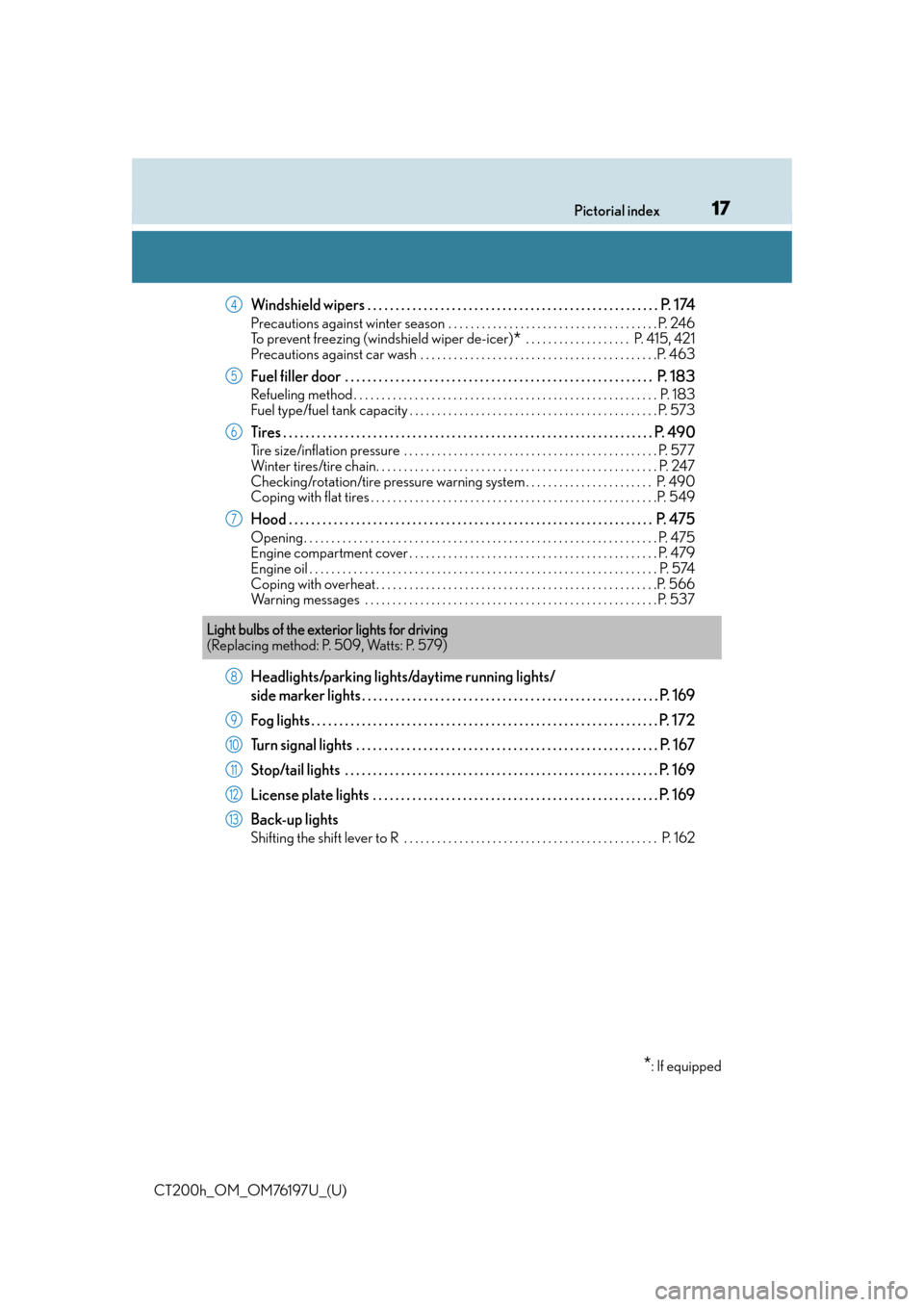
Windshield wipers . . . . . . . . . . . . . . . . . . . . . . . . . . . . . . . . . . . . . . . . . . . . . . . . . . . . P. 17 4
Precautions against winter season . . . . . . . . . . . . . . . . . . . . . . . . . . . . . . . . . . . . . . P. 246
To prevent freezing (windshield wiper de-icer)
* . . . . . . . . . . . . . . . . . . . P. 415, 421
Precautions against car wash . . . . . . . . . . . . . . . . . . . . . . . . . . . . . . . . . . . . . . . . . . .P. 463
Fuel filler door . . . . . . . . . . . . . . . . . . . . . . . . . . . . . . . . . . . . . . . . . . . . . . . . . . . . . . . P. 1 8 3
Refueling method . . . . . . . . . . . . . . . . . . . . . . . . . . . . . . . . . . . . . . . . . . . . . . . . . . . . . . . P . 183
Fuel type/fuel tank capacity . . . . . . . . . . . . . . . . . . . . . . . . . . . . . . . . . . . . . . . . . . . . . P. 573
Tires . . . . . . . . . . . . . . . . . . . . . . . . . . . . . . . . . . . . . . . . . . . . . . . . . . . . . . . . . . . . . . . . . . P. 490
Tire size/inflation pressure . . . . . . . . . . . . . . . . . . . . . . . . . . . . . . . . . . . . . . . . . . . . . . P. 577
Winter tires/tire chain. . . . . . . . . . . . . . . . . . . . . . . . . . . . . . . . . . . . . . . . . . . . . . . . . . . P. 247
Checking/rotation/tire pressure warning system . . . . . . . . . . . . . . . . . . . . . . . P. 490
Coping with flat tires . . . . . . . . . . . . . . . . . . . . . . . . . . . . . . . . . . . . . . . . . . . . . . . . . . . .P. 549
Hood . . . . . . . . . . . . . . . . . . . . . . . . . . . . . . . . . . . . . . . . . . . . . . . . . . . . . . . . . . . . . . . . . P. 475
Opening. . . . . . . . . . . . . . . . . . . . . . . . . . . . . . . . . . . . . . . . . . . . . . . . . . . . . . . . . . . . . . . . P. 475
Engine compartment cover . . . . . . . . . . . . . . . . . . . . . . . . . . . . . . . . . . . . . . . . . . . . . P. 479
Engine oil . . . . . . . . . . . . . . . . . . . . . . . . . . . . . . . . . . . . . . . . . . . . . . . . . . . . . . . . . . . . . . . P. 574
Coping with overheat . . . . . . . . . . . . . . . . . . . . . . . . . . . . . . . . . . . . . . . . . . . . . . . . . . .P. 566
Warning messages . . . . . . . . . . . . . . . . . . . . . . . . . . . . . . . . . . . . . . . . . . . . . . . . . . . . . P. 53 7
Headlights/parking lights/daytime running lights/
side marker lights . . . . . . . . . . . . . . . . . . . . . . . . . . . . . . . . . . . . . . . . . . . . . . . . . . . . . P. 169
Fog lights . . . . . . . . . . . . . . . . . . . . . . . . . . . . . . . . . . . . . . . . . . . . . . . . . . . . . . . . . . . . . . P. 172
Turn signal lights . . . . . . . . . . . . . . . . . . . . . . . . . . . . . . . . . . . . . . . . . . . . . . . . . . . . . . P . 167
Stop/tail lights . . . . . . . . . . . . . . . . . . . . . . . . . . . . . . . . . . . . . . . . . . . . . . . . . . . . . . . .P. 169
License plate lights . . . . . . . . . . . . . . . . . . . . . . . . . . . . . . . . . . . . . . . . . . . . . . . . . . . P. 16 9
Back-up lights
Shifting the shift lever to R . . . . . . . . . . . . . . . . . . . . . . . . . . . . . . . . . . . . . . . . . . . . . . P. 16 2
4
5
6
7
Light bulbs of the exterior lights for driving
(Replacing method: P. 509, Watts: P. 579)
*: If equipped
8
9
10
11
12
13
Page 238 of 632

238
CT200h_OM_OM76197U_(U)4-5. Using the driving support systems
WA R N I N G
■The ABS does not operate effectively when
●The limits of tire gripping performance have been exceeded (such as excessively
worn tires on a snow covered road).
●The vehicle hydroplanes while driving at high speed on wet or slick road.
■Stopping distance when the ABS is operat
ing may exceed that of normal conditions
The ABS is not designed to shorten the vehicle’s stopping distance. Always maintain a
safe distance from the vehicle in front of you, especially in the following situations:
●When driving on dirt, gravel or snow-covered roads
●When driving with tire chains
●When driving over bumps in the road
●When driving over roads with potholes or uneven surfaces
■TRAC may not operate effectively when
Directional control and power may not be achievable while drivin g on slippery road
surfaces, even if the TRAC system is operating.
Drive the vehicle carefully in conditions where stability and power may be lost.
■When the VSC is activated
The slip indicator light flashes. Always drive carefully. Reckless driving may cause an
accident. Exercise particular care when the indicator light flashes.
■Hill-start assist control does not operate effectively when
●Do not overly rely on the hill-start assist control. The hill-start assist control may not
operate effectively on steep inclines and roads covered with ice.
●Unlike the parking brake, hill-start assist control is not intended to hold the vehicle
stationary for an extended period of time. Do not attempt to use hill-start assist con-
trol to hold the vehicle on an incline, as doing so may lead to an accident.
■When the TRAC system is turned off
Be especially careful and drive at a speed ap propriate to the road conditions. As this is
the system to help ensure vehicle stability and driving force, do not turn the TRAC sys-
tem off unless necessary.
■Replacing tires
Make sure that all tires are of the specified size and of the same brand, tread pattern
and total load capacity. In addition, make su re that the tires are inflated to the recom-
mended tire inflation pressure level.
The ABS, VSC and TRAC systems will not fu nction correctly if different tires are
installed on the vehicle.
Contact your Lexus dealer for further information when replacing tires or wheels.
■Handling of tires and the suspension
Using tires with any kind of problem or modi fying the suspension will affect the driving
assist systems, and may caus e a system to malfunction.
Page 245 of 632

CT200h_OM_OM76197U_(U)
2454-6. Driving tips
4
Driving
◆Delays
Repeated acceleration and deceleration, as well as long waits at traffic lights,
will lead to bad fuel economy. Check traffic reports before leaving and avoid
delays as much as possible. When driving in a traffic jam, gently release the
brake pedal to allow the vehicle to move forward slightly while avoiding over-
use of the accelerator pedal. Doing so can help control excessive gasoline
consumption.
◆Highway driving
Control and maintain the vehicle at a co nstant speed. Before stopping at a toll
booth or similar, allow plenty of time to release the accelerator and gently
apply the brakes. A greater amount of electrical energy can be regenerated
when slowing down.
◆Air conditioning
Use the air conditioning only when necessary. Doing so can help reduce
excessive gasoline consumption.
In summer: When the ambient temperature is high, use the recirculated air
mode. Doing so will help to reduce th e burden on the air conditioning system
and reduce fuel consumption as well.
In winter: Because the gasoline engine will not automatically cut out until it
and the interior of the vehicle are warm , it will consume fuel. Fuel consumption
can be improved by avoiding overuse of the heater.
◆Checking tire inflation pressure
Make sure to check the tire inflation pressure frequently. Improper tire infla-
tion pressure can cause poor fuel economy.
Also, as snow tires can cause large amou nts of friction, their use on dry roads
can lead to poor fuel economy. Use ti res that are appropriate for the season.
◆Luggage
Carrying heavy luggage will lead to poor fuel economy. Avoid carrying
unnecessary luggage. Installing a large roof rack will also cause poor fuel
economy.
◆Warming up before driving
Since the gasoline engine starts up and cuts out automatically when cold,
warming up the engine is unnecessary. Moreover, frequently driving short dis-
tances will cause the engine to repeated ly warm up, which can lead to excess
fuel consumption.
Page 461 of 632

461
CT200h_OM_OM76197U_(U)
7Maintenance and care
7-1. Maintenance and careCleaning and protecting the vehicle exterior ........................ 462
Cleaning and protecting the vehicle interior ......................... 465
7-2. Maintenance Maintenance requirements............................. 467
General maintena nce .............. 469
Emission inspection and maintenance (I/M)
programs .....................................472
7-3. Do-it-yourself maintenance Do-it-yourself service precautions .................................473
Hood ............................................... 475
Positioning a floor jack ..............477
Engine compartment ............... 478
12-volt battery..............................486
Tires .................................................. 490
Tire inflation pressure ................497
Wheels .......................................... 500
Air conditioning filter ...............502
Electronic key battery ..............504
Checking and replacing fuses ..............................................506
Light bulbs.....................................509
Page 471 of 632
CT200h_OM_OM76197U_(U)
4717-2. Maintenance
7
Maintenance and care
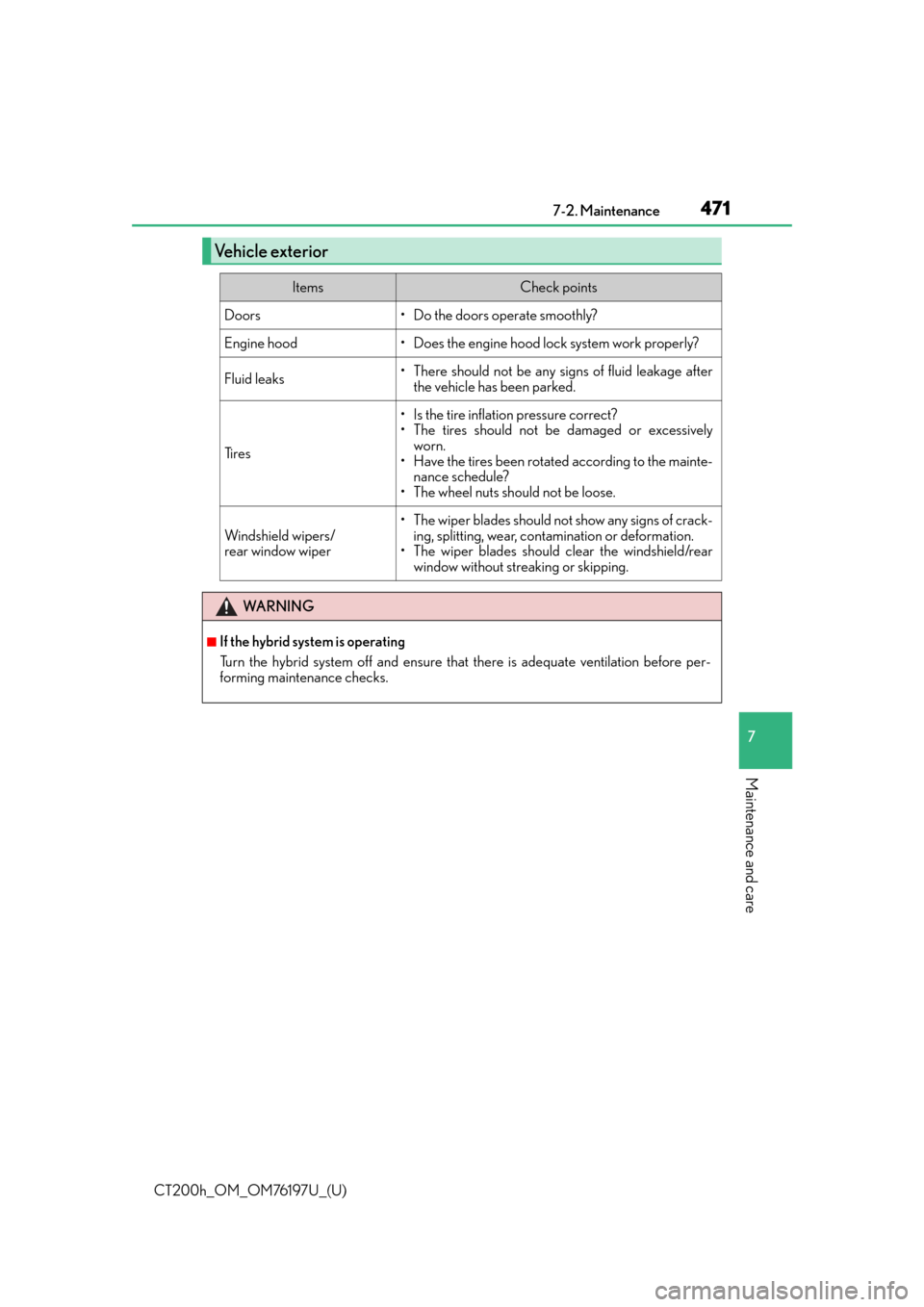
Vehicle exterior
ItemsCheck points
Doors• Do the doors operate smoothly?
Engine hood• Does the engine hood lock system work properly?
Fluid leaks• There should not be any signs of fluid leakage after
the vehicle has been parked.
Ti r e s
• Is the tire inflation pressure correct?
• The tires should not be damaged or excessively worn.
• Have the tires been rotated according to the mainte- nance schedule?
• The wheel nuts should not be loose.
Windshield wipers/
rear window wiper
• The wiper blades should no t show any signs of crack-
ing, splitting, wear, contamination or deformation.
• The wiper blades should clear the windshield/rear
window without streaking or skipping.
WA R N I N G
■If the hybrid system is operating
Turn the hybrid system off and ensure that there is adequate ventilation before per-
forming maintenance checks.
Page 473 of 632
473
CT200h_OM_OM76197U_(U)7-3. Do-it-yourself maintenance
7
Maintenance and care
Do-it-yourself service precautions
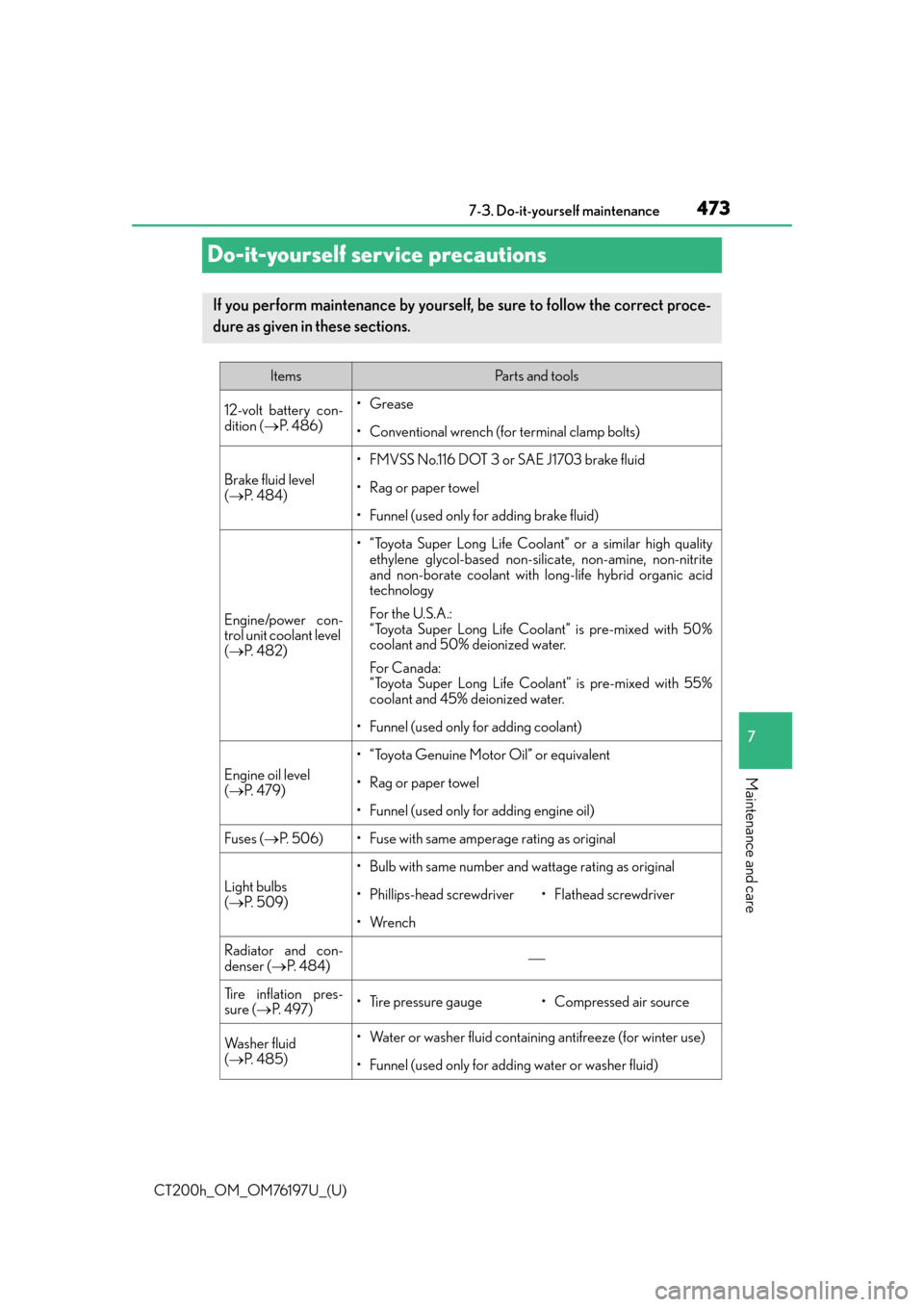
If you perform maintenance by yourself, be sure to follow the correct proce-
dure as given in these sections.
ItemsPa r t s a n d t o o l s
12-volt battery con-
dition (
P. 4 8 6 )•Grease
• Conventional wrench (for terminal clamp bolts)
Brake fluid level
( P. 4 8 4 )
• FMVSS No.116 DOT 3 or SAE J1703 brake fluid
•Rag or paper towel
• Funnel (used only for adding brake fluid)
Engine/power con-
trol unit coolant level
( P. 4 8 2 )
• “Toyota Super Long Life Coolant” or a similar high quality
ethylene glycol-based non-silicate, non-amine, non-nitrite
and non-borate coolant with long-life hybrid organic acid
technology
For the U.S.A.:
“Toyota Super Long Life Coolant” is pre-mixed with 50%
coolant and 50% deionized water.
For Canada:
“Toyota Super Long Life Coolant” is pre-mixed with 55%
coolant and 45% deionized water.
• Funnel (used only for adding coolant)
Engine oil level
( P. 4 7 9 )
• “Toyota Genuine Motor Oil” or equivalent
•Rag or paper towel
• Funnel (used only for adding engine oil)
Fuses ( P. 5 0 6 )• Fuse with same amperage rating as original
Light bulbs
( P. 5 0 9 )
• Bulb with same number and wattage rating as original
• Phillips-head screwdriver•Flathead screwdriver
•Wrench
Radiator and con-
denser ( P. 484)
Tire inflation pres-
sure (P. 4 9 7 )•Tire pressure gauge• Compressed air source
Wa s h e r f l u i d
( P. 4 8 5 )• Water or washer fluid containi ng antifreeze (for winter use)
• Funnel (used only for adding water or washer fluid)
Page 491 of 632

CT200h_OM_OM76197U_(U)
4917-3. Do-it-yourself maintenance
7
Maintenance and care
Your vehicle is equipped with a tire pressure warning system that uses tire pres-
sure warning valves and transmitters to detect low tire inflation pressure before
serious problems arise.
If the tire pressure drops below a predetermined level, the driver is warned by a
warning light. (P. 5 3 1 )
◆Installing tire pressure warning valves and transmitters
When replacing tires or wheels, tire pressure warning valves and transmitters
must also be installed.
When new tire pressure warning valves and transmitters are installed, new ID
codes must be registered in the tire pressure warning computer and the tire
pressure warning system must be initialized. Have tire pressure warning valve
and transmitter ID codes registered by your Lexus dealer. ( P. 4 9 2 )
◆Initializing the tire pressure warning system
■The tire pressure warning system must be initialized in the following circum-
stances:
●Vehicles with 17 inch tires: When rotating front and rear tires which have
different tire inflation pressures
●When changing the tire size
When the tire pressure warning system is initialized, the current tire inflation
pressure is set as the benchmark pressure.
■How to initialize the tire pressure warning system Park the vehicle in a safe place and turn the power switch off.
Initialization cannot be performe d while the vehicle is moving.
Adjust the tire inflation pressure to the specified cold tire inflation pressure
level. (P. 5 7 7 )
Make sure to adjust the tire pressure to the specified cold tire inflation pressure
level. The tire pressure warning system w ill operate based on this pressure level.
Turn the power switch to ON mode.
Tire pressure warning system
1
2
3
Page 492 of 632

492
CT200h_OM_OM76197U_(U)7-3. Do-it-yourself maintenance
Press and hold the tire pressure
warning reset switch until the tire
pressure warning light blinks
slowly 3 times.
Wait for a few minutes with the power switch in ON mode and then turn
the power switch off.
◆Registering ID codes
The tire pressure warning valve and transmitter is equipped with a unique ID
code. When replacing a tire pressure warning valve and transmitter, it is nec-
essary to register the ID code. Have the ID code registered by your Lexus
dealer.
■When to replace your vehicle’s tires
Tires should be replaced if:
●The treadwear indicators are showing on a tire.
●You have tire damage such as cuts, splits, cracks deep enough to expose the fabric, and
bulges indicating internal damage.
●A tire goes flat repeatedly or cannot be prop
erly repaired due to the size or location of
a cut or other damage.
If you are not sure, consult with your Lexus dealer.
■Replacing tires and wheels
If the ID code of the tire pressure warning valve and transmitter is not registered, the tire
pressure warning system will not work proper ly. After driving for about 20 minutes, the
tire pressure warning light blinks for 1 minute and stays on to indicate a system malfunc-
tion.
■Tire life
Any tire over 6 years old must be checked by a qualified technician even if it has seldom
or never been used or damage is not obvious.
■Routine tire inflation pressure checks
The tire pressure warning system does not replace routine tire inflation pressure checks.
Make sure to check tire inflation pressure as part of your routine of daily vehicle checks.
4
5
Page 493 of 632

CT200h_OM_OM76197U_(U)
4937-3. Do-it-yourself maintenance
7
Maintenance and care
■Low profile tires (vehicles with 17 inch tires)
Generally, low profile tires will wear more rapidly and tire grip performance will be
reduced on snowy and/or icy roads when compared to standard tires. Be sure to use
snow tires or tire chains on snowy and/or icy roads and drive carefully at a speed appro-
priate for road and weather conditions.
■Maximum load of tire
Check that the maximum load of the replacem ent tire is greater than 1 /2 of the Gross
Axle Weight Ratings (GAWR) of either the front axle or the rear axle, whichever is
greater.
■Tire types
●Summer tires
Summer tires are high-speed performance tires best suited to highway driving under
dry conditions. Since summer tires do not have the same traction performance as
snow tires, summer tires are inadequate for driving on snow-covered or icy roads. For
driving on snow-covered roads or icy roads, the use of snow tires is recommended.
When installing snow tires, be sure to replace all four tires.
●All season tires
All season tires are designed to provide better traction in snow and to be adequate for
driving in most winter condit ions as well as for use year-round. All season tires, how-
ever, do not have adequate traction performance compared with snow tires in heavy
or loose snow. Also, all season tires fall short in acceleration and handling perfor-
mance compared with summer tires in highway driving.
●Snow tires
For driving on snow-covered roads or icy roads, we recommend using snow tires. If
you need snow tires, select tires of the same size, construction and load capacity as the
originally installed tires. Since your vehicle has radial tires as original equipment, make
sure your snow tires also have radial cons truction. Do not install studded tires without
first checking local regulations for possible re strictions. Snow tires should be installed
on all wheels. ( P. 2 4 6 )
■If the tread on snow tires wears down below 0.16 in. (4 mm)
The effectiveness of the tires as snow tires is lost. For the GAWR, see the Certification Label. For
the maximum load of the tire, see the load limit
at maximum cold tire inflation pressure men-
tioned on the sidewall of the tire. ( P. 5 8 2 )