brake Lexus ES300h 2013 Workshop Manual
[x] Cancel search | Manufacturer: LEXUS, Model Year: 2013, Model line: ES300h, Model: Lexus ES300h 2013Pages: 910, PDF Size: 9.95 MB
Page 312 of 910
ES350 300h_OM_OM33A01U_(U)
3114-5. Using the driving support systems
4
Driving
CAUTION
■Limitations of the pre-collision system
Do not overly rely on the pre-collision system. Always drive safely, taking care to
observe your surroundings and checking for any obstacles or other road hazards.
Failure to do so may cause an accident resulting in death or serious injury.
■When the sensor may not be correctly detecting the vehicle ahead
Apply the brakes as necessary in any of the following situations.
●When water or snow thrown up by the surrounding vehicles hinders the function-
ing of the sensor
●When your vehicle is pointing upwards (caused by a heavy load in the luggage
compartment etc.)
●Vehicles that cut in suddenly
●Vehicles with small rear ends (trailers with no load on board etc.)
●Motorcycles traveling in the same lane
■Handling the radar sensor
Observe the following to ensure the pre-collision system can function effectively.
Otherwise, the system may not function correctly and could result in an accident.
●Keep the sensor and grille cover clean at all times.
Clean the sensor and grille cover with a soft cloth so you do not mark or damage
them.
●Do not subject the sensor or surrounding area to a strong impact.
If the sensor moves even slightly off position, the system may become inaccurate
or malfunction. If the sensor or surrounding area is subject to a strong impact,
always have the area inspected and adjusted by your Lexus dealer.
●Do not disassemble the sensor.
●Do not attach accessories or stickers to the sensor, grille cover or surrounding
area.
●Do not modify or paint the sensor and grille cover.
●Do not replace them with non-genuine parts.
Page 313 of 910
312
ES350 300h_OM_OM33A01U_(U)
4-5. Using the driving support systems
CAUTION
■Cautions regarding the assist contents of the system
By means of alarms and brake control, the pre-collision system is intended to assist
the driver in avoiding collisions through the process of LOOK-JUDGE-ACT.
There are limits to the degree of assistance the system can provide, so please keep
in mind the following important points.
●Assisting the driver in watching the road
The pre-collision system is only able to detect obstacles directly in front of the
vehicle, and only within a limited range. It is not a mechanism that allows careless
or inattentive driving, and it is not a system that can assist the driver in low-visibil-
ity conditions. It is still necessary for the driver to pay close attention to the vehi-
cle’s surroundings.
●Assisting the driver in making correct judgment
When attempting to estimate the possibility of a collision, the only data available
to the pre-collision system is that from obstacles it has detected directly in front of
the vehicle. Therefore, it is absolutely necessary for the driver to remain vigilant
and to determine whether or not there is a possibility of collision in any given situ-
ation.
●Assisting the driver in taking action
The pre-collision system’s braking assist feature is designed to help reduce the
severity of a collision, and so only acts when the system has judged that a collision
is unavoidable. This system by itself is not capable of automatically avoiding a col-
lision or bringing the vehicle to a stop safely. For this reason, when encountering a
dangerous situation the driver must take direct and immediate action in order to
ensure the safety of all involved.
Page 324 of 910
323
ES350 300h_OM_OM33A01U_(U)
4-6. Driving tips
4
Driving
Hybrid vehicle driving tips (hybrid vehicles)
When using Eco drive mode, the torque corresponding to the accelerator
pedal depression amount can be generated more smoothly than it is in
normal conditions. In addition, the operation of the air conditioning system
(heating/cooling) will be minimized, improving the fuel economy.
(→P. 2 9 6 )
The Eco-friendly driving is possible by keeping the indicate of Hybrid Sys-
tem Indicator within Eco area. ( →P. 9 6 )
Make sure to operate the brakes gently and in good time. A greater
amount of electrical energy can be retained when slowing down.
Repeated acceleration and deceleration, as well as long waits at traffic
lights, will lead to bad fuel consumption. Check traffic reports before leav-
ing and avoid delays as much as possible. When encountering a delay,
gently release the brake pedal to allow the vehicle to move forward
slightly while avoiding overuse of the accelerator pedal. Doing so can help
control excessive gasoline consumption.
For economical and ecological drivin g, pay attention to the following
points:
Using Eco drive mode
Use of Hybrid System Indicator
When braking the vehicle
Delays
Page 325 of 910
324
ES350 300h_OM_OM33A01U_(U)
4-6. Driving tips
Control your speed and keep at a constant speed. Also, before stopping
at a toll booth or similar, allow plenty of time to release the accelerator and
gently apply the brakes. A greater amount of electrical energy can be
retained when slowing down.
Use the air conditioning only when necessary. Doing so can help control
excessive gasoline consumption.
In summer: In high temperatures, use the recirculated air mode. Doing so
will help to reduce the burden on the air conditioner and reduce fuel con-
sumption as well.
In winter: Because the gasoline engine will not automatically cut out until
the gasoline engine and the interior of the vehicle are warm, it will con-
sume fuel. Also, fuel consumption can be improved by avoiding overuse of
the heater.
Make sure to check the tire inflation pressure frequently. Improper tire
inflation pressure can cause poor fuel consumption.
Also, as snow tires can cause large amounts of friction, their use on dry
roads can lead to poor fuel consumption. Use a tire that is appropriate for
the season.
Carrying heavy luggage can lead to poor fuel consumption. Avoid carry-
ing unnecessary luggage. Installing a large roof rack can also cause poor
fuel consumption.
Highway driving
Air conditioning
Checking tire inflation pressure
Luggage
Page 328 of 910
ES350 300h_OM_OM33A01U_(U)
3274-6. Driving tips
4
Driving
Perform the following according to the driving conditions:
●Do not try to forcibly open a window or move a wiper that is frozen.
Pour warm water over the frozen area to melt the ice. Wipe away the
water immediately to prevent it from freezing.
●To ensure proper operation of the climate control system fan, remove
any snow that has accumulated on the air inlet vents in front of the wind-
shield.
●Check for and remove any excess ice or snow that may have accumu-
lated on the exterior lights, vehicle’s roof, chassis, around the tires or on
the brakes.
●Remove any snow or mud from the bottom of your shoes before getting
in the vehicle.
Accelerate the vehicle slowly, keep a safe distance between you and the
vehicle ahead, and drive at a reduced speed suitable to road conditions.
Park the vehicle and move the shift lever to P without setting the parking
brake. The parking brake may freeze up, preventing it from being
released. If necessary, block the wheels to prevent inadvertent sliding or
creeping.
Before driving the vehicle
When driving the vehicle
When parking the vehicle
Page 661 of 910
660
ES350 300h_OM_OM33A01U_(U)
6-2. Maintenance
General maintenance
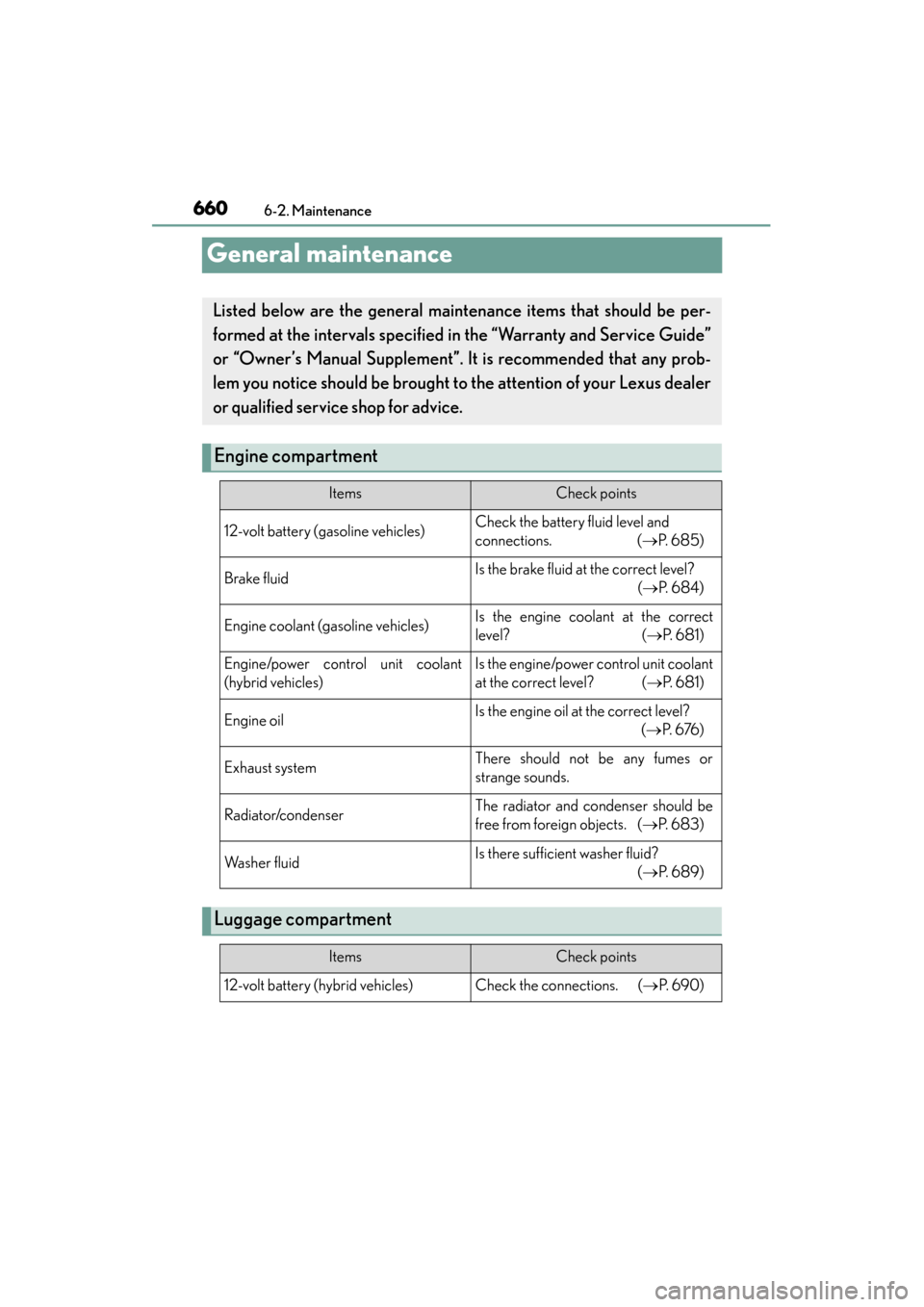
Listed below are the general maintenance items that should be per-
formed at the intervals specified in the “Warranty and Service Guide”
or “Owner’s Manual Supplement”. It is recommended that any prob-
lem you notice should be brought to the attention of your Lexus dealer
or qualified service shop for advice.
Engine compartment
ItemsCheck points
12-volt battery (gasoline vehicles)Check the battery fluid level and
connections. ( →P. 6 8 5 )
Brake fluidIs the brake fluid at the correct level?
(→ P. 6 8 4 )
Engine coolant (gasoline vehicles)Is the engine coolant at the correct
level? ( →P. 6 8 1 )
Engine/power control unit coolant
(hybrid vehicles)Is the engine/power control unit coolant
at the correct level? ( →P. 6 8 1 )
Engine oilIs the engine oil at the correct level?
(→ P. 6 76 )
Exhaust systemThere should not be any fumes or
strange sounds.
Radiator/condenserThe radiator and condenser should be
free from foreign objects. ( →P. 6 8 3 )
Wa s h e r f l u i dIs there sufficient washer fluid?
(→ P. 6 8 9 )
Luggage compartment
ItemsCheck points
12-volt battery (hybrid vehicles)Check the connections. ( →P. 6 9 0 )
Page 662 of 910
ES350 300h_OM_OM33A01U_(U)
6616-2. Maintenance
6
Maintenance and care
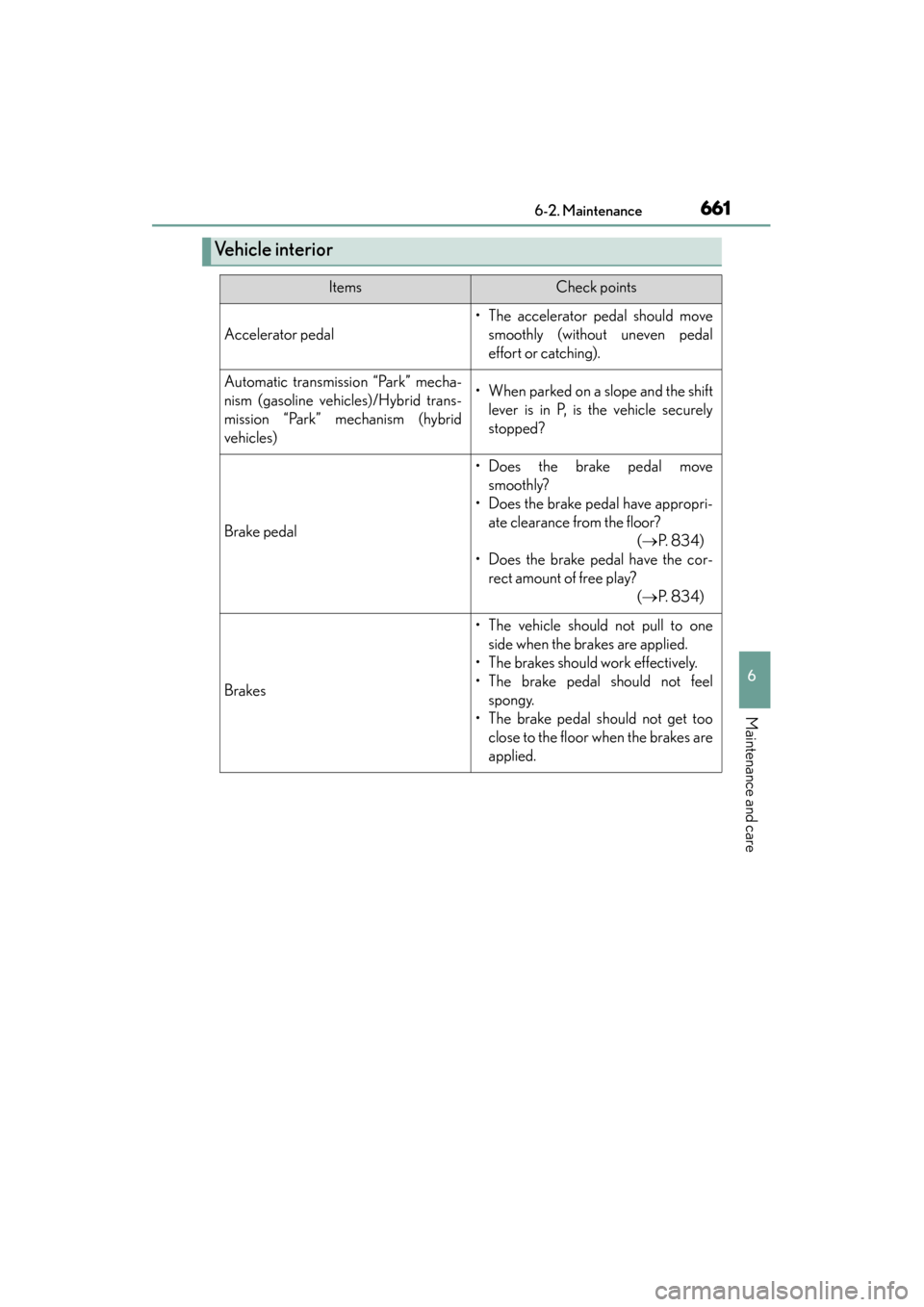
Ve h i c l e i n t e r i o r
ItemsCheck points
Accelerator pedal
• The accelerator pedal should movesmoothly (without uneven pedal
effort or catching).
Automatic transmission “Park” mecha-
nism (gasoline vehicles)/Hybrid trans-
mission “Park” mechanism (hybrid
vehicles)• When parked on a slope and the shiftlever is in P, is the vehicle securely
stopped?
Brake pedal
• Does the brake pedal movesmoothly?
• Does the brake pedal have appropri- ate clearance from the floor? (→ P. 8 3 4 )
• Does the brake pedal have the cor- rect amount of free play? (→ P. 8 3 4 )
Brakes
• The vehicle should not pull to one
side when the brakes are applied.
• The brakes should work effectively.
• The brake pedal should not feel spongy.
• The brake pedal should not get too close to the floor when the brakes are
applied.
Page 663 of 910
662
ES350 300h_OM_OM33A01U_(U)
6-2. Maintenance
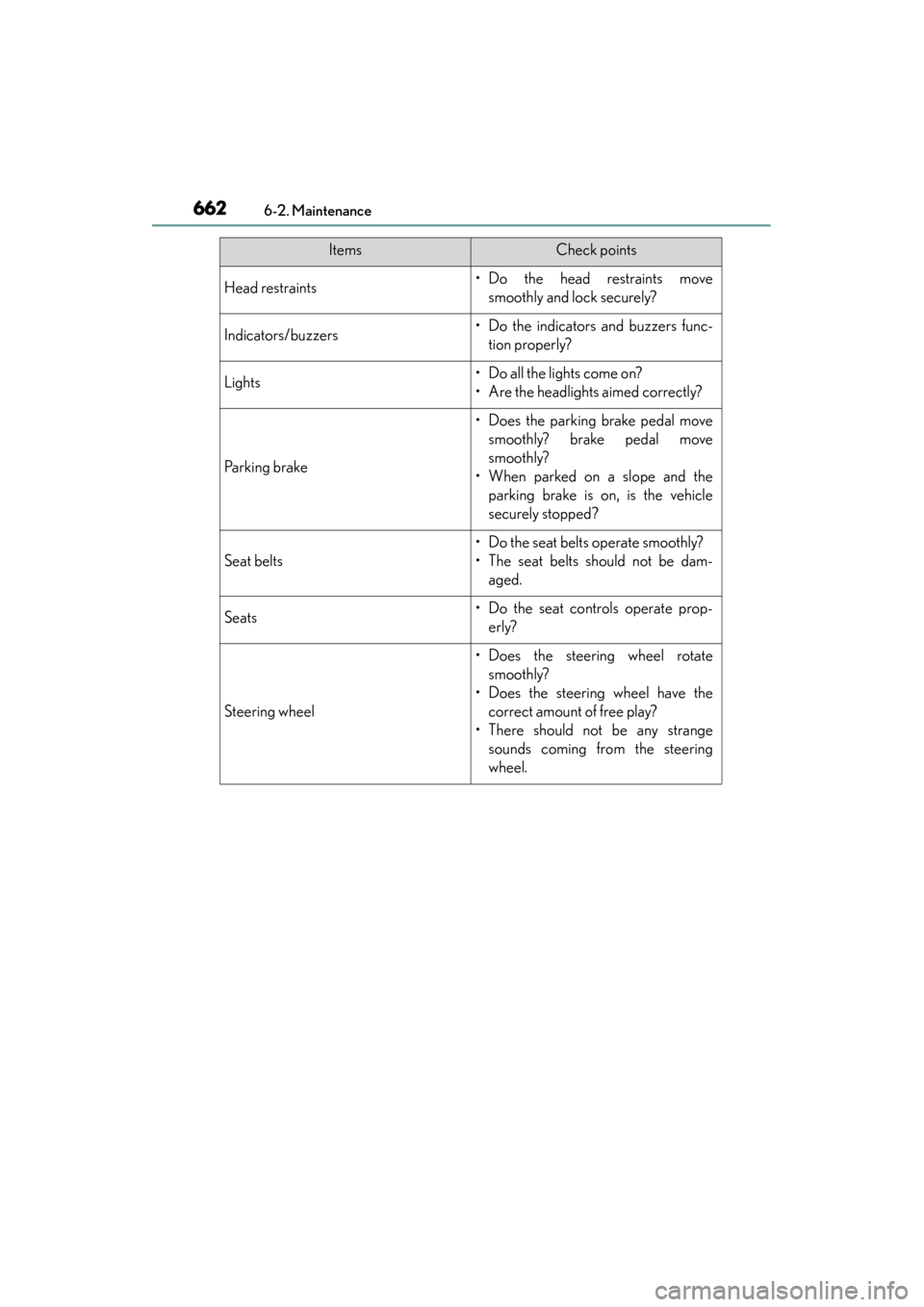
Head restraints• Do the head restraints movesmoothly and lock securely?
Indicators/buzzers• Do the indicators and buzzers func-tion properly?
Lights• Do all the lights come on?
• Are the headlights aimed correctly?
Parking brake
• Does the parking brake pedal movesmoothly? brake pedal move
smoothly?
• When parked on a slope and the parking brake is on, is the vehicle
securely stopped?
Seat belts
• Do the seat belts operate smoothly?
• The seat belts should not be dam-aged.
Seats• Do the seat controls operate prop-erly?
Steering wheel
• Does the steering wheel rotatesmoothly?
• Does the steering wheel have the correct amount of free play?
• There should not be any strange sounds coming from the steering
wheel.
ItemsCheck points
Page 666 of 910
665
ES350 300h_OM_OM33A01U_(U)
6-3. Do-it-yourself maintenance
6
Maintenance and care
Do-it-yourself service precautions
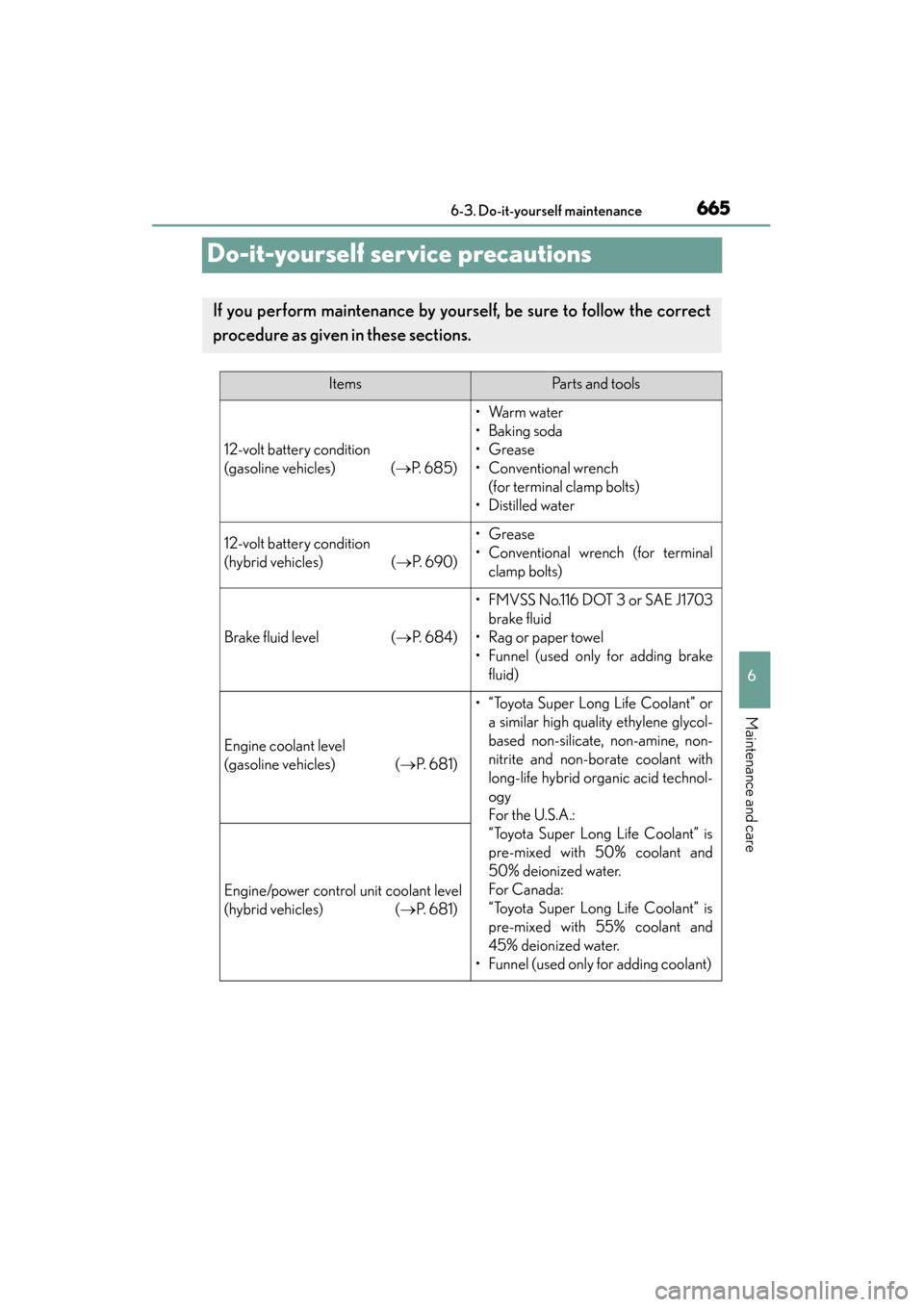
If you perform maintenance by yourself, be sure to follow the correct
procedure as given in these sections.
ItemsPa r t s a n d t o o l s
12-volt battery condition
(gasoline vehicles) (→P. 6 8 5 )
•Warm water
•Baking soda
•Grease
• Conventional wrench
(for terminal clamp bolts)
• Distilled water
12-volt battery condition
(hybrid vehicles) ( →P. 6 9 0 )•Grease
• Conventional wrench (for terminal
clamp bolts)
Brake fluid level ( →P. 6 8 4 )
•FMVSS No.116 DOT 3 or SAE J1703
brake fluid
• Rag or paper towel
• Funnel (used only for adding brake fluid)
Engine coolant level
(gasoline vehicles) ( →P. 6 8 1 )
• “Toyota Super Long Life Coolant” or
a similar high quality ethylene glycol-
based non-silicate, non-amine, non-
nitrite and non-borate coolant with
long-life hybrid organic acid technol-
ogy
For the U.S.A.:
“Toyota Super Long Life Coolant” is
pre-mixed with 50% coolant and
50% deionized water.
For Canada:
“Toyota Super Long Life Coolant” is
pre-mixed with 55% coolant and
45% deionized water.
• Funnel (used only for adding coolant)
Engine/power control unit coolant level
(hybrid vehicles) ( →P. 6 8 1 )
Page 673 of 910
672
ES350 300h_OM_OM33A01U_(U)
6-3. Do-it-yourself maintenance
CAUTION
■When raising your vehicle
Make sure to observe the following precautions to reduce the possibility of death
or serious injury:
●When using a floor jack, follow the instructions of the manual provided with the
jack.
●Do not use the jack that was supplied with your vehicle.
●Do not put any part of your body underneath the vehicle when it is supported
only by the floor jack.
●Always use floor jack and/or automotive jack stands on a solid, flat, level surface.
●Do not start the engine
jack.
●Stop the vehicle on level, firm ground, firmly set the parking brake and shift the
shift lever to P.
●Make sure to set the floor jack properly at the jack point.
Raising the vehicle with an improperly positioned floor jack will damage the vehi-
cle and may cause the vehicle to fall off the floor jack.
●Do not raise the vehicle while someone is in the vehicle.
●When raising the vehicle, do not place any object on top of or underneath the
floor jack.
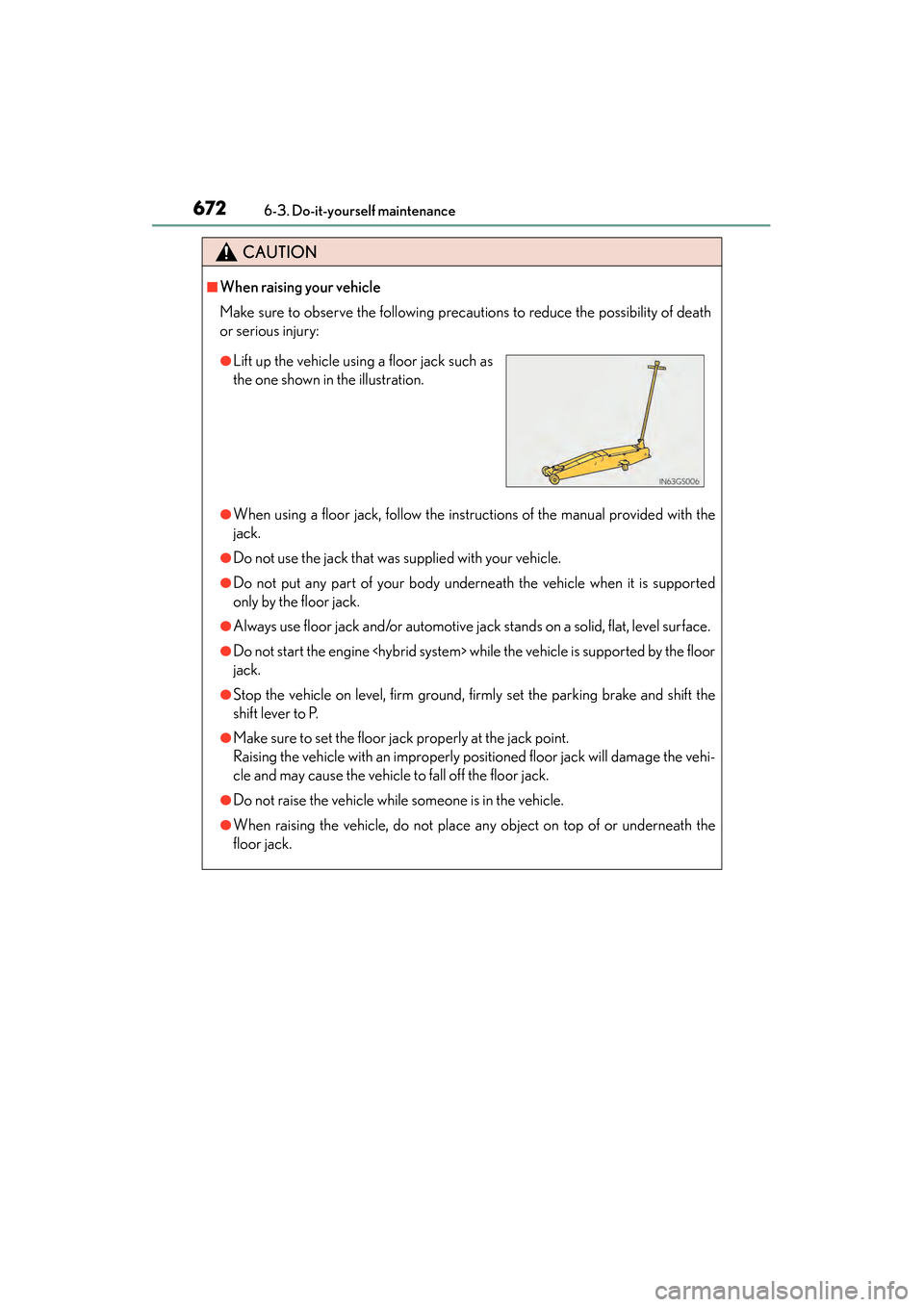
●Lift up the vehicle using a floor jack such as
the one shown in the illustration.