read Lexus ES300h 2014 Workshop Manual
[x] Cancel search | Manufacturer: LEXUS, Model Year: 2014, Model line: ES300h, Model: Lexus ES300h 2014Pages: 918, PDF Size: 25.26 MB
Page 749 of 918
748
ES350_300h_OM_OM33A60U_(U)
7-1. Essential information
Emergency flashers
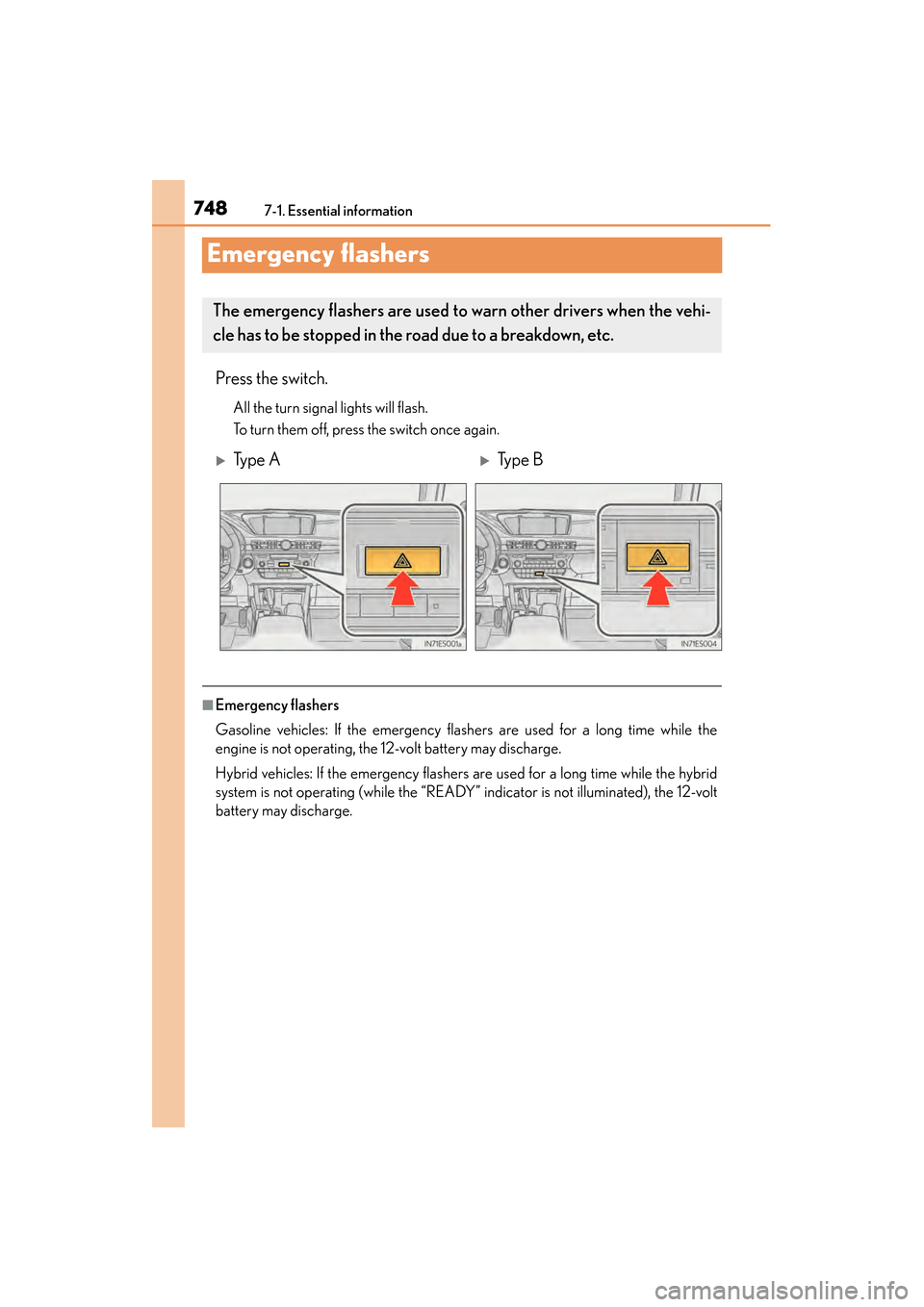
Press the switch.
All the turn signal lights will flash.
To turn them off, press the switch once again.
■Emergency flashers
Gasoline vehicles: If the emergency flashers are used for a long time while the
engine is not operating, the 12-volt battery may discharge.
Hybrid vehicles: If the emergency flashers are used for a long time while the hybrid
system is not operating (while the “READY” indicator is not illuminated), the 12-volt
battery may discharge.
The emergency flashers are used to warn other drivers when the vehi-
cle has to be stopped in the road due to a breakdown, etc.
XTy p e AXType B
Page 768 of 918
7677-2. Steps to take in an emergency
ES350_300h_OM_OM33A60U_(U)
7
When trouble arises
CAUTION
■Maintenance of the tires
Each tire, including the spare (if provided), should be checked monthly when cold
and inflated to the inflation pressure recommended by the vehicle manufacturer on
the vehicle placard or tire inflation pressure label (tire and load information label).
(If your vehicle has tires of a different size than the size indicated on the vehicle
placard or tire inflation pressure label [tire and load information label], you should
determine the proper tire inflation pressure for those tires.)
As an added safety feature, your vehicle has been equipped with a tire pressure
monitoring system (TPMS-tire pressure warning system) that illuminates a low tire
pressure telltale (tire pressure warning light) when one or more of your tires is sig-
nificantly under-inflated. Accordingly, when the low tire pressure telltale (tire pres-
sure warning light) illuminates, you should stop and check your tires as soon as
possible, and inflate them to the proper pressure. Driving on a significantly under-
inflated tire causes the tire to overheat and can lead to tire failure. Under-inflation
also reduces fuel efficiency and tire tread life, and may affect the vehicle’s handling
and stopping ability.
Please note that the TPMS (tire pressure warning system) is not a substitute for
proper tire maintenance, and it is the driver’s responsibility to maintain correct tire
pressure, even if under-inflation has not reached the level to trigger illumination of
the TPMS low tire pressure telltale (tire pressure warning light).
Your vehicle has also been equipped with a TPMS (tire pressure warning system)
malfunction indicator to indicate when the system is not operating properly. The
TPMS (tire pressure warning system) malfunction indicator is combined with the
low tire pressure telltale (tire pressure warning light). When the system detects a
malfunction, the telltale will flash for approximately one minute and then remain
continuously illuminated. This sequence will continue upon subsequent vehicle
start-ups as long as the malfunction exists. When the malfunction indicator is illumi-
nated, the system may not be able to detect or signal low tire pressure as intended.
Page 769 of 918
7687-2. Steps to take in an emergency
ES350_300h_OM_OM33A60U_(U)
CAUTION
TPMS (tire pressure warning system) malfunctions may occur for a variety of rea-
sons, including the installation of replacement or alternate tires or wheels on the
vehicle that prevent the TPMS (tire pressure warning system) from functioning
properly. Always check the TPMS (tire pressure warning system) malfunction tell-
tale after replacing one or more tires or wheels on your vehicle to ensure that the
replacement or alternate tires and wheels allow the TPMS (tire pressure warning
system) to continue to function properly.
NOTICE
■Precaution when installing a different tire
When differently constructed tires or tires of different makers, models or tread pat-
terns are installed, the tire pressure warning system may not operate properly.
Page 800 of 918
7997-2. Steps to take in an emergency
ES350_300h_OM_OM33A60U_(U)
7
When trouble arises
CAUTION
■Replacing a flat tire
●Observe the following precautions.
Failure to do so may result in serious injury:
• Do not try to remove the wheel ornament by hand. Take due care in handlingthe ornament to avoid unexpected personal injury.
• Do not touch the disc wheels or the area around the brakes immediately after the vehicle has been driven.
After the vehicle has been driven the disc wheels and the area around the
brakes will be extremely hot. Touching these areas with hands, feet or other
body parts while changing a tire, etc. may result in burns.
●Failure to follow these precautions could cause the wheel nuts to loosen and the
tire to fall off, resulting in death or serious injury.
• Never use oil or grease on the wheel bolts or wheel nuts.Oil and grease may cause the wheel nuts to be excessively tightened, leading
to bolt or disc wheel damage. In addition, the oil or grease can cause the
wheel nuts to loosen and the wheel may fall off, causing a serious accident.
Remove any oil or grease from the wheel bolts or wheel nuts.
• Have the wheel nuts tightened with a torque wrench to 76 ft•lbf (103 N•m, 10.5 kgf•m) as soon as possible after changing wheels.
• Do not attach a heavily damaged wheel ornament, as it may fly off the wheel while the vehicle is moving.
• When installing a tire, only use wheel nuts that have been specifically designed for that wheel.
• If there are any cracks or deformations in the bolt screws, nut threads or bolt holes of the wheel, have the vehicle inspected by your Lexus dealer.
Page 819 of 918
8187-2. Steps to take in an emergency
ES350_300h_OM_OM33A60U_(U)
Connect a positive jumper cable clamp to the positive (+) battery
terminal on your vehicle.
Connect the clamp on the other end of the positive cable to the pos-
itive (+) battery terminal on the second vehicle.
Connect a negative cable clamp to the negative (-) battery terminal
on the second vehicle.
Connect the clamp at the other end of the negative cable to a solid,
stationary, unpainted metallic point away from the 12-volt battery
and any moving parts, as shown in the illustration.
Start the engine of the second ve hicle. Increase the engine speed
slightly and maintain at that level for approximately 5 minutes to
recharge the 12-volt battery of your vehicle.
Open and close any of the doors of your vehicle with the “POWER”
switch off.
Maintain the engine speed of the second vehicle and start the hybrid
system of your vehicle by turning the “POWER” switch to ON mode.
Make sure the “READY” indicator comes on. If the indicator does not
come on, contact your Lexus dealer.
Once the hybrid system has started, remove the jumper cables in the
exact reverse order from which they were connected.
Once the hybrid system starts, have the vehicle inspected at your Lexus
dealer as soon as possible.1
2
3
4
3
4
5
6
7
Page 828 of 918
8277-2. Steps to take in an emergency
ES350_300h_OM_OM33A60U_(U)
7
When trouble arises
Start the hybrid system and check for the multi-information display.
If the message does not disappear:
Stop the hybrid system and contact your Lexus dealer.
If the message is not displayed:
Have the vehicle inspected at the nearest Lexus dealer.
CAUTION
■When inspecting under the hood of your vehicle
Observe the following precautions.
Failure to do so may result in serious injury such as burns.
●If steam is seen coming from under the hood, do not open the hood until the
steam has subsided. The engine compartment may be very hot.
●After the hybrid system has been turned off, check that the indicator on the
“POWER” switch and the “READY” indicator are off.
When the hybrid system is operating, the gasoline engine may automatically
start, or the cooling fan may suddenly operate even if the gasoline engine stops.
Do not touch or approach rotating parts such as the fan, which may lead to fin-
gers or clothing (especially a tie, a scarf or a muffler) getting caught, resulting in
serious injury.
●Do not loosen the radiator cap or the coolant reservoir cap while the hybrid sys-
tem and radiator are hot. High temperature steam or coolant could spray out.
NOTICE
■When adding engine/power control unit coolant
Add coolant slowly after the hybrid system has cooled down sufficiently. Adding
cool coolant to a hot hybrid system too quickly can cause damage to the hybrid
system.
■To prevent damage to the cooling system
Observe the following precautions:
●Avoid contaminating the coolant with foreign matter (such as sand or dust etc.).
●Do not use any coolant additives.
6
Page 833 of 918
832
ES350_300h_OM_OM33A60U_(U)
8-1. Specifications
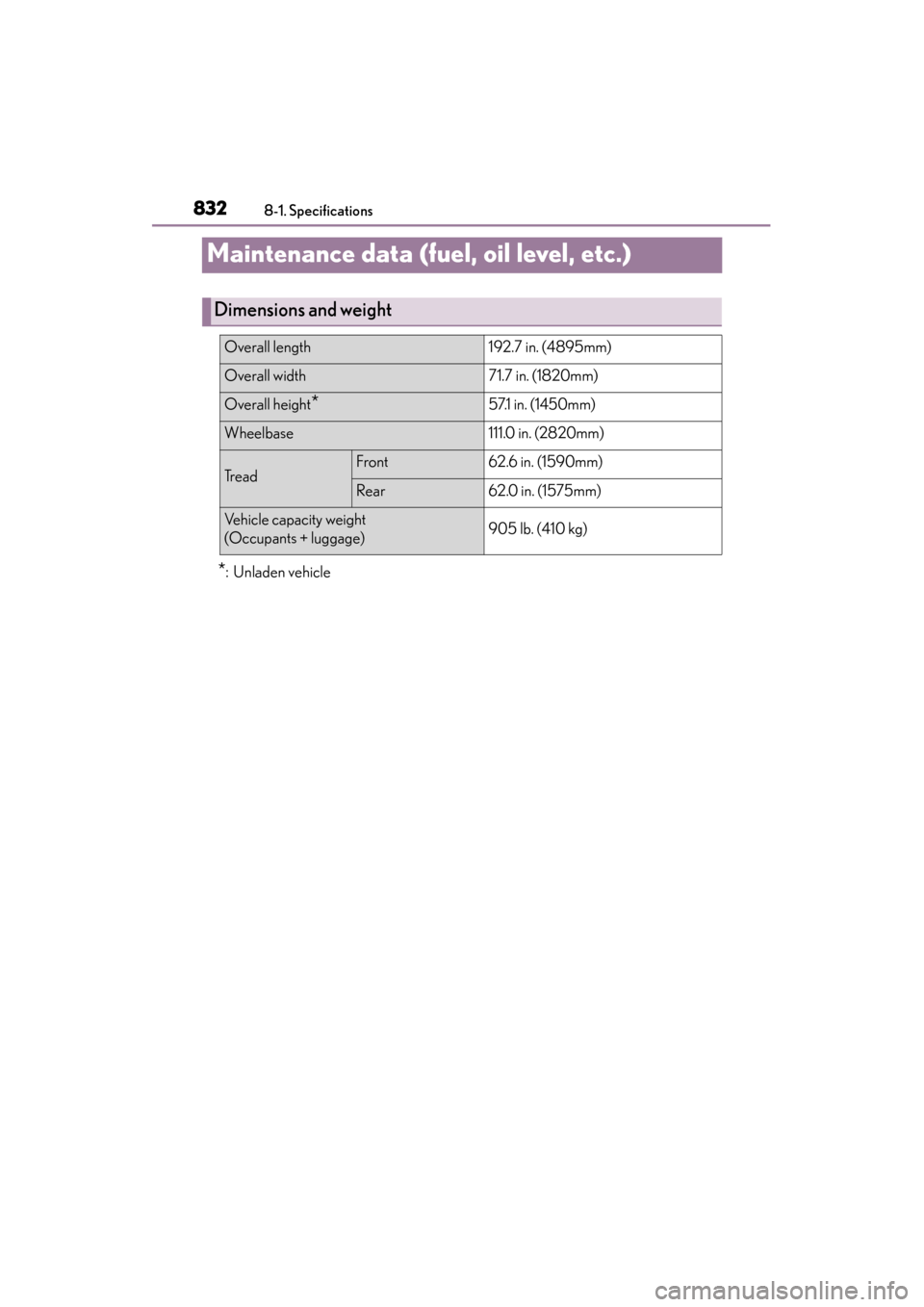
Maintenance data (fuel, oil level, etc.)
*: Unladen vehicle
Dimensions and weight
Overall length192.7 in. (4895mm)
Overall width71.7 in. (1820mm)
Overall height*57.1 in. (1450mm)
Wheelbase111.0 in. (2820mm)
TreadFront62.6 in. (1590mm)
Rear62.0 in. (1575mm)
Vehicle capacity weight
(Occupants + luggage)905 lb. (410 kg)
Page 839 of 918
838
ES350_300h_OM_OM33A60U_(U)
8-1. Specifications
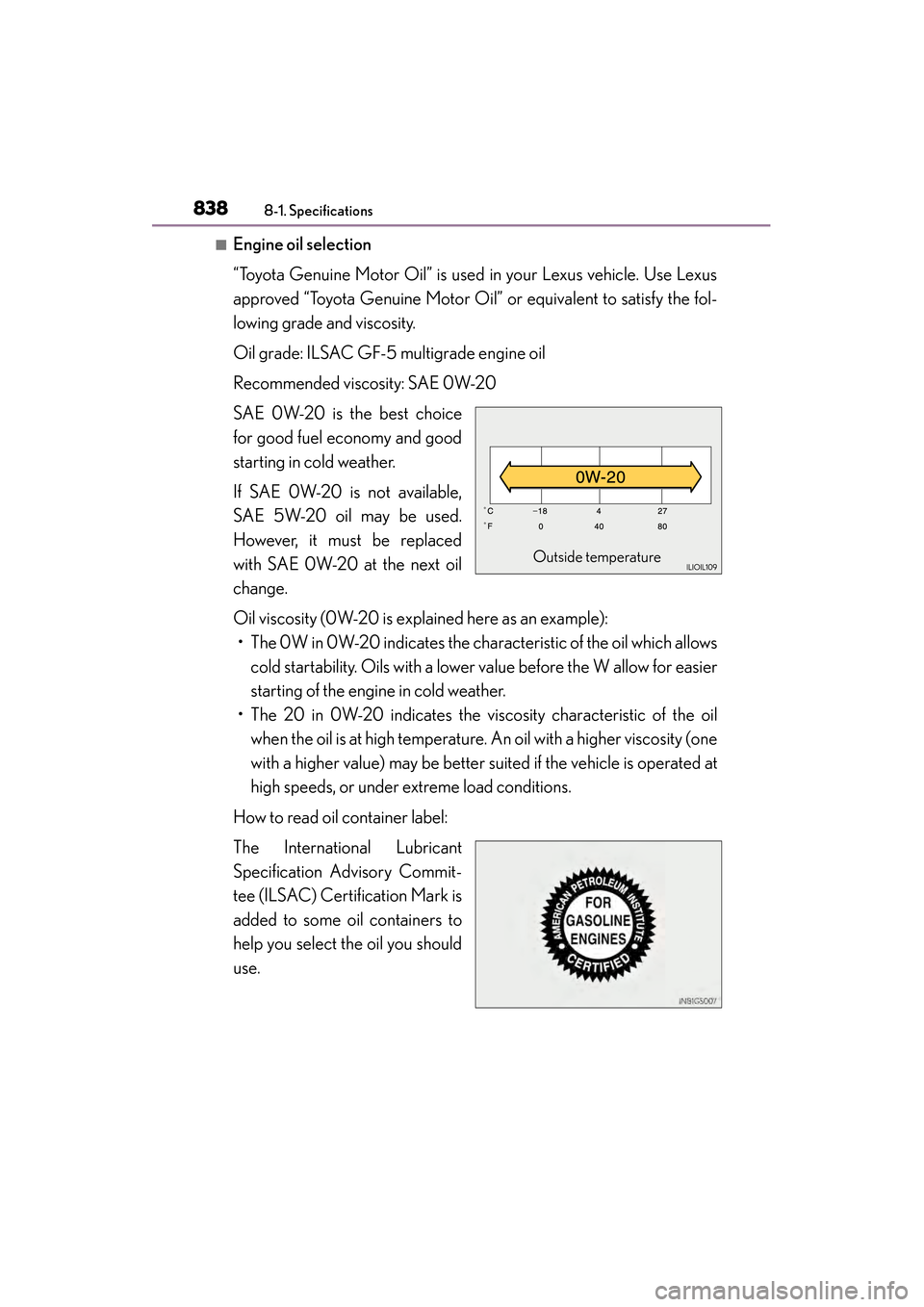
■Engine oil selection
“Toyota Genuine Motor Oil” is used in your Lexus vehicle. Use Lexus
approved “Toyota Genuine Motor Oil” or equivalent to satisfy the fol-
lowing grade and viscosity.
Oil grade: ILSAC GF-5 multigrade engine oil
Recommended viscosity: SAE 0W-20
SAE 0W-20 is the best choice
for good fuel economy and good
starting in cold weather.
If SAE 0W-20 is not available,
SAE 5W-20 oil may be used.
However, it must be replaced
with SAE 0W-20 at the next oil
change.
Oil viscosity (0W-20 is explained here as an example):• The 0W in 0W-20 indicates the characteristic of the oil which allows
cold startability. Oils with a lower value before the W allow for easier
starting of the engine in cold weather.
• The 20 in 0W-20 indicates the viscosity characteristic of the oil when the oil is at high temperature. An oil with a higher viscosity (one
with a higher value) may be better suited if the vehicle is operated at
high speeds, or under extreme load conditions.
How to read oil container label:
The International Lubricant
Specification Advisory Commit-
tee (ILSAC) Certification Mark is
added to some oil containers to
help you select the oil you should
use.
Outside temperature
Page 842 of 918
ES350_300h_OM_OM33A60U_(U)
8418-1. Specifications
8
Vehicle specifications
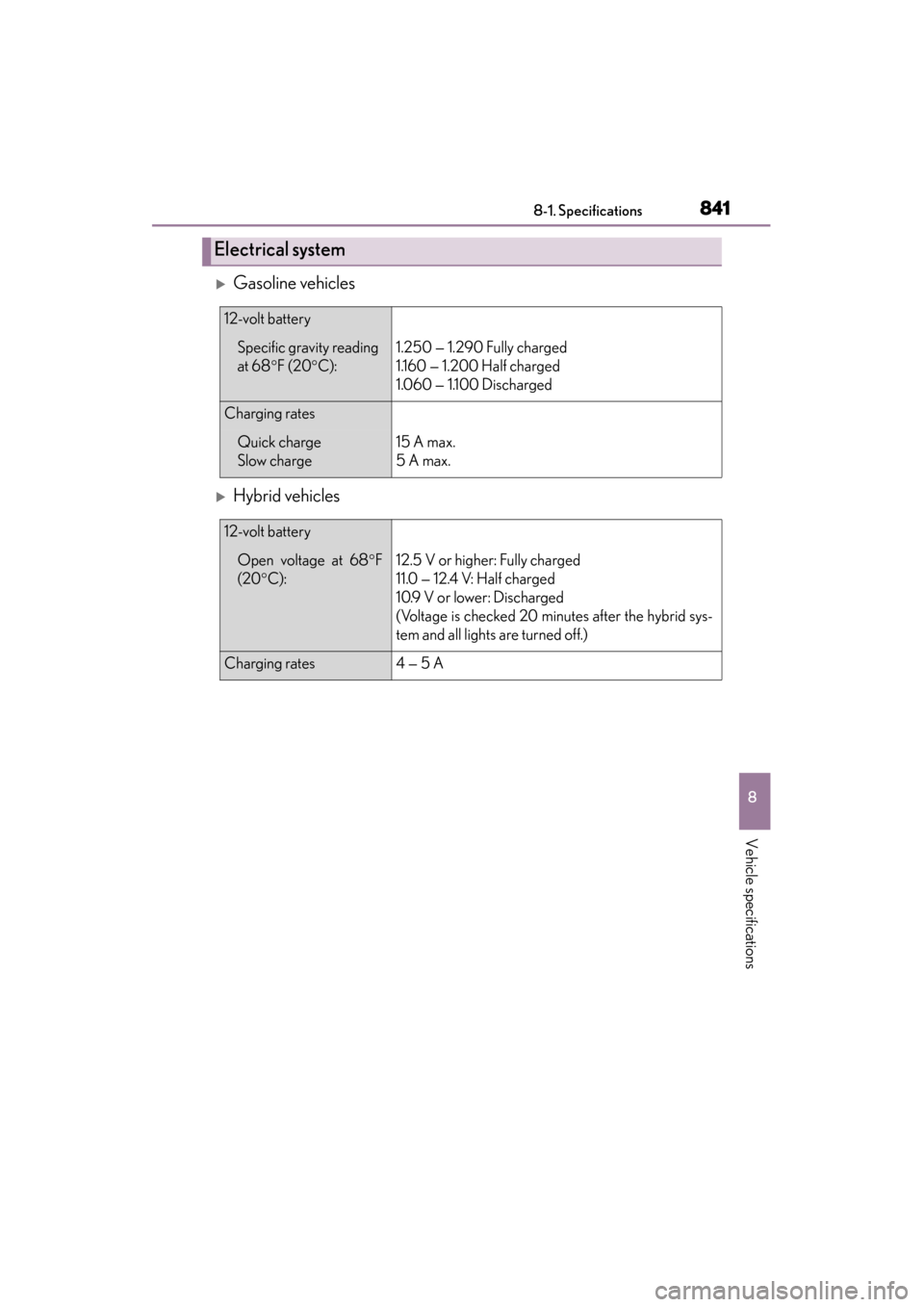
XGasoline vehicles
XHybrid vehicles
Electrical system
12-volt battery
Specific gravity reading
at 68°F (20 °C): 1.250 — 1.290 Fully charged
1.160 — 1.200 Half charged
1.060 — 1.100 Discharged
Charging rates
Quick charge
Slow charge15 A max.
5 A max.
12-volt battery
Open voltage at 68 °F
(20 °C):12.5 V or higher: Fully charged
11.0 — 12.4 V: Half charged
10.9 V or lower: Discharged
(Voltage is checked 20 minutes after the hybrid sys-
tem and all lights are turned off.)
Charging rates4 — 5 A
Page 852 of 918
ES350_300h_OM_OM33A60U_(U)
8518-1. Specifications
8
Vehicle specifications
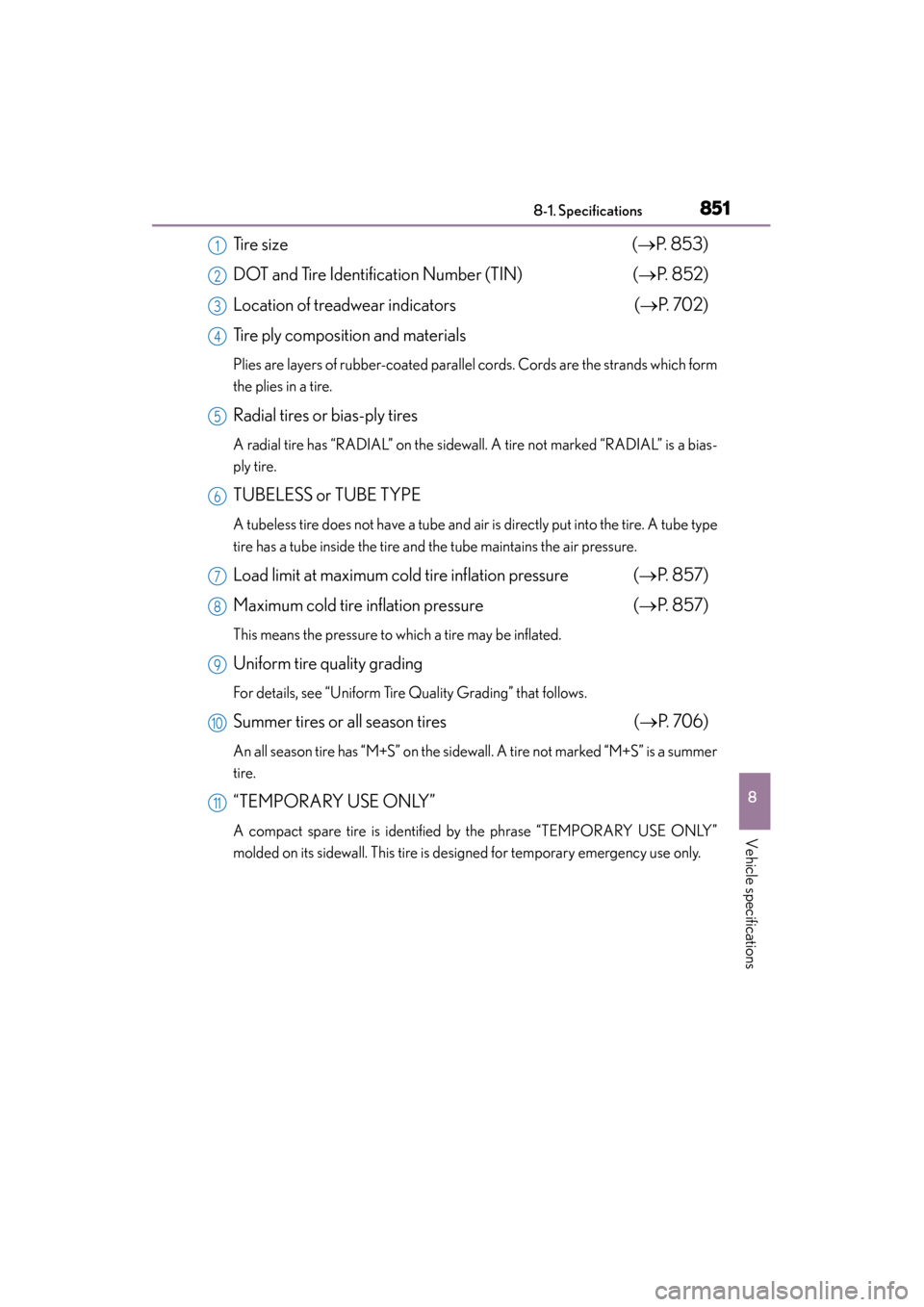
Tire size (→ P. 853)
DOT and Tire Identification Number (TIN) (→P. 8 5 2 )
Location of treadwear indicators (→ P. 7 0 2 )
Tire ply composition and materials
Plies are layers of rubber-coated parallel cords. Cords are the strands which form
the plies in a tire.
Radial tires or bias-ply tires
A radial tire has “RADIAL” on the sidewall. A tire not marked “RADIAL” is a bias-
ply tire.
TUBELESS or TUBE TYPE
A tubeless tire does not have a tube and air is directly put into the tire. A tube type
tire has a tube inside the tire and the tube maintains the air pressure.
Load limit at maximum cold tire inflation pressure ( →P. 8 5 7 )
Maximum cold tire inflation pressure ( →P. 8 5 7 )
This means the pressure to which a tire may be inflated.
Uniform tire quality grading
For details, see “Uniform Tire Quality Grading” that follows.
Summer tires or all season tires (→P. 7 0 6 )
An all season tire has “M+S” on the sidewall. A tire not marked “M+S” is a summer
tire.
“TEMPORARY USE ONLY”
A compact spare tire is identified by the phrase “TEMPORARY USE ONLY”
molded on its sidewall. This tire is designed for temporary emergency use only.
1
2
3
4
5
6
7
8
9
10
11