spare tire Lexus ES300h 2015 Playing an audio CD and MP3/WMA/AAC discs / (OM33B99U) User Guide
[x] Cancel search | Manufacturer: LEXUS, Model Year: 2015, Model line: ES300h, Model: Lexus ES300h 2015Pages: 784, PDF Size: 9.63 MB
Page 634 of 784

6348-2. Steps to take in an emergency
ES350_300h_OM_OM33B99U_(U)
CAUTION
■Maintenance of the tires
Each tire, including the spare (if provided), should be checked monthly when cold
and inflated to the inflation pressure re commended by the vehicle manufacturer on
the vehicle placard or tire inflation pressu re label (tire and load information label).
(If your vehicle has tires of a different size than the size indicated on the vehicle
placard or tire inflation pressure label [t ire and load information label], you should
determine the proper tire inflation pressure for those tires.)
As an added safety feature, your vehicle has been equipped with a tire pressure
monitoring system (TPMS-tire pressure wa rning system) that illuminates a low tire
pressure telltale (tire pressure warning light ) when one or more of your tires is sig-
nificantly under-inflated. Accordingly, when the low tire pressure telltale (tire pres-
sure warning light) illuminates, you should stop and check your tires as soon as
possible, and inflate them to the proper pressure. Driving on a significantly under-
inflated tire causes the tire to overheat and can lead to tire failure. Under-inflation
also reduces fuel efficiency and tire tread life, and may affect the vehicle’s handling
and stopping ability.
Please note that the TPMS (tire pressure warning system) is not a substitute for
proper tire maintenance, and it is the driver’s responsibility to maintain correct tire
pressure, even if under-inflation has not re ached the level to trigger illumination of
the TPMS low tire pressure telltale (tire pressure warning light).
Your vehicle has also been equipped with a TPMS (tire pressure warning system)
malfunction indicator to indicate when th e system is not operating properly. The
TPMS (tire pressure warning system) malfunction indicator is combined with the
low tire pressure telltale (tire pressure warning light). When the system detects a
malfunction, the telltale will flash for approximately one minute and then remain
continuously illuminated. This sequence will continue upon subsequent vehicle
start-ups as long as the malfunction exists . When the malfunction indicator is illumi-
nated, the system may not be able to detect or signal low tire pressure as intended.
Page 659 of 784
659
ES350_300h_OM_OM33B99U_(U)
8-2. Steps to take in an emergency
8
When trouble arises
If you have a flat tire
●Stop the vehicle on a hard, flat surface.
●Set the parking brake.
●Shift the shift lever to P.
●Stop the engine
●Turn on the emergency flashers. (P. 6 1 4 )
Your vehicle is equipped with a spar e tire. The flat tire can be replaced
with the spare tire.
For details about tires: P. 5 6 6
CAUTION
■If you have a flat tire
Do not continue driving with a flat tire.
Driving even a short distance with a flat tire can damage the tire and the wheel
beyond repair, which could result in an accident.
Before jacking up the vehicle
Page 660 of 784
6608-2. Steps to take in an emergency
ES350_300h_OM_OM33B99U_(U)
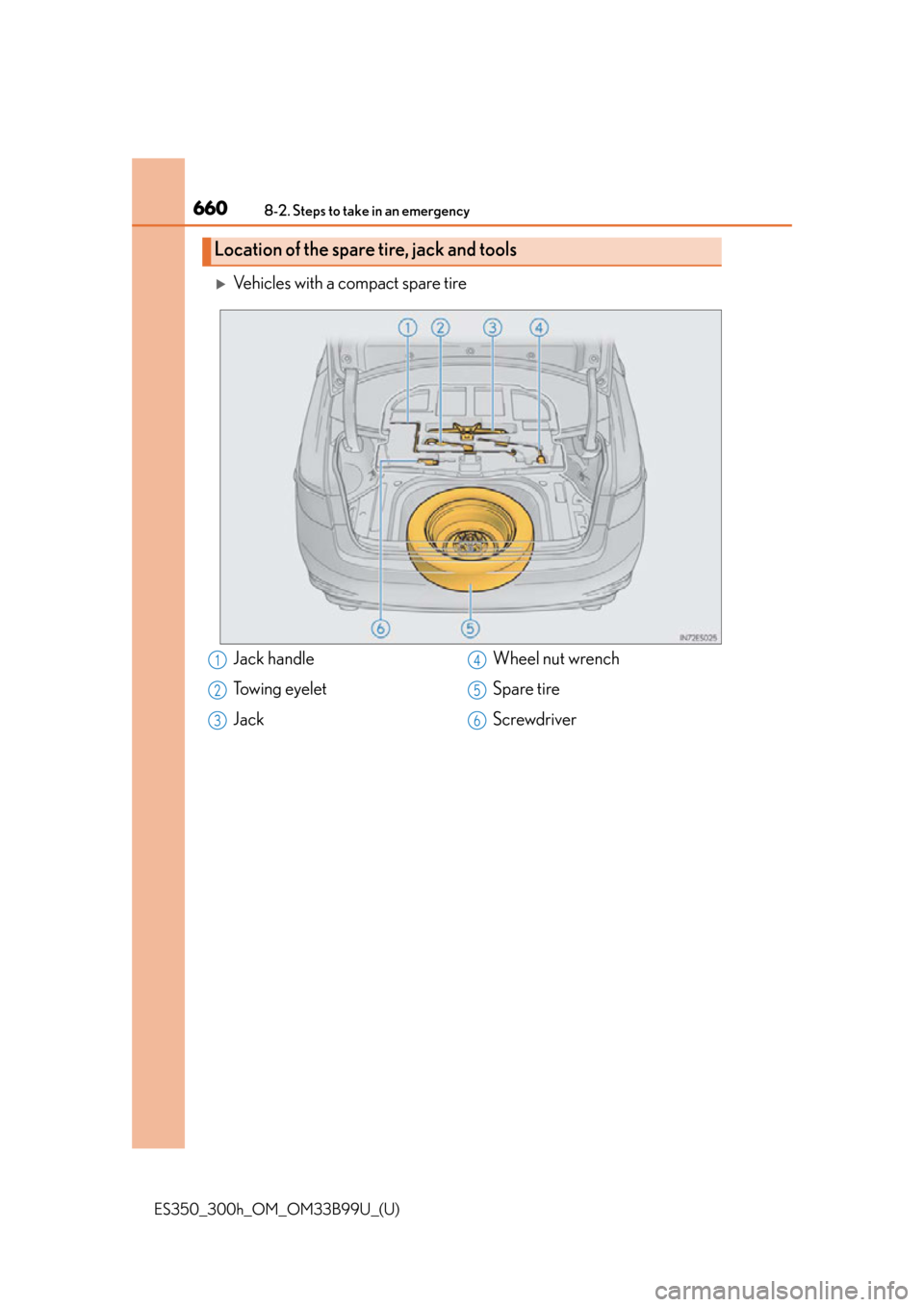
Vehicles with a compact spare tire
Location of the spare tire, jack and tools
Jack handle
Towing eyelet
JackWheel nut wrench
Spare tire
Screwdriver1
2
3
4
5
6
Page 661 of 784

6618-2. Steps to take in an emergency
ES350_300h_OM_OM33B99U_(U)
8
When trouble arises
Vehicles with a full-size spare tire
Towing eyelet
Wheel nut wrench
JackJack handle
Screwdriver
Spare tire1
2
3
4
5
6
Page 663 of 784
6638-2. Steps to take in an emergency
ES350_300h_OM_OM33B99U_(U)
8
When trouble arises
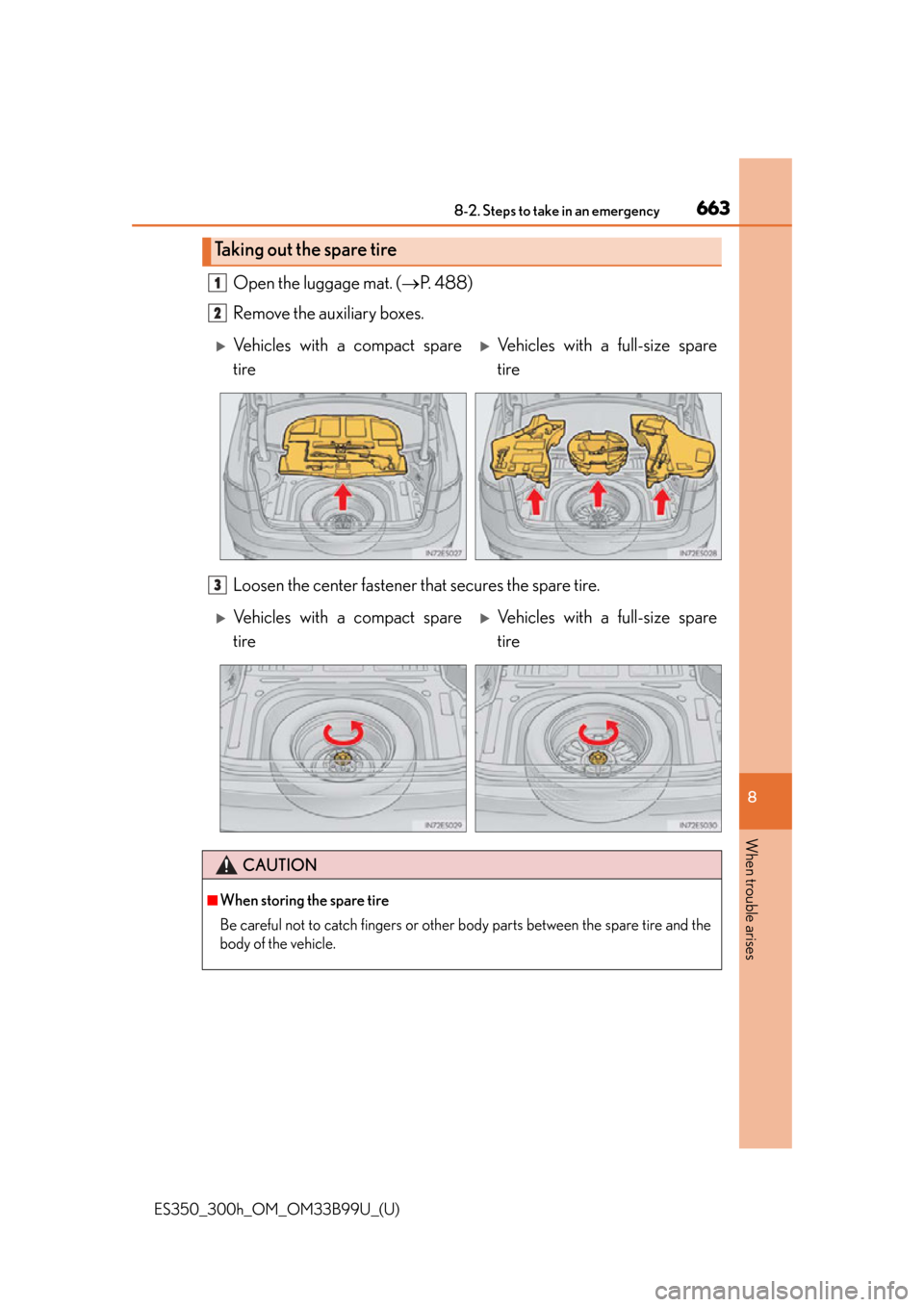
Open the luggage mat. (P. 4 8 8 )
Remove the auxiliary boxes.
Loosen the center fastener that secures the spare tire.
Taking out the spare tire
1
2
Vehicles with a compact spare
tireVehicles with a full-size spare
tire
3
Vehicles with a compact spare
tireVehicles with a full-size spare
tire
CAUTION
■When storing the spare tire
Be careful not to catch fingers or other body parts between the spare tire and the
body of the vehicle.
Page 665 of 784

6658-2. Steps to take in an emergency
ES350_300h_OM_OM33B99U_(U)
8
When trouble arises
Raise the vehicle until the tire is
slightly raised off the ground.
Remove all the wheel nuts and
the tire.
When resting the tire on the ground,
place the tire so that the wheel design
faces up to avoid scratching the wheel
surface.
Vehicles with a full-size spare tire:
Remove the wheel ornament by
pushing from the reverse side.
4
5
6
Page 667 of 784
6678-2. Steps to take in an emergency
ES350_300h_OM_OM33B99U_(U)
8
When trouble arises
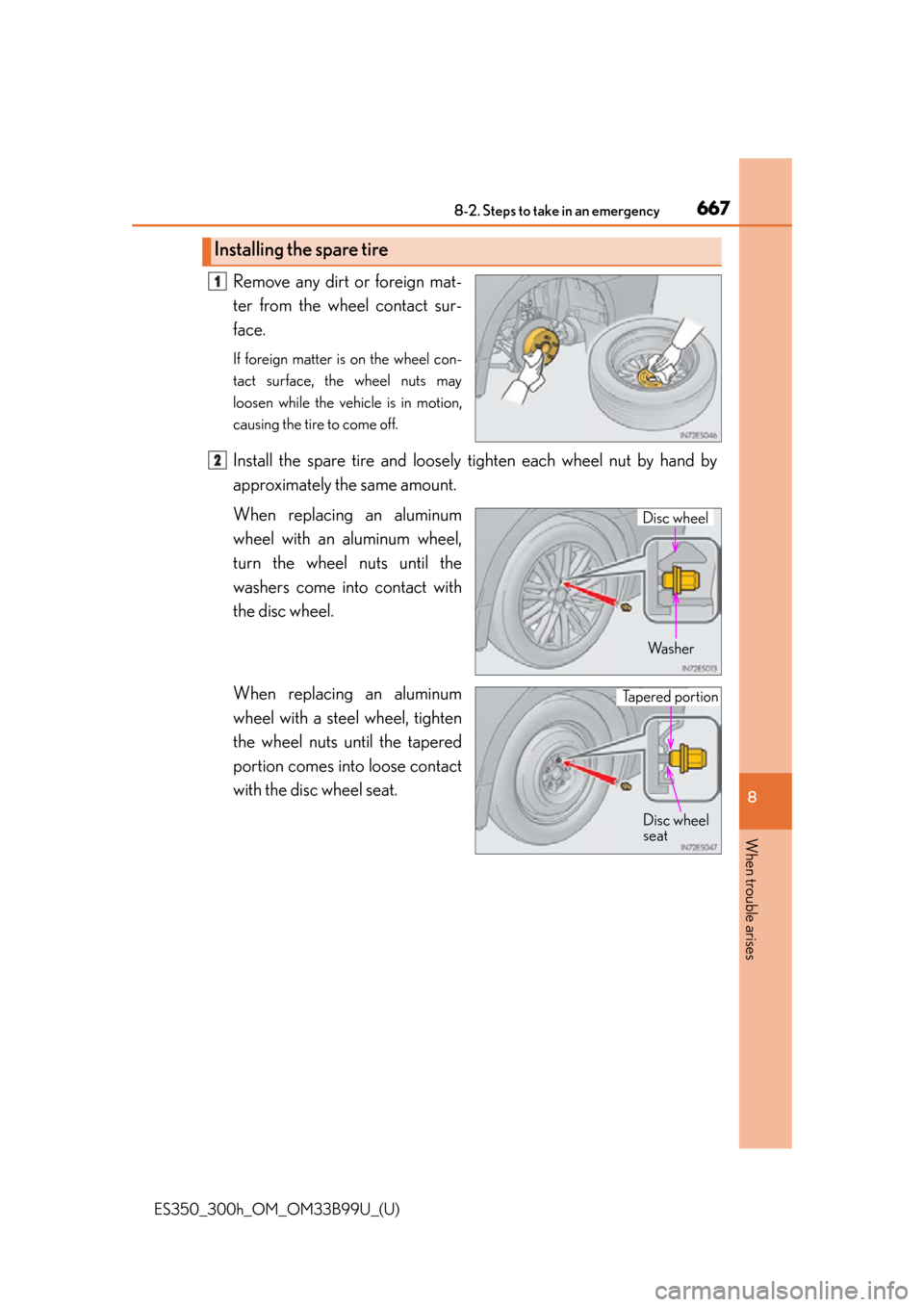
Remove any dirt or foreign mat-
ter from the wheel contact sur-
face.
If foreign matter is on the wheel con-
tact surface, the wheel nuts may
loosen while the vehicle is in motion,
causing the tire to come off.
Install the spare tire and loosely tighten each wheel nut by hand by
approximately the same amount.
When replacing an aluminum
wheel with an aluminum wheel,
turn the wheel nuts until the
washers come into contact with
the disc wheel.
When replacing an aluminum
wheel with a steel wheel, tighten
the wheel nuts until the tapered
portion comes into loose contact
with the disc wheel seat.
Installing the spare tire
1
2
Disc wheel
Wa s h e r
Tapered portion
Disc wheel
seat
Page 668 of 784
6688-2. Steps to take in an emergency
ES350_300h_OM_OM33B99U_(U)
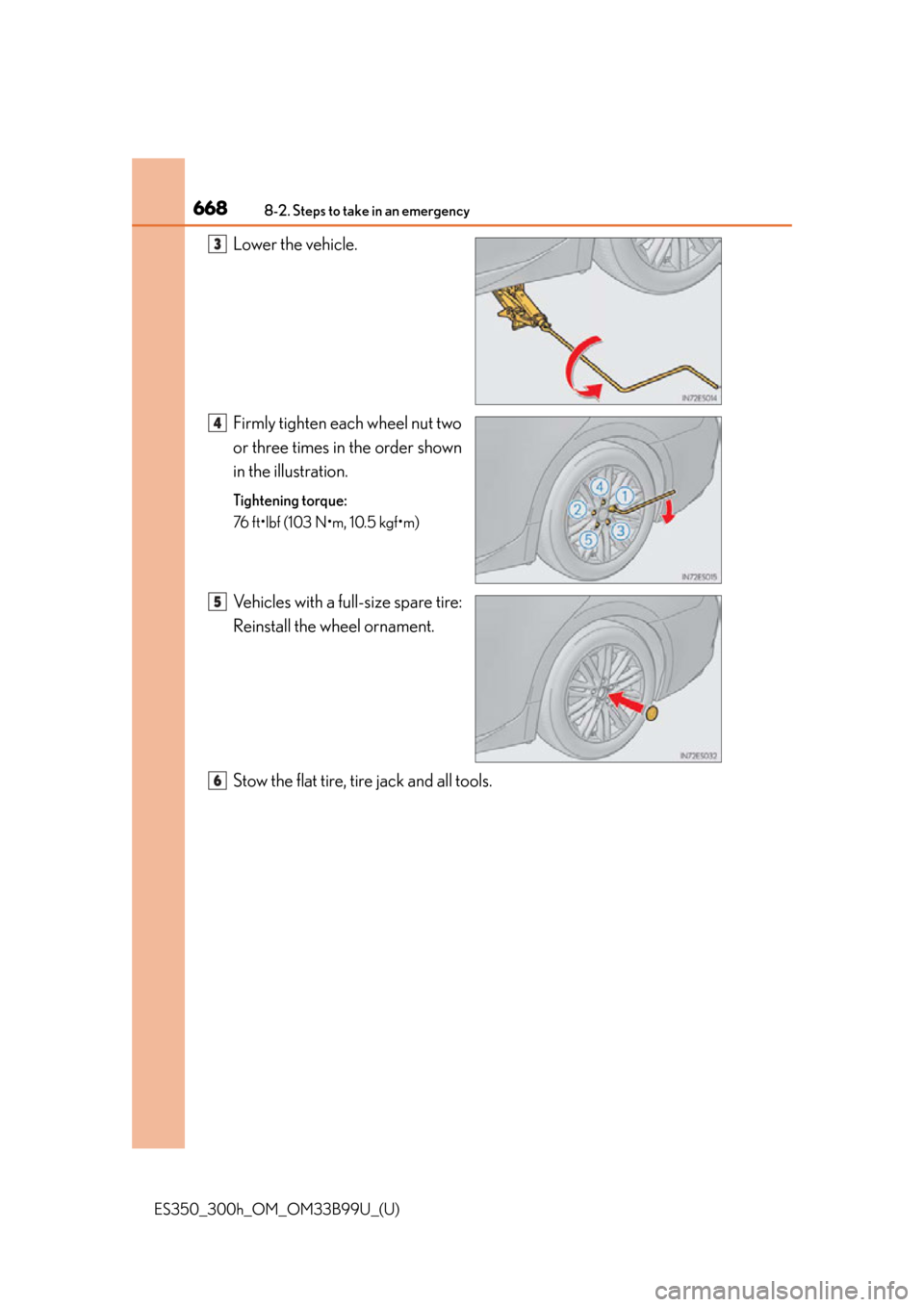
Lower the vehicle.
Firmly tighten each wheel nut two
or three times in the order shown
in the illustration.
Tightening torque:
76 ft•lbf (103 N•m, 10.5 kgf•m)
Vehicles with a full-size spare tire:
Reinstall the wheel ornament.
Stow the flat tire, tire jack and all tools.
3
4
5
6
Page 669 of 784

6698-2. Steps to take in an emergency
ES350_300h_OM_OM33B99U_(U)
8
When trouble arises
■The compact spare tire
●The compact spare tire is identified by the label “TEMPORARY USE ONLY” on
the tire sidewall.
Use the compact spare tire temporarily, and only in an emergency.
●Make sure to check the tire inflation pressure of the compact spare tire. ( P. 7 1 2 )
■When using the compact spare tire
As the compact spare tire is not equipped with a tire pressure warning valve and
transmitter, low inflation pressure of the spare tire will not be indicated by the tire
pressure warning system. Also, if you replace the compact spare tire after the tire
pressure warning light comes on, the light remains on.
■When the compact spare tire is equipped
The vehicle becomes lower when driving wi th the compact spare tire compared to
when driving with standard tires.
■If you have a flat front tire on a road co vered with snow or ice (vehicles with a com-
pact spare tire)
Install the compact spare tire on one of the rear wheels of the vehicle. Perform the
following steps and fit tire chains to the front tires:
Replace a rear tire with the compact spare tire.
Replace the flat front tire with the tire removed from the rear of the vehicle.
Fit tire chains to the front tires.
1
2
3
Page 670 of 784

6708-2. Steps to take in an emergency
ES350_300h_OM_OM33B99U_(U)
CAUTION
■When using the compact spare tire
●Remember that the compact spare tire provided is specifically designed for use
with your vehicle. Do not use your compact spare tire on another vehicle.
●Do not use more than one compact spare tire simultaneously.
●Replace the compact spare tire with a standard tire as soon as possible.
●Avoid sudden acceleration, abrupt steering, sudden braking and shifting opera-
tions that cause sudden engine braking.
■When the compact spare tire is attached
The vehicle speed may not be correctly detected, and the following systems may
not operate correctly:
■Speed limit when using the compact spare tire
Do not drive at speeds in excess of 50 mph (80 km/h) when a compact spare tire
is installed on the vehicle.
The compact spare tire is not designed for driving at high speeds. Failure to
observe this precaution may lead to an accident causing death or serious injury.
■After using the tools and jack
Before driving, make sure all the tools and jack are securely in place in their stor-
age location to reduce the possibility of pe rsonal injury during a collision or sudden
braking.
• ABS & Brake assist
•VSC
•TRAC
•Cruise control
• Dynamic radar cruise control (if equipped)
•PCS (if equipped)
•EPS • LDA (Lane Departure Alert)
(if equipped)
• Rear view monitor system (if equipped)
•Intuitive parking as sist (if equipped)
• Navigation system (if equipped)