Tow Lexus ES350 2008 User Guide
[x] Cancel search | Manufacturer: LEXUS, Model Year: 2008, Model line: ES350, Model: Lexus ES350 2008Pages: 459, PDF Size: 5.93 MB
Page 140 of 459

138
2-3. Operating the lights and windshield wipers
ES350_U_(L/O_0708)
■Rain drop sensor (vehicles equipped with the rain-sensing windshield wipers)
■AUTO mode
If the wiper switch is turned to AUTO position while the “ENGINE START STOP”
switch is in IGNITION ON mode, the wiper will operate once to show that AUTO
mode is activated.
■If no windshield washer fluid sprays
Check that the washer nozzles are not blocked if there is washer fluid in the wind-
shield washer fluid reservoir.
CAUTION
■Caution regarding the use of windshield wipers in AUTO mode (vehicles
equipped with the rain-sensing windshield wipers)
The windshield wipers may operate unexpectedly if the sensor is touched or the
windshield is subject to vibration in AUTO mode. Take care that your fingers or any-
thing else do not become caught in the windshield wipers.
NOTICE
■When the windshield is dry
Do not use the wipers, as they may damage the windshield.
■When there is no washer fluid spray from the nozzle
Damage to the washer fluid pump may be caused if the lever is pulled toward you
and held continually.
The sensor judges the amount of raindrops.
Page 142 of 459
![Lexus ES350 2008 User Guide 140
2-4. Using other driving systems
ES350_U_(L/O_0708)
■Fine adjustment of the set speed
Fine adjustment of the set speed (approximately 1.0 mph [1.6 km/h]) can be made
by lightly pressing the leve](/img/36/13000/w960_13000-141.png "Lexus ES350 2008 User Guide 140
2-4. Using other driving systems
ES350_U_(L/O_0708)
■Fine adjustment of the set speed
Fine adjustment of the set speed (approximately 1.0 mph [1.6 km/h]) can be made
by lightly pressing the leve")
140
2-4. Using other driving systems
ES350_U_(L/O_0708)
■Fine adjustment of the set speed
Fine adjustment of the set speed (approximately 1.0 mph [1.6 km/h]) can be made
by lightly pressing the lever up or down and releasing it.
■Cruise control can be set when
●The shift lever is in the D or 4,5, or 6 range of S.
●Vehicle speed is between approximately 25 mph (40 km/h) and 125 mph
(200 km/h).
■Accelerating
The vehicle can be accelerated normally.
■Automatic cruise control cancellation
The set speed is automatically cancelled in any of the following situations.
●Actual vehicle speed falls more than 10 mph (16 km/h) below the preset vehicle
speed
At this time, the memorized set speed is not retained.
●Actual vehicle speed is below 25 mph (40km/h)
●VSC is activated
■Canceling and resuming regular acceleration
Cancel
Push the lever towards you to
cancel cruise control.
The speed setting is also can-
celed when the brakes are
applied.
Resume
To resume cruise control and
return to the set speed, push the
lever up.
Page 145 of 459
143
2-4. Using other driving systems
2
When driving
ES350_U_(L/O_0708)
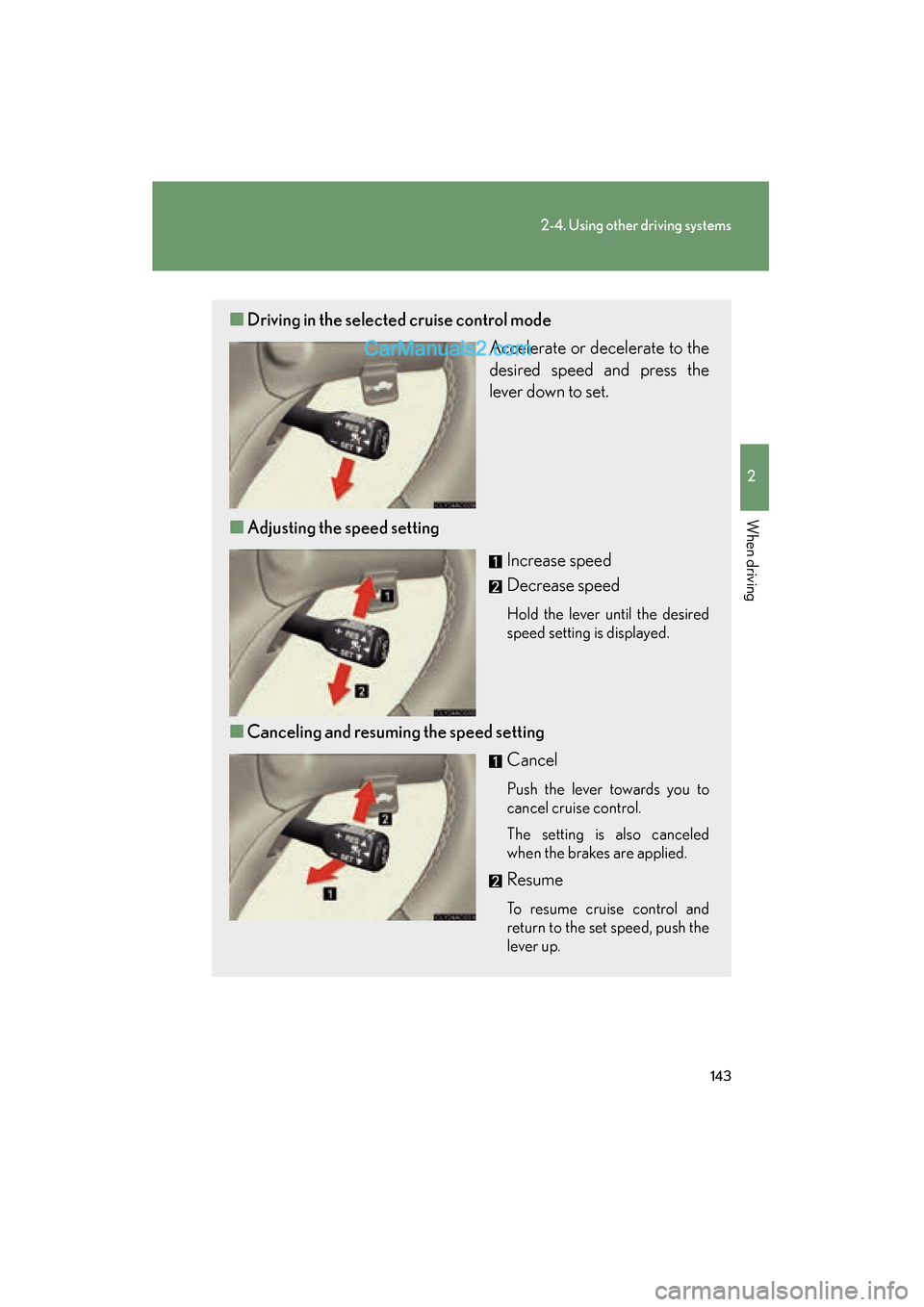
■Driving in the selected cruise control mode
Accelerate or decelerate to the
desired speed and press the
lever down to set.
■ Adjusting the speed setting
Increase speed
Decrease speed
Hold the lever until the desired
speed setting is displayed.
■Canceling and resuming the speed setting
Cancel
Push the lever towards you to
cancel cruise control.
The setting is also canceled
when the brakes are applied.
Resume
To resume cruise control and
return to the set speed, push the
lever up.
Page 157 of 459

155
2-4. Using other driving systems
2
When driving
ES350_U_(L/O_0708)
■Sensor detection information
●Certain vehicle conditions and the surrounding environment may affect the
ability of the sensor to correctly detect obstacles. Particular instances where this
may occur are listed below.
• There is dirt, snow or ice on the sensor.
• The sensor is frozen.
• The sensor is covered in any way.
• The vehicle is leaning considerably to one side.
• On an extremely bumpy road, on an incline, on gravel, or on grass
• The vicinity of the vehicle is noisy due to vehicle horns, motorcycle engines,air brakes of large vehicles, or other loud noises producing ultrasonic waves.
• There is another vehicle equipped with parking assist sensors in the vicinity.
• The sensor is coated with a sheet of spray or heavy rain
• The vehicle is equipped with a fender pole or wireless antenna.
• Towing eyelets are installed.
• The bumper or sensor receives a strong impact.
• The vehicle is approaching a tall or curved curb.
• In harsh sunlight or intense cold weather
In addition to the examples above, there are instances in which, because of their
shapes, signs and other objects may be judged by the sensor to be closer than they
are.
●The shape of the obstacle may prevent the sensor from detecting it. Pay particu-
lar attention to the following obstacles.
• Wires, fences, ropes etc.
• Cotton, snow and other materials that absorb radio waves
• Sharply-angled objects
• Low obstacles
• Tall obstacles with upper sections projecting outwards in the direction of your
vehicle
Page 165 of 459
163
2
When driving
ES350_U_(L/O_0708)
2-5. Driving information
Cargo and luggage
Capacity and distributionCargo capacity depends on the total weight of the occupants.
(Cargo capacity) = (Total load capacity) — (Total weight of occupants)
Steps for Determining Correct Load Limit
(1) Locate the statement “The combined weight of occupants and cargo should never exceed XXX kg or XXX lbs.” on your vehicle’s placard.
(2) Determine the combined weight of the driver and passengers that will be riding in your vehicle.
(3) Subtract the combined weight of the driver and passengers from XXX kg or XXX lbs.
(4) The resulting figure equals the available amount of cargo and lug- gage load capacity.
For example, if the XXX amount equals 1400 lbs. and there will be
five 150 lb passengers in your vehicle, the amount of available cargo
and luggage load capacity is 650 lbs. (1400 − 750 (150 × 5) = 650
lbs.)
(5) Determine the combined weight of luggage and cargo being loaded on the vehicle. That weight may not safely exceed the available cargo
and luggage load capacity calculated in Step 4.
Take notice of the following information about storage precautions, cargo
capacity and load.
●Stow cargo and luggage in the trunk whenever possible. Be sure
all items are secured in place.
● Be careful to keep the vehicle level. Placing the weight as far for-
ward as possible helps maintain vehicle balance.
● For better fuel economy, do not carry unnecessary weight.
Page 166 of 459
164
2-5. Driving information
ES350_U_(L/O_0708)(6) If your vehicle will be towing a trailer, load from your trailer will be
transferred to your vehicle. Consult this manual to determine how this
reduces the available cargo and luggage load capacity of your vehi-
cle. (→ P. 1 7 3 )
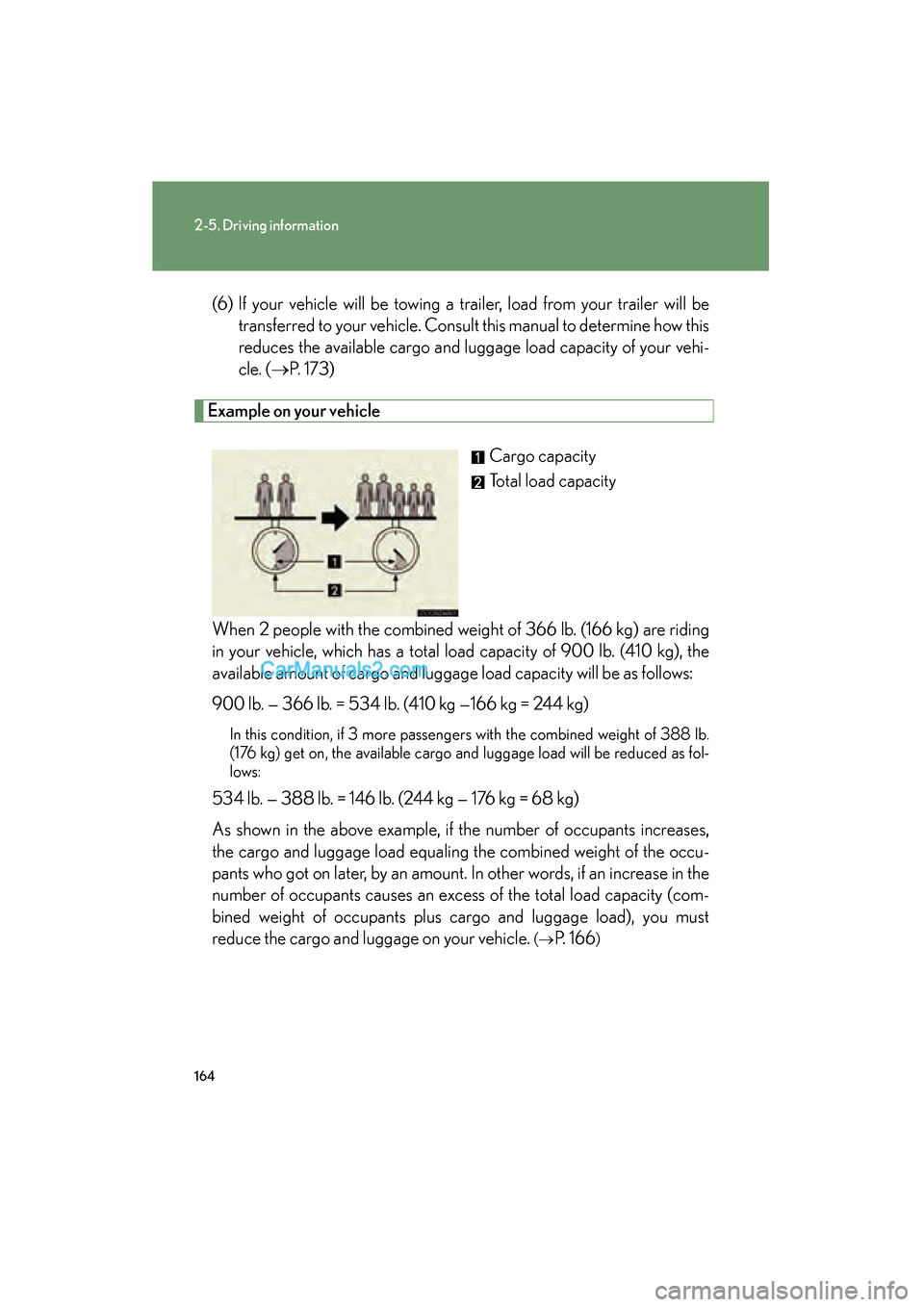
Example on your vehicle
Cargo capacity
Total load capacity
When 2 people with the combined weight of 366 lb. (166 kg) are riding
in your vehicle, which has a total load capacity of 900 lb. (410 kg), the
available amount of cargo and luggage load capacity will be as follows:
900 lb. — 366 lb. = 534 lb. (410 kg —166 kg = 244 kg)
In this condition, if 3 more passengers with the combined weight of 388 lb.
(176 kg) get on, the available cargo and luggage load will be reduced as fol-
lows:
534 lb. — 388 lb. = 146 lb. (244 kg — 176 kg = 68 kg)
As shown in the above example, if the number of occupants increases,
the cargo and luggage load equaling the combined weight of the occu-
pants who got on later, by an amount. In other words, if an increase in the
number of occupants causes an excess of the total load capacity (com-
bined weight of occupants plus cargo and luggage load), you must
reduce the cargo and luggage on your vehicle.
( →P. 1 6 6)
Page 168 of 459

166
2-5. Driving information
ES350_U_(L/O_0708)
Vehicle load limits
■Total load capacity and seating capacity
These details are also described on the tire and loading information label.
( → P. 3 2 4 )
CAUTION
■Overloading the vehicle
Do not overload the vehicle.
It may not only cause damage to the tires, but also degrade steering and braking
ability, resulting in an accident.
Vehicle load limits include total load capacity, seating capacity, towing
capacity and cargo capacity.
■Total load capacity: 900 lb. (410 kg)
Total load capacity means the combined weight of occupants, cargo and
luggage.
■Seating capacity: 5 occupants (Front 2, Rear 3)
Seating capacity means the maximum number of occupants whose esti-
mated average weight is 150 lb. (68 kg) per person.
■Towing capacity: 1000 lb. (450 kg)
■ Cargo capacity
Cargo capacity may increase or decrease depending on the weight and
the number of occupants.
Page 175 of 459
173
2-5. Driving information
2
When driving
ES350_U_(L/O_0708)
Trailer towing
Your vehicle is designed primarily as a passenger-carrying vehicle, thus
towing a trailer will have an adverse effect on handling, performance, brak-
ing, durability, and fuel consumption. For your safety and the safety of oth-
ers, do not overload the vehicle or trailer.
Lexus warranties do not apply to damage or malfunction caused by towing
a trailer for commercial purposes
■Weight limits
Confirm the total trailer weight, gross vehicle weight, gross axle
weight and trailer tongue load are all within the limits.
■ Gross vehicle weight
The gross vehicle weight must not exceed the Gross Vehicle Weight
Rating (GVWR) indicated on the Certification Label. The gross
vehicle weight is the sum weight of the unloaded vehicle, driver, pas-
sengers, luggage, hitch and trailer tongue load. Also included is the
weight of any special equipment installed on your vehicle.
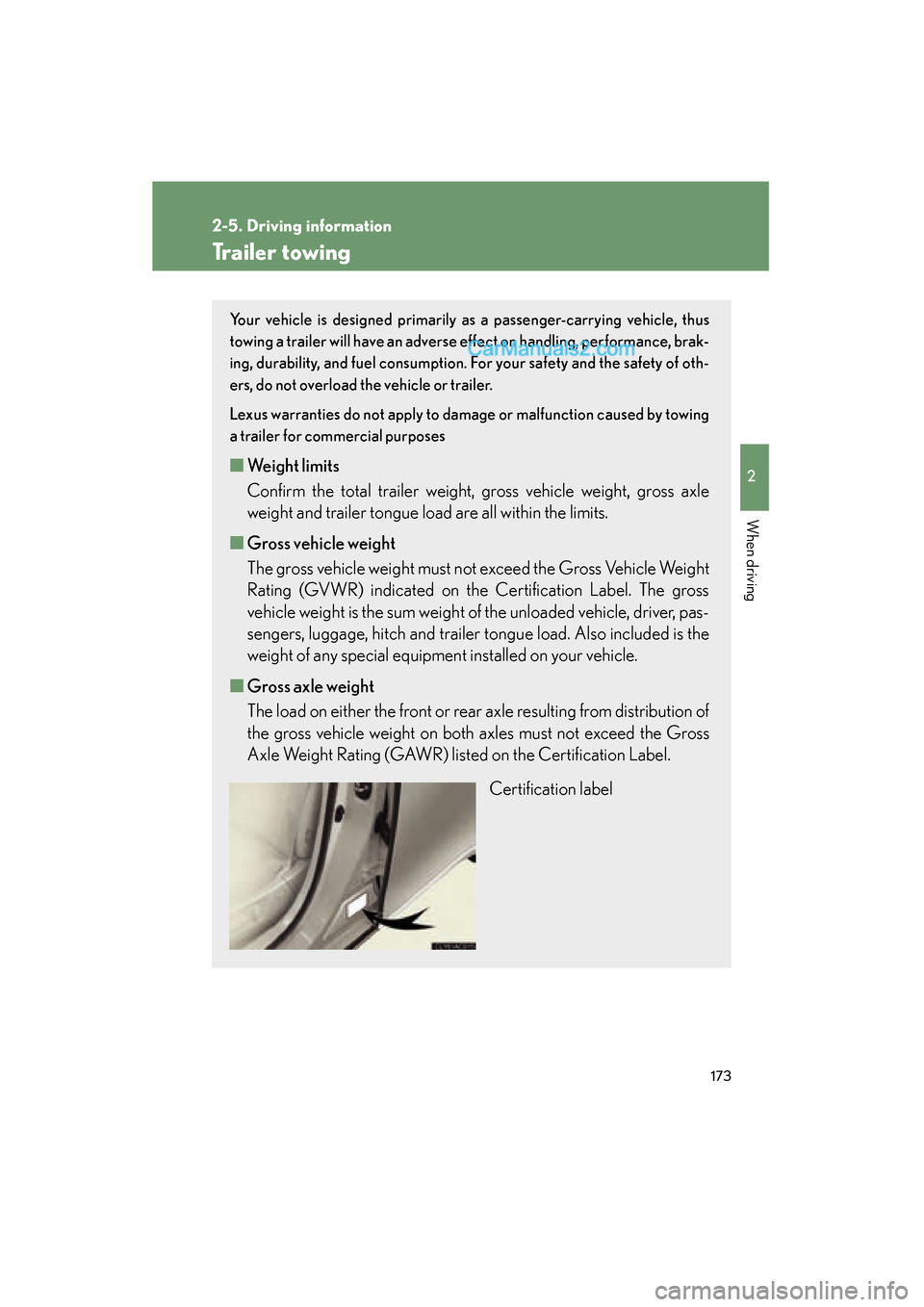
■ Gross axle weight
The load on either the front or rear axle resulting from distribution of
the gross vehicle weight on both axles must not exceed the Gross
Axle Weight Rating (GAWR) listed on the Certification Label.
Certification label
Page 176 of 459
174
2-5. Driving information
ES350_U_(L/O_0708)
Towing a trailerConsult your Lexus dealer for further information on additional require-
ments such as a towing kits, etc.
■ Trailer tongue load
The trailer cargo load should be distributed so that the tongue load
is 9 to 11% of the total trailer weight, not exceeding the maximum
100 lb. (45 kg). (Tongue load / Tota l trailer weight x 100 = 9 to 11%)
The total trailer weight and tongue load can be measured with plat-
form scales found at a highway weighing stations, building supply
company, trucking company, junk yards, etc.
Total trailer weight
Tongue load
Page 177 of 459
175
2-5. Driving information
2
When driving
ES350_U_(L/O_0708)
■Before towing
●Ensure that your vehicle’s tires are properly inflated. (→P. 3 2 4 )
●Trailer tires should be inflated according to the trailer manufacturer's recom-
mendation.
●All trailer lights work to be legal.
●Confirm all lights work each time you connect them.
●Check that your vehicle remains level when a loaded or unloaded trailer is
hitched. Do not drive if the vehicle is not level, and check for improper tongue
load, overloading, worn suspension, or other possible causes.
●Make sure the trailer cargo is securely loaded.
●Check that your rear view mirrors conform to any federal, state/provincial or
local regulations. If they do not, install rear view mirrors appropriate for towing
purposes.
■Break-in schedule
Lexus recommends that you do not use a new vehicle or a vehicle with any new
power train components (engine, transmission, differential, wheel bearings, etc.) to
tow a trailer for the first 500 miles (800 km) of driving.
■Maintenance
●If you tow a trailer, your vehicle will require more frequent maintenance due to
the additional load. (See “Warranty and Services Guide/Owner's Manual Sup-
plement/ Scheduled Maintenance”.)
●Retighten the fixing bolts of the towing ball and bracket after approximately
600 miles (1000 km) of trailer towing.
CAUTION
■To avoid accident or injury
●The total trailer weight (trailer weight plus the weight of cargo) must not exceed
1000 lb. (450 kg).
●Do not exceed the trailer hitch assembly weight, gross vehicle weight, gross axle
weight and trailer tongue load capacities.
●Never load more weight in the back than in the front of the trailer. About 60% of
the load should be in the front half of the trailer, and the remaining 40% in the
rear.