trailer Lexus ES350 2009 User Guide
[x] Cancel search | Manufacturer: LEXUS, Model Year: 2009, Model line: ES350, Model: Lexus ES350 2009Pages: 475, PDF Size: 6.2 MB
Page 184 of 475
182
2-5. Driving information
ES350_U_(L/O_0808)
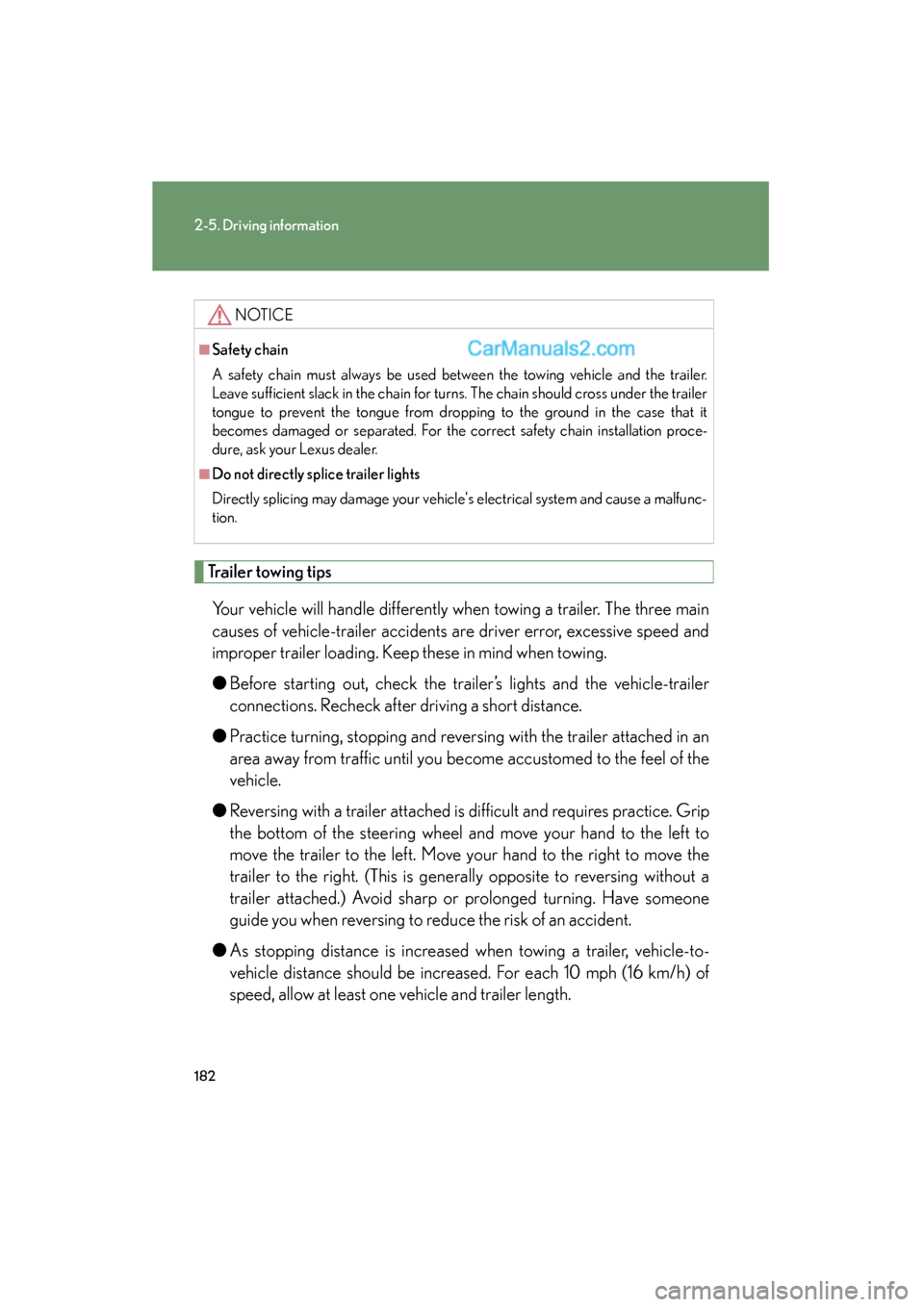
Trailer towing tipsYour vehicle will handle differently when towing a trailer. The three main
causes of vehicle-trailer accidents are driver error, excessive speed and
improper trailer loading. Keep these in mind when towing.
● Before starting out, check the trailer’s lights and the vehicle-trailer
connections. Recheck after driving a short distance.
● Practice turning, stopping and reversing with the trailer attached in an
area away from traffic until you become accustomed to the feel of the
vehicle.
● Reversing with a trailer attached is difficult and requires practice. Grip
the bottom of the steering wheel and move your hand to the left to
move the trailer to the left. Move your hand to the right to move the
trailer to the right. (This is generally opposite to reversing without a
trailer attached.) Avoid sharp or prolonged turning. Have someone
guide you when reversing to reduce the risk of an accident.
● As stopping distance is increased when towing a trailer, vehicle-to-
vehicle distance should be increased. For each 10 mph (16 km/h) of
speed, allow at least one vehicle and trailer length.
NOTICE
■Safety chain
A safety chain must always be used between the towing vehicle and the trailer.
Leave sufficient slack in the chain for turns. The chain should cross under the trailer
tongue to prevent the tongue from dropping to the ground in the case that it
becomes damaged or separated. For the correct safety chain installation proce-
dure, ask your Lexus dealer.
■Do not directly splice trailer lights
Directly splicing may damage your vehicle's electrical system and cause a malfunc-
tion.
Page 185 of 475
183
2-5. Driving information
2
When driving
ES350_U_(L/O_0808)●
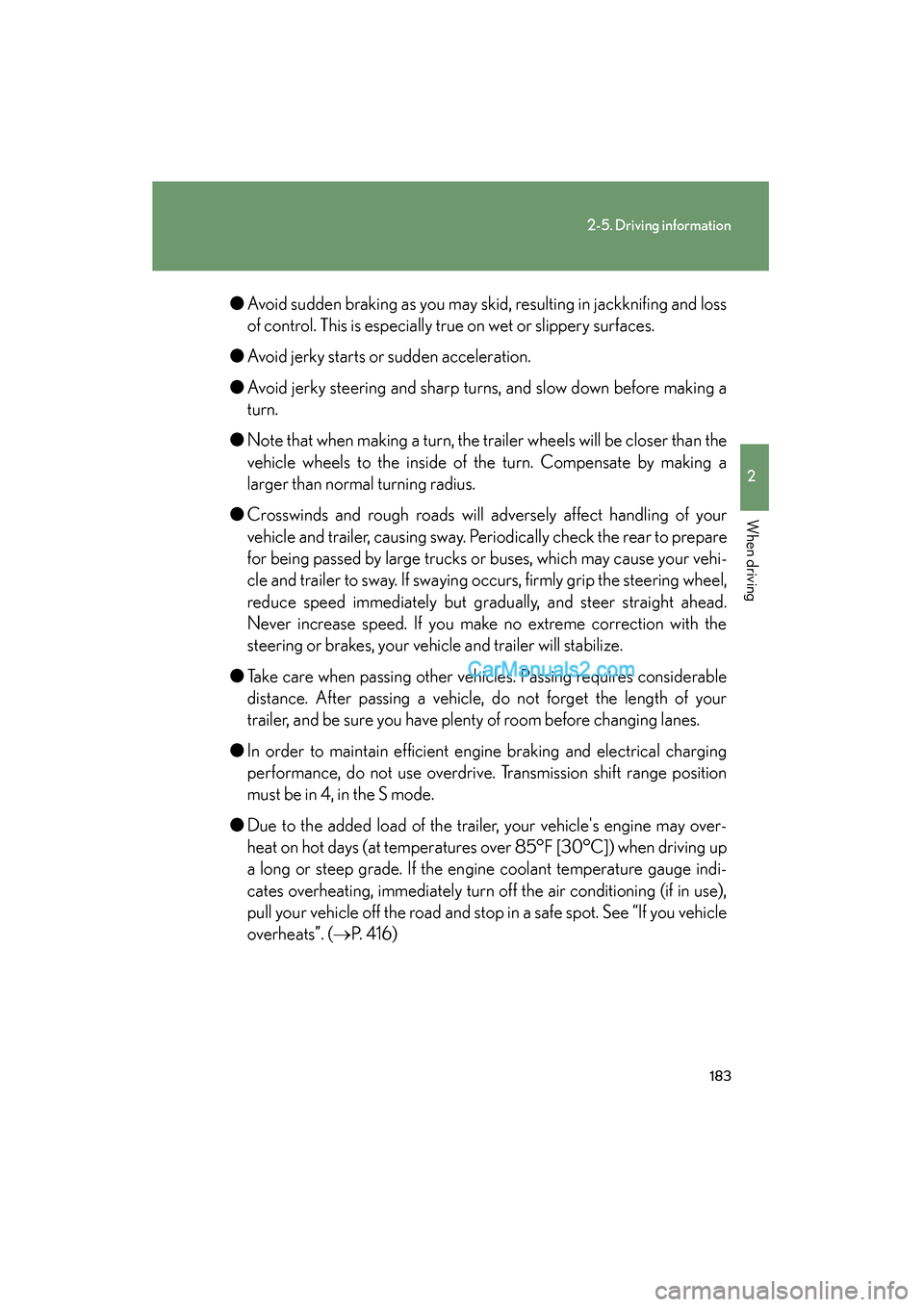
Avoid sudden braking as you may skid, resulting in jackknifing and loss
of control. This is especially true on wet or slippery surfaces.
● Avoid jerky starts or sudden acceleration.
● Avoid jerky steering and sharp turns, and slow down before making a
turn.
● Note that when making a turn, the trailer wheels will be closer than the
vehicle wheels to the inside of the turn. Compensate by making a
larger than normal turning radius.
● Crosswinds and rough roads will adversely affect handling of your
vehicle and trailer, causing sway. Periodically check the rear to prepare
for being passed by large trucks or buses, which may cause your vehi-
cle and trailer to sway. If swaying occurs, firmly grip the steering wheel,
reduce speed immediately but gradually, and steer straight ahead.
Never increase speed. If you make no extreme correction with the
steering or brakes, your vehicle and trailer will stabilize.
● Take care when passing other vehicles. Passing requires considerable
distance. After passing a vehicle, do not forget the length of your
trailer, and be sure you have plenty of room before changing lanes.
● In order to maintain efficient engine braking and electrical charging
performance, do not use overdrive. Transmission shift range position
must be in 4, in the S mode.
● Due to the added load of the trailer, your vehicle's engine may over-
heat on hot days (at temperatures over 85°F [30°C]) when driving up
a long or steep grade. If the engine coolant temperature gauge indi-
cates overheating, immediately turn off the air conditioning (if in use),
pull your vehicle off the road and stop in a safe spot. See “If you vehicle
overheats”. ( →P. 4 1 6 )
Page 186 of 475
184
2-5. Driving information
ES350_U_(L/O_0808)●
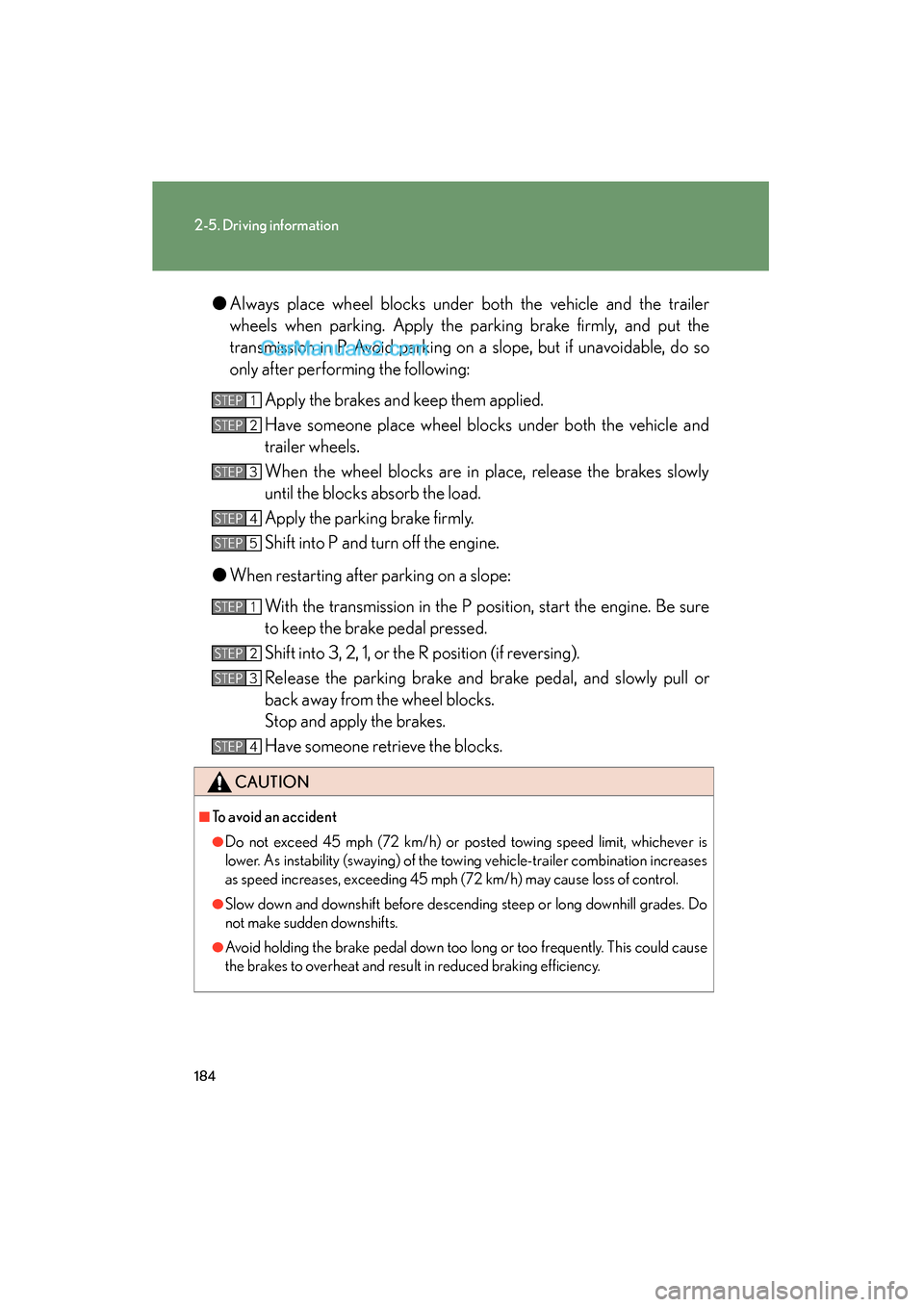
Always place wheel blocks under both the vehicle and the trailer
wheels when parking. Apply the parking brake firmly, and put the
transmission in P. Avoid parking on a slope, but if unavoidable, do so
only after performing the following:
Apply the brakes and keep them applied.
Have someone place wheel blocks under both the vehicle and
trailer wheels.
When the wheel blocks are in place, release the brakes slowly
until the blocks absorb the load.
Apply the parking brake firmly.
Shift into P and turn off the engine.
● When restarting after parking on a slope:
With the transmission in the P position, start the engine. Be sure
to keep the brake pedal pressed.
Shift into 3, 2, 1, or the R position (if reversing).
Release the parking brake and brake pedal, and slowly pull or
back away from the wheel blocks.
Stop and apply the brakes.
Have someone retrieve the blocks.
CAUTION
■To avoid an accident
●Do not exceed 45 mph (72 km/h) or posted towing speed limit, whichever is
lower. As instability (swaying) of the towing vehicle-trailer combination increases
as speed increases, exceeding 45 mph (72 km/h) may cause loss of control.
●Slow down and downshift before descending steep or long downhill grades. Do
not make sudden downshifts.
●Avoid holding the brake pedal down too long or too frequently. This could cause
the brakes to overheat and result in reduced braking efficiency.
STEP1
STEP2
STEP3
STEP4
STEP5
STEP1
STEP2
STEP3
STEP4
Page 424 of 475
422
ES350_U_(L/O_0808)
6-1. Specifications
Maintenance data (fuel, oil level, etc.)
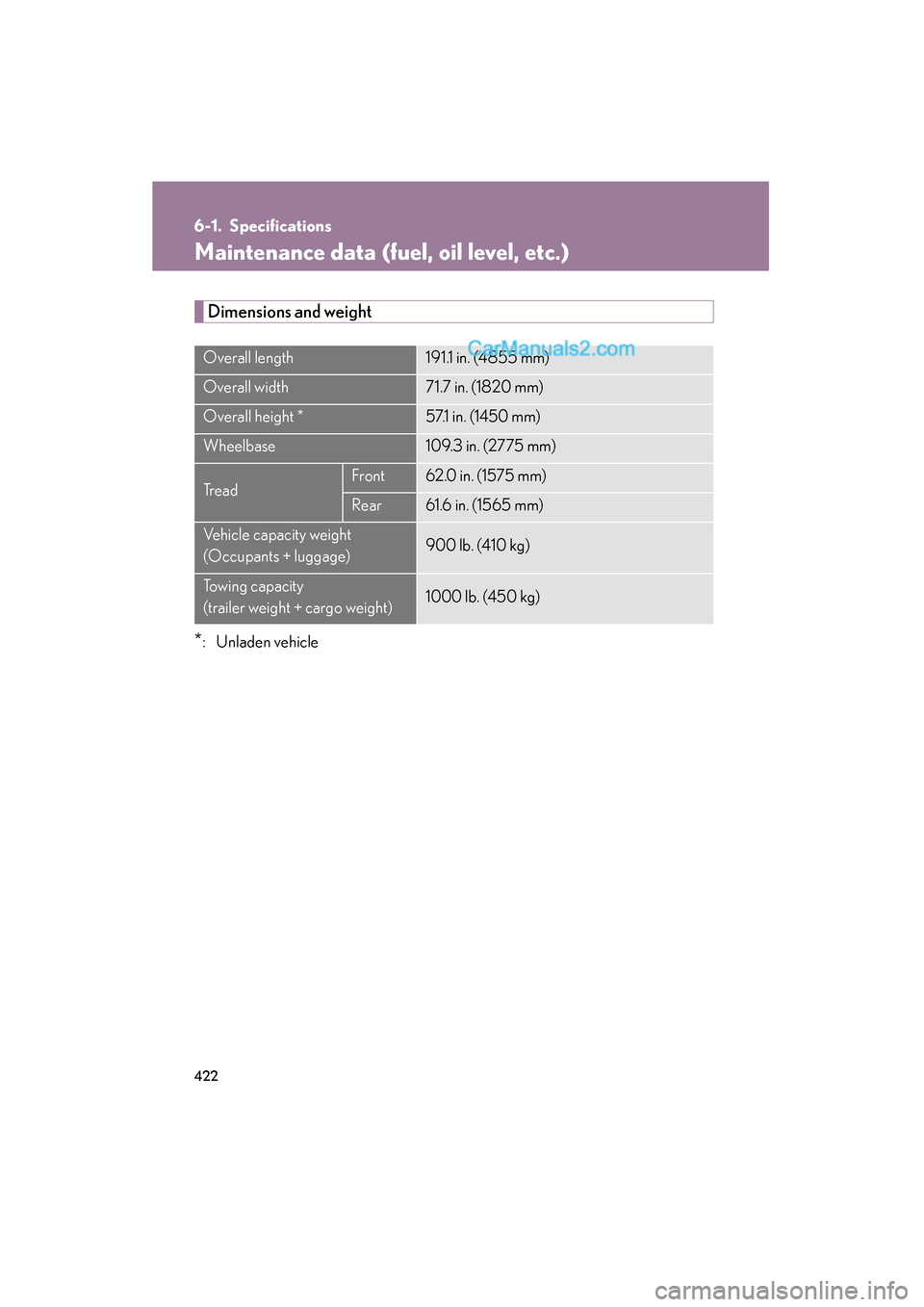
Dimensions and weight
*: Unladen vehicle
Overall length191.1 in. (4855 mm)
Overall width71.7 in. (1820 mm)
Overall height *57.1 in. (1450 mm)
Wheelbase109.3 in. (2775 mm)
Tr e a dFront62.0 in. (1575 mm)
Rear61.6 in. (1565 mm)
Vehicle capacity weight
(Occupants + luggage)900 lb. (410 kg)
Towing capacity
(trailer weight + cargo weight)1000 lb. (450 kg)
Page 431 of 475
429
6-1. Specifications
6
Vehicle specifications
ES350_U_(L/O_0808)
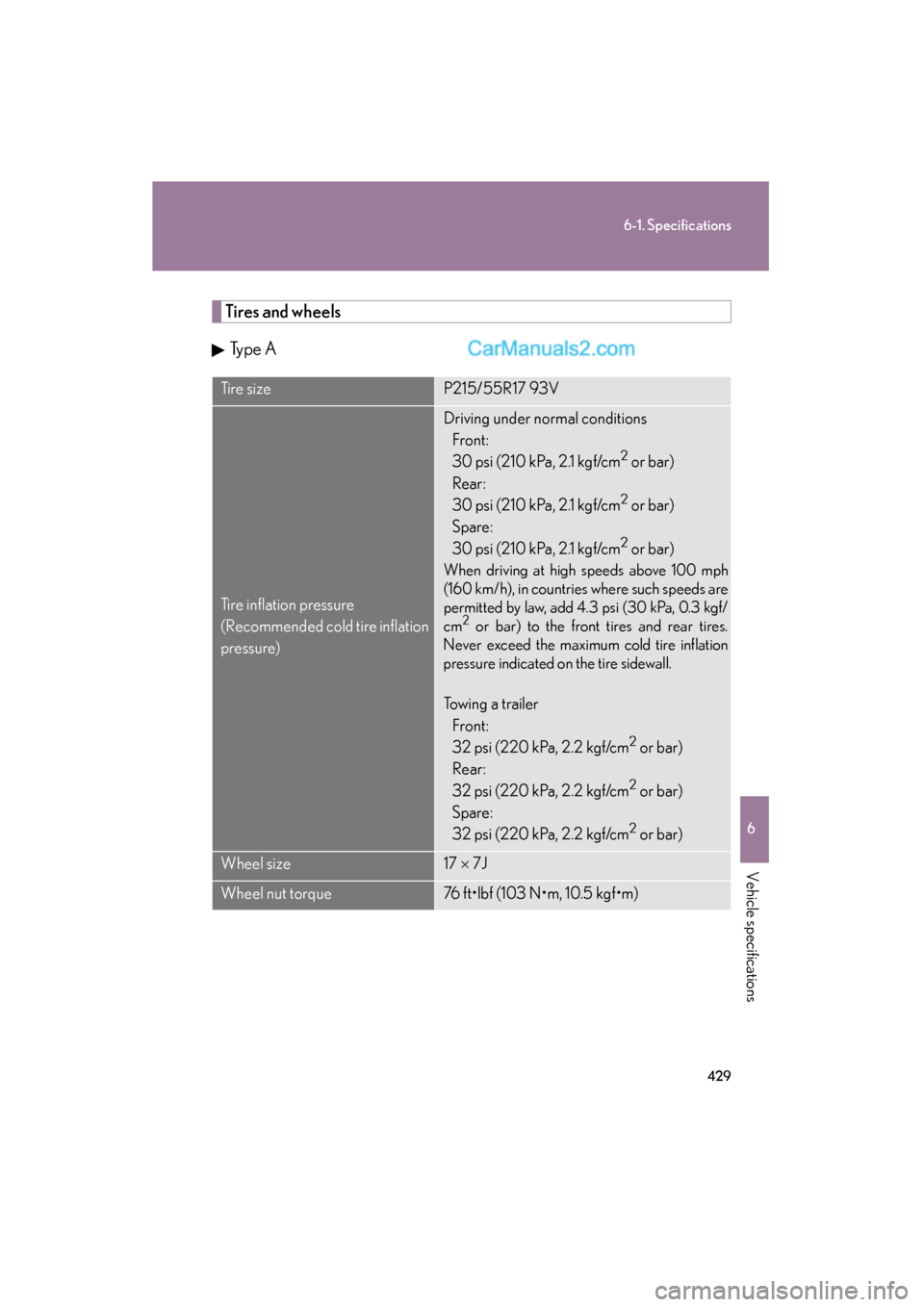
Tires and wheelsType A
Ti r e s i z eP215/55R17 93V
Tire inflation pressure
(Recommended cold tire inflation
pressure)
Driving under normal conditions Front:
30 psi (210 kPa, 2.1 kgf/cm
2 or bar)
Rear:
30 psi (210 kPa, 2.1 kgf/cm
2 or bar)
Spare:
30 psi (210 kPa, 2.1 kgf/cm
2 or bar)
When driving at high speeds above 100 mph
(160 km/h), in countries where such speeds are
permitted by law, add 4.3 psi (30 kPa, 0.3 kgf/
cm
2 or bar) to the front tires and rear tires.
Never exceed the maximum cold tire inflation
pressure indicated on the tire sidewall.
Towing a trailer
Front:
32 psi (220 kPa, 2.2 kgf/cm
2 or bar)
Rear:
32 psi (220 kPa, 2.2 kgf/cm
2 or bar)
Spare:
32 psi (220 kPa, 2.2 kgf/cm
2 or bar)
Wheel size17 × 7J
Wheel nut torque76 ft•lbf (103 N•m, 10.5 kgf•m)
Page 432 of 475
430
6-1. Specifications
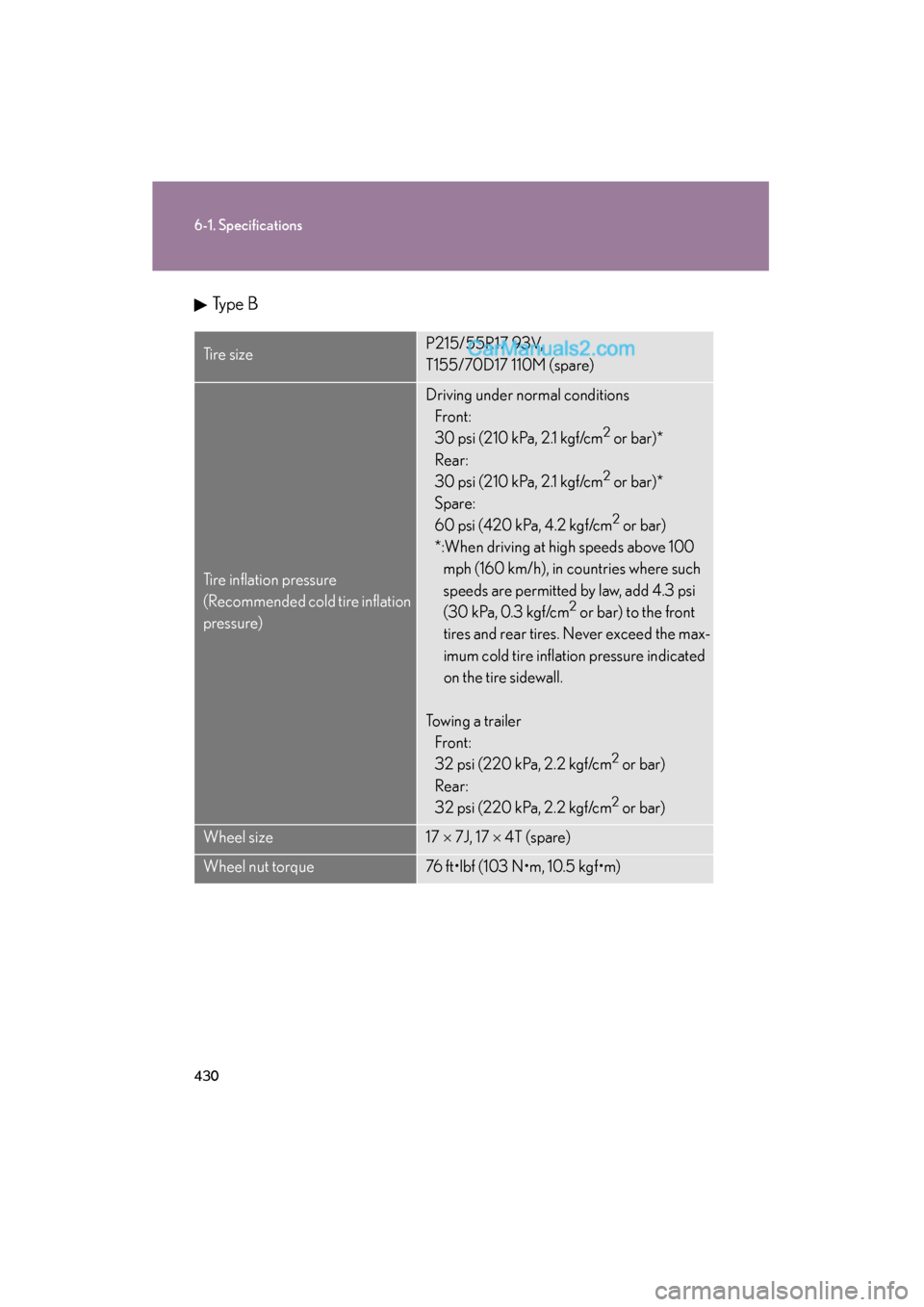
ES350_U_(L/O_0808)Ty p e B
Ti r e s i z eP215/55R17 93V,
T155/70D17 110M (spare)
Tire inflation pressure
(Recommended cold tire inflation
pressure)
Driving under normal conditions
Front:
30 psi (210 kPa, 2.1 kgf/cm
2 or bar)*
Rear:
30 psi (210 kPa, 2.1 kgf/cm
2 or bar)*
Spare:
60 psi (420 kPa, 4.2 kgf/cm
2 or bar)
*:When driving at high speeds above 100 mph (160 km/h), in countries where such
speeds are permitted by law, add 4.3 psi
(30 kPa, 0.3 kgf/cm
2 or bar) to the front
tires and rear tires. Never exceed the max-
imum cold tire inflation pressure indicated
on the tire sidewall.
Towing a trailer Front:
32 psi (220 kPa, 2.2 kgf/cm
2 or bar)
Rear:
32 psi (220 kPa, 2.2 kgf/cm
2 or bar)
Wheel size17 × 7J, 17 × 4T (spare)
Wheel nut torque76 ft•lbf (103 N•m, 10.5 kgf•m)
Page 470 of 475
468
Alphabetical index
ES350_U_(L/O_0808)
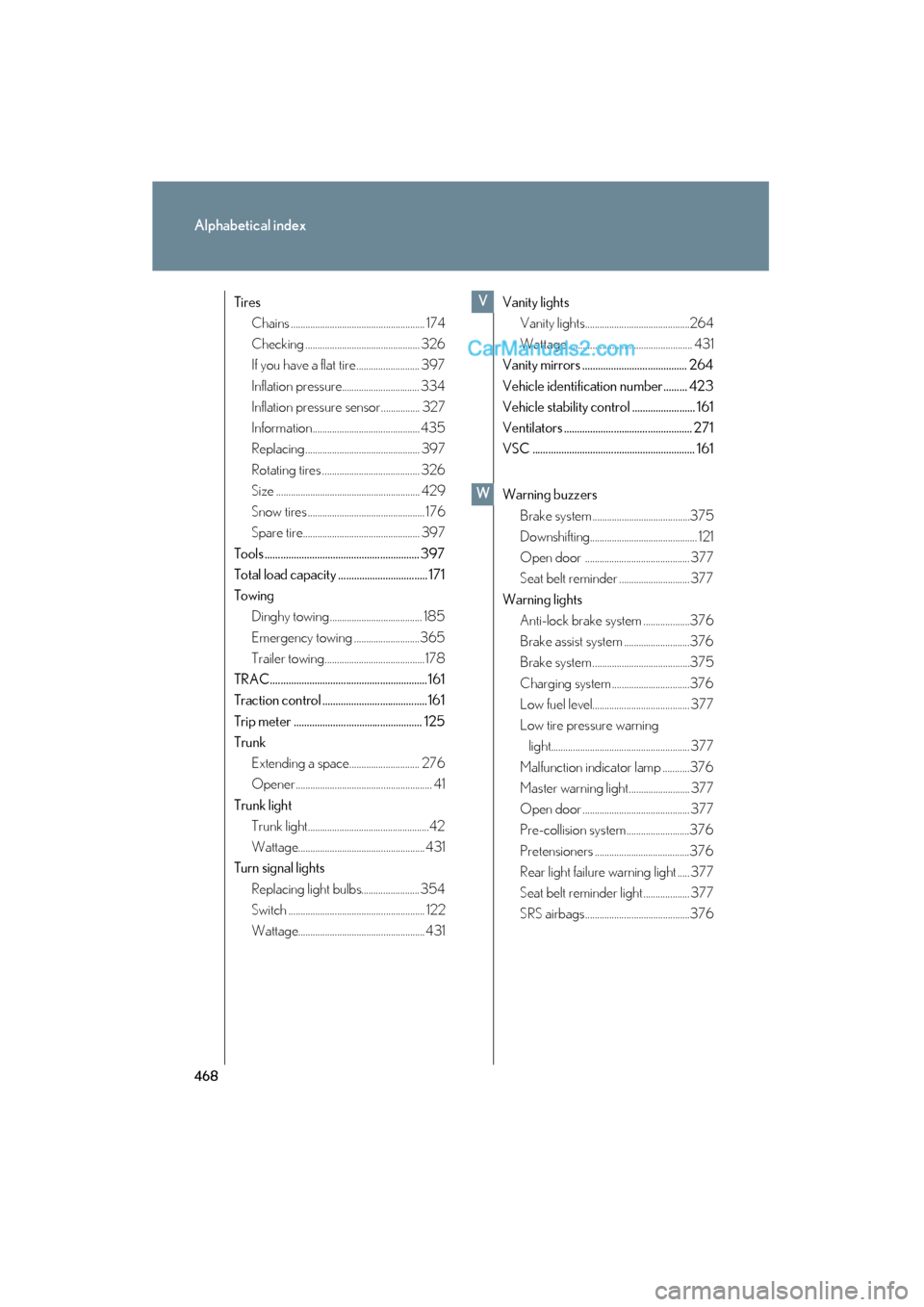
TiresChains ....................................................... 174
Checking ............................................... 326
If you have a flat tire.......................... 397
Inflation pressure................................ 334
Inflation pressure sensor................ 327
Information............................................ 435
Replacing............................................... 397
Rotating tires ........................................ 326
Size ........................................................... 429
Snow tires ................................................ 176
Spare tire................................................ 397
Tools ........................................................... 397
Total load capacity .................................. 171
Towing Dinghy towing ...................................... 185
Emergency towing ...........................365
Trailer towing.........................................178
TRAC............................................................ 161
Traction control ........................................ 161
Trip meter ................................................. 125
Trunk Extending a space............................. 276
Opener ........................................................ 41
Trunk light Trunk light..................................................42
Wattage.................................................... 431
Turn signal lights
Replacing light bulbs........................ 354
Switch ........................................................ 122
Wattage.................................................... 431 Vanity lights
Vanity lights...........................................264
Wattage ................................................... 431
Vanity mirrors ........................................ 264
Vehicle identification number ......... 423
Vehicle stability control ........................ 161
Ventilators ................................................. 271
VSC .............................................................. 161
Warning buzzers
Brake system........................................375
Downshifting............................................ 121
Open door ........................................... 377
Seat belt reminder ............................. 377
Warning lights Anti-lock brake system ...................376
Brake assist system ...........................376
Brake system........................................375
Charging system ................................376
Low fuel level........................................ 377
Low tire pressure warning light......................................................... 377
Malfunction indicator lamp ...........376
Master warning light......................... 377
Open door ............................................ 377
Pre-collision system..........................376
Pretensioners .......................................376
Rear light failure warning light ..... 377
Seat belt reminder light ................... 377
SRS airbags...........................................376V
W