trailer Lexus ES350 2009 Owner's Manual
[x] Cancel search | Manufacturer: LEXUS, Model Year: 2009, Model line: ES350, Model: Lexus ES350 2009Pages: 475, PDF Size: 6.2 MB
Page 5 of 475
1
2
3
4
5
6
7
ES350_U_(L/O_0808)
3
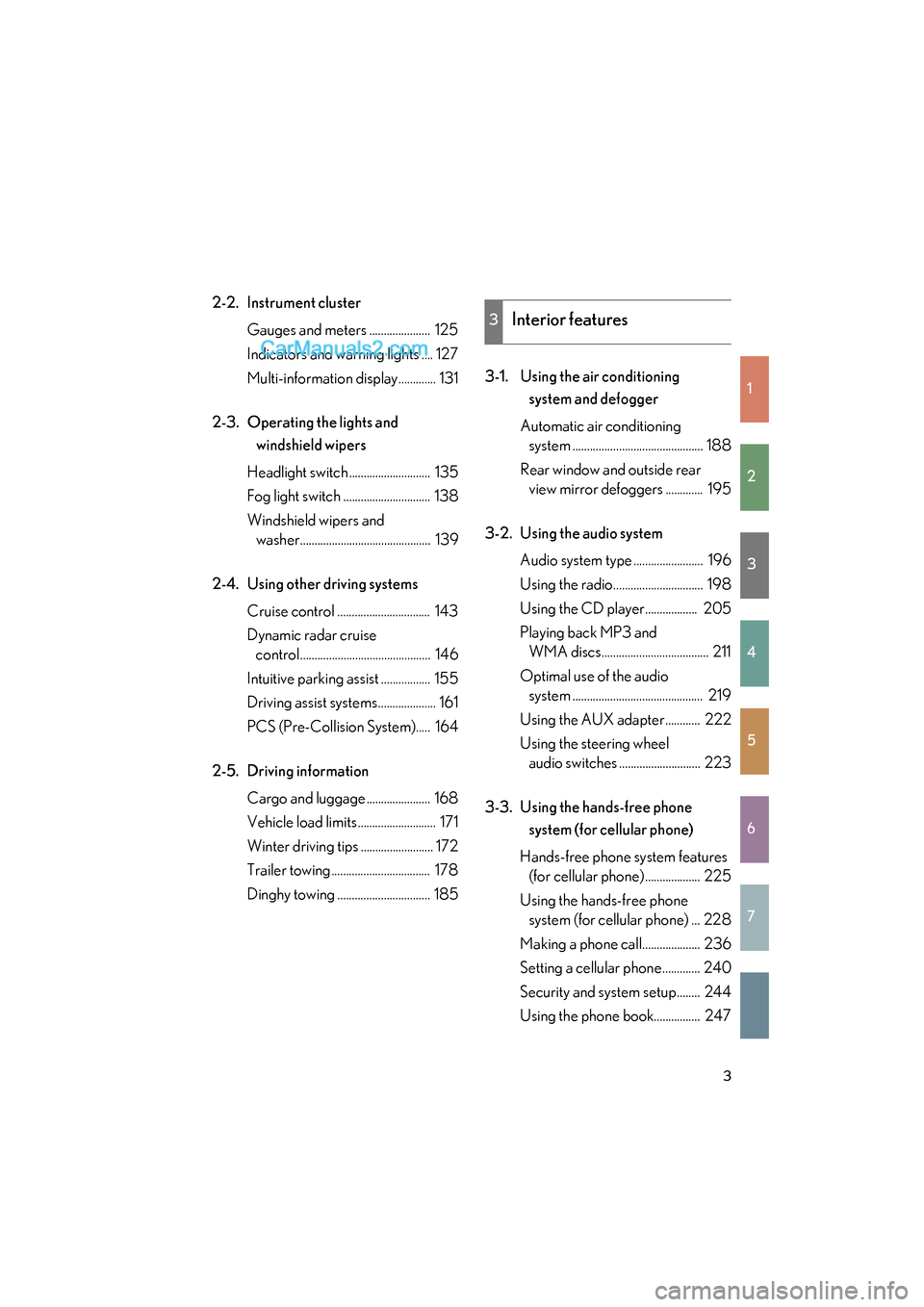
2-2. Instrument clusterGauges and meters ..................... 125
Indicators and warning lights .... 127
Multi-information display............. 131
2-3. Operating the lights and windshield wipers
Headlight switch ............................ 135
Fog light switch .............................. 138
Windshield wipers and washer............................................. 139
2-4. Using other driving systems Cruise control ................................ 143
Dynamic radar cruise control............................................. 146
Intuitive parking assist ................. 155
Driving assist systems.................... 161
PCS (Pre-Collision System)..... 164
2-5. Driving information Cargo and luggage ...................... 168
Vehicle load limits ........................... 171
Winter driving tips ......................... 172
Trailer towing .................................. 178
Dinghy towing ................................ 185 3-1. Using the air conditioning
system and defogger
Automatic air conditioning system ............................................. 188
Rear window and outside rear view mirror defoggers ............. 195
3-2. Using the audio system Audio system type ........................ 196
Using the radio............................... 198
Using the CD player.................. 205
Playing back MP3 and WMA discs..................................... 211
Optimal use of the audio system ............................................. 219
Using the AUX adapter............ 222
Using the steering wheel audio switches ............................ 223
3-3. Using the hands-free phone system (for cellular phone)
Hands-free phone system features (for cellular phone) ................... 225
Using the hands-free phone system (for cellular phone) ... 228
Making a phone call.................... 236
Setting a cellular phone............. 240
Security and system setup........ 244
Using the phone book................ 247
3Interior features
Page 109 of 475
When driving2
107
ES350_U_(L/O_0808)
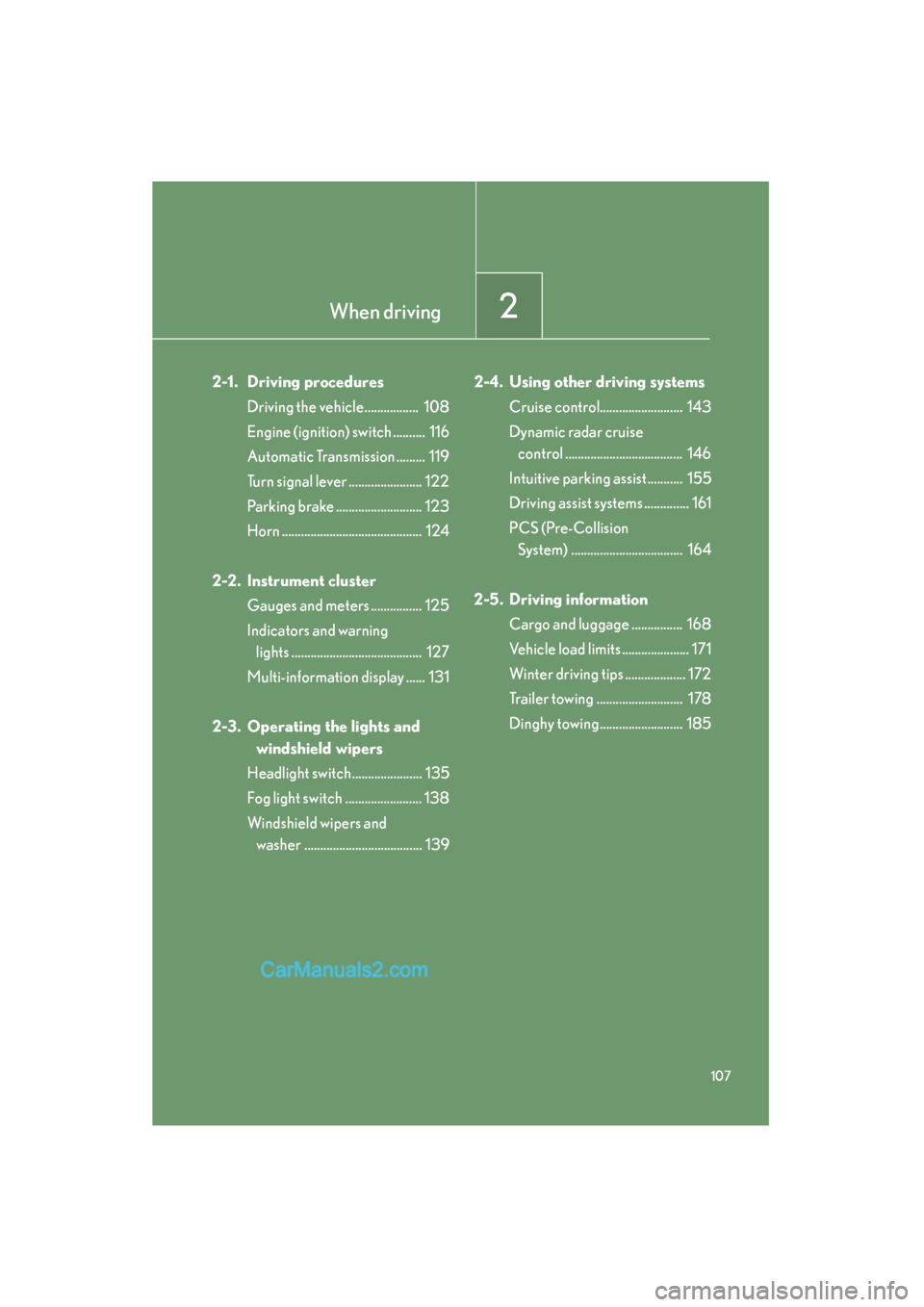
2-1. Driving proceduresDriving the vehicle................. 108
Engine (ignition) switch .......... 116
Automatic Transmission ......... 119
Turn signal lever ....................... 122
Parking brake ........................... 123
Horn ............................................ 124
2-2. Instrument cluster Gauges and meters ................ 125
Indicators and warning lights ......................................... 127
Multi-information display ...... 131
2-3. Operating the lights and windshield wipers
Headlight switch...................... 135
Fog light switch ........................ 138
Windshield wipers and washer ..................................... 139 2-4. Using other driving systems
Cruise control.......................... 143
Dynamic radar cruise control ..................................... 146
Intuitive parking assist ........... 155
Driving assist systems .............. 161
PCS (Pre-Collision System) ................................... 164
2-5. Driving information Cargo and luggage ................ 168
Vehicle load limits ..................... 171
Winter driving tips ................... 172
Trailer towing ........................... 178
Dinghy towing.......................... 185
Page 147 of 475
145
2-4. Using other driving systems
2
When driving
ES350_U_(L/O_0808)
■If the cruise control indicator light flashes
Turn the ON-OFF button off once, and then reactivate the system.
If the cruise control speed cannot be set or if the cruise control cancels immediately
after being activated, there may be a malfunction in the cruise control system. Have
the vehicle inspected by your Lexus dealer.
CAUTION
■To avoid inadvertent cruise control activation
Keep the ON-OFF button off when not in use.
■Situations unsuitable for cruise control
Do not use cruise control in any of the following situations.
Doing so may result in control of the vehicle being lost and could cause an accident
resulting in death or serious injury.
●In heavy traffic
●On roads with sharp bends
●On slippery roads, such as those covered with rain, ice or snow
●On steep hills
●On winding roads
●When towing a trailer
Page 155 of 475
153
2-4. Using other driving systems
2
When driving
ES350_U_(L/O_0808)
For vehicles sold in Canada
Operation is subject to the following two conditions;
(1) This device may not cause interference, and
(2) This device must accept any interference received, including interference that
may cause undesired operation of the device.
CAUTION
■Before using dynamic radar cruise control
Do not overly rely on vehicle-to-vehicle distance control.
Be aware of the set vehicle speed. If automatic deceleration/acceleration is not
appropriate, adjust the vehicle speed, as well as the distance between your vehicle
and vehicles ahead by applying the brakes, etc.
■To avoid inadvertent cruise control activation
Keep the ON-OFF button off when not in use.
■Situations unsuitable for dynamic radar cruise control
Do not use dynamic radar cruise control in any of the following situations.
Doing so may result in control of the vehicle being lost and could cause an accident
resulting in death or serious injury.
●In heavy traffic
●On roads with sharp bends
●On winding roads
●On slippery roads, such as those covered with rain, ice or snow.
●Where there are sudden changes between sharp up and down gradients
●At entrances to expressways
●When weather conditions are bad enough that they may prevent the sensors
from functioning correctly (fog, snow, sandstorm, etc.)
●Where buzzer can be heard often
●When towing a trailer
Page 156 of 475
154
2-4. Using other driving systems
ES350_U_(L/O_0808)
CAUTION
■When the radar sensor may not be correctly detecting the vehicle ahead
Apply the brakes as necessary when any of the following types of vehicles are in
front of you.
As the sensor may not be able to correctly detect these types of vehicles, the prox-
imity alarm (→P. 386) will not be activated, and an accident may result.
●Vehicles that cut in suddenly
●Vehicles traveling at low speeds
●Vehicles that are not moving
●Vehicles with small rear ends (trailers with no load on board etc.)
●Motorcycles traveling in the same lane
■Conditions under which the vehicle-to-vehicle distance control may not function
correctly
Apply the brakes as necessary in the following conditions as the radar sensor may
not be able to correctly detect vehicles ahead, and an accident may result.
●When water or snow thrown up by the surrounding vehicles hinders the function-
ing of the sensor
●When your vehicle is pointing upwards (caused by a heavy load in the trunk, etc.)
●When the road curves or when the lanes are narrow
●When steering wheel operation or your position in the lane is unstable
■To ensure the radar sensor functions correctly
Do not do the following to the sensor or grille cover as doing so may cause the sen-
sor not to function correctly and could result in an accident.
●Stick or attach anything to them
●Leave them dirty
●Disassemble, subject them to strong shocks
●Modify or paint them
●Replace them with non-genuine parts
Page 171 of 475
169
2-5. Driving information
2
When driving
ES350_U_(L/O_0808)(6) If your vehicle will be towing a trailer, load from your trailer will be
transferred to your vehicle. Consult this manual to determine how this
reduces the available cargo and luggage load capacity of your vehi-
cle. (→ P. 178)
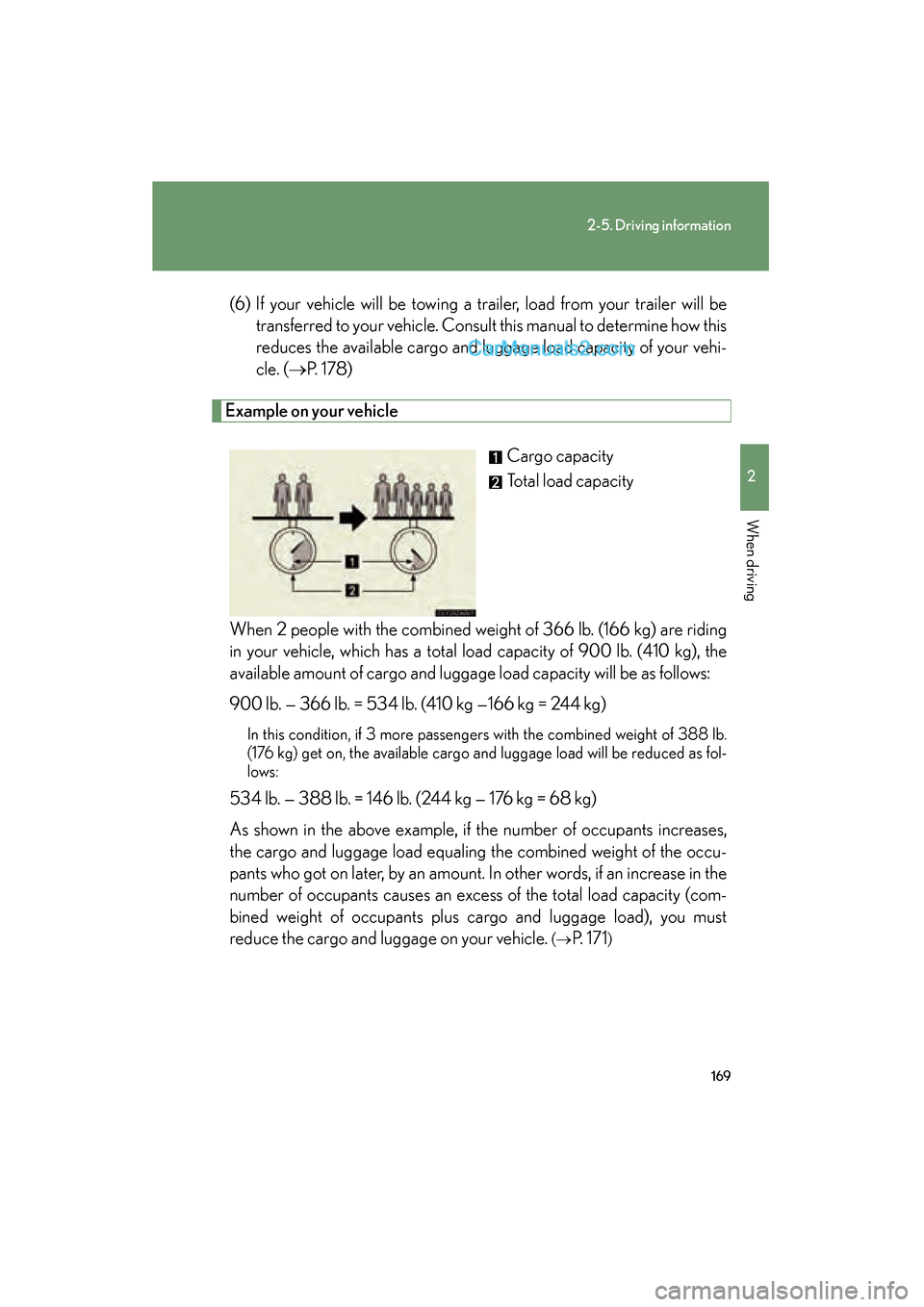
Example on your vehicle
Cargo capacity
Total load capacity
When 2 people with the combined weight of 366 lb. (166 kg) are riding
in your vehicle, which has a total load capacity of 900 lb. (410 kg), the
available amount of cargo and luggage load capacity will be as follows:
900 lb. — 366 lb. = 534 lb. (410 kg —166 kg = 244 kg)
In this condition, if 3 more passengers with the combined weight of 388 lb.
(176 kg) get on, the available cargo and luggage load will be reduced as fol-
lows:
534 lb. — 388 lb. = 146 lb. (244 kg — 176 kg = 68 kg)
As shown in the above example, if the number of occupants increases,
the cargo and luggage load equaling the combined weight of the occu-
pants who got on later, by an amount. In other words, if an increase in the
number of occupants causes an excess of the total load capacity (com-
bined weight of occupants plus cargo and luggage load), you must
reduce the cargo and luggage on your vehicle.
( →P. 1 7 1)
Page 180 of 475
178
2-5. Driving information
ES350_U_(L/O_0808)
Trailer towing
Your vehicle is designed primarily as a passenger-carrying vehicle, thus
towing a trailer will have an adverse effect on handling, performance, brak-
ing, durability, and fuel consumption. For your safety and the safety of oth-
ers, do not overload the vehicle or trailer.
Lexus warranties do not apply to damage or malfunction caused by towing
a trailer for commercial purposes
■Weight limits
Confirm the total trailer weight, gross vehicle weight, gross axle
weight and trailer tongue load are all within the limits.
■ Gross vehicle weight
The gross vehicle weight must not exceed the Gross Vehicle Weight
Rating (GVWR) indicated on the Certification Label. The gross
vehicle weight is the sum weight of the unloaded vehicle, driver, pas-
sengers, luggage, hitch and trailer tongue load. Also included is the
weight of any special equipment installed on your vehicle.
■ Gross axle weight
The load on either the front or rear axle resulting from distribution of
the gross vehicle weight on both axles must not exceed the Gross
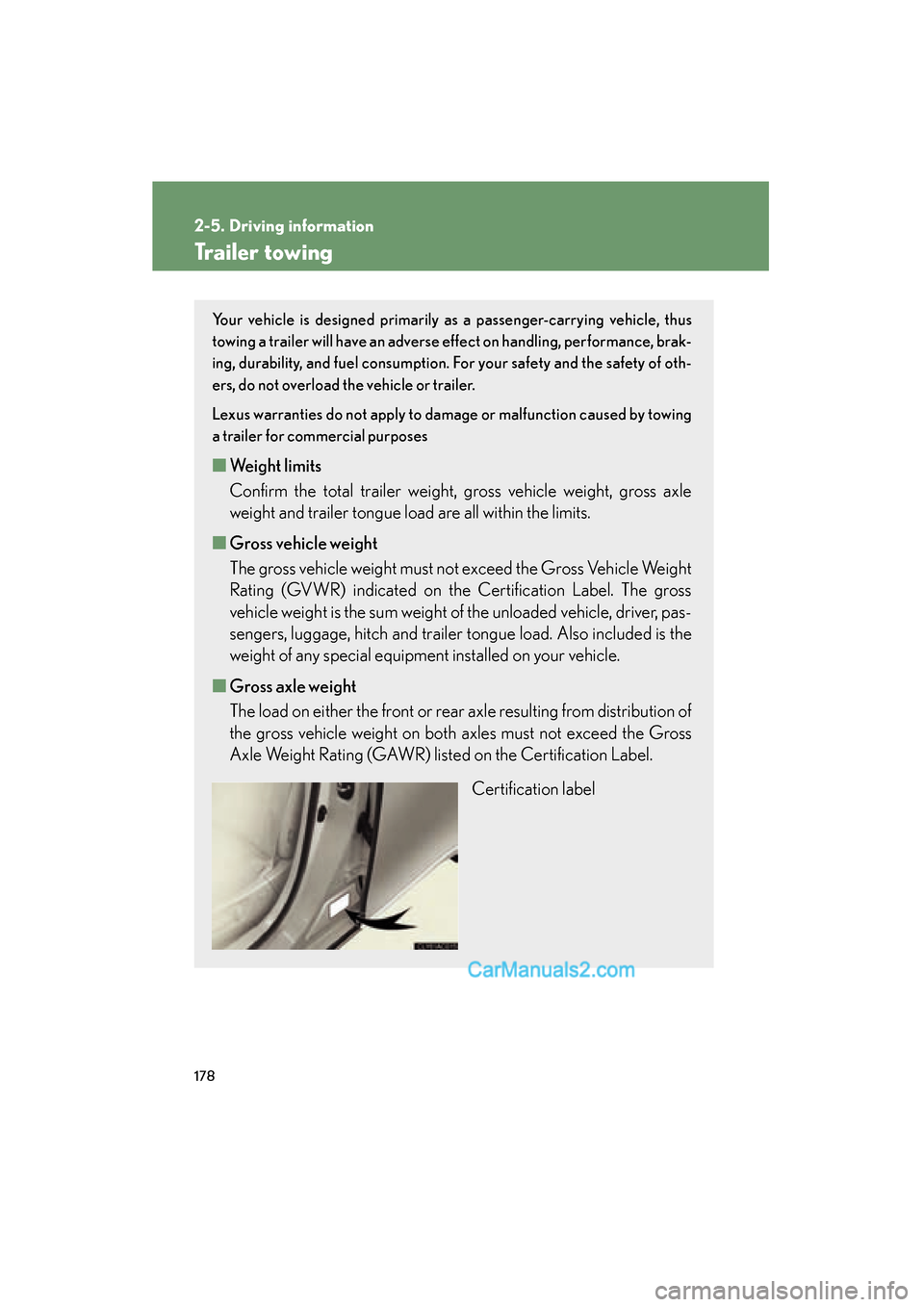
Axle Weight Rating (GAWR) listed on the Certification Label.
Certification label
Page 181 of 475
179
2-5. Driving information
2
When driving
ES350_U_(L/O_0808)
Towing a trailerConsult your Lexus dealer for further information on additional require-
ments such as a towing kits, etc.
■ Trailer tongue load
The trailer cargo load should be distributed so that the tongue load
is 9 to 11% of the total trailer weight, not exceeding the maximum
100 lb. (45 kg). (Tongue load / Tota l trailer weight x 100 = 9 to 11%)
The total trailer weight and tongue load can be measured with plat-
form scales found at a highway weighing stations, building supply
company, trucking company, junk yards, etc.
Total trailer weight
Tongue load
Page 182 of 475
180
2-5. Driving information
ES350_U_(L/O_0808)
■Before towing
●Ensure that your vehicle’s tires are properly inflated. (→P. 3 3 4 )
●Trailer tires should be inflated according to the trailer manufacturer's recom-
mendation.
●All trailer lights work to be legal.
●Confirm all lights work each time you connect them.
●Check that your vehicle remains level when a loaded or unloaded trailer is
hitched. Do not drive if the vehicle is not level, and check for improper tongue
load, overloading, worn suspension, or other possible causes.
●Make sure the trailer cargo is securely loaded.
●Check that your rear view mirrors conform to any federal, state/provincial or
local regulations. If they do not, install rear view mirrors appropriate for towing
purposes.
■Break-in schedule
Lexus recommends that you do not use a new vehicle or a vehicle with any new
power train components (engine, transmission, differential, wheel bearings, etc.) to
tow a trailer for the first 500 miles (800 km) of driving.
■Maintenance
●If you tow a trailer, your vehicle will require more frequent maintenance due to
the additional load. (See “Warranty and Services Guide/Owner's Manual Sup-
plement/ Scheduled Maintenance”.)
●Retighten the fixing bolts of the towing ball and bracket after approximately
600 miles (1000 km) of trailer towing.
CAUTION
■To avoid accident or injury
●The total trailer weight (trailer weight plus the weight of cargo) must not exceed
1000 lb. (450 kg).
●Do not exceed the trailer hitch assembly weight, gross vehicle weight, gross axle
weight and trailer tongue load capacities.
●Never load more weight in the back than in the front of the trailer. About 60% of
the load should be in the front half of the trailer, and the remaining 40% in the
r e a r.
Page 183 of 475
181
2-5. Driving information
2
When driving
ES350_U_(L/O_0808)
CAUTION
■Hitches
Trailer hitch assemblies have different weight capacities established by the hitch
manufacturer. Even though the vehicle may be physically capable of towing a
higher weight, the operator must never exceed the maximum weight rating speci-
fied for the trailer hitch.
●If you wish to install a trailer hitch, your Lexus dealer should be consulted.
●Use only a hitch that conforms to the total trailer weight requirement.
●Follow the directions supplied by the hitch manufacturer.
●Lubricate the hitch ball with a light coat of grease.
●Remove the trailer hitch whenever you are not towing a trailer. After removing
the hitch, seal any mounting holes in the vehicle body to prevent entry of any sub-
stances into the vehicle.
■When towing a trailer
●Never tap into your vehicle's hydraulic system, as this will lower the vehicle's
braking effectiveness.
●Never tow a trailer without using a safety chain securely attached to both the
trailer and the vehicle. If damage occurs to the coupling unit or hitch ball, there is
danger of the trailer wandering into another lane.
●Do not use cruise control/dynamic radar cruise control.
Doing so may result in inappropriate control of speed and could cause serious or
fatal accident.
NOTICE
■When installing a trailer hitch
●Use only the position recommended by your Lexus dealer. Do not install the
trailer hitch on the bumper; this may cause body damage.
●Do not use axle-mounted hitches, as they can cause damage to the axle housing,
wheel bearings, wheels or tires.
■Brakes
Lexus recommends trailers with brakes that conform to any applicable federal and
state/provincial regulations.