pedal Lexus ES350 2009 Owner's Guide
[x] Cancel search | Manufacturer: LEXUS, Model Year: 2009, Model line: ES350, Model: Lexus ES350 2009Pages: 475, PDF Size: 6.2 MB
Page 279 of 475
277
3-6. Other interior features
3
Interior features
ES350_U_(L/O_0808)
Floor mat
CAUTION
■When inserting the floor mat
Observe the following precautions.
Failure to do so may result in the floor mat slipping and interfering with the move-
ment of the pedals during driving, resulting in an accident.
●Make sure the floor mat is properly placed on the vehicle carpet and the correct
side faces upward.
●Do not place floor mats on top of existing mats.
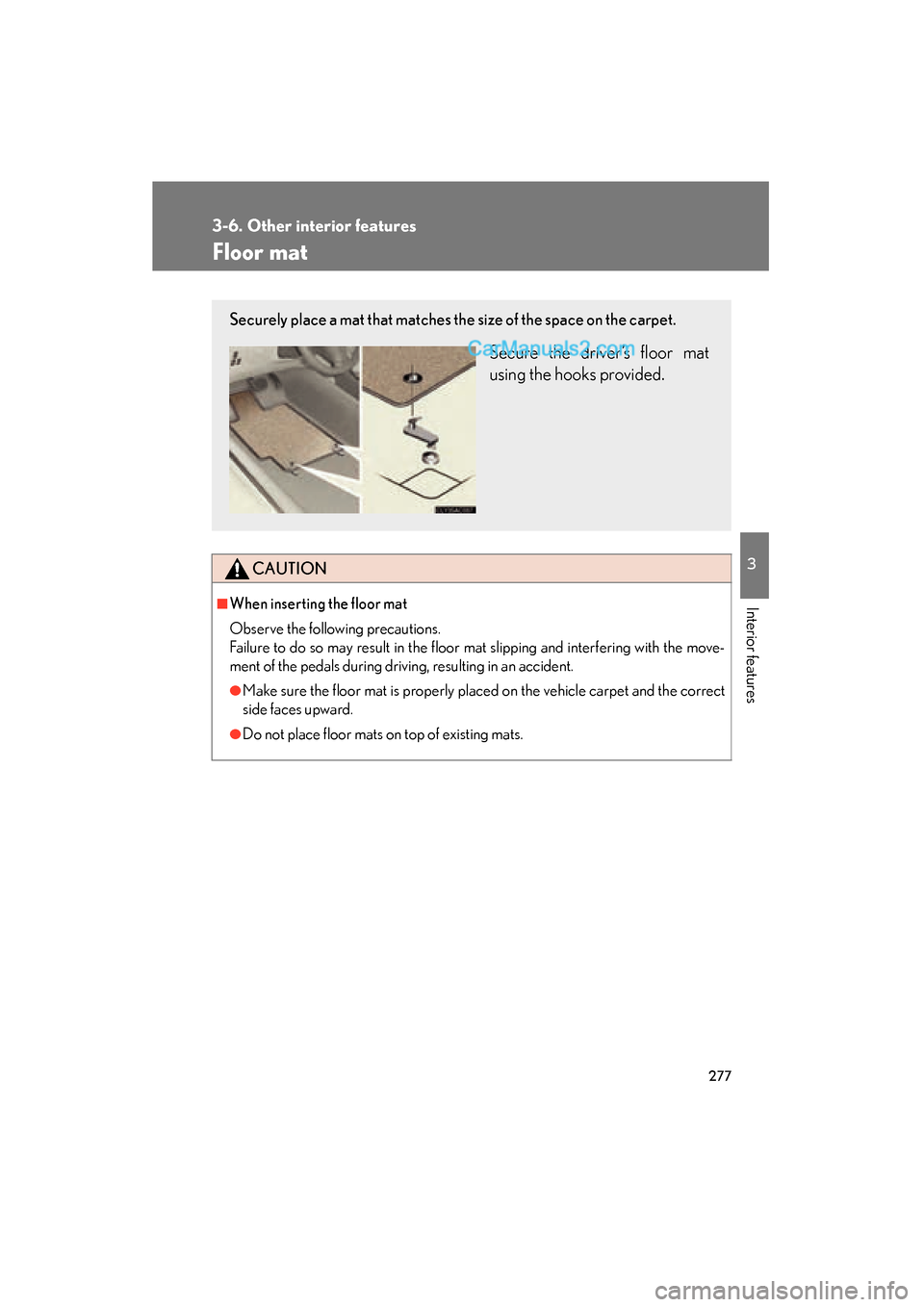
Securely place a mat that matches the size of the space on the carpet.
Secure the driver’s floor mat
using the hooks provided.
Page 303 of 475
301
4-2. Maintenance
4
Maintenance and care
ES350_U_(L/O_0808)
Vehicle interior
ItemsCheck points
Accelerator pedal• Moves smoothly (without uneven pedal effort or catching)?
Automatic transmission “Park”
mechanism• Can the vehicle be hold securely on an incline with the shift lever in
P?
Brake pedal
• Moves smoothly?
• Does it have appropriate clearance and correct amount of free play?
Brakes
• Not pull to one side when applied?
• Loss of brake effectiveness?
• Spongy feeling brake pedal?
• Pedal almost touches floor?
Head restraints• Move smoothly and lock securely?
Indicators/buzzers• Function properly?
Lights
• Do all the lights come on?
• Headlights aimed correctly? (→ P. 3 5 2 )
Parking brake
• Moves smoothly?
• Can hold the vehicle securely on
an incline?
Seat belts
• Does the seat belt system operate smoothly?
• Are the belts undamaged?
Seats• Do the seat controls operate prop- erly?
Page 373 of 475
5
When trouble arises
371
5-1. Essential information
ES350_U_(L/O_0808)
If you think something is wrong
If you notice any of the following symptoms, your vehicle probably needs
adjustment or repair. Contact your Lexus dealer as soon as possible.
■Visible symptoms
●Fluid leaks under the vehicle
(Water dripping from the air conditioning after use is normal.)
● Flat-looking tires or uneven tire wear
● Engine coolant temperature gauge needle continually points
higher than normal
■ Audible symptoms
●Changes in exhaust sound
● Excessive tire squeal when cornering
● Strange noises related to the suspension system
● Pinging or other noises related to the engine
■ Operational symptoms
●Engine missing, stumbling or running rough
● Appreciable loss of power
● Vehicle pulls heavily to one side when braking
● Vehicle pulls heavily to one side when driving on a level road
● Loss of brake effectiveness, spongy feeling, pedal almost touches
the floor
Page 375 of 475
5
When trouble arises
373
5-1. Essential information
ES350_U_(L/O_0808)
Event data recorder
In a crash or a near car crash eventThe SRS airbag sensor assembly contains the EDR. In a crash or a near
car crash event, this device may record some or all of the following infor-
mation:
● Engine speed
● Whether the brake pedal was applied or not
● Vehicle speed
● To what extent the accelerator pedal was depressed
● Position of the transmission shift lever
● Whether the driver and front passenger wore seat belts or not
● Driver's seat position
● SRS airbag deployment data
● SRS airbag system diagnostic data
● Front passenger's occupant classification
The information above is intended to be used for the purpose of improv-
ing vehicle safety performance. Unlike general data recorders, the EDR
does not record sound data such as conversation between passengers.
Your vehicle has computers that monitor and control certain aspects of
your vehicle. These computers assist in driving and maintaining optimal
vehicle performance.
Besides storing data useful for troubleshooting, there is a system to
that record data in a crash or a near car crash event.
Page 395 of 475
5
When trouble arises
393
5-2. Steps to take in an emergency
ES350_U_(L/O_0808)
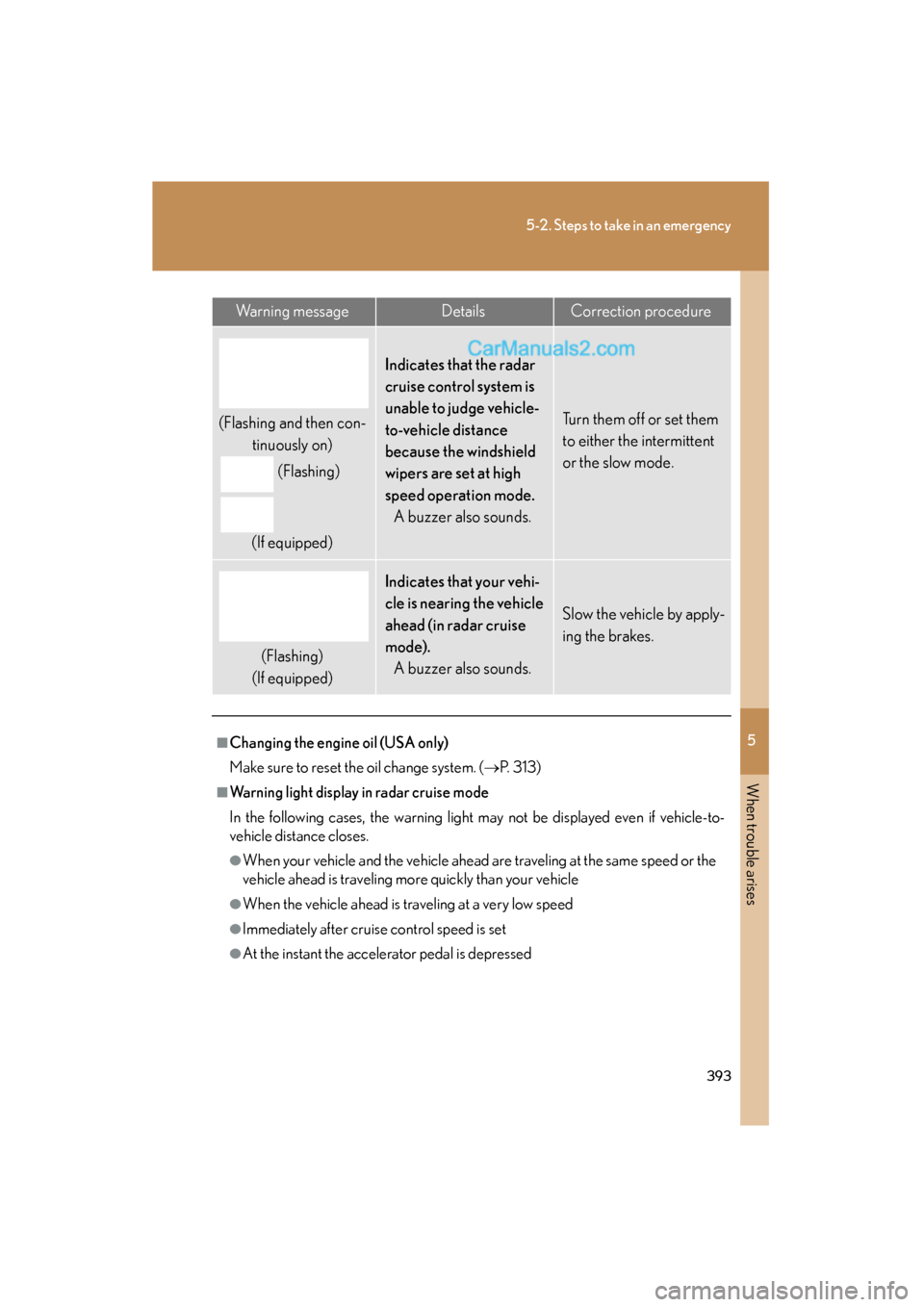
Warning messageDetailsCorrection procedure
(Flashing and then con-tinuously on)
(Flashing)
(If equipped)
Indicates that the radar
cruise control system is
unable to judge vehicle-
to-vehicle distance
because the windshield
wipers are set at high
speed operation mode. A buzzer also sounds.
Turn them off or set them
to either the intermittent
or the slow mode.
(Flashing)
(If equipped)
Indicates that your vehi-
cle is nearing the vehicle
ahead (in radar cruise
mode). A buzzer also sounds.
Slow the vehicle by apply-
ing the brakes.
■Changing the engine oil (USA only)
Make sure to reset the oil change system. ( →P. 313)
■Warning light display in radar cruise mode
In the following cases, the warning light may not be displayed even if vehicle-to-
vehicle distance closes.
●When your vehicle and the vehicle ahead are traveling at the same speed or the
vehicle ahead is traveling more quickly than your vehicle
●When the vehicle ahead is traveling at a very low speed
●Immediately after cruise control speed is set
●At the instant the accelerator pedal is depressed
Page 398 of 475
396
5-2. Steps to take in an emergency
ES350_U_(L/O_0808)*: If the engine does not start when the electronic key is inside the vehicle,
the electronic key battery may be de pleted or there may be difficulties
receiving the signal from the key. ( →P. 2 6 )
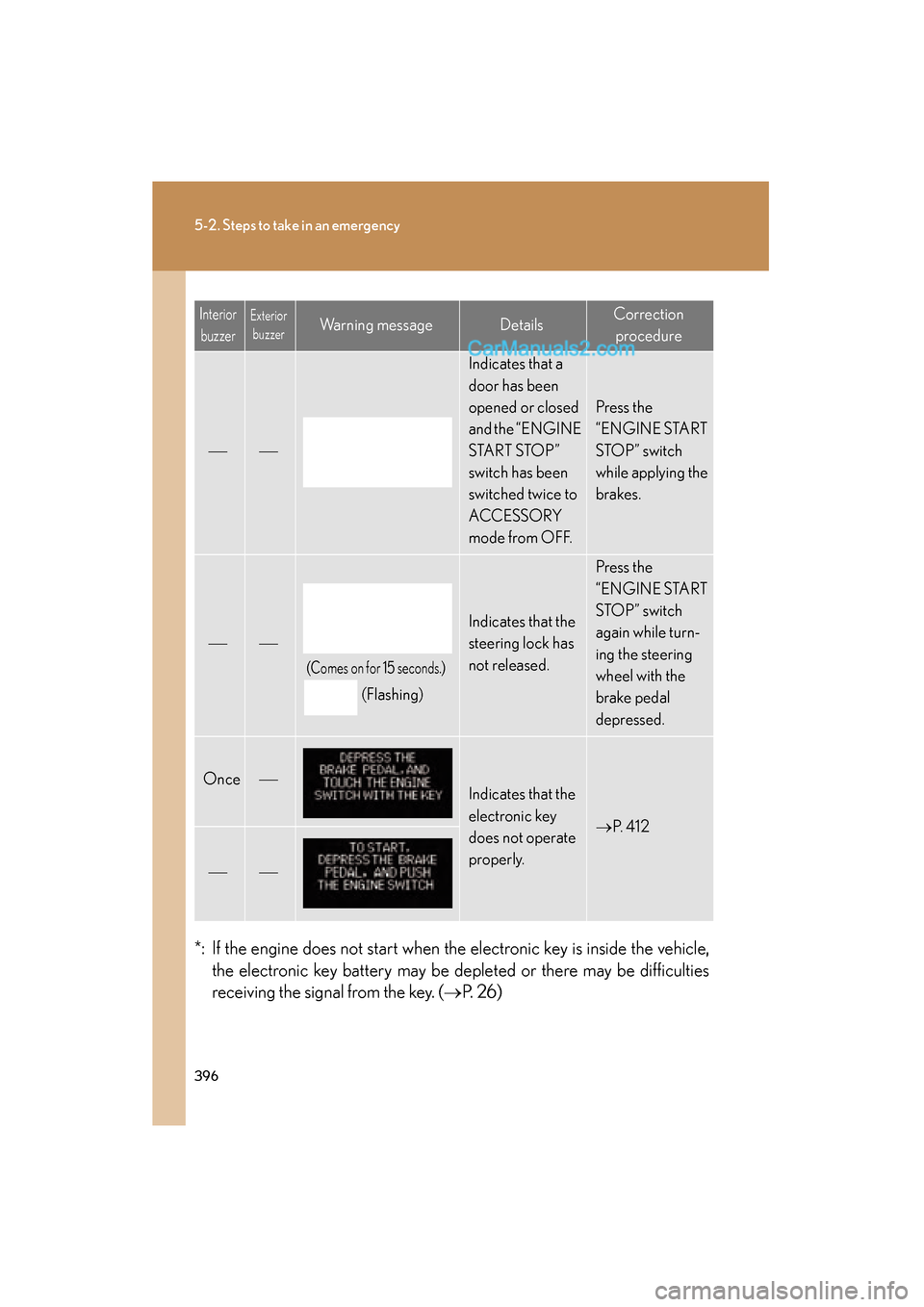
Interior
buzzerExterior buzzerWarning messageDetailsCorrection
procedure
Indicates that a
door has been
opened or closed
and the “ENGINE
S TA R T S TO P ”
switch has been
switched twice to
ACCESSORY
mode from OFF.
Press the
“ENGINE START
STOP” switch
while applying the
brakes.
(Comes on for 15 seconds.)
(Flashing)
Indicates that the
steering lock has
not released.
Press the
“ENGINE START
STOP” switch
again while turn-
ing the steering
wheel with the
brake pedal
depressed.
OnceIndicates that the
electronic key
does not operate
properly.
→ P. 4 1 2
Page 410 of 475
408
5-2. Steps to take in an emergency
ES350_U_(L/O_0808)
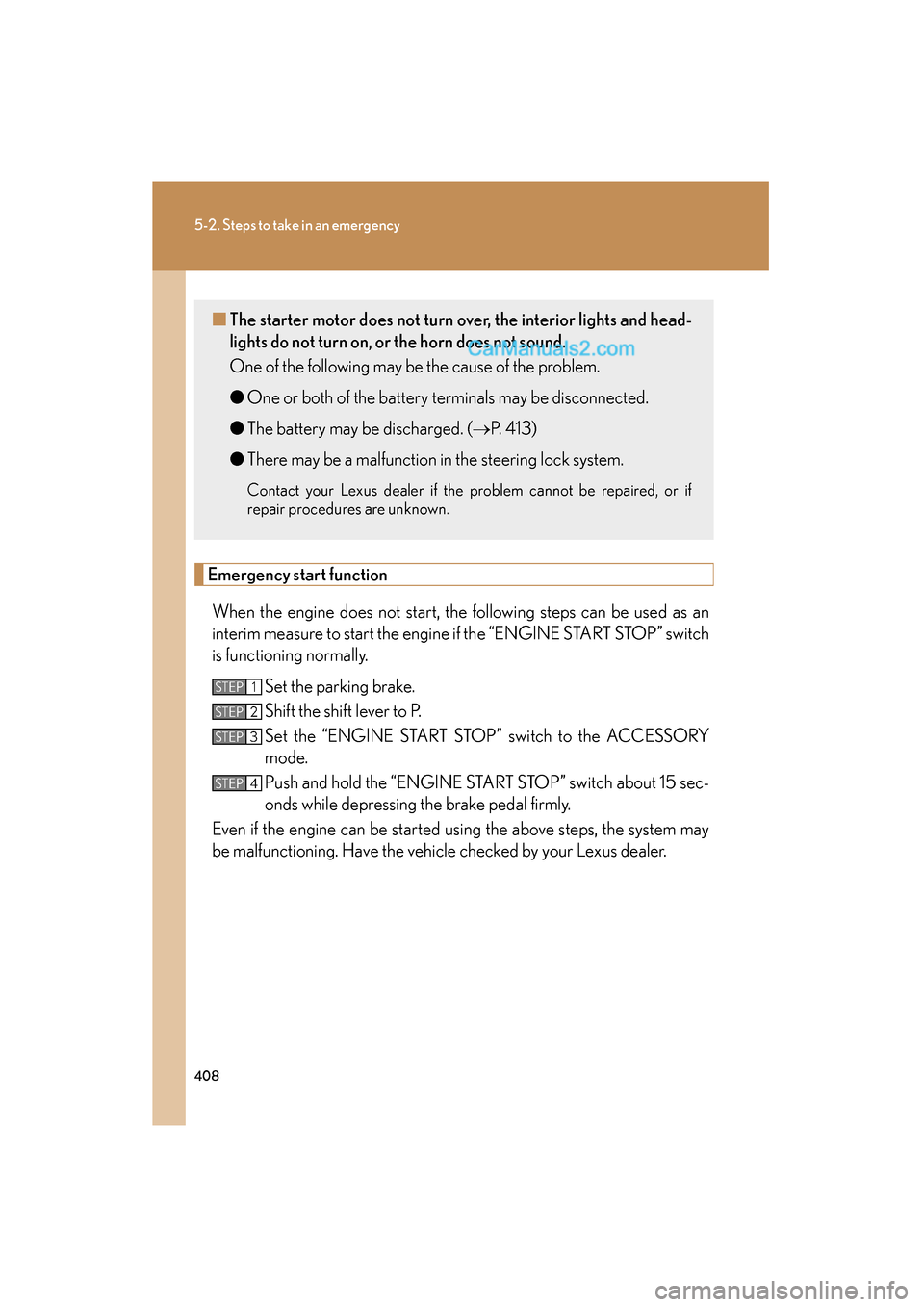
Emergency start functionWhen the engine does not start, the following steps can be used as an
interim measure to start the engine if the “ENGINE START STOP” switch
is functioning normally. Set the parking brake.
Shift the shift lever to P.
Set the “ENGINE START STOP” switch to the ACCESSORY
mode.
Push and hold the “ENGINE START STOP” switch about 15 sec-
onds while depressing the brake pedal firmly.
Even if the engine can be started using the above steps, the system may
be malfunctioning. Have the vehicle checked by your Lexus dealer.
■ The starter motor does not turn over, the interior lights and head-
lights do not turn on, or the horn does not sound.
One of the following may be the cause of the problem.
● One or both of the battery terminals may be disconnected.
● The battery may be discharged. ( →P. 413)
● There may be a malfunction in the steering lock system.
Contact your Lexus dealer if the problem cannot be repaired, or if
repair procedures are unknown.
STEP1
STEP2
STEP3
STEP4
Page 411 of 475
5
When trouble arises
409
5-2. Steps to take in an emergency
ES350_U_(L/O_0808)
If the shift lever cannot be shifted from P
If the shift lever cannot be shifted with your foot on the brake, there may be
a problem with the shift lock system (a system to prevent accidental opera-
tion of the shift lever). Have the vehicle inspected by your Lexus dealer
immediately.
The following steps may be used as an emergency measure to ensure that
the shift lever can be shifted.
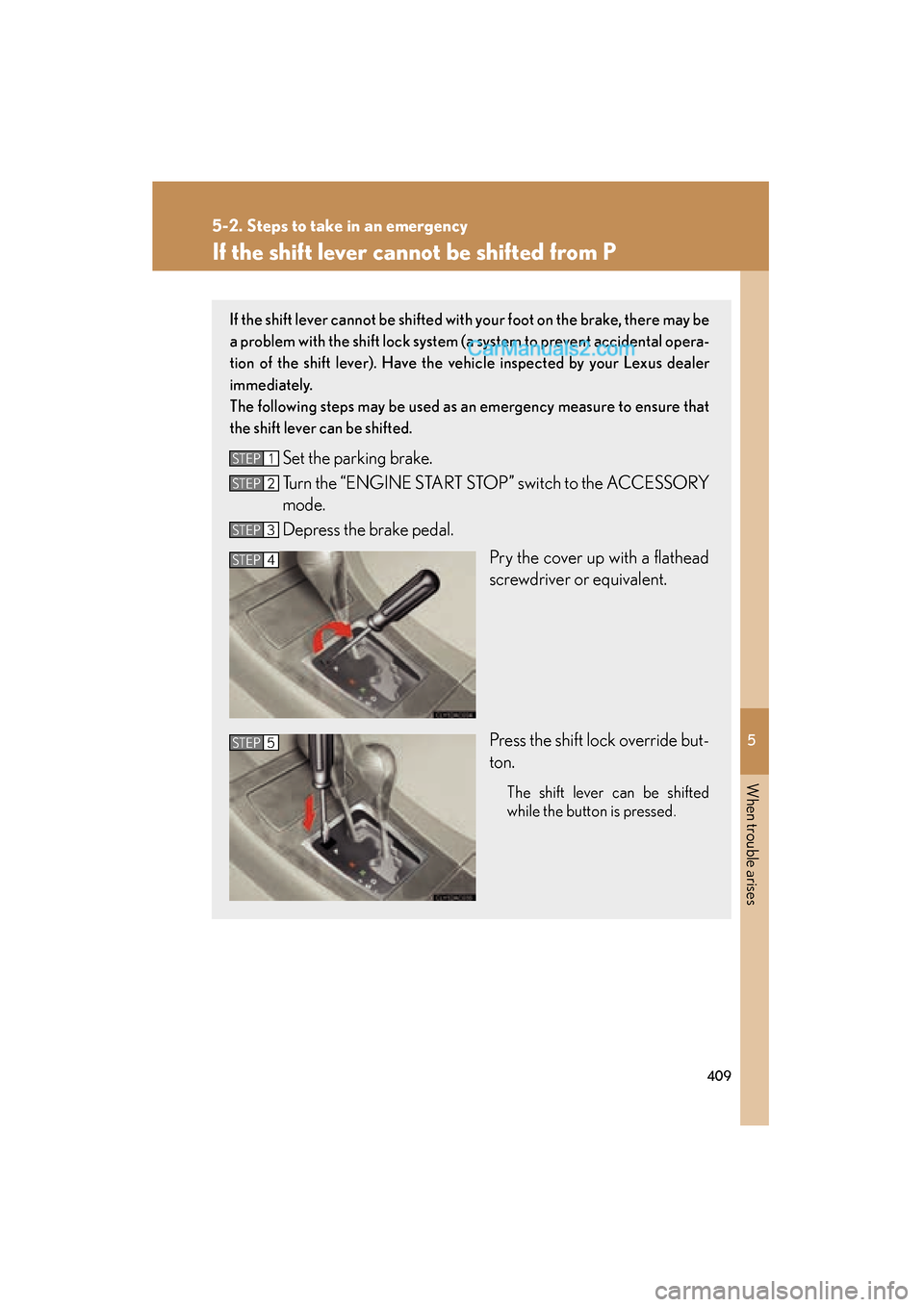
Set the parking brake.
Turn the “ENGINE START STOP” switch to the ACCESSORY
mode.
Depress the brake pedal.
Pry the cover up with a flathead
screwdriver or equivalent.
Press the shift lock override but-
ton.
The shift lever can be shifted
while the button is pressed.
STEP1
STEP2
STEP3
STEP4
STEP5
Page 414 of 475
412
5-2. Steps to take in an emergency
ES350_U_(L/O_0808)
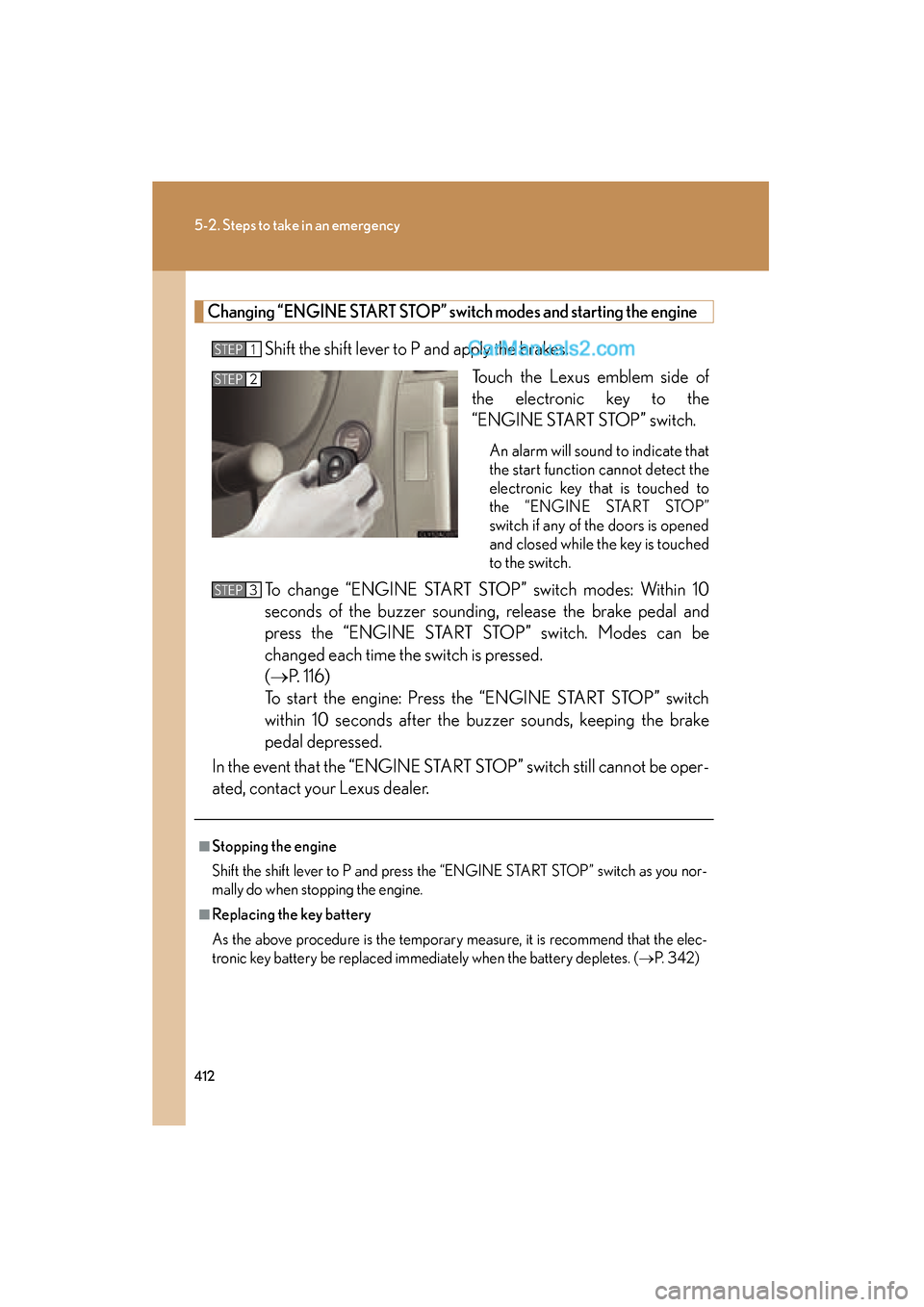
Changing “ENGINE START STOP” switch modes and starting the engine
Shift the shift lever to P and apply the brakes.Touch the Lexus emblem side of
the electronic key to the
“ENGINE START STOP” switch.
An alarm will sound to indicate that
the start function cannot detect the
electronic key that is touched to
the “ENGINE START STOP”
switch if any of the doors is opened
and closed while the key is touched
to the switch.
To change “ENGINE START ST OP” switch modes: Within 10
seconds of the buzzer sounding, release the brake pedal and
press the “ENGINE START STOP” switch. Modes can be
changed each time the switch is pressed.
(→ P. 1 1 6 )
To start the engine: Press the “ENGINE START STOP” switch
within 10 seconds after the buzzer sounds, keeping the brake
pedal depressed.
In the event that the “ENGINE START STOP” switch still cannot be oper-
ated, contact your Lexus dealer.
STEP1
STEP2
■Stopping the engine
Shift the shift lever to P and press the “ENGINE START STOP” switch as you nor-
mally do when stopping the engine.
■Replacing the key battery
As the above procedure is the temporary measure, it is recommend that the elec-
tronic key battery be replaced immediately when the battery depletes. ( →P. 3 4 2 )
STEP3
Page 421 of 475
5
When trouble arises
419
5-2. Steps to take in an emergency
ES350_U_(L/O_0808)
If the vehicle becomes stuck
CAUTION
■When attempting to free a stuck vehicle
If you choose to rock the vehicle back and forth to free it, make sure the surround-
ing area is clear, to avoid striking other vehicles, objects or persons. The vehicle
may also lunge forward or lunge back suddenly as it becomes free. Use extreme
caution.
■When shifting the shift lever
Be careful not to shift the shift lever with the accelerator pedal depressed.
This may lead to unexpected rapid acceleration of the vehicle that may cause an
accident and result in death or serious injury.
NOTICE
■To avoid damaging the transmission and other components
●Avoid spinning the wheels and do not rev the engine.
●If the vehicle remains stuck after trying these procedures, the vehicle may require
towing to be freed.
Carry out the following procedures if the tires spin or the vehicle becomes
stuck in mud, dirt, or snow.
●Stop the engine. Set the parking brake and put the shift lever in P.
● Remove the mud, snow, or sand from around the stuck tire.
● Place wood, stones or some other material to help provide trac-
tion under the tires.
● Restart the engine.
● Carefully apply the accelerator to free the vehicle.