tow Lexus ES350 2009 Owner's Guide
[x] Cancel search | Manufacturer: LEXUS, Model Year: 2009, Model line: ES350, Model: Lexus ES350 2009Pages: 475, PDF Size: 6.2 MB
Page 335 of 475
333
4-3. Do-it-yourself maintenance
4
Maintenance and care
ES350_U_(L/O_0808)
CAUTION
■When inspecting or replacing tires
Observe the following precautions to prevent accidents.
Failure to do so may cause damage to parts of the drive train, as well as dangerous
handling characteristics, which may lead to an accident resulting in death or serious
injury.
●Do not mix tires of different makes, models or tread patterns. Also, do not mix
tires of remarkably different treadwear.
●Do not use tire sizes other than those recommended by Lexus.
●Do not mix differently constructed tires (radial, bias-belted or bias-ply tires).
●Do not mix summer, all season and winter tires.
●Do not tow the vehicle with the compact spare tire installed.
■When initializing the tire pressure warning system
Do not push the tire pressure warning reset switch without first adjusting the tire
inflation pressure to the specified level. Otherwise, the tire pressure warning light
may not come on even if the tire inflation pressure is low, or it may come on when
the tire inflation pressure is actually normal.
NOTICE
■Repairing or replacing tires, wheels and tire pressure warning valves and trans-
mitters
When removing or fitting the wheels, tires or the tire pressure warning valve and
transmitter, contact your Lexus dealer as the tire pressure warning valve and trans-
mitter may be damaged if not handled correctly.
■To avoid damaging the tire pressu re warning valves and transmitters
Do not use liquid sealants on flat tires.
■Driving on rough roads
Take particular care when driving on roads with loose surfaces or potholes.
These conditions may cause losses in tire inflation pressure, reducing the cushion-
ing ability of the tires. In addition driving on rough roads may cause damage to the
tires themselves, as well as the vehicle’s wheels and body.
■If tire inflation pressures become low while driving
Do not continue driving, or your tires and/or wheels may be ruined.
Page 365 of 475
When trouble arises5
363
ES350_U_(L/O_0808)
5-1. Essential informationEmergency flashers .............. 364
If your vehicle needs to be towed ................................ 365
If you think something is wrong ................................... 371
Fuel pump shut off system ..................................... 372
Event data recorder.............. 373
5-2. Steps to take in an emergency
If a warning light turns on or a warning buzzer
sounds..................................... 375
If a warning message is displayed................................ 386
If you have a flat tire............... 397
If the engine will not start .... 407
If the shift lever cannot be shifted from P ....................... 409
If you lose your keys ............... 410
If the electronic key does not operate properly............ 411
If the vehicle battery is discharged ............................. 413
If your vehicle overheats ...... 416
If the vehicle becomes stuck......................................... 419
Page 367 of 475
5
When trouble arises
365
5-1. Essential information
ES350_U_(L/O_0808)
If your vehicle needs to be towed
Before towingThe following may indicate a problem with your transmission. Contact
your Lexus dealer before towing.
● The engine is running, but the vehicle will not move.
● The vehicle makes an abnormal sound.
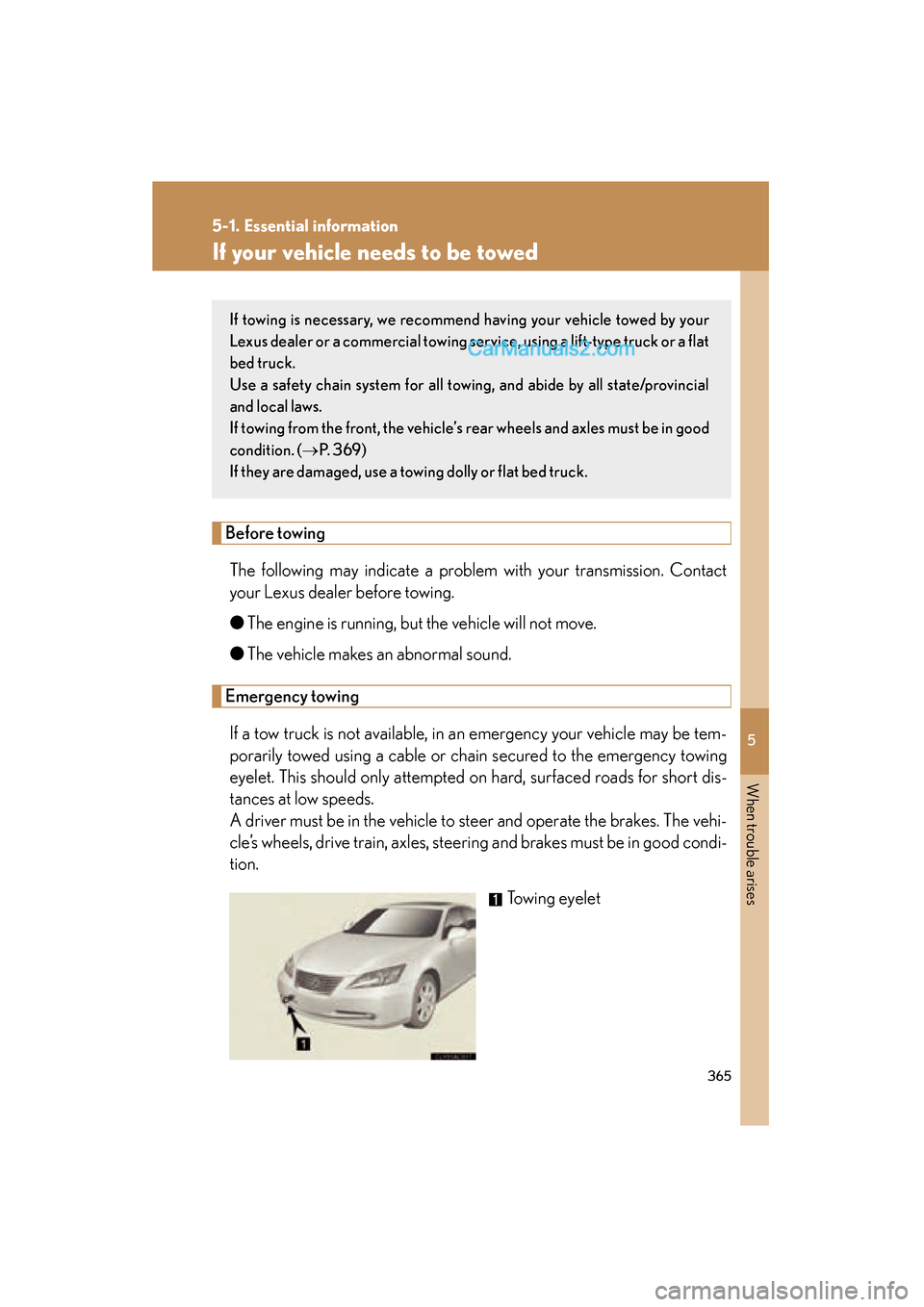
Emergency towing
If a tow truck is not available, in an emergency your vehicle may be tem-
porarily towed using a cable or chain secured to the emergency towing
eyelet. This should only attempted on hard, surfaced roads for short dis-
tances at low speeds.
A driver must be in the vehicle to steer and operate the brakes. The vehi-
cle’s wheels, drive train, axles, steering and brakes must be in good condi-
tion. Towing eyelet
If towing is necessary, we recommend having your vehicle towed by your
Lexus dealer or a commercial towing se rvice, using a lift-type truck or a flat
bed truck.
Use a safety chain system for all towing, and abide by all state/provincial
and local laws.
If towing from the front, the vehicle’s rear wheels and axles must be in good
condition. ( →P. 3 6 9 )
If they are damaged, use a towing dolly or flat bed truck.
Page 368 of 475
366
5-1. Essential information
ES350_U_(L/O_0808)
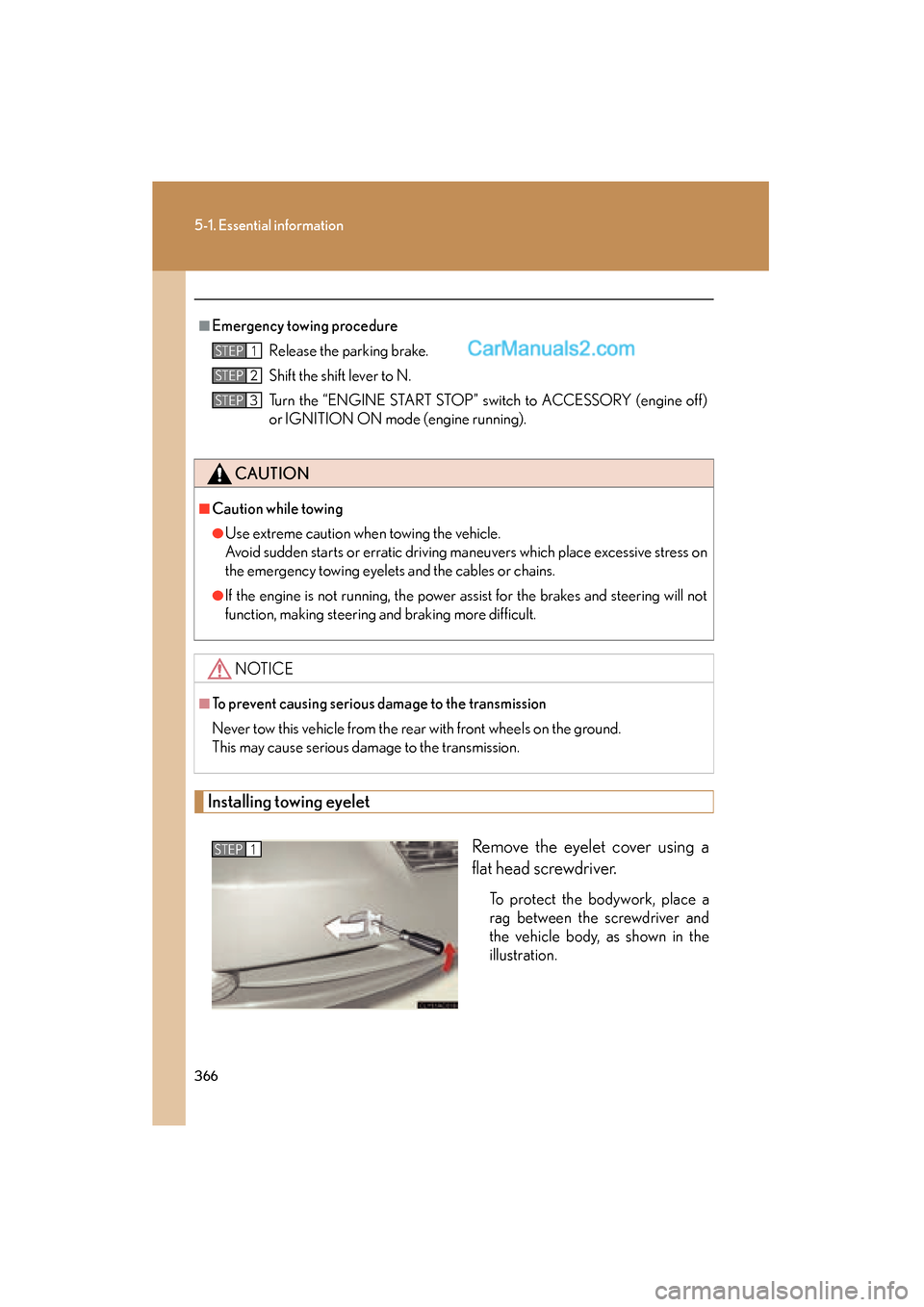
Installing towing eyeletRemove the eyelet cover using a
flat head screwdriver.
To protect the bodywork, place a
rag between the screwdriver and
the vehicle body, as shown in the
illustration.
■Emergency towing procedureRelease the parking brake.
Shift the shift lever to N.
Turn the “ENGINE START STOP” switch to ACCESSORY (engine off)
or IGNITION ON mode (engine running).
CAUTION
■Caution while towing
●Use extreme caution when towing the vehicle.
Avoid sudden starts or erratic driving maneuvers which place excessive stress on
the emergency towing eyelets and the cables or chains.
●If the engine is not running, the power assist for the brakes and steering will not
function, making steering and braking more difficult.
NOTICE
■To prevent causing serious da mage to the transmission
Never tow this vehicle from the rear with front wheels on the ground.
This may cause serious damage to the transmission.
STEP1
STEP2
STEP3
STEP1
Page 369 of 475
5
When trouble arises
367
5-1. Essential information
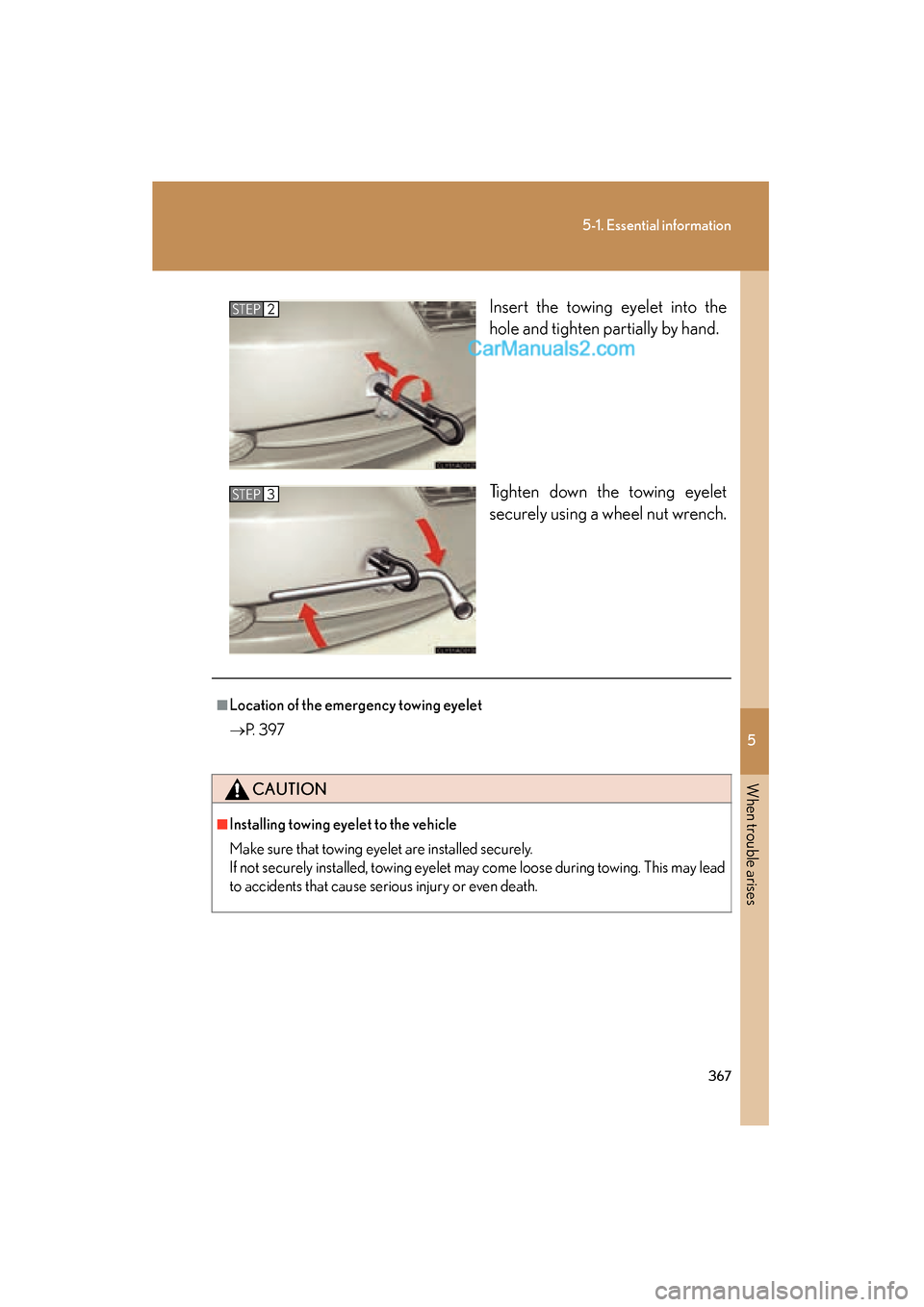
ES350_U_(L/O_0808)Insert the towing eyelet into the
hole and tighten partially by hand.
Tighten down the towing eyelet
securely using a wheel nut wrench.
STEP2
STEP3
■Location of the emergency towing eyelet
→
P. 3 9 7
CAUTION
■Installing towing eyelet to the vehicle
Make sure that towing eyelet are installed securely.
If not securely installed, towing eyelet may come loose during towing. This may lead
to accidents that cause serious injury or even death.
Page 370 of 475
368
5-1. Essential information
ES350_U_(L/O_0808)
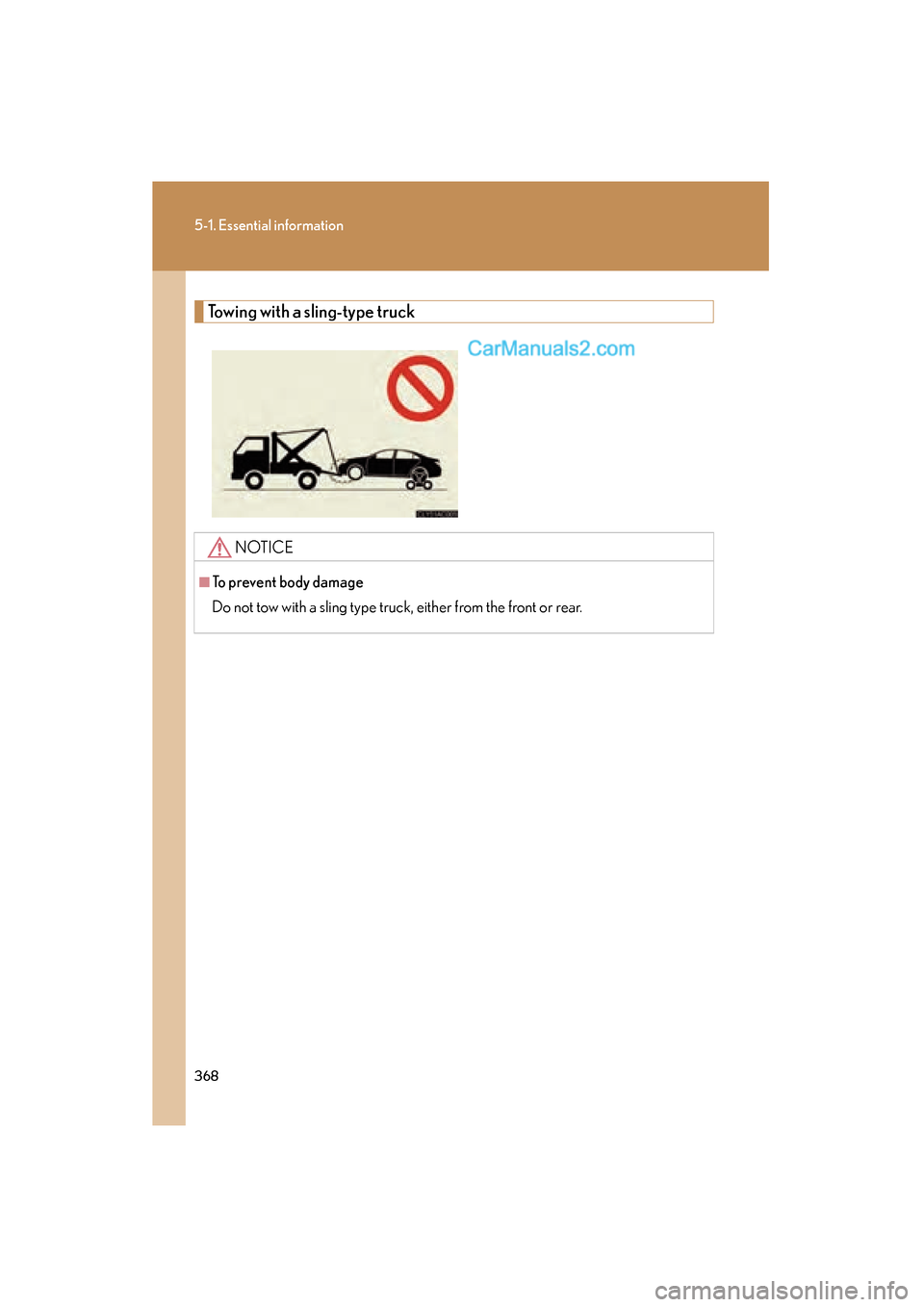
Towing with a sling-type truck
NOTICE
■To prevent body damage
Do not tow with a sling type truck, either from the front or rear.
Page 371 of 475
5
When trouble arises
369
5-1. Essential information
ES350_U_(L/O_0808)
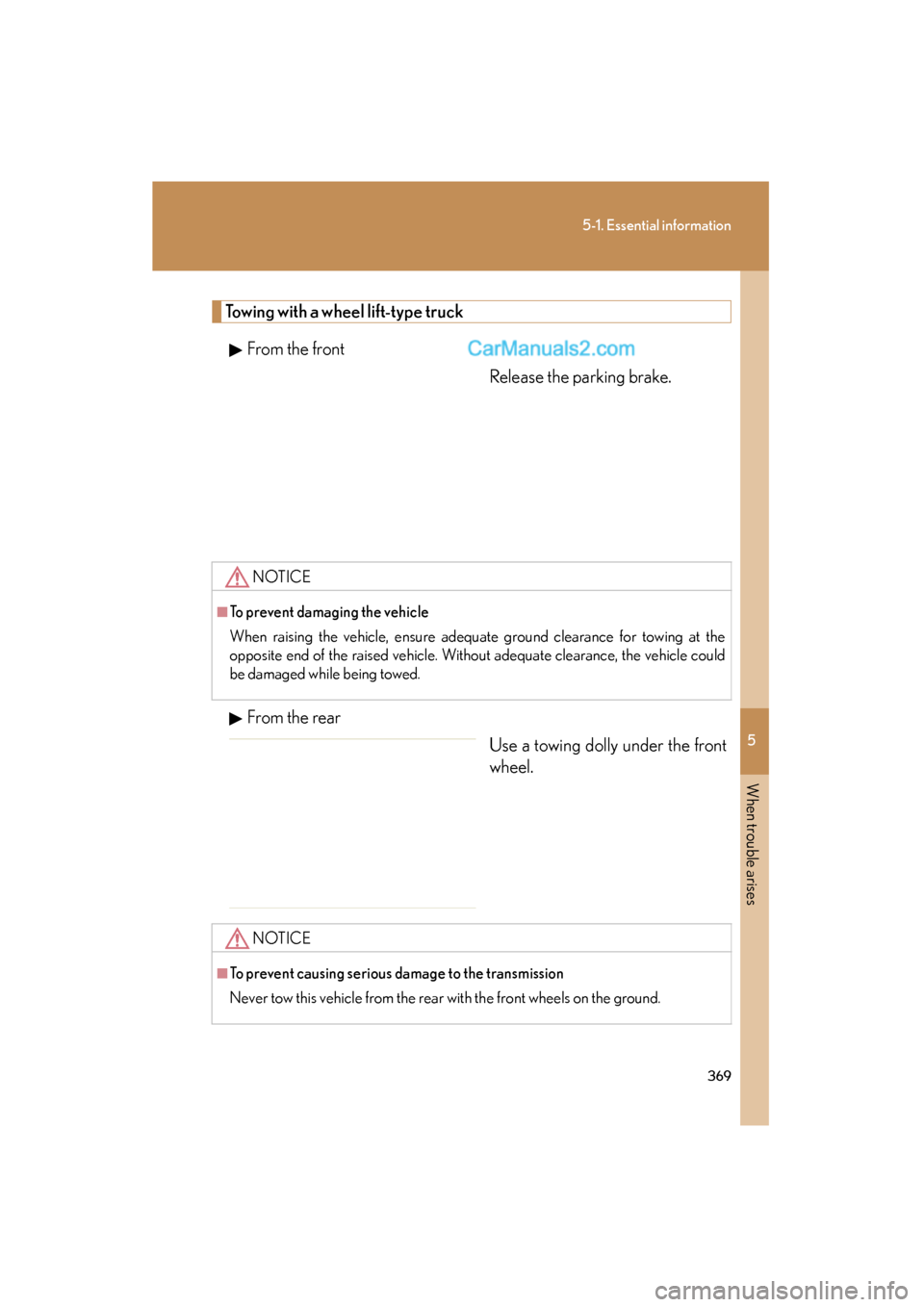
Towing with a wheel lift-type truckFrom the front Release the parking brake.
From the rear Use a towing dolly under the front
wheel.
NOTICE
■To prevent damaging the vehicle
When raising the vehicle, ensure adequate ground clearance for towing at the
opposite end of the raised vehicle. Without adequate clearance, the vehicle could
be damaged while being towed.
NOTICE
■To prevent causing serious damage to the transmission
Never tow this vehicle from the rear with the front wheels on the ground.
Page 399 of 475
5
When trouble arises
397
5-2. Steps to take in an emergency
ES350_U_(L/O_0808)
If you have a flat tire
Remove the flat tire and replace it with the spare provided.
■Before jacking up the vehicle
●Stop the vehicle on a hard, flat surface.
● Set the parking brake.
● Shift the shift lever to P.
● Stop the engine.
● Turn on the emergency flashers.
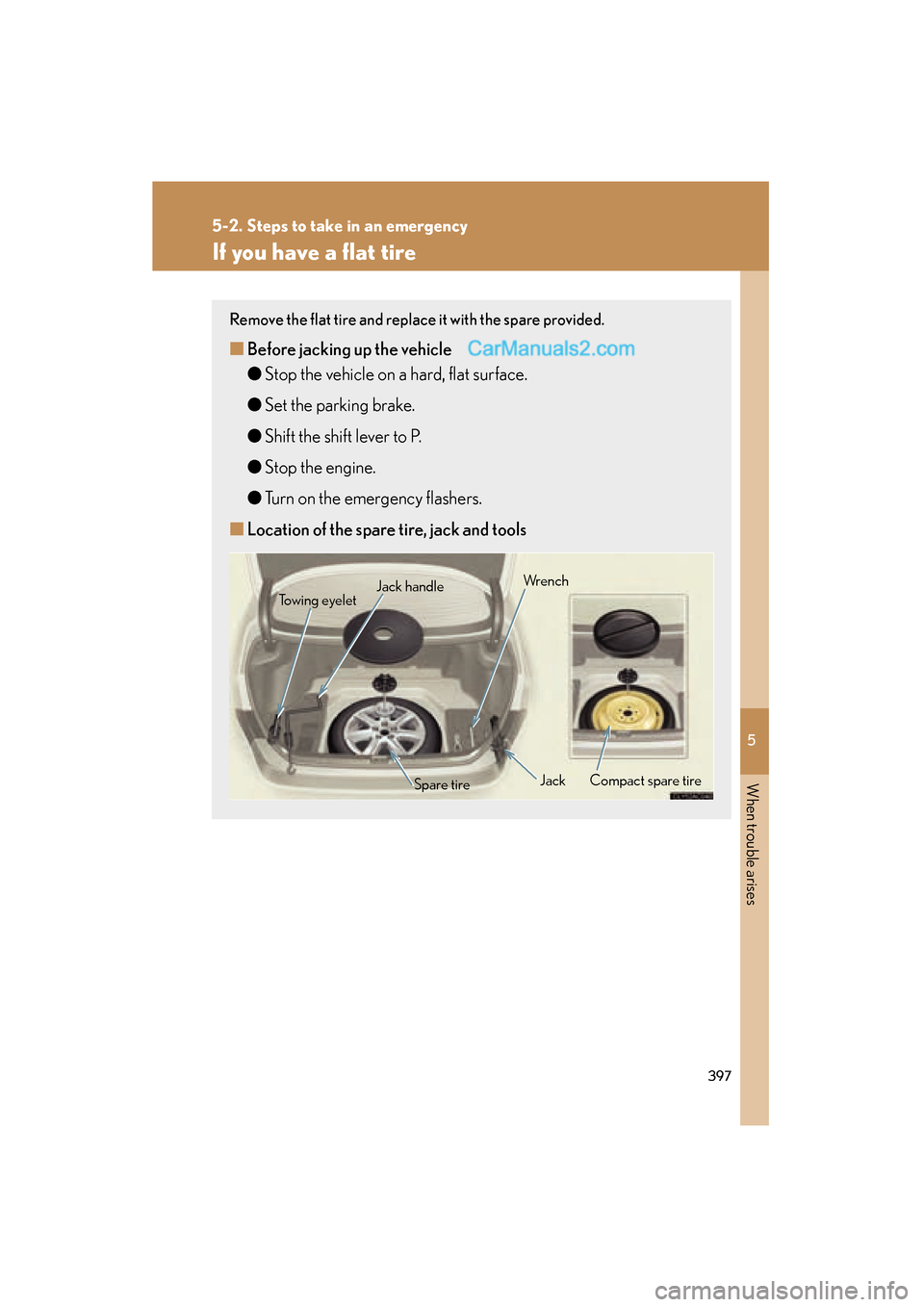
■ Location of the spare tire, jack and tools
Jack
Jack handle
Spare tireCompact spare tire
Wr e n c h
Towing eyelet
Page 404 of 475
402
5-2. Steps to take in an emergency
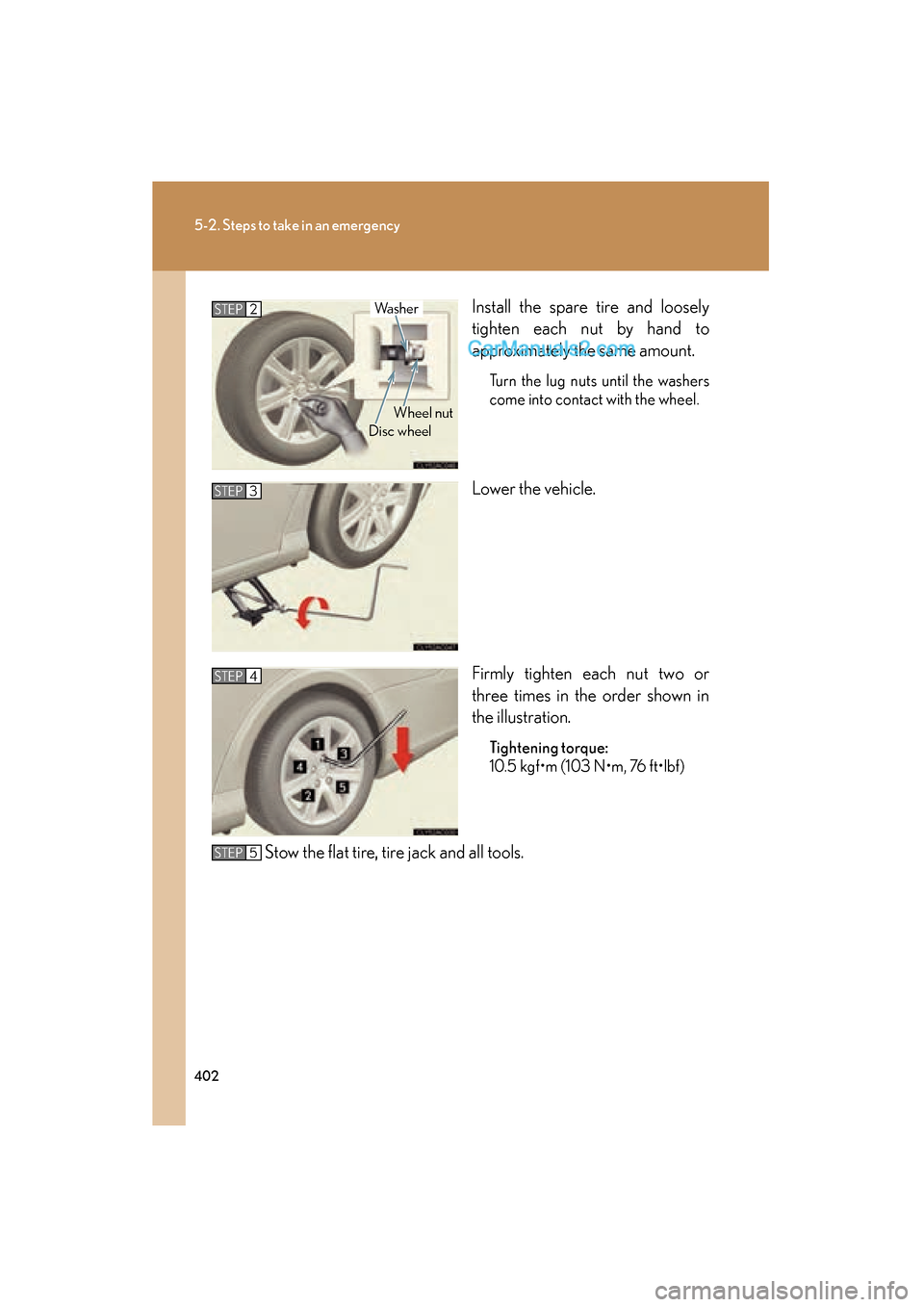
ES350_U_(L/O_0808)Install the spare tire and loosely
tighten each nut by hand to
approximately the same amount.
Turn the lug nuts until the washers
come into contact with the wheel.
Lower the vehicle.
Firmly tighten each nut two or
three times in the order shown in
the illustration.
Tightening torque:
10.5 kgf•m (103 N•m, 76 ft•lbf)
Stow the flat tire, tire jack and all tools.
STEP2
Wheel nut
Wa s h e r
Disc wheel
STEP3
STEP4
STEP5
Page 421 of 475
5
When trouble arises
419
5-2. Steps to take in an emergency
ES350_U_(L/O_0808)
If the vehicle becomes stuck
CAUTION
■When attempting to free a stuck vehicle
If you choose to rock the vehicle back and forth to free it, make sure the surround-
ing area is clear, to avoid striking other vehicles, objects or persons. The vehicle
may also lunge forward or lunge back suddenly as it becomes free. Use extreme
caution.
■When shifting the shift lever
Be careful not to shift the shift lever with the accelerator pedal depressed.
This may lead to unexpected rapid acceleration of the vehicle that may cause an
accident and result in death or serious injury.
NOTICE
■To avoid damaging the transmission and other components
●Avoid spinning the wheels and do not rev the engine.
●If the vehicle remains stuck after trying these procedures, the vehicle may require
towing to be freed.
Carry out the following procedures if the tires spin or the vehicle becomes
stuck in mud, dirt, or snow.
●Stop the engine. Set the parking brake and put the shift lever in P.
● Remove the mud, snow, or sand from around the stuck tire.
● Place wood, stones or some other material to help provide trac-
tion under the tires.
● Restart the engine.
● Carefully apply the accelerator to free the vehicle.