eco Lexus ES350 2010 Owner's Manuals
[x] Cancel search | Manufacturer: LEXUS, Model Year: 2010, Model line: ES350, Model: Lexus ES350 2010Pages: 543, PDF Size: 6.54 MB
Page 479 of 543
5
When trouble arises
477
5-2. Steps to take in an emergency
ES350_U
If the vehicle battery is discharged
The following procedures may be used to start the engine if the vehicle’s
battery is discharged.
You can call your Lexus dealer or qualified repair shop.
If you have a set of jumper (or booster) cables and a second vehicle
with a 12-volt battery, you can jump start your Lexus following the steps
below.
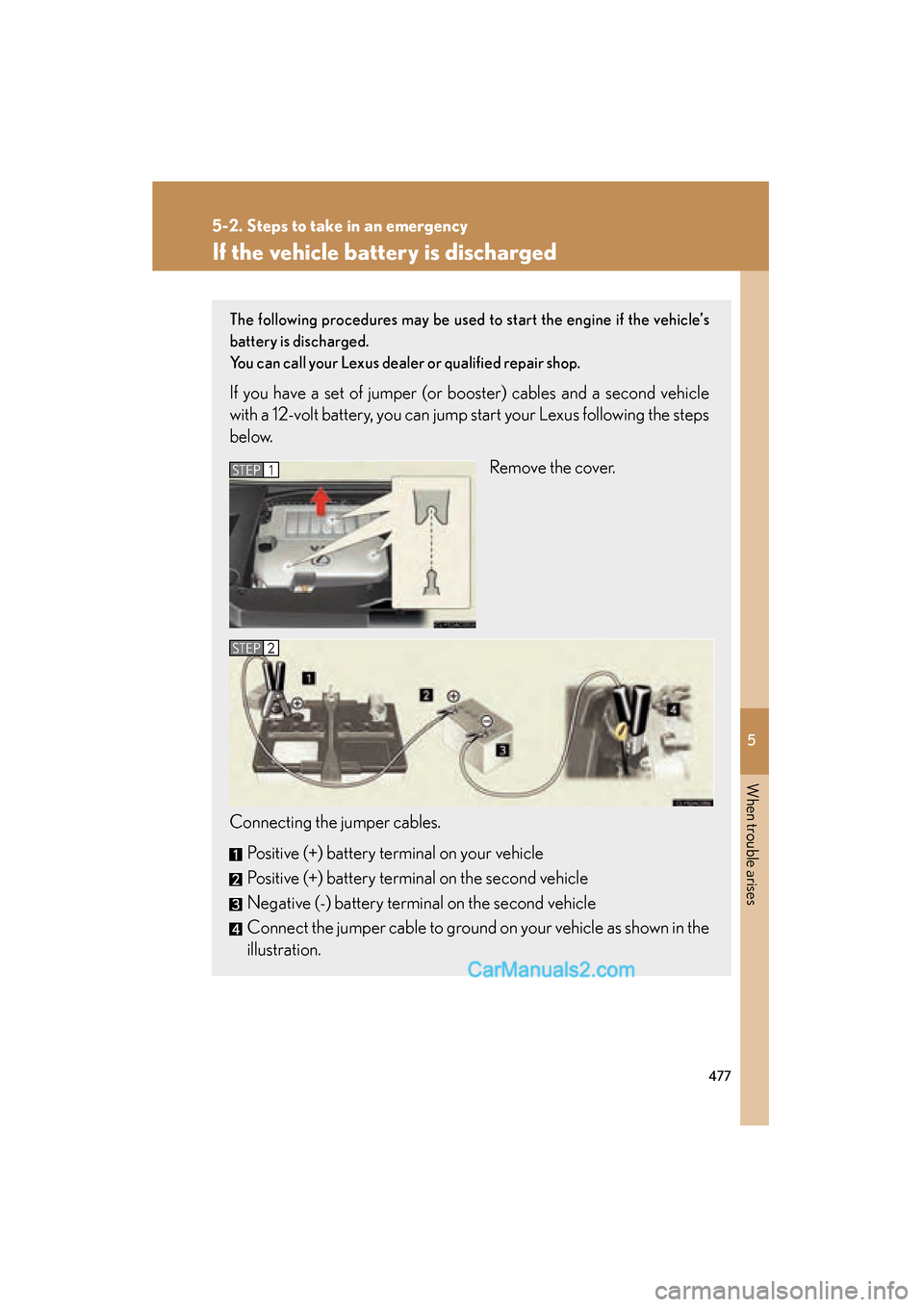
Remove the cover.
Connecting the jumper cables. Positive (+) battery terminal on your vehicle
Positive (+) battery terminal on the second vehicle
Negative (-) battery terminal on the second vehicle
Connect the jumper cable to ground on your vehicle as shown in the
illustration.
STEP1
STEP2
Page 480 of 543
478
5-2. Steps to take in an emergency
ES350_U
■Starting the engine when the battery is discharged
The engine cannot be started by push-starting.
■Avoiding a discharged battery
●Turn off the headlights and the audio system while the engine is turned off.
●Turn off any unnecessary electrical components when the vehicle is running at a
low speed for an extended period, such as in heavy traffic, etc.
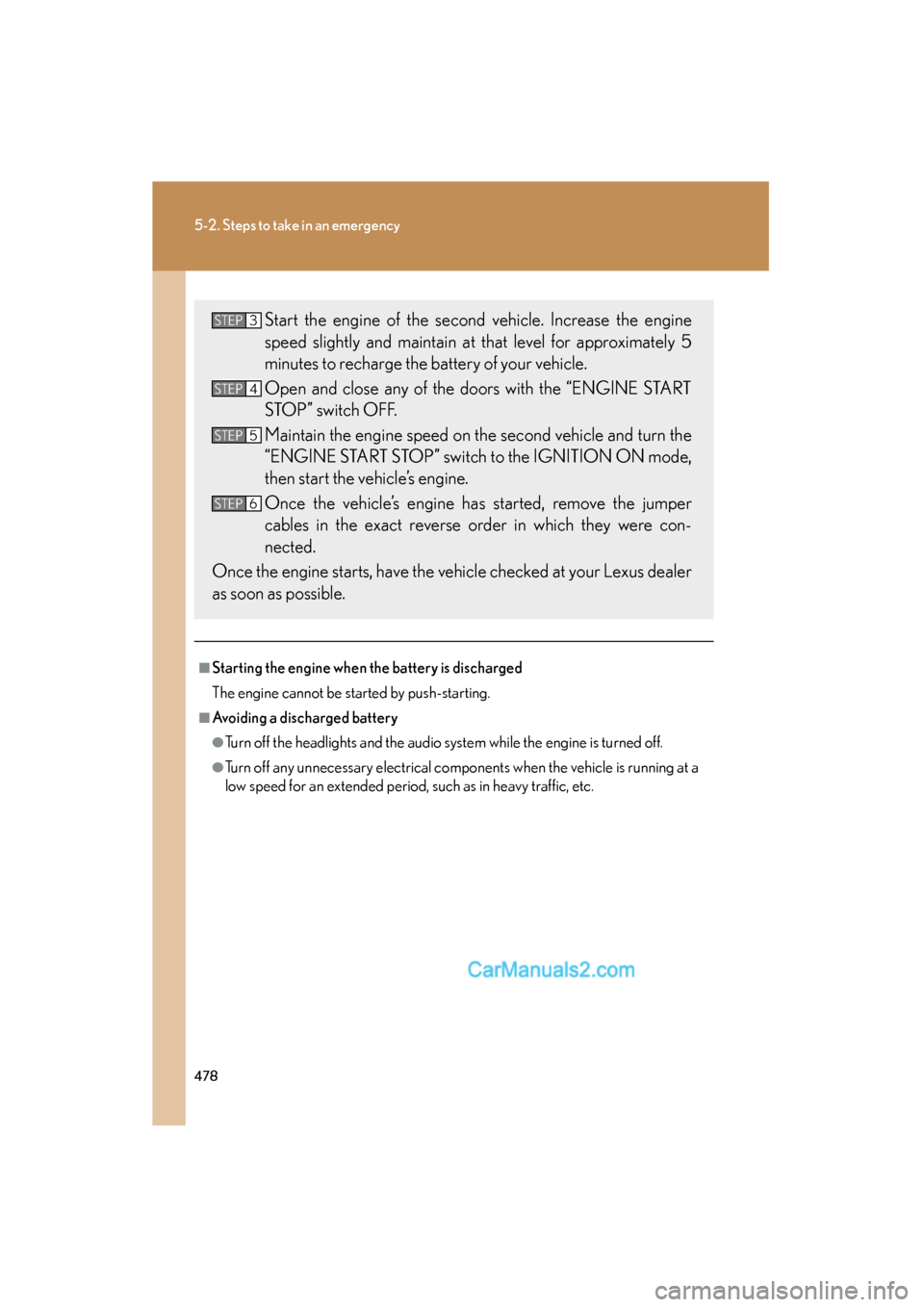
Start the engine of the second vehicle. Increase the engine
speed slightly and maintain at that level for approximately 5
minutes to recharge the battery of your vehicle.
Open and close any of the doors with the “ENGINE START
STOP” switch OFF.
Maintain the engine speed on the second vehicle and turn the
“ENGINE START STOP” switch to the IGNITION ON mode,
then start the vehicle’s engine.
Once the vehicle’s engine has started, remove the jumper
cables in the exact reverse order in which they were con-
nected.
Once the engine starts, have the vehicle checked at your Lexus dealer
as soon as possible.STEP3
STEP4
STEP5
STEP6
Page 481 of 543
5
When trouble arises
479
5-2. Steps to take in an emergency
ES350_U
CAUTION
■Avoiding battery fires or explosions
Observe the following precautions to prevent accidentally igniting the flammable
gas that may be emitted from the battery.
●Make sure the jumper cable is connected to the correct terminal and that it is not
unintentionally in contact with any part other than the intended terminal.
●Do not allow the jumper cables to come into contact with the “+” and “-” termi-
nals.
●Do not allow open flame or use matches, cigarette lighters or smoke near the
battery.
■Battery precautions
The battery contains poisonous and corrosive acidic electrolyte, while related parts
contain lead and lead compounds. Observe the following precautions when han-
dling the battery.
●When working with the battery, always wear safety glasses and take care not to
allow any battery fluids (acid) to come into contact with skin, clothing or the vehi-
cle body.
●Do not lean over the battery.
●In the event that battery fluid comes into contact with the skin or eyes, immedi-
ately wash the affected area with water and seek medical attention.
Place a wet sponge or cloth over the affected area until medical attention can be
received.
●Always wash your hands after handling the battery support, terminals, and other
battery-related parts.
●Do not allow children near the battery.
NOTICE
■When handling jumper cables
Be careful that the jumper cables do not become tangled in the cooling fan or any
of the belts when connecting or disconnecting them.
Page 485 of 543
5
When trouble arises
483
5-2. Steps to take in an emergency
ES350_U
If the vehicle becomes stuck
CAUTION
■When attempting to free a stuck vehicle
If you choose to rock the vehicle back and forth to free it, make sure the surround-
ing area is clear, to avoid striking other vehicles, objects or persons. The vehicle
may also lunge forward or lunge back suddenly as it becomes free. Use extreme
caution.
■When shifting the shift lever
Be careful not to shift the shift lever with the accelerator pedal depressed.
This may lead to unexpected rapid acceleration of the vehicle that may cause an
accident and result in death or serious injury.
NOTICE
■To avoid damaging the transmission and other components
●Avoid spinning the wheels and do not rev the engine.
●If the vehicle remains stuck after trying these procedures, the vehicle may require
towing to be freed.
Carry out the following procedures if the tires spin or the vehicle becomes
stuck in mud, dirt, or snow.
●Stop the engine. Set the parking brake and put the shift lever in P.
● Remove the mud, snow, or sand from around the stuck tire.
● Place wood, stones or some other material to help provide trac-
tion under the tires.
● Restart the engine.
● Carefully apply the accelerator to free the vehicle.
Page 491 of 543
489
6-1. Specifications
6
Vehicle specifications
ES350_U
Lubrication system■ Engine oil selection
“Toyota Genuine Motor Oil” is used in your Lexus vehicle. Use Lexus
approved “Toyota Genuine Motor Oil” or equivalent to satisfy the follow-
ing grade and viscosity.
Oil grade: ILSAC multigrade engine oil
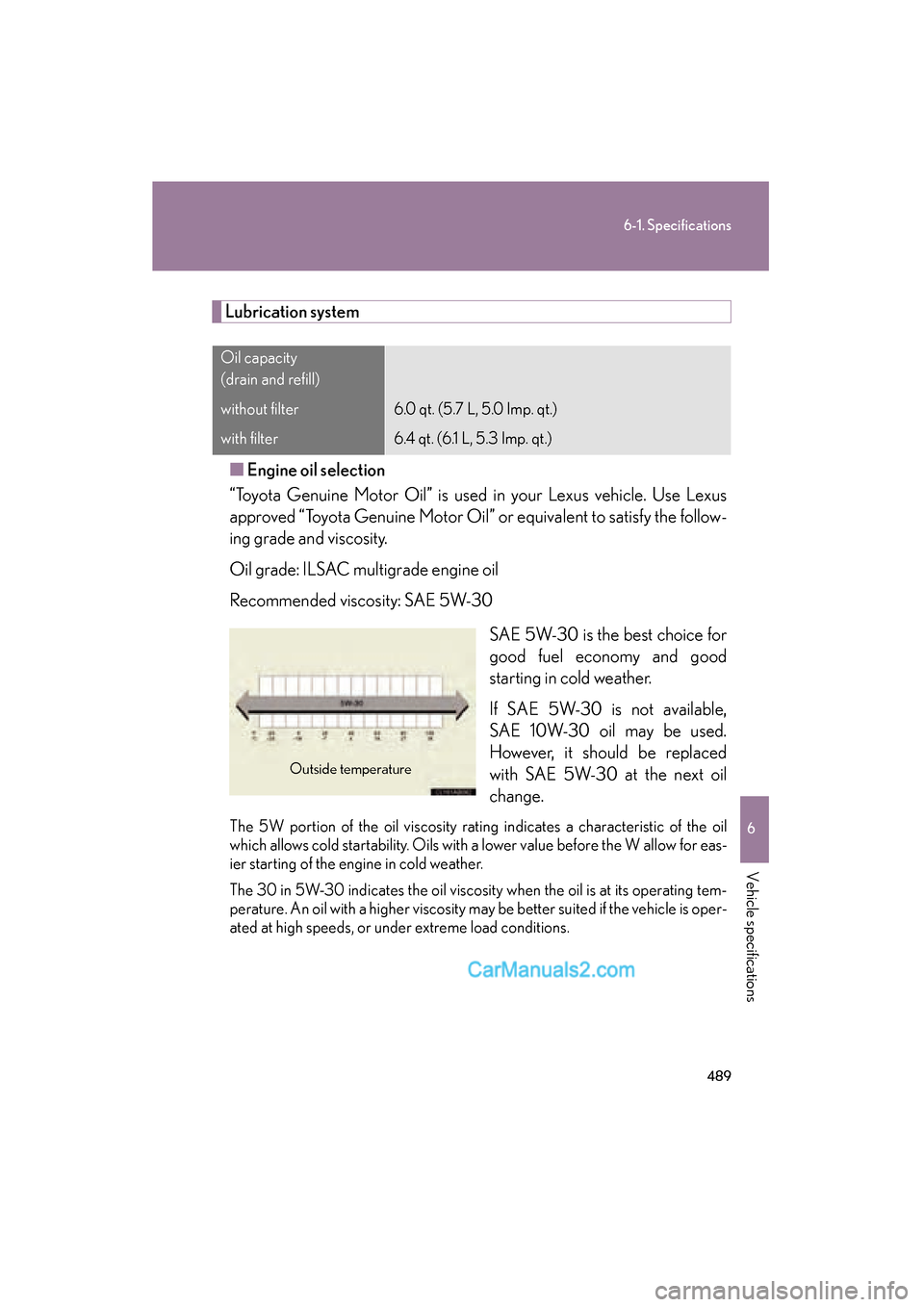
Recommended viscosity: SAE 5W-30
SAE 5W-30 is the best choice for
good fuel economy and good
starting in cold weather.
If SAE 5W-30 is not available,
SAE 10W-30 oil may be used.
However, it should be replaced
with SAE 5W-30 at the next oil
change.
The 5W portion of the oil viscosity rating indicates a characteristic of the oil
which allows cold startability. Oils with a lower value before the W allow for eas-
ier starting of the engine in cold weather.
The 30 in 5W-30 indicates the oil viscosity when the oil is at its operating tem-
perature. An oil with a higher viscosity may be better suited if the vehicle is oper-
ated at high speeds, or under extreme load conditions.
Oil capacity
(drain and refill)
without filter 6.0 qt. (5.7 L, 5.0 Imp. qt.)
with filter6.4 qt. (6.1 L, 5.3 Imp. qt.)
Outside temperature
Page 495 of 543
493
6-1. Specifications
6
Vehicle specifications
ES350_U
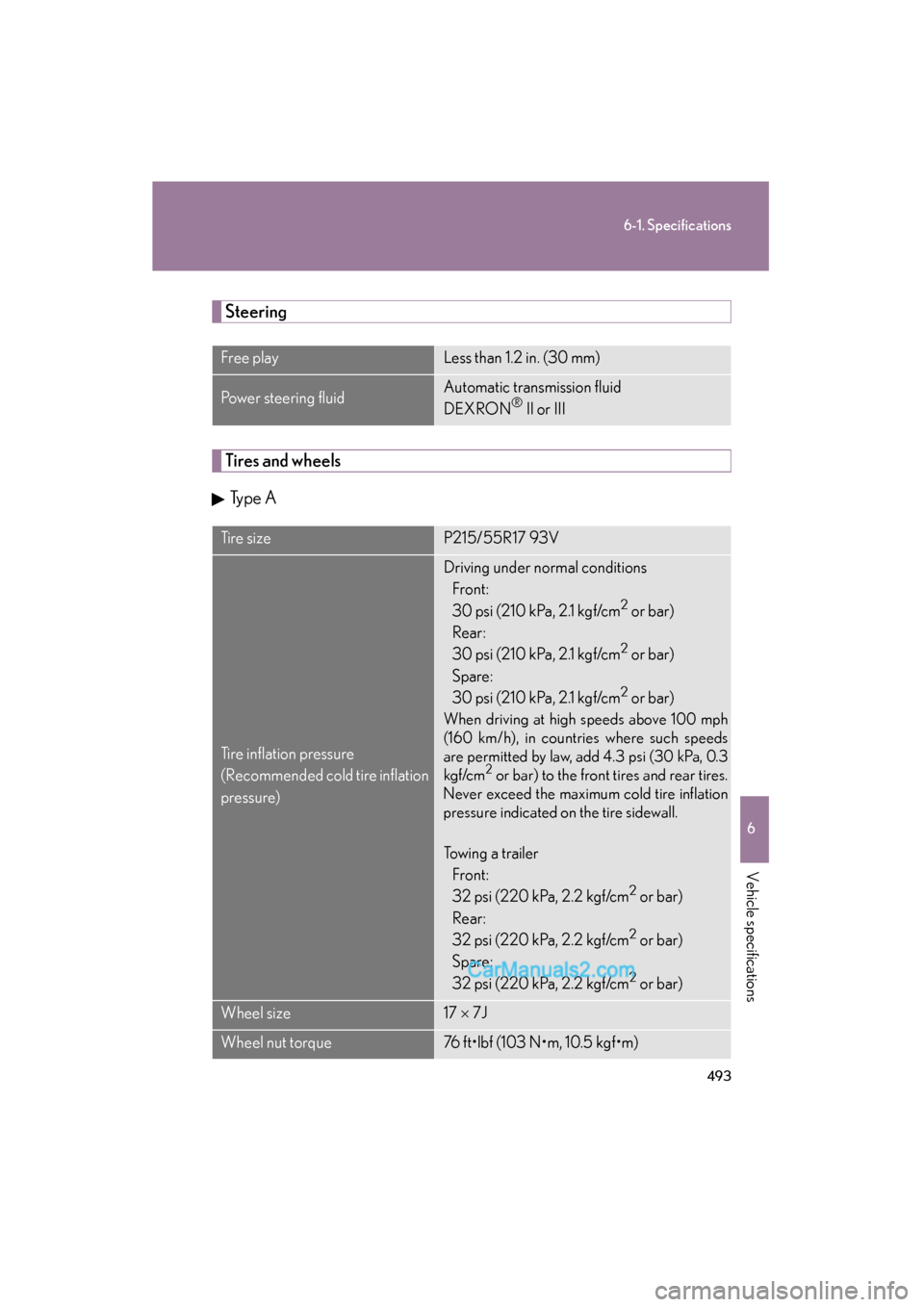
Steering
Tires and wheelsType A
Free playLess than 1.2 in. (30 mm)
Power steering fluidAutomatic transmission fluid
DEXRON® II or III
Ti r e s i z eP215/55R17 93V
Tire inflation pressure
(Recommended cold tire inflation
pressure)
Driving under normal conditions Front:
30 psi (210 kPa, 2.1 kgf/cm
2 or bar)
Rear:
30 psi (210 kPa, 2.1 kgf/cm
2 or bar)
Spare:
30 psi (210 kPa, 2.1 kgf/cm
2 or bar)
When driving at high speeds above 100 mph
(160 km/h), in countries where such speeds
are permitted by law, add 4.3 psi (30 kPa, 0.3
kgf/cm
2 or bar) to the front tires and rear tires.
Never exceed the maximum cold tire inflation
pressure indicated on the tire sidewall.
Towing a trailer
Front:
32 psi (220 kPa, 2.2 kgf/cm
2 or bar)
Rear:
32 psi (220 kPa, 2.2 kgf/cm
2 or bar)
Spare:
32 psi (220 kPa, 2.2 kgf/cm
2 or bar)
Wheel size17 u 7J
Wheel nut torque76 ft•lbf (103 N•m, 10.5 kgf•m)
Page 496 of 543
494
6-1. Specifications
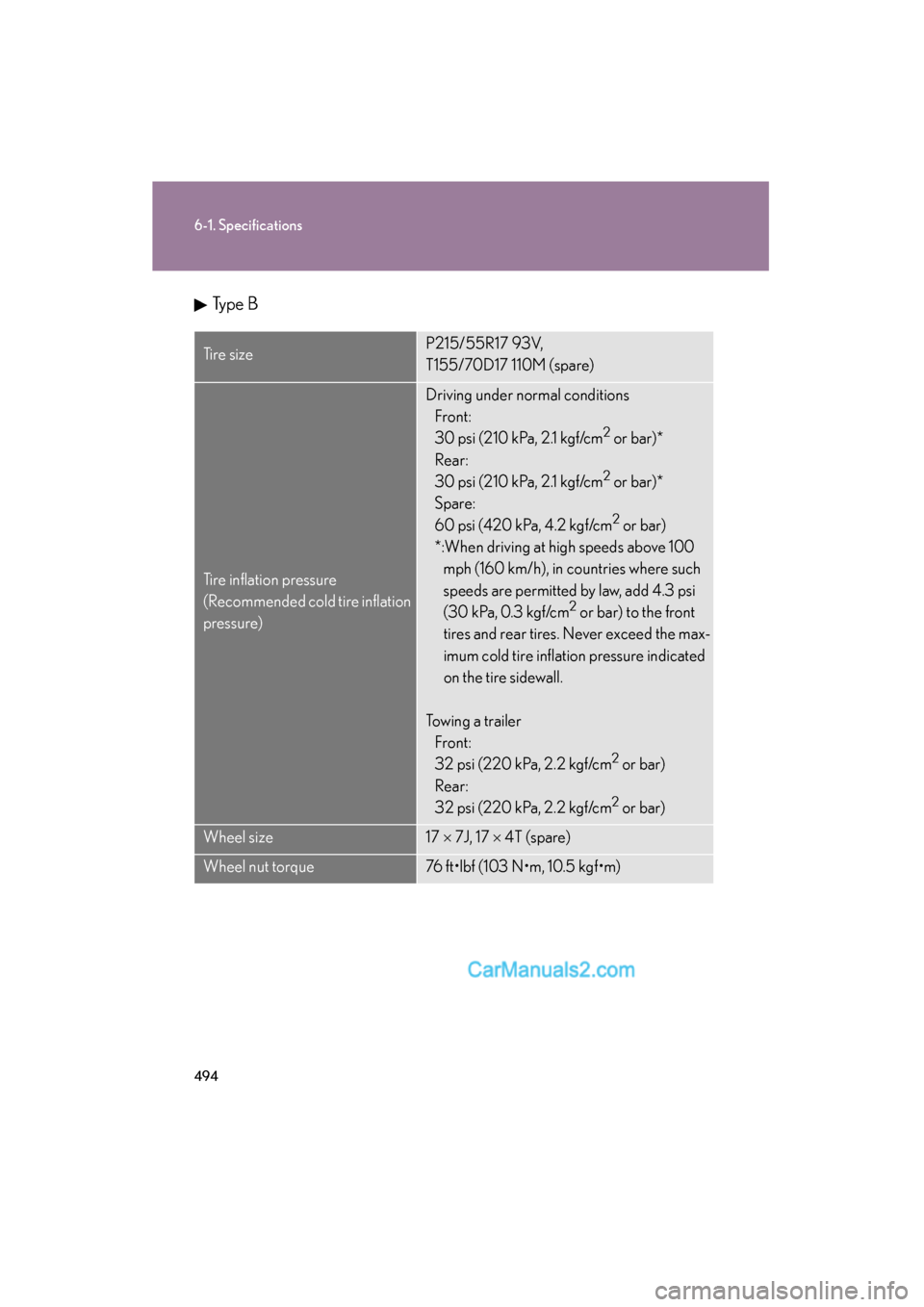
ES350_UTy p e B
Ti r e s i z eP215/55R17 93V,
T155/70D17 110M (spare)
Tire inflation pressure
(Recommended cold tire inflation
pressure)
Driving under normal conditions
Front:
30 psi (210 kPa, 2.1 kgf/cm
2 or bar)*
Rear:
30 psi (210 kPa, 2.1 kgf/cm
2 or bar)*
Spare:
60 psi (420 kPa, 4.2 kgf/cm
2 or bar)
*:When driving at high speeds above 100 mph (160 km/h), in countries where such
speeds are permitted by law, add 4.3 psi
(30 kPa, 0.3 kgf/cm
2 or bar) to the front
tires and rear tires. Never exceed the max-
imum cold tire inflation pressure indicated
on the tire sidewall.
Towing a trailer Front:
32 psi (220 kPa, 2.2 kgf/cm
2 or bar)
Rear:
32 psi (220 kPa, 2.2 kgf/cm
2 or bar)
Wheel size17 u 7J, 17 u 4T (spare)
Wheel nut torque76 ft•lbf (103 N•m, 10.5 kgf•m)
Page 499 of 543
497
6-1. Specifications
6
Vehicle specifications
ES350_U
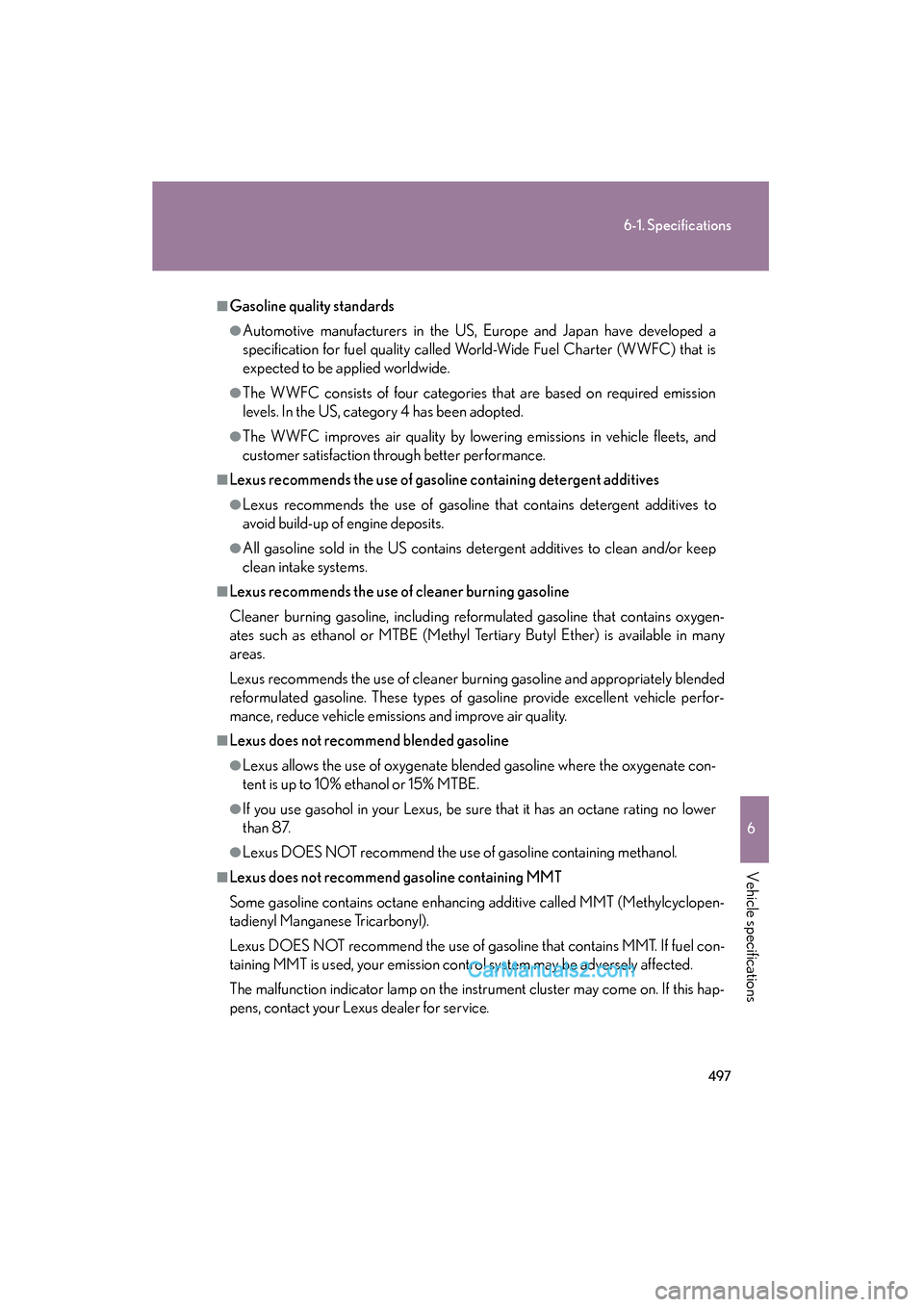
■Gasoline quality standards
●Automotive manufacturers in the US, Europe and Japan have developed a
specification for fuel quality called World-Wide Fuel Charter (WWFC) that is
expected to be applied worldwide.
●The WWFC consists of four categories that are based on required emission
levels. In the US, category 4 has been adopted.
●The WWFC improves air quality by lowering emissions in vehicle fleets, and
customer satisfaction through better performance.
■Lexus recommends the use of gasoline containing detergent additives
●Lexus recommends the use of gasoline that contains detergent additives to
avoid build-up of engine deposits.
●All gasoline sold in the US contains detergent additives to clean and/or keep
clean intake systems.
■Lexus recommends the use of cleaner burning gasoline
Cleaner burning gasoline, including reformulated gasoline that contains oxygen-
ates such as ethanol or MTBE (Methyl Tertiary Butyl Ether) is available in many
areas.
Lexus recommends the use of cleaner burning gasoline and appropriately blended
reformulated gasoline. These types of gasoline provide excellent vehicle perfor-
mance, reduce vehicle emissions and improve air quality.
■Lexus does not recommend blended gasoline
●Lexus allows the use of oxygenate blended gasoline where the oxygenate con-
tent is up to 10% ethanol or 15% MTBE.
●If you use gasohol in your Lexus, be sure that it has an octane rating no lower
t h a n 8 7.
●Lexus DOES NOT recommend the use of gasoline containing methanol.
■Lexus does not recommend gasoline containing MMT
Some gasoline contains octane enhancing additive called MMT (Methylcyclopen-
tadienyl Manganese Tricarbonyl).
Lexus DOES NOT recommend the use of gasoline that contains MMT. If fuel con-
taining MMT is used, your emission control system may be adversely affected.
The malfunction indicator lamp on the instrument cluster may come on. If this hap-
pens, contact your Lexus dealer for service.
Page 506 of 543
504
6-1. Specifications
ES350_U■
Temperature A, B, C
The temperature grades are A (the highest), B, and C, representing
the tire's resistance to the generation of heat and its ability to dissipate
heat when tested under controlled conditions on a specified indoor
laboratory test wheel.
Sustained high temperature can cause the material of the tire to degenerate
and reduce tire life, and excessive temperature can lead to sudden tire fail-
ure.
The grade C corresponds to a level of performance which all passenger car
tires must meet under the Federal Motor Vehicle Safety Standard No. 109.
Grades B and A represent higher levels of performance on the laboratory
test wheel than the minimum required by law.
Warning: The temperature grades for this tire are established for a tire that
is properly inflated and not overloaded.
Excessive speed, underinflation, or excessive loading, either separately or in
combination, can cause heat buildup and possible tire failure.
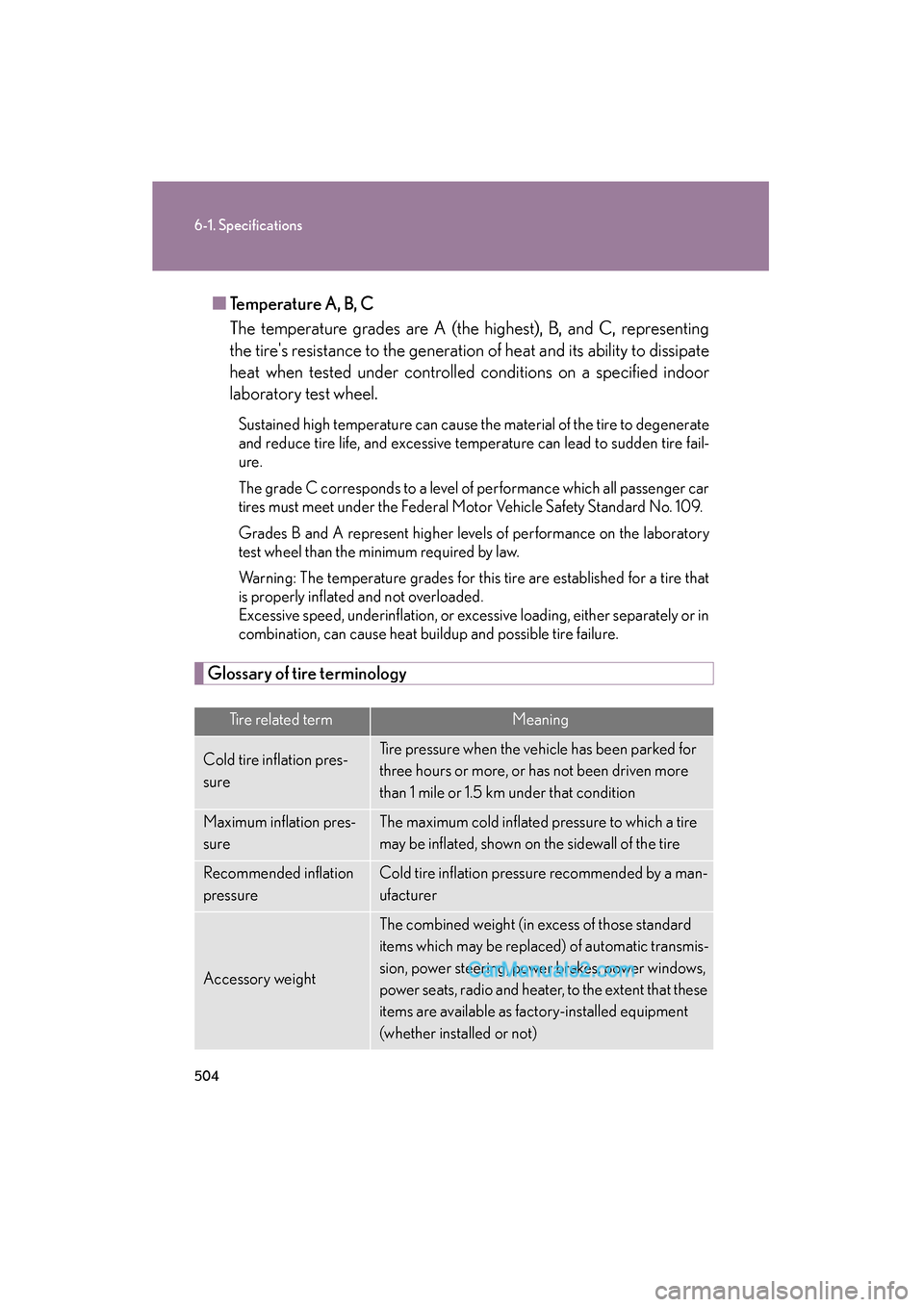
Glossary of tire terminology
Tire related termMeaning
Cold tire inflation pres-
sureTire pressure when the vehicle has been parked for
three hours or more, or has not been driven more
than 1 mile or 1.5 km under that condition
Maximum inflation pres-
sureThe maximum cold inflated pressure to which a tire
may be inflated, shown on the sidewall of the tire
Recommended inflation
pressureCold tire inflation pressure recommended by a man-
ufacturer
Accessory weight
The combined weight (in excess of those standard
items which may be replaced) of automatic transmis-
sion, power steering, power brakes, power windows,
power seats, radio and heater, to the extent that these
items are available as factory-installed equipment
(whether installed or not)
Page 507 of 543
505
6-1. Specifications
6
Vehicle specifications
ES350_U
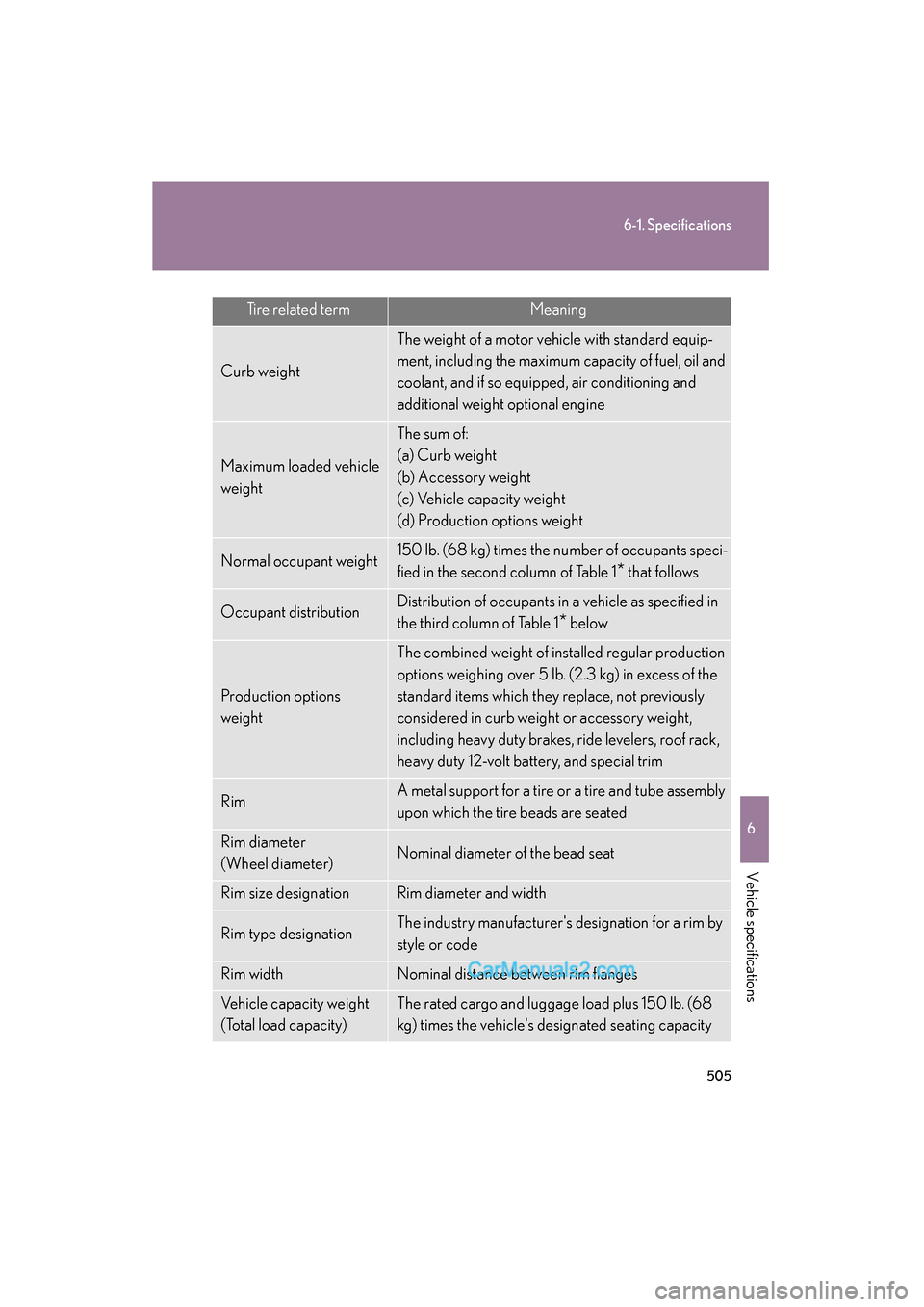
Curb weight
The weight of a motor vehicle with standard equip-
ment, including the maximum capacity of fuel, oil and
coolant, and if so equipped, air conditioning and
additional weight optional engine
Maximum loaded vehicle
weight
The sum of:
(a) Curb weight
(b) Accessory weight
(c) Vehicle capacity weight
(d) Production options weight
Normal occupant weight150 lb. (68 kg) times the number of occupants speci-
fied in the second column of Table 1
* that follows
Occupant distributionDistribution of occupants in a vehicle as specified in
the third column of Table 1
* below
Production options
weight
The combined weight of installed regular production
options weighing over 5 lb. (2.3 kg) in excess of the
standard items which they replace, not previously
considered in curb weight or accessory weight,
including heavy duty brakes, ride levelers, roof rack,
heavy duty 12-volt battery, and special trim
RimA metal support for a tire or a tire and tube assembly
upon which the tire beads are seated
Rim diameter
(Wheel diameter)Nominal diameter of the bead seat
Rim size designationRim diameter and width
Rim type designationThe industry manufacturer's designation for a rim by
style or code
Rim widthNominal distance between rim flanges
Vehicle capacity weight
(Total load capacity)The rated cargo and luggage load plus 150 lb. (68
kg) times the vehicle's designated seating capacity
Tire related termMeaning