steering wheel Lexus ES350 2011 s Service Manual
[x] Cancel search | Manufacturer: LEXUS, Model Year: 2011, Model line: ES350, Model: Lexus ES350 2011Pages: 563, PDF Size: 6.72 MB
Page 288 of 563
286
3-4. Using the hands-free system (for mobile phone)
ES350_U
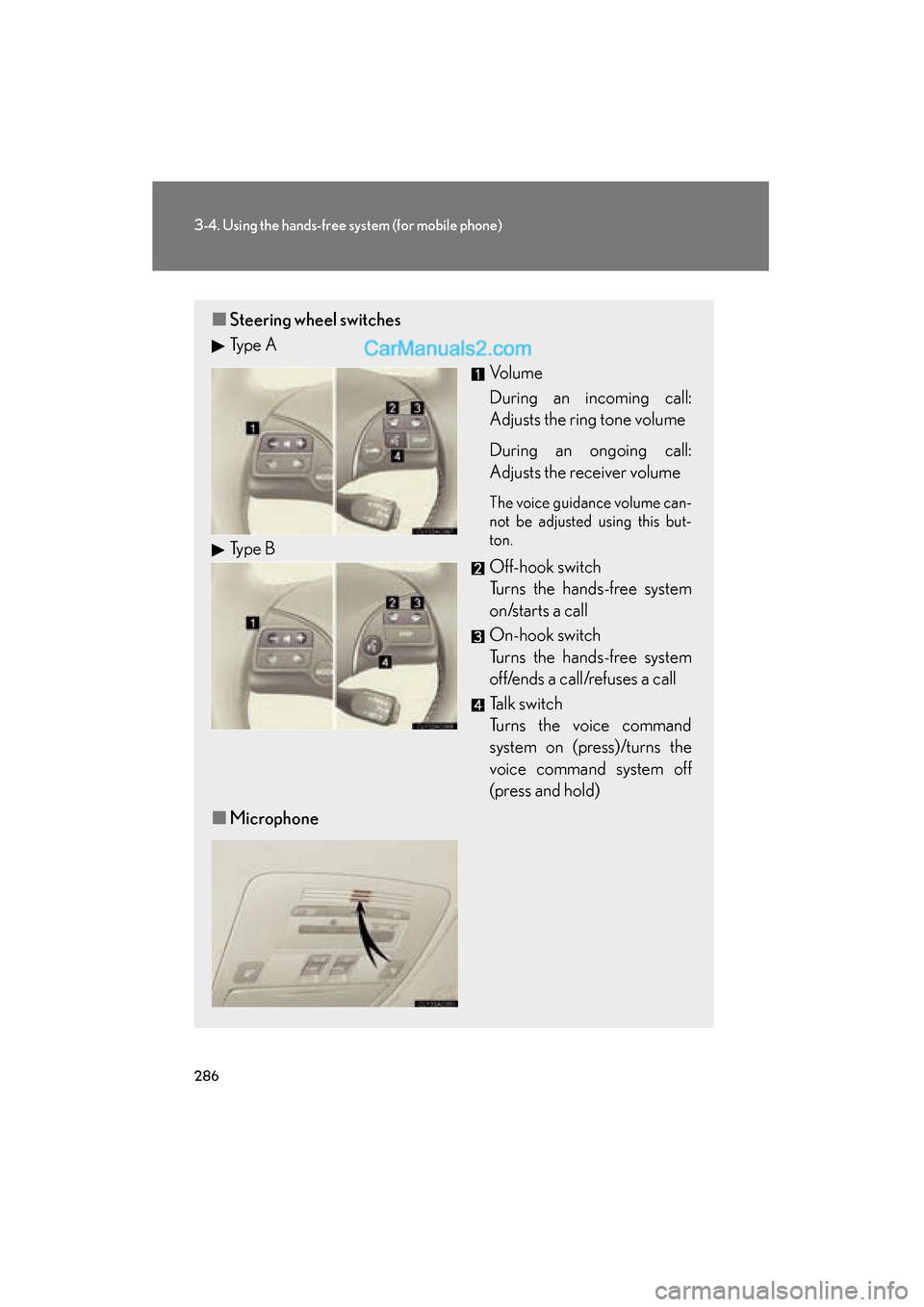
■Steering wheel switches
Ty p e A
Vo l u m e
During an incoming call:
Adjusts the ring tone volume
During an ongoing call:
Adjusts the receiver volume
The voice guidance volume can-
not be adjusted using this but-
ton.
Off-hook switch
Turns the hands-free system
on/starts a call
On-hook switch
Turns the hands-free system
off/ends a call/refuses a call
Talk switch
Turns the voice command
system on (press)/turns the
voice command system off
(press and hold)
■ Microphone
Type B
Page 374 of 563
372
4-2. Maintenance
ES350_U
Vehicle exterior
ItemsCheck points
Steering wheel
• Moves smoothly?
• Has correct free play?
• No strange noises?
ItemsCheck points
Door/trunk• Operate smoothly?
Engine hood• The lock system works properly?
Fluid leaks• Is there any leakage after parking?
Ti r e
• Inflation pressure is correct?
• Tire surfaces not worn or dam-aged?
• Tires rotated according to the maintenance schedule?
• Wheel nuts are not loose?
CAUTION
■If the engine is running
Turn the engine off and ensure that there is adequate ventilation before performing
maintenance checks.
Page 437 of 563
5
When trouble arises
435
5-1. Essential information
ES350_U
If your vehicle needs to be towed
Before towingThe following may indicate a problem with your transmission. Contact
your Lexus dealer before towing.
● The engine is running, but the vehicle will not move.
● The vehicle makes an abnormal sound.
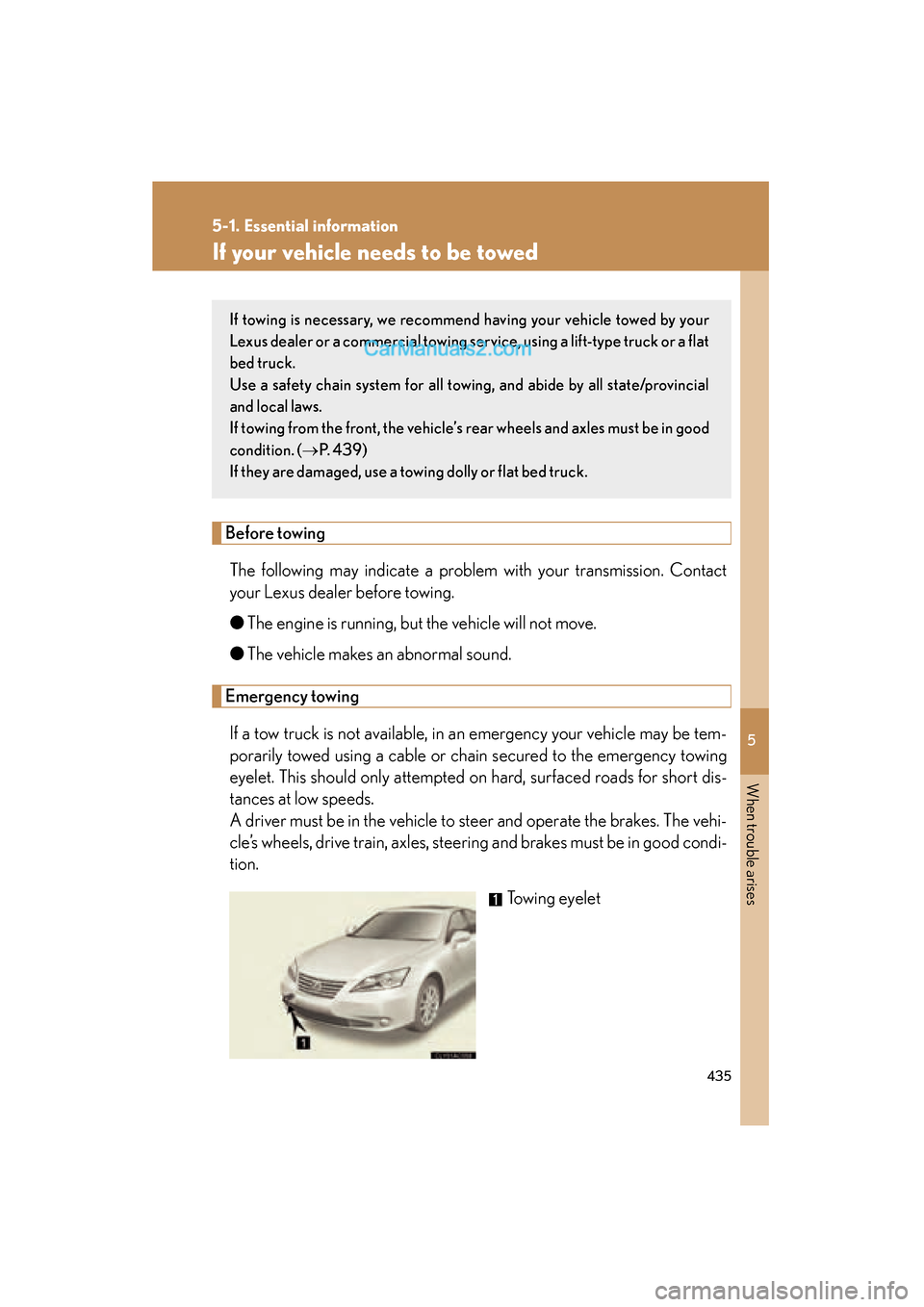
Emergency towing
If a tow truck is not available, in an emergency your vehicle may be tem-
porarily towed using a cable or chain secured to the emergency towing
eyelet. This should only attempted on hard, surfaced roads for short dis-
tances at low speeds.
A driver must be in the vehicle to steer and operate the brakes. The vehi-
cle’s wheels, drive train, axles, steering and brakes must be in good condi-
tion. Towing eyelet
If towing is necessary, we recommend having your vehicle towed by your
Lexus dealer or a commercial towing se rvice, using a lift-type truck or a flat
bed truck.
Use a safety chain system for all towing, and abide by all state/provincial
and local laws.
If towing from the front, the vehicle’s rear wheels and axles must be in good
condition. ( →P. 439)
If they are damaged, use a towing dolly or flat bed truck.
Page 438 of 563
436
5-1. Essential information
ES350_U
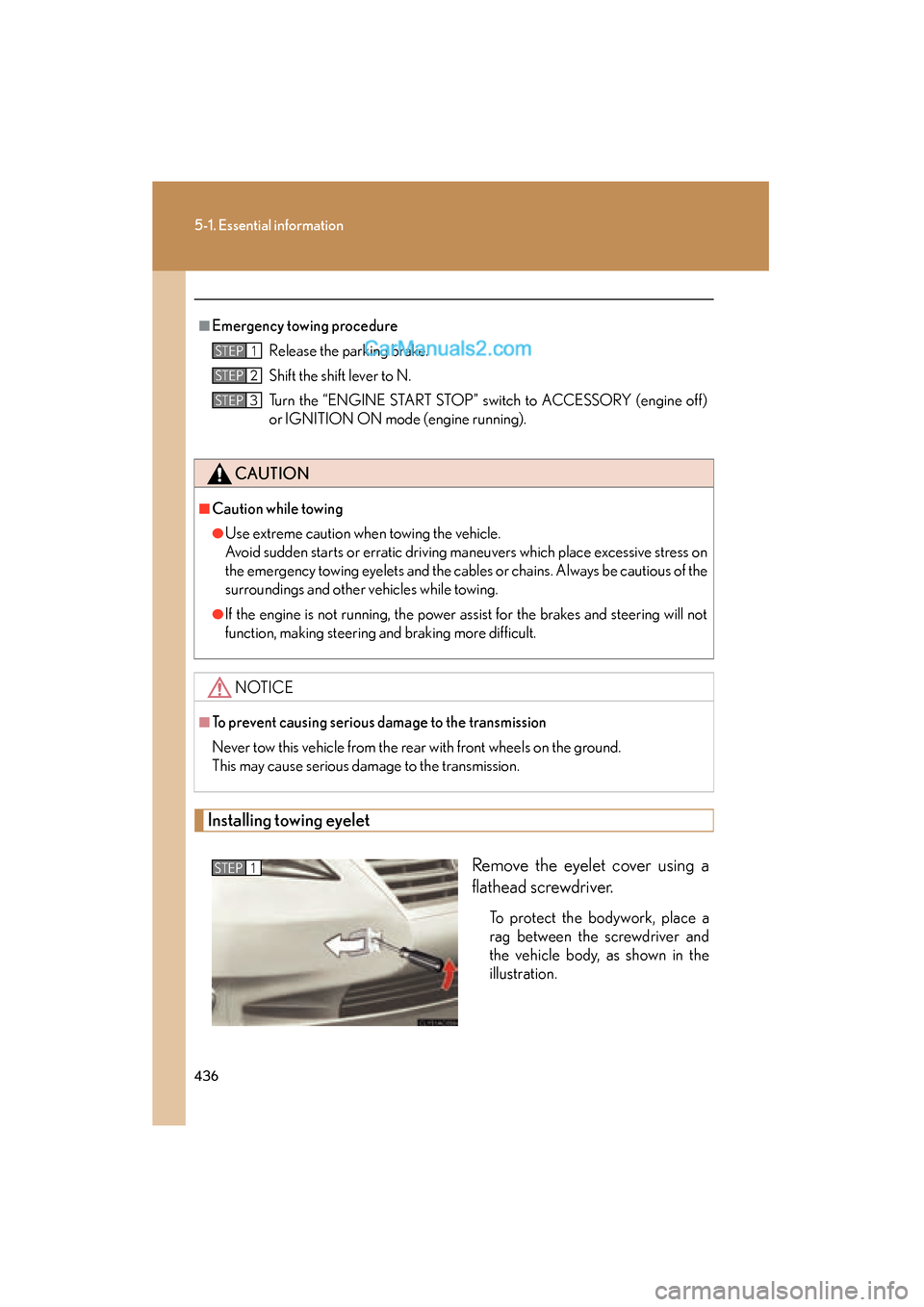
Installing towing eyeletRemove the eyelet cover using a
flathead screwdriver.
To protect the bodywork, place a
rag between the screwdriver and
the vehicle body, as shown in the
illustration.
■Emergency towing procedureRelease the parking brake.
Shift the shift lever to N.
Turn the “ENGINE START STOP” switch to ACCESSORY (engine off)
or IGNITION ON mode (engine running).
CAUTION
■Caution while towing
●Use extreme caution when towing the vehicle.
Avoid sudden starts or erratic driving maneuvers which place excessive stress on
the emergency towing eyelets and the cables or chains. Always be cautious of the
surroundings and other vehicles while towing.
●If the engine is not running, the power assist for the brakes and steering will not
function, making steering and braking more difficult.
NOTICE
■To prevent causing serious da mage to the transmission
Never tow this vehicle from the rear with front wheels on the ground.
This may cause serious damage to the transmission.
STEP1
STEP2
STEP3
STEP1
Page 454 of 563
452
5-2. Steps to take in an emergency
ES350_U
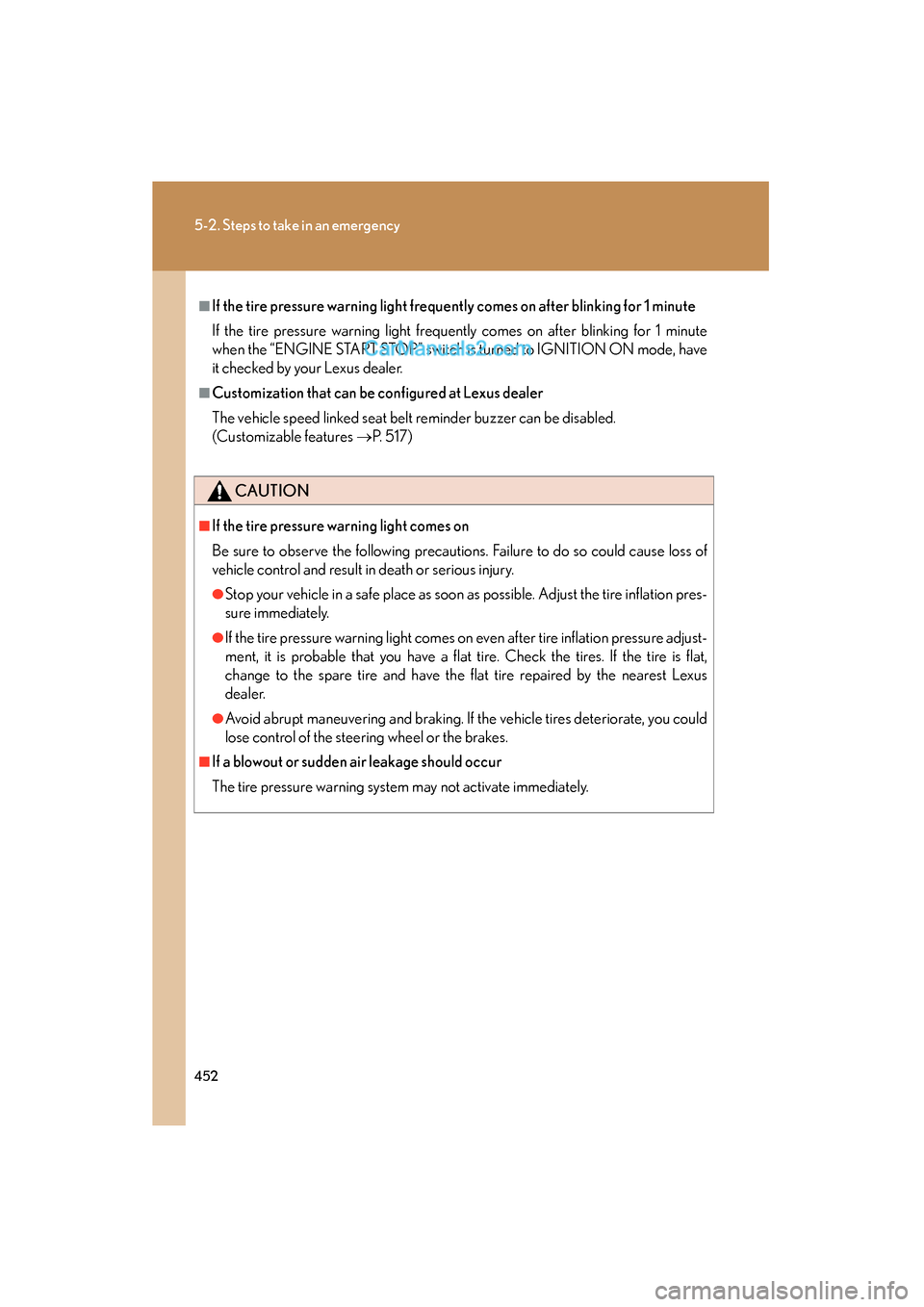
■If the tire pressure warning light frequently comes on after blinking for 1 minute
If the tire pressure warning light frequently comes on after blinking for 1 minute
when the “ENGINE START STOP” switch is turned to IGNITION ON mode, have
it checked by your Lexus dealer.
■Customization that can be configured at Lexus dealer
The vehicle speed linked seat belt reminder buzzer can be disabled.
(Customizable features →P. 5 1 7 )
CAUTION
■If the tire pressure warning light comes on
Be sure to observe the following precautions. Failure to do so could cause loss of
vehicle control and result in death or serious injury.
●Stop your vehicle in a safe place as soon as possible. Adjust the tire inflation pres-
sure immediately.
●If the tire pressure warning light comes on even after tire inflation pressure adjust-
ment, it is probable that you have a flat tire. Check the tires. If the tire is flat,
change to the spare tire and have the flat tire repaired by the nearest Lexus
dealer.
●Avoid abrupt maneuvering and braking. If the vehicle tires deteriorate, you could
lose control of the steering wheel or the brakes.
■If a blowout or sudden air leakage should occur
The tire pressure warning system may not activate immediately.
Page 468 of 563
466
5-2. Steps to take in an emergency
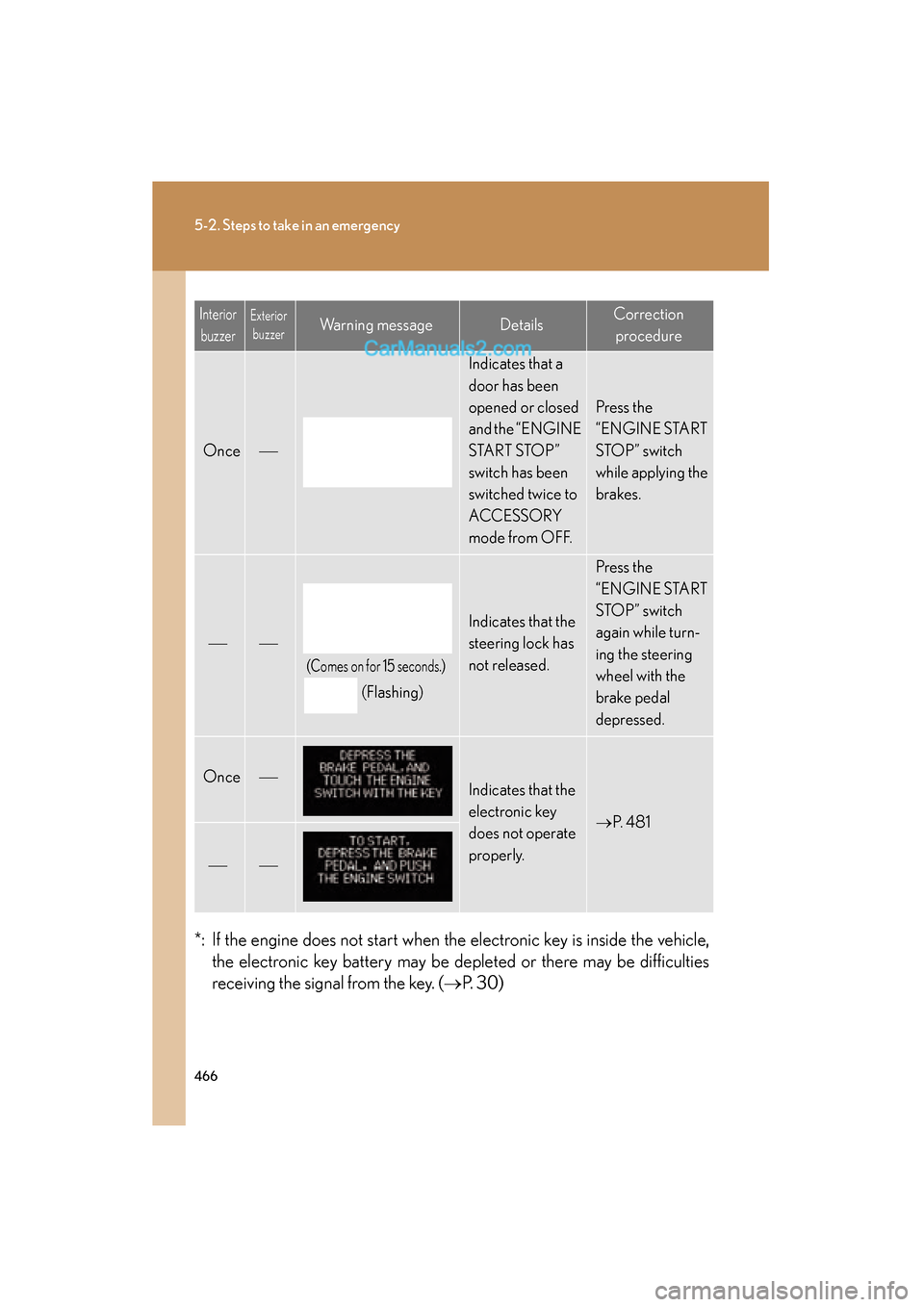
ES350_U*: If the engine does not start when the electronic key is inside the vehicle,
the electronic key battery may be de pleted or there may be difficulties
receiving the signal from the key. ( →P. 30)
Interior
buzzerExterior buzzerWarning messageDetailsCorrection
procedure
Once
Indicates that a
door has been
opened or closed
and the “ENGINE
S TA R T S TO P ”
switch has been
switched twice to
ACCESSORY
mode from OFF.
Press the
“ENGINE START
STOP” switch
while applying the
brakes.
(Comes on for 15 seconds.)
(Flashing)
Indicates that the
steering lock has
not released.
Press the
“ENGINE START
STOP” switch
again while turn-
ing the steering
wheel with the
brake pedal
depressed.
OnceIndicates that the
electronic key
does not operate
properly.
→ P. 4 8 1
Page 492 of 563
490
5-2. Steps to take in an emergency
ES350_U
If your vehicle has to be stopped in an emergency
CAUTION
■If the engine has to be turned off while driving
Power assist for the brakes and steering wheel will be lost, making the brake pedal
harder to depress and the steering wheel heavier to turn. Decelerate as much as
possible before turning off the engine.
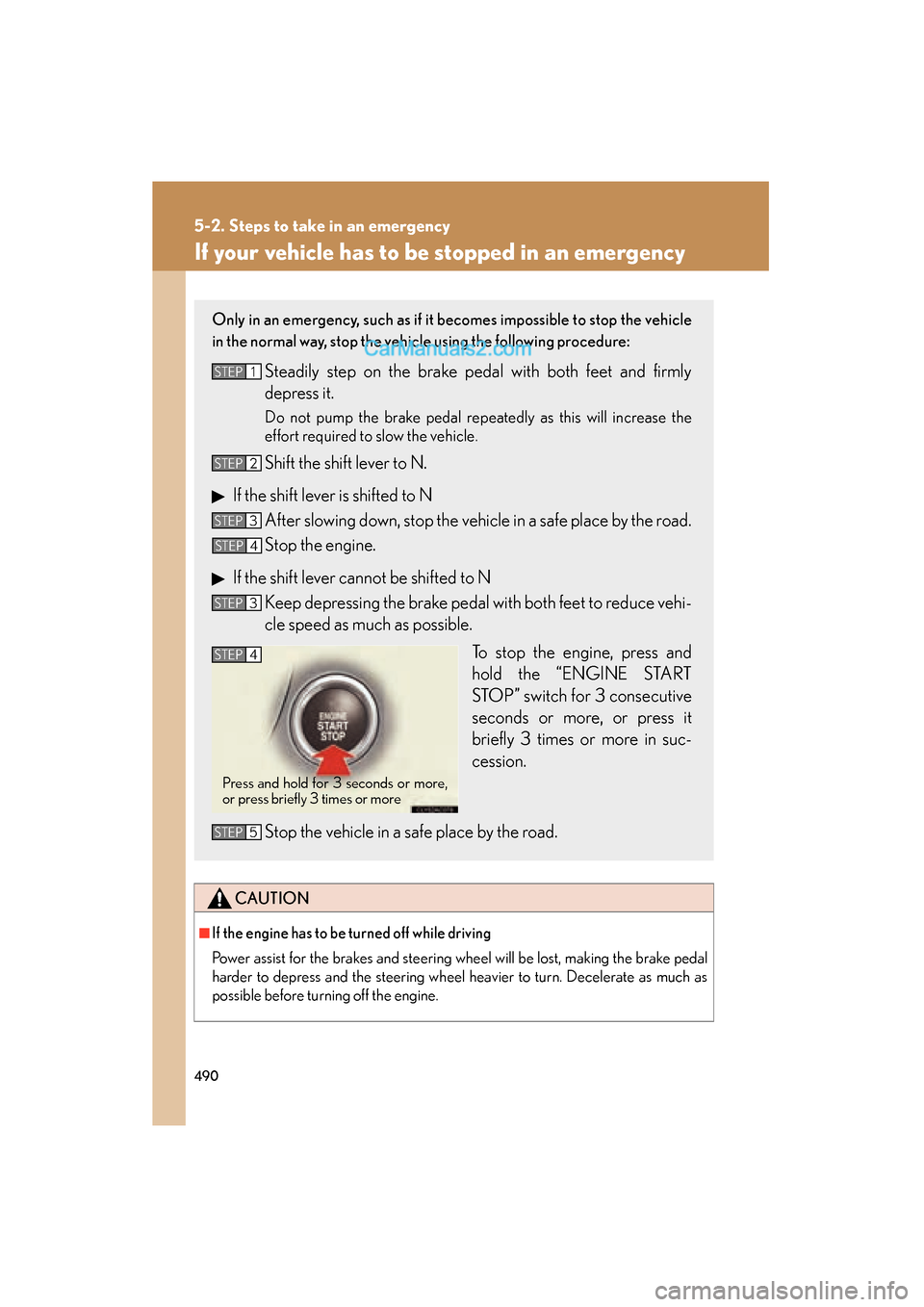
Only in an emergency, such as if it becomes impossible to stop the vehicle
in the normal way, stop the vehicle using the following procedure:
Steadily step on the brake pedal with both feet and firmly
depress it.
Do not pump the brake pedal repeatedly as this will increase the
effort required to slow the vehicle.
Shift the shift lever to N.
If the shift lever is shifted to N After slowing down, stop the vehicle in a safe place by the road.
Stop the engine.
If the shift lever cannot be shifted to N Keep depressing the brake pedal with both feet to reduce vehi-
cle speed as much as possible.
To stop the engine, press and
hold the “ENGINE START
STOP” switch for 3 consecutive
seconds or more, or press it
briefly 3 times or more in suc-
cession.
Stop the vehicle in a safe place by the road.
STEP1
STEP2
STEP3
STEP4
STEP3
STEP4
Press and hold for 3 seconds or more,
or press briefly 3 times or more
STEP5
Page 501 of 563
499
6-1. Specifications
6
Vehicle specifications
ES350_U
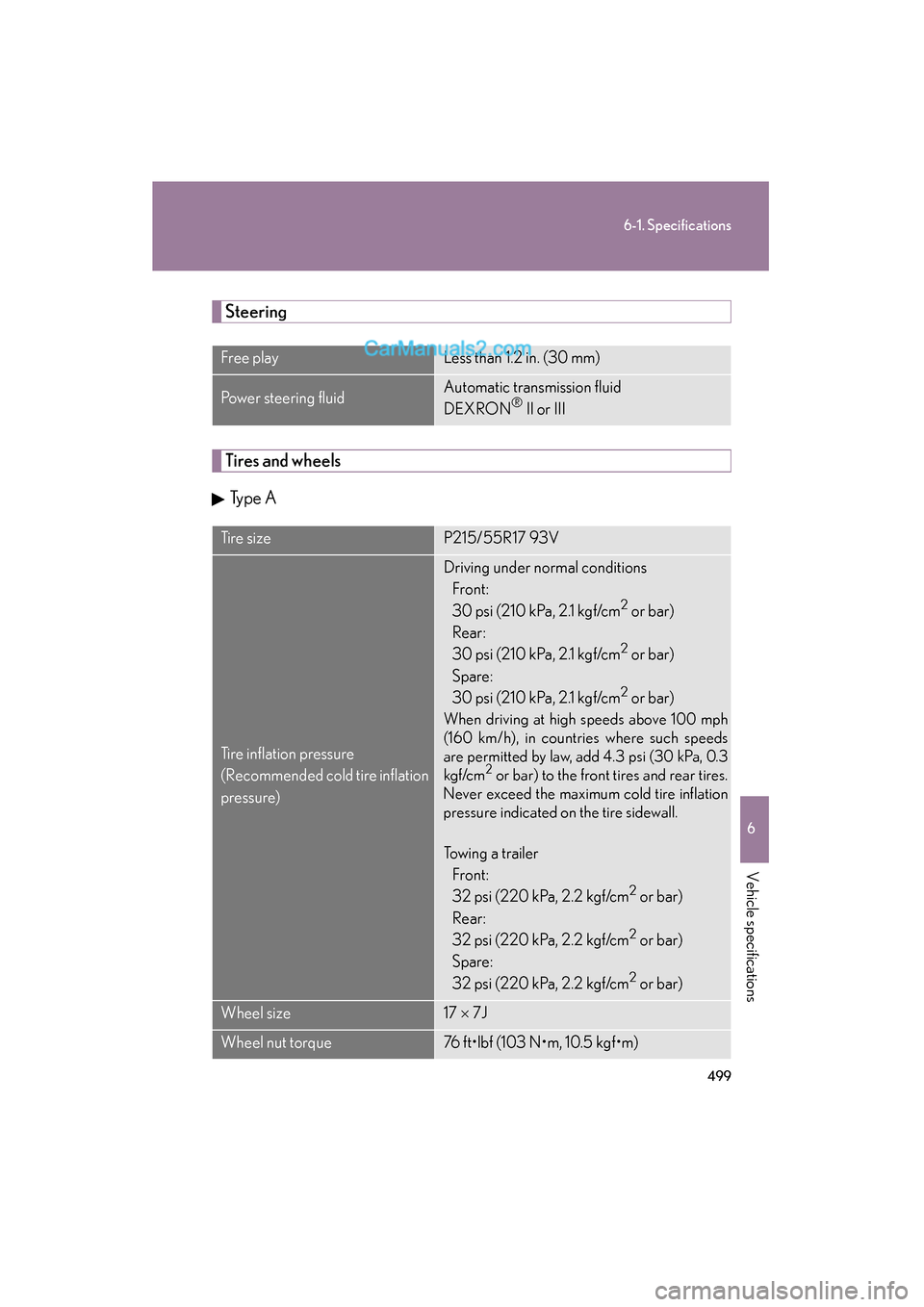
Steering
Tires and wheelsType A
Free playLess than 1.2 in. (30 mm)
Power steering fluidAutomatic transmission fluid
DEXRON® II or III
Ti r e s i z eP215/55R17 93V
Tire inflation pressure
(Recommended cold tire inflation
pressure)
Driving under normal conditions Front:
30 psi (210 kPa, 2.1 kgf/cm
2 or bar)
Rear:
30 psi (210 kPa, 2.1 kgf/cm
2 or bar)
Spare:
30 psi (210 kPa, 2.1 kgf/cm
2 or bar)
When driving at high speeds above 100 mph
(160 km/h), in countries where such speeds
are permitted by law, add 4.3 psi (30 kPa, 0.3
kgf/cm
2 or bar) to the front tires and rear tires.
Never exceed the maximum cold tire inflation
pressure indicated on the tire sidewall.
Towing a trailer
Front:
32 psi (220 kPa, 2.2 kgf/cm
2 or bar)
Rear:
32 psi (220 kPa, 2.2 kgf/cm
2 or bar)
Spare:
32 psi (220 kPa, 2.2 kgf/cm
2 or bar)
Wheel size17 × 7J
Wheel nut torque76 ft•lbf (103 N•m, 10.5 kgf•m)
Page 512 of 563
510
6-1. Specifications
ES350_U■
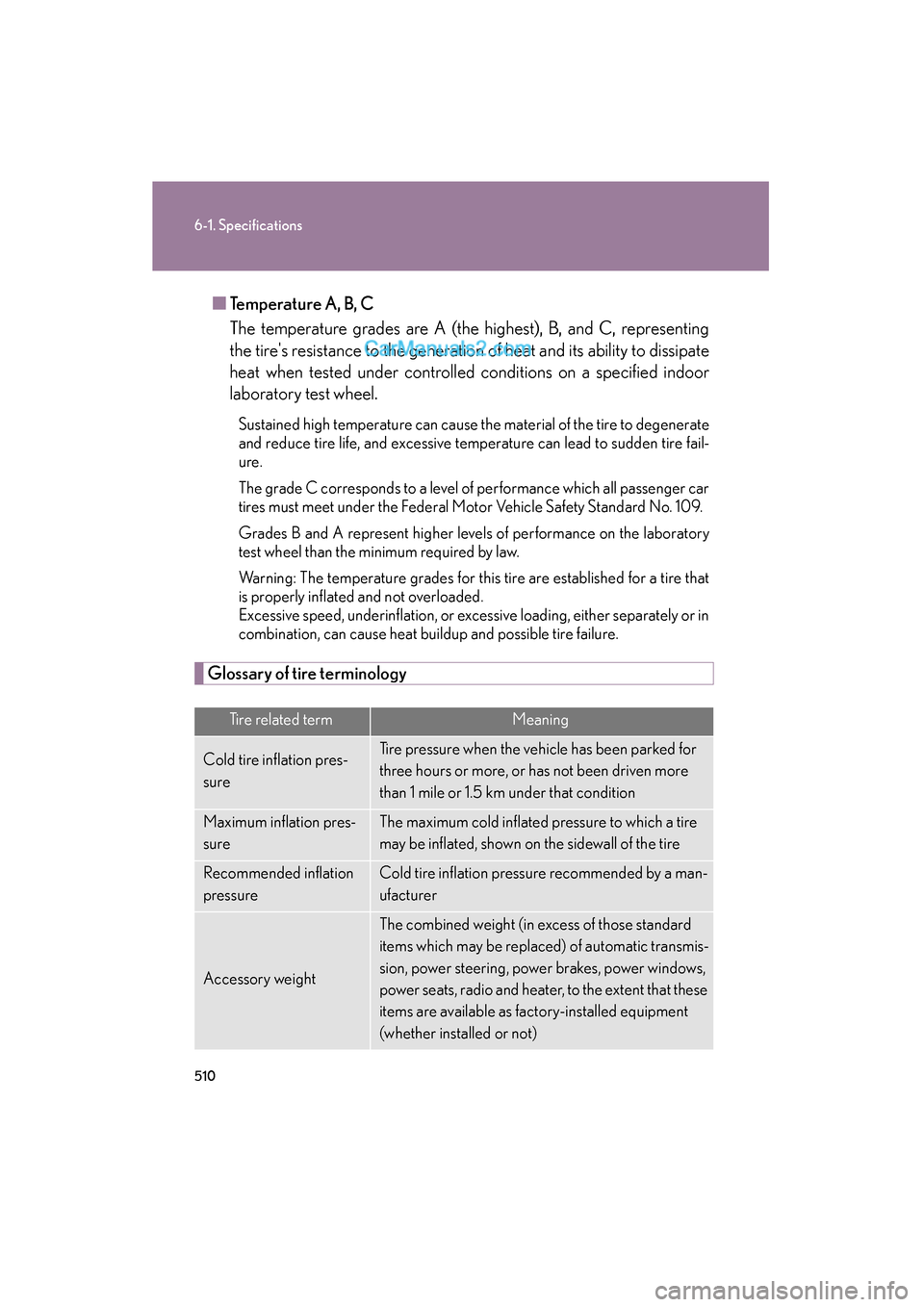
Temperature A, B, C
The temperature grades are A (the highest), B, and C, representing
the tire's resistance to the generation of heat and its ability to dissipate
heat when tested under controlled conditions on a specified indoor
laboratory test wheel.
Sustained high temperature can cause the material of the tire to degenerate
and reduce tire life, and excessive temperature can lead to sudden tire fail-
ure.
The grade C corresponds to a level of performance which all passenger car
tires must meet under the Federal Motor Vehicle Safety Standard No. 109.
Grades B and A represent higher levels of performance on the laboratory
test wheel than the minimum required by law.
Warning: The temperature grades for this tire are established for a tire that
is properly inflated and not overloaded.
Excessive speed, underinflation, or excessive loading, either separately or in
combination, can cause heat buildup and possible tire failure.
Glossary of tire terminology
Tire related termMeaning
Cold tire inflation pres-
sureTire pressure when the vehicle has been parked for
three hours or more, or has not been driven more
than 1 mile or 1.5 km under that condition
Maximum inflation pres-
sureThe maximum cold inflated pressure to which a tire
may be inflated, shown on the sidewall of the tire
Recommended inflation
pressureCold tire inflation pressure recommended by a man-
ufacturer
Accessory weight
The combined weight (in excess of those standard
items which may be replaced) of automatic transmis-
sion, power steering, power brakes, power windows,
power seats, radio and heater, to the extent that these
items are available as factory-installed equipment
(whether installed or not)
Page 546 of 563
544
ES350_U
Alphabetical index
Alphabetical index
A/C ........................................................... 208
ABS............................................................... 177
Adaptive front lighting system ......... 148
AFS .............................................................. 148
Air conditioning filter ..........................409
Air conditioning systemAir conditioning filter .......................409
Automatic air conditioning system ..................................................208
Airbags
Airbag operating conditions...........88
Airbag precautions for your child.......................................................... 92
Airbag warning light ........................ 446
Curtain shield airbag operating conditions.............................................. 89
Curtain shield airbag precautions .......................................... 92
Front passenger occupant classification system......................... 97
General airbag precautions ........... 92
Locations of airbags............................ 86
Modification and disposal of airbags .................................................... 96
Proper driving posture ............. 84, 92
Side airbag operating conditions.............................................. 89
Side airbag precautions .................... 92
SRS airbags ............................................. 86 Alarm ..............................................................81
Antenna .................................................... 223
Anti-lock brake system ........................ 177
Armrest .................................................... 334
Ashtray...................................................... 327
Audio input.............................................. 258
Audio system
Antenna...................................................223
Audio input........................................... 258
AUX port .............................................. 258
CD player/changer ..........................226
iPod .......................................................... 240
MP3/WMA disc................................233
Optimal use ......................................... 256
Portable music player ..................... 258
Radio ......................................................... 219
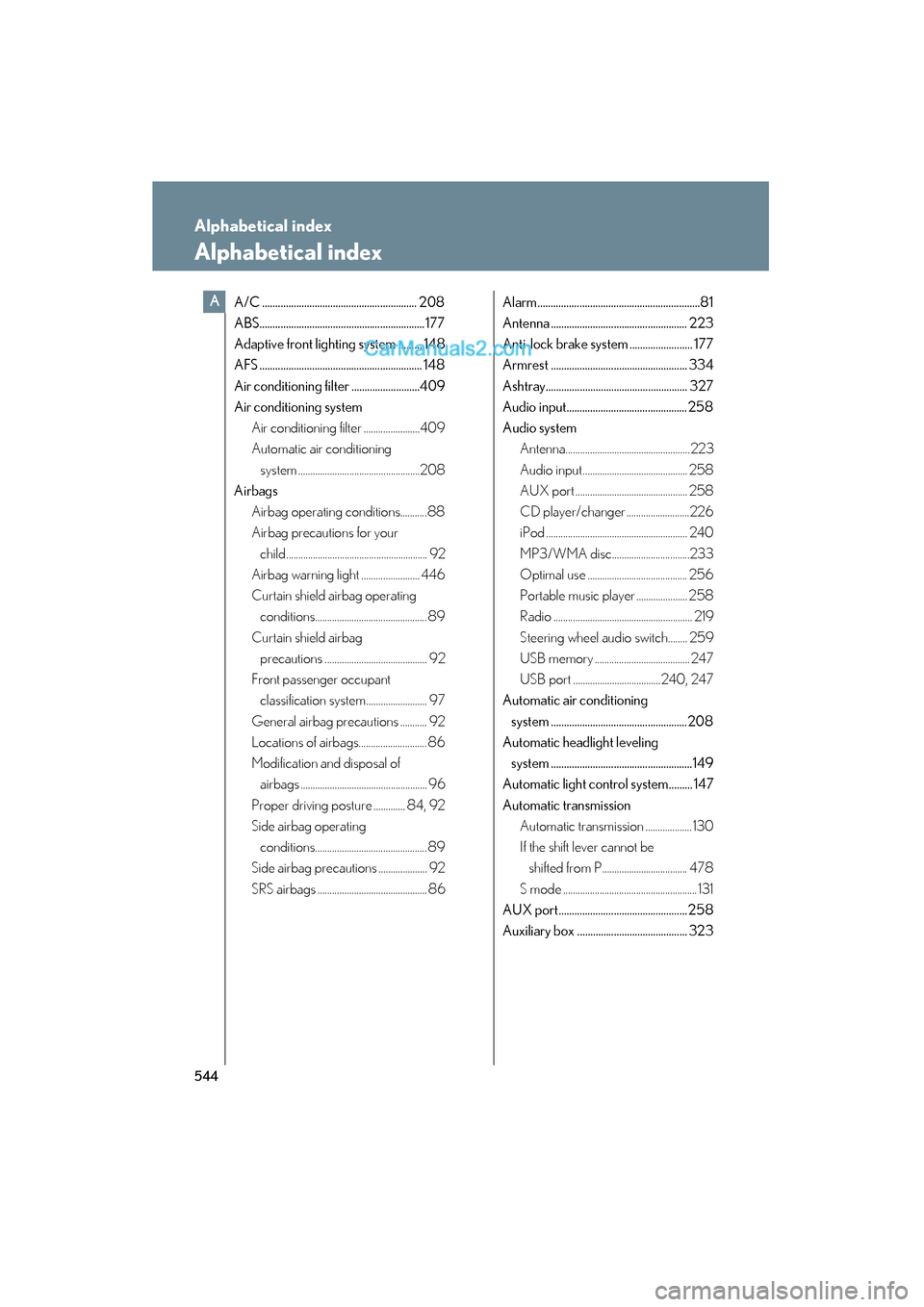
Steering wheel audio switch........ 259
USB memory ....................................... 247
USB port ....................................240, 247
Automatic air conditioning
system ....................................................208
Automatic headlight leveling
system ......................................................149
Automatic light control system......... 147
Automatic transmission Automatic transmission ................... 130
If the shift lever cannot be shifted from P................................... 478
S mode ....................................................... 131
AUX port................................................. 258
Auxiliary box .......................................... 323A