warning Lexus ES350 2011 s Repair Manual
[x] Cancel search | Manufacturer: LEXUS, Model Year: 2011, Model line: ES350, Model: Lexus ES350 2011Pages: 563, PDF Size: 6.72 MB
Page 464 of 563
462
5-2. Steps to take in an emergency
ES350_U
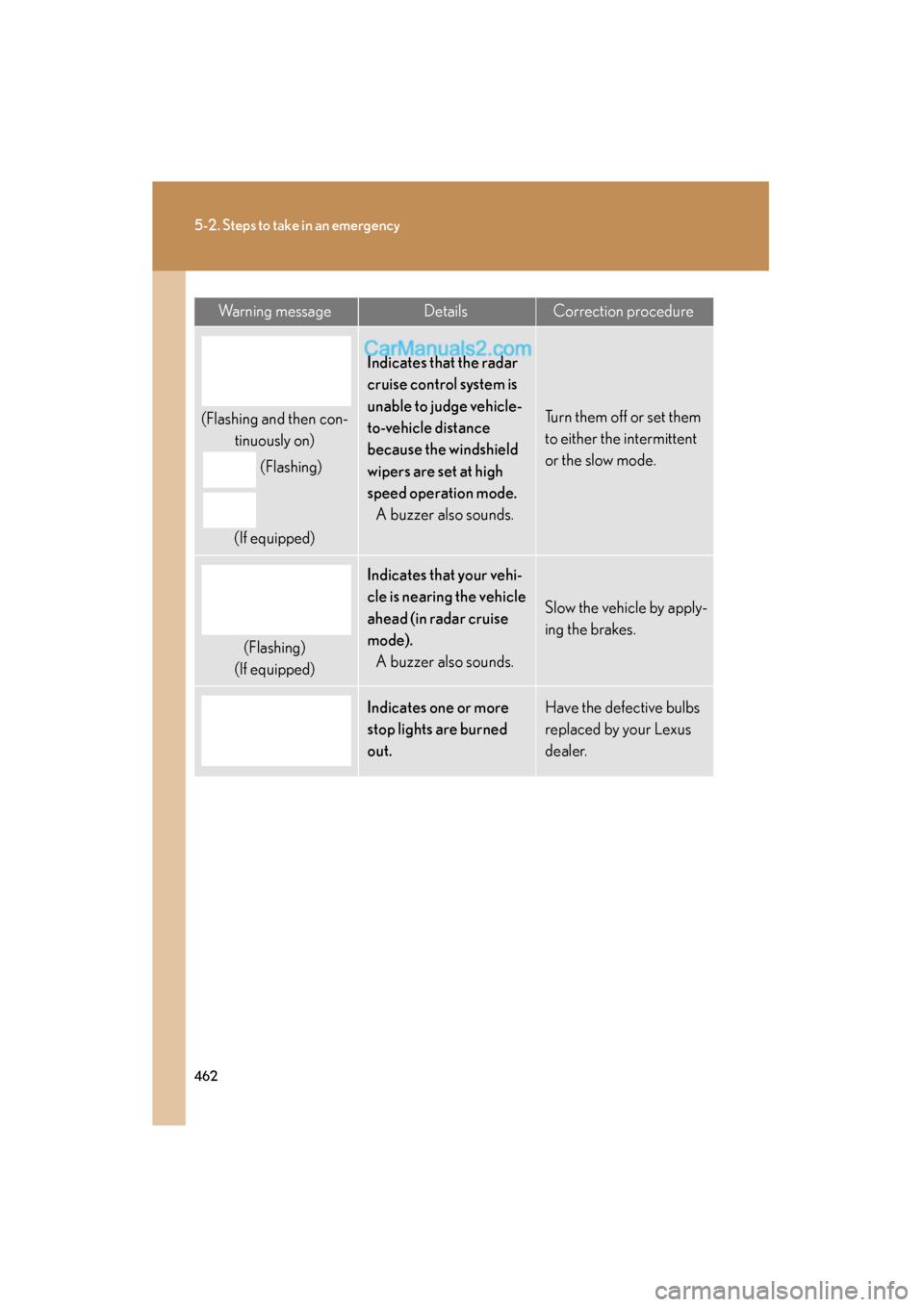
Warning messageDetailsCorrection procedure
(Flashing and then con-tinuously on)
(Flashing)
(If equipped)
Indicates that the radar
cruise control system is
unable to judge vehicle-
to-vehicle distance
because the windshield
wipers are set at high
speed operation mode. A buzzer also sounds.
Turn them off or set them
to either the intermittent
or the slow mode.
(Flashing)
(If equipped)
Indicates that your vehi-
cle is nearing the vehicle
ahead (in radar cruise
mode). A buzzer also sounds.
Slow the vehicle by apply-
ing the brakes.
Indicates one or more
stop lights are burned
out.Have the defective bulbs
replaced by your Lexus
dealer.
Page 465 of 563
5
When trouble arises
463
5-2. Steps to take in an emergency
ES350_U
■Changing the engine oil (USA only)
Make sure to reset the oil change system. (→P. 383)
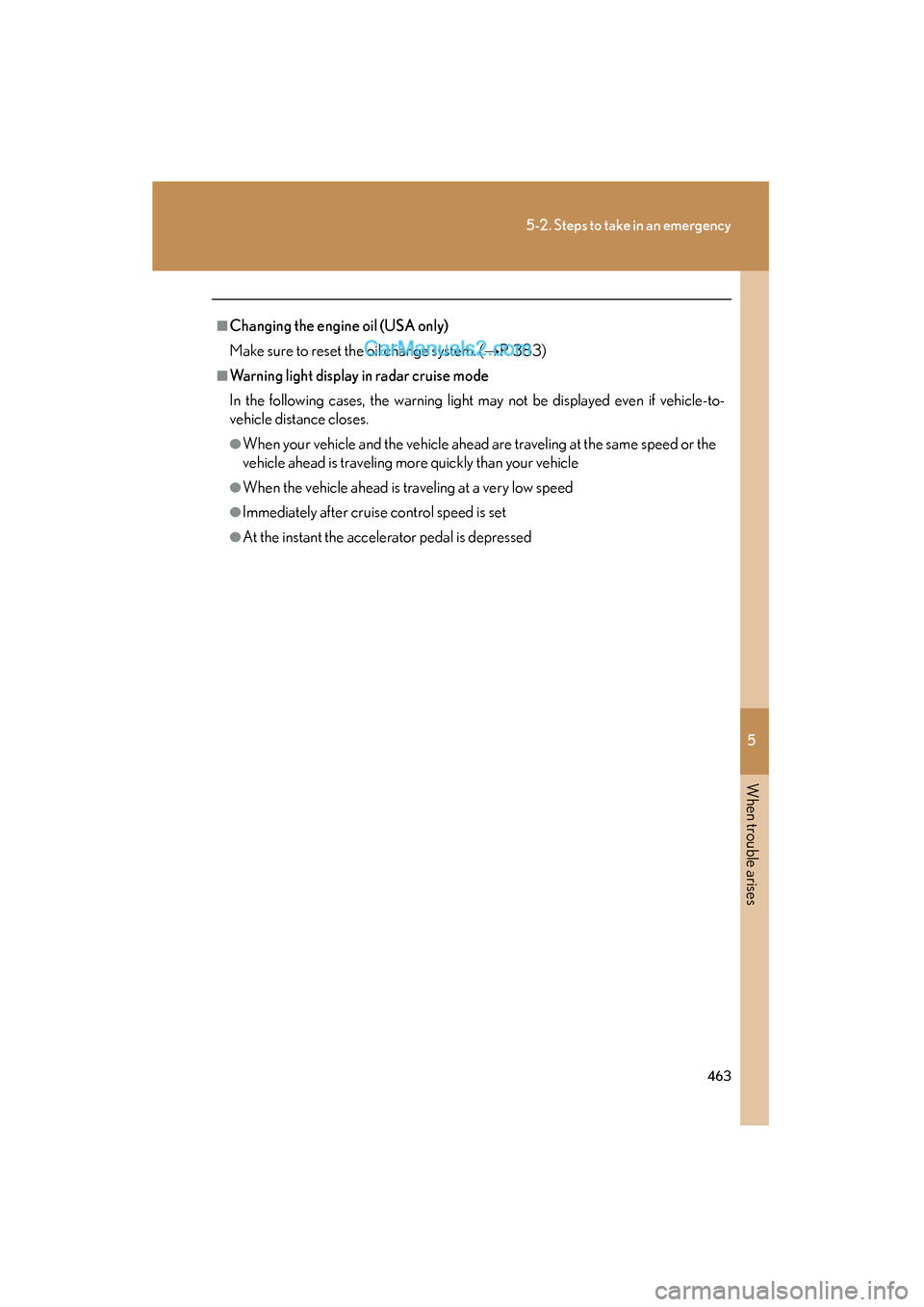
■Warning light display in radar cruise mode
In the following cases, the warning light may not be displayed even if vehicle-to-
vehicle distance closes.
●When your vehicle and the vehicle ahead are traveling at the same speed or the
vehicle ahead is traveling more quickly than your vehicle
●When the vehicle ahead is traveling at a very low speed
●Immediately after cruise control speed is set
●At the instant the accelerator pedal is depressed
Page 466 of 563
464
5-2. Steps to take in an emergency
ES350_U
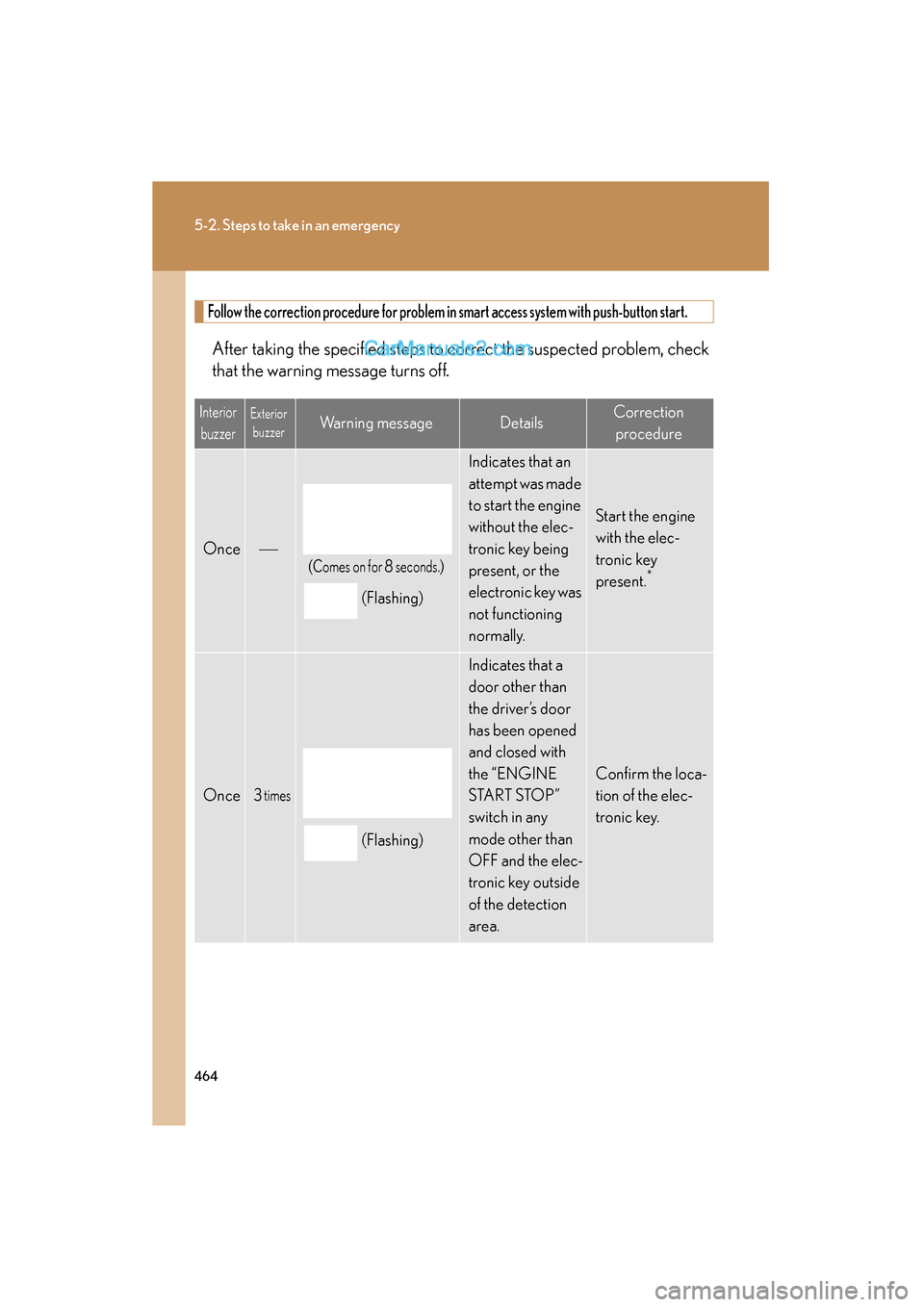
Follow the correction procedure for problem in smart access system with push-button start.
After taking the specified steps to correct the suspected problem, check
that the warning message turns off.
InteriorbuzzerExterior buzzerWarning messageDetailsCorrection
procedure
Once
(Comes on for 8 seconds.)
(Flashing)
Indicates that an
attempt was made
to start the engine
without the elec-
tronic key being
present, or the
electronic key was
not functioning
n o r m a l l y.
Start the engine
with the elec-
tronic key
present.
*
Once3 times
(Flashing)
Indicates that a
door other than
the driver’s door
has been opened
and closed with
the “ENGINE
S TA R T S TO P ”
switch in any
mode other than
OFF and the elec-
tronic key outside
of the detection
area.
Confirm the loca-
tion of the elec-
tronic key.
Page 467 of 563
5
When trouble arises
465
5-2. Steps to take in an emergency
ES350_U
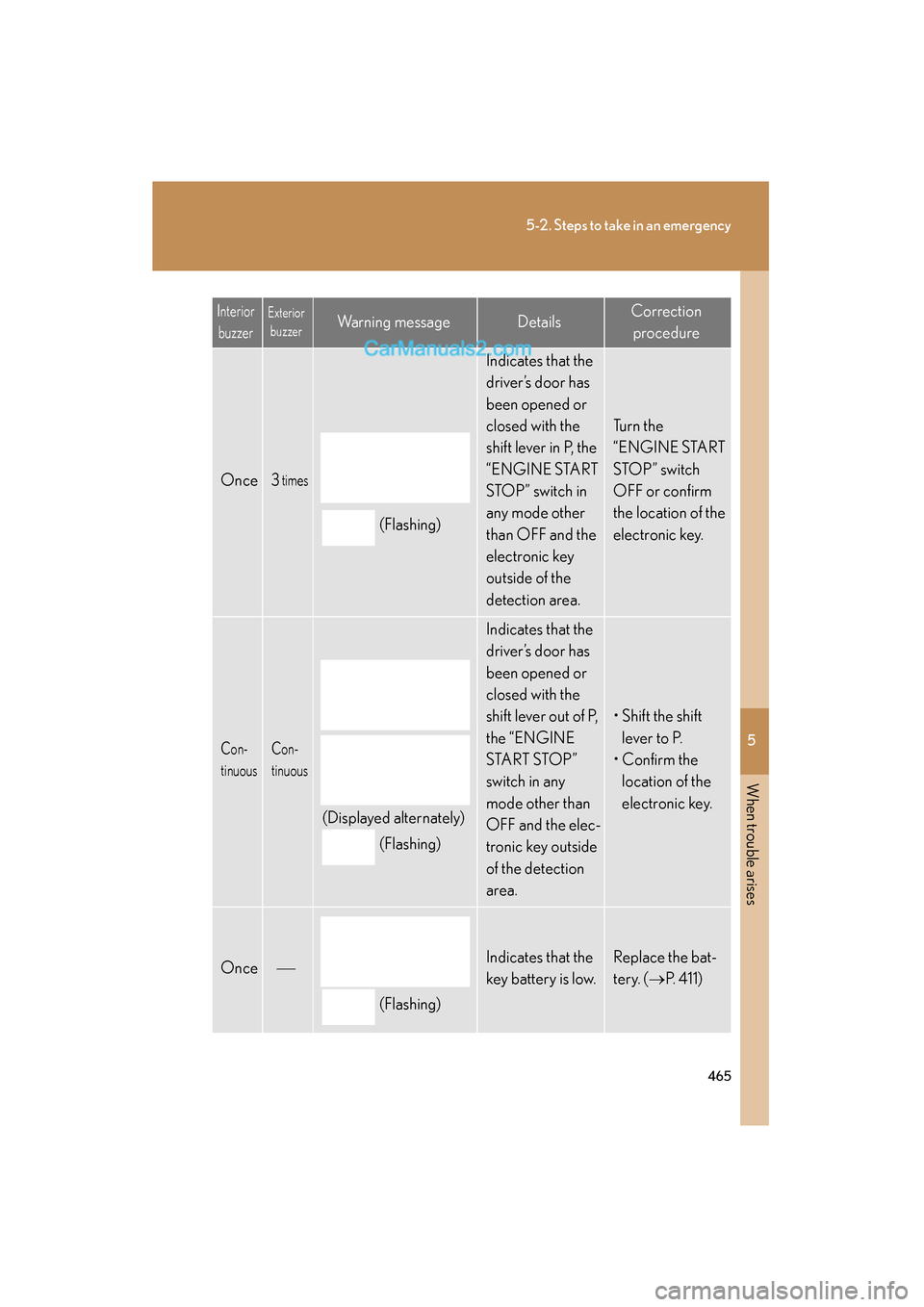
InteriorbuzzerExterior buzzerWarning messageDetailsCorrection
procedure
Once3 times
(Flashing)
Indicates that the
driver’s door has
been opened or
closed with the
shift lever in P, the
“ENGINE START
STOP” switch in
any mode other
than OFF and the
electronic key
outside of the
detection area.
Tu r n t h e
“ENGINE START
STO P ” s w i t c h
OFF or confirm
the location of the
electronic key.
Con-
tinuousCon-
tinuous
(Displayed alternately)
(Flashing)
Indicates that the
driver’s door has
been opened or
closed with the
shift lever out of P,
the “ENGINE
START STOP”
switch in any
mode other than
OFF and the elec-
tronic key outside
of the detection
area.
• Shift the shift lever to P.
• Confirm the
location of the
electronic key.
Once
(Flashing)
Indicates that the
key battery is low.Replace the bat-
tery. ( →P. 411)
Page 468 of 563
466
5-2. Steps to take in an emergency
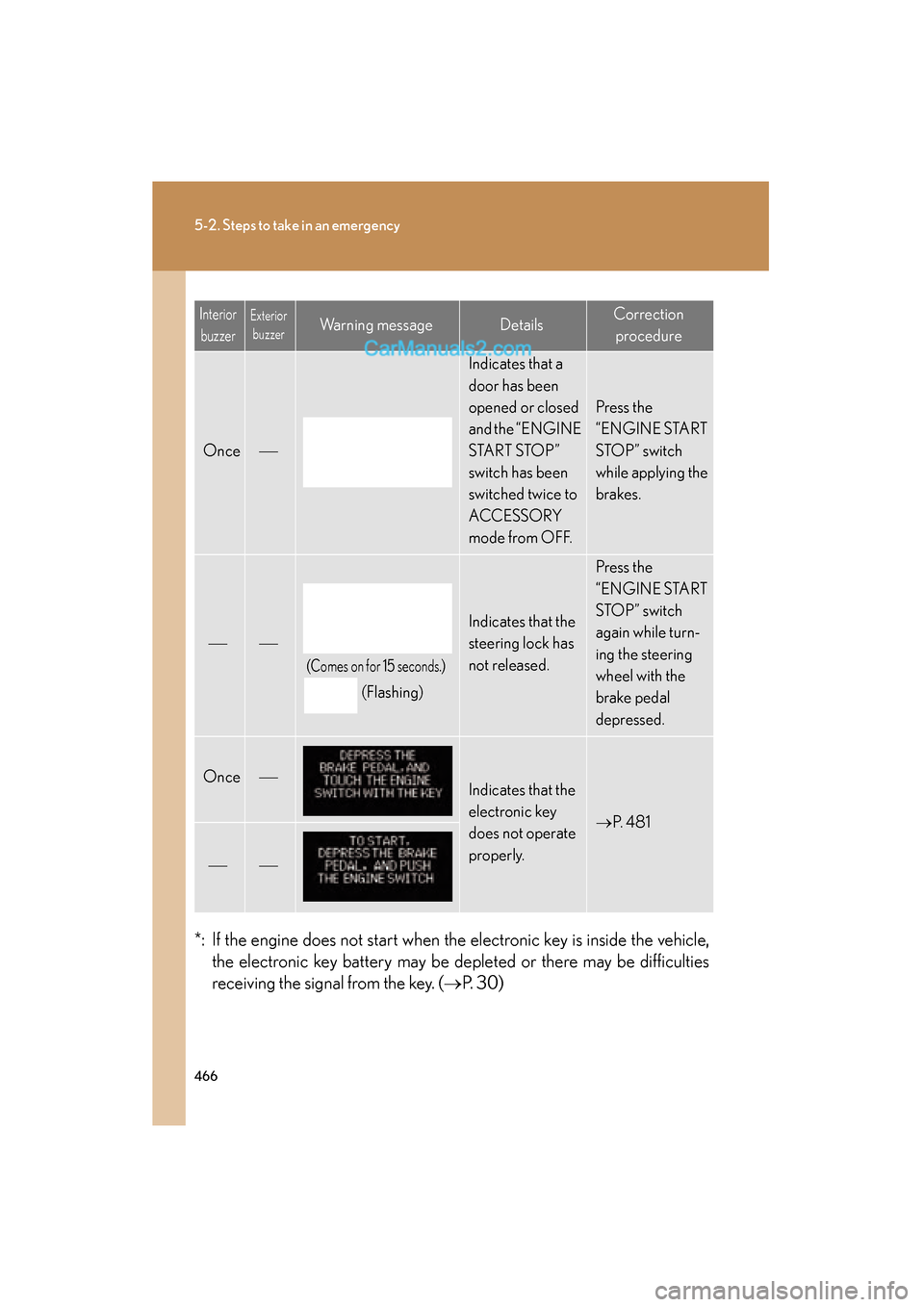
ES350_U*: If the engine does not start when the electronic key is inside the vehicle,
the electronic key battery may be de pleted or there may be difficulties
receiving the signal from the key. ( →P. 30)
Interior
buzzerExterior buzzerWarning messageDetailsCorrection
procedure
Once
Indicates that a
door has been
opened or closed
and the “ENGINE
S TA R T S TO P ”
switch has been
switched twice to
ACCESSORY
mode from OFF.
Press the
“ENGINE START
STOP” switch
while applying the
brakes.
(Comes on for 15 seconds.)
(Flashing)
Indicates that the
steering lock has
not released.
Press the
“ENGINE START
STOP” switch
again while turn-
ing the steering
wheel with the
brake pedal
depressed.
OnceIndicates that the
electronic key
does not operate
properly.
→ P. 4 8 1
Page 475 of 563
5
When trouble arises
473
5-2. Steps to take in an emergency
ES350_U
■When using the compact spare tire
As the compact spare tire is not equipped with the tire pressure warning valve and
transmitter, low inflation pressure of the spare tire will not be warned. Also, if you
replace the compact spare tire after the tire pressure warning light comes on, the
light remains on.
■If you have a flat front tire on a road covered with snow or ice (vehicles with com-
pact spare tire)
Install the compact spare tire on the rear of the vehicle. Perform the following steps
and fit tire chains to the front tires.Replace a rear tire with the compact spare tire.
Replace the flat front tire with the tire removed from the rear of the vehi-
cle.
Fit tire chains to the front tires.
■After completing the tire change
The tire pressure warning system must be reset. ( →P. 396)
CAUTION
■Using the tire jack
Improper use of the tire jack may lead to death or serious injuries due to the vehicle
suddenly falling off the jack.
●Do not use the tire jack for any purpose other than replacing tires or installing and
removing tire chains.
●Only use the tire jack that comes with this vehicle for replacing a flat tire.
Do not use it on other vehicles, and do not use other tire jacks for replacing tires
on this vehicle.
●Always check that the tire jack is securely set to the jack point.
●Do not put any part of your body under the vehicle supported by a jack.
●Do not start or run the engine while your vehicle is supported by the jack.
●Do not raise the vehicle while someone is in it.
●When raising the vehicle, do not put an object on or under the jack.
STEP1
STEP2
STEP3
Page 477 of 563
5
When trouble arises
475
5-2. Steps to take in an emergency
ES350_U
CAUTION
■When the compact spare tire attached
The vehicle speed may not be correctly detected, and the following systems may
not operate correctly:
●ABS & Brake assist
●VSC
●TRAC
●Navigation system (if equipped)
NOTICE
■Do not drive the vehicle with a flat tire.
Do not continue driving with a flat tire.
Driving even a short distance with a flat tire can damage the tire and the wheel
beyond repair.
■When replacing the tires
When removing or fitting the wheels, tires or the tire pressure warning valve and
transmitter, contact your Lexus dealer as the tire pressure warning valve and trans-
mitter may be damaged if not handled correctly.
■To avoid damage to the tire pressure warning valves and transmitters
When a tire is repaired with liquid sealants, the tire pressure warning valve and
transmitter may not operate properly. If a liquid sealant is used, contact your Lexus
dealer or other qualified service shop as soon as possible. Make sure to replace the
tire pressure warning valve and transmitter when replacing the tire. (→P. 395)
■Be careful when driving over bumps with the compact spare tire installed on the
vehicle.
The vehicle becomes lower when driving with the compact spare tire compared to
when driving with standard tires. Be careful when driving over uneven road sur-
faces.
■Driving with tire chains and the compact spare tire
Do not fit tire chains to the compact spare tire.
Tire chains may damage the vehicle body and adversely affect driving performance.
Page 511 of 563
509
6-1. Specifications
6
Vehicle specifications
ES350_U■
DOT quality grades
All passenger vehicle tires must conform to Federal Safety Require-
ments in addition to these grades. Quality grades can be found where
applicable on the tire sidewall between tread shoulder and maximum
section width.
For example: Treadwear 200 Traction AA Temperature A
■Treadwear
The treadwear grade is a comparative rating based on the wear rate of
the tire when tested under controlled conditions on a specified gov-
ernment test course.
For example, a tire graded 150 would wear one and a half (1 - 1 /2) times as
well on the government course as a tire graded 100.
The relative performance of tires depends upon the actual conditions of
their use, however, and may depart sign ificantly from the norm due to varia-
tions in driving habits, service practices and differences in road characteris-
tics and climate.
■ Traction AA, A, B, C
The traction grades, from highest to lowest, are AA, A, B and C, and
they represent the tire's ability to stop on wet pavement as measured
under controlled conditions on specified government test surfaces of
asphalt and concrete.
A tire marked C may have poor traction performance.
Warning: The traction grade assigned to this tire is based on braking
(straight ahead) traction tests and does not include cornering (turning) trac-
tion.
Page 512 of 563
510
6-1. Specifications
ES350_U■
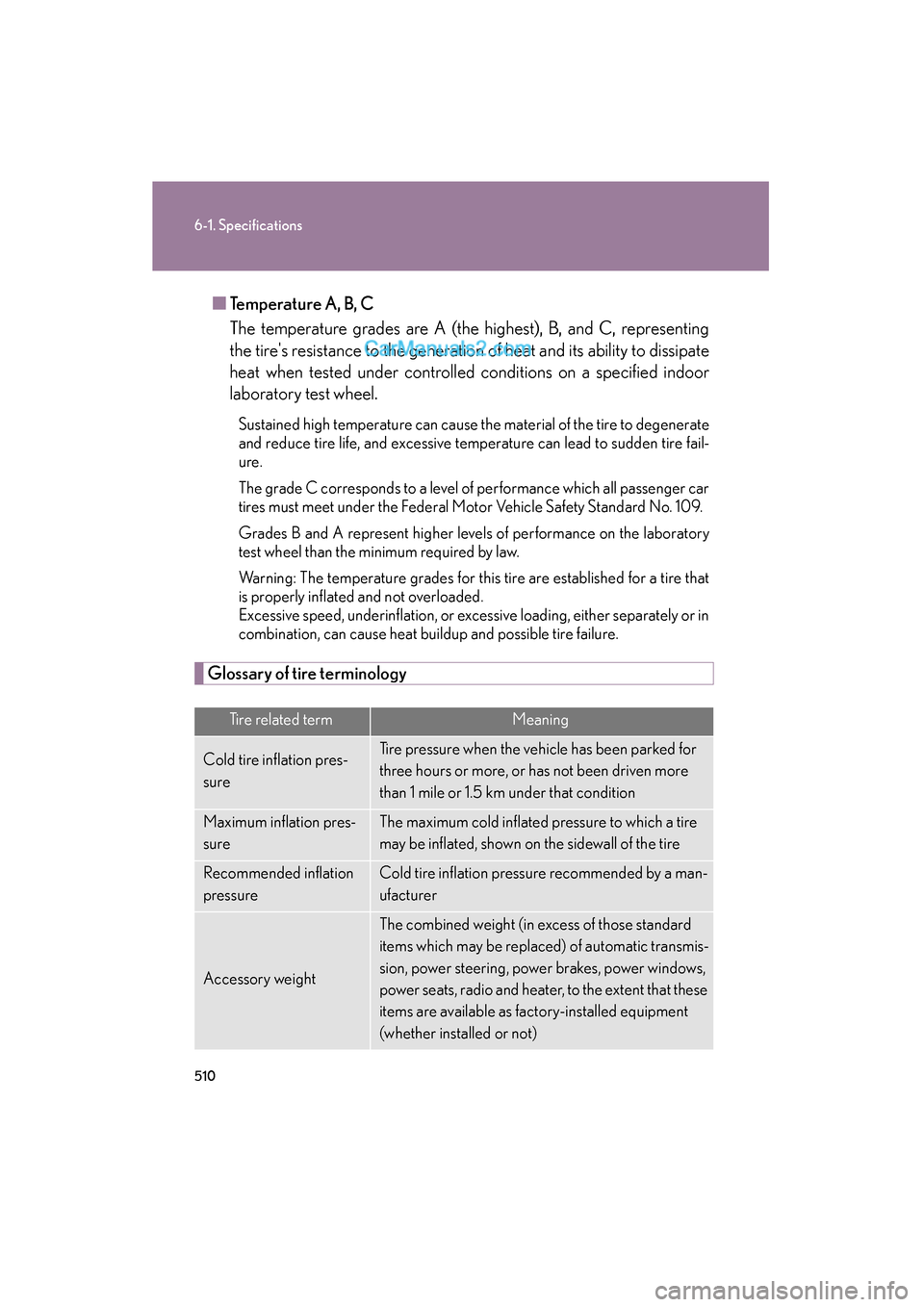
Temperature A, B, C
The temperature grades are A (the highest), B, and C, representing
the tire's resistance to the generation of heat and its ability to dissipate
heat when tested under controlled conditions on a specified indoor
laboratory test wheel.
Sustained high temperature can cause the material of the tire to degenerate
and reduce tire life, and excessive temperature can lead to sudden tire fail-
ure.
The grade C corresponds to a level of performance which all passenger car
tires must meet under the Federal Motor Vehicle Safety Standard No. 109.
Grades B and A represent higher levels of performance on the laboratory
test wheel than the minimum required by law.
Warning: The temperature grades for this tire are established for a tire that
is properly inflated and not overloaded.
Excessive speed, underinflation, or excessive loading, either separately or in
combination, can cause heat buildup and possible tire failure.
Glossary of tire terminology
Tire related termMeaning
Cold tire inflation pres-
sureTire pressure when the vehicle has been parked for
three hours or more, or has not been driven more
than 1 mile or 1.5 km under that condition
Maximum inflation pres-
sureThe maximum cold inflated pressure to which a tire
may be inflated, shown on the sidewall of the tire
Recommended inflation
pressureCold tire inflation pressure recommended by a man-
ufacturer
Accessory weight
The combined weight (in excess of those standard
items which may be replaced) of automatic transmis-
sion, power steering, power brakes, power windows,
power seats, radio and heater, to the extent that these
items are available as factory-installed equipment
(whether installed or not)
Page 527 of 563
525
6
Vehicle specifications
ES350_U
6-3. Initialization
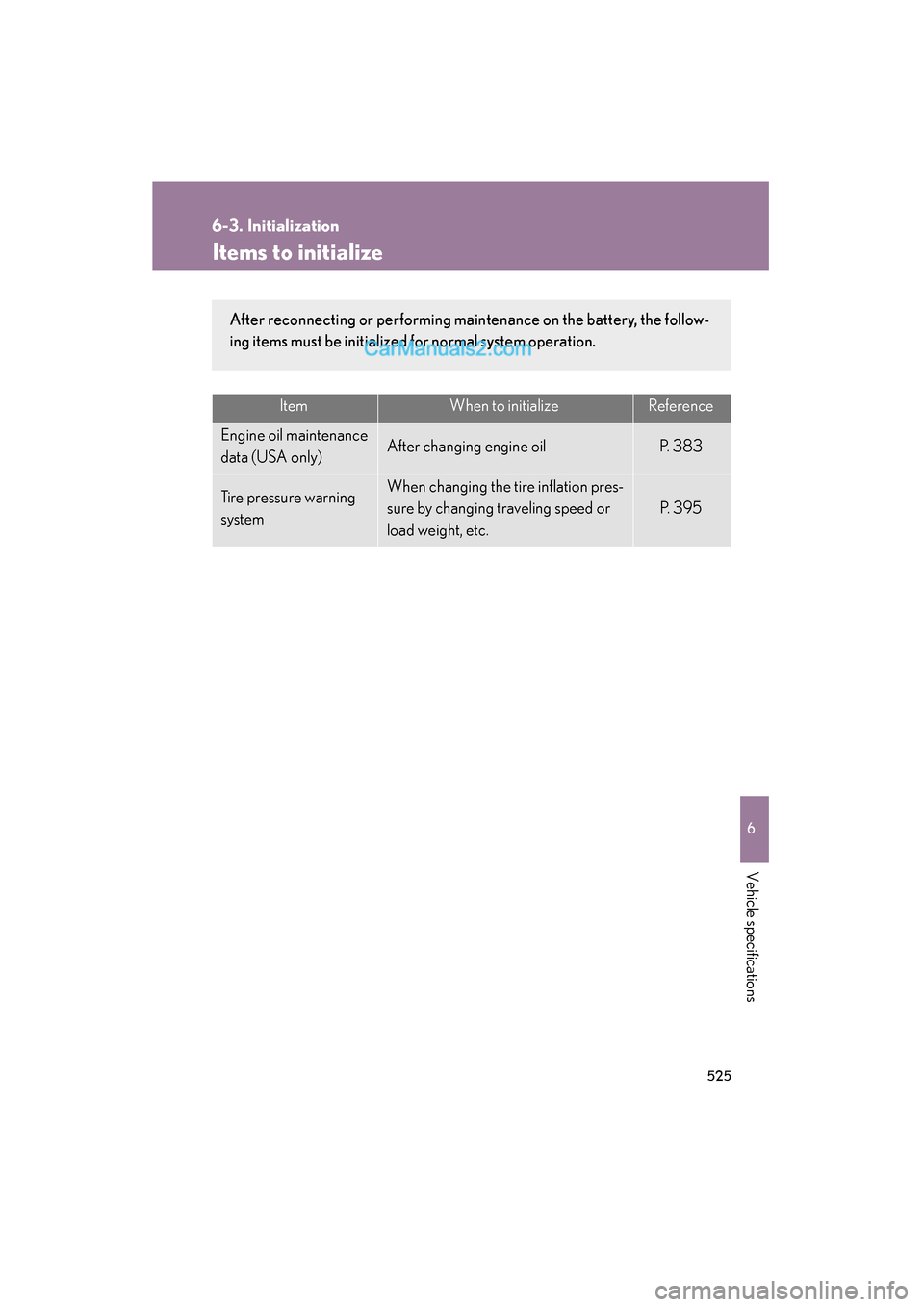
Items to initialize
ItemWhen to initializeReference
Engine oil maintenance
data (USA only)After changing engine oilP. 3 8 3
Tire pressure warning
systemWhen changing the tire inflation pres-
sure by changing traveling speed or
load weight, etc.
P. 3 9 5
After reconnecting or performing maintenance on the battery, the follow-
ing items must be initialized for normal system operation.