eco Lexus ES350 2012 Owner's Manual
[x] Cancel search | Manufacturer: LEXUS, Model Year: 2012, Model line: ES350, Model: Lexus ES350 2012Pages: 554, PDF Size: 6.43 MB
Page 462 of 554
5
When trouble arises
461
5-2. Steps to take in an emergency
ES350_U
If you have a flat tire
Remove the flat tire and replace it with the spare provided.
■Before jacking up the vehicle
●Stop the vehicle on a hard, flat surface.
● Set the parking brake.
● Shift the shift lever to P.
● Stop the engine.
● Turn on the emergency flashers.
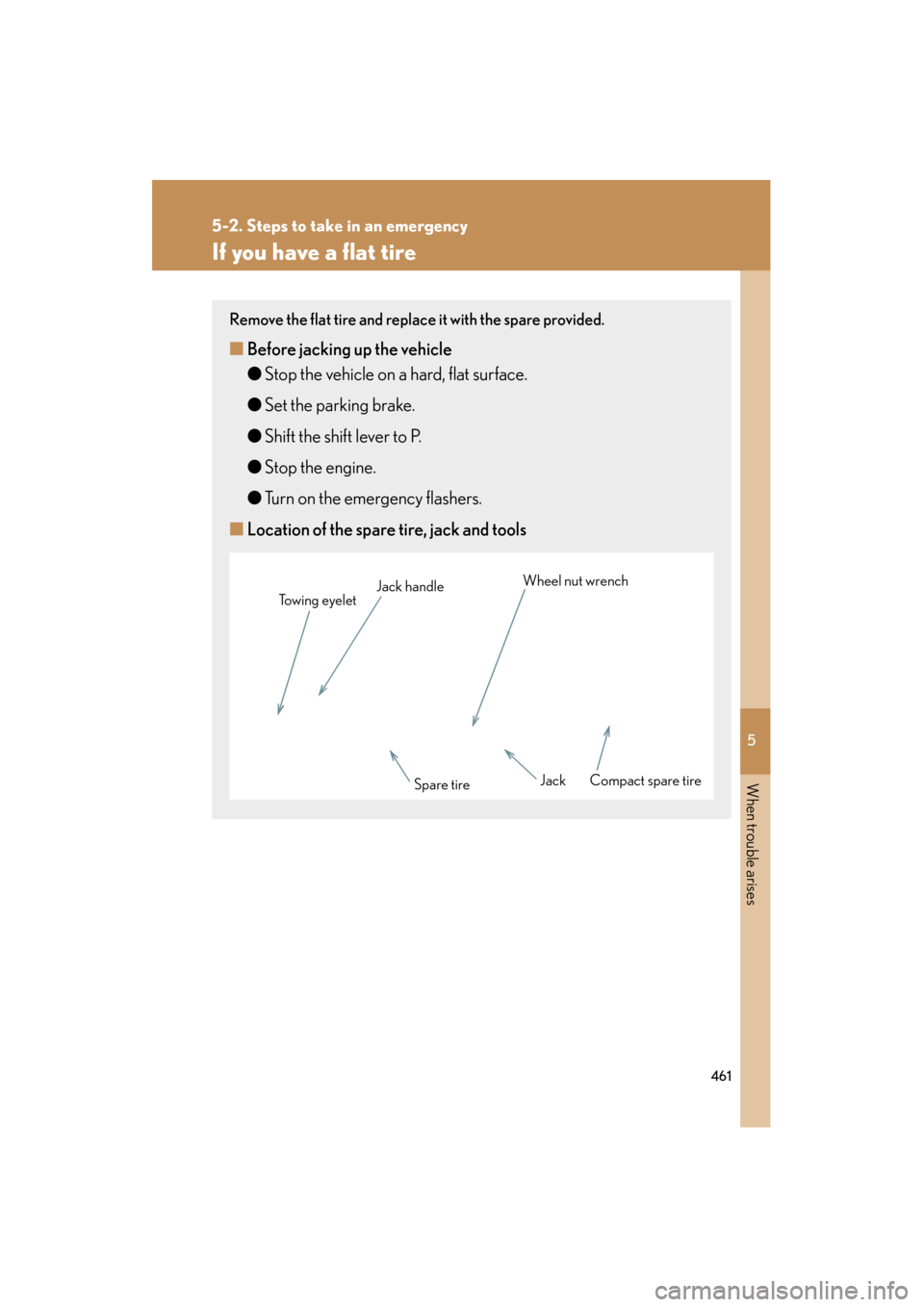
■ Location of the spare tire, jack and tools
Jack
Jack handle
Spare tireCompact spare tire
Wheel nut wrench
Towing eyelet
Page 470 of 554

5
When trouble arises
469
5-2. Steps to take in an emergency
ES350_U
CAUTION
■When the compact spare tire attached
The vehicle speed may not be correctly detected, and the following systems may
not operate correctly:
●ABS & Brake assist
●VSC
●TRAC
●Navigation system (if equipped)
NOTICE
■Do not drive the vehicle with a flat tire.
Do not continue driving with a flat tire.
Driving even a short distance with a flat tire can damage the tire and the wheel
beyond repair.
■When replacing the tires
When removing or fitting the wheels, tires or the tire pressure warning valve and
transmitter, contact your Lexus dealer as the tire pressure warning valve and trans-
mitter may be damaged if not handled correctly.
■To avoid damage to the tire pressure warning valves and transmitters
When a tire is repaired with liquid sealants, the tire pressure warning valve and
transmitter may not operate properly. If a liquid sealant is used, contact your Lexus
dealer or other qualified service shop as soon as possible. Make sure to replace the
tire pressure warning valve and transmitter when replacing the tire. (→P. 3 9 1 )
■Be careful when driving over bumps with the compact spare tire installed on the
vehicle.
The vehicle becomes lower when driving with the compact spare tire compared to
when driving with standard tires. Be careful when driving over uneven road sur-
faces.
■Driving with tire chains and the compact spare tire
Do not fit tire chains to the compact spare tire.
Tire chains may damage the vehicle body and adversely affect driving performance.
Page 477 of 554
476
5-2. Steps to take in an emergency
ES350_UTo change “ENGINE START ST
OP” switch modes: Within 10
seconds of the buzzer sounding, release the brake pedal and
press the “ENGINE START STOP” switch. Modes can be
changed each time the switch is pressed. ( →P. 1 2 8 )
To start the engine: Press the “ENGINE START STOP” switch
within 10 seconds after the buzzer sounds, keeping the brake
pedal depressed.
In the event that the “ENGINE START STOP” switch still cannot be oper-
ated, contact your Lexus dealer.
■Stopping the engine
Shift the shift lever to P and press the “ENGINE START STOP” switch as you nor-
mally do when stopping the engine.
■Replacing the key battery
As the above procedure is a temporary measure, it is recommended that the elec-
tronic key battery be replaced immediately when the battery depletes. ( →P. 4 0 7 )
STEP3
Page 478 of 554
5
When trouble arises
477
5-2. Steps to take in an emergency
ES350_U
If the vehicle battery is discharged
The following procedures may be used to start the engine if the vehicle’s
battery is discharged.
You can call your Lexus dealer or qualified repair shop.
If you have a set of jumper (or booster) cables and a second vehicle
with a 12-volt battery, you can jump start your Lexus following the steps
below.
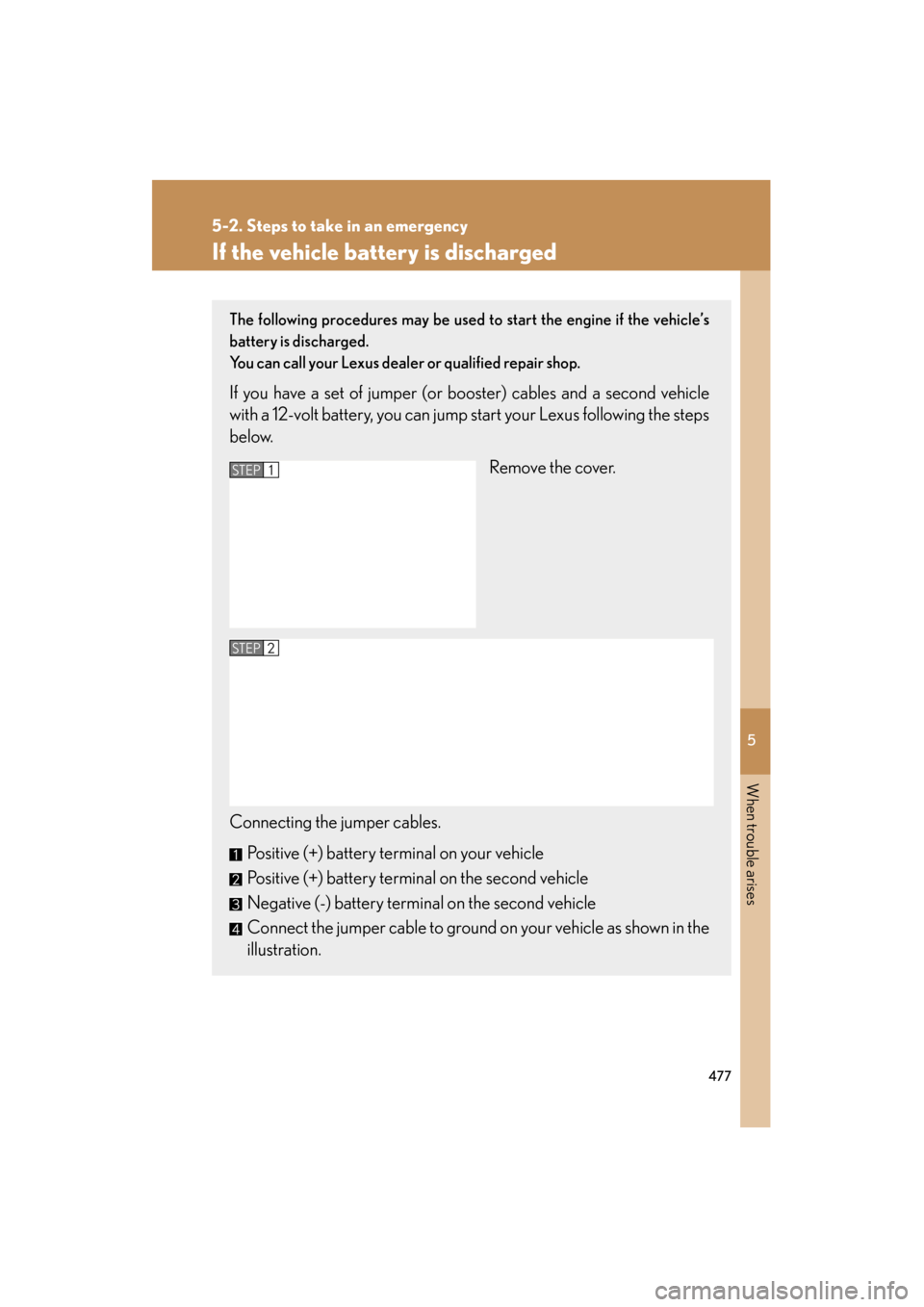
Remove the cover.
Connecting the jumper cables. Positive (+) battery terminal on your vehicle
Positive (+) battery terminal on the second vehicle
Negative (-) battery terminal on the second vehicle
Connect the jumper cable to ground on your vehicle as shown in the
illustration.
STEP1
STEP2
Page 479 of 554
478
5-2. Steps to take in an emergency
ES350_U
■Starting the engine when the battery is discharged
The engine cannot be started by push-starting.
■Avoiding a discharged battery
●Turn off the headlights and the audio system while the engine is turned off.
●Turn off any unnecessary electrical components when the vehicle is running at a
low speed for an extended period, such as in heavy traffic, etc.
■Charging the battery
The electricity stored in the battery will discharge gradually even when the vehi-
cle is not in use, due to natural discharge and the draining effects of certain
electrical appliances. If the vehicle is left for a long time, the battery may dis-
charge, and the engine may be unable to start. (The battery recharges automat-
ically during driving.)
Start the engine of the second vehicle. Increase the engine
speed slightly and maintain at that level for approximately 5
minutes to recharge the battery of your vehicle.
Open and close any of the doors with the “ENGINE START
STOP” switch OFF.
Maintain the engine speed of the second vehicle and turn the
“ENGINE START STOP” switch to the IGNITION ON mode,
then start the vehicle’s engine.
Once the vehicle’s engine has started, remove the jumper
cables in the exact reverse order in which they were con-
nected.
Once the engine starts, have the vehicle checked at your Lexus dealer
as soon as possible.STEP3
STEP4
STEP5
STEP6
Page 480 of 554
5
When trouble arises
479
5-2. Steps to take in an emergency
ES350_U
CAUTION
■Avoiding battery fires or explosions
Observe the following precautions to prevent accidentally igniting the flammable
gas that may be emitted from the battery.
●Make sure the jumper cable is connected to the correct terminal and that it is not
unintentionally in contact with any part other than the intended terminal.
●Do not allow the jumper cables to come into contact with the “+” and “-” termi-
nals.
●Do not allow open flame or use matches, cigarette lighters or smoke near the
battery.
■Battery precautions
The battery contains poisonous and corrosive acidic electrolyte, while related parts
contain lead and lead compounds. Observe the following precautions when han-
dling the battery.
●When working with the battery, always wear safety glasses and take care not to
allow any battery fluids (acid) to come into contact with skin, clothing or the vehi-
cle body.
●Do not lean over the battery.
●In the event that battery fluid comes into contact with the skin or eyes, immedi-
ately wash the affected area with water and seek medical attention.
Place a wet sponge or cloth over the affected area until medical attention can be
received.
●Always wash your hands after handling the battery support, terminals, and other
battery-related parts.
●Do not allow children near the battery.
NOTICE
■When handling jumper cables
Be careful that the jumper cables do not become tangled in the cooling fan or any
of the belts when connecting or disconnecting them.
Page 484 of 554
5
When trouble arises
483
5-2. Steps to take in an emergency
ES350_U
If the vehicle becomes stuck
CAUTION
■When attempting to free a stuck vehicle
If you choose to rock the vehicle back and forth to free it, make sure the surround-
ing area is clear, to avoid striking other vehicles, objects or persons. The vehicle
may also lunge forward or lunge back suddenly as it becomes free. Use extreme
caution.
■When shifting the shift lever
Be careful not to shift the shift lever with the accelerator pedal depressed.
This may lead to unexpected rapid acceleration of the vehicle that may cause an
accident and result in death or serious injury.
NOTICE
■To avoid damaging the transmission and other components
●Avoid spinning the wheels and do not rev the engine.
●If the vehicle remains stuck after trying these procedures, the vehicle may require
towing to be freed.
Carry out the following procedures if the tires spin or the vehicle becomes
stuck in mud, dirt, or snow.
●Stop the engine. Set the parking brake and put the shift lever in P.
● Remove the mud, snow, or sand from around the stuck tire.
● Place wood, stones or some other material to help provide trac-
tion under the tires.
● Restart the engine.
● Carefully apply the accelerator to free the vehicle.
Page 485 of 554
484
5-2. Steps to take in an emergency
ES350_U
If your vehicle has to be stopped in an emergency
CAUTION
■If the engine has to be turned off while driving
Power assist for the brakes and steering wheel will be lost, making the brake pedal
harder to depress and the steering wheel heavier to turn. Decelerate as much as
possible before turning off the engine.
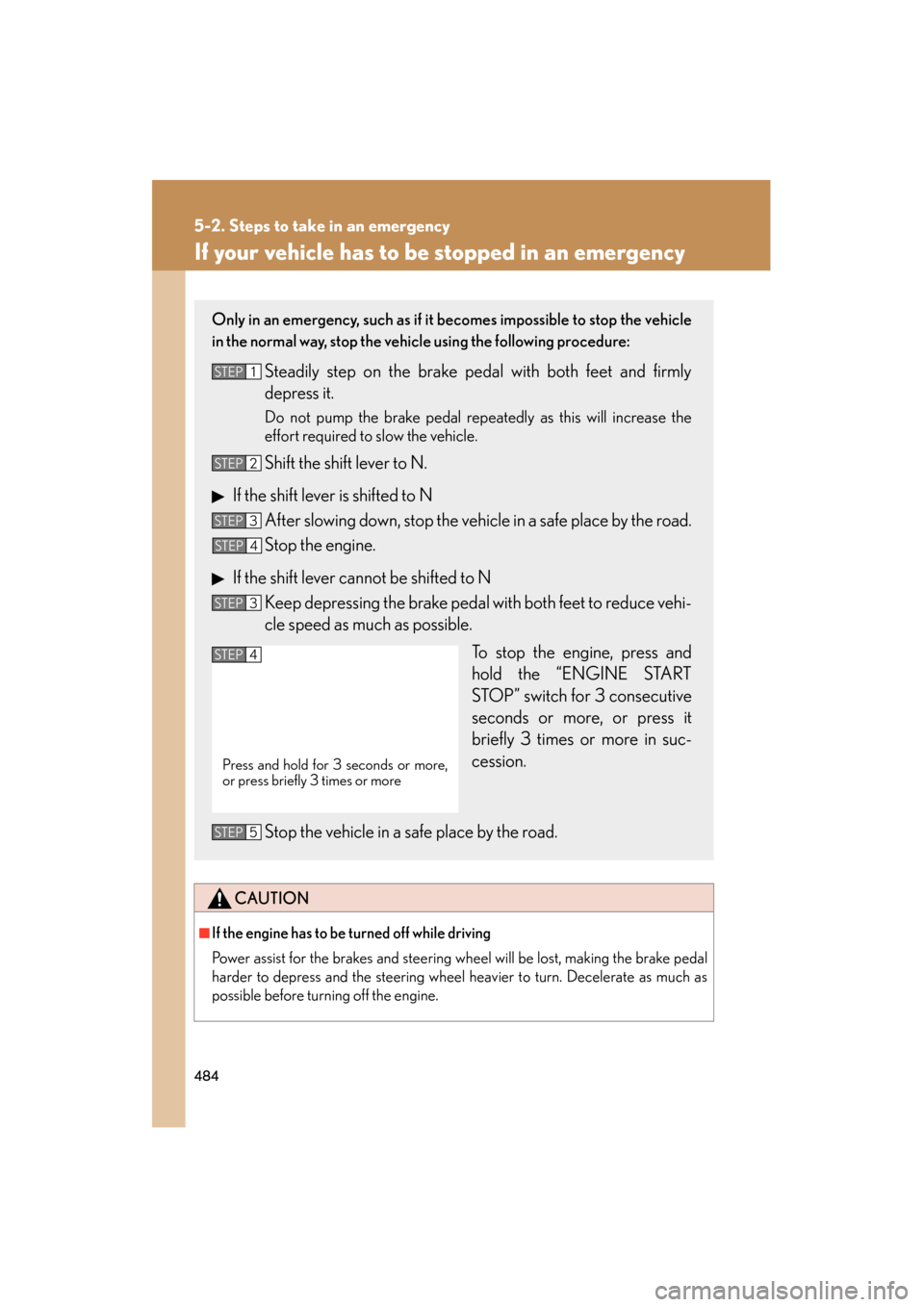
Only in an emergency, such as if it becomes impossible to stop the vehicle
in the normal way, stop the vehicle using the following procedure:
Steadily step on the brake pedal with both feet and firmly
depress it.
Do not pump the brake pedal repeatedly as this will increase the
effort required to slow the vehicle.
Shift the shift lever to N.
If the shift lever is shifted to N After slowing down, stop the vehicle in a safe place by the road.
Stop the engine.
If the shift lever cannot be shifted to N Keep depressing the brake pedal with both feet to reduce vehi-
cle speed as much as possible.
To stop the engine, press and
hold the “ENGINE START
STOP” switch for 3 consecutive
seconds or more, or press it
briefly 3 times or more in suc-
cession.
Stop the vehicle in a safe place by the road.
STEP1
STEP2
STEP3
STEP4
STEP3
STEP4
Press and hold for 3 seconds or more,
or press briefly 3 times or more
STEP5
Page 490 of 554
489
6-1. Specifications
6
Vehicle specifications
ES350_U
Lubrication system
*: The engine oil capacity is a reference quantity to be used when exchang- ing. Warm up and turn off the engine, wait more than 5 minutes, and
check the oil level on the dipstick.
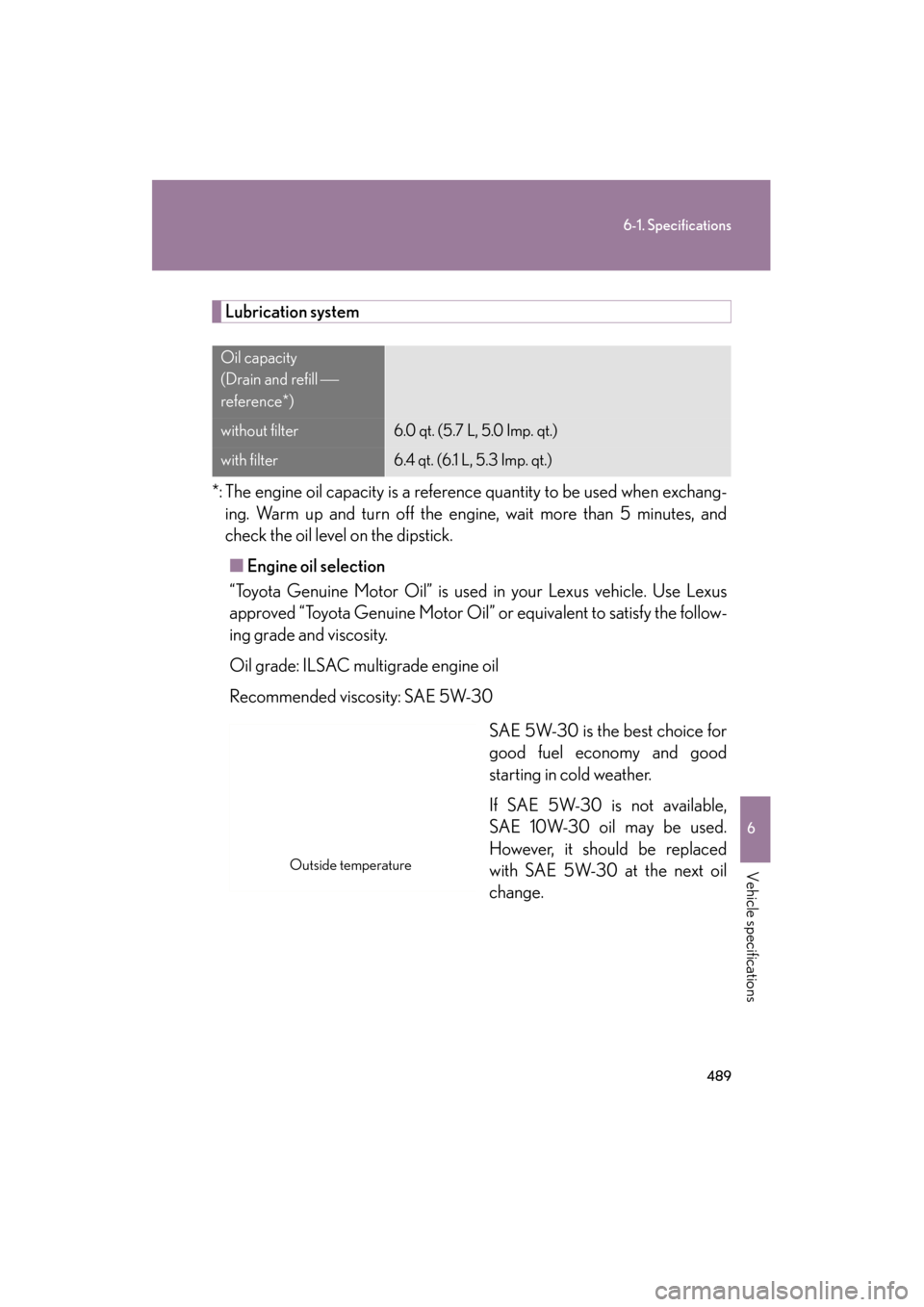
■ Engine oil selection
“Toyota Genuine Motor Oil” is used in your Lexus vehicle. Use Lexus
approved “Toyota Genuine Motor Oil” or equivalent to satisfy the follow-
ing grade and viscosity.
Oil grade: ILSAC multigrade engine oil
Recommended viscosity: SAE 5W-30
SAE 5W-30 is the best choice for
good fuel economy and good
starting in cold weather.
If SAE 5W-30 is not available,
SAE 10W-30 oil may be used.
However, it should be replaced
with SAE 5W-30 at the next oil
change.
Oil capacity
(Drain and refill
reference*)
without filter 6.0 qt. (5.7 L, 5.0 Imp. qt.)
with filter6.4 qt. (6.1 L, 5.3 Imp. qt.)
Outside temperature
Page 494 of 554
493
6-1. Specifications
6
Vehicle specifications
ES350_U
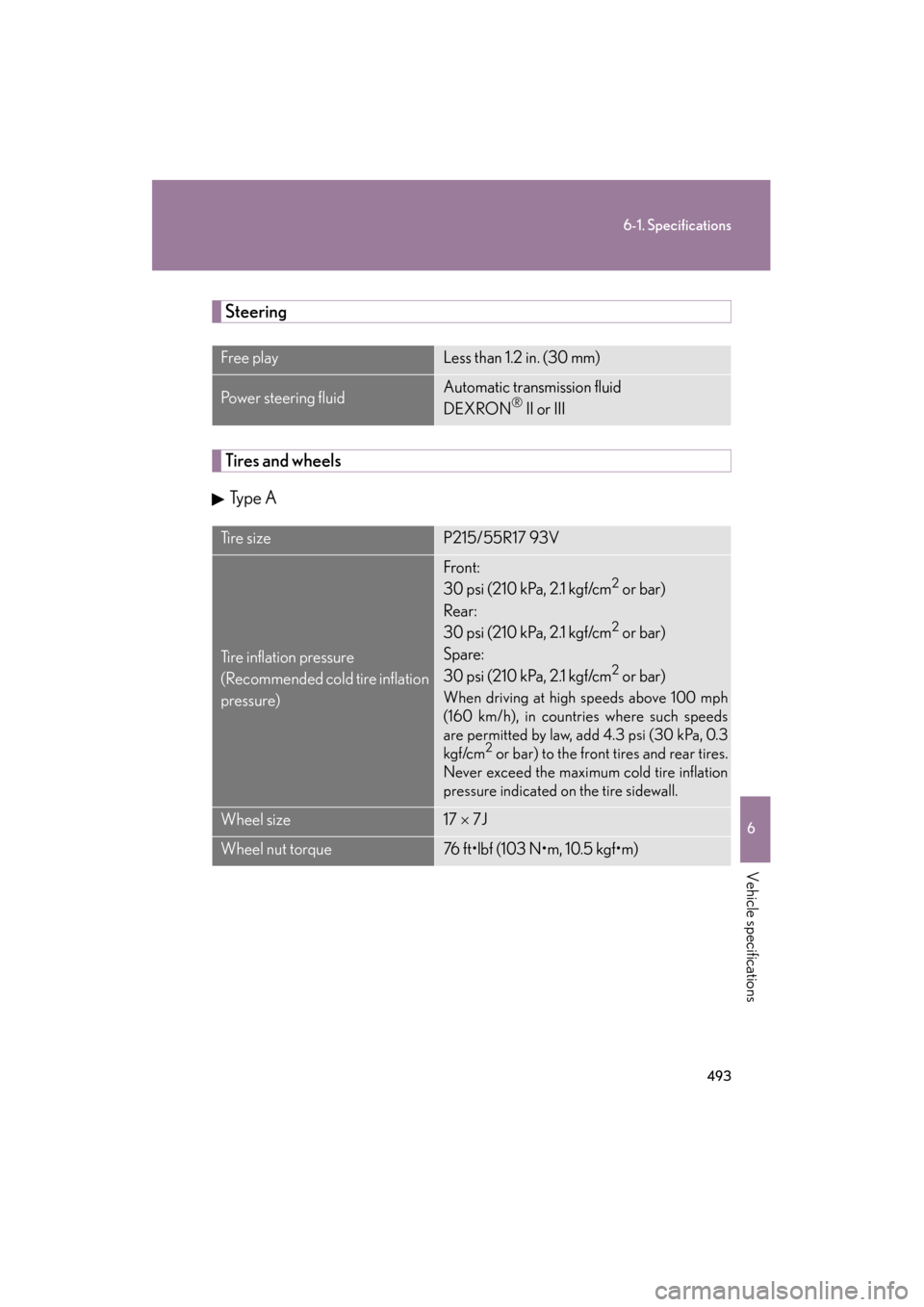
Steering
Tires and wheelsType A
Free playLess than 1.2 in. (30 mm)
Power steering fluidAutomatic transmission fluid
DEXRON® II or III
Ti r e s i z eP215/55R17 93V
Tire inflation pressure
(Recommended cold tire inflation
pressure)
Front:
30 psi (210 kPa, 2.1 kgf/cm2 or bar)
Rear:
30 psi (210 kPa, 2.1 kgf/cm
2 or bar)
Spare:
30 psi (210 kPa, 2.1 kgf/cm
2 or bar)
When driving at high speeds above 100 mph
(160 km/h), in countries where such speeds
are permitted by law, add 4.3 psi (30 kPa, 0.3
kgf/cm
2 or bar) to the front tires and rear tires.
Never exceed the maximum cold tire inflation
pressure indicated on the tire sidewall.
Wheel size17 × 7J
Wheel nut torque76 ft•lbf (103 N•m, 10.5 kgf•m)