wheel size Lexus ES350 2016 s / User Guide
[x] Cancel search | Manufacturer: LEXUS, Model Year: 2016, Model line: ES350, Model: Lexus ES350 2016Pages: 576, PDF Size: 8.3 MB
Page 448 of 576

448
ES350_OM_OM33B64U_(U)7-3. Do-it-yourself maintenance
WA R N I N G
■When replacing wheels
●Do not use wheels that are a different size from those recommended in the Owner’s
Manual, as this may result in a loss of handling control.
●Never use an inner tube in a leaking wheel which is designed for a tubeless tire. Doing
so may result in an accident,
causing death or serious injury.
■Use of defective wheels prohibited
Do not use cracked or deformed wheels.
Doing so could cause the tire to leak air during driving, possibly causing an accident.
NOTICE
■Replacing tire pressure warning valves and transmitters
●Because tire repair or replacement may affect the tire pressure warning valves and
transmitters, make sure to have tires servic ed by your Lexus dealer or other qualified
service shop. In addition, make sure to pu rchase your tire pressure warning valves
and transmitters at your Lexus dealer.
●Ensure that only genuine Lexus wheels are used on your vehicle.
Tire pressure warning valves and transmitte rs may not work properly with non-genu-
ine wheels.
Page 481 of 576
4818-2. Steps to take in an emergency
ES350_OM_OM33B64U_(U)
8
When trouble arises
WA R N I N G
■Maintenance of the tires
Each tire, including the spare (if provided), should be checked monthly when cold and
inflated to the inflation pressure recomm ended by the vehicle manufacturer on the
vehicle placard or tire inflation pressure la bel (tire and load information label). (If your
vehicle has tires of a different size than the size indicated on the vehicle placard or tire
inflation pressure label [tire and load in formation label], you should determine the
proper tire inflation pressure for those tires.)
As an added safety feature, your vehicle has been equipped with a tire pressure moni-
toring system (TPMS-tire pressure warning system) that illuminates a low tire pressure
telltale (tire pressure warning light) when on e or more of your tires is significantly
under-inflated. Accordingly, when the low ti re pressure telltale (tire pressure warning
light) illuminates, you should stop and check your tires as soon as possible, and inflate
them to the proper pressure. Driving on a significantly under-inflated tire causes the
tire to overheat and can lead to tire failure. Under-inflation also reduces fuel efficiency
and tire tread life, and ma y affect the vehicle’s handling and stopping ability.
Please note that the TPMS (tire pressure wa rning system) is not a substitute for proper
tire maintenance, and it is the driver’s resp onsibility to maintain correct tire pressure,
even if under-inflation has no t reached the level to trigger illumination of the TPMS low
tire pressure telltale (tire pressure warning light).
Your vehicle has also been equipped with a TPMS (tire pressure warning system) mal-
function indicator to indicate when the system is not operating properly. The TPMS
(tire pressure warning system) malfunction indi cator is combined with the low tire pres-
sure telltale (tire pressure warning light). When the system detects a malfunction, the
telltale will flash for approximately one minu te and then remain continuously illumi-
nated. This sequence will cont inue upon subsequent vehicle start-ups as long as the
malfunction exists. When the malfunction indicator is illuminated, the system may not
be able to detect or signal low tire pressure as intended.
TPMS (tire pressure warning system) malfun ctions may occur for a variety of reasons,
including the installation of replacement or alternate tires or wheels on the vehicle that
prevent the TPMS (tire pressure warning system) from functioning properly. Always
check the TPMS (tire pressure warning syst em) malfunction telltale after replacing one
or more tires or wheels on your vehicle to ensure that the replacement or alternate
tires and wheels allow the TPMS (tire pressure warning system) to continue to function
properly.
NOTICE
■To ensure the tire pressure warning system operates properly
Do not install tires with different specificatio ns or makers, as the tire pressure warning
system may not operate properly.
Page 518 of 576
518
ES350_OM_OM33B64U_(U)9-1. Specifications
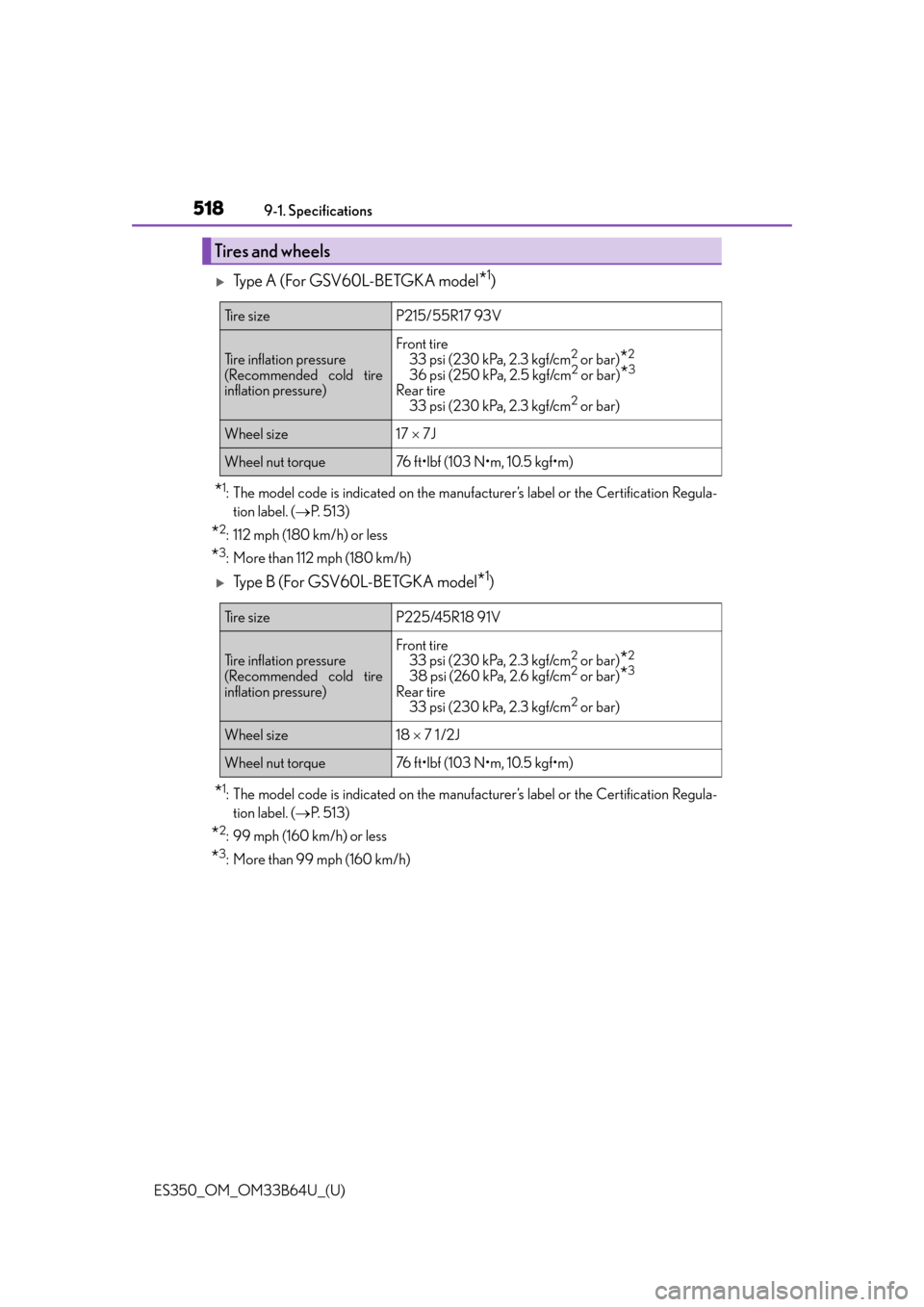
Type A (For GSV60L-BETGKA model*1)
*1: The model code is indicated on the manufa
cturer’s label or the Certification Regula-
tion label. ( P. 5 1 3 )
*2: 112 mph (180 km/h) or less
*3: More than 112 mph (180 km/h)
Type B (For GSV60L-BETGKA model*1)
*1: The model code is indicated on the manufa cturer’s label or the Certification Regula-
tion label. ( P. 5 1 3 )
*2: 99 mph (160 km/h) or less
*3: More than 99 mph (160 km/h)
Tires and wheels
Ti r e s i z eP215/55R17 93V
Tire inflation pressure
(Recommended cold tire
inflation pressure)
Front tire
33 psi (230 kPa, 2.3 kgf/cm2 or bar)*2
36 psi (250 kPa, 2.5 kgf/cm2 or bar)*3
Rear tire33 psi (230 kPa, 2.3 kgf/cm2 or bar)
Wheel size17 7J
Wheel nut torque76 ft•lbf (103 N•m, 10.5 kgf•m)
Ti r e s i z eP225/45R18 91V
Tire inflation pressure
(Recommended cold tire
inflation pressure)Front tire
33 psi (230 kPa, 2.3 kgf/cm2 or bar)*2
38 psi (260 kPa, 2.6 kgf/cm2 or bar)*3
Rear tire33 psi (230 kPa, 2.3 kgf/cm2 or bar)
Wheel size18 7 1 /2J
Wheel nut torque76 ft•lbf (103 N•m, 10.5 kgf•m)
Page 519 of 576
ES350_OM_OM33B64U_(U)
5199-1. Specifications
9
Vehicle specifications
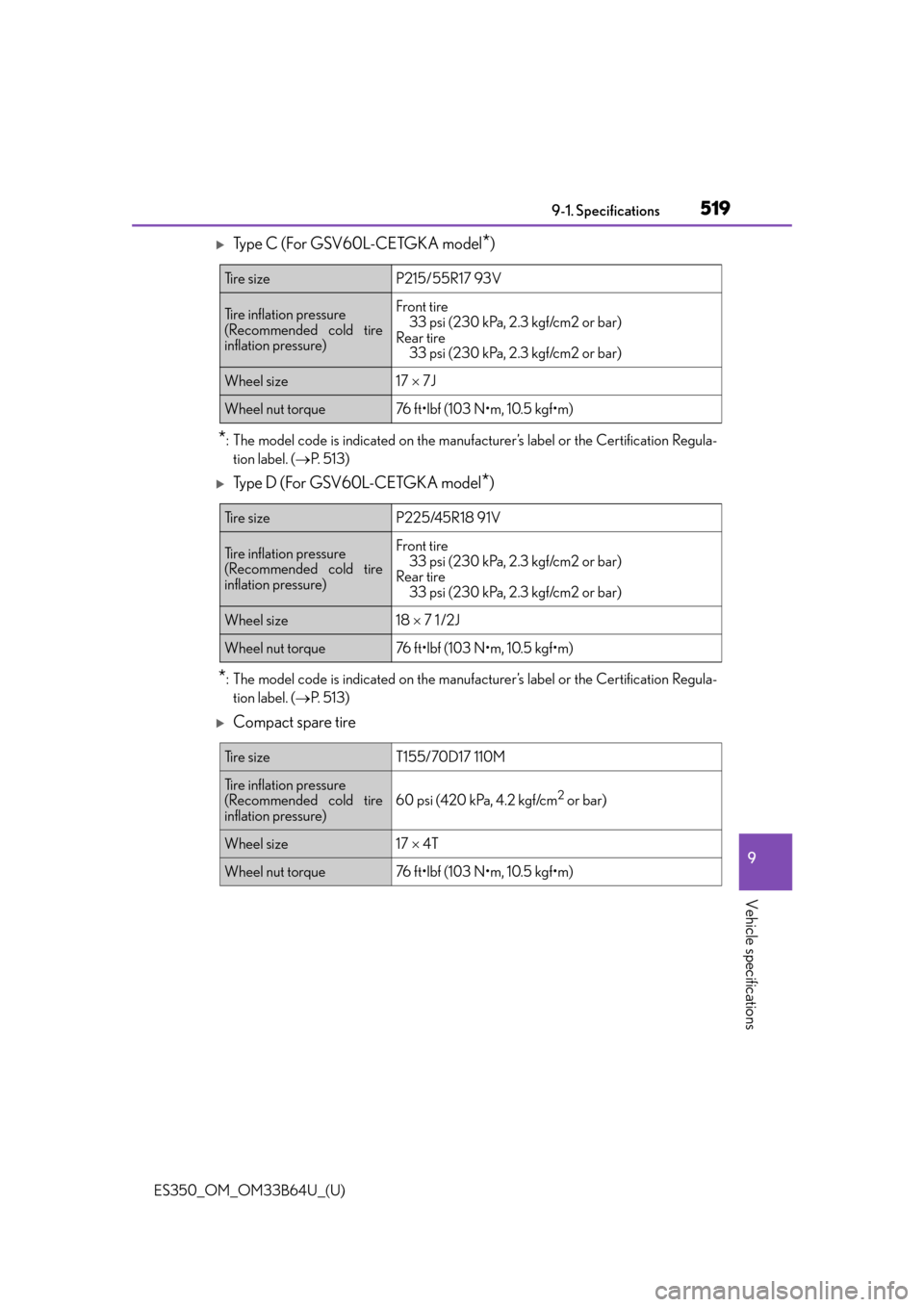
Type C (For GSV60L-CETGKA model*)
*: The model code is indicated on the manufacturer’s label or the Certification Regula-
tion label. ( P. 5 1 3 )
Ty p e D ( F o r G S V 6 0 L - C E T G K A m o d e l*)
*: The model code is indicated on the manufa cturer’s label or the Certification Regula-
tion label. ( P. 5 1 3 )
Compact spare tire
Ti r e s i z eP215/55R17 93V
Tire inflation pressure
(Recommended cold tire
inflation pressure)Front tire
33 psi (230 kPa, 2.3 kgf/cm2 or bar)
Rear tire 33 psi (230 kPa, 2.3 kgf/cm2 or bar)
Wheel size17 7J
Wheel nut torque76 ft•lbf (103 N•m, 10.5 kgf•m)
Ti r e s i z eP225/45R18 91V
Tire inflation pressure
(Recommended cold tire
inflation pressure)Front tire
33 psi (230 kPa, 2.3 kgf/cm2 or bar)
Rear tire
33 psi (230 kPa, 2.3 kgf/cm2 or bar)
Wheel size18 7 1 /2J
Wheel nut torque76 ft•lbf (103 N•m, 10.5 kgf•m)
Ti r e s i z eT155/70D17 110M
Tire inflation pressure
(Recommended cold tire
inflation pressure)60 psi (420 kPa, 4.2 kgf/cm2 or bar)
Wheel size17 4T
Wheel nut torque76 ft•lbf (103 N•m, 10.5 kgf•m)
Page 526 of 576
526
ES350_OM_OM33B64U_(U)9-1. Specifications
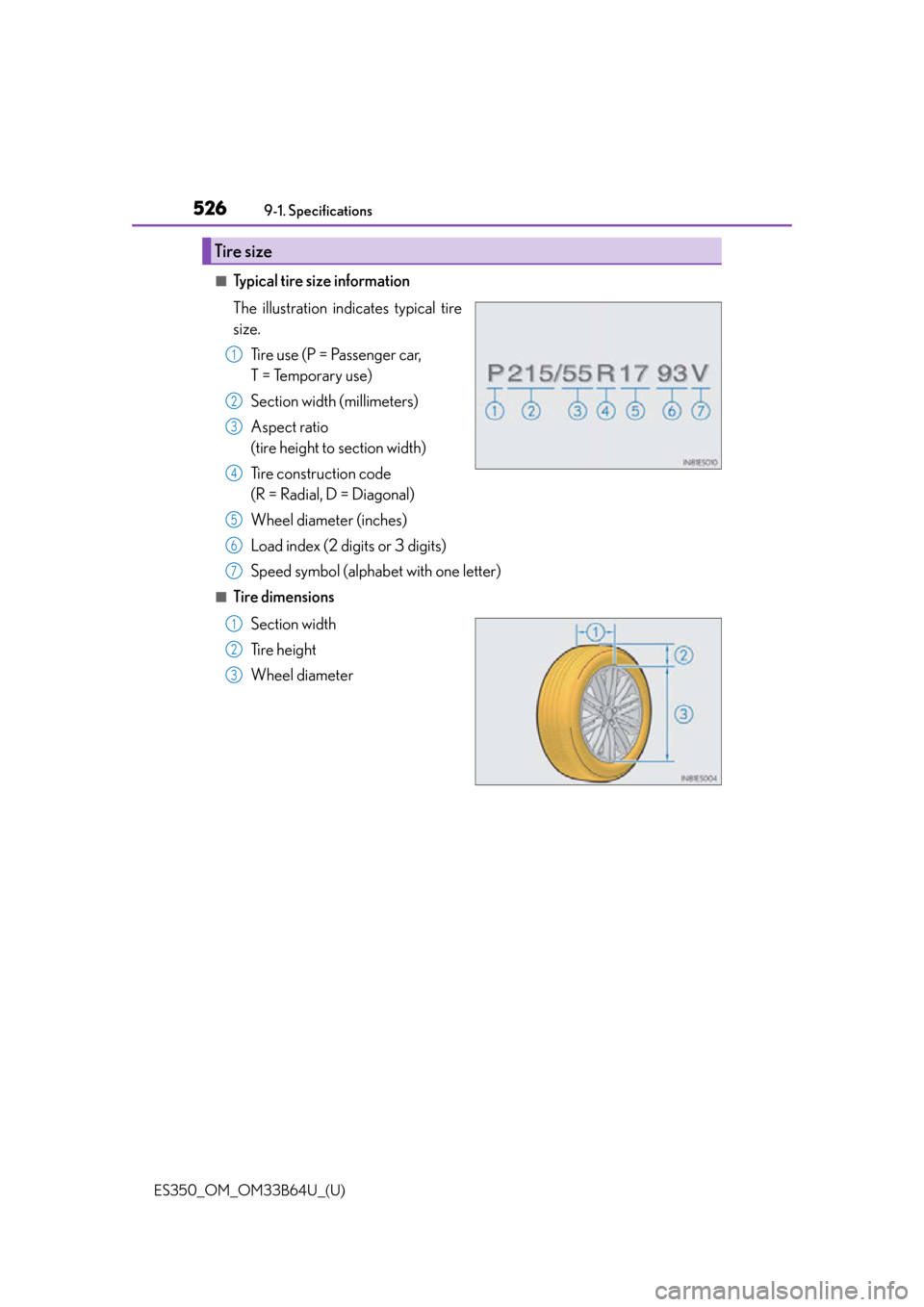
■Typical tire size information
The illustration indicates typical tire
size.
Tire use (P = Passenger car,
T = Temporary use)
Section width (millimeters)
Aspect ratio
(tire height to section width)
Tire construction code
(R = Radial, D = Diagonal)
Wheel diameter (inches)
Load index (2 digits or 3 digits)
Speed symbol (alphabet with one letter)
■Tire dimensions
Section width
Tire height
Wheel diameter
Tire size
1
2
3
4
5
6
7
1
2
3
Page 529 of 576
ES350_OM_OM33B64U_(U)
5299-1. Specifications
9
Vehicle specifications
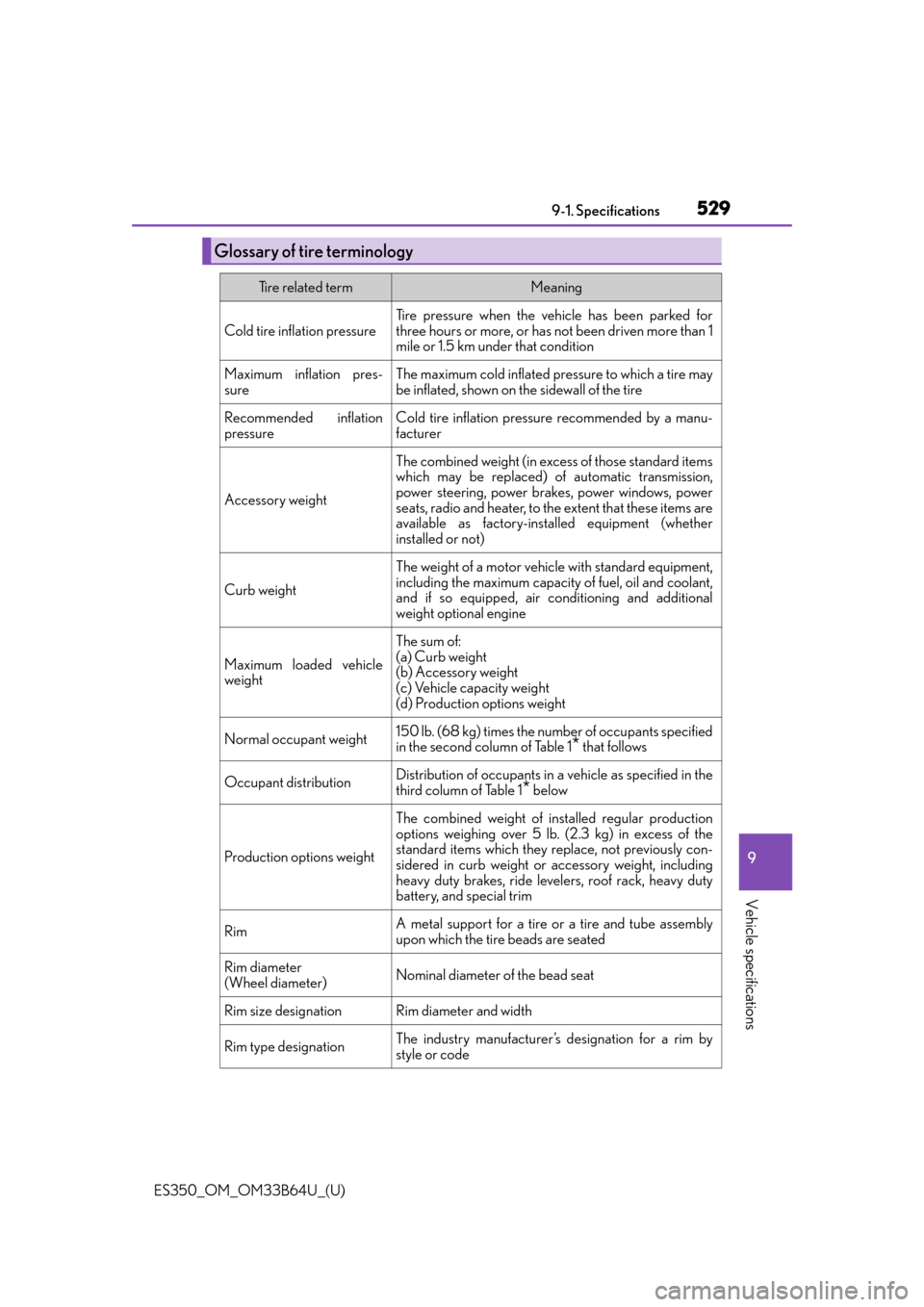
Glossary of tire terminology
Tire related termMeaning
Cold tire inflation pressure
Tire pressure when the vehicle has been parked for
three hours or more, or has not been driven more than 1
mile or 1.5 km under that condition
Maximum inflation pres-
sureThe maximum cold inflated pressure to which a tire may
be inflated, shown on the sidewall of the tire
Recommended inflation
pressureCold tire inflation pressure recommended by a manu-
facturer
Accessory weight
The combined weight (in excess of those standard items
which may be replaced) of automatic transmission,
power steering, power brakes, power windows, power
seats, radio and heater, to the extent that these items are
available as factory-installed equipment (whether
installed or not)
Curb weight
The weight of a motor vehicle with standard equipment,
including the maximum capacity of fuel, oil and coolant,
and if so equipped, air co nditioning and additional
weight optional engine
Maximum loaded vehicle
weight
The sum of:
(a) Curb weight
(b) Accessory weight
(c) Vehicle capacity weight
(d) Production options weight
Normal occupant weight150 lb. (68 kg) times the numb er of occupants specified
in the second column of Table 1* that follows
Occupant distributionDistribution of occupants in a vehicle as specified in the
third column of Table 1
* below
Production options weight
The combined weight of installed regular production
options weighing over 5 lb. (2.3 kg) in excess of the
standard items which they replace, not previously con-
sidered in curb weight or accessory weight, including
heavy duty brakes, ride levelers, roof rack, heavy duty
battery, and special trim
RimA metal support for a tire or a tire and tube assembly
upon which the tire beads are seated
Rim diameter
(Wheel diameter)Nominal diameter of the bead seat
Rim size designationRim diameter and width
Rim type designationThe industry manufacturer’s designation for a rim by
style or code
Page 573 of 576
573Alphabetical index
ES350_OM_OM33B64U_(U)
Turn signal lightsReplacing light bulbs ........... 459, 462
Turn signal lever .................................. 159
Wattage ................................................. 520
USB memory
*........................................274
Vanity lights Vanity lights ......................................... 384
Wattage ................................................. 520
Vanity mirrors ........................................... 384
Vehicle data recordings .......................... 9
Vehicle identification number .......... 513
Vehicle Stability Control (VSC) ..................................................... 255
Ventilators (seat ventilators)............ 374
VSC (Vehicle Stability Control) ............ 255
Warning buzzers Approach warning .............................. 212
Downshifting ......................................... 158
Seat belt reminder ............................. 477 Warning lights ............................................ 71
ABS .......................................................... 476
Brake system ....................................... 476
Electric power steering ...................477
Low fuel level ........................................477
Malfunction indicator lamp........... 476
Master warning light .........................477
Pre-collision system ..........................477
Seat belt reminder light ...................477
Slip indicator .........................................477
SRS............................................................ 476
Tire pressure ........................................ 478
Warning messages.............................. 482
Washer Checking ............................................... 435
Preparing and checking before winter .................................... 260
Switch ........................................................169
Washing and waxing .......................... 408
Weight Cargo capacity.....................................148
Load limits ...............................................148
Weight ...................................................... 512
Welcome light illumination control .......................................................94
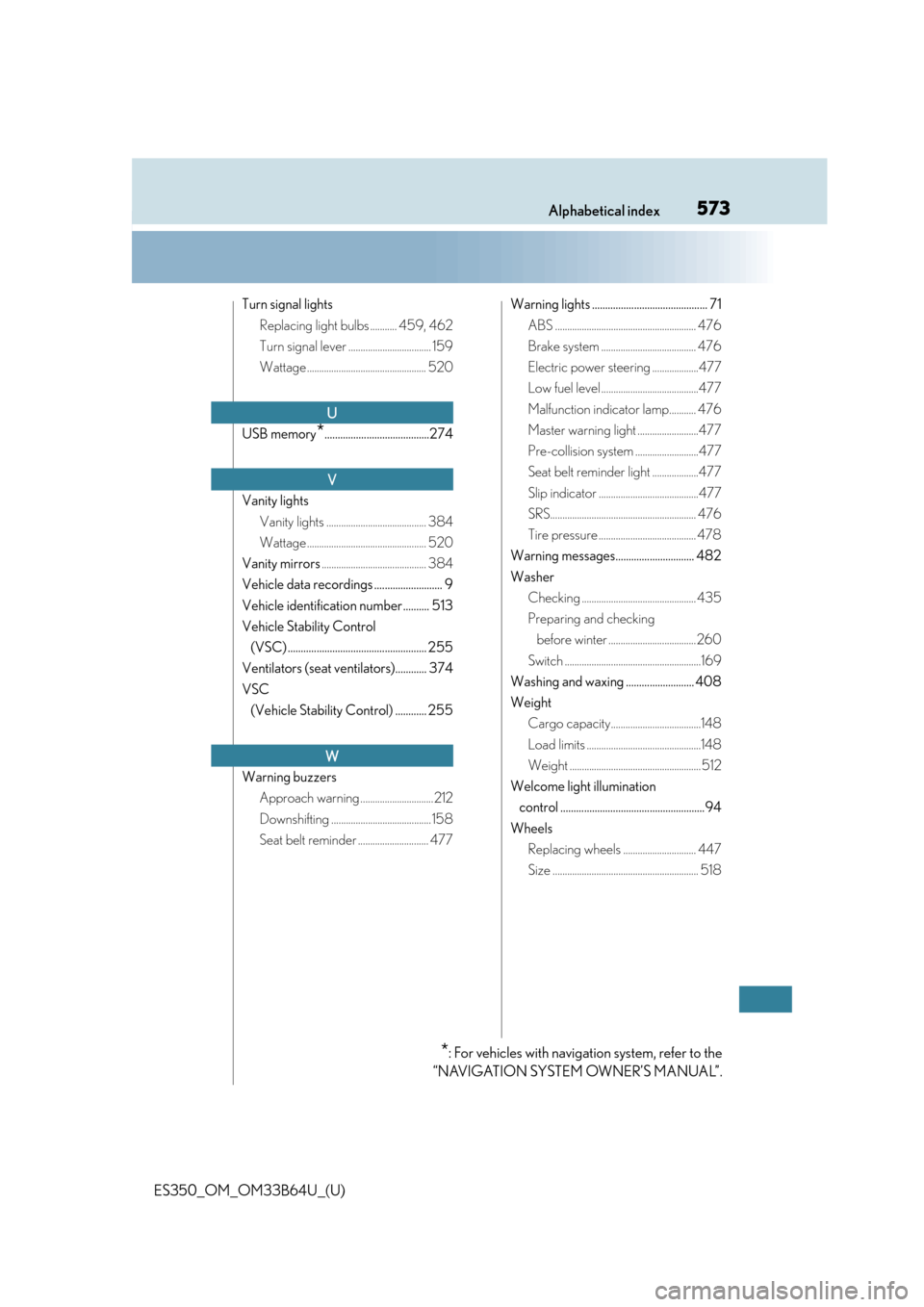
Wheels Replacing wheels .............................. 447
Size ............................................................ 518
U
V
W
*: For vehicles with navigation system, refer to the
“NAVIGATION SYSTEM OWNER’S MANUAL”.