towing LEXUS ES350 2021 Owner's Manual
[x] Cancel search | Manufacturer: LEXUS, Model Year: 2021, Model line: ES350, Model: LEXUS ES350 2021Pages: 464, PDF Size: 9.61 MB
Page 242 of 464
2424-5. Using the driving support systems
snow, dirt, etc.
●When it is raining heavily or water strikes
the vehicle
●When the detection area of a radar sen-
sor is obstructed by an adjacent vehicle
●If the vehicle is significantly tilted
●When equipment that may obstruct a
sensor is installed, such as a towing eye-
let, bumper protector (an additional trim
strip, etc.), bicycle carrier, or snow plow
●If the suspension has been modified or
tires of a size other than specified are
installed
●If the front of the vehicle is raised or low-
ered due to the carried load
●If a sticker or an electronic component,
such as a backlit license plate (especially
fluorescent type), fog light, fender pole or
wireless antenna is installed near a radar
sensor
●If the orientation of a radar sensor has
been changed
●When multiple vehicles are approaching
with only a small gap between each vehi-
cle
●If a vehicle is approaching the rear of
your vehicle rapidly
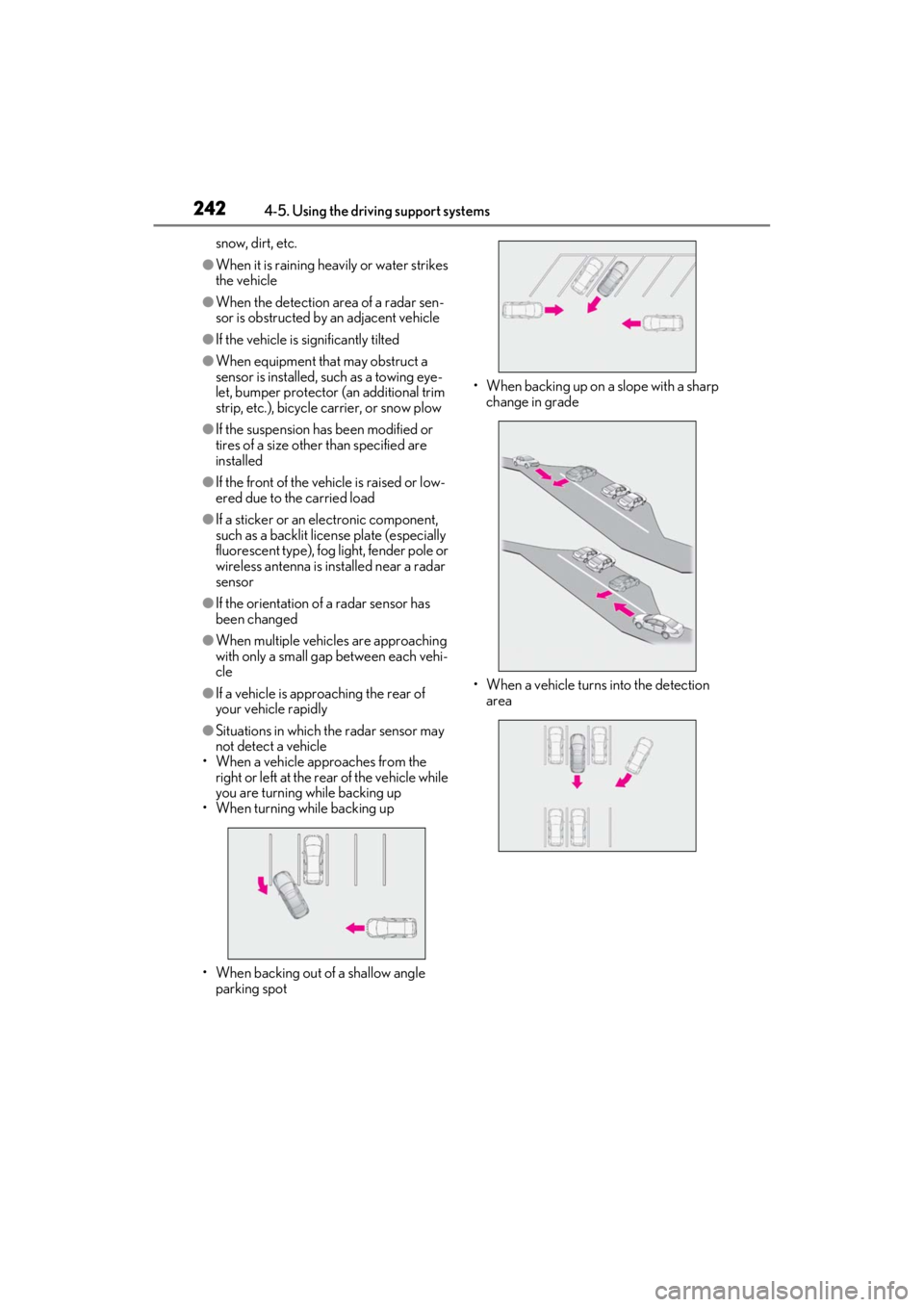
●Situations in which the radar sensor may
not detect a vehicle
• When a vehicle approaches from the right or left at the rear of the vehicle while
you are turning while backing up
• When turning while backing up
• When backing out of a shallow angle parking spot • When backing up on
a slope with a sharp
change in grade
• When a vehicle turns into the detection area
Page 245 of 464

2454-5. Using the driving support systems
4
Driving
• Pedestrians who suddenly enter the detection area
• People riding a bicycle, skateboard, or
other light vehicle
• Pedestrians wearing oversized clothing such as a rain coat, long skirt, etc., making
their silhouette obscure
• Pedestrians whose body is partially hid- den by an object, such as a cart or
umbrella
• Pedestrians which are obscured by dark- ness, such as at night
●In some situations, such as the following,
pedestrians may not be detected by the
Parking Support Brake function (rear
pedestrians), preventing the function
from operating properly:
• When backing up in inclement weather (rain, snow, fog, etc.)
• When the rear camera is obscured (dirt,
snow, ice, etc. are attached) or scratched
• When a very bright light, such as the sun, or the headlights of another vehicle,
shines directly into the rear camera
• When backing up in a place where the surrounding brightness changes sud-
denly, such as at the entrance or exit of a
garage or underground parking lot
• When backing up in a dim environment
such as during dusk or in an underground
parking lot
●Even though there are no pedestrians in
the detection area, some objects, such as
the following, may be detected, possibly
causing the Parking Support Brake func-
tion (rear pedestri ans) to operate.
• Three dimensional objects, such as a
pole, traffic cone, fence, or parked vehi-
cle
• Moving objects, such as a car or motor-
cycle
• Objects moving toward your vehicle when backing up, such as flags or pud-
dles (or airborne matter, such as smoke,
steam, rain, or snow)
• Cobblestone or gravel roads, tram rails, road repairs, white lines, pedestrian
crossings, puddles or fallen leaves on the
road
• Metal covers (gratings), such as those
used for drainage ditches
• Objects reflected in a puddle or on a wet road surface • The roadside or bumps on the road
•Shadows on the road
●In some situations, such as the following,
the Parking Support Brake function (rear
pedestrians) may operate even though
there are no pedestrians in the detection
area.
• When backing up toward the roadside or
a bump on the road
• If the vehicle is signif icantly tilted, such as
when carrying a heavy load
• When backing up toward an incline/decline
• If the suspension has been modified or
tires of a size othe r than specified are
installed
• If the rear of the vehicle is raised or low-
ered due to the carried load
• If an electronic component, such as a backlit license plate or rear fog light, is
installed near the rear camera
• If a bumper protector, such as an addi- tional trim strip, is installed to the rear
bumper
• If the orientation of the rear camera has been changed due to a collision or other
impact, or removal and installation
• If a towing eyelet is in stalled to the rear of
the vehicle
• When water is flowing over the rear cam- era lens
• When the rear camera is obscured (dirt,
snow, ice, etc. are at tached) or scratched
• If there is a flashing light in the detection area, such as the emergency flashers of
another vehicle
Page 355 of 464
3557-2. Steps to take in an emergency
7
When trouble arises
7-2.Steps to take in an emergency
If your vehicle needs to be
towed
If towing is necessary, we recom-
mend having your vehicle towed by
your Lexus dealer or commercial
towing service, using a wheel-lift
type truck or flatbed truck.
Use a safety chain system for all
towing, and abide by all state/pro-
vincial and local laws.
2WD models: If towing your vehi-
cle with a wheel-lif t type truck from
the front, the vehicle’s rear wheels
and axles must be in good condi-
tions. ( P.355, 357)
If they are damaged, use a towing
dolly or flatbed truck.
AWD models: If towing your vehi-
cle with a wheel-lift type truck, use
a towing dolly. ( P.355, 357)
WARNING
Observe the following precautions.
Failure to do so may result in death or
serious injury.
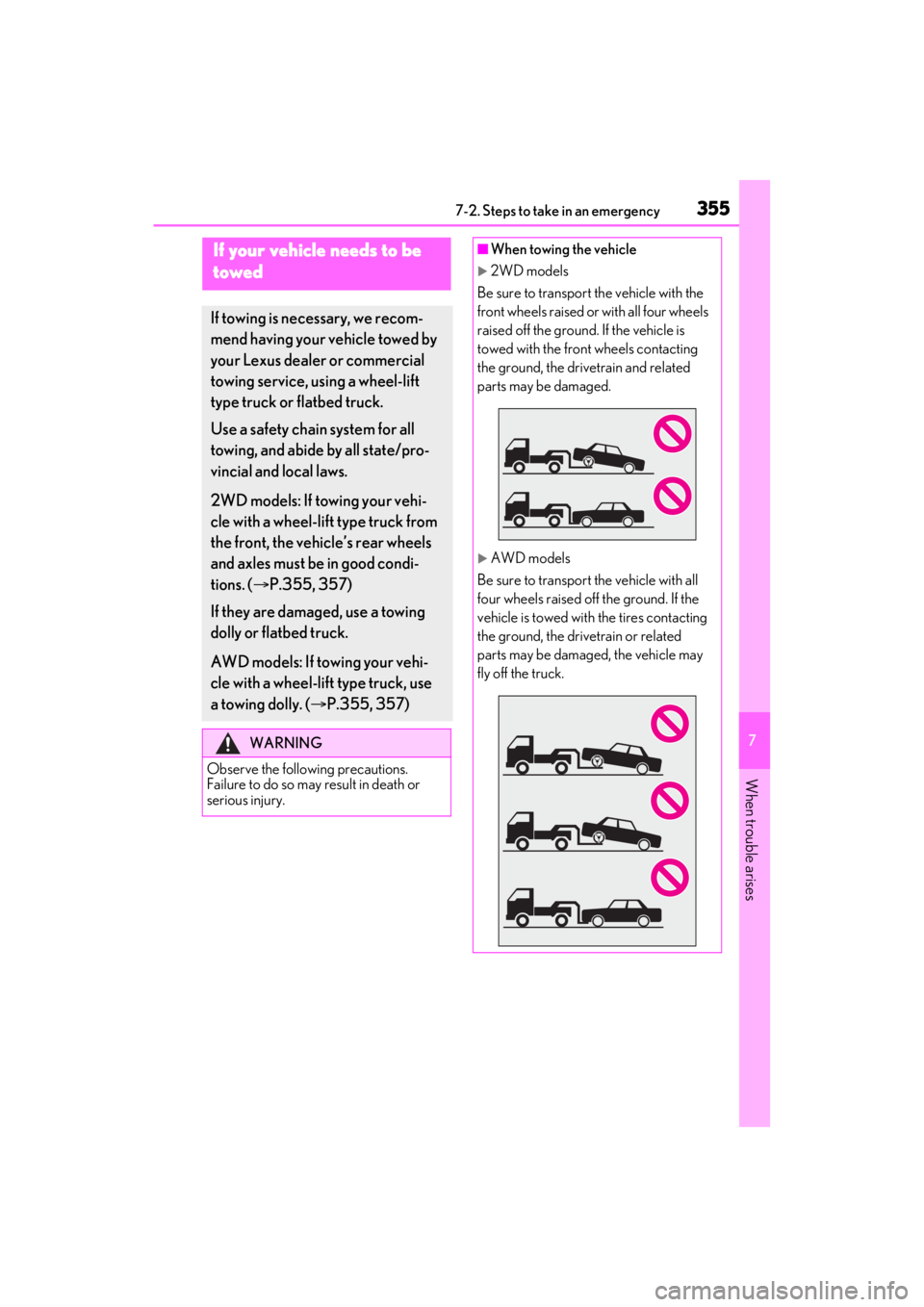
■When towing the vehicle
2WD models
Be sure to transport the vehicle with the
front wheels raised or with all four wheels
raised off the ground. If the vehicle is
towed with the front wheels contacting
the ground, the drivetrain and related
parts may be damaged.
AWD models
Be sure to transport the vehicle with all
four wheels raised off the ground. If the
vehicle is towed with the tires contacting
the ground, the driv etrain or related
parts may be damaged, the vehicle may
fly off the truck.
Page 356 of 464
3567-2. Steps to take in an emergency
The following may indicate a problem
with your transmission. Contact your
Lexus dealer or commercial towing
service before towing.
The engine is running but the vehi-
cle does not move.
The vehicle makes an abnormal
sound.
WARNING
■While towing (vehicles with a towing
eyelet)
●When towing using cables or chains,
avoid sudden starts, etc. which place
excessive stress on the towing eyelets,
cables or chains. The towing eyelets,
cables or chains may become dam-
aged, broken debris may hit people,
and cause serious damage.
●Do not turn the engine switch off.
There is a possibility that the steering
wheel is locked and cannot be oper-
ated.
■Installing towing eyelets to the vehi-
cle (vehicles with a towing eyelet)
Make sure that towing eyelets are
installed securely.
If not securely installed, towing eyelets
may come loose during towing.
NOTICE
■To prevent damage to the vehicle
when towing using a wheel-lift type
truck
●Do not tow the vehicle from the rear
when the engine switch is off. The
steering lock mechanism is not strong
enough to hold the front wheels
straight.
●When raising the vehicle, ensure ade-
quate ground clearance for towing at
the opposite end of the raised vehicle.
Without adequate clearance, the vehi-
cle could be damaged while being
towed.
■To prevent damage to the vehicle
when towing with a sling-type truck
Do not tow with a sling-type truck, either
from the front or rear.
■To prevent damage to the vehicle
during emergency towing (vehicles
with a towing eyelet)
Do not secure cables or chains to the
suspension components.
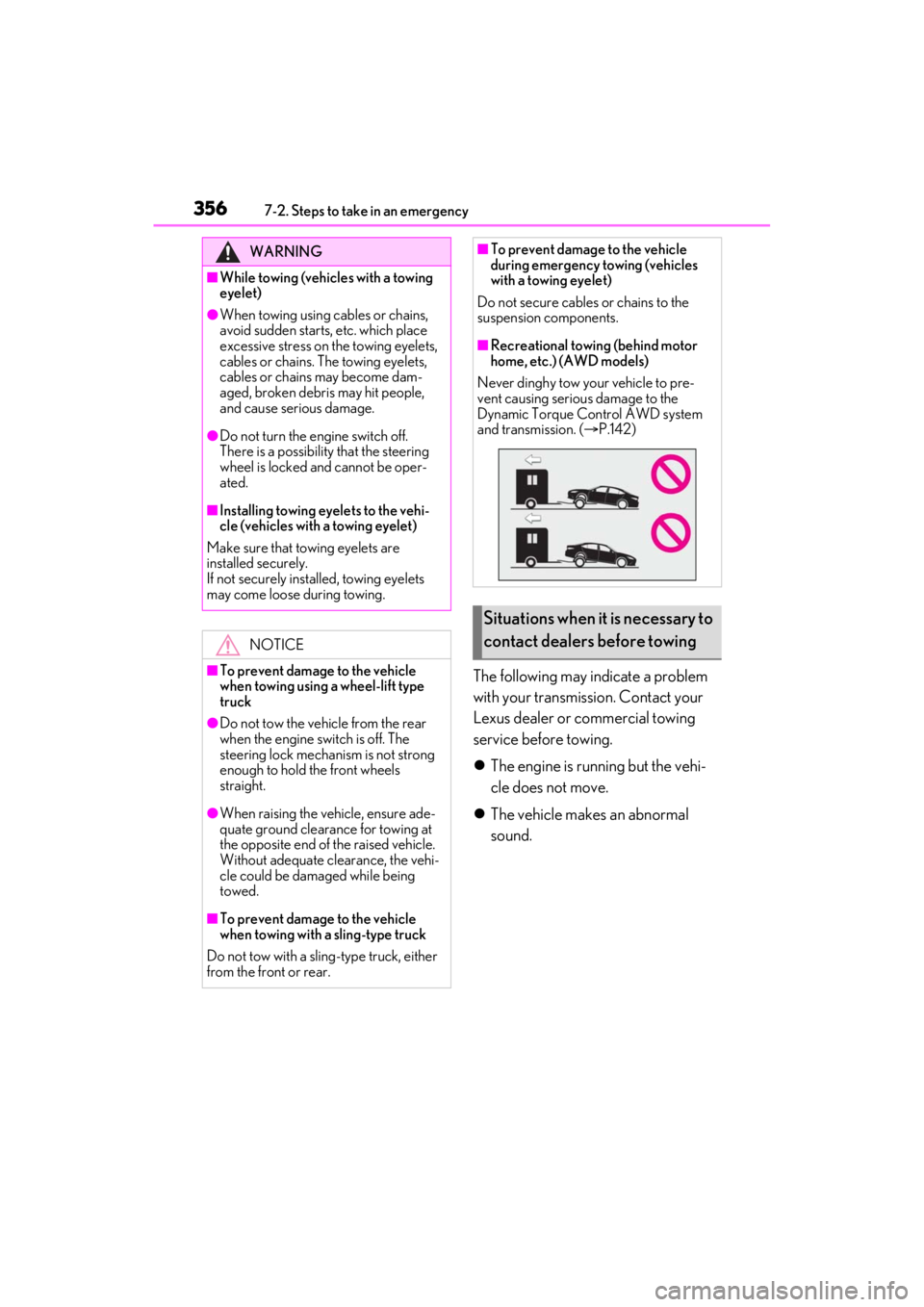
■Recreational towing (behind motor
home, etc.) (AWD models)
Never dinghy tow your vehicle to pre-
vent causing serious damage to the
Dynamic Torque Control AWD system
and transmission. ( P.142)
Situations when it is necessary to
contact dealers before towing
Page 357 of 464
3577-2. Steps to take in an emergency
7
When trouble arises
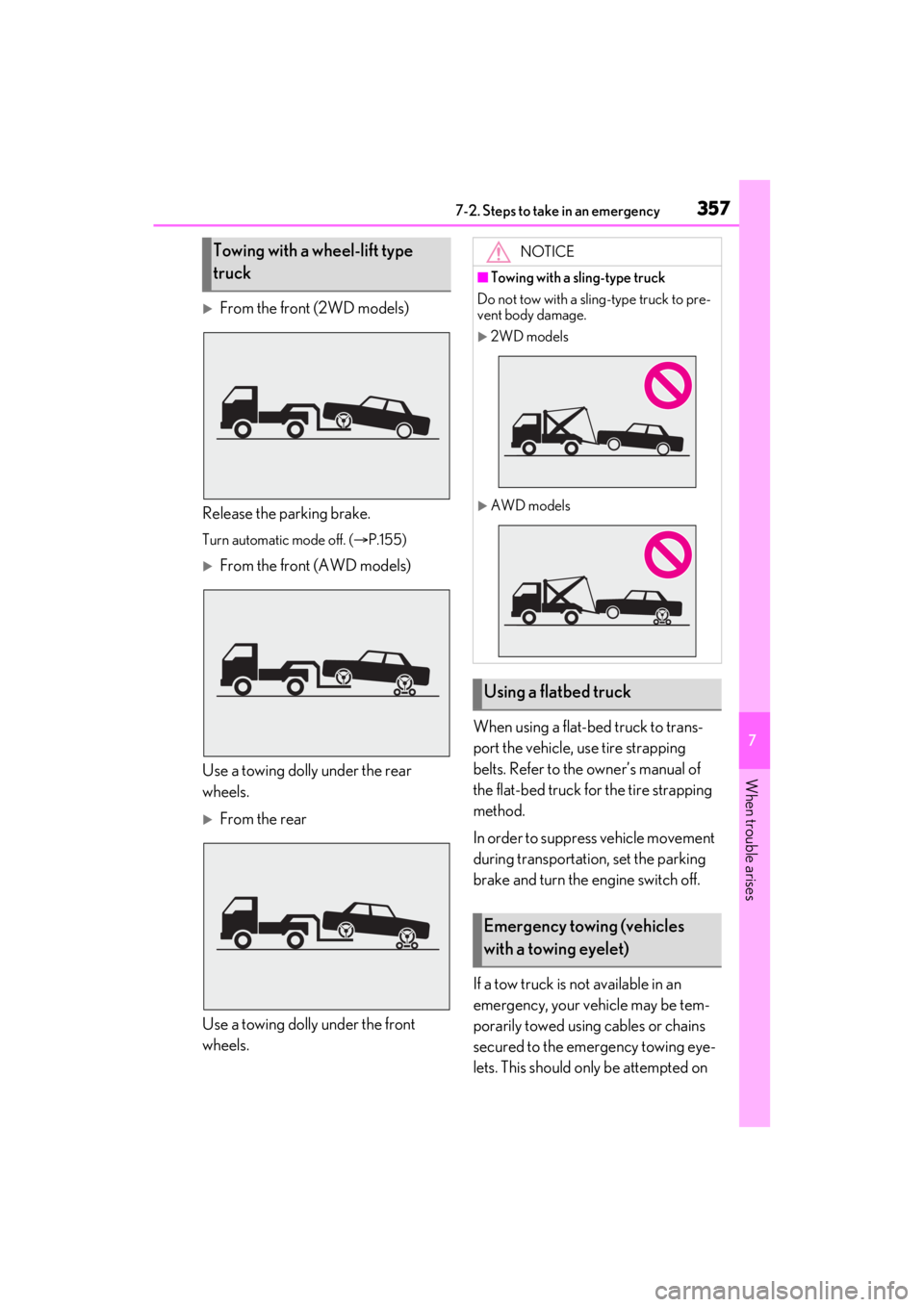
From the front (2WD models)
Release the parking brake.
Turn automatic mode off. ( P.155)
From the front (AWD models)
Use a towing dolly under the rear
wheels.
From the rear
Use a towing dolly under the front
wheels. When using a flat-bed truck to trans-
port the vehicle, use tire strapping
belts. Refer to the owner’s manual of
the flat-bed truck for the tire strapping
method.
In order to suppress vehicle movement
during transportation, set the parking
brake and turn the engine switch off.
If a tow truck is not available in an
emergency, your vehicle may be tem-
porarily towed using cables or chains
secured to the emergency towing eye-
lets. This should only be attempted on
Towing with a wheel-lift type
truckNOTICE
■Towing with a sling-type truck
Do not tow with a sling-type truck to pre-
vent body damage.
2WD models
AWD models
Using a flatbed truck
Emergency towing (vehicles
with a towing eyelet)
Page 358 of 464
3587-2. Steps to take in an emergency
hard surfaced roads for at most 50
miles (80 km) at under 18 mph (30
km/h).
A driver must be in the vehicle to steer
and operate the brakes. The vehicle’s
wheels, drive train, axles, steering and
brakes must be in good condition.
To have your vehicle towed by another
vehicle, the towing eyelet must be
installed to your vehicle. Install the tow-
ing eyelet using the following proce-
dure.
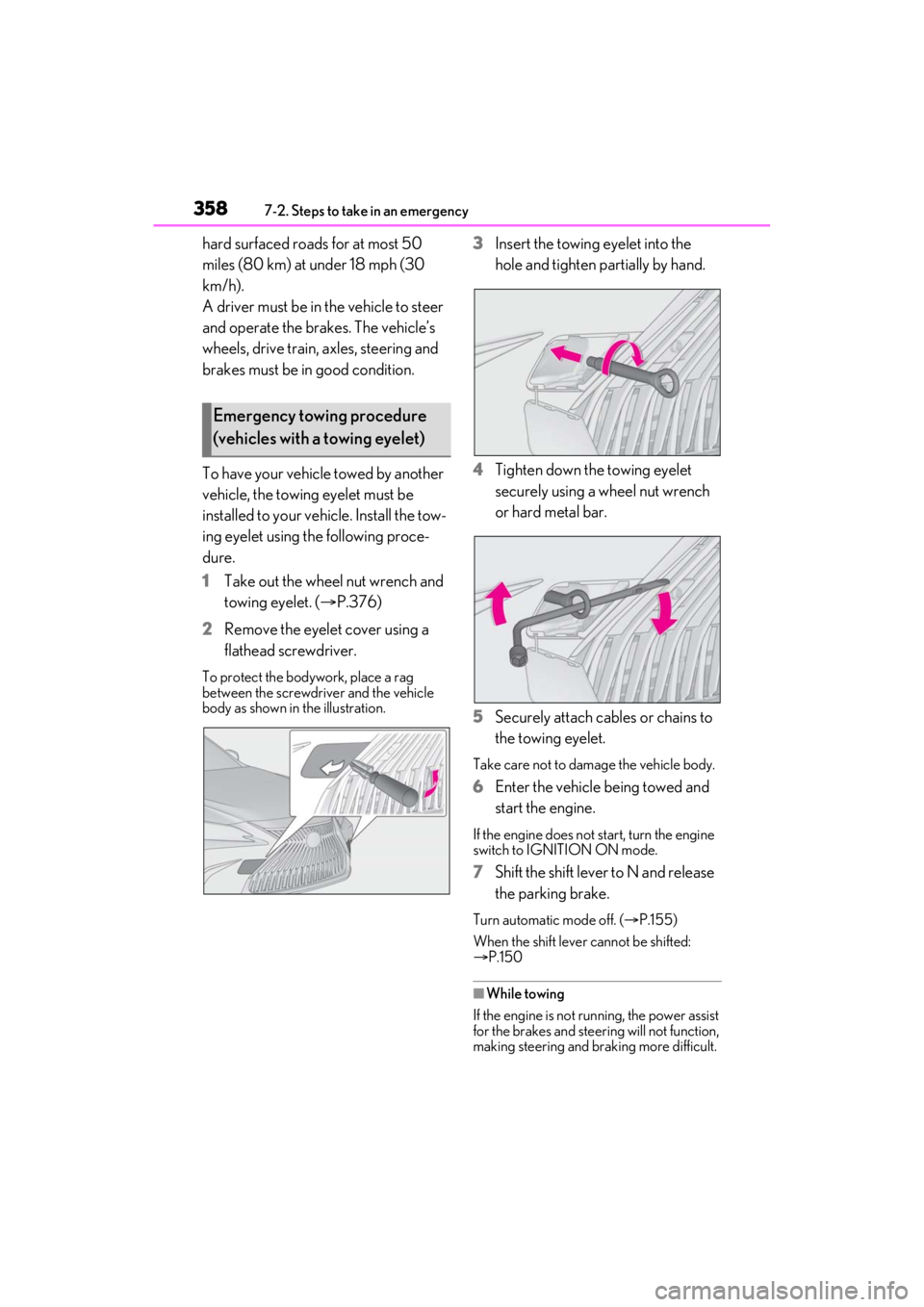
1 Take out the wheel nut wrench and
towing eyelet. ( P.376)
2 Remove the eyelet cover using a
flathead screwdriver.
To protect the bodywork, place a rag
between the screwdriver and the vehicle
body as shown in the illustration.
3Insert the towing eyelet into the
hole and tighten partially by hand.
4 Tighten down the towing eyelet
securely using a wheel nut wrench
or hard metal bar.
5 Securely attach cables or chains to
the towing eyelet.
Take care not to damage the vehicle body.
6Enter the vehicle being towed and
start the engine.
If the engine does not start, turn the engine
switch to IGNITION ON mode.
7Shift the shift lever to N and release
the parking brake.
Turn automatic mode off. ( P.155)
When the shift lever cannot be shifted:
P.150
■While towing
If the engine is not running, the power assist
for the brakes and steering will not function,
making steering and braking more difficult.
Emergency towing procedure
(vehicles with a towing eyelet)
Page 376 of 464
3767-2. Steps to take in an emergency
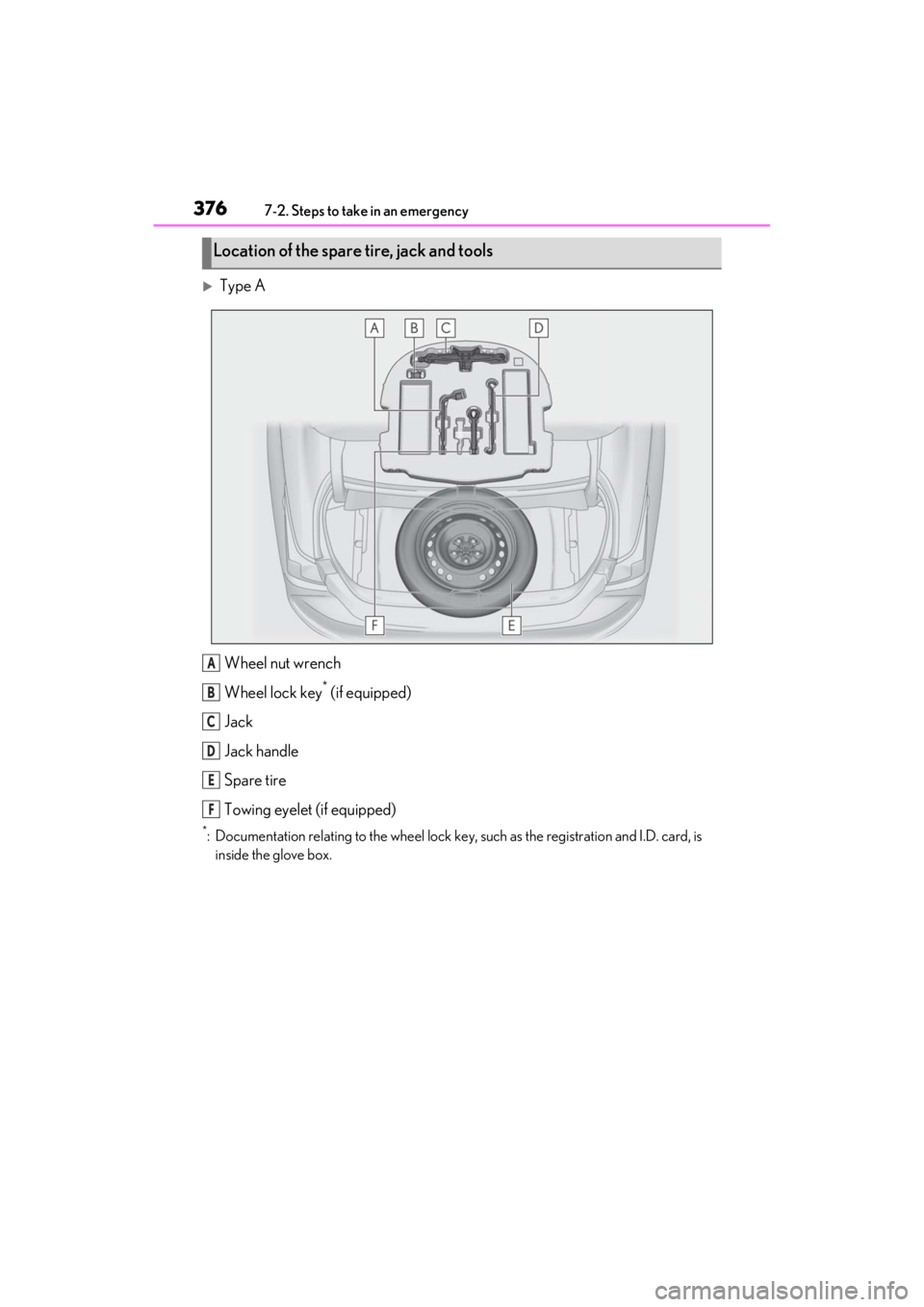
Type AWheel nut wrench
Wheel lock key
* (if equipped)
Jack
Jack handle
Spare tire
Towing eyelet (if equipped)
*: Documentation relating to the wheel lock key, such as the registration and I.D. card, is
inside the glove box.
Location of the spare tire, jack and tools
A
B
C
D
E
F
Page 396 of 464

3967-2. Steps to take in an emergency
WARNING
■When attempting to free a stuck vehi-
cle
If you choose to push the vehicle back
and forth to free it, make sure the sur-
rounding area is clear to avoid striking
other vehicles, objects or people. The
vehicle may also lunge forward or lunge
back suddenly as it becomes free. Use
extreme caution.
■When shifting the shift lever
Be careful not to shif t the shift lever with
the accelerator pedal depressed.
This may lead to unexpected rapid accel-
eration of the vehicle that may cause an
accident resulting in death or serious
injury.
NOTICE
■To avoid damaging the transmission
and other components
●Avoid spinning the front wheels and
depressing the accelerator pedal
more than necessary.
●If the vehicle remains stuck even after
these procedures are performed, the
vehicle may require towing to be
freed.
Page 450 of 464

450Alphabetical index
C
Care ...................................................... 304, 307Aluminum wheels ......................................304
Exterior ...........................................................304
Interior ............................................................. 307
Seat belts........................................................ 307
Cargo capacity................................................ 141
Cargo hooks .................................................280
Center Display ............................................. 256
Chains .............................................................. 252
Child-protectors............................................. 98
Child restraint system................................... 43 Fixed with a LATCH system ..................50
Fixed with a seat belt....................................47
Front passenger occupant classification system ..............................................................37
Points to remember .................................... 43
Riding with children ..................................... 43
Types of child restraint system installation method ........................................................... 44
Using an anchor bracket .......................... 53
Child safety ....................................................... 43 Airbag precautions...................................... 33
Battery precautions ...................... 324, 392
Child restraint system................................. 44
Heated steering wheel and seat heater precautions................................................ 270
How your child should wear the seat belt ............................................................................ 25
Moon roof precautions ............................ 127
Panoramic moon roof precautions ..... 131
Power window lock switch.....................125
Power window precautions ...................125
Rear door child-protectors ..................... 98
Seat belt extender precautions ............. 25
Seat belt precautions ...................................24
Trunk precautions ........................................ 99
Cleaning.............................................. 304, 307 Aluminum wheels ......................................304
Exterior ...........................................................304
Interior ............................................................. 307 Radar sensor ........
............................... 171, 207
Seat belts ........................................................307
Clock ................................................. 70, 73, 281
Coat hooks..................................................... 292
Compass ......................................................... 299
Condenser ..................................................... 322
Console box .................................................. 278
Console box light ........................................ 278
Cooling system............................................. 322 Engine overheating...................................393
Cornering lights ............................................ 160 Replacing light bulbs ................................346
Cruise control Dynamic radar cruise control with full-
speed range ............................................... 195
Cup holder ..................................................... 278
Current fuel consumption ...........................79
Curtain shield airbags .................................. 28
Customizable features ................................419
D
Daytime running light system .................. 158
Defogger Outside rear view mirrors..................... 264
Rear window ................................................ 264
Windshield .................................................... 264
Dimension ...................................................... 398
Dinghy towing................................................. 142
Display BSM (Blind Spot Monitor)................... 205
Dynamic radar cruise control with full-
speed range ............................................... 195
Head-up display............................................84
Intuitive parking assist ................................213
LTA (Lane Tracing Assist) ..................... 189
Multi-information display ...........................77
Parking Support Brake function (rear pedestrians)............................................... 243
RCD (Rear Camera Detection) ........ 224
RCTA...............................................................220
Warning message .......................................371
Distance until next engine oil
Page 459 of 464

Alphabetical index459
Tire information ............................................. 410Glossary........................................................... 414
Size...................................................................... 412
Tire identification number ....................... 412
Uniform Tire Quality Grading..............413
Tire pressure warning system ................ 328 Function .......................................................... 328
Initializing ....................................................... 332
Installing tire pressure warning valves and transmitters ........................................331
Registering ID codes ............................... 334
Warning light ...............................................365
Tires................................................................... 326 Chains ............................................................. 252
Checking ....................................................... 326
If you have a flat tire .................................. 375
Inflation pressure........................................ 336
Information ..................................................... 410
Replacing ....................................................... 375
Rotating tires ................................................ 328
Size....................................................................405
Snow tires ........................................................251
Spare tire........................................................ 375
Tire inflation pressu re display function
......................................................................... 328
Tire pressure warning system ............. 328
Warning light ...............................................365
Tools.................................................................. 376
Top tether strap............................................... 53
Total load capacity ...................................... 398
Towing Dinghy towing ............................................... 142
Emergency towing ...................................355
Towing eyelet ............................................. 358
Trailer towing ................................................. 142
TRAC (Traction Control) ........................ 246
Traction Control (TRAC) ........................ 246
Trailer towing .................................................. 142
Transmission Automatic transmission ............................149
Driving Mode Select switch...................210
Paddle shift switches ......................... 151, 152 S mode ............................................................. 152
Trip meters .................................................. 71, 76
Trunk .................................................................... 99 Hands Free Power Trunk Lid............... 102
Internal trunk release lever..................... 103
Power trunk lid ...............................................99
Smart access system with push-button start ................................................................... 101
Trunk closer switch .................................... 102
Trunk easy closer........................................ 103
Trunk features ............................................. 280
Trunk grip ....................................................... 103
Trunk light ....................................................... 103
Trunk opener main switch...................... 105
Trunk opener switch ................................... 101
Trunk storage extension...........................291
Wireless remote control ........................... 101
Trunk light ........................................................ 103
Turn signal lights ............................................153 Replacing light bulbs ................................346
Turn signal lever .......................................... 153
U
USB charging ports.................................... 282
V
Vanity lights......................................................281
Vanity mirrors .................................................281
Vehicle data recordings ..................................6
Vehicle identification number ................ 398
Vehicle Stability Control (VSC) ........... 246
Ventilators (seat ventilators)................... 270
VSC (Vehicle Stability Control) ........... 246
W
Warning buzzersABS ...................................................................363
Airbags............................................................362
Approach warning..................................... 201
Brake hold .................................................... 368