warning light LEXUS ES350 2021 Owners Manual
[x] Cancel search | Manufacturer: LEXUS, Model Year: 2021, Model line: ES350, Model: LEXUS ES350 2021Pages: 464, PDF Size: 9.61 MB
Page 2 of 464
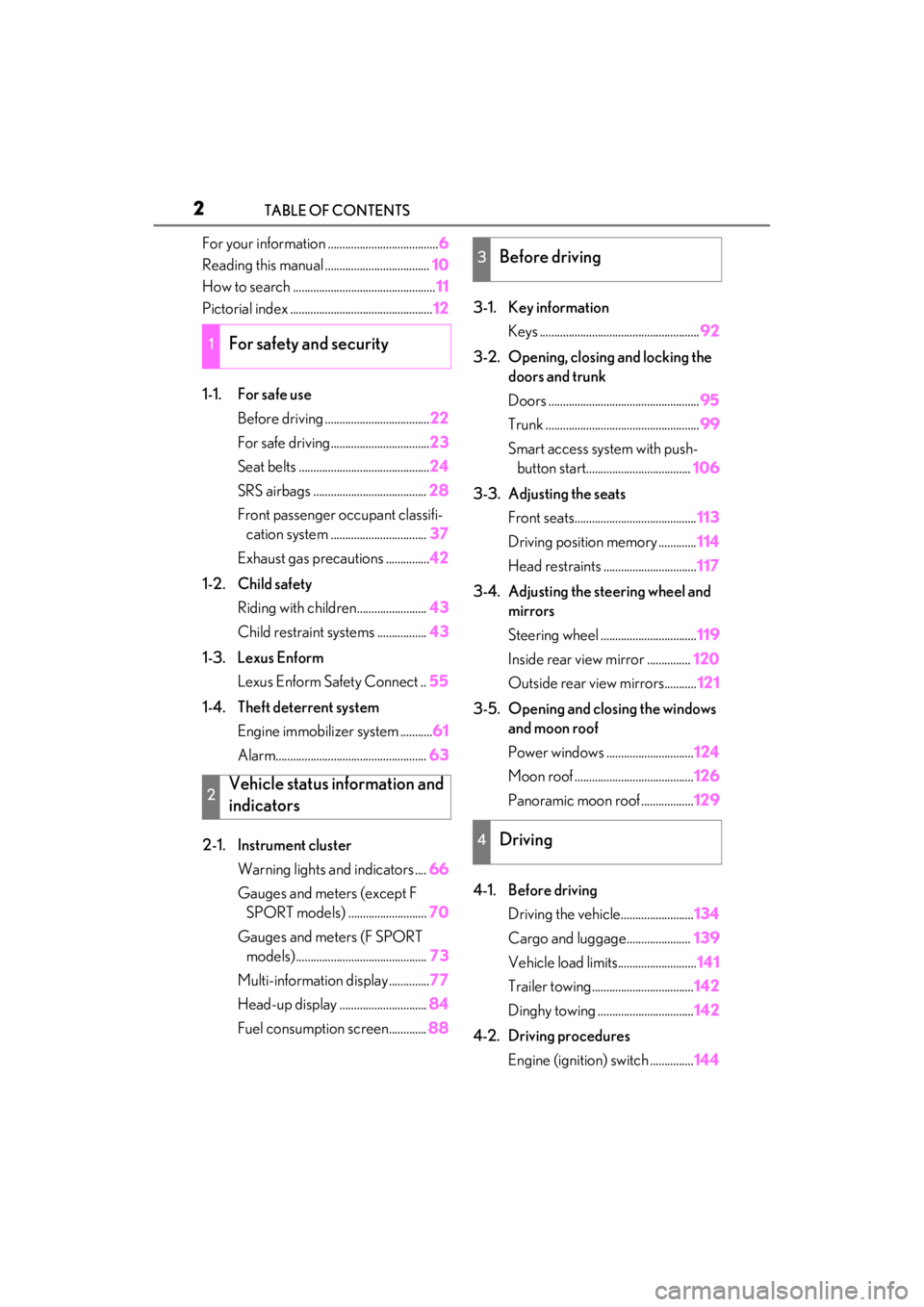
2TABLE OF CONTENTS
For your information ......................................6
Reading this manual .................................... 10
How to search ................................................. 11
Pictorial index ................................................. 12
1-1. For safe use Before driving .................................... 22
For safe driving.................................. 23
Seat belts ............................................. 24
SRS airbags ....................................... 28
Front passenger occupant classifi- cation system ................................. 37
Exhaust gas precautions ............... 42
1-2. Child safety Riding with children........................ 43
Child restraint systems ................. 43
1-3. Lexus Enform Lexus Enform Safety Connect .. 55
1-4. Theft deterrent system Engine immobilizer system ........... 61
Alarm.................................................... 63
2-1. Instrument cluster Warning lights and indicators .... 66
Gauges and meters (except F SPORT models) ........................... 70
Gauges and meters (F SPORT models) ............................................. 73
Multi-information display.............. 77
Head-up display .............................. 84
Fuel consumption screen............. 883-1. Key information
Keys ....................................................... 92
3-2. Opening, closing and locking the doors and trunk
Doors .................................................... 95
Trunk ..................................................... 99
Smart access system with push- button start.................................... 106
3-3. Adjusting the seats Front seats.......................................... 113
Driving position memory ............. 114
Head restraints ................................ 117
3-4. Adjusting the steering wheel and mirrors
Steering wheel ................................. 119
Inside rear view mirror ............... 120
Outside rear view mirrors........... 121
3-5. Opening and closing the windows and moon roof
Power windows .............................. 124
Moon roof ......................................... 126
Panoramic moon roof .................. 129
4-1. Before driving Driving the vehicle......................... 134
Cargo and luggage...................... 139
Vehicle load limits........................... 141
Trailer towing................................... 142
Dinghy towing ................................. 142
4-2. Driving procedures Engine (ignitio n) switch ............... 144
1For safety and security
2Vehicle status information and
indicators
3Before driving
4Driving
Page 4 of 464
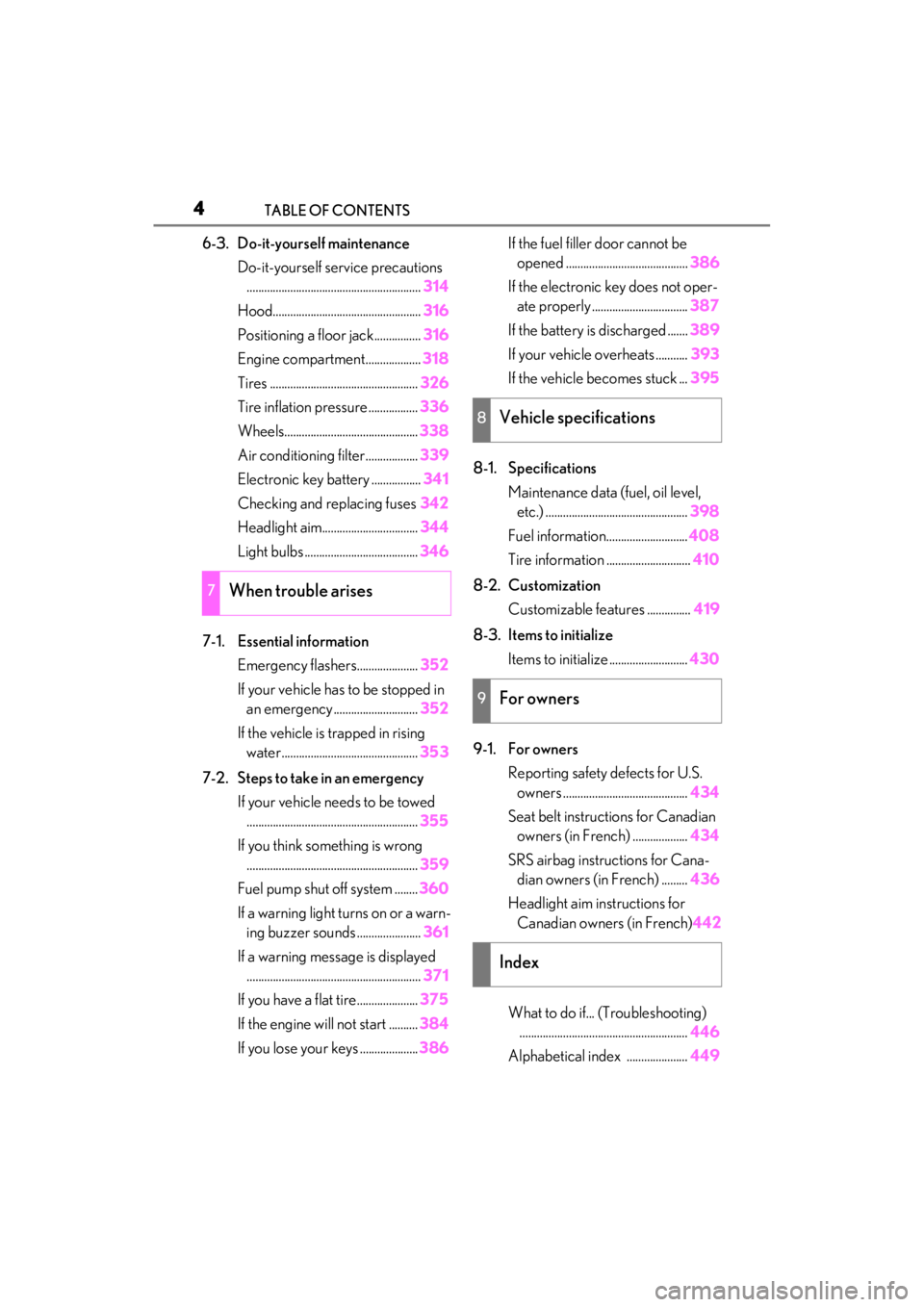
4TABLE OF CONTENTS
6-3. Do-it-yourself maintenanceDo-it-yourself service precautions............................................................ 314
Hood................................................... 316
Positioning a floor jack................ 316
Engine compartment................... 318
Tires ................................................... 326
Tire inflation pressure ................. 336
Wheels.............................................. 338
Air conditioning filter..................339
Electronic key battery ................. 341
Checking and replacing fuses 342
Headlight aim................................. 344
Light bulbs ....................................... 346
7-1. Essential information Emergency flashers..................... 352
If your vehicle has to be stopped in an emergency ............................. 352
If the vehicle is trapped in rising water............................................... 353
7-2. Steps to take in an emergency If your vehicle needs to be towed........................................................... 355
If you think something is wrong ........................................................... 359
Fuel pump shut off system ........ 360
If a warning light turns on or a warn- ing buzzer sounds ...................... 361
If a warning message is displayed ............................................................ 371
If you have a flat tire..................... 375
If the engine wi ll not start .......... 384
If you lose your keys .................... 386If the fuel filler door cannot be
opened .......................................... 386
If the electronic key does not oper- ate properly ................................. 387
If the battery is discharged ....... 389
If your vehicle overheats ........... 393
If the vehicle becomes stuck ... 395
8-1. Specifications Maintenance data (fuel, oil level, etc.) ................................................. 398
Fuel information............................ 408
Tire information ............................. 410
8-2. Customization Customizable features ............... 419
8-3. Items to initialize Items to initialize ........................... 430
9-1. For owners Reporting safety defects for U.S. owners ........................................... 434
Seat belt instructions for Canadian owners (in French) ................... 434
SRS airbag instructions for Cana- dian owners (in French) ......... 436
Headlight aim instructions for Canadian owners (in French) 442
What to do if... (Troubleshooting) .......................................................... 446
Alphabetical index ..................... 44
9
7When trouble arises
8Vehicle specifications
9For owners
Index
Page 13 of 464
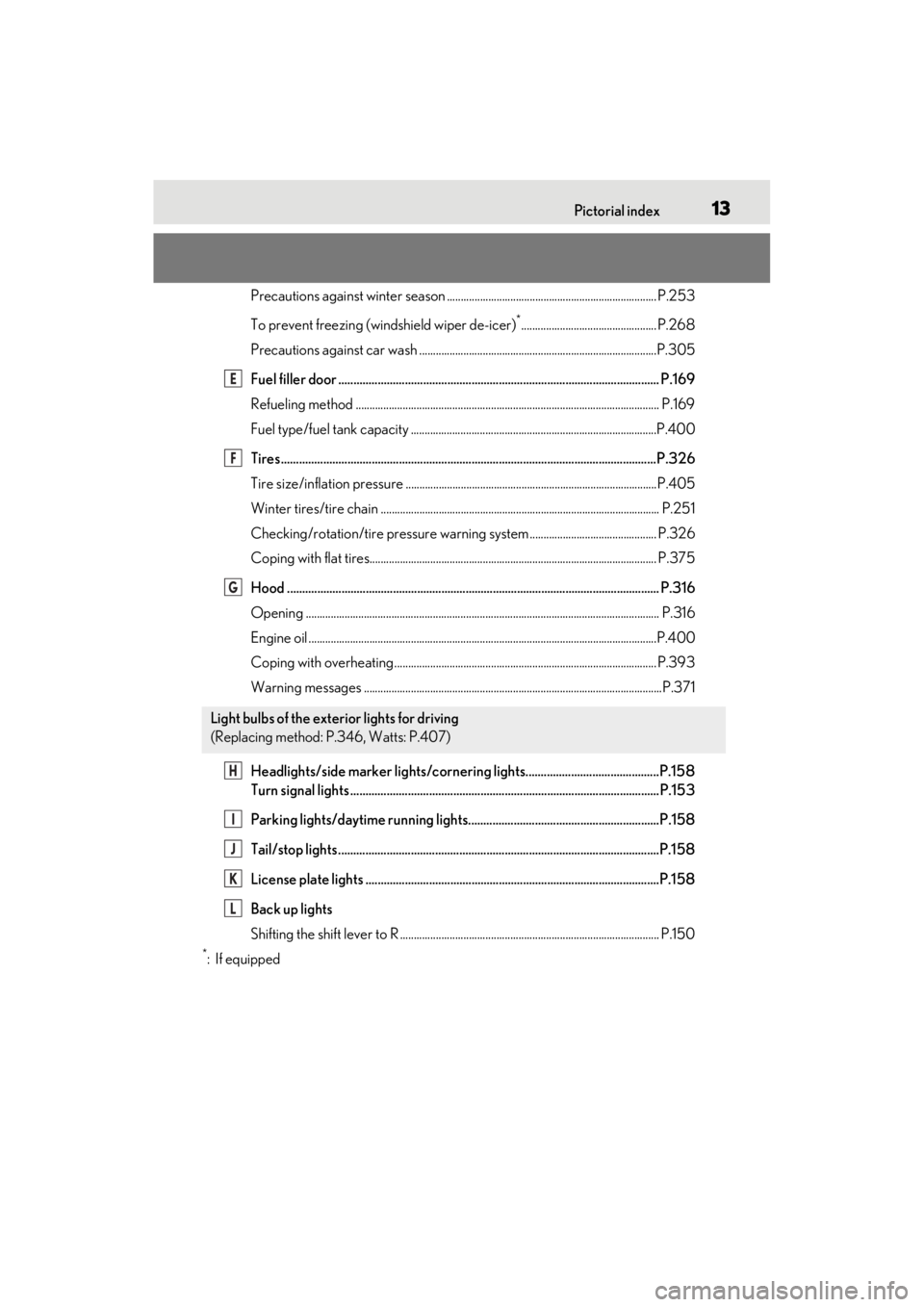
13Pictorial index
Precautions against winter season ............................................................................ P.253
To prevent freezing (windshield wiper de-icer)
*................................................. P.268
Precautions against car wash ......................................................................................P.305
Fuel filler door .......................................................................................................... P.169
Refueling method .............................................................................................................. P .169
Fuel type/fuel tank capacity ...... ...................................................................................P.400
Tires.......................................................................................................................... ..P.326
Tire size/inflation pressure ...........................................................................................P.405
Winter tires/tire chain ..................................................................................................... P.2 51
Checking/rotation/tire pressure warning system.............................................. P.326
Coping with flat tires........................................................................................................ P .375
Hood ........................................................................................................................... P.316
Opening ........................................................................................................................ ........ P.316
Engine oil ..................................................................................................................... .........P.400
Coping with overheating ............................................................................................... P.393
Warning messages ............................................................................................................P.3 71
Headlights/side marker lights/cornering lights............................................P.158
Turn signal lights ......................................................................................................P.153
Parking lights/daytime running lights...............................................................P.158
Tail/stop lights ..........................................................................................................P.158
License plate lights .................................................................................................P.158
Back up lights
Shifting the shift lever to R .............................................................................................. P.150
*:If equipped
Light bulbs of the exterior lights for driving
(Replacing method: P.346, Watts: P.407)
E
F
G
H
I
J
K
L
Page 14 of 464

14Pictorial index
■Instrument panel
Engine switch ........................................................................................................... P.144
Starting the engine/changing the mode ........... .............................................. P.144, 147
Emergency stop of the engine ........................ ............................................................ P.352
When the engine will not start .....................................................................................P.384
Warning messages ............................................................................................................P.3 71
Shift lever................................................................................................................... P .149
Changing the shift position ............................................................................................ P.150
Precautions against towing............................... ............................................................P.355
When the shift lever does not move .......................................................................... P.150
Meters .................................................................................................................. P.70, 7 3
Reading the meters/adjusting the instru ment panel lights......... P.70, 72, 73, 76
Warning lights/indicator lights ...................................................................................... P.66
When the warning lights come on .............................................................................. P.361
Multi-information display ....................................................................................... P.77
Display .......................................................................................................................................P.77
When the warning messages are displayed............................................................P.371A
B
C
D
Page 15 of 464
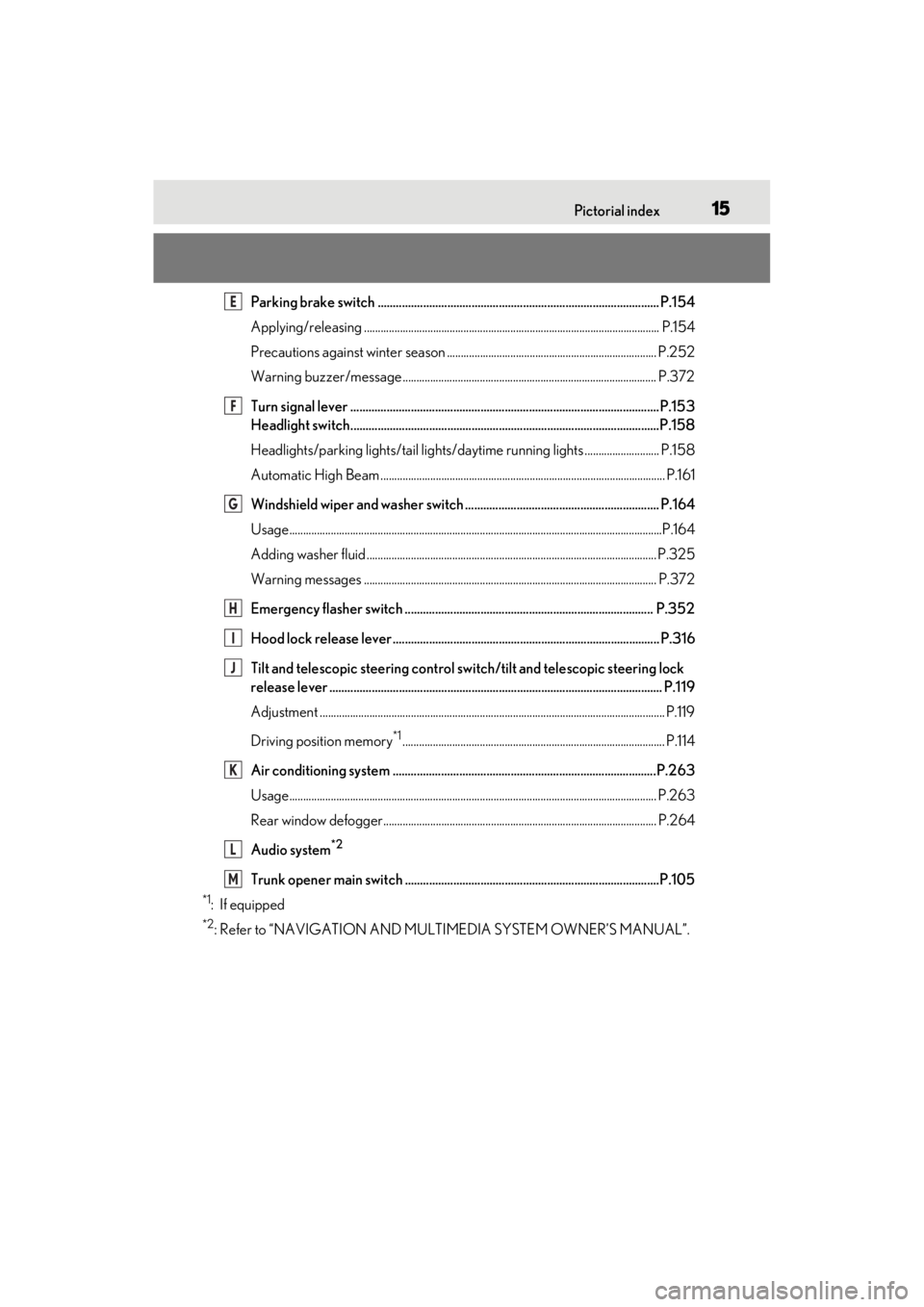
15Pictorial index
Parking brake switch ............................................................................................. P.154
Applying/releasing ........................................................................................................... P.154
Precautions against winter season ............................................................................ P.252
Warning buzzer/message............................................................................................ P.372
Turn signal lever ......................................................................................................P.153
Headlight switch......................................................................................................P.158
Headlights/parking lights/tail lights/daytime running lights ........................... P.158
Automatic High Beam ....................................................................................................... P.161
Windshield wiper and washer switch ................................................................ P.164
Usage.......................................................................................................................................P.164
Adding washer fluid ......................................................................................................... P.3 25
Warning messages .......................................................................................................... P.372
Emergency flasher switch .................................................................................. P.352
Hood lock release lever ........................................................................................ P.316
Tilt and telescopic steering control swit ch/tilt and telescopic steering lock
release lever .............................................................................................................. P.11 9
Adjustment ..................................................................................................................... ........ P.119
Driving position memory
*1............................................................................................... P.114
Air conditioning system .......................................................................................P.263
Usage.......................................................................................................................... ........... P.263
Rear window defogger................................................................................................... P.264
Audio system
*2
Trunk opener main switch ....................................................................................P.105
*1: If equipped
*2: Refer to “NAVIGATION AND MULTIMEDIA SYSTEM OWNER’S MANUAL”.
E
F
G
H
I
J
K
L
M
Page 23 of 464
231-1. For safe use
1
For safety and security
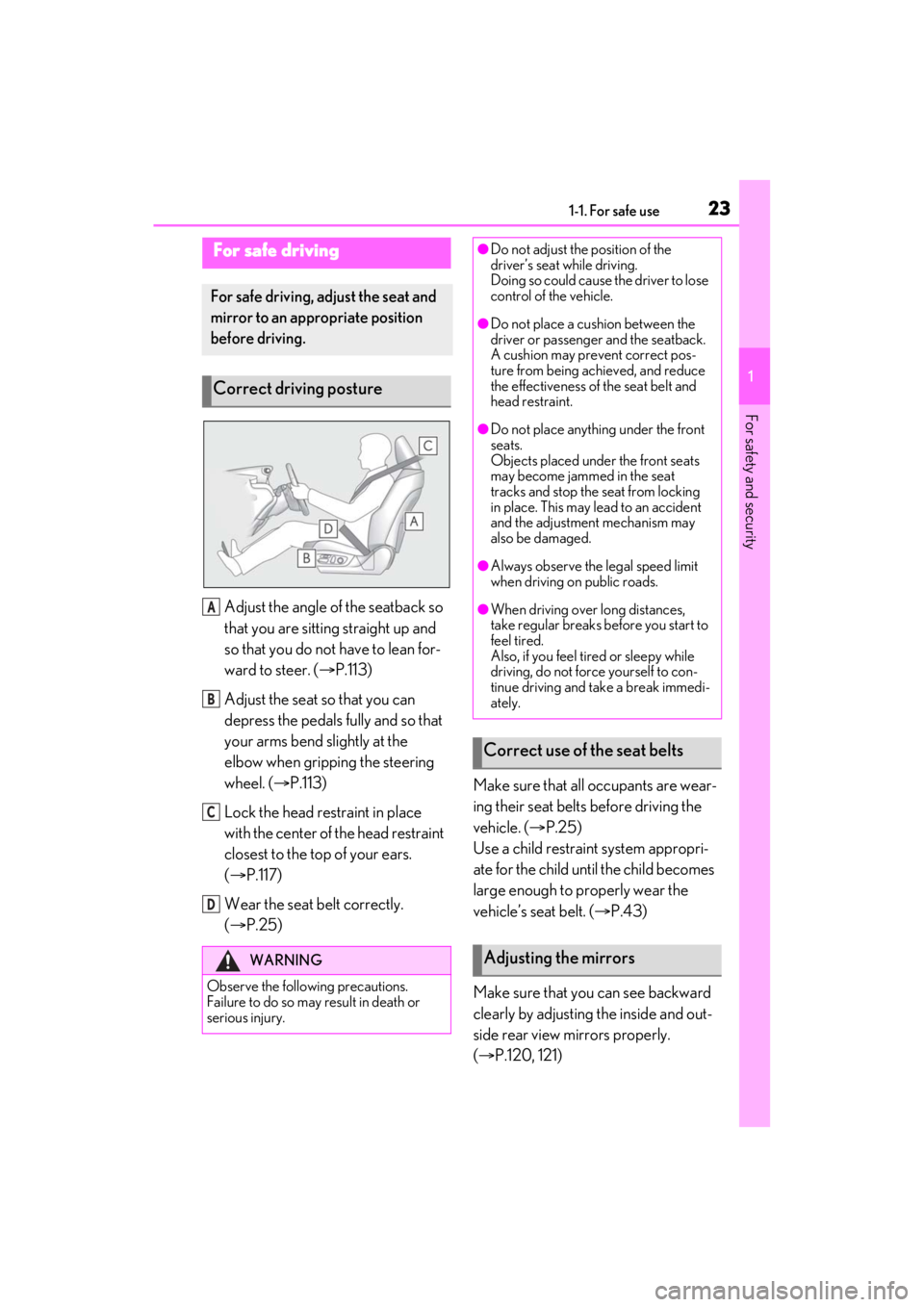
Adjust the angle of the seatback so
that you are sitting straight up and
so that you do not have to lean for-
ward to steer. (P.113)
Adjust the seat so that you can
depress the pedals fully and so that
your arms bend slightly at the
elbow when gripping the steering
wheel. ( P.113)
Lock the head restraint in place
with the center of the head restraint
closest to the top of your ears.
( P.117)
Wear the seat belt correctly.
( P.25) Make sure that all occupants are wear-
ing their seat belts before driving the
vehicle. (
P.25)
Use a child restraint system appropri-
ate for the child until the child becomes
large enough to properly wear the
vehicle’s seat belt. ( P.43)
Make sure that you can see backward
clearly by adjusting the inside and out-
side rear view mirrors properly.
( P.120, 121)
For safe driving
For safe driving, adjust the seat and
mirror to an appropriate position
before driving.
Correct driving posture
WARNING
Observe the following precautions.
Failure to do so may result in death or
serious injury.
A
B
C
D
●Do not adjust the position of the
driver’s seat while driving.
Doing so could cause the driver to lose
control of the vehicle.
●Do not place a cushion between the
driver or passenger and the seatback.
A cushion may prevent correct pos-
ture from being achieved, and reduce
the effectiveness of the seat belt and
head restraint.
●Do not place anything under the front
seats.
Objects placed under the front seats
may become jammed in the seat
tracks and stop the seat from locking
in place. This may lead to an accident
and the adjustment mechanism may
also be damaged.
●Always observe the legal speed limit
when driving on public roads.
●When driving over long distances,
take regular breaks before you start to
feel tired.
Also, if you feel tired or sleepy while
driving, do not force yourself to con-
tinue driving and take a break immedi-
ately.
Correct use of the seat belts
Adjusting the mirrors
Page 26 of 464
261-1. For safe use
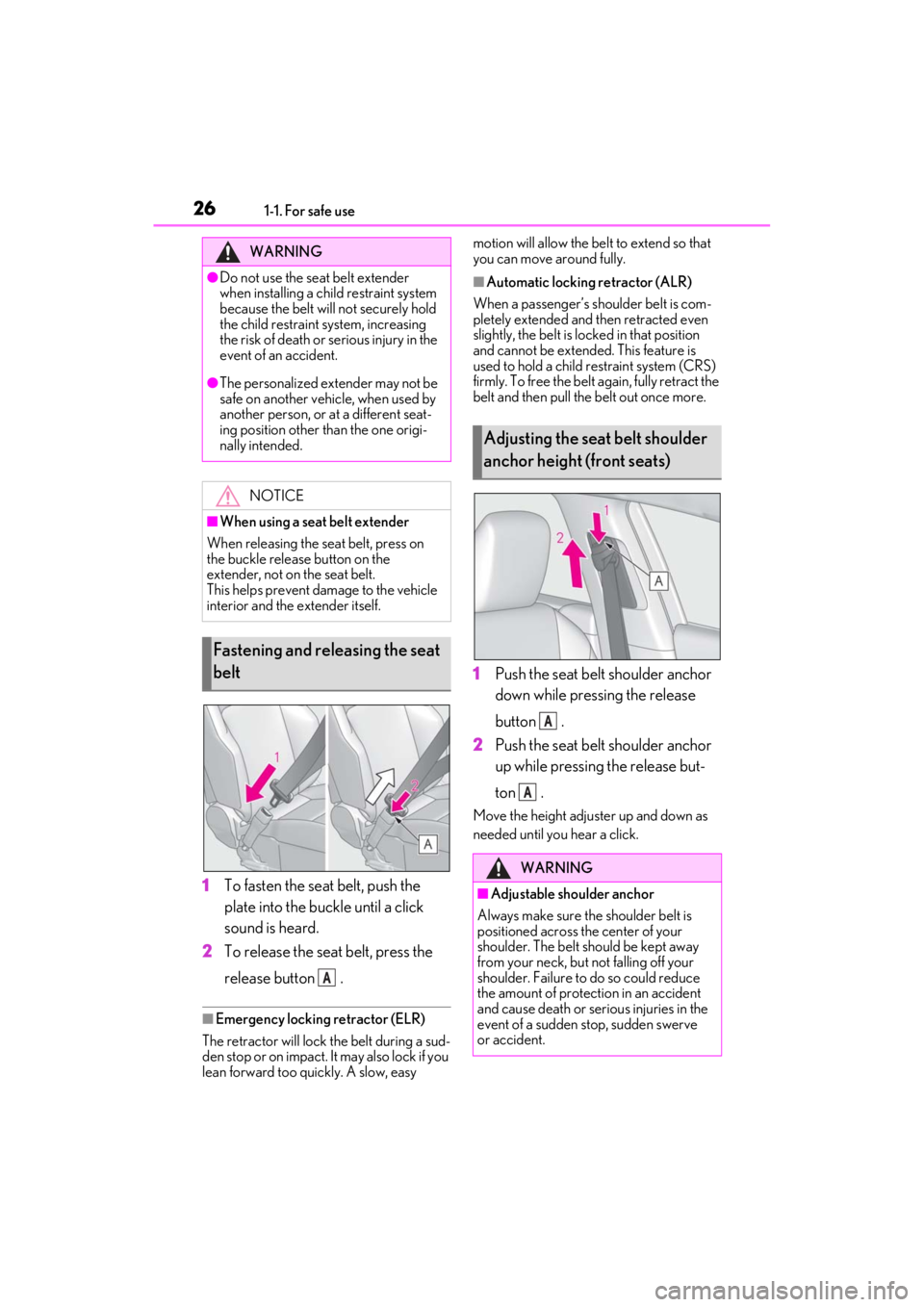
1To fasten the seat belt, push the
plate into the buckle until a click
sound is heard.
2 To release the seat belt, press the
release button .
■Emergency locking retractor (ELR)
The retractor will lock the belt during a sud-
den stop or on impact. It may also lock if you
lean forward too quickly. A slow, easy motion will allow the belt to extend so that
you can move around fully.
■Automatic locking retractor (ALR)
When a passenger’s shoulder belt is com-
pletely extended and then retracted even
slightly, the belt is lo cked in that position
and cannot be extended. This feature is
used to hold a child restraint system (CRS)
firmly. To free the belt again, fully retract the
belt and then pull the belt out once more.
1 Push the seat belt shoulder anchor
down while pressing the release
button .
2 Push the seat belt shoulder anchor
up while pressing the release but-
ton .
Move the height adjuster up and down as
needed until you hear a click.
WARNING
●Do not use the seat belt extender
when installing a child restraint system
because the belt will not securely hold
the child restraint system, increasing
the risk of death or serious injury in the
event of an accident.
●The personalized extender may not be
safe on another vehicle, when used by
another person, or at a different seat-
ing position other than the one origi-
nally intended.
NOTICE
■When using a seat belt extender
When releasing the se at belt, press on
the buckle release button on the
extender, not on the seat belt.
This helps prevent damage to the vehicle
interior and the extender itself.
Fastening and releasing the seat
belt
A
Adjusting the seat belt shoulder
anchor height (front seats)
WARNING
■Adjustable shoulder anchor
Always make sure the shoulder belt is
positioned across the center of your
shoulder. The belt should be kept away
from your neck, but not falling off your
shoulder. Failure to do so could reduce
the amount of protection in an accident
and cause death or serious injuries in the
event of a sudden stop, sudden swerve
or accident.
A
A
Page 27 of 464

271-1. For safe use
1
For safety and security
The pretensioners help the seat belts to
quickly restrain the occupants by
retracting the seat belts when the vehi-
cle is subjected to certain types of
severe frontal or side collision or a
vehicle rollover.
The pretensioners do not activate in the
event of a minor frontal impact, a minor
side impact or a rear impact.
■Replacing the belt after the preten-
sioner has been activated
If the vehicle is involv ed in multiple colli-
sions, the pretensioner will activate for the
first collision, but will not activate for the
second or subsequent collisions.
Seat belt pretensioners (front
and outboard rear seats)
WARNING
■Seat belt pretensioners
Observe the following precautions to
reduce the risk of injury in the event of
sudden braking, sudd en swerving or an
accident.
Failure to do so may cause death or seri-
ous injury.
●Do not place anything, such as a cush-
ion, on the front passenger’s seat.
Doing so will disperse the passenger’s
weight, which prevents the sensor
from detecting the passenger’s weight
properly. As a result , the seat belt pre-
tensioner for the front passenger’s seat
may not activate in the event of a colli-
sion.
●If the pretensioner has activated, the
SRS warning light will come on. In that
case, the seat belt cannot be used
again and must be replaced at your
Lexus dealer.
Page 29 of 464

291-1. For safe use
1
For safety and security
SRS curtain shield airbags
• Can help protect primarily the head of occupants in the outer seats
• Can help prevent the occupants from being thrown from the vehicle in the event of vehi- cle rollover
■SRS airbag system components
Front passenger occupant classifi cation system (ECU and sensors)
Knee airbags
Front passenger airbag
Curtain shield airbags
Side impact sensors (front door)
Seat belt pretensioners and force limiters
Side impact sensors (front)
Front side airbags
Side impact sensors (rear)
Rear side airbags
Driver airbag
SRS warning light
Driver’s seat position sensor
E
A
B
C
D
E
F
G
H
I
J
K
L
M
Page 33 of 464
331-1. For safe use
1
For safety and security
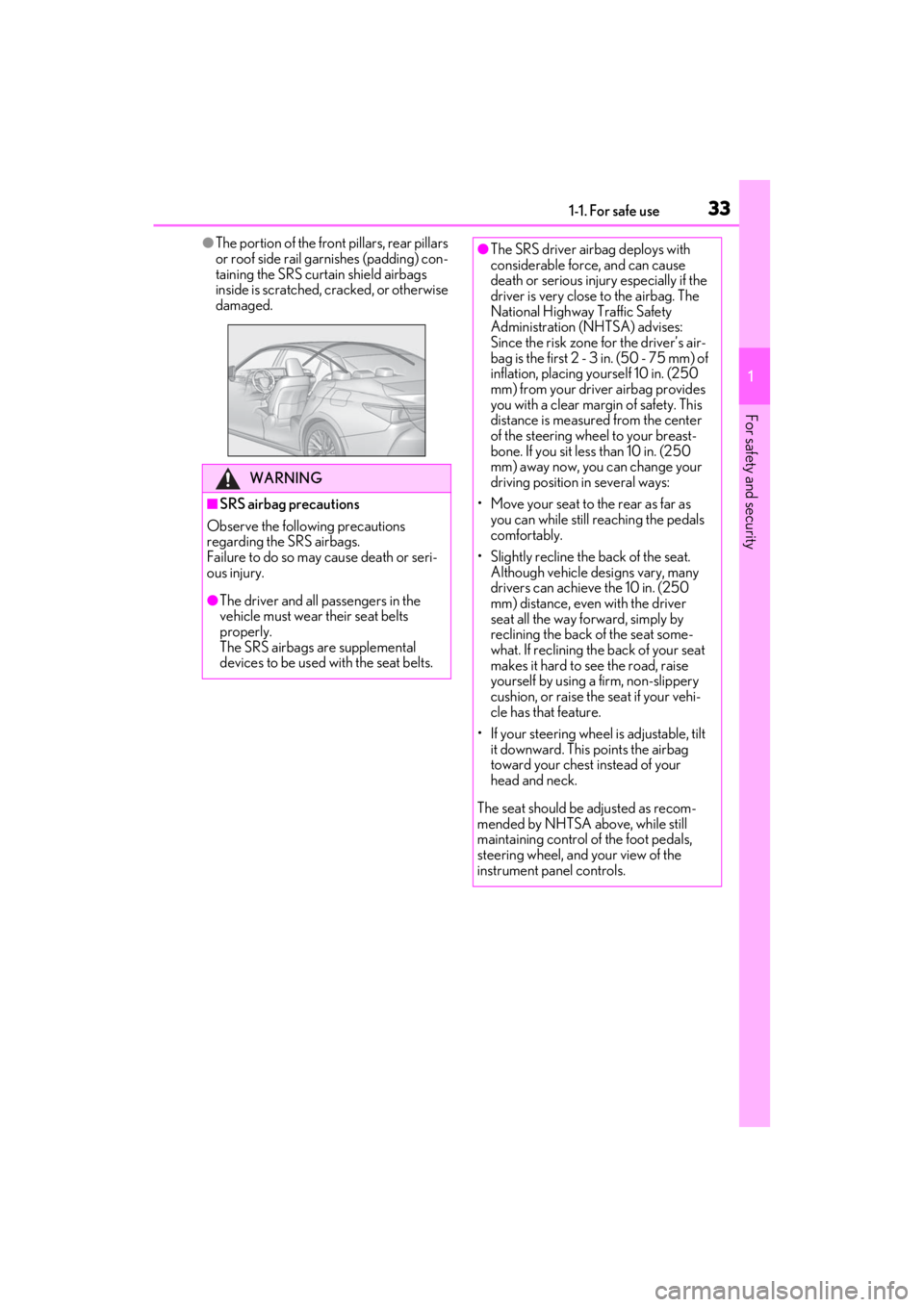
●The portion of the front pillars, rear pillars
or roof side rail garnishes (padding) con-
taining the SRS curtain shield airbags
inside is scratched, cracked, or otherwise
damaged.
WARNING
■SRS airbag precautions
Observe the following precautions
regarding the SRS airbags.
Failure to do so may cause death or seri-
ous injury.
●The driver and all passengers in the
vehicle must wear their seat belts
properly.
The SRS airbags are supplemental
devices to be used with the seat belts.
●The SRS driver airbag deploys with
considerable force, and can cause
death or serious injury especially if the
driver is very close to the airbag. The
National Highway Traffic Safety
Administration (NHTSA) advises:
Since the risk zone for the driver’s air-
bag is the first 2 - 3 in. (50 - 75 mm) of
inflation, placing yourself 10 in. (250
mm) from your driver airbag provides
you with a clear margin of safety. This
distance is measured from the center
of the steering wheel to your breast-
bone. If you sit less than 10 in. (250
mm) away now, you can change your
driving position in several ways:
• Move your seat to the rear as far as you can while still reaching the pedals
comfortably.
• Slightly recline the back of the seat. Although vehicle designs vary, many
drivers can achieve the 10 in. (250
mm) distance, even with the driver
seat all the way forward, simply by
reclining the back of the seat some-
what. If reclining the back of your seat
makes it hard to see the road, raise
yourself by using a firm, non-slippery
cushion, or raise the seat if your vehi-
cle has that feature.
• If your steering wheel is adjustable, tilt it downward. This points the airbag
toward your chest instead of your
head and neck.
The seat should be adjusted as recom-
mended by NHTSA above, while still
maintaining control of the foot pedals,
steering wheel, and your view of the
instrument panel controls.