weight LEXUS ES350 2022 User Guide
[x] Cancel search | Manufacturer: LEXUS, Model Year: 2022, Model line: ES350, Model: LEXUS ES350 2022Pages: 468, PDF Size: 26.96 MB
Page 332 of 468
3306-3. Do-it-yourself maintenance
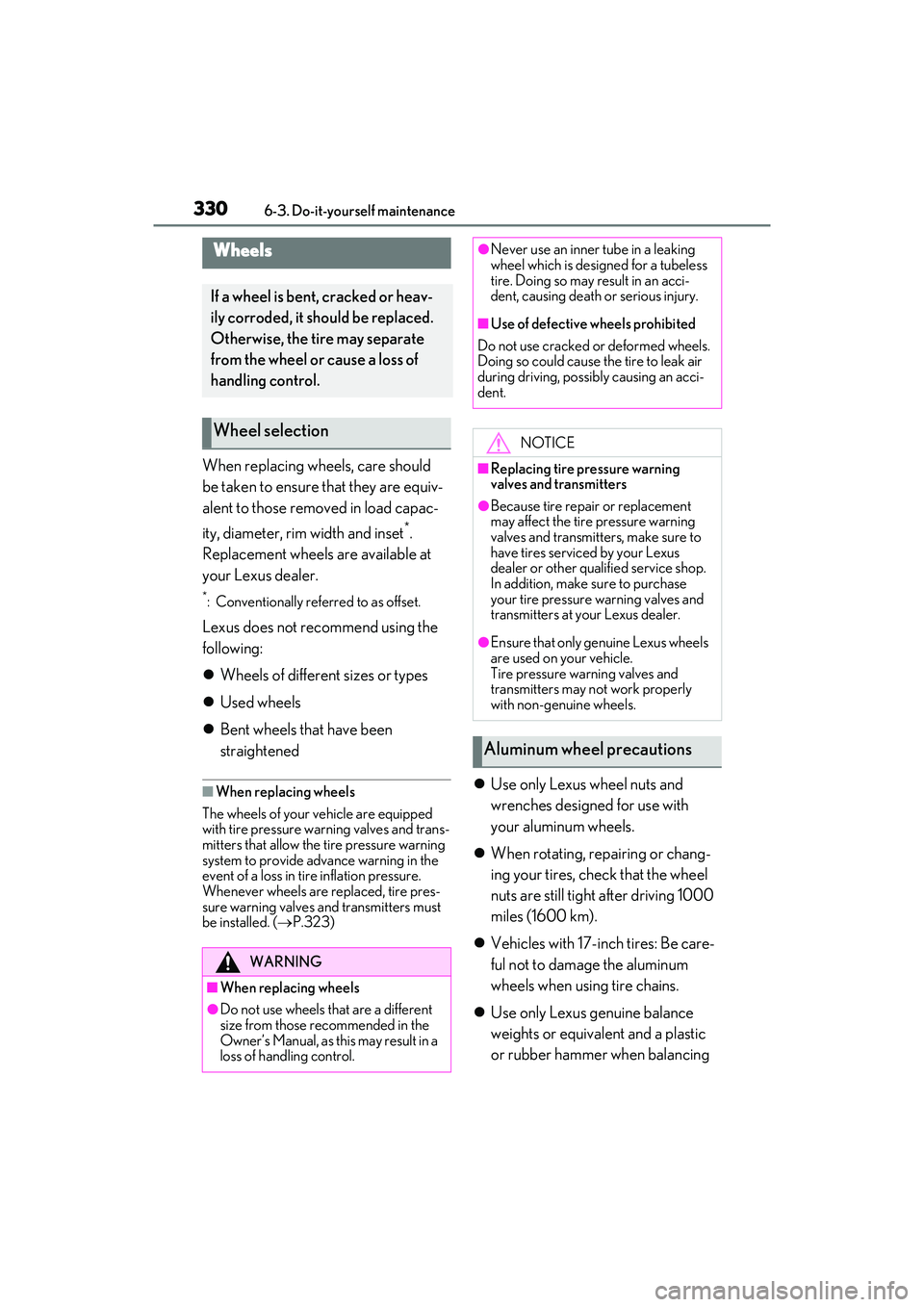
When replacing wheels, care should
be taken to ensure that they are equiv-
alent to those removed in load capac-
ity, diameter, rim width and inset
*.
Replacement wheels are available at
your Lexus dealer.
*: Conventionally referred to as offset.
Lexus does not recommend using the
following:
Wheels of different sizes or types
Used wheels
Bent wheels that have been
straightened
■When replacing wheels
The wheels of your vehicle are equipped
with tire pressure warning valves and trans-
mitters that allow the tire pressure warning
system to provide advance warning in the
event of a loss in tire inflation pressure.
Whenever wheels are replaced, tire pres-
sure warning valves and transmitters must
be installed. ( P.323) Use only Lexus wheel nuts and
wrenches designed for use with
your aluminum wheels.
When rotating, repairing or chang-
ing your tires, check that the wheel
nuts are still tight after driving 1000
miles (1600 km).
Vehicles with 17-inch tires: Be care-
ful not to damage the aluminum
wheels when using tire chains.
Use only Lexus genuine balance
weights or equivalent and a plastic
or rubber hammer when balancing
Wheels
If a wheel is bent, cracked or heav-
ily corroded, it should be replaced.
Otherwise, the tire may separate
from the wheel or cause a loss of
handling control.
Wheel selection
WARNING
■When replacing wheels
●Do not use wheels that are a different
size from those recommended in the
Owner’s Manual, as this may result in a
loss of handling control.
●Never use an inner tube in a leaking
wheel which is designed for a tubeless
tire. Doing so may result in an acci-
dent, causing death or serious injury.
■Use of defective wheels prohibited
Do not use cracked or deformed wheels.
Doing so could cause the tire to leak air
during driving, possibly causing an acci-
dent.
NOTICE
■Replacing tire pressure warning
valves and transmitters
●Because tire repair or replacement
may affect the tire pressure warning
valves and transmitters, make sure to
have tires serviced by your Lexus
dealer or other qualified service shop.
In addition, make sure to purchase
your tire pressure warning valves and
transmitters at your Lexus dealer.
●Ensure that only genuine Lexus wheels
are used on your vehicle.
Tire pressure warning valves and
transmitters may not work properly
with non-genuine wheels.
Aluminum wheel precautions
Page 390 of 468
3888-1. Specifications
8-1 .S pec if ic ati on s
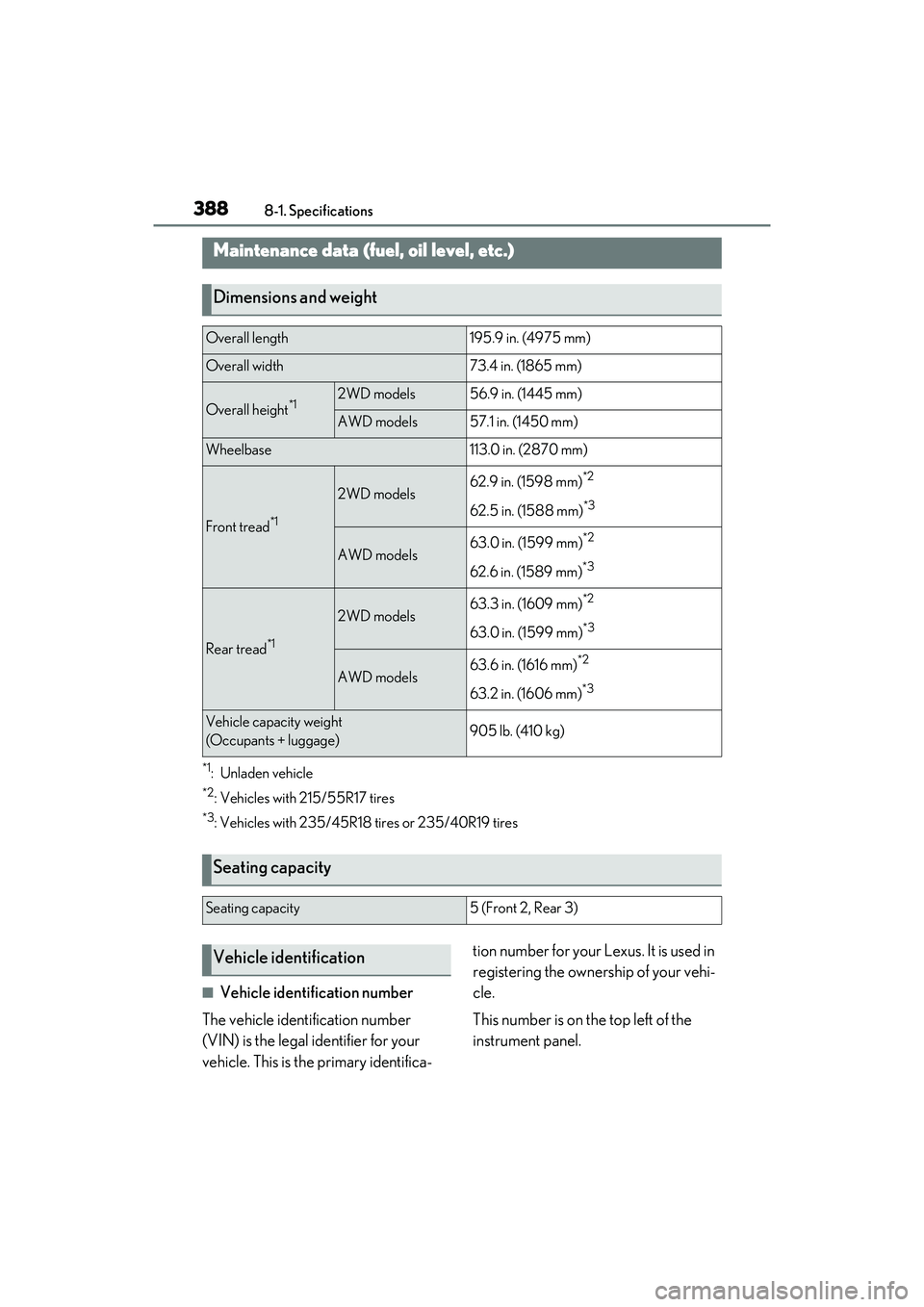
*1:Unladen vehicle
*2: Vehicles with 215/55R17 tires
*3: Vehicles with 235/45R18 tires or 235/40R19 tires
■Vehicle identification number
The vehicle identification number
(VIN) is the legal identifier for your
vehicle. This is the primary identifica- tion number for your Lexus. It is used in
registering the ownership of your vehi-
cle.
This number is on the top left of the
instrument panel.
Maintenance data (fuel, oil level, etc.)
Dimensions and weight
Overall length195.9 in. (4975 mm)
Overall width73.4 in. (1865 mm)
Overall height*12WD models56.9 in. (1445 mm)
AWD models57.1 in. (1450 mm)
Wheelbase113.0 in. (2870 mm)
Front tread*1
2WD models62.9 in. (1598 mm)*2
62.5 in. (1588 mm)*3
AWD models63.0 in. (1599 mm)*2
62.6 in. (1589 mm)*3
Rear tread*1
2WD models63.3 in. (1609 mm)*2
63.0 in. (1599 mm)*3
AWD models63.6 in. (1616 mm)*2
63.2 in. (1606 mm)*3
Vehicle capacity weight
(Occupants + luggage)905 lb. (410 kg)
Seating capacity
Seating capacity5 (Front 2, Rear 3)
Vehicle identification
Page 405 of 468
4038-1. Specifications
8
Vehicle specifications
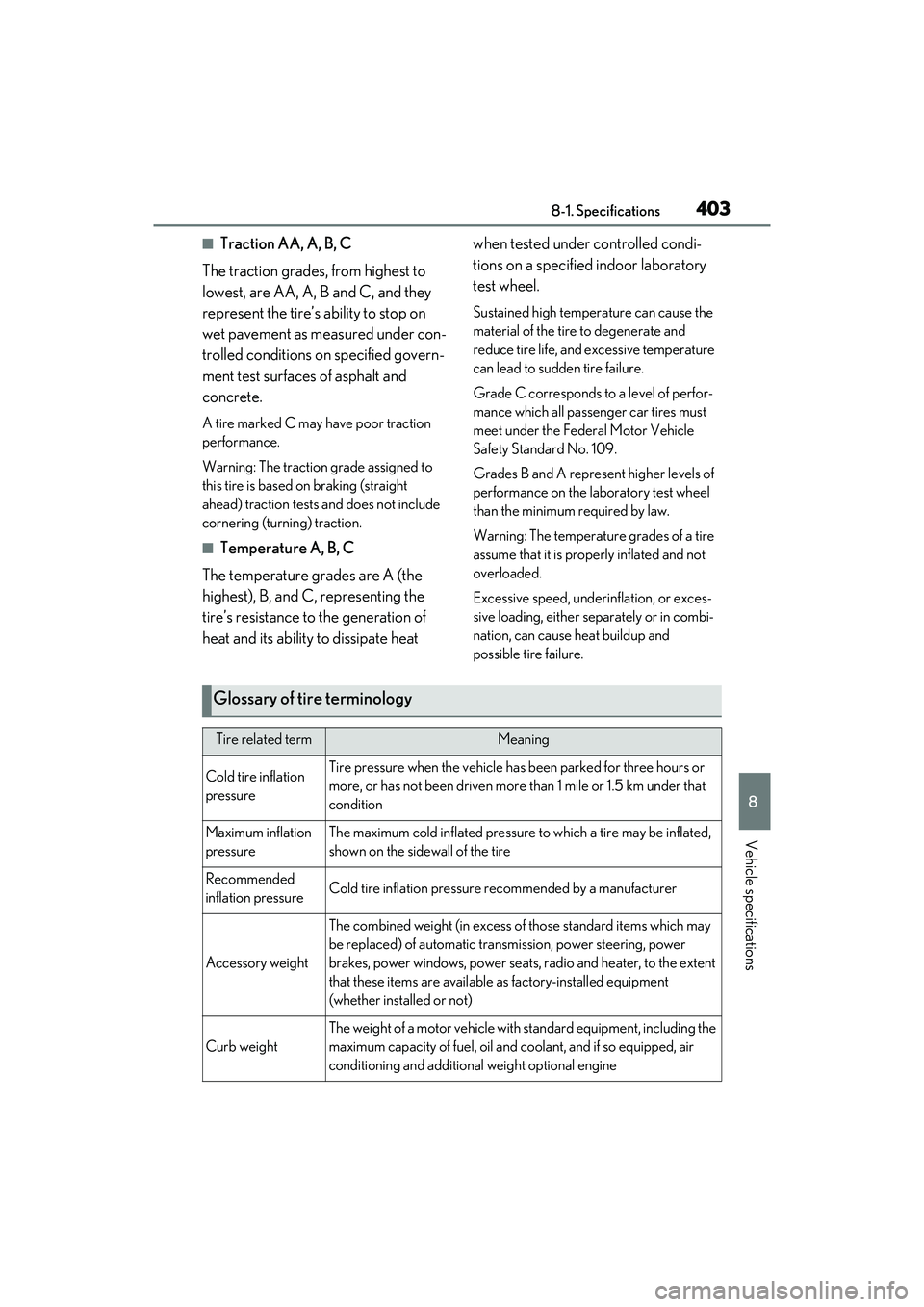
■Traction AA, A, B, C
The traction grades, from highest to
lowest, are AA, A, B and C, and they
represent the tire’s ability to stop on
wet pavement as measured under con-
trolled conditions on specified govern-
ment test surfaces of asphalt and
concrete.
A tire marked C may have poor traction
performance.
Warning: The traction grade assigned to
this tire is based on braking (straight
ahead) traction tests and does not include
cornering (turning) traction.
■Temperature A, B, C
The temperature grades are A (the
highest), B, and C, representing the
tire’s resistance to the generation of
heat and its ability to dissipate heat when tested under controlled condi-
tions on a specified indoor laboratory
test wheel.
Sustained high temperature can cause the
material of the tire to degenerate and
reduce tire life, and excessive temperature
can lead to sudden tire failure.
Grade C corresponds to a level of perfor-
mance which all passenger car tires must
meet under the Federal Motor Vehicle
Safety Standard No. 109.
Grades B and A represent higher levels of
performance on the laboratory test wheel
than the minimum required by law.
Warning: The temperature grades of a tire
assume that it is properly inflated and not
overloaded.
Excessive speed, underinflation, or exces-
sive loading, either separately or in combi-
nation, can cause heat buildup and
possible tire failure.
Glossary of tire terminology
Tire related termMeaning
Cold tire inflation
pressureTire pressure when the vehicle has been parked for three hours or
more, or has not been driven more
than 1 mile or 1.5 km under that
condition
Maximum inflation
pressureThe maximum cold inflated pressure to which a tire may be inflated,
shown on the sidewall of the tire
Recommended
inflation pressureCold tire inflation pressure recommended by a manufacturer
Accessory weight
The combined weight (in excess of those standard items which may
be replaced) of automatic transmission, power steering, power
brakes, power windows, power seats, radio and heater, to the extent
that these items are available as factory-installed equipment
(whether installed or not)
Curb weight
The weight of a motor vehicle with standard equipment, including the
maximum capacity of fuel, oil and coolant, and if so equipped, air
conditioning and additional weight optional engine
Page 406 of 468
4048-1. Specifications
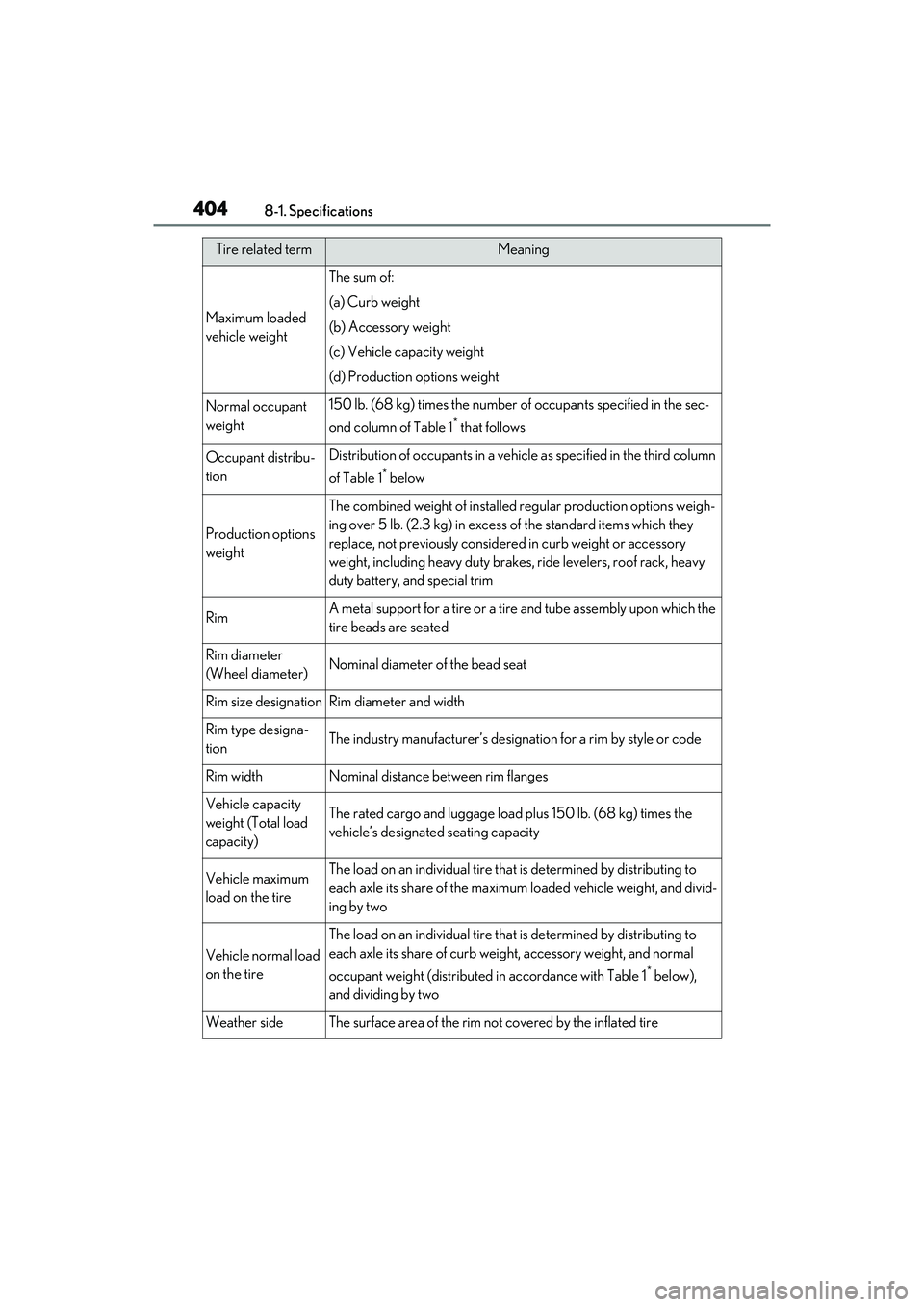
Maximum loaded
vehicle weight
The sum of:
(a) Curb weight
(b) Accessory weight
(c) Vehicle capacity weight
(d) Production options weight
Normal occupant
weight150 lb. (68 kg) times the number of occupants specified in the sec-
ond column of Table 1
* that follows
Occupant distribu-
tionDistribution of occupants in a vehicle as specified in the third column
of Table 1
* below
Production options
weight
The combined weight of installed regular production options weigh-
ing over 5 lb. (2.3 kg) in excess of the standard items which they
replace, not previously considered in curb weight or accessory
weight, including heavy duty brakes, ride levelers, roof rack, heavy
duty battery, and special trim
RimA metal support for a tire or a tire and tube assembly upon which the
tire beads are seated
Rim diameter
(Wheel diameter)Nominal diameter of the bead seat
Rim size designationRim diameter and width
Rim type designa-
tionThe industry manufacturer’s designation for a rim by style or code
Rim widthNominal distance between rim flanges
Vehicle capacity
weight (Total load
capacity)The rated cargo and luggage load plus 150 lb. (68 kg) times the
vehicle’s designated seating capacity
Vehicle maximum
load on the tireThe load on an individual tire that is determined by distributing to
each axle its share of the maximum loaded vehicle weight, and divid-
ing by two
Vehicle normal load
on the tire
The load on an individual tire that is determined by distributing to
each axle its share of curb weight, accessory weight, and normal
occupant weight (distributed in accordance with Table 1
* below),
and dividing by two
Weather sideThe surface area of the rim not covered by the inflated tire
Tire related termMeaning
Page 407 of 468
4058-1. Specifications
8
Vehicle specifications
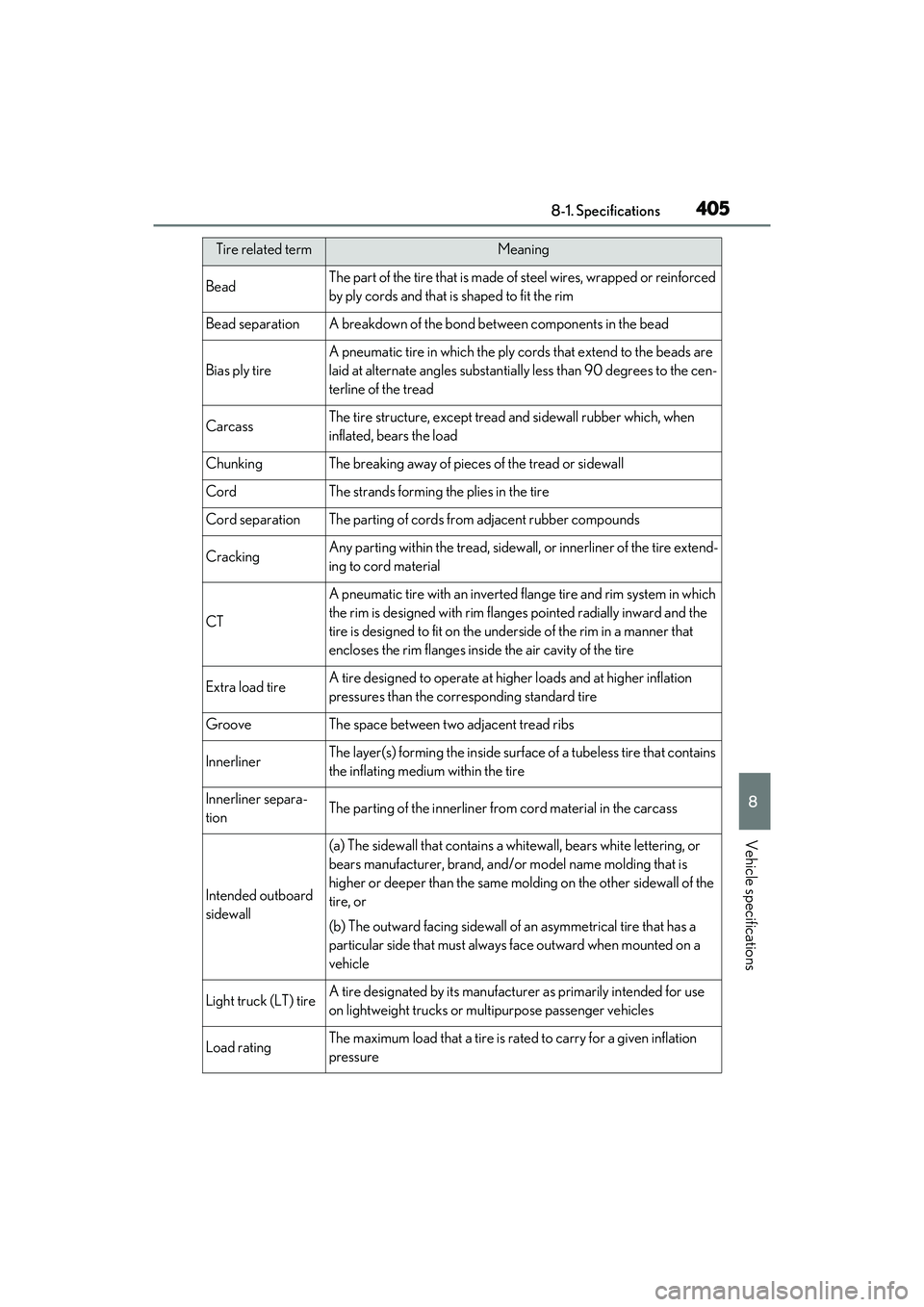
BeadThe part of the tire that is made of steel wires, wrapped or reinforced
by ply cords and that is shaped to fit the rim
Bead separationA breakdown of the bond between components in the bead
Bias ply tire
A pneumatic tire in which the ply cords that extend to the beads are
laid at alternate angles substantially less than 90 degrees to the cen-
terline of the tread
CarcassThe tire structure, except tread and sidewall rubber which, when
inflated, bears the load
ChunkingThe breaking away of pieces of the tread or sidewall
CordThe strands forming the plies in the tire
Cord separationThe parting of cords from adjacent rubber compounds
CrackingAny parting within the tread, sidewall, or innerliner of the tire extend-
ing to cord material
CT
A pneumatic tire with an inverted flange tire and rim system in which
the rim is designed with rim flange s pointed radially inward and the
tire is designed to fit on the underside of the rim in a manner that
encloses the rim flanges inside the air cavity of the tire
Extra load tireA tire designed to operate at higher loads and at higher inflation
pressures than the corresponding standard tire
GrooveThe space between two adjacent tread ribs
InnerlinerThe layer(s) forming the inside surface of a tubeless tire that contains
the inflating medium within the tire
Innerliner separa-
tionThe parting of the innerliner from cord material in the carcass
Intended outboard
sidewall
(a) The sidewall that contains a whit ewall, bears white lettering, or
bears manufacturer, brand, and/or model name molding that is
higher or deeper than the same molding on the other sidewall of the
tire, or
(b) The outward facing sidewall of an asymmetrical tire that has a
particular side that must always face outward when mounted on a
vehicle
Light truck (LT) tireA tire designated by its manufacturer as primarily intended for use
on lightweight trucks or multipurpose passenger vehicles
Load ratingThe maximum load that a tire is rated to carry for a given inflation
pressure
Tire related termMeaning
Page 408 of 468
4068-1. Specifications
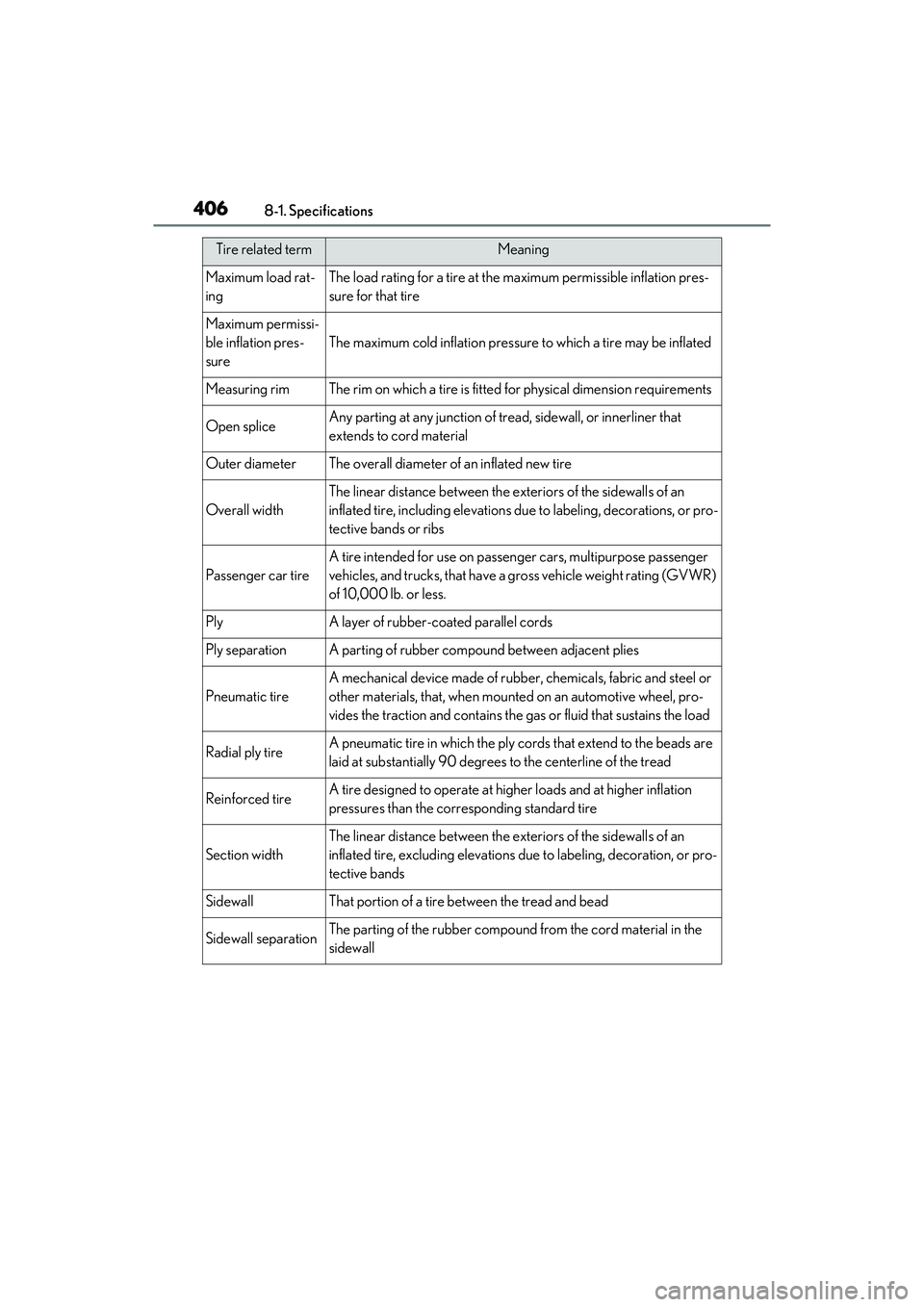
Maximum load rat-
ingThe load rating for a tire at the maximum permissible inflation pres-
sure for that tire
Maximum permissi-
ble inflation pres-
sure
The maximum cold inflation pressure to which a tire may be inflated
Measuring rimThe rim on which a tire is fitted for physical dimension requirements
Open spliceAny parting at any junction of trea d, sidewall, or innerliner that
extends to cord material
Outer diameterThe overall diameter of an inflated new tire
Overall width
The linear distance between the exteriors of the sidewalls of an
inflated tire, including elevations due to labeling, decorations, or pro-
tective bands or ribs
Passenger car tire
A tire intended for use on passeng er cars, multipurpose passenger
vehicles, and trucks, that have a gross vehicle weight rating (GVWR)
of 10,000 lb. or less.
PlyA layer of rubber-coated parallel cords
Ply separationA parting of rubber compound between adjacent plies
Pneumatic tire
A mechanical device made of rubber, chemicals, fabric and steel or
other materials, that, when mounted on an automotive wheel, pro-
vides the traction and contains the gas or fluid that sustains the load
Radial ply tireA pneumatic tire in which the ply cords that extend to the beads are
laid at substantially 90 degrees to the centerline of the tread
Reinforced tireA tire designed to operate at higher loads and at higher inflation
pressures than the corresponding standard tire
Section width
The linear distance between the exteriors of the sidewalls of an
inflated tire, excluding elevations due to labeling, decoration, or pro-
tective bands
SidewallThat portion of a tire between the tread and bead
Sidewall separationThe parting of the rubber compound from the cord material in the
sidewall
Tire related termMeaning
Page 450 of 468
448Alphabetical index
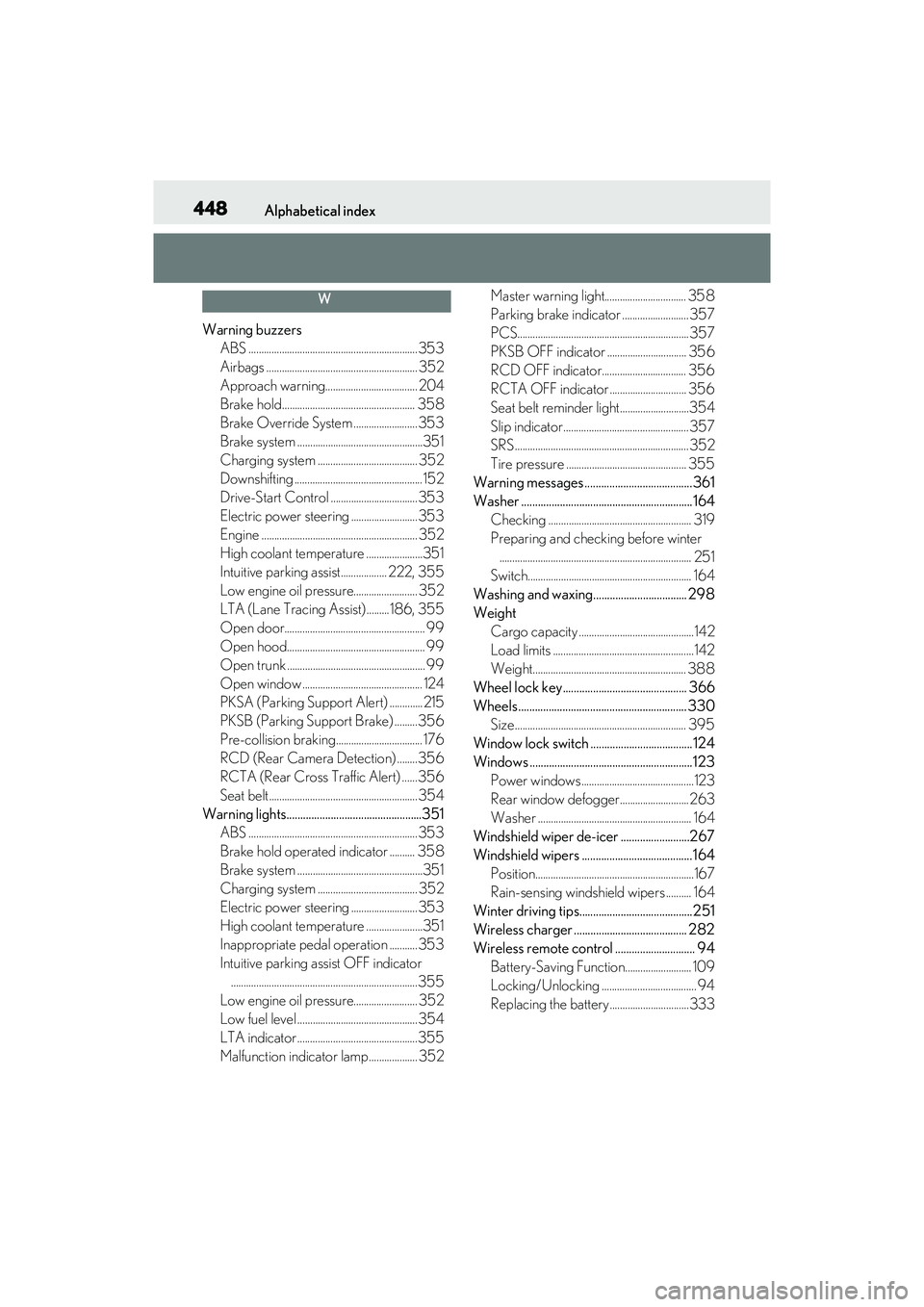
W
Warning buzzersABS ..................................................................353
Airbags ........................................................... 352
Approach warning.................................... 204
Brake hold.................................................... 358
Brake Override System .........................353
Brake system .................................................351
Charging system ....................................... 352
Downshifting ..................................................152
Drive-Start Control ..................................353
Electric power steering ..........................353
Engine ............................................................. 352
High coolant temperature ......................351
Intuitive parking assist.................. 222, 355
Low engine oil pressure......................... 352
LTA (Lane Tracing Assist).........186, 355
Open door....................................................... 99
Open hood...................................................... 99
Open trunk ...................................................... 99
Open window ............................................... 124
PKSA (Parking Support Alert) .............215
PKSB (Parking Support Brake) .........356
Pre-collision braking.................................. 176
RCD (Rear Camera Detection) ........356
RCTA (Rear Cross Traffic Alert) ......356
Seat belt ..........................................................354
Warning lights.................................................351 ABS ..................................................................353
Brake hold operated indicator .......... 358
Brake system .................................................351
Charging system ....................................... 352
Electric power steering ..........................353
High coolant temperature ......................351
Inappropriate pedal operation ...........353
Intuitive parking assist OFF indicator.........................................................................355
Low engine oil pressure......................... 352
Low fuel level ...............................................354
LTA indicator...............................................355
Malfunction indicator lamp................... 352 Master warning light................................ 358
Parking brake indicator .......................... 357
PCS...................................................................357
PKSB OFF indicator ............................... 356
RCD OFF indicator................................. 356
RCTA OFF indicator .............................. 356
Seat belt reminder light...........................354
Slip indicator................................................. 357
SRS ....................................................................352
Tire pressure ............................................... 355
Warning messages .......................................361
Washer ..............................................................164 Checking ........................................................ 319
Preparing and checking before winter........................................................................... 251
Switch................................................................ 164
Washing and waxing.................................. 298
Weight Cargo capacity .............................................142
Load limits .......................................................142
Weight............................................................ 388
Wheel lock key............................................. 366
Wheels ............................................................. 330 Size................................................................... 395
Window lock switch .....................................124
Windows ...........................................................123 Power windows............................................123
Rear window defogger...........................263
Washer ............................................................ 164
Windshield wiper de-icer .........................267
Windshield wipers ........................................164 Position..............................................................167
Rain-sensing windshield wipers .......... 164
Winter driving tips.........................................251
Wireless charger ......................................... 282
Wireless remote control ............................. 94 Battery-Saving Function.......................... 109
Locking/Unlocking ..................................... 94
Replacing the battery...............................333