warning Lexus GS F 2019 Owner's Manuals
[x] Cancel search | Manufacturer: LEXUS, Model Year: 2019, Model line: GS F, Model: Lexus GS F 2019Pages: 600, PDF Size: 13.04 MB
Page 496 of 600
4967-2. Steps to take in an emergency
GS F_OM_OM30G90U_(U)
WARNING
■Driving to spread the liquid sealant evenly
●Drive the vehicle carefully at a low speed. Be especially careful when turning and cor-
nering.
●If the vehicle does not drive straight or you feel a pull through the steering wheel, stop
the vehicle and check the following:
• Tire condition. The tire may have separated from the wheel.
• Tire inflation pressure. If tire inflation pressure is 19 psi (130 kPa, 1.3 kgf/cm
2 or
bar) or less, the tire may be severely damaged.
NOTICE
■When performing an emergency repair
●Perform the emergency repair without removi ng the nail or screw that has punctured
the tread of the tire. If the object that has punctured the tire is removed, repair by the
emergency tire puncture repair kit may not be possible.
●The repair kit is not waterproof. Make sure that the repair kit is not exposed to water,
such as when it is be ing used in the rain.
●Do not put the repair kit directly onto dusty ground such as sand at the side of the
road. If the repair kit vacuums up dust etc., a malfunction may occur.
■Handling the emergency tire puncture repair kit
●The repair kit power source should be 12 V DC suitable for vehicle use. Do not con-
nect the repair kit to any other source.
●If gasoline splatters on the repair kit, the repair kit may deteriorate. Take care not to
allow gasoline to contact it.
●Store the emergency tire puncture repair kit in the trunk.
The kit may be thrown around during sudden braking and so forth, damaging the kit.
●Store the repair kit in the tr unk out of reach of children.
●Do not disassemble or modify the repair kit. Do not subject parts such as the air pres-
sure indicator to impacts. This may cause a malfunction.
■To avoid damage to the tire pressu re warning valves and transmitters
When a tire is repaired with liquid sealants, the tire pressure warning valve and trans-
mitter may not operate properly. If a liquid sealant is used, contact your Lexus dealer or
other qualified service shop as soon as possible. Make sure to replace the tire pressure
warning valve and transmitter when replacing the tire. ( P. 394)
Page 500 of 600
5007-2. Steps to take in an emergency
GS F_OM_OM30G90U_(U)
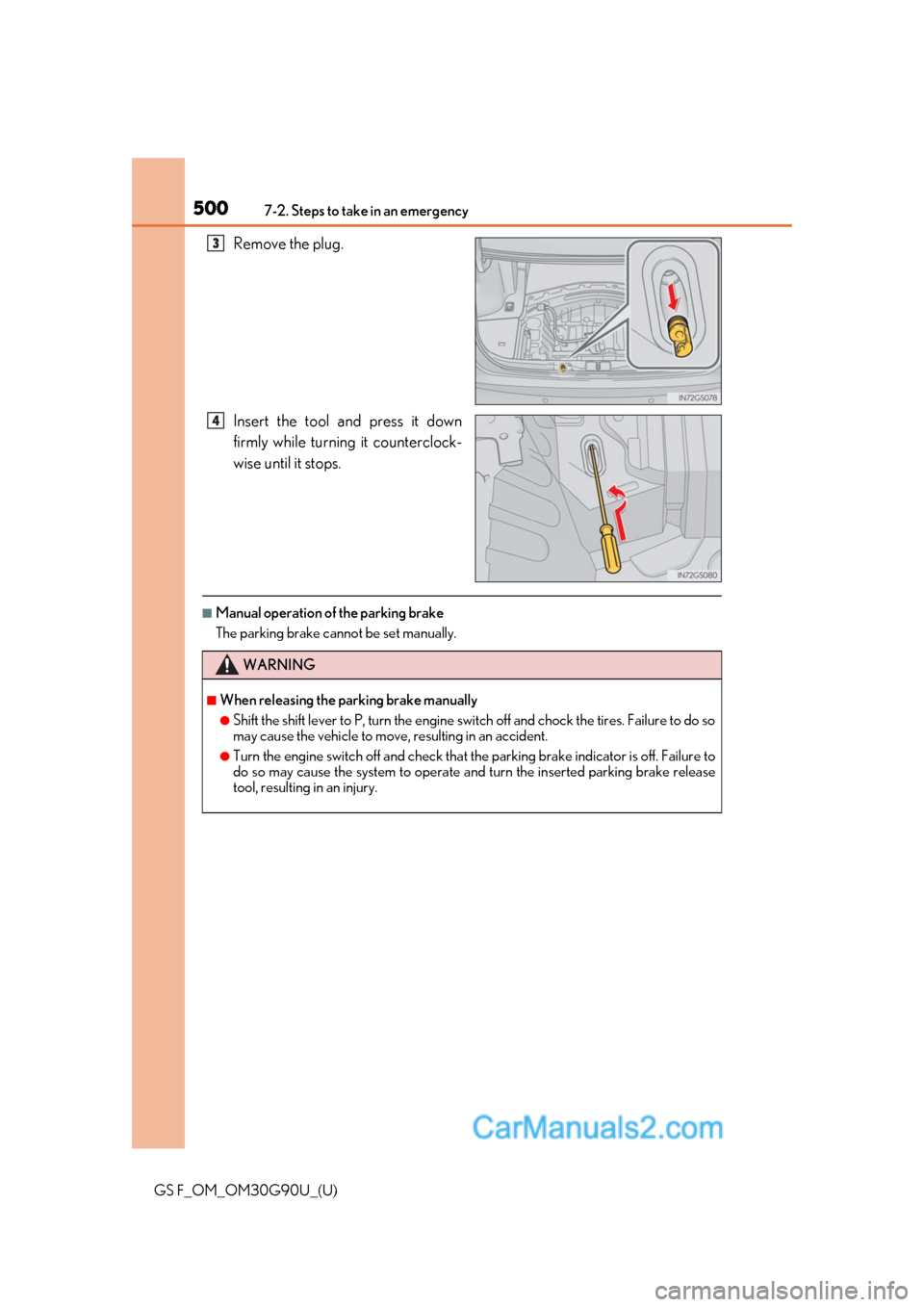
Remove the plug.
Insert the tool and press it down
firmly while turning it counterclock-
wise until it stops.
■Manual operation of the parking brake
The parking brake cannot be set manually.
3
4
WARNING
■When releasing the parking brake manually
●Shift the shift lever to P, turn the engine switch off and chock the tires. Failure to do so
may cause the vehicle to move, resulting in an accident.
●Turn the engine switch off and check that the parking brake indicato r is off. Failure to
do so may cause the system to operate and turn the inserted parking brake release
tool, resulting in an injury.
Page 503 of 600
5037-2. Steps to take in an emergency
GS F_OM_OM30G90U_(U)
7
When trouble arises
■Stopping the engine
Shift the shift lever to P and press the engine switch as you normally do when stopping
the engine.
■Replacing the key battery
As the above procedure is a temporary measure, it is recommended that the electronic
key battery be replaced immediately when the battery is depleted. ( P. 410)
■Alarm
If the trunk is opened using the mechanical key when the alarm system is set, the alarm
may be triggered. ( P. 74)
■Changing engine switch modes
Release the brake pedal and press the engine switch in step above.
The engine does not start and modes will be changed each time the switch is
pressed.( P. 198)
■When the electronic key does not work properly
●Make sure that the smart access system wi th push-button start has not been deacti-
vated in the customization setting. If it is off, turn the function on.
(Customizable features: P. 545)
●Check if battery-saving mode is set. If it is set, cancel the function. (P. 151)
WARNING
■When using the mechanical key and operating the power windows or moon roof
Operate the power window or moon roof afte r checking to make sure that there is no
possibility of any passenger having any of their body parts caught in the window or
moon roof.
Also, do not allow children to op erate the mechanical key. It is possible for children and
other passengers to get caught in the power window or moon roof.
3
Page 508 of 600
5087-2. Steps to take in an emergency
GS F_OM_OM30G90U_(U)
WARNING
■Avoiding battery fires or explosions
Observe the following precautions to prevent accidentally igniting the flammable gas
that may be emitted from the battery:
●Make sure each jumper cable is connected to the correct terminal and that it is not
unintentionally in contact with any other than the intended terminal.
●Do not allow the other end of the jumper cab le connected to the “+” terminal to come
into contact with any other parts or metal surfaces in the area, such as brackets or
unpainted metal.
●Do not allow the + and - clamps of the jump er cables to come into contact with each
other.
●Do not smoke, use matches, cigarette lighters or allow open flame near the battery.
■Battery precautions
The battery contains poisonous and corrosive acidic electrolyte, while related parts
contain lead and lead compounds. Observ e the following precautions when handling
the battery:
●When working with the battery, always wear safety glasses and take care not to allow
any battery fluids (acid) to come into cont act with skin, clothing or the vehicle body.
●Do not lean over the battery.
●In the event that battery fluid comes into contact with the skin or eyes, immediately
wash the affected area with water and seek medical attention.
Place a wet sponge or cloth over the affected area until medical attention can be
received.
●Always wash your hands afte r handling the battery support, terminals, and other bat-
tery-related parts.
●Do not allow childre n near the battery.
NOTICE
■When handling jumper cables
When connecting the jumper cables, ensure that they do not become entangled in the
cooling fans or engine drive belt.
Page 513 of 600
5137-2. Steps to take in an emergency
GS F_OM_OM30G90U_(U)
7
When trouble arises
WARNING
■When inspecting under the hood of your vehicle
Observe the following precautions.
Failure to do so may result in serious injury such as burns.
●If steam is seen coming from under the h ood, do not open the hood until the steam
has subsided. The engine compartment may be very hot.
●Keep hands and clothing (especially a tie, a scarf or a muffler) away from the fans and
belts. Failure to do so may cause the hands or clothing to be caught, resulting in seri-
ous injury.
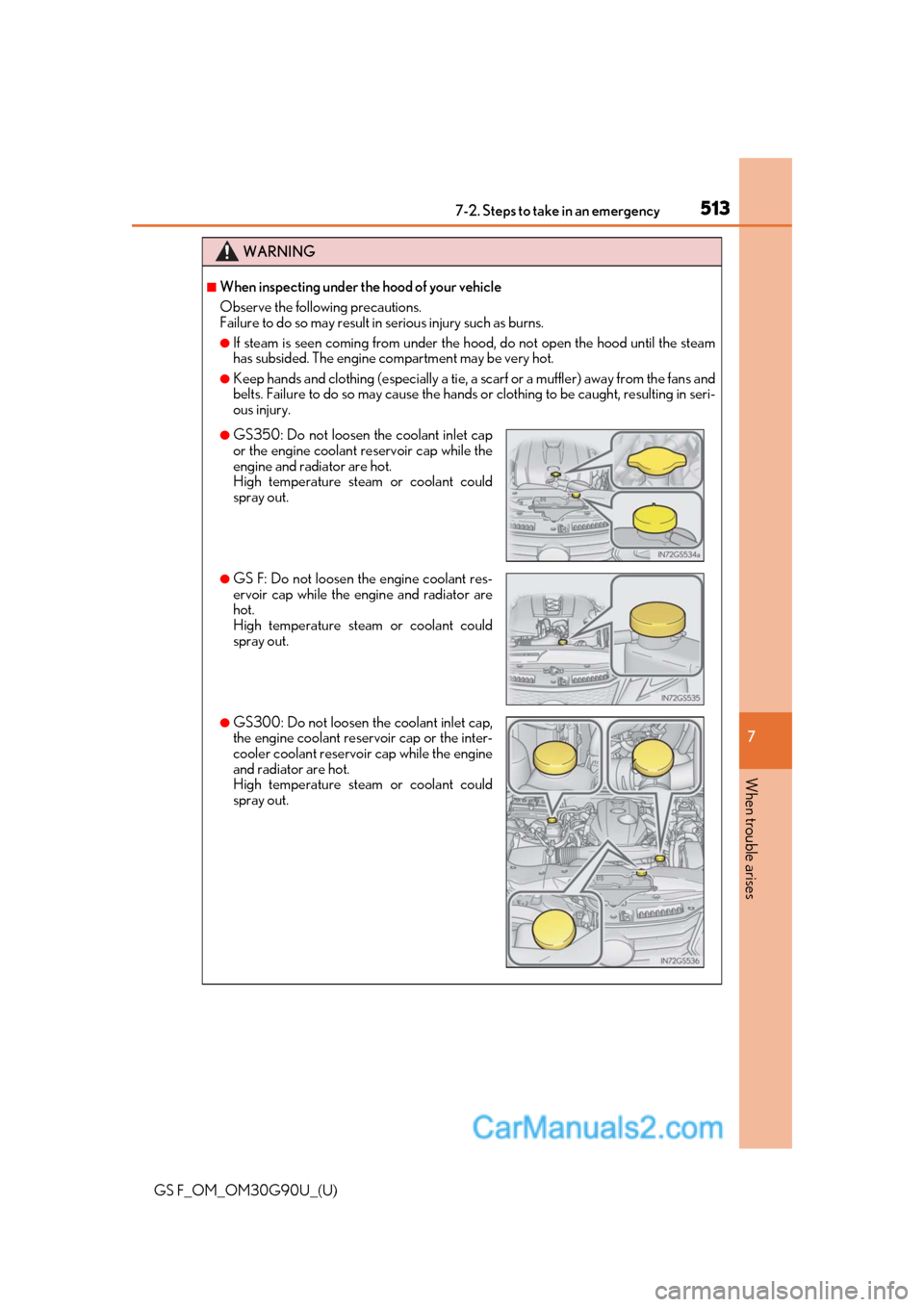
●GS350: Do not loosen the coolant inlet cap
or the engine coolant reservoir cap while the
engine and radiator are hot.
High temperature steam or coolant could
spray out.
●GS F: Do not loosen the engine coolant res-
ervoir cap while the engine and radiator are
hot.
High temperature steam or coolant could
spray out.
●GS300: Do not loosen the coolant inlet cap,
the engine coolant rese rvoir cap or the inter-
cooler coolant reservoir cap while the engine
and radiator are hot.
High temperature steam or coolant could
spray out.
Page 516 of 600
5167-2. Steps to take in an emergency
GS F_OM_OM30G90U_(U)
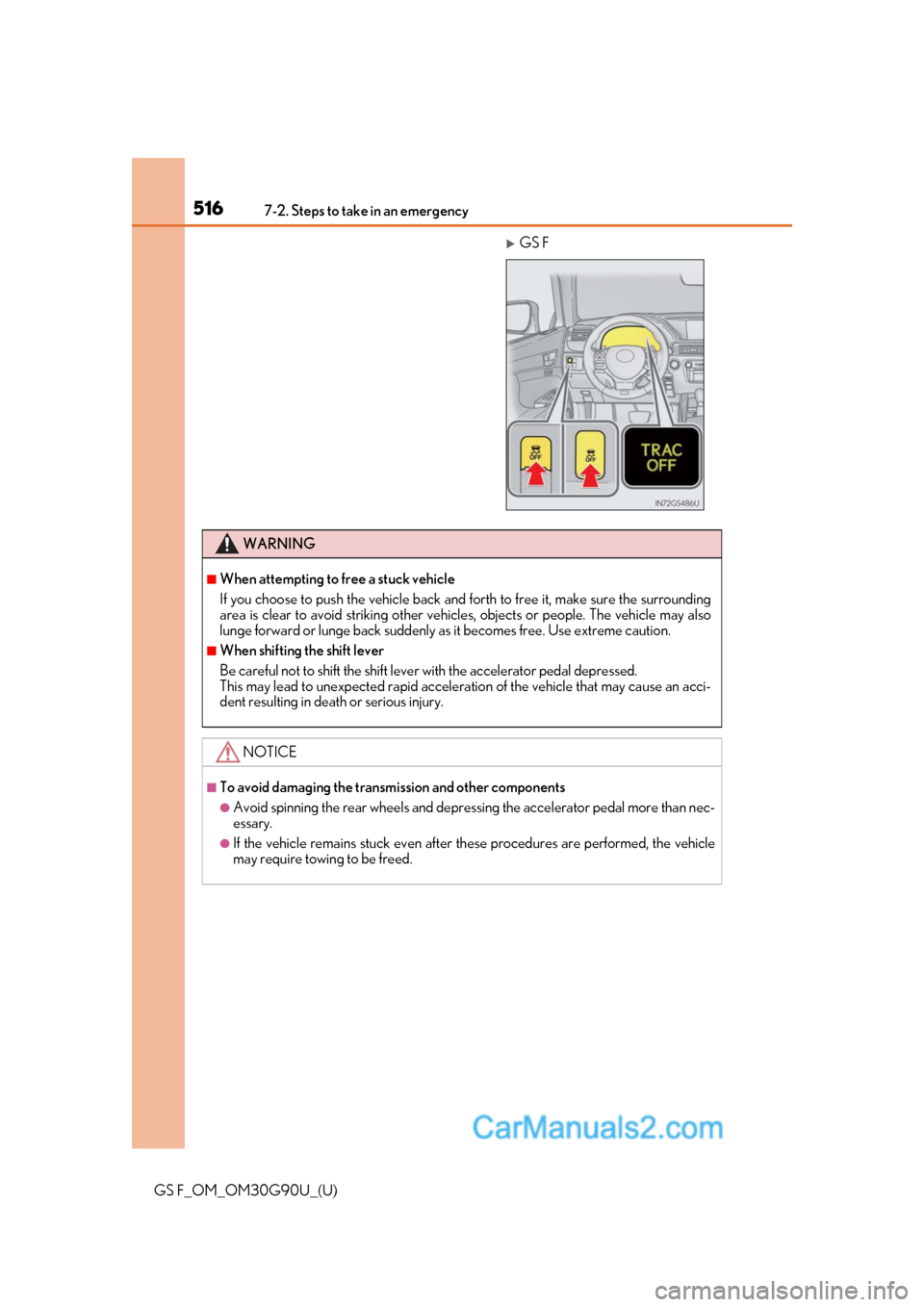
GS F
WARNING
■When attempting to free a stuck vehicle
If you choose to push the vehicle back and forth to free it, make sure the surrounding
area is clear to avoid striking other vehicles, objects or people. The vehicle may also
lunge forward or lunge back suddenly as it becomes free. Use extreme caution.
■When shifting the shift lever
Be careful not to shift the shift lever with the accelerator pedal depressed.
This may lead to unexpected rapid acceleration of the vehicle that may cause an acci-
dent resulting in deat h or serious injury.
NOTICE
■To avoid damaging the transmission and other components
●Avoid spinning the rear wheels and depressing the accelerator pedal more than nec-
essary.
●If the vehicle remains stuck even after th ese procedures are performed, the vehicle
may require towing to be freed.
Page 539 of 600
GS F_OM_OM30G90U_(U)
5398-1. Specifications
8
Vehicle specifications
This information has been prepared in accordance with regulations issued by the
National Highway Traffic Safety Administra tion of the U.S. Department of Trans-
portation.
It provides the purchasers and/or prospe ctive purchasers of Lexus vehicles with
information on uniform tire quality grading.
Your Lexus dealer will help answer any ques tions you may have as you read this infor-
mation.
■DOT quality grades
All passenger vehicle tires must conform to Federal Safety Requirements in
addition to these grades. Quality grades can be found where applicable on
the tire sidewall between tread shoulder and maximum section width.
For example: Treadwear 200 Traction AA Temperature A
■Treadwear
The treadwear grade is a comparative rati ng based on the wear rate of the tire
when tested under controlled conditio ns on a specified government test
course.
For example, a tire graded 150 would wear one and a half (1 - 1/2) times as well on
the government course as a tire graded 100.
The relative performance of tires depends upon the actua l conditions of their use.
Performance may differ significantly from the norm due to variations in driving
habits, service practices and difference s in road characteristics and climate.
■Traction AA, A, B, C
The traction grades, from highest to lowest, are AA, A, B and C, and they rep-
resent the tire’s ability to stop on wet pavement as measured under controlled
conditions on specified government test surfaces of asphalt and concrete.
A tire marked C may have poor traction performance.
Warning: The traction grade assigned to this tire is based on braking (straight
ahead) traction tests and does not include cornering (turning) traction.
Uniform Tire Quality Grading
Page 540 of 600
540
GS F_OM_OM30G90U_(U)8-1. Specifications
■Temperature A, B, C
The temperature grades are A (the highes
t), B, and C, representing the tire’s
resistance to the generation of heat and its ability to dissipate heat when
tested under controlled conditions on a specified indoor laboratory test
wheel.
Sustained high temperature can cause the ma terial of the tire to degenerate and
reduce tire life, and excessive temperature can lead to sudden tire failure.
Grade C corresponds to a level of perfor mance which all passenger car tires must
meet under the Federal Motor Vehicle Safety Standard No. 109.
Grades B and A represent higher levels of performance on the laboratory test
wheel than the minimum required by law.
Warning: The temperature grades of a tire assume that it is properly inflated and
not overloaded.
Excessive speed, underi nflation, or excessive loading, either separately or in com-
bination, can cause heat buildup and possible tire failure.
Glossary of tire terminology
Tire related termMeaning
Cold tire inflation pressure
Tire pressure when the vehicle has been parked for
three hours or more, or has not been driven more than 1
mile or 1.5 km un der that condition
Maximum inflation pres-
sureThe maximum cold inflated pr essure to which a tire may
be inflated, shown on the sidewall of the tire
Recommended inflation
pressureCold tire inflation pressure recommended by a manu-
facturer
Accessory weight
The combined weight (in exce ss of those standard items
which may be replaced) of automatic transmission,
power steering, power brakes, power windows, power
seats, radio and heater, to the extent that these items are
available as factory-installed equipment (whether
installed or not)
Curb weight
The weight of a motor vehicle with standard equipment,
including the maximum capacity of fuel, oil and coolant,
and if so equipped, air co nditioning and additional
weight optional engine
Maximum loaded vehicle
weight
The sum of:
(a) Curb weight
(b) Accessory weight
(c) Vehicle capacity weight
(d) Production options weight
Normal occupant weight150 lb. (68 kg) times the numb er of occupants specified
in the second column of Table 1
* that follows
Page 550 of 600
550
GS F_OM_OM30G90U_(U)8-2. Customization
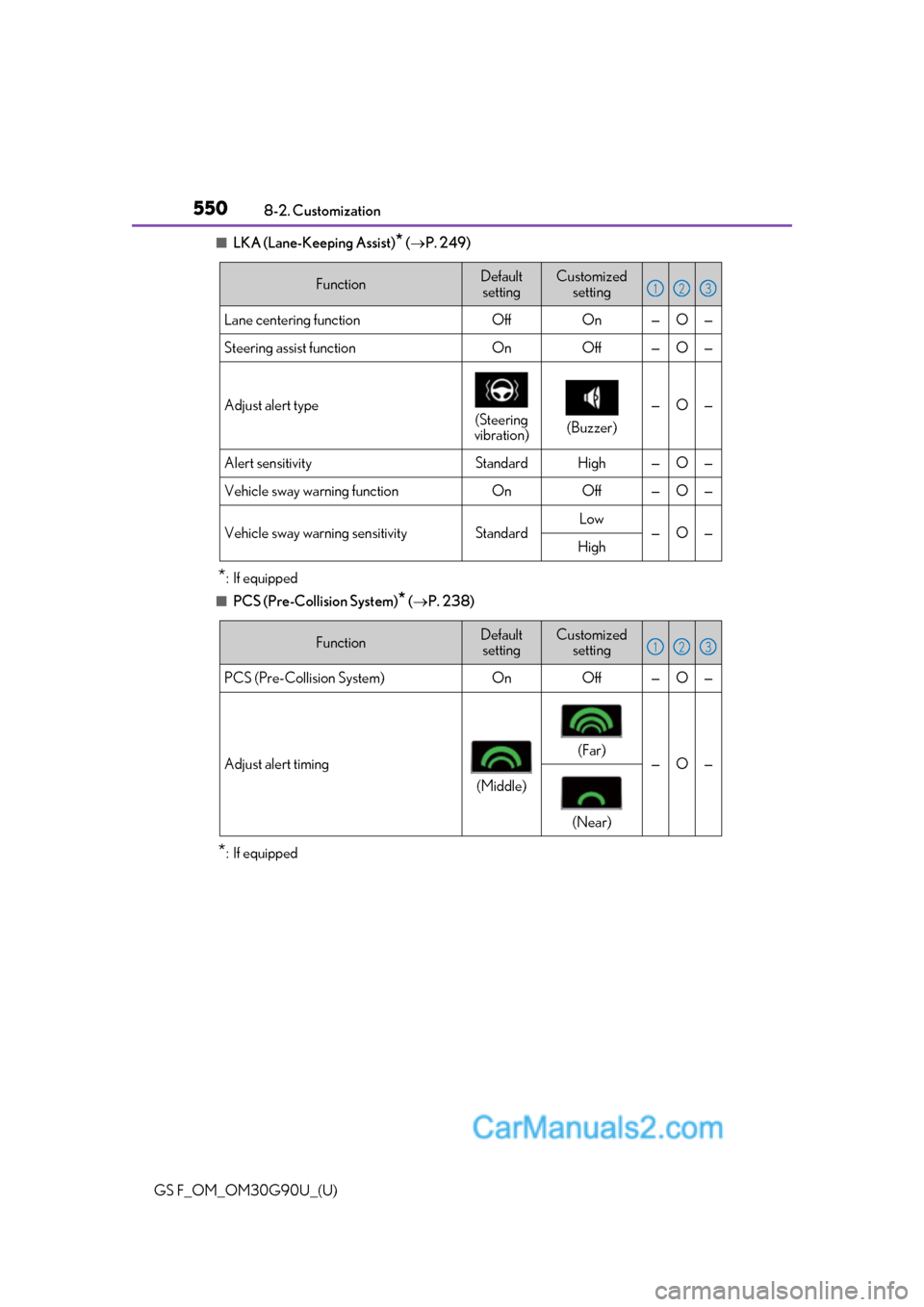
■LKA (Lane-Keeping Assist)* (
P. 249)
*: If equipped
■PCS (Pre-Collision System)* ( P. 238)
*: If equipped
FunctionDefault
settingCustomized setting
Lane centering functionOffOn—O—
Steering assist functionOnOff—O—
Adjust alert type(Steering
vibration)(Buzzer)
—O—
Alert sensitivityStandardHigh—O—
Vehicle sway warning functionOnOff—O—
Vehicle sway warning sensitivityStandardLow—O—High
123
FunctionDefault settingCustomized setting
PCS (Pre-Collision System)OnOff—O—
Adjust alert timing
(Middle)
(Far)—O—
(Near)
123
Page 559 of 600
GS F_OM_OM30G90U_(U)
5598-2. Customization
8
Vehicle specifications
WARNING
■During customization
As the engine needs to be running during customization, ensure that the vehicle is
parked in a place with adequate ventilation. In a closed area such as a garage, exhaust
gases including harmful carbon monoxide (CO) may collect and enter the vehicle. This
may lead to death or a serious health hazard.
NOTICE
■During customization
To prevent battery discharge, ensure that the engine is running while customizing fea-
tures.