towing Lexus GS250 2014 User Guide
[x] Cancel search | Manufacturer: LEXUS, Model Year: 2014, Model line: GS250, Model: Lexus GS250 2014Pages: 688, PDF Size: 152.64 MB
Page 229 of 688
2294-1. Before driving
4
Driving
GS350_250_OM_OM30E16E_(EE)
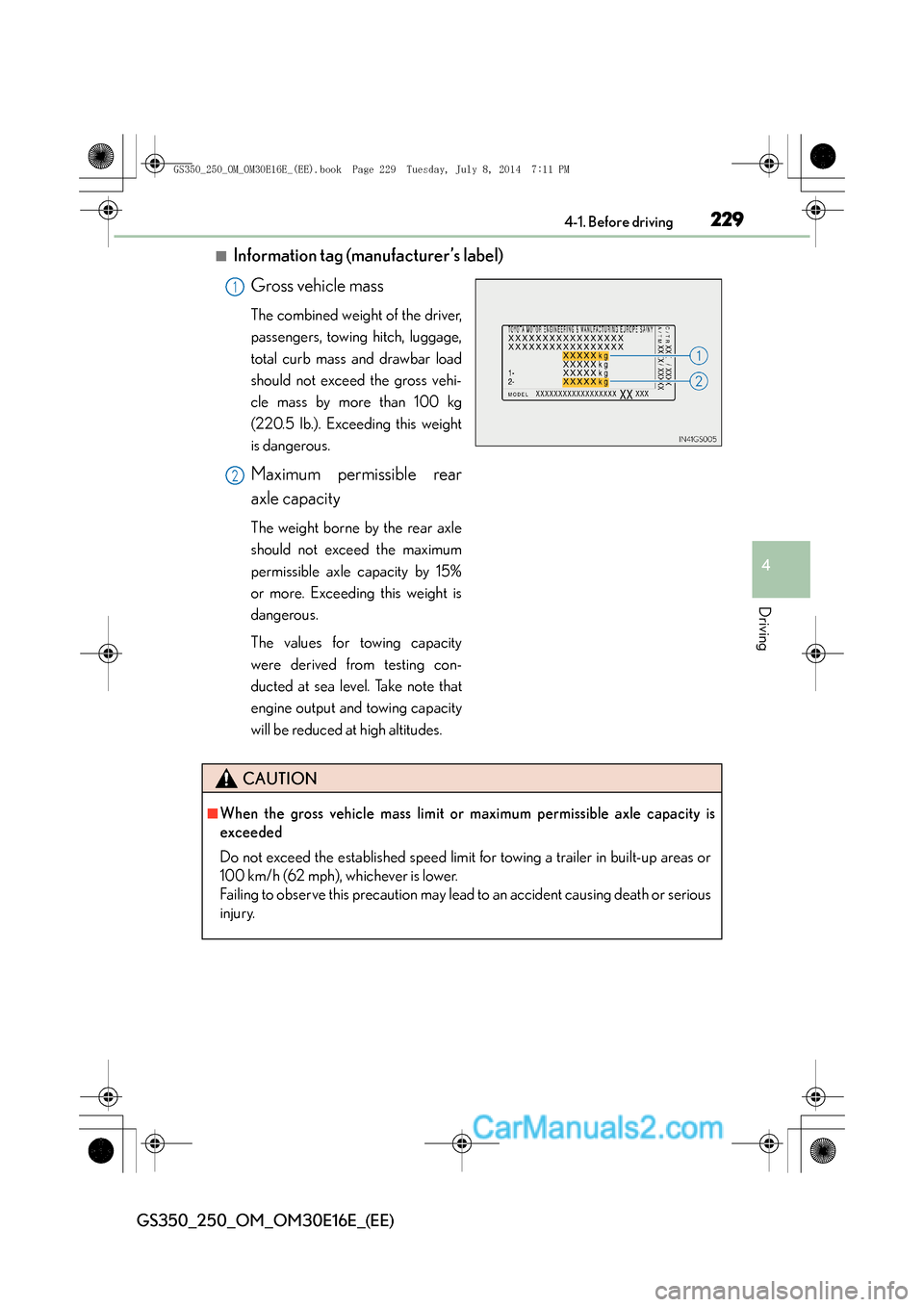
■Information tag (manufacturer’s label)Gross vehicle mass
The combined weight of the driver,
passengers, towing hitch, luggage,
total curb mass and drawbar load
should not exceed the gross vehi-
cle mass by more than 100 kg
(220.5 lb.). Exceeding this weight
is dangerous.
Maximum permissible rear
axle capacity
The weight borne by the rear axle
should not exceed the maximum
permissible axle capacity by 15%
or more. Exceeding this weight is
dangerous.
The values for towing capacity
were derived from testing con-
ducted at sea level. Take note that
engine output and towing capacity
will be reduced at high altitudes.
1
2
CAUTION
■When the gross vehicle mass limit or maximum permissible axle capacity is
exceeded
Do not exceed the established speed limit for towing a trailer in built-up areas or
100 km/h (62 mph), whichever is lower.
Failing to observe this precaution may lead to an accident causing death or serious
injury.
GS350_250_OM_OM30E16E_(EE).book Page 229 Tuesday, July 8, 201 4 7:11 PM
Page 230 of 688
2304-1. Before driving
GS350_250_OM_OM30E16E_(EE)
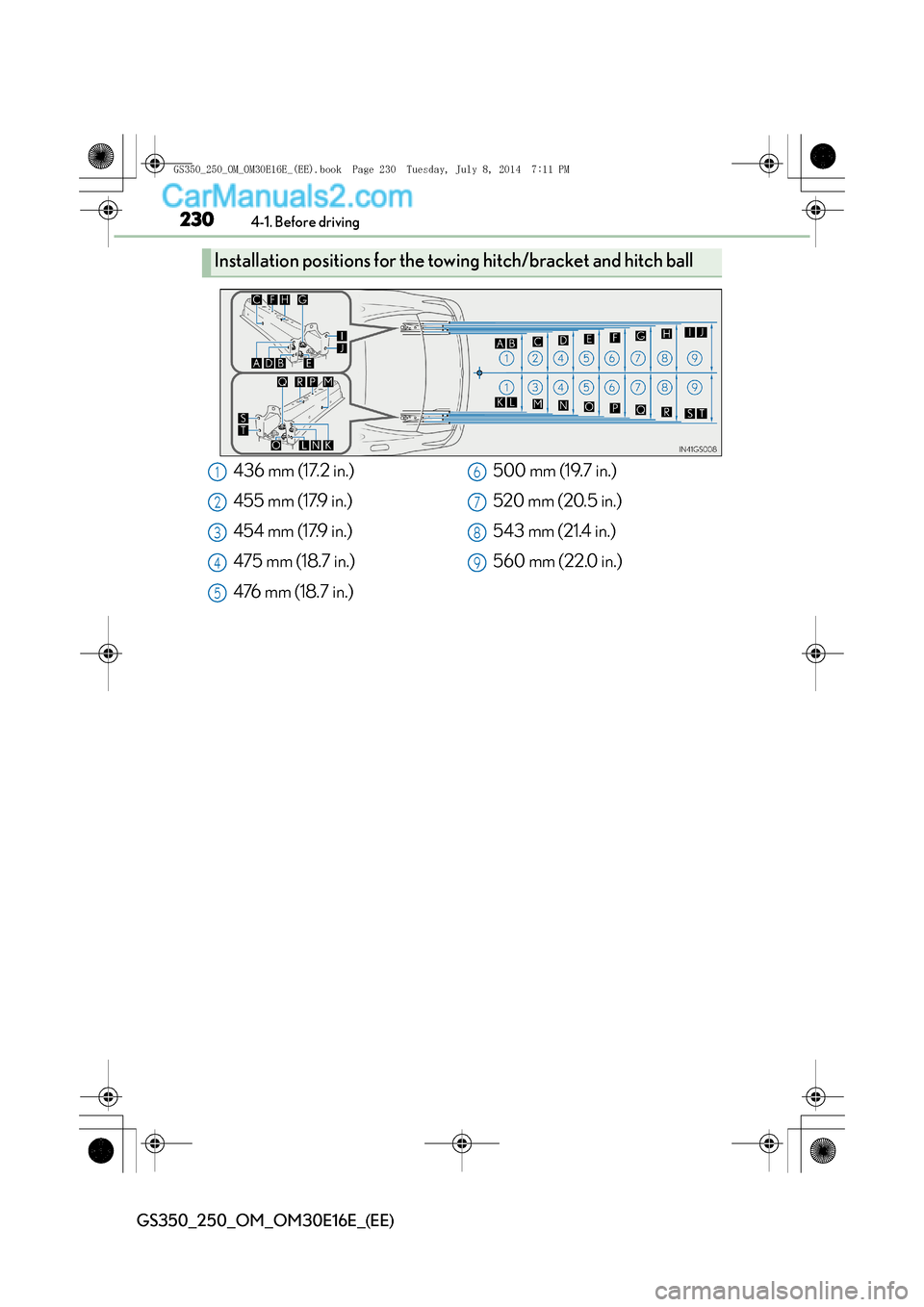
Installation positions for the towing hitch/bracket and hitch ball
436 mm (17.2 in.)
455 mm (17.9 in.)
454 mm (17.9 in.)
475 mm (18.7 in.)
476 mm (18.7 in.)500 mm (19.7 in.)
520 mm (20.5 in.)
543 mm (21.4 in.)
560 mm (22.0 in.)1
2
3
4
5
6
7
8
9
GS350_250_OM_OM30E16E_(EE).book Page 230 Tuesday, July 8, 201
4 7:11 PM
Page 232 of 688
2324-1. Before driving
GS350_250_OM_OM30E16E_(EE)
■Tire information
●Increase the tire inflation pressure to 20.0 kPa (0.2 kgf/cm2 or bar, 3 psi) greater
than the recommended value when towing. ( →P. 6 4 5 )
●Increase the air pressure of the trailer tires in accordance with the total trailer
weight and according to the values recommended by the manufacturer of your
trailer.
■Trailer lights
●Please consult at any authorized dealer or repairer, or another duly qualified and
equipped professional when installing trailer lights, as incorrect installation may
cause damage to the vehicle’s lights. Please take care to comply with your state’s
laws when installing trailer lights.
●Check that the turn signal lights and stoplights are operating correctly every time
you hitch up the trailer. Directly wiring up to your vehicle may damage the electrical
system and stop the lights from functioning correctly.
■Break-in schedule
Lexus recommends that vehicles fitted with new power train components should not
be used for towing trailers for the first 800 km (500 miles).
■Safety checks before towing
●Check that the maximum load limit for the towing hitch/bracket and hitch ball is not
exceeded. Bear in mind that the coupling weight of the trailer will add to the load
exerted on the vehicle. Also make sure that the total load exerted on the vehicle is
within the range of the weight limits. ( →P. 2 2 8 )
●Ensure that the trailer load is secure.
●Supplementary outside rear view mirrors should be added to the vehicle if the traf-
fic behind cannot be clearly seen with standard mirrors. Adjust the extending arms
of these mirrors on both sides of the vehicle so that they always provide maximum
visibility of the road behind.
■Maintenance
●Maintenance must be performed more frequently when using the vehicle for tow-
ing due to the greater weight burden placed on the vehicle compared to normal
driving.
●Retighten all bolts securing the hitching ball and bracket after towing for approxi-
mately 1000 km (600 miles).
GS350_250_OM_OM30E16E_(EE).book Page 232 Tuesday, July 8, 201 4 7:11 PM
Page 233 of 688
2334-1. Before driving
4
Driving
GS350_250_OM_OM30E16E_(EE)
Your vehicle will handle differently when towing a trailer. In order to avoid
accident, death or serious injury, keep the following in mind when towing:
■Checking connections between trailer and lights
Stop the vehicle and check the operation of the connection between
the trailer and lights after driving for a brief period as well as before
starting off.
■Practicing driving with a coupled trailer
●Get the feel for turning, stopping and reversing with the trailer cou-
pled by practicing in an area with no or light traffic.
●When reversing with a coupled trailer, hold the section of the steer-
ing wheel nearest to you and rotate clockwise to turn the trailer left
or counterclockwise to turn it right. Always rotate a little at a time to
prevent steering error. Have someone guide you when reversing to
lessen the risk of an accident.
NOTICE
■When the rear bumper strengthening material is aluminum
Ensure the steel bracket part does not come directly in contact with that area.
When steel and aluminum come into contact, there is a reaction similar to corro-
sion, which will weaken the section concerned and may result in damage. Apply a
rust inhibitor to parts that will come in contact when attaching a steel bracket.
Guidance
GS350_250_OM_OM30E16E_(EE).book Page 233 Tuesday, July 8, 201 4 7:11 PM
Page 234 of 688
2344-1. Before driving
GS350_250_OM_OM30E16E_(EE)
■Increasing vehicle-to-vehicle distance
At a speed of 10 km/h (6 mph), the distance to the vehicle running
ahead of you should be equivalent to or greater than the combined
length of your vehicle and trailer. Avoid sudden braking that may cause
skidding. Otherwise, the vehicle may spin out of control. This is espe-
cially true when driving on wet or slippery road surfaces.
■Sudden acceleration/steering input/cornering
Executing sharp turns when towing may result in the trailer colliding
with your vehicle. Decelerate well in advance when approaching turns
and take them slowly and carefully to avoid sudden braking.
■Important points regarding turning
The wheels of the trailer will travel closer to the inside of the curve than
the wheels of the vehicle. To make allowance for this, take the turns
wider than you would normally do.
■Important points regarding stability
Vehicle movement resulting from uneven road surfaces and strong
crosswinds will affect handling. The vehicle may also be rocked by pass-
ing buses or large trucks. Frequent ly check behind when moving along-
side such vehicles. As soon as such vehicle movement occurs,
immediately start to decelerate smoot hly by slowly applying the brakes.
Always steer the vehicle straight ahead while braking.
■Passing other vehicles
Consider the total combined length of your vehicle and trailer and
ensure that the vehicle-to-vehicle distance is sufficient before execut-
ing lane changes.
■Transmission information
To maintain engine braking efficiency, when using engine braking,
when driving on a long steep downgrade, do not use the transmission in
D. If in the M mode, the transmission shift range position must be in 4 or
lower. ( →P. 2 4 8 )
GS350_250_OM_OM30E16E_(EE).book Page 234 Tuesday, July 8, 201 4 7:11 PM
Page 235 of 688
2354-1. Before driving
4
Driving
GS350_250_OM_OM30E16E_(EE)
■If the engine overheats
Towing a loaded trailer up a long, steep incline in temperatures exceed-
ing 30°C (85 °F) may result in the engine overheating. If the engine
coolant temperature gauge indicates that the engine is overheating,
turn the air conditioning off immediately, leave the road and stop the
vehicle in a safe place. ( →P. 625)
■When parking the vehicle
Always place wheel chocks under the wheels of both the vehicle and
trailer. Firmly set the parking brake and shift the shift lever to P.
CAUTION
Follow all the instructions described in this section. Failure to do so could cause an
accident resulting in death or serious injury.
■Trailer towing precautions
When towing, make sure that none of the weight limits are exceeded. ( →P. 2 2 8 )
■To avoid accident or injury
●Do not tow a trailer when the compact spare tire is installed on your vehicle.
●Do not tow a trailer when the tire installed is repaired with the emergency tire
puncture repair kit.
●Do not use cruise control (if equipped) or dynamic radar cruise control (if
equipped) when trailer towing.
■Vehicle speed in towing
Observe the legal maximum speeds for trailer towing.
■Before descending hills or long declines
Reduce speed and downshift. However, never downshift suddenly while descend-
ing steep or long downhill grades.
■Operation of the brake pedal
Do not hold the brake pedal depressed often or for long periods of time.
Doing so may result in the brake overheating or reduce braking effects.
GS350_250_OM_OM30E16E_(EE).book Page 235 Tuesday, July 8, 201 4 7:11 PM
Page 288 of 688
2884-5. Using the driving support systems
GS350_250_OM_OM30E16E_(EE)
CAUTION
■To avoid operating the cruise control by mistake
Switch the cruise control off using the “ON/OFF” button when not in use.
■Situations unsuitable for cruise control
Do not use cruise control in any of the following situations.
Doing so may result in loss of control and could cause an accident resulting in
death or serious injury.
●In heavy traffic
●On roads with sharp bends
●On winding roads
●On slippery roads, such as those covered with rain, ice or snow
●On steep hills
Vehicle speed may exceed the set speed when driving down a steep hill.
●When your vehicle is towing a trailer or during emergency towing
GS350_250_OM_OM30E16E_(EE).book Page 288 Tuesday, July 8, 2014 7:11 PM
Page 302 of 688
3024-5. Using the driving support systems
GS350_250_OM_OM30E16E_(EE)
CAUTION
■To avoid inadvertent cruise control activation
Switch the cruise control off using the “ON/OFF” button when not in use.
■Situations unsuitable for dynamic radar cruise control
Do not use dynamic radar cruise control in any of the following situations.
Doing so may result in inappropriate speed control and could cause an accident
resulting in death or serious injury.
●In heavy traffic
●On roads with sharp bends
●On winding roads
●On slippery roads, such as those covered with rain, ice or snow
●On steep downhills, or where there are sudden changes between sharp up and
down gradients
Vehicle speed may exceed the set speed when driving down a steep hill.
●At entrances to expressways
●When weather conditions are bad enough that they may prevent the sensors
from functioning correctly (fog, snow, sandstorm, heavy rain, etc.)
●When an approach warning buzzer is heard often
●When your vehicle is towing a trailer or during emergency towing
GS350_250_OM_OM30E16E_(EE).book Page 302 Tuesday, July 8, 201 4 7:11 PM
Page 313 of 688
3134-5. Using the driving support systems
4
Driving
GS350_250_OM_OM30E16E_(EE)
CAUTION
■Situations unsuitable for LKA
Do not use LKA in any of the following situations.
Otherwise, the system may not function correctly and could result in an accident.
●When driving with snow tires, tire chains, a spare tire, or similar equipment
●When the tires have been excessively worn, or when the tire inflation pressure is
low
●When there are objects or structures along the roadside that might be misinter-
preted as lane markers (such as guardrails, curb, reflector posts, etc.)
●When driving on snowy roads
●When pavement lane markers are difficult to see due to rain, snow, fog, sand, dirt,
etc.
●When there are visible lines on the pavement from road repairs, or if the remains
of old lane markers are still visible on the road
●When driving on slippery roads, such as those covered with rain, ice or snow
●When driving in a lane other than the driving or passing lanes on a freeway or
highway
●When driving on a road with lane closures due to maintenance, or when driving
in a temporary lane
●When towing a trailer
NOTICE
■To prevent damage to or incorrect operation of the LKA system
●Do not modify the headlights or attach stickers to the surface of the lights.
●Do not modify the suspension. If any suspension part needs to be replaced, con-
tact any authorized Lexus dealer or repairer, or another duly qualified and
equipped professional.
●Do not install or place anything on the hood or the grille. Also, do not install a
grille guard (bull bars, kangaroo bar etc.).
●Do not modify the sun visor. If any sun visor part needs to be replaced, contact
any authorized Lexus dealer or repairer, or another duly qualified and equipped
professional.
●If your windshield needs repairs, contact any authorized Lexus dealer or repairer,
or another duly qualified and equipped professional.
GS350_250_OM_OM30E16E_(EE).book Page 313 Tuesday, July 8, 201 4 7:11 PM
Page 350 of 688
3504-5. Using the driving support systems
GS350_250_OM_OM30E16E_(EE)
■Conditions under which the Blind Spot Monitor function may not function cor-
rectly
●The Blind Spot Monitor function may not detect vehicles correctly in the following
conditions:
• During bad weather such as heavy rain, fog, snow etc.
• When ice or mud etc. is attached to the rear bumper
• When driving on a road surface that is wet due to rain, standing water etc.
• When there is a significant difference in speed between your vehicle and thevehicle that enters the detection area
• When a vehicle is in the detection area from a stop and remains in the detection area as your vehicle accelerates
• When driving up or down consecutive steep inclines, such as hills, a dip in the road etc.
• When multiple vehicles approach with only a small gap between each vehicle
• When vehicle lanes are wide, and the vehicle in the next lane is too far away from your vehicle
• When the vehicle that enters the detection area is traveling at about the same speed as your vehicle
• When there is a significant difference in height between your vehicle and the vehicle that enters the detection area
• Directly after the BSM main switch is set to on
• When your vehicle is towing a trailer
●Instances of the Blind Spot Monitor function unnecessarily detecting a vehicle and/
or object may increase under the following conditions:
• When there is only a short distance between your vehicle and a guardrail, wall etc.
• When there is only a short distance between your vehicle and a following vehi- cle
• When vehicle lanes are narrow and a vehicle driving 2 lanes across from your vehicle enters the detection area
• When items such as a bicycle carrier are installed on the rear of the vehicle
GS350_250_OM_OM30E16E_(EE).book Page 350 Tuesday, July 8, 201 4 7:11 PM