fuel Lexus GS300h 2013 Owner's Guide
[x] Cancel search | Manufacturer: LEXUS, Model Year: 2013, Model line: GS300h, Model: Lexus GS300h 2013Pages: 1014
Page 405 of 1014
3944-5. Using the driving support system
GS450h_300h_OM_OM30D53E_(EE)
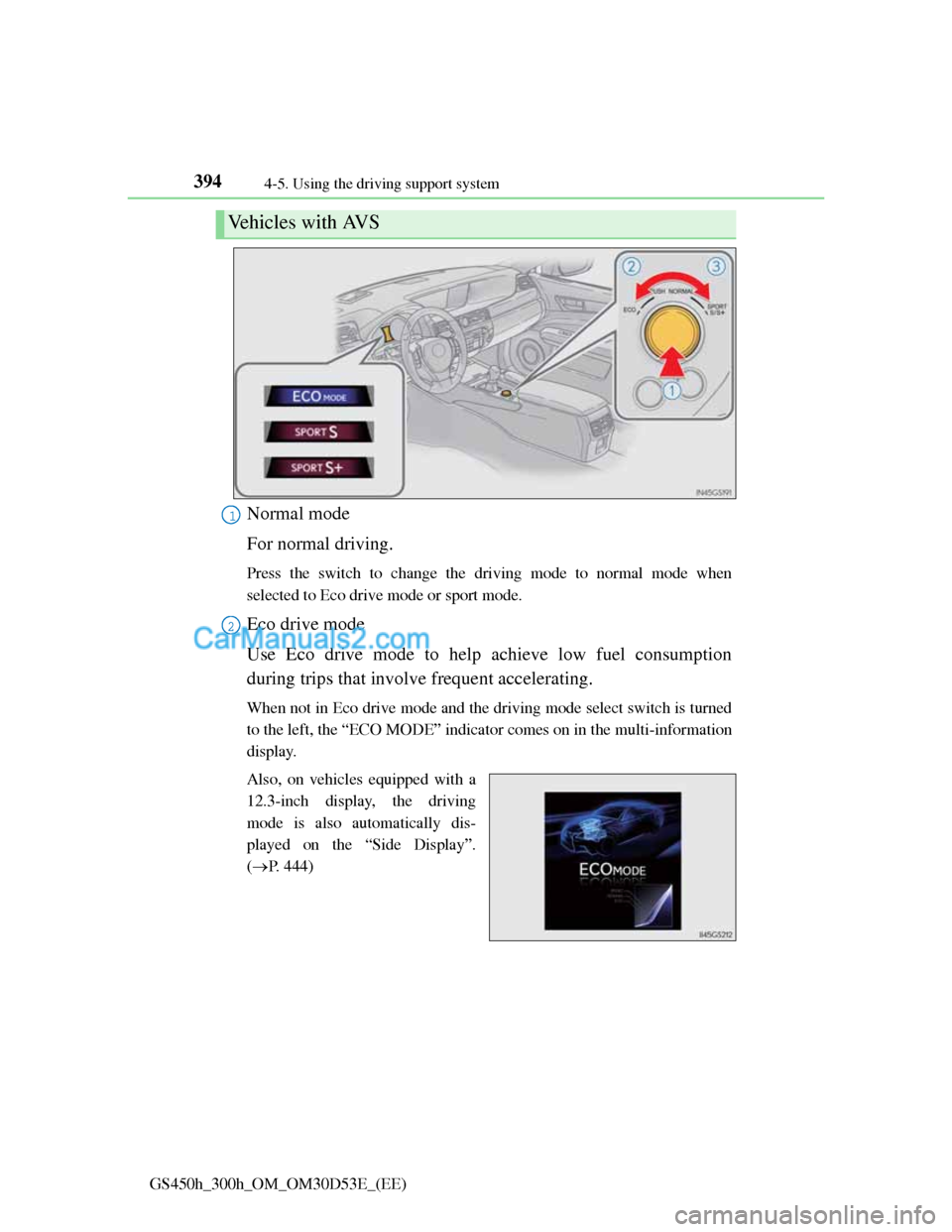
Normal mode
For normal driving.
Press the switch to change the driving mode to normal mode when
selected to Eco drive mode or sport mode.
Eco drive mode
Use Eco drive mode to help achieve low fuel consumption
during trips that involve frequent accelerating.
When not in Eco drive mode and the driving mode select switch is turned
to the left, the “ECO MODE” indicator comes on in the multi-information
display.
Also, on vehicles equipped with a
12.3-inch display, the driving
mode is also automatically dis-
played on the “Side Display”.
(P. 444)
Vehicles with AVS
1
2
Page 407 of 1014
3964-5. Using the driving support system
GS450h_300h_OM_OM30D53E_(EE)
Operation of the air conditioning system in Eco drive mode
Eco drive mode controls the heating/cooling operations and fan speed of the
air conditioning system to enhance fuel efficiency (P. 478). To improve air
conditioning performance, adjust the fan speed or turn off Eco drive mode.
Automatic operation of the seat heater during Eco drive mode
Eco drive mode controls the heating operation and fan speed of the air condi-
tioning system to enhance fuel efficiency. If the driving mode select switch is
switched to Eco drive mode in cold temperatures, the seat heater will be auto-
matically operated to assist heating performance.
Sport mode automatic deactivation
Sport mode is automatically deactivated if the power switch is turned off
after driving in sport mode.
Operation of the Eco drive mode (on some models)
The driving mode will set to Eco drive mode each time the power switch is
turned to ON mode.
Page 449 of 1014
4324-6. Driving tips
GS450h_300h_OM_OM30D53E_(EE)
Hybrid vehicle driving tips
Using Eco drive mode
When using Eco drive mode, the torque corresponding to the
accelerator pedal depression amount can be generated more
smoothly than it is in normal conditions. In addition, the opera-
tion of the air conditioning system (heating/cooling) will be min-
imized, improving the fuel economy. (P. 392)
Use of Hybrid System Indicator
The Eco-friendly driving is possible by keeping the indicate of
Hybrid System Indicator within Eco area. (P. 126)
When braking the vehicle
Make sure to operate the brakes gently and in good time. A
greater amount of electrical energy can be retained when slowing
down.
Delays
Repeated acceleration and deceleration, as well as long waits at
traffic lights, will lead to bad fuel consumption. Check traffic
reports before leaving and avoid delays as much as possible.
When encountering a delay, gently release the brake pedal to
allow the vehicle to move forward slightly while avoiding over-
use of the accelerator pedal. Doing so can help control excessive
gasoline consumption.
Highway driving
Control your speed and keep at a constant speed. Also, before
stopping at a toll booth or similar, allow plenty of time to release
For economical and ecological driving, pay attention to the follow-
ing points:
Page 450 of 1014
4334-6. Driving tips
4
Driving
GS450h_300h_OM_OM30D53E_(EE)
the accelerator and gently apply the brakes. A greater amount of
electrical energy can be retained when slowing down.
Air conditioning
Use the air conditioning only when necessary. Doing so can help
control excessive gasoline consumption.
In summer: In high temperatures, use the recirculated air mode.
Doing so will help to reduce the burden on the air conditioner
and reduce fuel consumption as well.
In winter: Because the gasoline engine will not automatically cut
out until the gasoline engine and the interior of the vehicle are
warm, it will consume fuel. Also, fuel consumption can be
improved by avoiding overuse of the heater.
Checking tire inflation pressure
Make sure to check the tire inflation pressure frequently.
Improper tire inflation pressure can cause poor fuel consumption.
Also, as snow tires can cause large amounts of friction, their use
on dry roads can lead to poor fuel consumption. Use a tire that is
appropriate for the season.
Luggage
Carrying heavy luggage can lead to poor fuel consumption.
Avoid carrying unnecessary luggage. Installing a large roof rack
can also cause poor fuel consumption.
Warming up before driving
Since the gasoline engine starts up and cuts out automatically
when cold, warming up the engine is unnecessary. Moreover, fre-
quently driving short distances will cause the engine to repeat-
edly warm up, which can lead to poor fuel consumption.
Page 510 of 1014
4925-2. Using the air conditioning system and defogger
GS450h_300h_OM_OM30D53E_(EE)
The windows may fog up if the recirculated air mode is used.
Outside/recirculated air mode
When driving on dusty roads such as tunnels or in heavy traffic, set the out-
side/recirculated air mode button to the recirculated air mode. This is effec-
tive in preventing outside air from entering the vehicle interior. During
cooling operation, setting the recirculated air mode will also cool the vehi-
cle interior effectively.
Outside/recirculated air mode may automatically switch depending on the
temperature setting or the inside temperature.
Automatic mode for air intake control
In automatic mode, the system detects exhaust gas and other pollutants and
automatically switches between outside air and recirculated air modes.
When the dehumidification function is off, and the fan is operating, turning
automatic mode on will activate the dehumidification function.
Pollen removal mode
In order to prevent the windshield from fogging up when the outside air is
cold, the following may occur:
• Outside air mode does not switch to (recirculated air) mode.
• The dehumidification function operates.
• The operation cancels after approximately 1 minute.
In rainy weather, the windows may fog up. Press .
In extremely humid weather, the windows may fog up.
The pollens are filtered out even if the pollen removal mode is turned off.
Operation of the air conditioning system in Eco drive mode
In the Eco drive mode, the air conditioning system is controlled as follows to
prioritize fuel efficiency:
Engine speed and compressor operation controlled to restrict heating/cool-
ing capacity
Fan speed restricted when automatic mode is selected
To improve air conditioning performance, perform the following opera-
tions:
Adjust the fan speed
Turn off Eco drive mode
When the S-FLOW mode operates
If air flows to the driver’s seat only, the temperature setting for the front pas-
senger’s seat is not displayed.
When the outside temperature falls to nearly 0C (32F)
Page 732 of 1014
7085-7. Other interior features
GS450h_300h_OM_OM30D53E_(EE)
The seat heaters/seat ventilators can be used when
The power switch is in ON mode.
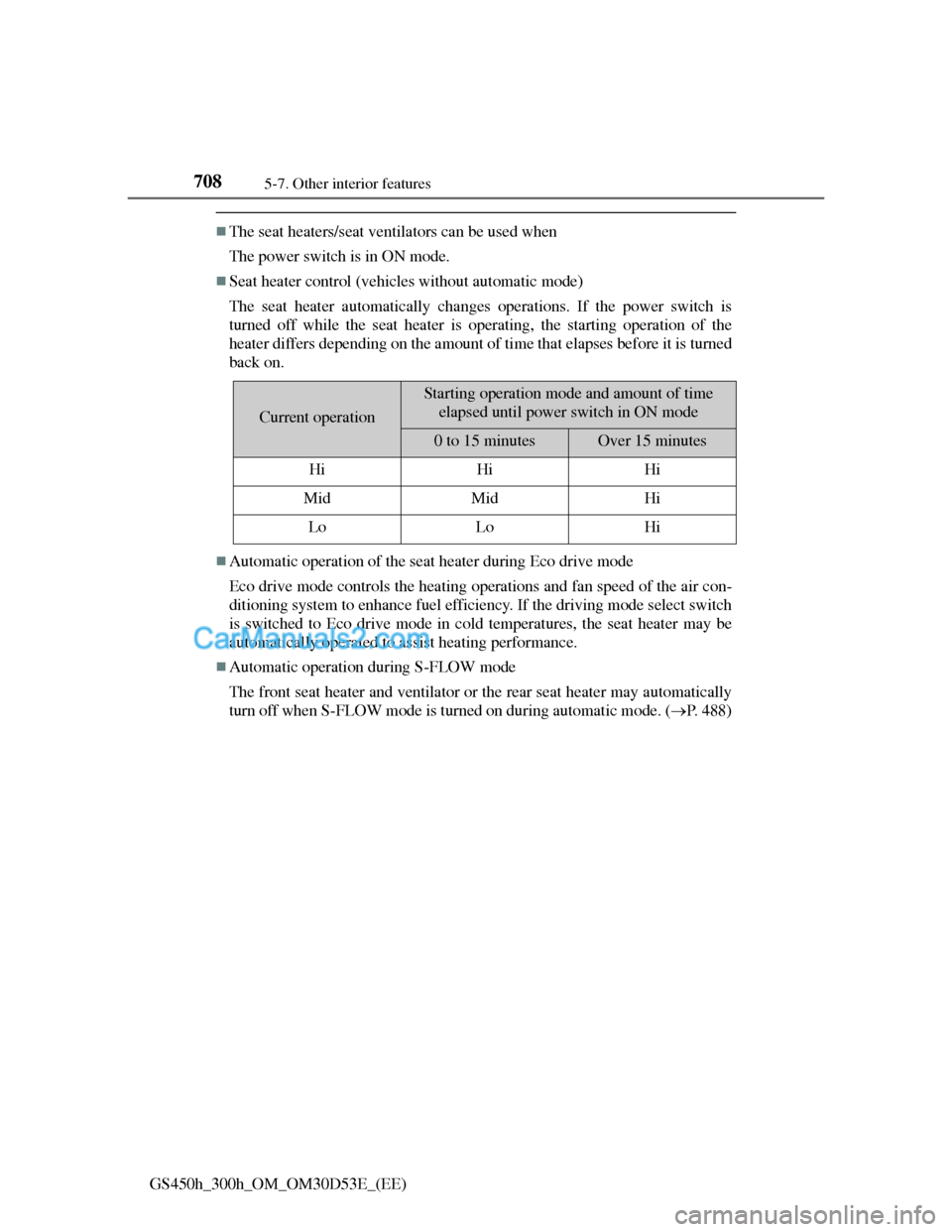
Seat heater control (vehicles without automatic mode)
The seat heater automatically changes operations. If the power switch is
turned off while the seat heater is operating, the starting operation of the
heater differs depending on the amount of time that elapses before it is turned
back on.
Automatic operation of the seat heater during Eco drive mode
Eco drive mode controls the heating operations and fan speed of the air con-
ditioning system to enhance fuel efficiency. If the driving mode select switch
is switched to Eco drive mode in cold temperatures, the seat heater may be
automatically operated to assist heating performance.
Automatic operation during S-FLOW mode
The front seat heater and ventilator or the rear seat heater may automatically
turn off when S-FLOW mode is turned on during automatic mode. (P. 488)
Current operation
Starting operation mode and amount of time
elapsed until power switch in ON mode
0 to 15 minutesOver 15 minutes
HiHiHi
MidMidHi
LoLoHi
Page 744 of 1014
7206-1. Maintenance and care
GS450h_300h_OM_OM30D53E_(EE)
Cleaning and protecting the vehicle exterior
Working from top to bottom, liberally apply water to the vehicle
body, wheel wells and underside of the vehicle to remove any
dirt and dust.
Wash the vehicle body using a sponge or soft cloth, such as a
chamois.
For hard-to-remove marks, use car wash soap and rinse thor-
oughly with water.
Wipe away any water.
Wax the vehicle when the waterproof coating deteriorates.
If water does not bead on a clean surface, apply wax when the vehicle
body is cool.
Automatic car washes
Fold the mirrors before washing the vehicle. Start washing from the front of
the vehicle. Make sure to extend the mirrors before driving.
Brushes used in automatic car washes may scratch the vehicle surface and
harm your vehicle’s paint.
Rear spoiler (if equipped) may not be washable in some automatic car
washes. There may also be an increased risk of damage to vehicle.
High pressure car washes
Do not allow the nozzles of the car wash to come within close proximity of
the windows.
Before using the car wash, check that the fuel filler door on your vehicle is
closed properly.
Perform the following to protect the vehicle and maintain it in
prime condition:
Page 756 of 1014
7326-3. Do-it-yourself maintenance
GS450h_300h_OM_OM30D53E_(EE)
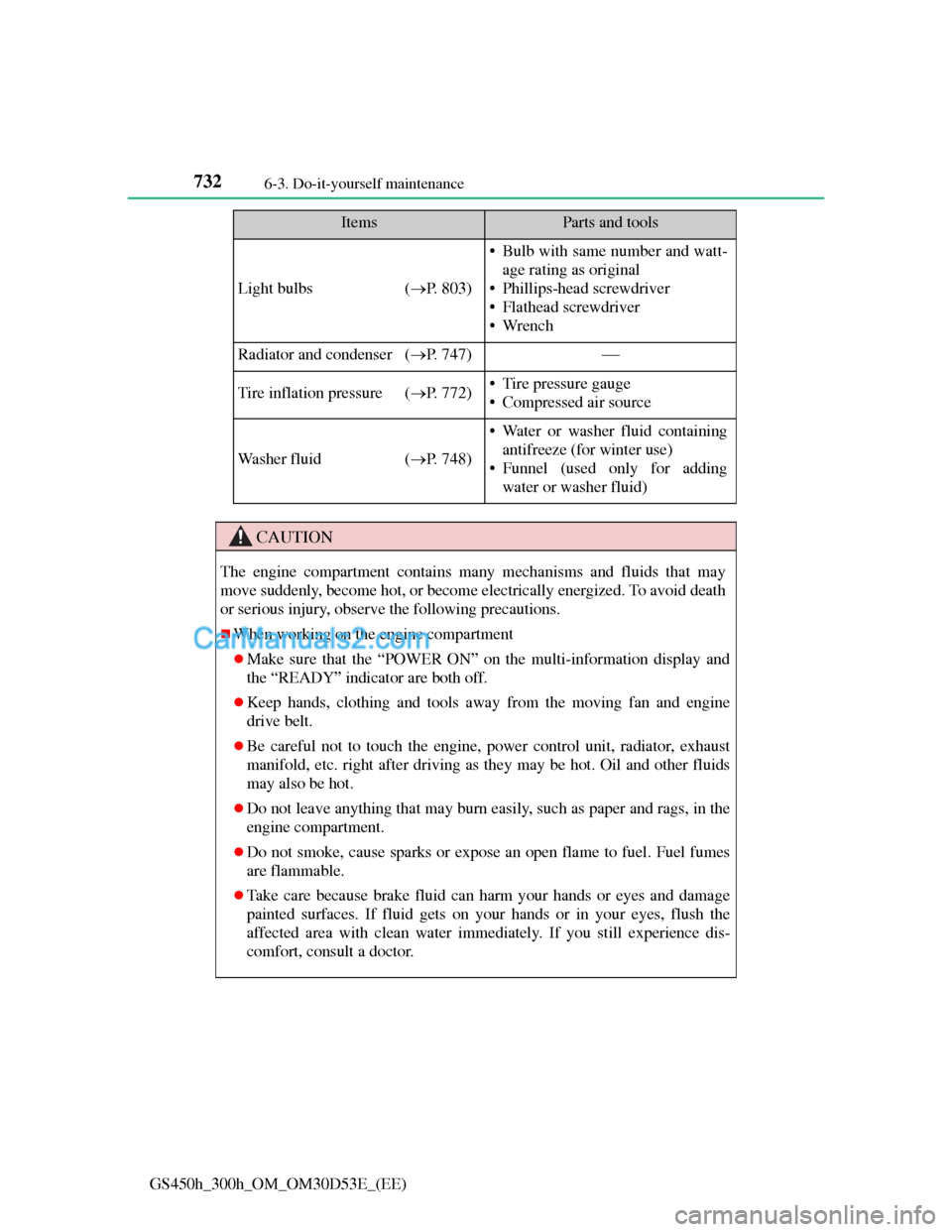
Light bulbs (P. 803)
• Bulb with same number and watt-
age rating as original
• Phillips-head screwdriver
• Flathead screwdriver
•Wrench
Radiator and condenser (P. 747)
Tire inflation pressure (P. 772)• Tire pressure gauge
• Compressed air source
Wa s h e r f l u i d (P. 748)
• Water or washer fluid containing
antifreeze (for winter use)
• Funnel (used only for adding
water or washer fluid)
CAUTION
The engine compartment contains many mechanisms and fluids that may
move suddenly, become hot, or become electrically energized. To avoid death
or serious injury, observe the following precautions.
When working on the engine compartment
Make sure that the “POWER ON” on the multi-information display and
the “READY” indicator are both off.
Keep hands, clothing and tools away from the moving fan and engine
drive belt.
Be careful not to touch the engine, power control unit, radiator, exhaust
manifold, etc. right after driving as they may be hot. Oil and other fluids
may also be hot.
Do not leave anything that may burn easily, such as paper and rags, in the
engine compartment.
Do not smoke, cause sparks or expose an open flame to fuel. Fuel fumes
are flammable.
Take care because brake fluid can harm your hands or eyes and damage
painted surfaces. If fluid gets on your hands or in your eyes, flush the
affected area with clean water immediately. If you still experience dis-
comfort, consult a doctor.
ItemsParts and tools
Page 796 of 1014
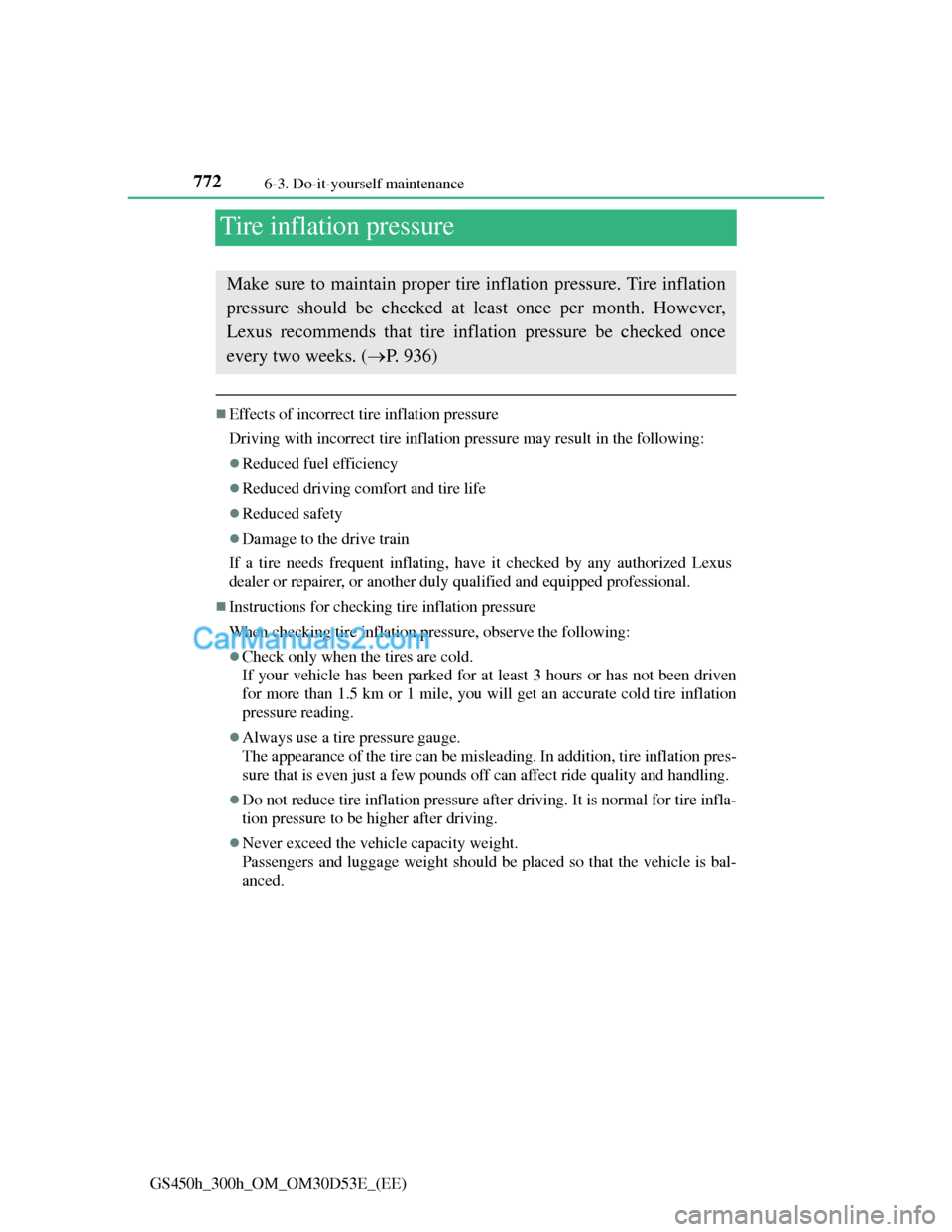
7726-3. Do-it-yourself maintenance
GS450h_300h_OM_OM30D53E_(EE)
Tire inflation pressure
Effects of incorrect tire inflation pressure
Driving with incorrect tire inflation pressure may result in the following:
Reduced fuel efficiency
Reduced driving comfort and tire life
Reduced safety
Damage to the drive train
If a tire needs frequent inflating, have it checked by any authorized Lexus
dealer or repairer, or another duly qualified and equipped professional.
Instructions for checking tire inflation pressure
When checking tire inflation pressure, observe the following:
Check only when the tires are cold.
If your vehicle has been parked for at least 3 hours or has not been driven
for more than 1.5 km or 1 mile, you will get an accurate cold tire inflation
pressure reading.
Always use a tire pressure gauge.
The appearance of the tire can be misleading. In addition, tire inflation pres-
sure that is even just a few pounds off can affect ride quality and handling.
Do not reduce tire inflation pressure after driving. It is normal for tire infla-
tion pressure to be higher after driving.
Never exceed the vehicle capacity weight.
Passengers and luggage weight should be placed so that the vehicle is bal-
anced.
Make sure to maintain proper tire inflation pressure. Tire inflation
pressure should be checked at least once per month. However,
Lexus recommends that tire inflation pressure be checked once
every two weeks. (P. 936)
Page 811 of 1014
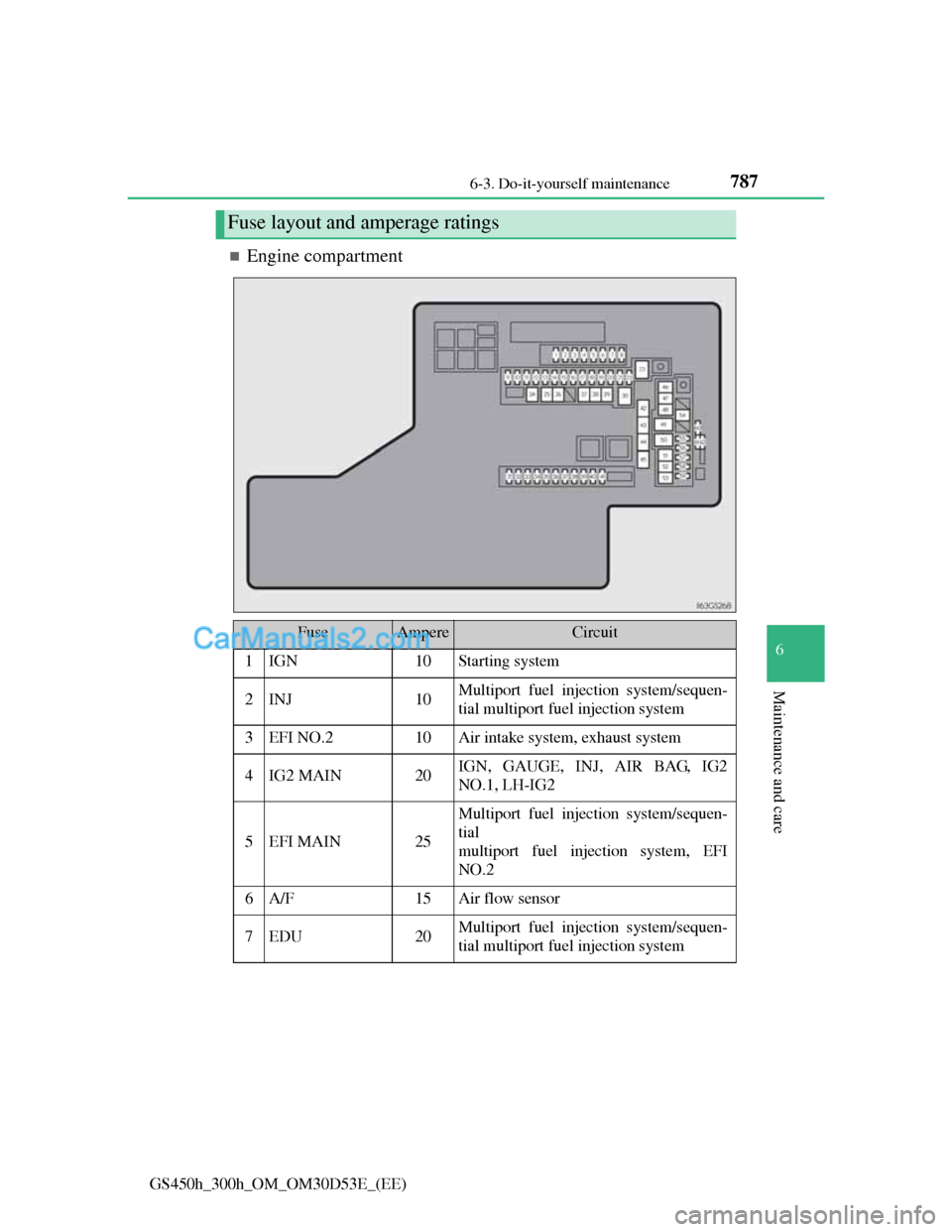
787 6-3. Do-it-yourself maintenance
6
Maintenance and care
GS450h_300h_OM_OM30D53E_(EE)
Engine compartment
Fuse layout and amperage ratings
FuseAmpereCircuit
1IGN10Starting system
2INJ10Multiport fuel injection system/sequen-
tial multiport fuel injection system
3EFI NO.210Air intake system, exhaust system
4IG2 MAIN20IGN, GAUGE, INJ, AIR BAG, IG2
NO.1, LH-IG2
5EFI MAIN25
Multiport fuel injection system/sequen-
tial
multiport fuel injection system, EFI
NO.2
6A/F15Air flow sensor
7EDU20Multiport fuel injection system/sequen-
tial multiport fuel injection system