Tire Lexus GS350 2008 Repair Manual
[x] Cancel search | Manufacturer: LEXUS, Model Year: 2008, Model line: GS350, Model: Lexus GS350 2008Pages: 598, PDF Size: 14.03 MB
Page 521 of 598
520
5-2. Steps to take in an emergency
GS_G_U
June 19, 2008 12:54 pm
CAUTION
■When using the compact spare tire
●Remember that your spare tire is specifically designed for use with your vehicle.
Do not use your spare tire on another vehicle.
●Do not use two spare tires simultaneously.
●Replace the spare tire with a standard tire as soon as possible.
●Avoid sudden acceleration, deceleration and braking, as well as sharp cornering.
■Speed limit when using the compact spare tire
Do not drive at speeds in excess of 50 mph (80 km/h) when a compact spare tire is
installed on the vehicle.
The compact spare tire is not designed for driving at high speeds. Failing to observe
this precaution may lead to an accident causing death or serious injury.
GS_U_G.book Page 520 Thursday, June 19, 2008 12:54 PM
Page 522 of 598
5
When trouble arises
521
5-2. Steps to take in an emergency
GS_G_U
June 19, 2008 12:54 pm
NOTICE
■Do not drive the vehicle with a flat tire
Do not continue driving with a flat tire.
Driving even a short distance with a flat tire can damage the tire and the wheel
beyond repair.
■Be careful when driving over bumps with the compact spare tire installed on the
vehicle
The vehicle becomes lower when driving with the compact spare tire compared to
when driving with standard tires. Be careful when driving over uneven road sur-
faces.
■Driving with tire chains and the compact spare tire
Do not fit tire chains to the compact spare tire.
Tire chains may damage the vehicle body and adversely affect driving performance.
■When replacing the tires
When removing or fitting the wheels, tires or the tire pressure warning valve and
transmitter, contact your Lexus dealer as the tire pressure warning valve and trans-
mitter may be damaged if not handled correctly.
■To avoid damaging the tire pressure warning valves and transmitters
Do not use liquid sealants on flat tires.
GS_U_G.book Page 521 Thursday, June 19, 2008 12:54 PM
Page 523 of 598
522
5-2. Steps to take in an emergency
GS_G_U
June 19, 2008 12:54 pm
If you have a flat tire (Vehicles with run-flat tires)
■In some condition (such as at high temperatures)
You can not continue driving for up to 100 miles (160 km).
■If you cannot distinguish between the standard tires and run-flat tires
Consult your Lexus dealer.
■For the detailed information on run-flat tires
See the tire warranty book.
NOTICE
■When replacing the tires
Have the tires replaced by the nearest Lexus dealer or authorized tire dealer. The
tire pressure warning valves and transmitters will be affected by the installation or
removal of tires.
■To avoid damaging the tire pressure warning valves and transmitters
Do not use liquid sealants on flat tires.
Take your vehicle to the nearest Lexus dealer or authorized tire dealer as
soon as possible.
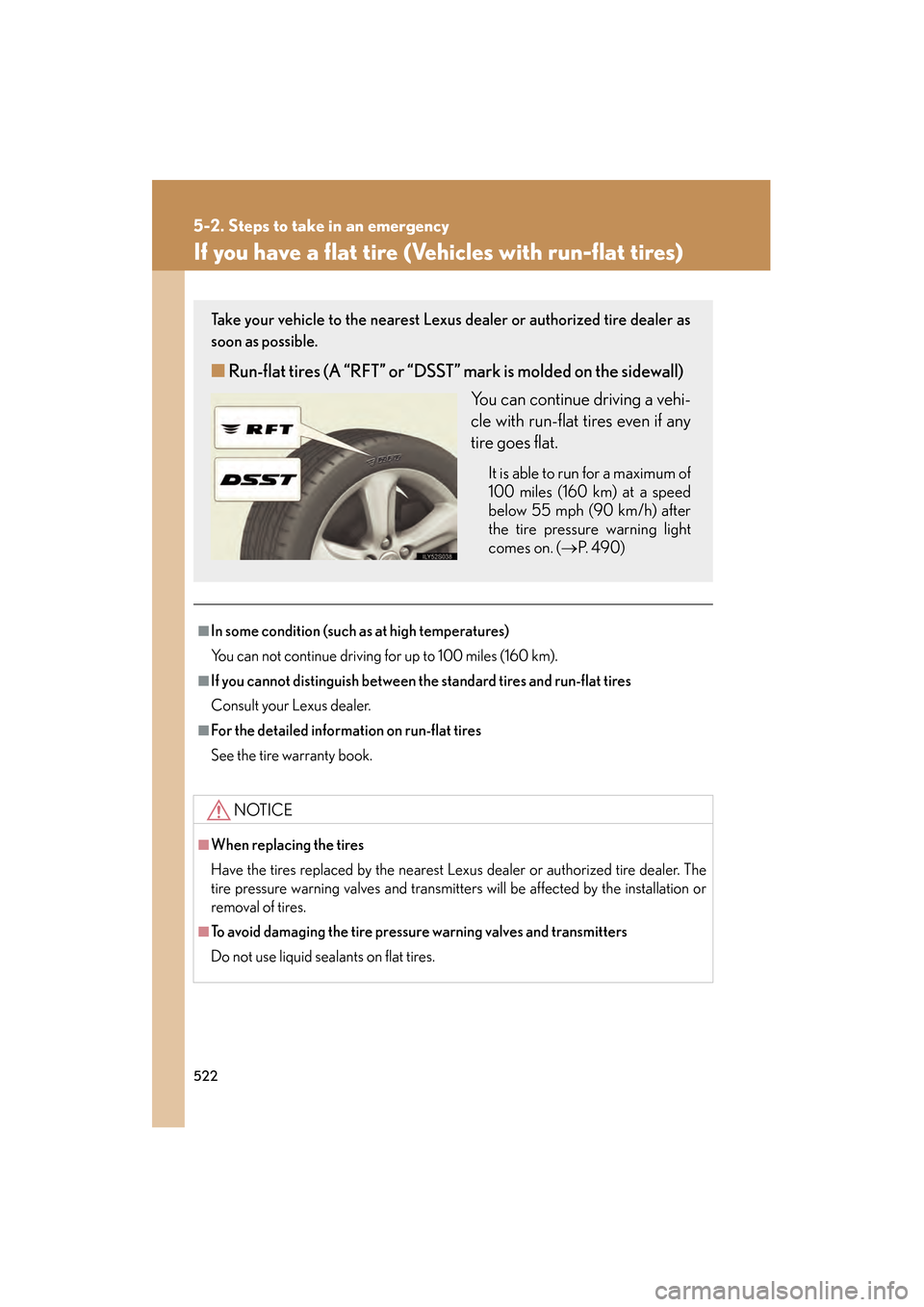
■ Run-flat tires (A “RFT” or “DSST” mark is molded on the sidewall)
You can continue driving a vehi-
cle with run-flat tires even if any
tire goes flat.
It is able to run for a maximum of
100 miles (160 km) at a speed
below 55 mph (90 km/h) after
the tire pressure warning light
comes on. ( →P. 4 9 0 )
GS_U_G.book Page 522 Thursday, June 19, 2008 12:54 PM
Page 532 of 598
5
When trouble arises
531
5-2. Steps to take in an emergency
GS_G_U
June 19, 2008 12:54 pm
■Starting the engine when the 12 volt battery is discharged
The engine cannot be started by push-starting.
■To prevent 12 volt battery discharge
●Turn off the headlights and the audio system while the engine is turned off.
●Turn off any unnecessary electrical components when the vehicle is running at a
low speed for an extended period, such as in heavy traffic, etc.
■When the 12 volt battery is removed or discharged
The following systems must be initialized.
●Tire pressure warning system (→P. 422)
●Intuitive parking assist (→P. 5 0 7 )
CAUTION
■Avoiding battery fires or explosions
Observe the following precautions to prevent accidentally igniting the flammable
gas that may be emitted from the battery.
●Make sure the jumper cable is connected to the correct terminal and that it is not
unintentionally in contact with any part other than the intended terminal.
●Do not allow the jumper cables to come into contact with the “+” and “-” termi-
nals.
●Do not allow open flame or use matches, cigarette lighters or smoke near the
battery.
Maintain the engine speed on the second vehicle and turn the
“ENGINE START STOP” switch to the IGNITION ON mode,
then start the vehicle’s engine.
Once the vehicle’s engine has started, remove the jumper
cables in the exact reverse order in which they were con-
nected.
Once the engine starts, have the vehicle checked at your Lexus dealer
as soon as possible.STEP5
STEP6
GS_U_G.book Page 531 Thursday, June 19, 2008 12:54 PM
Page 537 of 598
536
5-2. Steps to take in an emergency
GS_G_U
June 19, 2008 12:54 pm
If the vehicle becomes stuck
CAUTION
■When attempting to free a stuck vehicle
If you choose to rock the vehicle back and forth to free it, make sure the surround-
ing area is clear, to avoid striking other vehicles, objects or persons. The vehicle
may also lunge forward or lunge back suddenly as it becomes free. Use extreme
caution.
■When shifting the shift lever
Be careful not to shift the shift lever with the accelerator pedal depressed.
This may lead to unexpected rapid acceleration of the vehicle that may cause an
accident and result in death or serious injury.
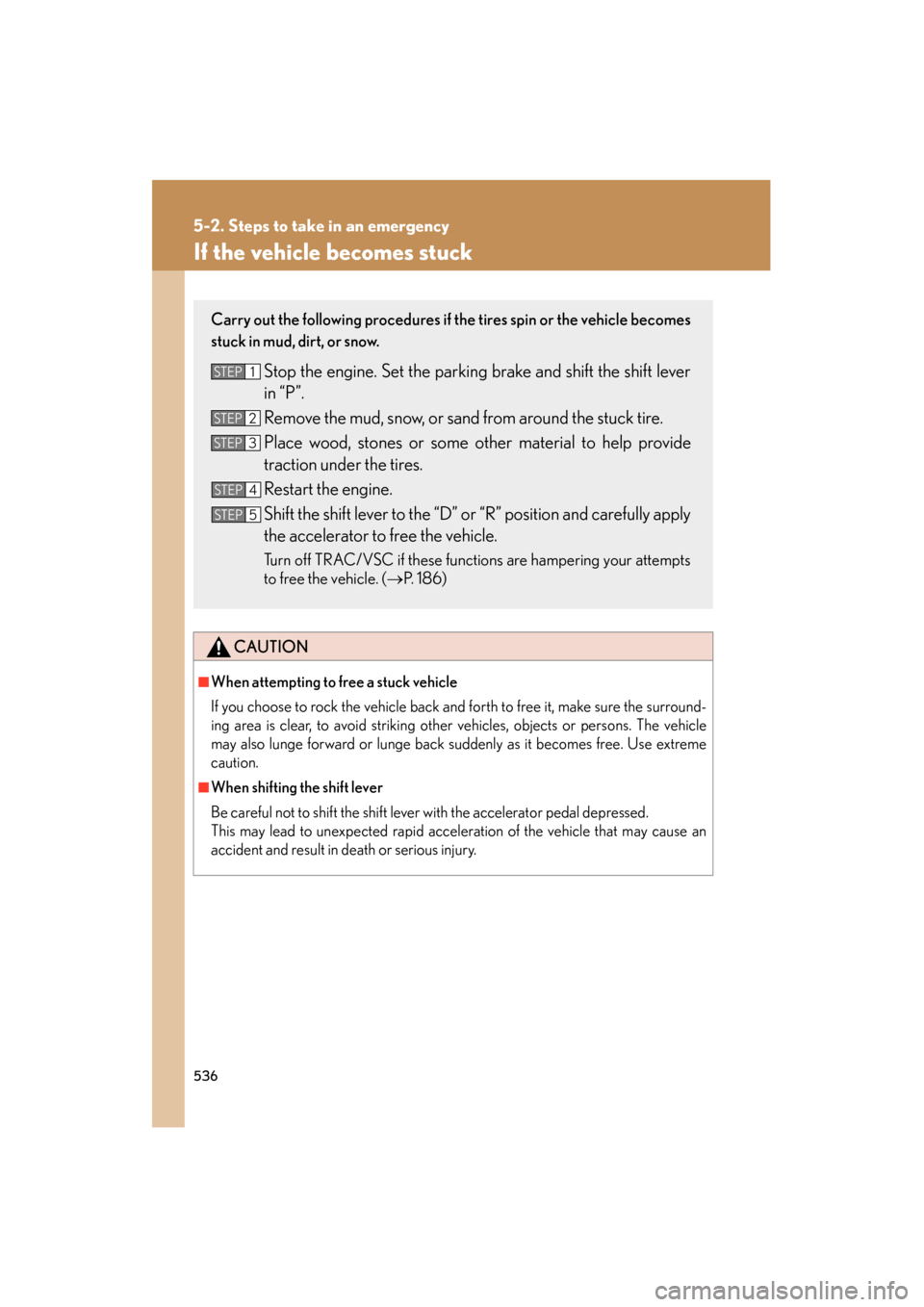
Carry out the following procedures if the tires spin or the vehicle becomes
stuck in mud, dirt, or snow.
Stop the engine. Set the parking brake and shift the shift lever
in “P”.
Remove the mud, snow, or sand from around the stuck tire.
Place wood, stones or some other material to help provide
traction under the tires.
Restart the engine.
Shift the shift lever to the “D” or “R” position and carefully apply
the accelerator to free the vehicle.
Turn off TRAC/VSC if these functions are hampering your attempts
to free the vehicle. (→P. 1 8 6 )
STEP1
STEP2
STEP3
STEP4
STEP5
GS_U_G.book Page 536 Thursday, June 19, 2008 12:54 PM
Page 540 of 598
Vehicle specifications6
539
GS_G_U
June 19, 2008 12:54 pm
6-1. Specifications................. 540Maintenance data (fuel, oil level, etc.) .............. 540
Fuel information ..................... 553
Tire information...................... 556
6-2. Customization................ 569 Customizable features ........ 569
6-3. Initialization ................... 575 Items to initialize ..................... 575
GS_U_G.book Page 539 Thursday, June 19, 2008 12:54 PM
Page 551 of 598
550
6-1. Specifications
GS_G_U
June 19, 2008 12:54 pm
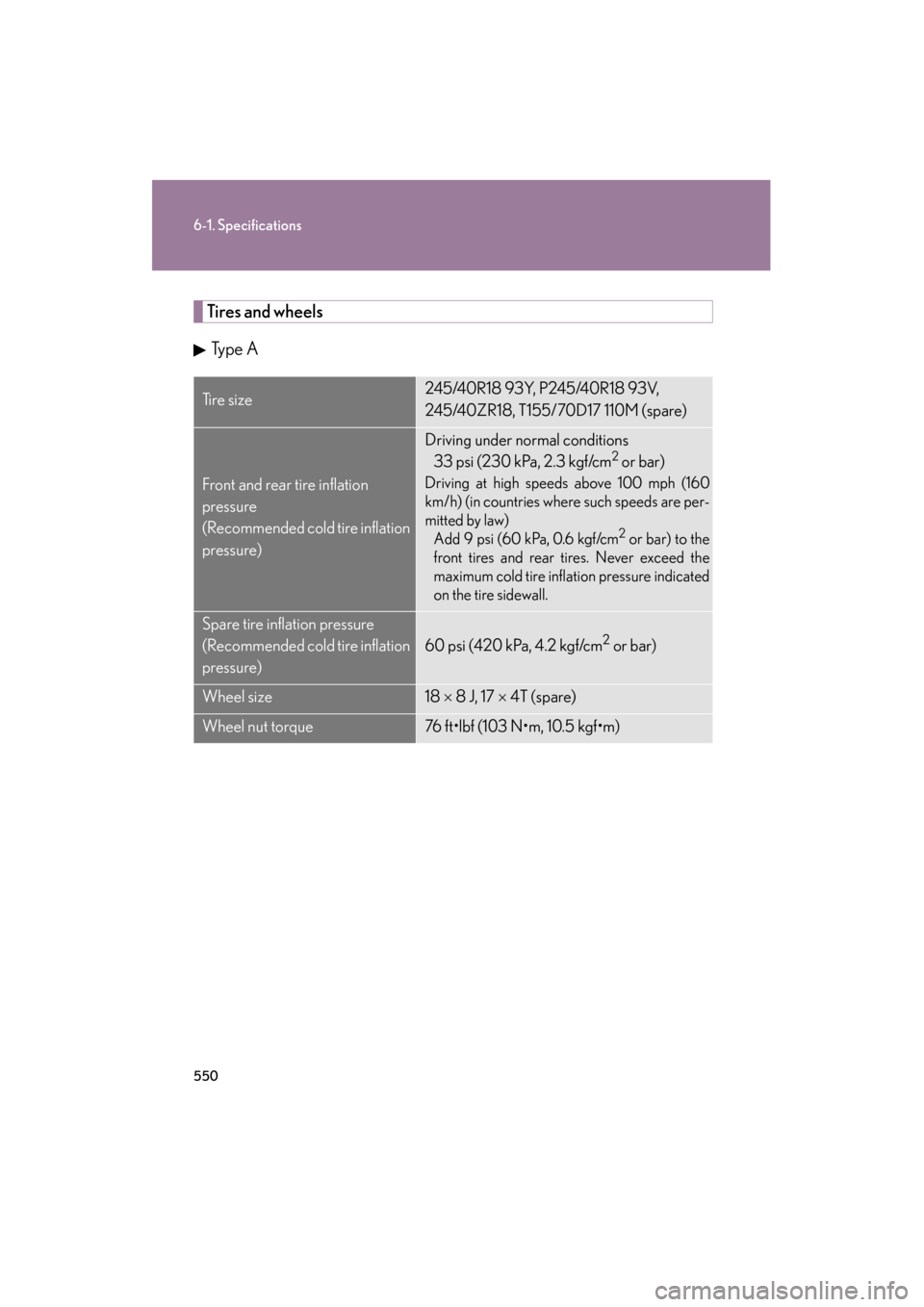
Tires and wheels
Ty p e A
Ti r e s i z e245/40R18 93Y, P245/40R18 93V,
245/40ZR18, T155/70D17 110M (spare)
Front and rear tire inflation
pressure
(Recommended cold tire inflation
pressure)
Driving under normal conditions 33 psi (230 kPa, 2.3 kgf/cm2 or bar)
Driving at high speeds above 100 mph (160
km/h) (in countries where such speeds are per-
mitted by law) Add 9 psi (60 kPa, 0.6 kgf/cm
2 or bar) to the
front tires and rear tires. Never exceed the
maximum cold tire inflation pressure indicated
on the tire sidewall.
Spare tire inflation pressure
(Recommended cold tire inflation
pressure)
60 psi (420 kPa, 4.2 kgf/cm2 or bar)
Wheel size18 × 8 J, 17 × 4T (spare)
Wheel nut torque76 ft•lbf (103 N•m, 10.5 kgf•m)
GS_U_G.book Page 550 Thursday, June 19, 2008 12:54 PM
Page 552 of 598
551
6-1. Specifications
6
Vehicle specifications
GS_G_U
June 19, 2008 12:54 pm
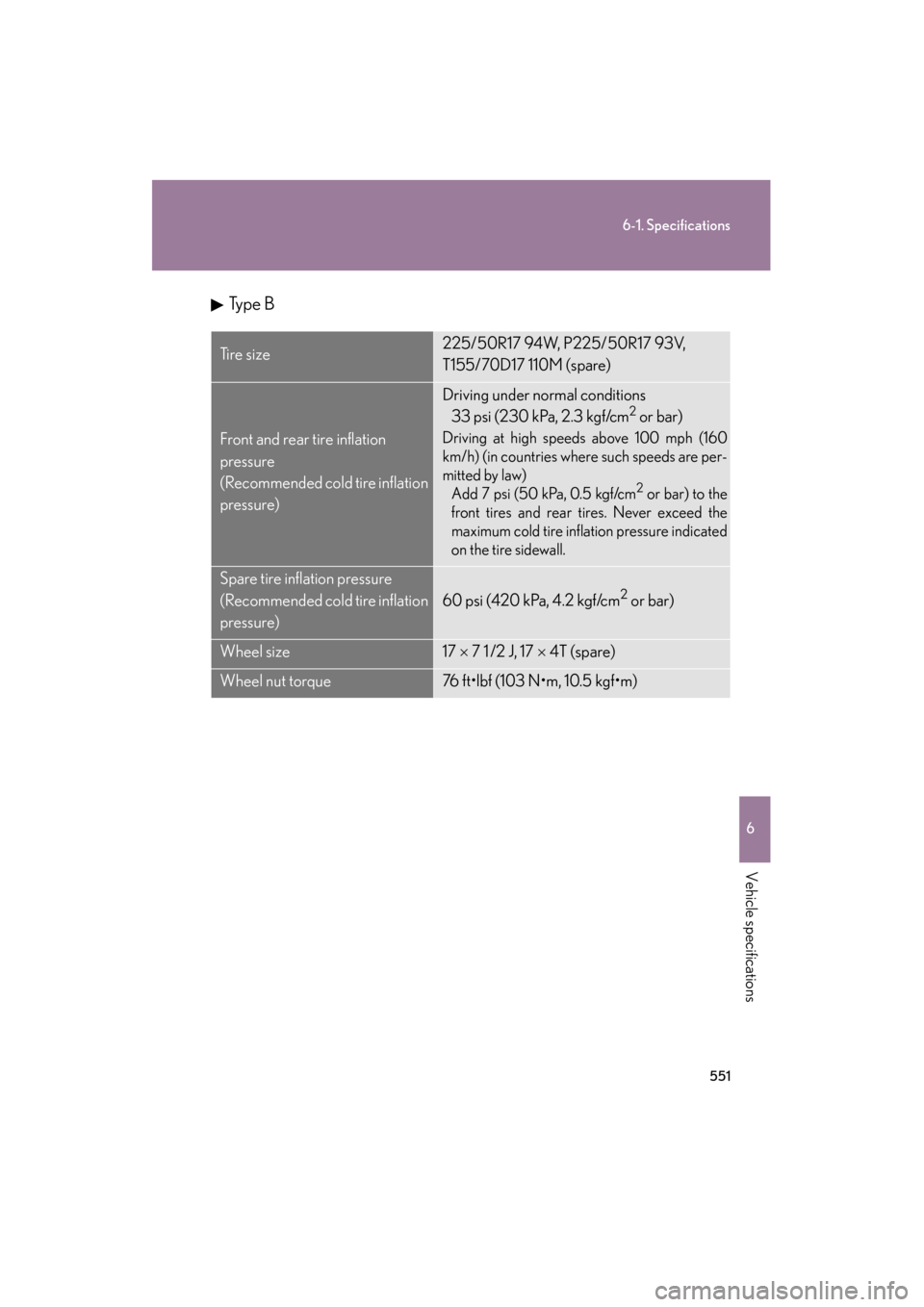
Type B
Ti r e s i z e225/50R17 94W, P225/50R17 93V,
T155/70D17 110M (spare)
Front and rear tire inflation
pressure
(Recommended cold tire inflation
pressure)
Driving under normal conditions33 psi (230 kPa, 2.3 kgf/cm2 or bar)
Driving at high speeds above 100 mph (160
km/h) (in countries where such speeds are per-
mitted by law) Add 7 psi (50 kPa, 0.5 kgf/cm
2 or bar) to the
front tires and rear tires. Never exceed the
maximum cold tire inflation pressure indicated
on the tire sidewall.
Spare tire inflation pressure
(Recommended cold tire inflation
pressure)
60 psi (420 kPa, 4.2 kgf/cm2 or bar)
Wheel size17 × 7 1 /2 J, 17 × 4T (spare)
Wheel nut torque76 ft•lbf (103 N•m, 10.5 kgf•m)
GS_U_G.book Page 551 Thursday, June 19, 2008 12:54 PM
Page 557 of 598
556
6-1. Specifications
GS_G_U
June 19, 2008 12:54 pm
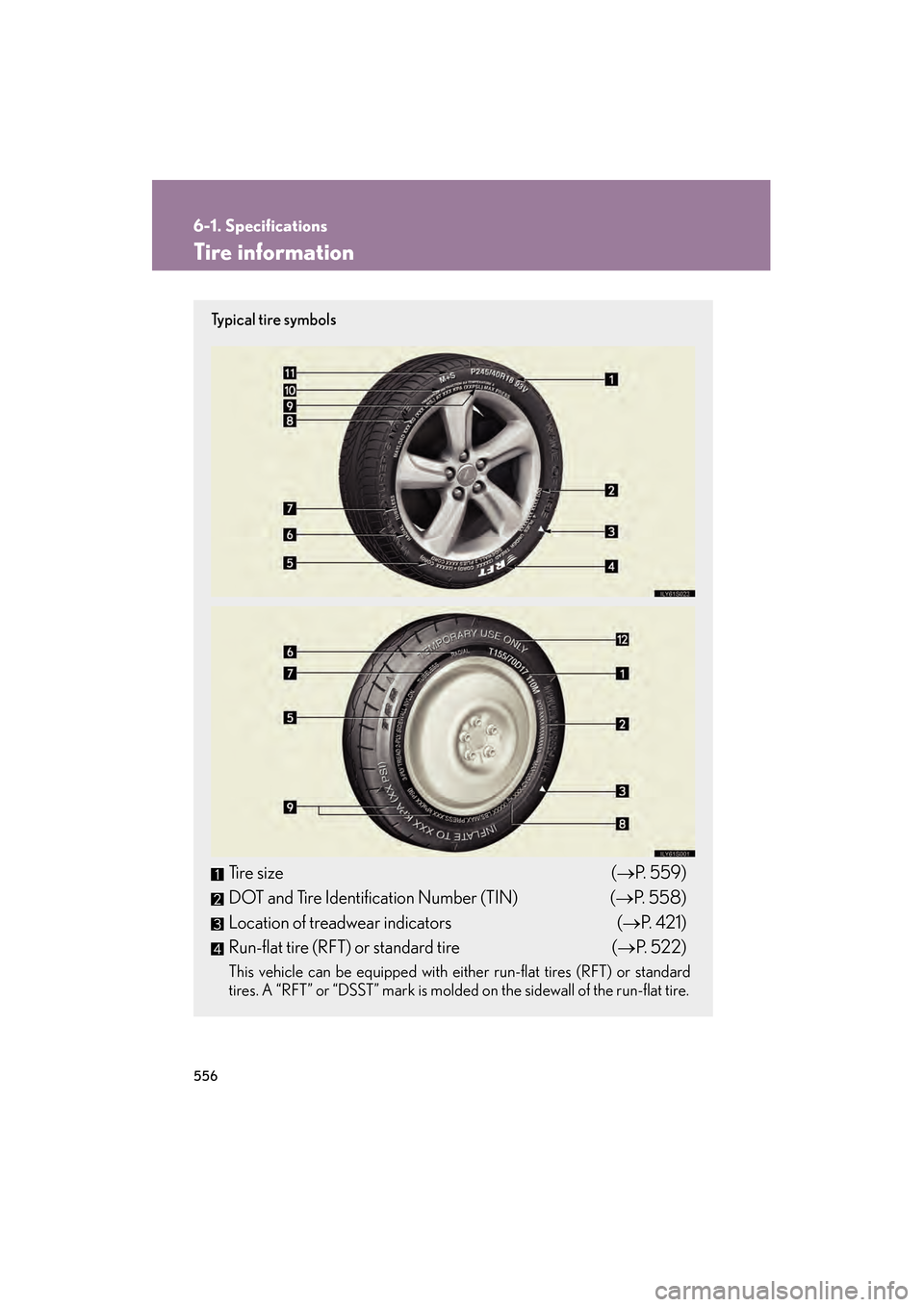
Tire information
Ty p i c a l t i r e s y m b o l s
Tire size(→ P. 559)
DOT and Tire Identification Number (TIN) (→ P. 5 5 8 )
Location of treadwear indicators (→ P. 421)
Run-flat tire (RFT) or standard tire (→ P. 522)
This vehicle can be equipped with either run-flat tires (RFT) or standard
tires. A “RFT” or “DSST” mark is molded on the sidewall of the run-flat tire.
GS_U_G.book Page 556 Thursday, June 19, 2008 12:54 PM
Page 558 of 598
557
6-1. Specifications
6
Vehicle specifications
GS_G_U
June 19, 2008 12:54 pm
Tire ply composition and materials
Plies are layers of rubber-coated parallel cords. Cords are the strands
which form the plies in a tire.
Radial tires or bias-ply tires
A radial tire has RADIAL on the sidewall. A tire not marked RADIAL is a
bias-ply tire.
TUBELESS or TUBE TYPE
A tubeless tire does not have a tube and air is directly filled in the tire. A
tube type tire has a tube inside the tire and the tube maintains the air pres-
sure.
Load limit at maximum cold tire inflation pressure ( →P. 562)
Maximum cold tire inflation pressure ( →P. 562)
This means the pressure to which a tire may be inflated.
Uniform tire quality grading
For details, see “Uniform Tire Quality Grading” that follows.
Summer tire or all season tire (→ P. 4 2 6 )
An all season tire has “M+S” on the sidewall. A tire not marked “M+S” is a
summer tire.
“TEMPORARY USE ONLY”
A compact spare tire is identified by the phrase “TEMPORARY USE
ONLY” molded into its sidewall. This tire is designed for temporary emer-
gency use only.
GS_U_G.book Page 557 Thursday, June 19, 2008 12:54 PM