ECU Lexus GS350 2009 Workshop Manual
[x] Cancel search | Manufacturer: LEXUS, Model Year: 2009, Model line: GS350, Model: Lexus GS350 2009Pages: 622, PDF Size: 17.98 MB
Page 511 of 622
510
5-2. Steps to take in an emergency
GS_G_U (OM30B43U)
April 27, 2009 10:48 am
*2: Open door warning buzzer:
→P. 5 2 1
*
3: Driver’s and front passenger’s seat belt reminder buzzer:
The driver’s and front passenger’s seat belts reminder sounds to alert the driver
and front passenger that his or her seat belt is not fastened. The buzzer sounds
intermittently for 10 seconds after the vehicle has reached a speed of at least 12
mph (20 km/h). Then, if the seat belt is still unfastened, the buzzer will sound in
a different tone for 20 more seconds.
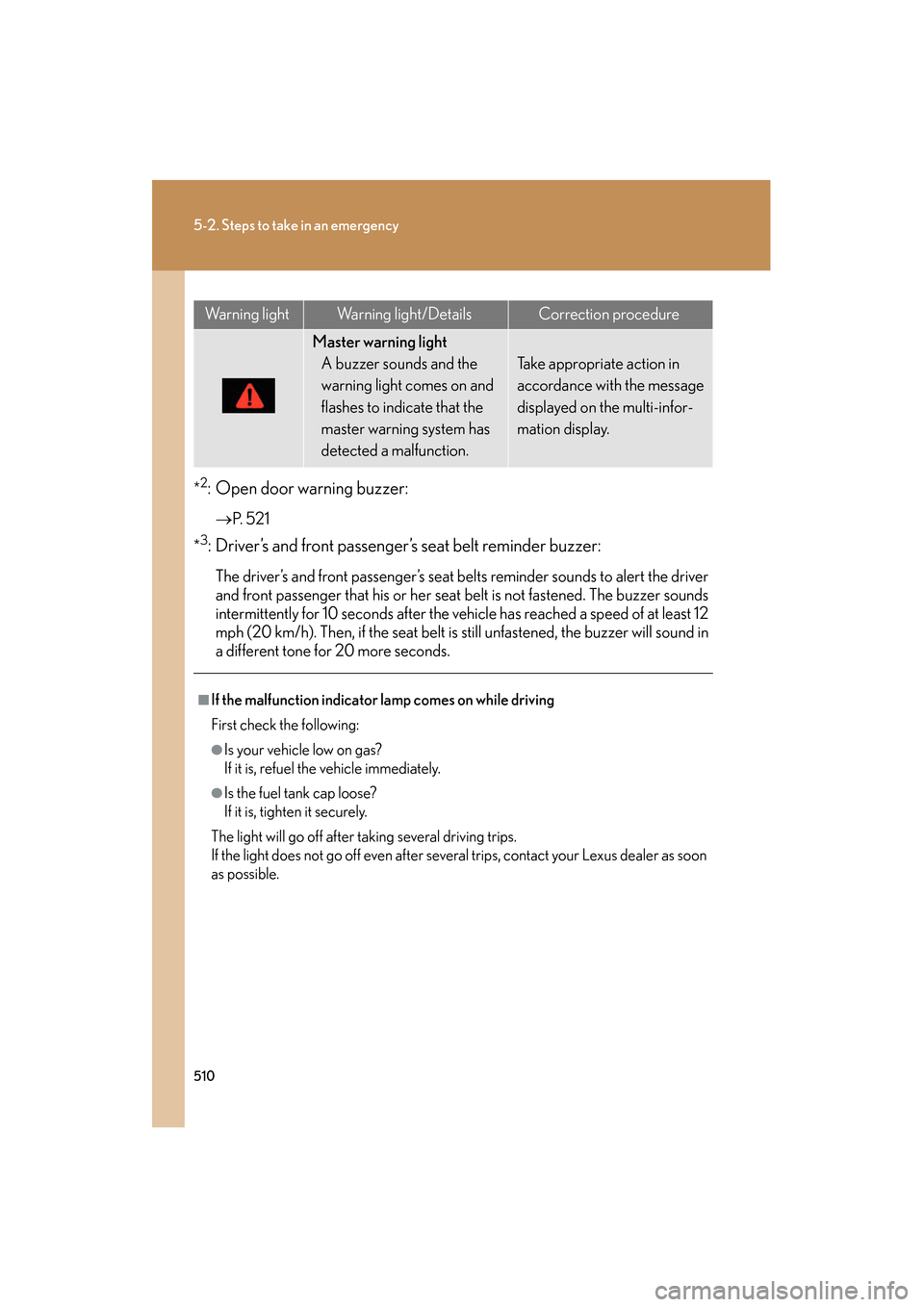
Warning lightWarning light/DetailsCorrection procedure
Master warning light
A buzzer sounds and the
warning light comes on and
flashes to indicate that the
master warning system has
detected a malfunction.
Take appropriate action in
accordance with the message
displayed on the multi-infor-
mation display.
■If the malfunction indicator lamp comes on while driving
First check the following:
●Is your vehicle low on gas?
If it is, refuel the vehicle immediately.
●Is the fuel tank cap loose?
If it is, tighten it securely.
The light will go off after taking several driving trips.
If the light does not go off even after several trips, contact your Lexus dealer as soon
as possible.
GS_U_G.book Page 510 Monday, April 27, 2009 10:50 AM
Page 512 of 622
5
When trouble arises
511
5-2. Steps to take in an emergency
GS_G_U (OM30B43U)
April 27, 2009 10:48 am
■Front passenger detection sensor and passenger seat belt reminder
●If luggage is placed on the front passenger seat, the front passenger detection
sensor may cause the warning light to flash, even if a passenger is not sitting in
the seat.
●If a cushion is placed on the seat, the sensor may not detect a passenger, and the
warning light may not operate properly.
■SRS warning light
This warning light system monitors the following:
●The airbag sensor assembly
●Front airbag sensors
●The curtain shield and rear side airbag sensors
●The side and curtain shield airbag sensors
●The front passenger occupant classification ECU
●“AIR BAG ON” and “AIR BAG OFF” indicator lights
●The pressure sensor
●The belt tension sensor
●The seat belt buckle switches
●The driver’s seat position sensor
●The inflators
●The warning light
●The interconnecting wiring and power sources
■When the tire pressure warning light comes on
Check the tire inflation pressure and adjust to the appropriate level. Pushing the tire
pressure warning reset switch does not turn off the tire pressure warning light.
GS_U_G.book Page 511 Monday, April 27, 2009 10:50 AM
Page 534 of 622
5
When trouble arises
533
5-2. Steps to take in an emergency
GS_G_U (OM30B43U)
April 27, 2009 10:48 am
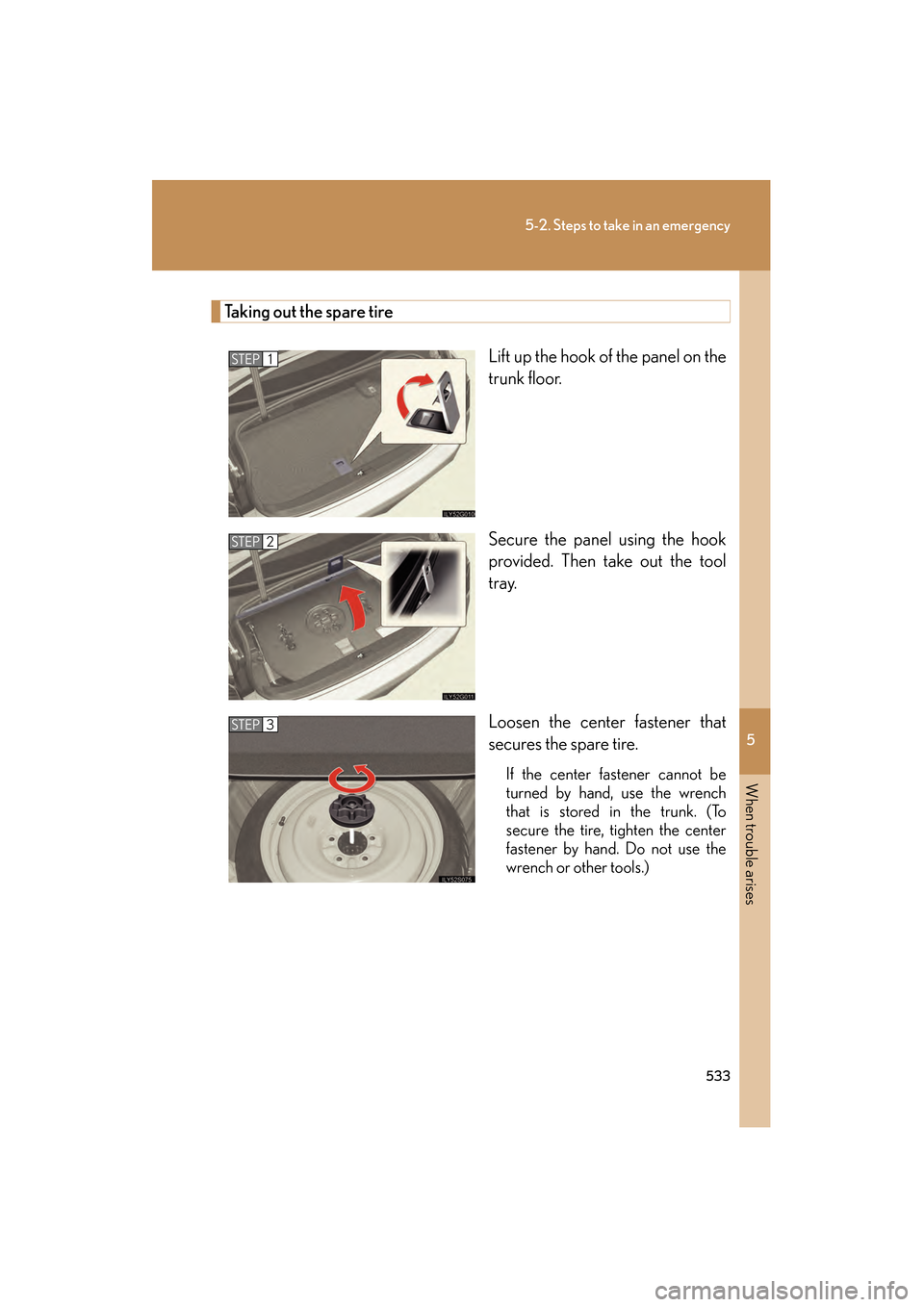
Taking out the spare tireLift up the hook of the panel on the
trunk floor.
Secure the panel using the hook
provided. Then take out the tool
tray.
Loosen the center fastener that
secures the spare tire.
If the center fastener cannot be
turned by hand, use the wrench
that is stored in the trunk. (To
secure the tire, tighten the center
fastener by hand. Do not use the
wrench or other tools.)
STEP1
STEP2
STEP3
GS_U_G.book Page 533 Monday, April 27, 2009 10:50 AM
Page 539 of 622
538
5-2. Steps to take in an emergency
GS_G_U (OM30B43U)
April 27, 2009 10:48 am
CAUTION
■Using the tire jack
Improper use of the tire jack may lead to death or serious injuries due to the vehicle
suddenly falling off the jack.
●Do not use the tire jack for any purpose other than replacing tires or installing and
removing tire chains.
●Only use the tire jack that comes with this vehicle for replacing a flat tire.
Do not use it on other vehicles, and do no t use other tire jacks for replacing tires
on this vehicle.
●Always check that the tire jack is securely set to the jack point.
●Do not raise the vehicle while someone is in it.
●When raising the vehicle, do not put an object on or under the jack.
●Do not raise the vehicle to a height greate r than that required to replace the tire.
●Use a jack stand if it is necessary to get under the vehicle.
●Do not put any part of your body under the vehicle supported by a jack.
●Do not start or run the engine while your vehicle is supported by the jack.
Take particular care when lowering the vehicle to ensure that no one working on or
near the vehicle may be injured.
■Replacing a flat tire
Observe the following precautions to reduce the risk of death or serious injury.
●Never use oil or grease on the wheel bolts or wheel nuts. Oil and grease may
cause the wheel nuts to be excessively tightened, leading to bolt or disc wheel
damage. In addition, the oil or grease can cause the wheel nuts to loosen and the
wheel may fall off, causing a serious accident. Remove any oil or grease from the
wheel bolts or wheel nuts.
●Have the wheel nuts tightened with a torque wrench to 76 ft•lbf (103 N•m, 10.5
kgf•m) as soon as possible after changing wheels.
Failure to follow these precautions could cause the nuts to loosen and the wheels
may fall off, which could lead to an accident causing death or serious injury.
GS_U_G.book Page 538 Monday, April 27, 2009 10:50 AM
Page 589 of 622
588
6-1. Specifications
GS_G_U (OM30B43U)
April 27, 2009 10:48 am
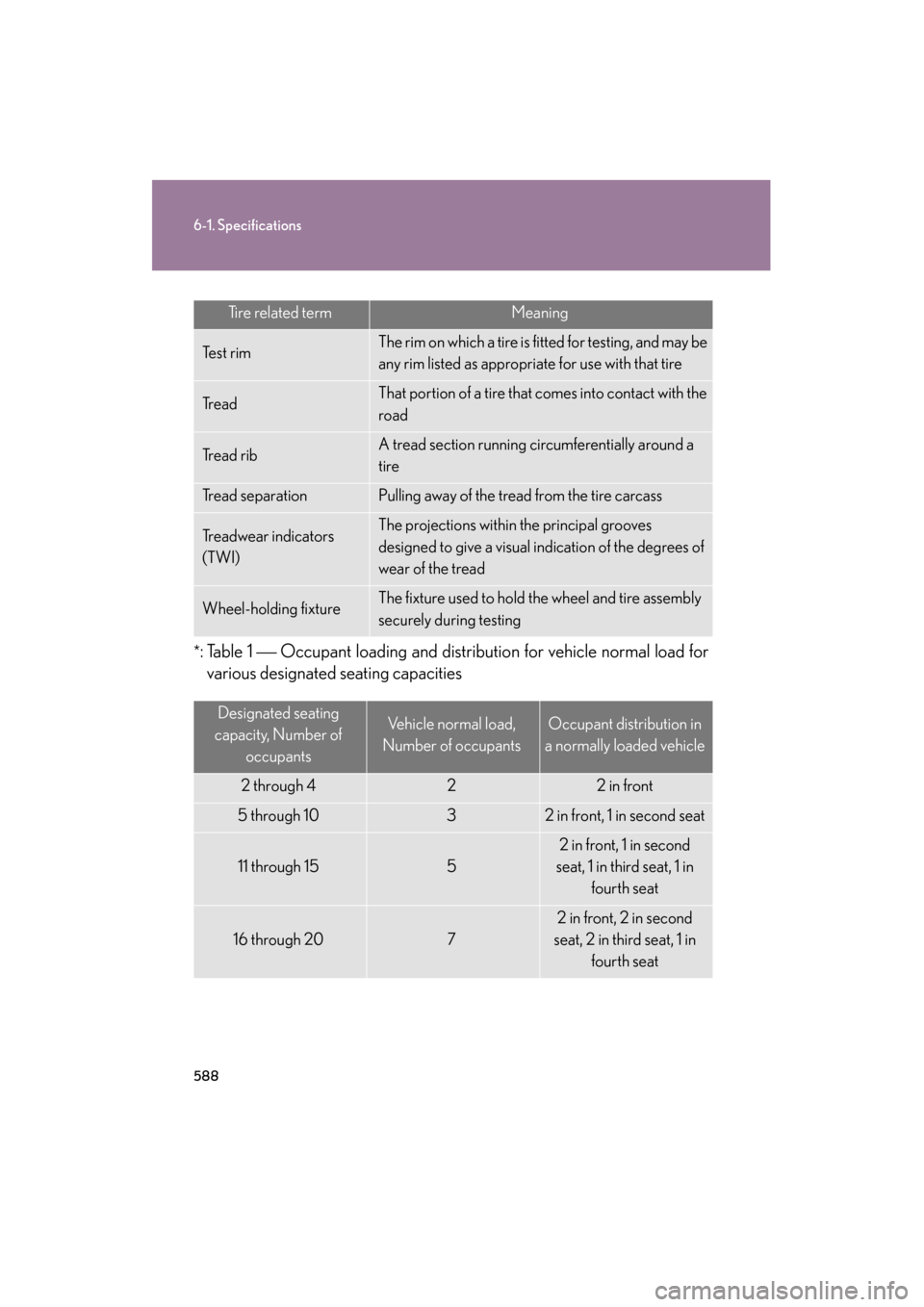
*: Table 1 Occupant loading and distribution for vehicle normal load for
various designated seating capacities
Tire related termMeaning
Te s t r i mThe rim on which a tire is fitted for testing, and may be
any rim listed as appropriate for use with that tire
Tr e a dThat portion of a tire that comes into contact with the
road
Tr e a d r i bA tread section running circumferentially around a
tire
Tr e a d s e p a r a t i o nPulling away of the tread from the tire carcass
Treadwear indicators
(TWI)The projections within the principal grooves
designed to give a visual indication of the degrees of
wear of the tread
Wheel-holding fixtureThe fixture used to hold the wheel and tire assembly
securely during testing
Designated seating
capacity, Number of
occupantsVehicle normal load,
Number of occupantsOccupant distribution in
a normally loaded vehicle
2 through 422 in front
5 through 1032 in front, 1 in second seat
11 through 155
2 in front, 1 in second
seat, 1 in third seat, 1 in fourth seat
16 through 207
2 in front, 2 in second
seat, 2 in third seat, 1 in
fourth seat
GS_U_G.book Page 588 Monday, April 27, 2009 10:50 AM
Page 600 of 622
599
7
GS_G_U (OM30B43U)
April 20, 2009 4:34 pm
For owners
Seat belt instructions for Canadian owners (in French)
The following is a French explanation of seat belt instructions extracted
from the seat belt section in this manual.
See the seat belt section for more detailed seat belt instructions in
English.
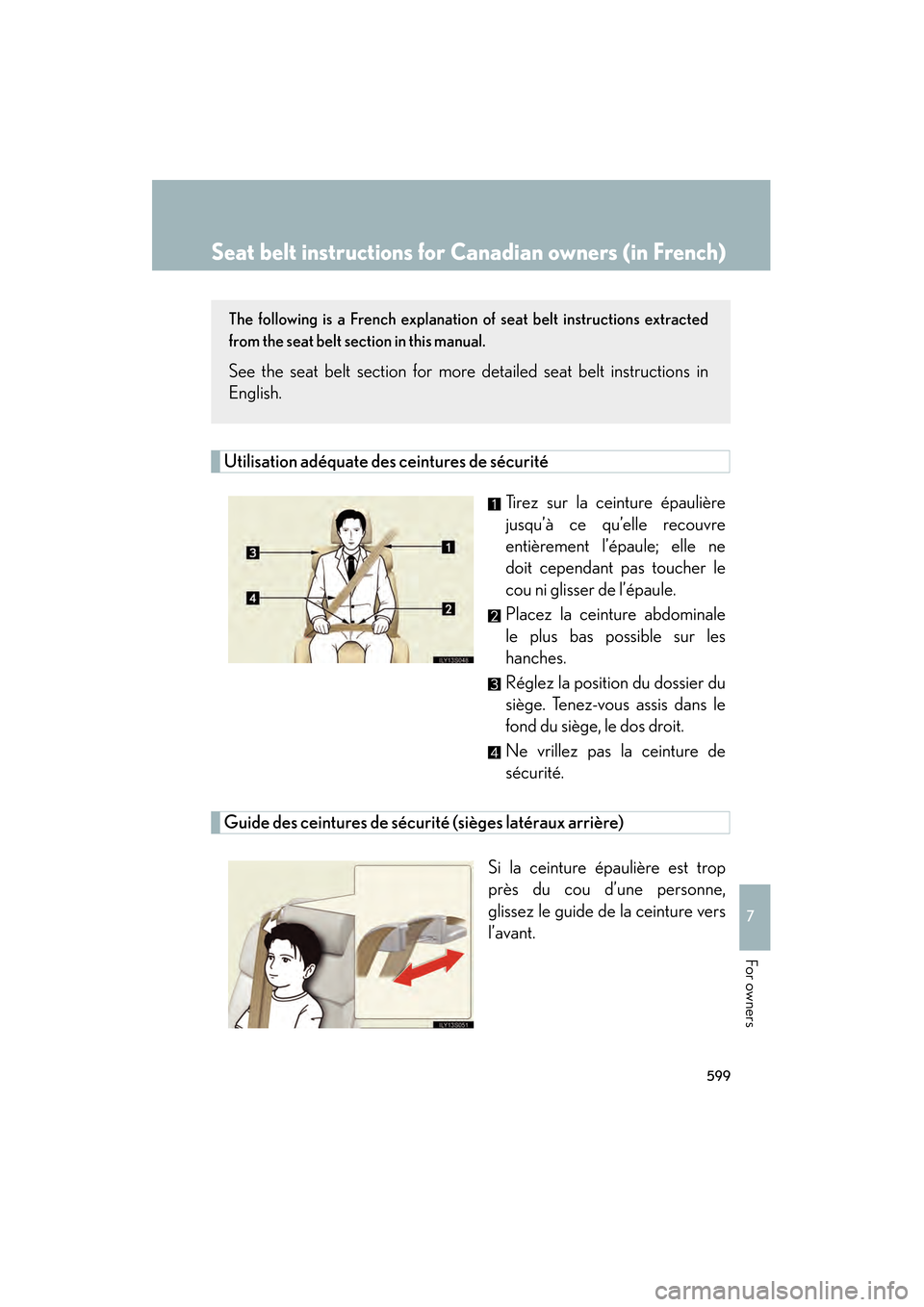
Utilisation adéquate des ceintures de sécurité
Tirez sur la ceinture épaulière
jusqu’à ce qu’elle recouvre
entièrement l’épaule; elle ne
doit cependant pas toucher le
cou ni glisser de l’épaule.
Placez la ceinture abdominale
le plus bas possible sur les
hanches.
Réglez la position du dossier du
siège. Tenez-vous assis dans le
fond du siège, le dos droit.
Ne vrillez pas la ceinture de
sécurité.
Guide des ceintures de sécurité (sièges latéraux arrière)
Si la ceinture épaulière est trop
près du cou d’une personne,
glissez le guide de la ceinture vers
l’avant.
GS_U_G.book Page 599 Monday, April 27, 2009 10:50 AM
Page 601 of 622
600
GS_G_U (OM30B43U)
April 20, 2009 4:34 pm
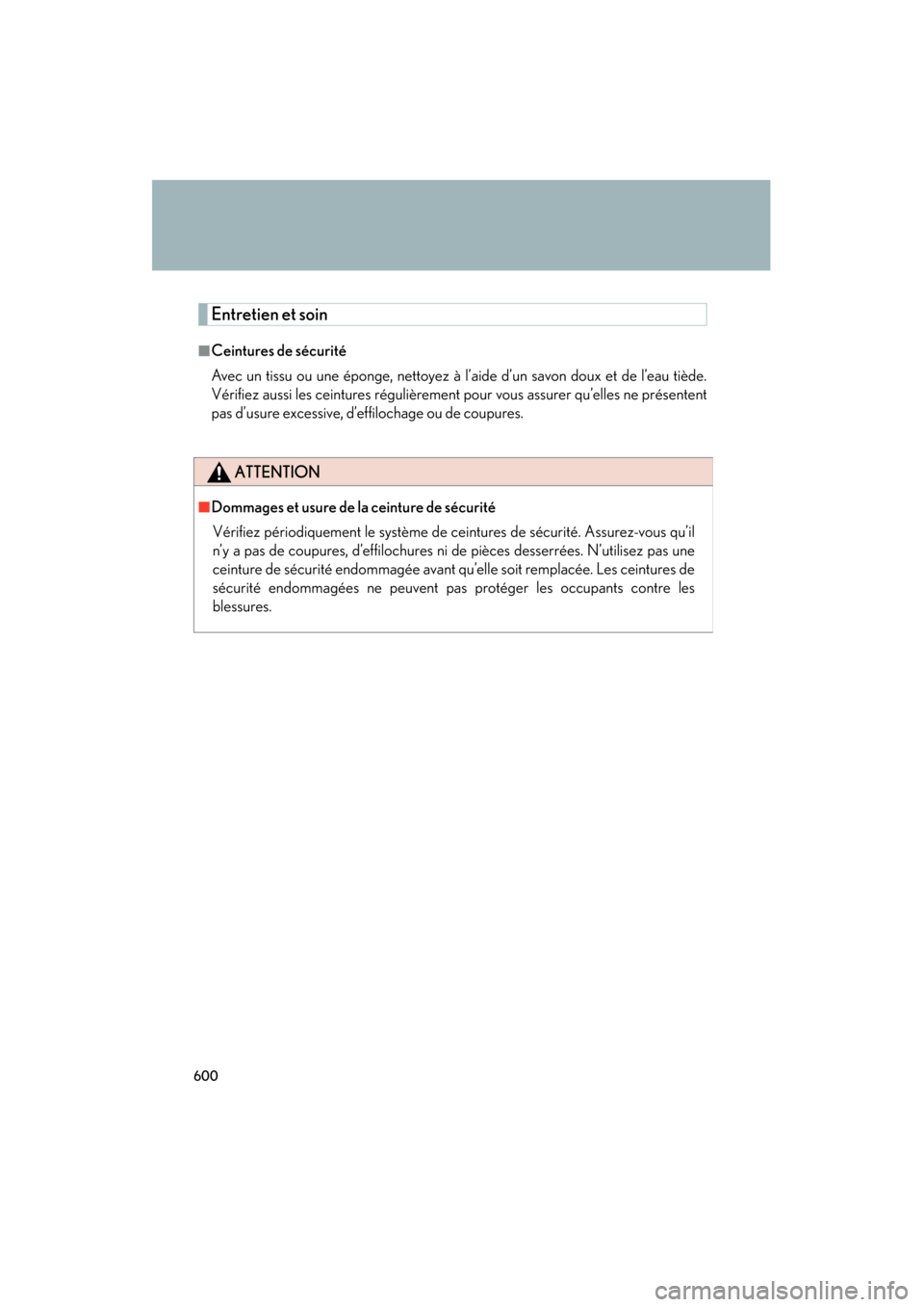
Entretien et soin
Ceintures de sécurité
Avec un tissu ou une éponge, nettoyez à l’aide d’un savon doux et de l’eau tiède.
Vérifiez aussi les ceintures régulièrement pour vous assurer qu’elles ne présentent
pas d’usure excessive, d’effilochage ou de coupures.
ATTENTION
Dommages et usure de la ceinture de sécuritéVérifiez périodiquement le système de ceintures de sécurité. Assurez-vous qu’il
n’y a pas de coupures, d’effilochures ni de pièces desserrées. N’utilisez pas une
ceinture de sécurité endommagée avant qu’elle soit remplacée. Les ceintures de
sécurité endommagées ne peuvent pas protéger les occupants contre les
blessures.
GS_U_G.book Page 600 Monday, April 27, 2009 10:50 AM
Page 603 of 622
602
GS_G_U (OM30B43U)
April 20, 2009 4:34 pm
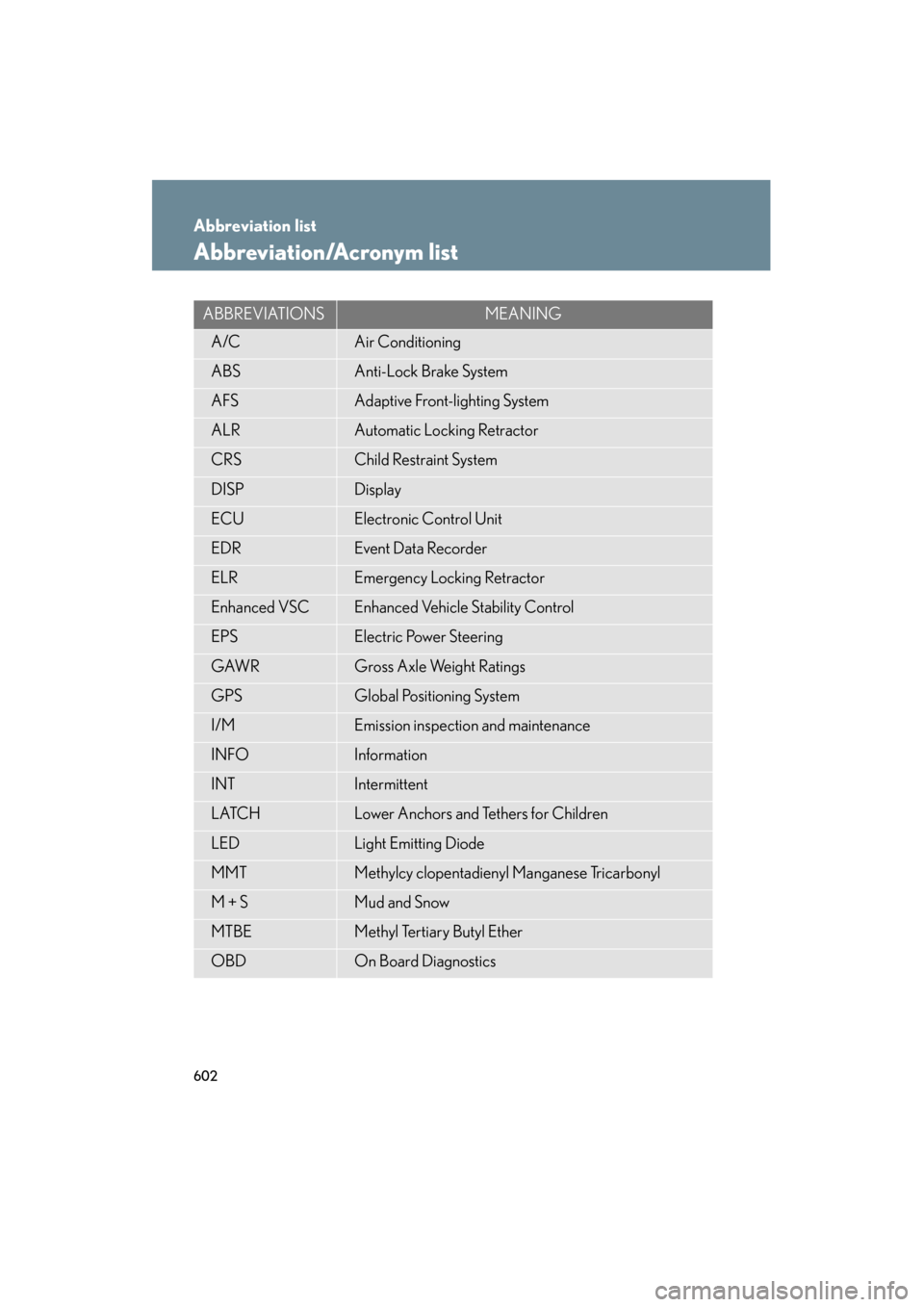
Abbreviation list
Abbreviation/Acronym list
ABBREVIATIONSMEANING
A/CAir Conditioning
ABSAnti-Lock Brake System
AFSAdaptive Front-lighting System
ALRAutomatic Locking Retractor
CRSChild Restraint System
DISPDisplay
ECUElectronic Control Unit
EDREvent Data Recorder
ELREmergency Locking Retractor
Enhanced VSCEnhanced Vehicle Stability Control
EPSElectric Power Steering
GAWRGross Axle Weight Ratings
GPSGlobal Positioning System
I/MEmission inspection and maintenance
INFOInformation
INTIntermittent
LATCHLower Anchors and Tethers for Children
LEDLight Emitting Diode
MMTMethylcy clopentadienyl Manganese Tricarbonyl
M + SMud and Snow
MTBEMethyl Tertiary Butyl Ether
OBDOn Board Diagnostics
GS_U_G.book Page 602 Monday, April 27, 2009 10:50 AM