Heat Lexus GS350 2011 Owner's Guide
[x] Cancel search | Manufacturer: LEXUS, Model Year: 2011, Model line: GS350, Model: Lexus GS350 2011Pages: 654, PDF Size: 11.03 MB
Page 503 of 654
502
4-3. Do-it-yourself maintenance
GS_G_U (OM30C11U)
October 28, 2011 5:15 pm
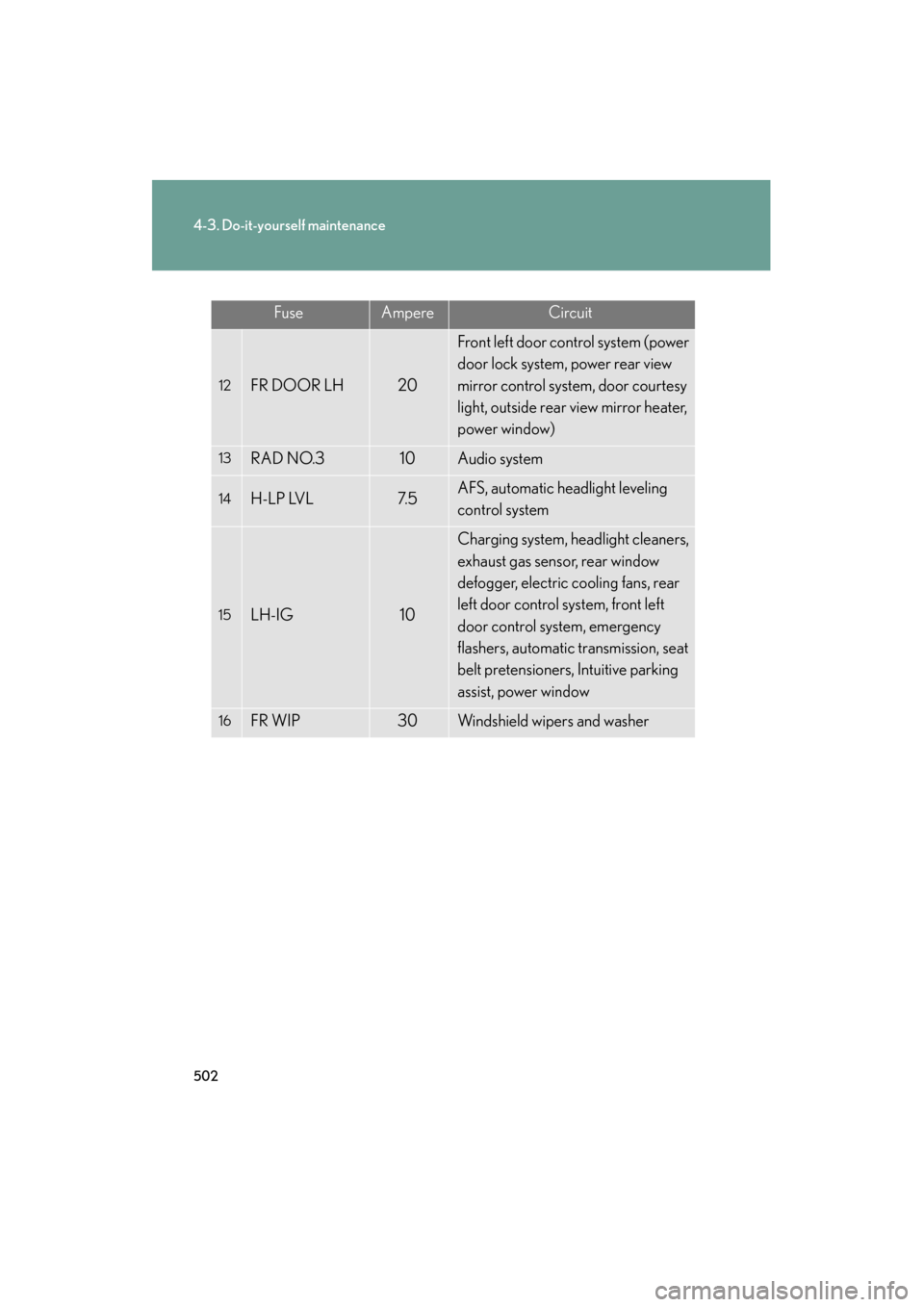
FuseAmpereCircuit
12FR DOOR LH20
Front left door control system (power
door lock system, power rear view
mirror control system, door courtesy
light, outside rear view mirror heater,
power window)
13RAD NO.310Audio system
14H-LP LVL7. 5AFS, automatic headlight leveling
control system
15LH-IG10
Charging system, headlight cleaners,
exhaust gas sensor, rear window
defogger, electric cooling fans, rear
left door control system, front left
door control system, emergency
flashers, automatic transmission, seat
belt pretensioners, Intuitive parking
assist, power window
16FR WIP30Windshield wipers and washer
Page 505 of 654
504
4-3. Do-it-yourself maintenance
GS_G_U (OM30C11U)
October 28, 2011 5:15 pm
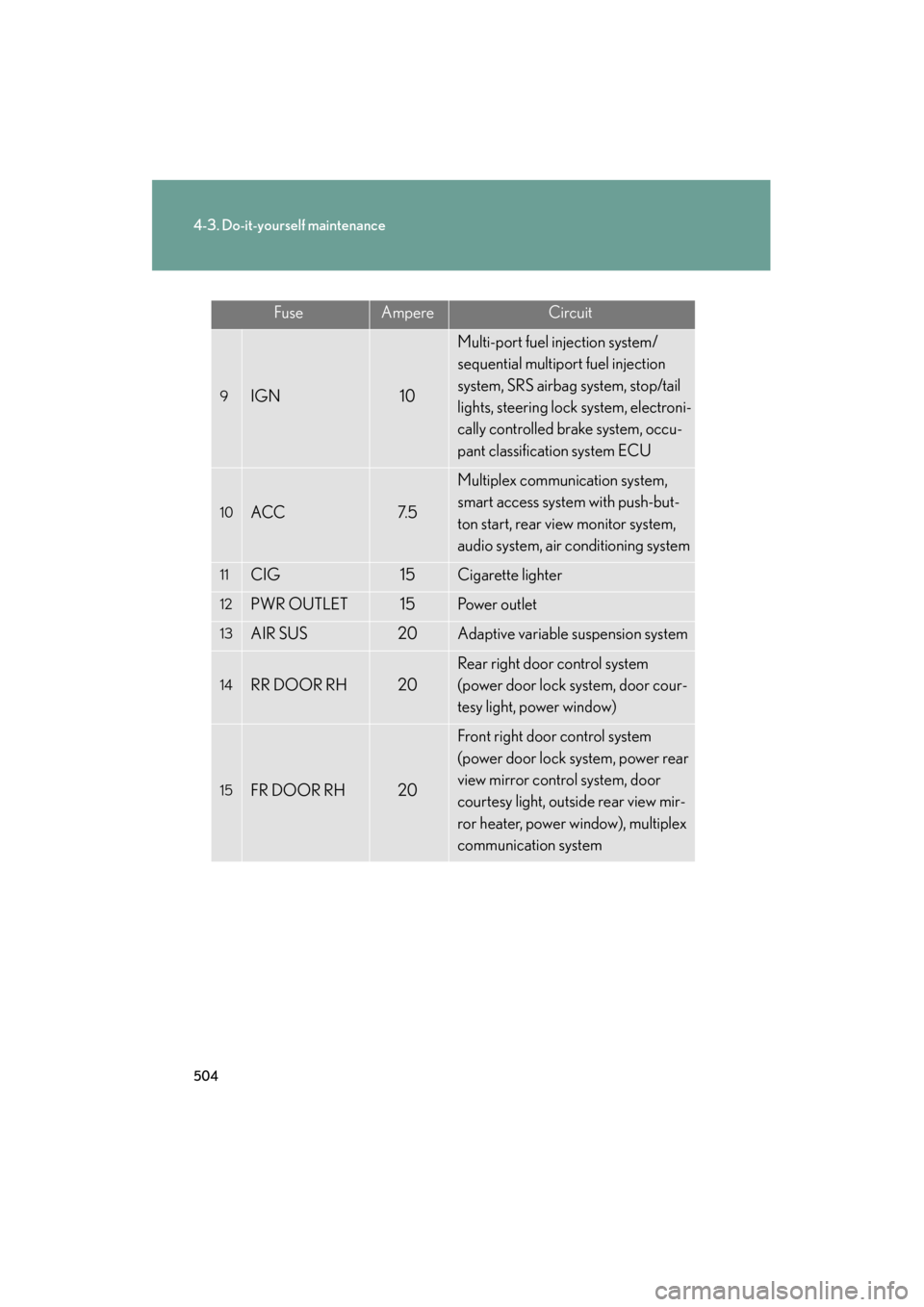
FuseAmpereCircuit
9IGN10
Multi-port fuel injection system/
sequential multiport fuel injection
system, SRS airbag system, stop/tail
lights, steering lock system, electroni-
cally controlled brake system, occu-
pant classification system ECU
10ACC7. 5
Multiplex communication system,
smart access system with push-but-
ton start, rear view monitor system,
audio system, air conditioning system
11CIG15Cigarette lighter
12PWR OUTLET15Po w e r o u t l e t
13AIR SUS20Adaptive variable suspension system
14RR DOOR RH20
Rear right door control system
(power door lock system, door cour-
tesy light, power window)
15FR DOOR RH20
Front right door control system
(power door lock system, power rear
view mirror control system, door
courtesy light, outside rear view mir-
ror heater, power window), multiplex
communication system
Page 506 of 654
505
4-3. Do-it-yourself maintenance
4
Maintenance and care
GS_G_U (OM30C11U)
October 28, 2011 5:15 pm
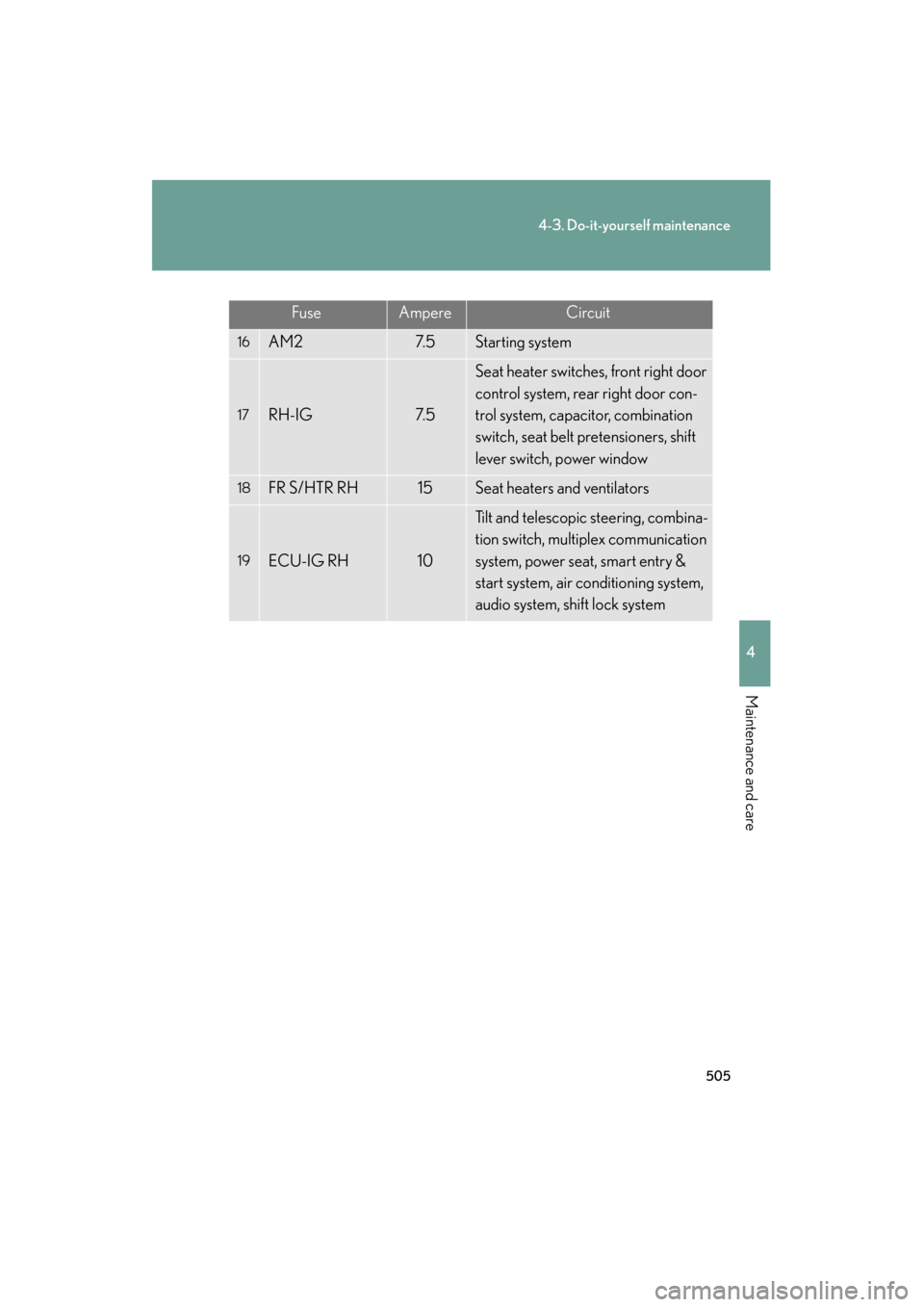
FuseAmpereCircuit
16AM27. 5Starting system
17RH-IG7. 5
Seat heater switches, front right door
control system, rear right door con-
trol system, capacitor, combination
switch, seat belt pretensioners, shift
lever switch, power window
18FR S/HTR RH15Seat heaters and ventilators
19ECU-IG RH10
Tilt and telescopic steering, combina-
tion switch, multiplex communication
system, power seat, smart entry &
start system, air conditioning system,
audio system, shift lock system
Page 519 of 654
518
4-3. Do-it-yourself maintenance
GS_G_U (OM30C11U)
October 28, 2011 5:15 pm
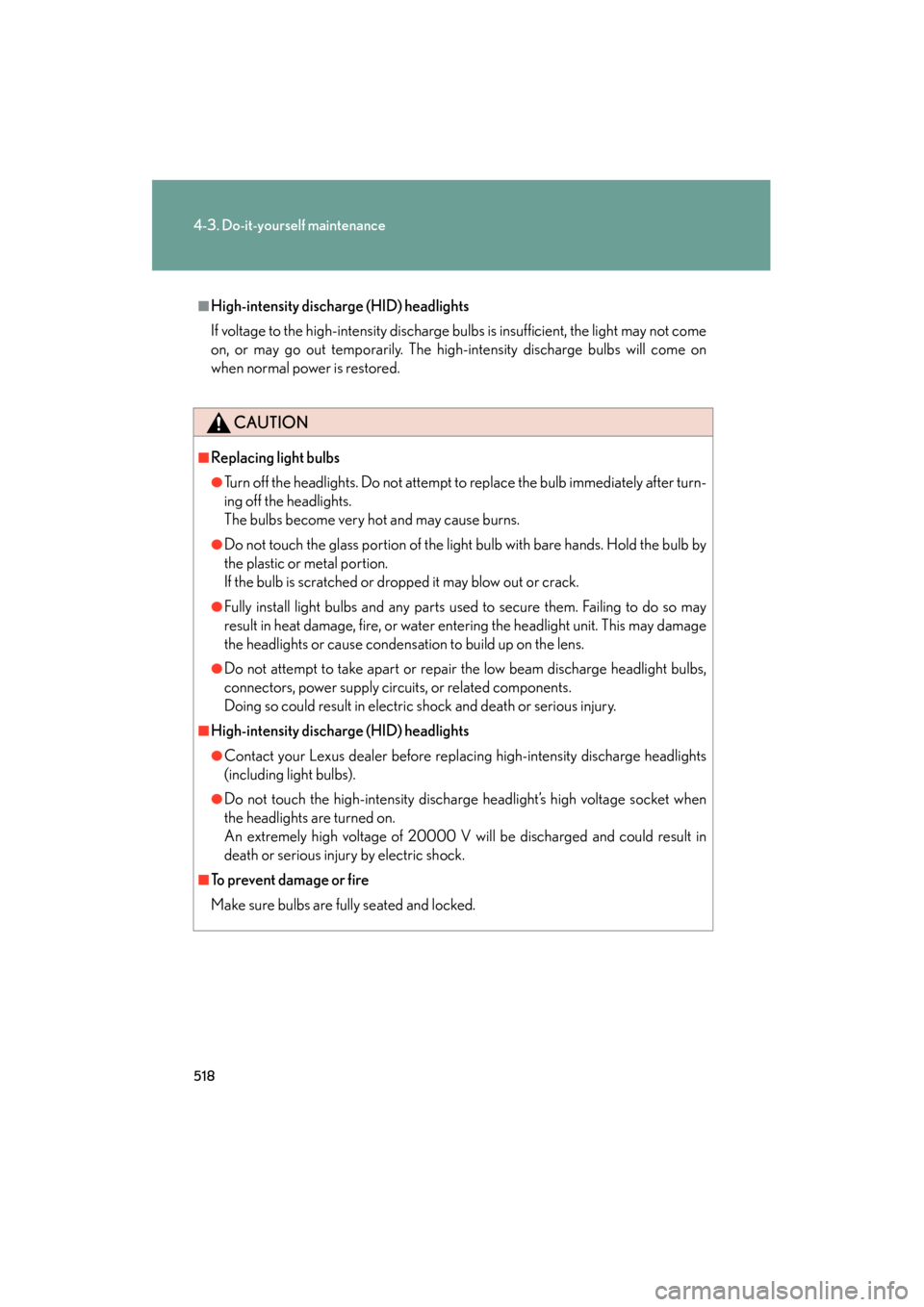
■High-intensity discharge (HID) headlights
If voltage to the high-intensity discharge bulbs is insufficient, the light may not come
on, or may go out temporarily. The high-intensity discharge bulbs will come on
when normal power is restored.
CAUTION
■Replacing light bulbs
●Turn off the headlights. Do not attempt to replace the bulb immediately after turn-
ing off the headlights.
The bulbs become very hot and may cause burns.
●Do not touch the glass portion of the light bulb with bare hands. Hold the bulb by
the plastic or metal portion.
If the bulb is scratched or dropped it may blow out or crack.
●Fully install light bulbs and any parts used to secure them. Failing to do so may
result in heat damage, fire, or water entering the headlight unit. This may damage
the headlights or cause condensation to build up on the lens.
●Do not attempt to take apart or repair the low beam discharge headlight bulbs,
connectors, power supply circuits, or related components.
Doing so could result in electric shock and death or serious injury.
■High-intensity discharge (HID) headlights
●Contact your Lexus dealer before replacing high-intensity discharge headlights
(including light bulbs).
●Do not touch the high-intensity discharge headlight’s high voltage socket when
the headlights are turned on.
An extremely high voltage of 20000 V will be discharged and could result in
death or serious injury by electric shock.
■To prevent damage or fire
Make sure bulbs are fully seated and locked.
Page 520 of 654
When trouble arises5
519
GS_G_U (OM30C11U)
May 21, 2010 12:06 pm
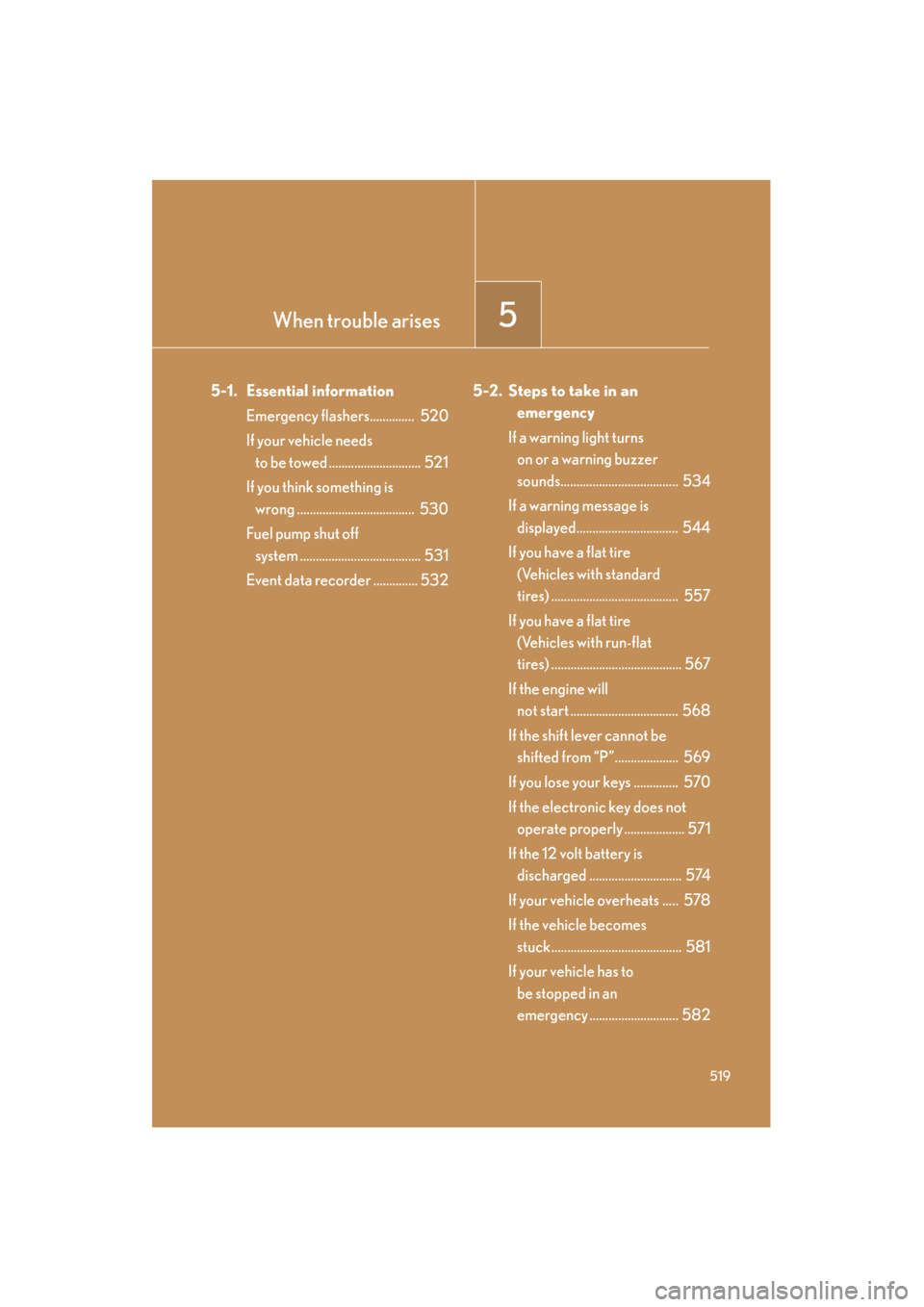
5-1. Essential informationEmergency flashers.............. 520
If your vehicle needs to be towed ............................. 521
If you think something is wrong ..................................... 530
Fuel pump shut off system ...................................... 531
Event data recorder .............. 532 5-2. Steps to take in an
emergency
If a warning light turns on or a warning buzzer
sounds..................................... 534
If a warning message is displayed................................ 544
If you have a flat tire (Vehicles with standard
tires) ........................................ 557
If you have a flat tire (Vehicles with run-flat
tires) ......................................... 567
If the engine will not start .................................. 568
If the shift lever cannot be shifted from “P”.................... 569
If you lose your keys .............. 570
If the electronic key does not operate properly ................... 571
If the 12 volt battery is discharged ............................. 574
If your vehicle overheats ..... 578
If the vehicle becomes stuck......................................... 581
If your vehicle has to be stopped in an
emergency ............................ 582
Page 543 of 654
542
5-2. Steps to take in an emergency
GS_G_U (OM30C11U)
October 28, 2011 5:15 pm
CAUTION
■Maintenance of the tires
Each tire, including the spare (if provided), should be checked monthly when cold
and inflated to the inflation pressure recommended by the vehicle manufacturer on
the vehicle placard or tire inflation pressure label (tire and load information label).
(If your vehicle has tires of a different size than the size indicated on the vehicle
placard or tire inflation pressure label [tire and load information label], you should
determine the proper tire inflation pressure for those tires.)
As an added safety feature, your vehicle has been equipped with a tire pressure
monitoring system (TPMS-tire pressure warning system) that illuminates a low tire
pressure telltale (tire pressure warning light) when one or more of your tires is sig-
nificantly under-inflated. Accordingly, when the low tire pressure telltale (tire pres-
sure warning light) illuminates, you should stop and check your tires as soon as
possible, and inflate them to the proper pressure. Driving on a significantly under-
inflated tire causes the tire to overheat and can lead to tire failure. Under-inflation
also reduces fuel efficiency and tire tread life, and may affect the vehicle’s handling
and stopping ability.
Please note that the TPMS (tire pressure warning system) is not a substitute for
proper tire maintenance, and it is the driver’s responsibility to maintain correct tire
pressure, even if under-inflation has not reached the level to trigger illumination of
the TPMS low tire pressure telltale (tire pressure warning light).
Your vehicle has also been equipped with a TPMS (tire pressure warning system)
malfunction indicator to indicate when the system is not operating properly. The
TPMS (tire pressure warning system) malfunction indicator is combined with the
low tire pressure telltale (tire pressure warning light). When the system detects a
malfunction, the telltale will flash for approximately one minute and then remain
continuously illuminated. This sequence will continue upon subsequent vehicle
start-ups as long as the malfunction exists. When the malfunction indicator is illumi-
nated, the system may not be able to detect or signal low tire pressure as intended.
TPMS (tire pressure warning system) malfunctions may occur for a variety of rea-
sons, including the installation of replacement or alternate tires or wheels on the
vehicle that prevent the TPMS (tire pressure warning system) from functioning
properly. Always check the TPMS (tire pressure warning system) malfunction tell-
tale after replacing one or more tires or wheels on your vehicle to ensure that the
replacement or alternate tires and wheels allow the TPMS (tire pressure warning
system) to continue to function properly.
Page 579 of 654
578
5-2. Steps to take in an emergency
GS_G_U (OM30C11U)
October 28, 2011 5:15 pm
If your vehicle overheats
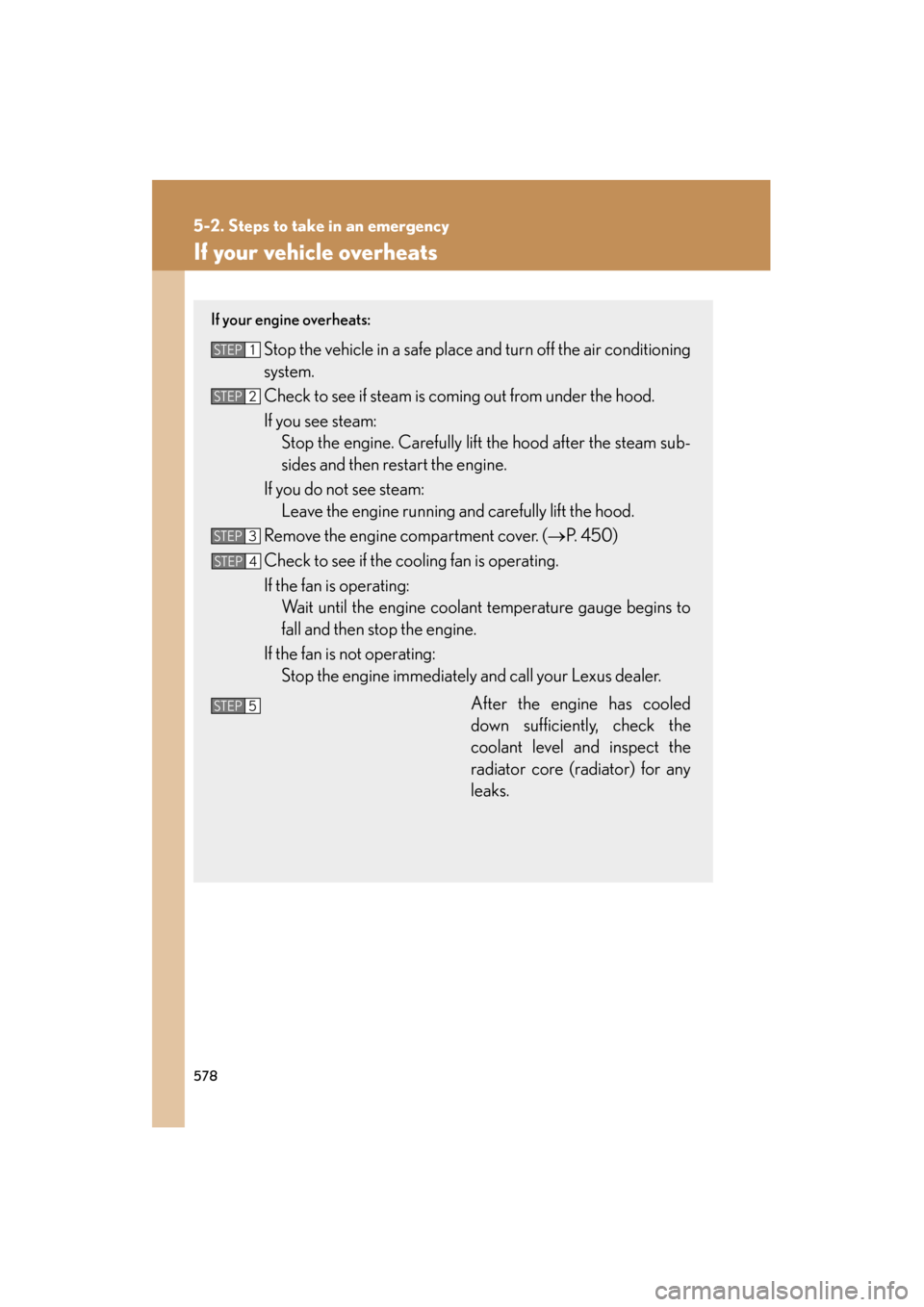
If your engine overheats:
Stop the vehicle in a safe place and turn off the air conditioning
system.
Check to see if steam is coming out from under the hood.
If you see steam: Stop the engine. Carefully lift the hood after the steam sub-
sides and then restart the engine.
If you do not see steam: Leave the engine running and carefully lift the hood.
Remove the engine compartment cover. ( →P. 4 5 0 )
Check to see if the cooling fan is operating.
If the fan is operating: Wait until the engine coolant temperature gauge begins to
fall and then stop the engine.
If the fan is not operating: Stop the engine immediately and call your Lexus dealer.
After the engine has cooled
down sufficiently, check the
coolant level and inspect the
radiator core (radiator) for any
leaks.STEP1
STEP2
STEP3
STEP4
STEP5
Page 580 of 654
5
When trouble arises
579
5-2. Steps to take in an emergency
GS_G_U (OM30C11U)
October 28, 2011 5:15 pm
■Overheating
In the following situations, your vehicle may be overheating.
●The engine coolant temperature gauge enters the red zone or a loss of power is
experienced.
●Steam is coming from under the hood.
CAUTION
■To prevent an accident or injury when inspecting under the hood of your vehicle
●If steam is seen coming from under the hood, do not open the hood until the
steam has subsided. The engine compartment may be very hot, causing serious
injury such as burns.
●Keep hands and clothing away from the fan and engine drive belt while the
engine is running.
●Do not loosen the radiator cap while the engine and radiator are hot.
Serious injury, such as burns, may result from hot coolant and steam released
under pressure.
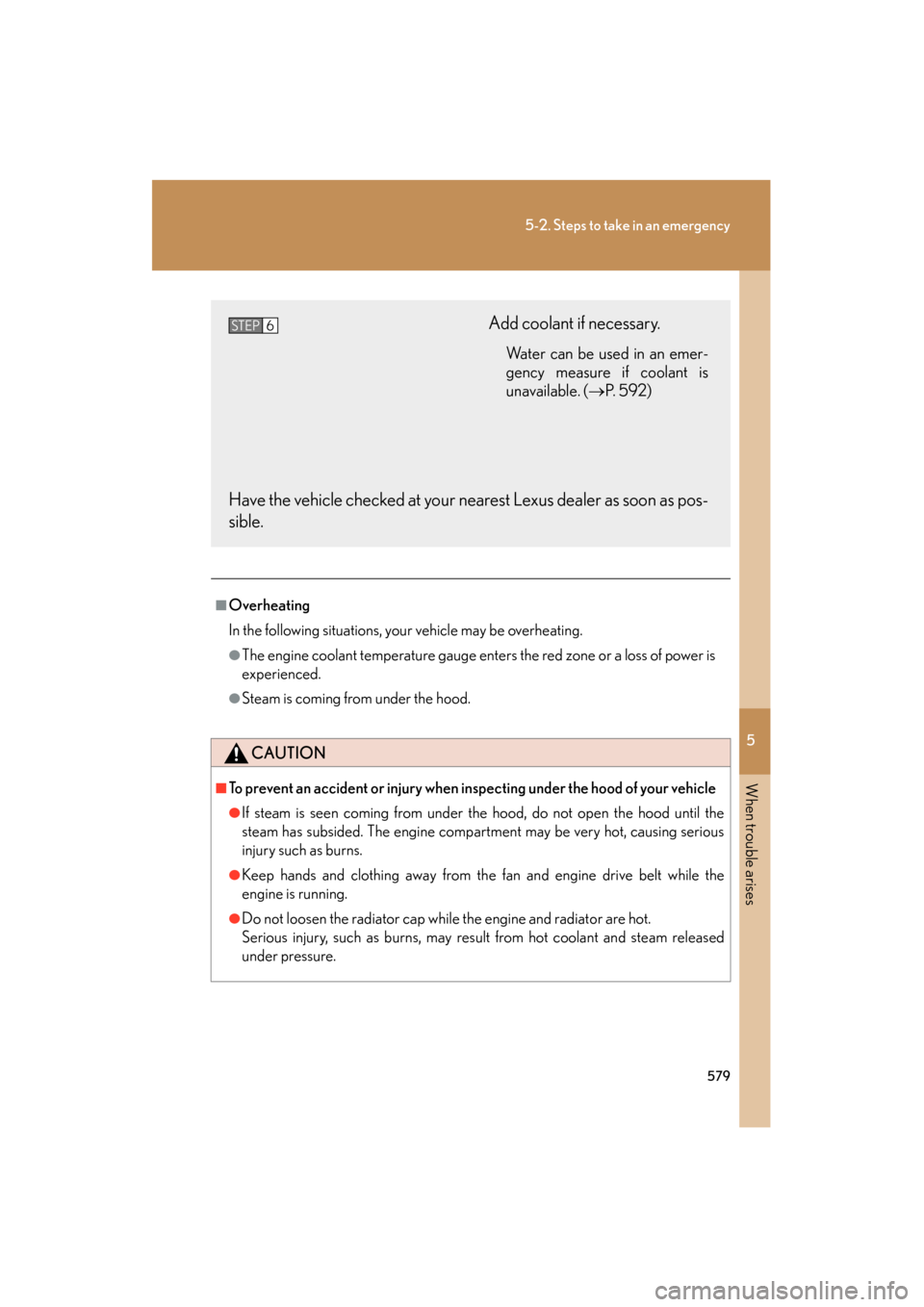
Add coolant if necessary.
Water can be used in an emer-
gency measure if coolant is
unavailable. (→P. 5 9 2 )
Have the vehicle checked at your nearest Lexus dealer as soon as pos-
sible.
STEP6
Page 609 of 654
608
6-1. Specifications
GS_G_U (OM30C11U)
October 28, 2011 5:15 pm
■Traction AA, A, B, C
The traction grades, from highest to lowest, are AA, A, B and C, and
they represent the tire’s ability to stop on wet pavement as measured
under controlled conditions on specified government test surfaces of
asphalt and concrete.
A tire marked C may have poor traction performance.
Warning: The traction grade assigned to this tire is based on braking
(straight ahead) traction tests and does not include cornering (turning) trac-
tion.
■ Temperature A, B, C
The temperature grades are A (the highest), B, and C, representing
the tire’s resistance to the generation of heat and its ability to dissipate
heat when tested under controlled conditions on a specified indoor
laboratory test wheel.
Sustained high temperature can cause the material of the tire to degenerate
and reduce tire life, and excessive temperature can lead to sudden tire fail-
ure.
The grade C corresponds to a level of performance which all passenger car
tires must meet under the Federal Motor Vehicle Safety Standard No. 109.
Grades B and A represent higher levels of performance on the laboratory
test wheel than the minimum required by law.
Warning: The temperature grades for this tire are established for a tire that
is properly inflated and not overloaded.
Excessive speed, underinflation, or excessive loading, either separately or in
combination, can cause heat buildup and possible tire failure.
Page 610 of 654
609
6-1. Specifications
6
Vehicle specifications
GS_G_U (OM30C11U)
October 28, 2011 5:15 pm
Glossary of tire terminology
Tire related termMeaning
Cold tire inflation pres-
sureTire pressure when the vehicle has been parked for
three hours or more, or has not been driven more
than 1 mile or 1.5 km under that condition
Maximum inflation pres-
sureThe maximum cold inflated pressure to which a tire
may be inflated, shown on the sidewall of the tire
Recommended inflation
pressureCold tire inflation pressure recommended by a man-
ufacturer
Accessory weight
The combined weight (in excess of those standard
items which may be replaced) of automatic transmis-
sion, power steering, power brakes, power windows,
power seats, radio and heater, to the extent that these
items are available as factory-installed equipment
(whether installed or not)
Curb weight
The weight of a motor vehicle with standard equip-
ment, including the maximum capacity of fuel, oil and
coolant, and if so equipped, air conditioning and
additional weight optional engine
Maximum loaded vehicle
weight
The sum of:
(a) Curb weight
(b) Accessory weight
(c) Vehicle capacity weight
(d) Production options weight
Normal occupant weight150 lb. (68 kg) times the number of occupants speci-
fied in the second column of Table 1
* that follows
Occupant distributionDistribution of occupants in a vehicle as specified in
the third column of Table 1
* below