ECO mode Lexus GS350 2020 Repair Manual
[x] Cancel search | Manufacturer: LEXUS, Model Year: 2020, Model line: GS350, Model: Lexus GS350 2020Pages: 600, PDF Size: 13.38 MB
Page 365 of 600
GS350_GS F_OM_OM30J07U_(U)
3656-1. Maintenance and care
6
Maintenance and care
WARNING
■When washing the vehicle
Do not apply water to the inside of the engine compartment. Doing so may cause the
electrical components etc. to catch fire.
■When cleaning the windshield (vehicles with rain-sensing windshield wipers)
●When the upper part of the windshield where the raindrop sensor is located is
touched by hand
●When a wet rag or similar is held close to the raindrop sensor
●If something bumps against the windshield
●If you directly touch the raindrop sensor body or if something bumps into the raindrop
sensor
■Precautions regarding the exhaust pipes and rear bumper diffusers
Exhaust gases cause the exhaust pipes and rear bumper diffusers to become quite hot.
When washing the vehicle, be careful not to touch the pipes and rear bumper diffusers
until they have cooled sufficiently, as touc hing hot exhaust pipes and rear bumper dif-
fusers can cause burns.
■Precaution regarding the rear bumper with Blind Spot Monitor (if equipped)
If the paint of the rear bumper is chipped or scratched, the system may malfunction. If
this occurs, consult your Lexus dealer.
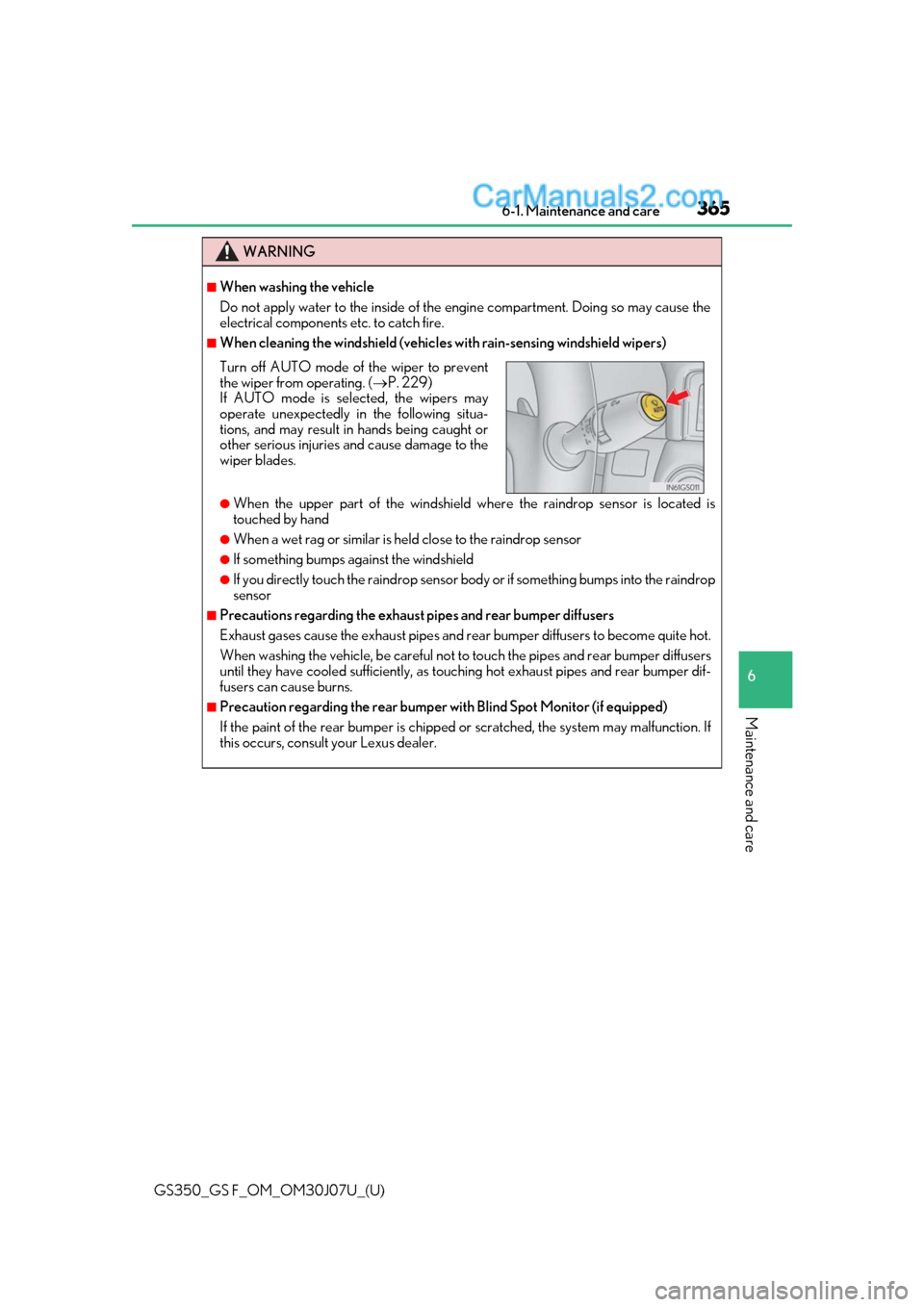
Turn off AUTO mode of the wiper to preventthe wiper from operating. ( P. 229)
If AUTO mode is selected, the wipers may
operate unexpectedly in the following situa-
tions, and may result in hands being caught or
other serious injuries and cause damage to the
wiper blades.
Page 366 of 600
366
GS350_GS F_OM_OM30J07U_(U)6-1. Maintenance and care
NOTICE
■Application of coatings to
the vehicle body (GS F)
Do not apply any kind of coating to the vehicle body as doing so may damage the paint
or reduce its durability.
■To prevent paint deterioration and corrosion on the body and components (aluminum
wheels etc.)
●Wash the vehicle immediately in the following cases:
• After driving near the sea coast
• After driving on salted roads
• If coal tar, pollen or tree sap is present on the paint surface
• If dead insects, insect droppings or bird droppings are present on the paint surface
• After driving in an area contaminated wi th soot, oily smoke, mine dust, iron pow-
der or chemical substances
• If the vehicle becomes heavily soiled with dust or mud
• If liquids such as benzene and gasoli ne are spilled on the paint surface
●If the paint is chipped or scratched, have it repaired immediately.
●To prevent the wheels from corroding, remove any dirt and store in a place with low
humidity when storing the wheels.
■Cleaning the exterior lights
●Wash carefully. Do not use organic subs tances or scrub with a hard brush.
This may damage the surfaces of the lights.
●Do not apply wax to the surfaces of the lights.
Wax may cause damage to the lenses.
■When using an automatic car wash (vehicles with rain-sensing windshield wipers)
Turn off AUTO mode of the wiper to prevent the wiper from operating. ( P. 229)
If AUTO mode is selected, the wipers may operate and the wiper blades may be dam-
aged.
■When using a high-pressure car wash
●When washing the vehicle, do not let water from the high-pressure washer directly hit
the camera or the area around the camera. Due to the shock from high-pressure
water, it is possible that the device may not operate normally.
●Do not bring the nozzle tip close to boots (rubber or resin manufactured cover), con-
nectors or the following parts. The parts may be damaged if they come into contact
with high-pressure water.
• Traction related parts
• Suspension parts
• Steering parts
• Brake parts
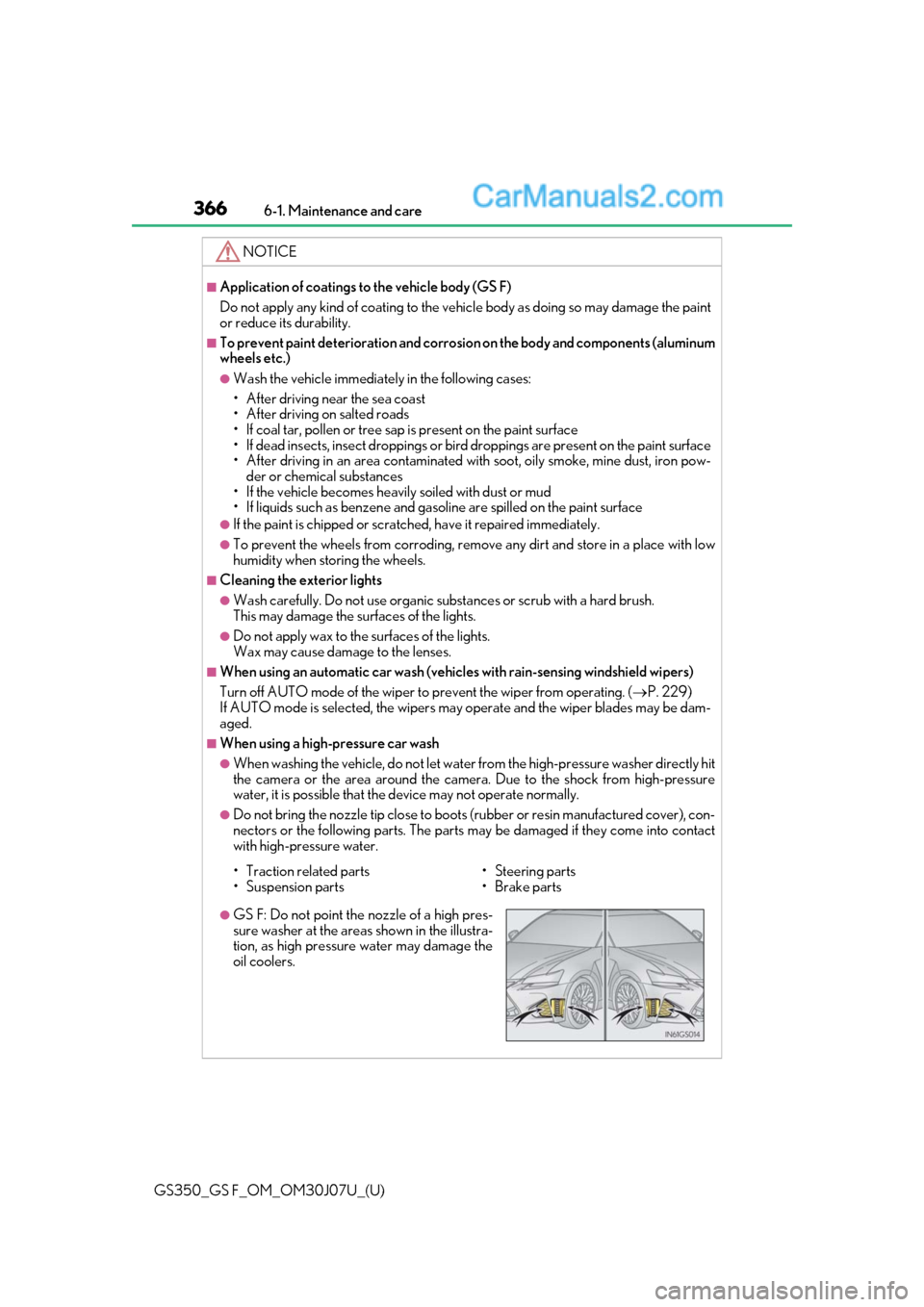
●GS F: Do not point the nozzle of a high pres-sure washer at the areas shown in the illustra-
tion, as high pressure water may damage the
oil coolers.
Page 377 of 600
GS350_GS F_OM_OM30J07U_(U)
3776-3. Do-it-yourself maintenance
6
Maintenance and care
WARNING
The engine compartment contains many mechan isms and fluids that may move suddenly,
become hot, or become electrically energize d. To avoid death or serious injury, observe
the following precautions.
■When working on the engine compartment
●Keep hands, clothing and tools away from the moving fan and engine drive belt.
●Be careful not to touch the engine, radiator, exhaust manifold, etc. right after driving
as they may be hot. Oil and other fluids may also be hot.
●Do not leave anything that may burn easily, such as paper and rags, in the engine
compartment.
●Do not smoke, cause sparks or expose an open flame to fuel or the battery. Fuel and
battery fumes are flammable.
●Be extremely cautious when working on the battery. It contains poisonous and corro-
sive sulfuric acid.
■When working near the electric cooling fans or radiator grille
Be sure the engine switch is off.
With the engine switch in IGNITION ON mode, the electric cooling fans may auto-
matically start to run if the air conditioning is on and/or the coolant temperature is high.
( P. 389)
■Safety glasses
Wear safety glasses to prevent flying or falling material, fluid spray, etc. from getting in
your eyes.
NOTICE
■If you remove the air cleaner filter
Driving with the air cleaner f ilter removed may cause excessive engine wear due to dirt
in the air.
Page 391 of 600

GS350_GS F_OM_OM30J07U_(U)
3916-3. Do-it-yourself maintenance
6
Maintenance and care
Check the battery as follows.
■Battery exterior
Make sure that the battery terminals are not corroded and that there are no
loose connections, cracks, or loose clamps.
Terminals
Hold-down clamp
■Before recharging
When recharging, the battery produces hydrogen gas which is flammable and explosive.
Therefore, observe the following before recharging:
●If recharging with the battery installed on the vehicle, be sure to disconnect the ground
cable.
●Make sure the power switch on the charge r is off when connecting and disconnecting
the charger cables to the battery.
■After recharging/reconnecting the battery
The engine may not start. Follow the procedure below to initialize the system.
Shift the shift lever to P.
Open and close any of the doors.
Restart the engine.
●Unlocking the doors using the smart access system with push-button start may not be
possible immediately after reconnecting the battery. If this happens, use the wireless
remote control or the mechanical key to lock/unlock the doors.
●Start the engine with the engine switch in ACCESSORY mode. The engine may not
start with the engine switch turned off. However, the engine will operate normally from
the second attempt.
●The engine switch mode is recorded by the vehicle. If the battery is reconnected, the
vehicle will return the engine switch mode to the status it was in before the battery was
disconnected. Make sure to turn off the engine before disconnect the battery. Take
extra care when connecting the battery if the engine switch mode prior to discharge is
unknown.
If the engine will not start even after multiple attempts at both methods, contact your
Lexus dealer.
Battery
1
2
1
2
3
Page 399 of 600
GS350_GS F_OM_OM30J07U_(U)
3996-3. Do-it-yourself maintenance
6
Maintenance and care
■Situations in which the tire pressure warning system may not operate properly
●In the following cases, the tire pressure warning system may not operate properly.
• If non-genuine Lexus wheels are used.
• A tire has been replaced with a tire that is not an OE (Original Equipment) tire.
• A tire has been replaced with a tire that is not of the specified size.
• Tire chains etc. are equipped.
• An auxiliary-supported run-flat tire is equipped.
• If a window tint that affects th e radio wave signals is installed.
• If there is a lot of snow or ice on the vehi cle, particularly around the wheels or wheel
housings.
• If the tire inflation pressure is extr emely higher than the specified level.
• If wheel without the tire pressure warning valve and transmitter are used.
• If the ID code on the tire pressure warning valves and transmitters is not registered
in the tire pressure warning computer.
●Performance may be affected in the following situations.
• Near a TV tower, electric power plant, gas station, radio station, large display, air-
port or other facility that generates st rong radio waves or electrical noise
• When carrying a portable radio, cellular phone, cordless phone or other wireless
communication device
If tire position information is not correctly displayed due to the radio wave conditions,
the display may be corrected by driving and changing the radio wave conditions.
●When the vehicle is parked, the time taken for the warning to start or go off could be
extended.
●When tire inflation pressure declines rapidly for example when a tire has burst, the
warning may not function.
■The initialization operation
●Make sure to carry out initialization afte r adjusting the tire inflation pressure.
Also, make sure the tires are cold before carryi ng out initialization or tire inflation pres-
sure adjustment.
●If you have accidentally turned the engine swit ch off during initialization, it is not neces-
sary to manually restart the in itialization again, as initialization will restart automatically
the next time the engine switch is turned to IGNITION ON mode.
●If you accidentally perform initialization when initialization is not necessary, adjust the
tire inflation pressure to the specified leve l when the tires are cold, and conduct initial-
ization again.
■When initialization of the tire pressure warning system has failed
Initialization can be completed in a few minutes. However, in the following cases, the set-
tings have not been recorded and the system will not operate properly. If repeated
attempts to record tire inflation pressure settings are unsuccessful, have the vehicle
inspected by your Lexus dealer.
●The initialization message is not displayed on the multi-information display when per-
forming initialization.
●After carrying out the initializat ion procedure, the tire pressure warning light blinks for 1
minute then stays on after driving for 20 minutes.
Page 402 of 600
402
GS350_GS F_OM_OM30J07U_(U)6-3. Do-it-yourself maintenance
WARNING
■When inspecting or replacing tires
Observe the following precautions to prevent accidents.
Failure to do so may cause damage to parts of the drive train as well as dangerous han-
dling characteristics,
which may lead to an accident resulting in death or serious injury.
●Do not mix tires of different makes, models or tread patterns.
Also, do not mix tires of remarkably different treadwear.
●Do not use tire sizes other than those recommended by Lexus.
●Do not mix differently constructed tires (radial, bias-belted or bias-ply tires).
●Do not mix summer, all season and snow tires.
●Do not use tires that have been used on another vehicle.
Do not use tires if you do not know how they were used previously.
●Vehicles with spare tire: Do not tow if your vehicle has a spare tire installed.
●Vehicles with emergency tire puncture repair kit: Do not tow anything if a tire that has
been repaired using the emergency tire puncture repair kit is in stalled. The load on
the tire may cause unexpected damage to the tire.
■When initializing the tire pressure warning system
Do not initialize tire inflatio n pressure without first adjustin g the tire inflation pressure to
the specified level. Otherwise, the tire pre ssure warning light may not come on even if
the tire inflation pressure is low, or it ma y come on when the tire inflation pressure is
actually normal.
■Caution regarding interference with electronic devices
●Users of any electrical medical device ot her than implantable cardiac pacemakers,
cardiac resynchronization th erapy-pacemakers or implantable cardioverter defibril-
lators should consult the manufacturer of the device for information about its opera-
tion under the influence of radio waves.
Radio waves could have unexpected effects on the operation of such medical
devices.
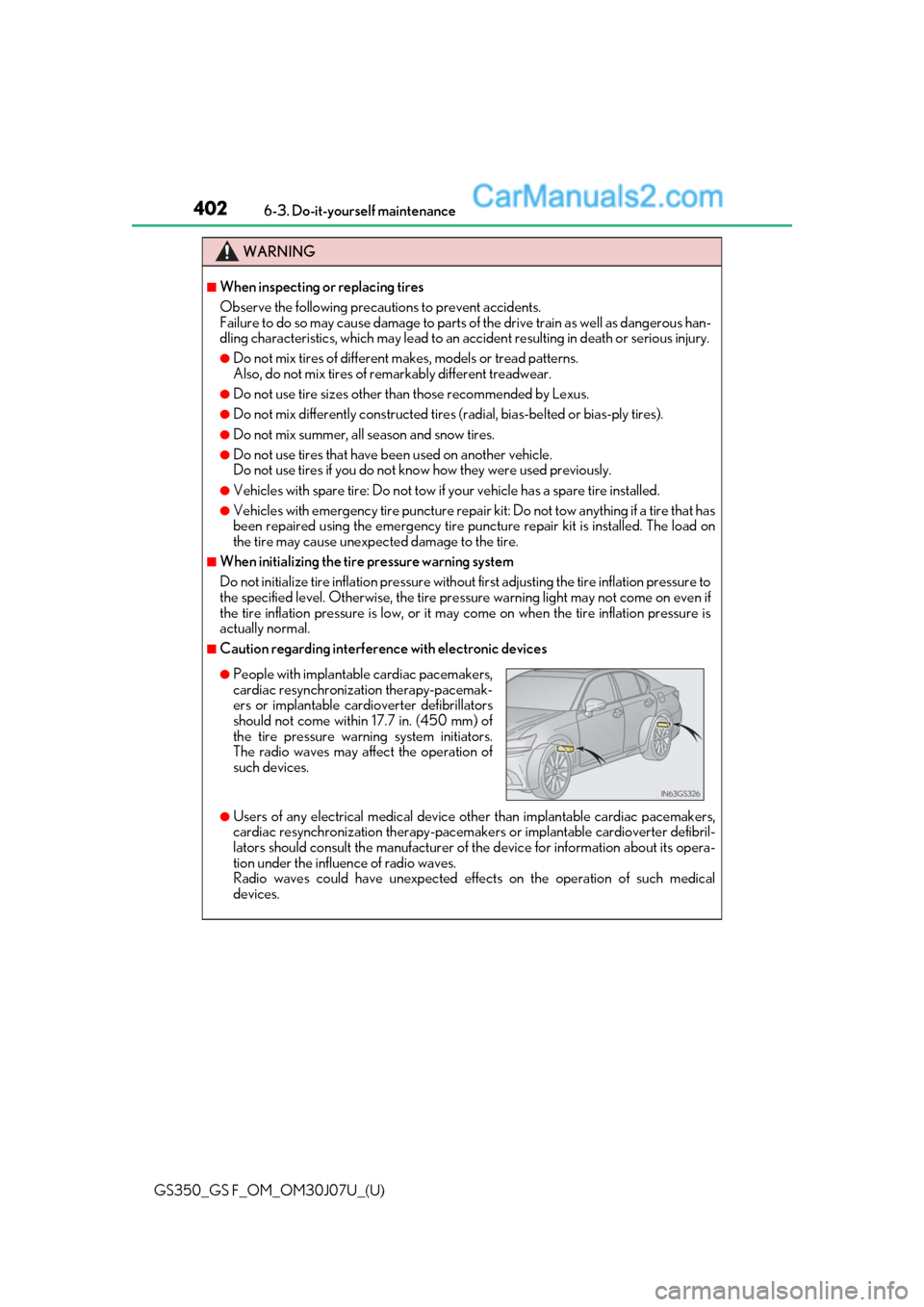
●People with implantabl e cardiac pacemakers,cardiac resynchronization therapy-pacemak-
ers or implantable cardioverter defibrillators
should not come within 17.7 in. (450 mm) of
the tire pressure warn ing system initiators.
The radio waves may affect the operation of
such devices.
Page 407 of 600

407
GS350_GS F_OM_OM30J07U_(U)6-3. Do-it-yourself maintenance
6
Maintenance and care
Wheels
When replacing wheels, care should be ta
ken to ensure that they are equivalent
to those removed in load capacity, diameter, rim width and inset
*.
Replacement wheels are available at your Lexus dealer.
*: Conventionally referred to as “offset”.
Lexus does not recommend using the following:
●Wheels of different sizes or types
●Used wheels
●Bent wheels that have been straightened
●Steel wheels (2WD F SPORT models only)
●Use only Lexus wheel nuts and wrenches designed for use with your alumi-
num wheels.
●When rotating, repairing or changing your tires, check that the wheel nuts are
still tight after driving 1000 miles (1600 km).
●Be careful not to damage the aluminum wheels when using tire chains.
●Use only Lexus genuine balance weights or equivalent and a plastic or rubber
hammer when balancing your wheels.
■When replacing wheels
The wheels of your vehicle are equipped with tire pressure warning valves and transmit-
ters that allow the tire pressure warning system to provide advance warning in the event
of a loss in tire inflation pressure. Whenever wheels are replaced, tire pressure warning
valves and transmitters must be installed. (P. 395)
If a wheel is bent, cracked or heavily corroded, it should be replaced. Other-
wise, the tire may separate from the wheel or cause a loss of handling control.
Wheel selection
Aluminum wheel precautions
Page 408 of 600
408
GS350_GS F_OM_OM30J07U_(U)6-3. Do-it-yourself maintenance
WARNING
■When replacing wheels
●Do not use wheels that are a different size from those recommended in the Owner’s
Manual, as this may result in a loss of handling control.
●Never use an inner tube in a leaking wheel which is designed for a tubeless tire. Doing
so may result in an accident, causing death or serious injury.
●2WD F SPORT models: Do not install steel wheels.
The wheel contact surface could be damaged, and the wheel could come off while
driving, which could lead to an accident
resulting in death or serious injury.
■Use of defective wheels prohibited
Do not use cracked or deformed wheels.
Doing so could cause the tire to leak air during driving, possibly causing an accident.
NOTICE
■Replacing tire pressure warning valves and transmitters
●Because tire repair or replacement may affect the tire pressure warning valves and
transmitters, make sure to have tires serviced by your Lexus dealer or other qualified
service shop. In addition, make sure to purchase your tire pressure warning valves
and transmitters at your Lexus dealer.
●Ensure that only genuine Lexus wheels are used on your vehicle.
Tire pressure warning valves and transmitters may not work properly with non-genu-
ine wheels.
Page 431 of 600
4317-2. Steps to take in an emergency
GS350_GS F_OM_OM30J07U_(U)
7
When trouble arises
WARNING
Observe the following precautions.
Failure to do so may result in death or serious injury.
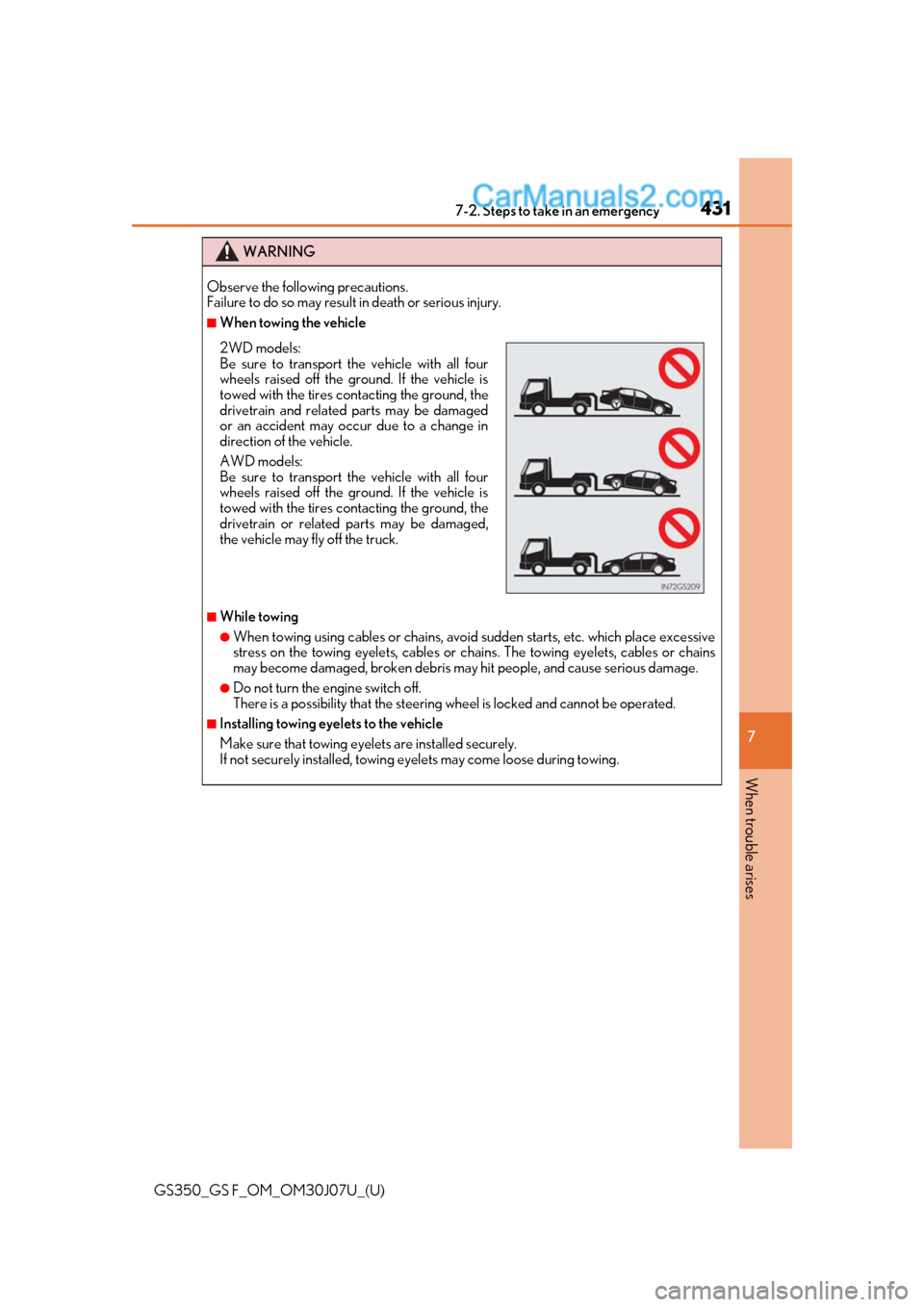
■When towing the vehicle
■While towing
●When towing using cables or chains, avoid sudden starts, etc. which place excessive
stress on the towing eyelets, cables or chains. The towing eyelets, cables or chains
may become damaged, broken debris may hit people, and cause serious damage.
●Do not turn the engine switch off.
There is a possibility that the steering wheel is locked and cannot be operated.
■Installing towing eyelets to the vehicle
Make sure that towing eyel ets are installed securely.
If not securely installed, towing ey elets may come loose during towing.
2WD models:
Be sure to transport the vehicle with all four
wheels raised off the ground. If the vehicle is
towed with the tires contacting the ground, the
drivetrain and related parts may be damaged
or an accident may occur due to a change in
direction of the vehicle.
AWD models:
Be sure to transport the vehicle with all four
wheels raised off the ground. If the vehicle is
towed with the tires contacting the ground, the
drivetrain or related parts may be damaged,
the vehicle may fly off the truck.
Page 438 of 600
4387-2. Steps to take in an emergency
GS350_GS F_OM_OM30J07U_(U)
*1: Open door warning buzzer: P. 442
*2: Driver’s seat belt buzzer:
The driver’s seat belt buzzer sounds to alert the driver that his or her seat belt is not
fastened. Once the engine switch is turned to IGNITION ON mode, the buzzer
sounds for 6 seconds. If the vehicle reaches a speed of 12 mph (20 km/h), the buzzer
sounds once. If the seat belt is still unfast ened after 24 seconds, the buzzer will sound
intermittently for 10 seconds. Then, if the se at belt is still unfastened, the buzzer will
sound in a different tone for 20 more seconds.
Front passenger’s seat belt buzzer:
The front passenger’s seat belt buzzer soun ds to alert the front passenger that his or
her seat belt is not fastened. The buzzer so unds once if the vehicle reaches a speed of
12 mph (20 km/h). If the seat belt is still unfastened after 24 se conds, the buzzer will
sound intermittently for 10 se conds. Then, if the seat belt is still unfastened, the buzzer
will sound in a different to ne for 20 more seconds.
(If equipped)
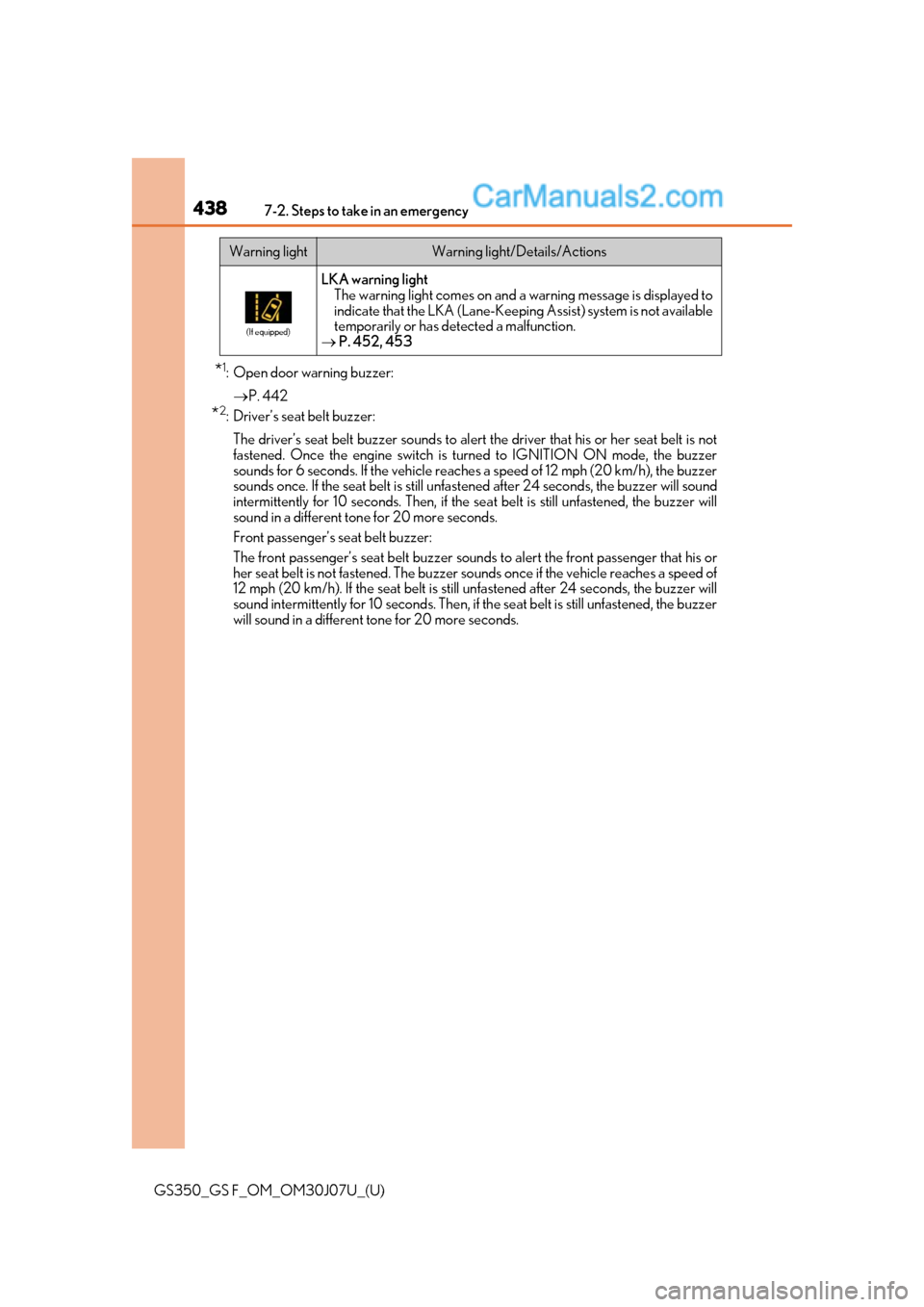
LKA warning light
The warning light comes on and a warning message is displayed to
indicate that the LKA (Lane-Keepin g Assist) system is not available
temporarily or has detected a malfunction.
P. 452, 453
Warning lightWarning light/Details/Actions