wheel Lexus GX460 2013 Owner's Manual
[x] Cancel search | Manufacturer: LEXUS, Model Year: 2013, Model line: GX460, Model: Lexus GX460 2013Pages: 846, PDF Size: 19.76 MB
Page 739 of 846
738
5-2. Steps to take in an emergency
GX460_OM_OM60J63U_(U)
CAUTION
■Replacing a flat tire
●Do not touch the disc wheels or the area around the brakes immediately after the
vehicle has been driven.
After the vehicle has been driven the disc wheels and the area around the brakes
will be extremely hot. Touching these areas with hands, feet or other body parts
while changing a tire, etc. may result in burns.
●Failure to follow these precautions could cause the wheel nuts to loosen and the
tire to fall off, resulting in death or serious injury.
• Lower the spare tire completely to the ground before removing it from underthe vehicle.
• Do not try to remove the wheel ornament by hand. Take due care in handling the ornament to avoid unexpected personal injury.
• Have the wheel nuts tightened with a torque wrench to 83 ft•lbf (112 N•m, 11.4 kgf•m) as soon as possible after changing wheels.
• Do not attach a heavily damaged wheel ornament, as it may fly off the wheel while the vehicle is moving.
• When installing a tire, only use wheel nuts that have been specifically designed for that wheel.
• If there are any cracks or deformations in the bolt screws, nut threads or bolt holes of the wheel, have the vehicle inspected by your Lexus dealer.
• When installing the wheel nuts, be sure to install them with the tapered ends facing inward. ( →P. 6 4 8 )
■After using the tools and jack
Before driving, make sure all the tools and jack are securely in place in their storage
location to reduce the possibility of personal injury during a collision or sudden
braking.
GX460_OM_OM60J63U_(U).book Page 738 Thursday, March 29, 2012 9:10 AM
Page 740 of 846
5
When trouble arises
739
5-2. Steps to take in an emergency
GX460_OM_OM60J63U_(U)
NOTICE
■Do not drive the vehicle with a flat tire
Do not continue driving with a flat tire.
Driving even a short distance with a flat tire can damage the tire and the wheel
beyond repair.
■When stowing the flat tire
●Ensure that there is no object caught between the tire and the vehicle underbody.
●To avoid damaging the suspension system, make sure that the spare tire does not
interfere with the suspension components when stowed.
■When replacing the tires
When removing or fitting the wheels, tires or the tire pressure warning valve and
transmitter, contact your Lexus dealer as the tire pressure warning valve and trans-
mitter may be damaged if not handled correctly.
■To avoid damage to the tire pressure warning valves and transmitters
When a tire is repaired with liquid sealants, the tire pressure warning valve and
transmitter may not operate properly. If a liquid sealant is used, contact your Lexus
dealer or other qualified service shop as soon as possible. Make sure to replace the
tire pressure warning valve and transmitter when replacing the tire. (→P. 6 3 7 )
GX460_OM_OM60J63U_(U).book Page 739 Thursday, March 29, 2012 9:10 AM
Page 754 of 846
5
When trouble arises
753
5-2. Steps to take in an emergency
GX460_OM_OM60J63U_(U)
CAUTION
■When attempting to free a stuck vehicle
If you choose to push the vehicle back and forth to free it, make sure the surround-
ing area is clear, to avoid striking other vehicles, objects or persons. The vehicle
may also lunge forward or lunge back suddenly as it becomes free. Use extreme
caution.
■When shifting the shift lever
Be careful not to shift the shift lever with the accelerator pedal depressed.
This may lead to unexpected rapid acceleration of the vehicle that may cause an
accident and result in death or serious injury.
NOTICE
■To avoid damaging the transmission and other components
●Avoid spinning the wheels and rev the engine.
●If the vehicle remains stuck even after trying these procedures, the vehicle may
require towing to be freed.
GX460_OM_OM60J63U_(U).book Page 753 Thursday, March 29, 2012 9:10 AM
Page 756 of 846
5
When trouble arises
755
5-2. Steps to take in an emergency
GX460_OM_OM60J63U_(U)
CAUTION
■If the engine has to be turned off while driving
Power assist for the brakes and steering wheel will be lost, making the brake pedal
harder to depress and the steering wheel heavier to turn. Decelerate as much as
possible before turning off the engine.
GX460_OM_OM60J63U_(U).book Page 755 Thursday, March 29, 2012 9:10 AM
Page 759 of 846
758
GX460_OM_OM60J63U_(U)
6-1. Specifications
Maintenance data (fuel, oil level, etc.)
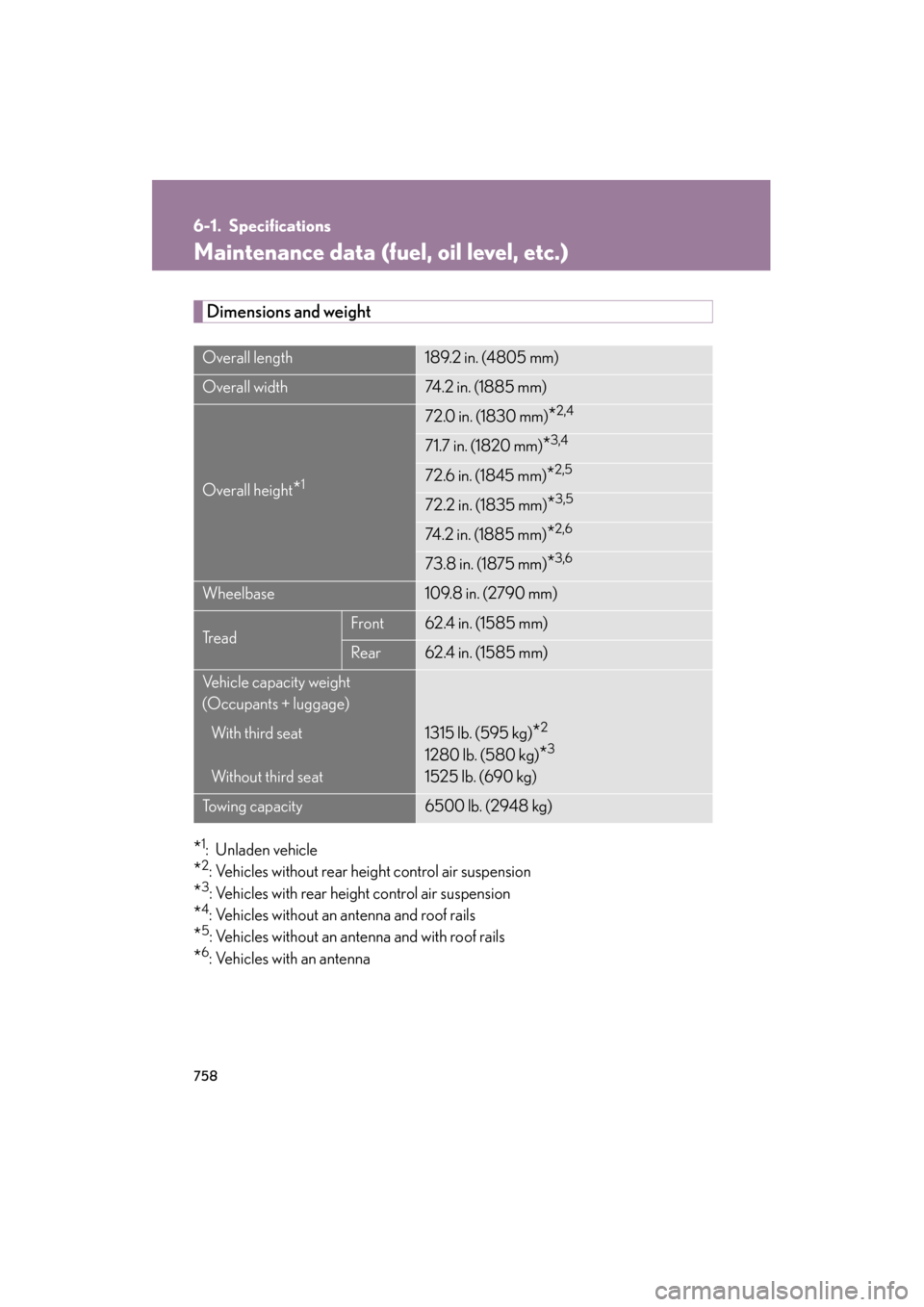
Dimensions and weight
*1:Unladen vehicle
*2: Vehicles without rear height control air suspension
*3: Vehicles with rear height control air suspension
*4: Vehicles without an antenna and roof rails
*5: Vehicles without an antenna and with roof rails
*6: Vehicles with an antenna
Overall length189.2 in. (4805 mm)
Overall width74.2 in. (1885 mm)
Overall height*1
72.0 in. (1830 mm)*2,4
71.7 in. (1820 mm)*3,4
72.6 in. (1845 mm)*2,5
72.2 in. (1835 mm)*3,5
74.2 in. (1885 mm)*2,6
73.8 in. (1875 mm)*3,6
Wheelbase109.8 in. (2790 mm)
Tr e a dFront62.4 in. (1585 mm)
Rear62.4 in. (1585 mm)
Vehicle capacity weight
(Occupants + luggage)
With third seat
Without third seat1315 lb. (595 kg)*2
1280 lb. (580 kg)*3
1525 lb. (690 kg)
Towing capacity6500 lb. (2948 kg)
GX460_OM_OM60J63U_(U).book Page 758 Thursday, March 29, 2012 9:10 AM
Page 769 of 846
768
6-1. Specifications
GX460_OM_OM60J63U_(U)
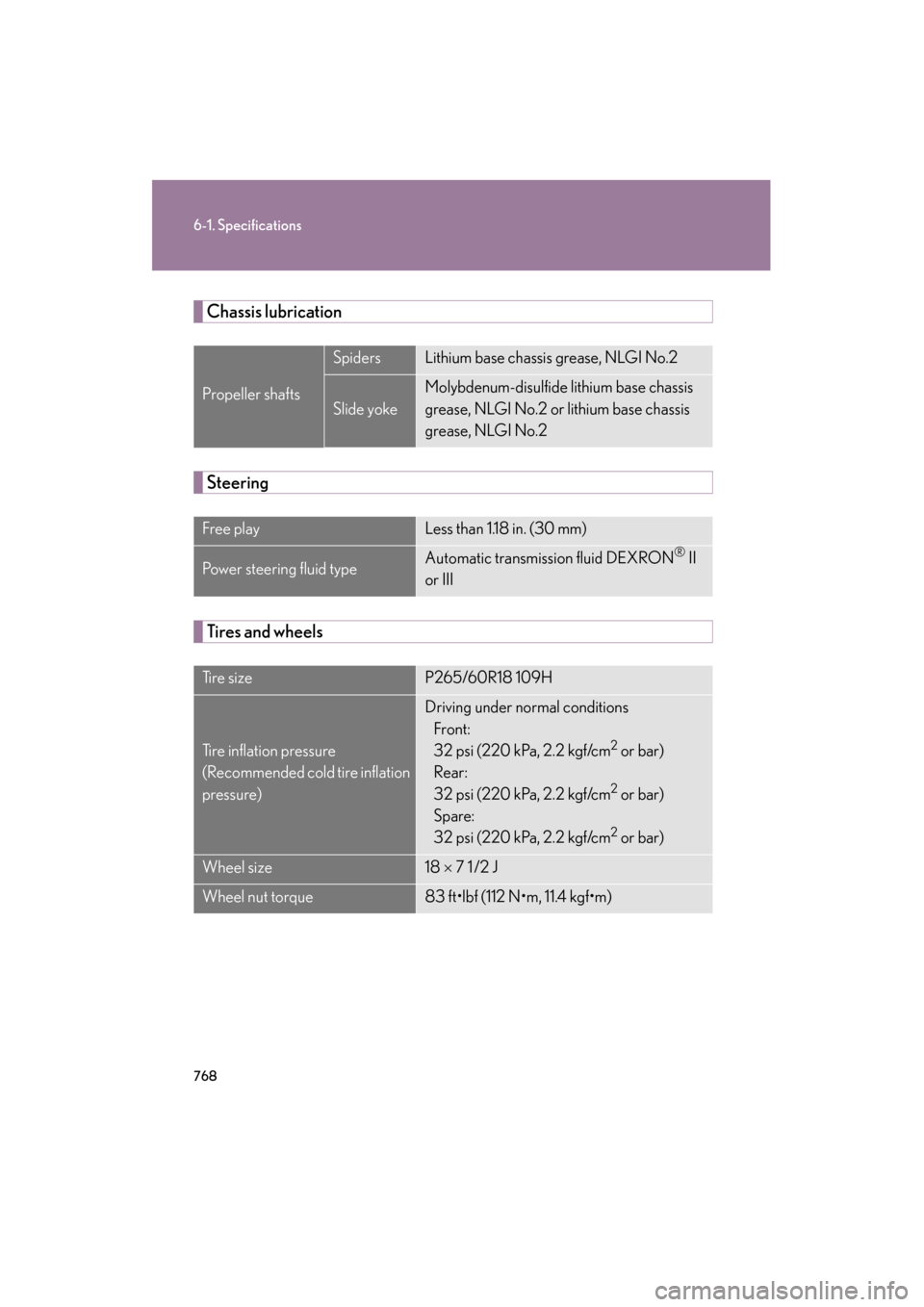
Chassis lubrication
Steering
Tires and wheels
Propeller shafts
SpidersLithium base chassis grease, NLGI No.2
Slide yoke
Molybdenum-disulfide lithium base chassis
grease, NLGI No.2 or lithium base chassis
grease, NLGI No.2
Free playLess than 1.18 in. (30 mm)
Power steering fluid typeAutomatic transmission fluid DEXRON® II
or III
Ti r e s i z eP265/60R18 109H
Tire inflation pressure
(Recommended cold tire inflation
pressure)
Driving under normal conditions Front:
32 psi (220 kPa, 2.2 kgf/cm
2 or bar)
Rear:
32 psi (220 kPa, 2.2 kgf/cm
2 or bar)
Spare:
32 psi (220 kPa, 2.2 kgf/cm
2 or bar)
Wheel size18 × 7 1 /2 J
Wheel nut torque83 ft•lbf (112 N•m, 11.4 kgf•m)
GX460_OM_OM60J63U_(U).book Page 768 Thursday, March 29, 2012 9:10 AM
Page 777 of 846
776
6-1. Specifications
GX460_OM_OM60J63U_(U)
Tire size
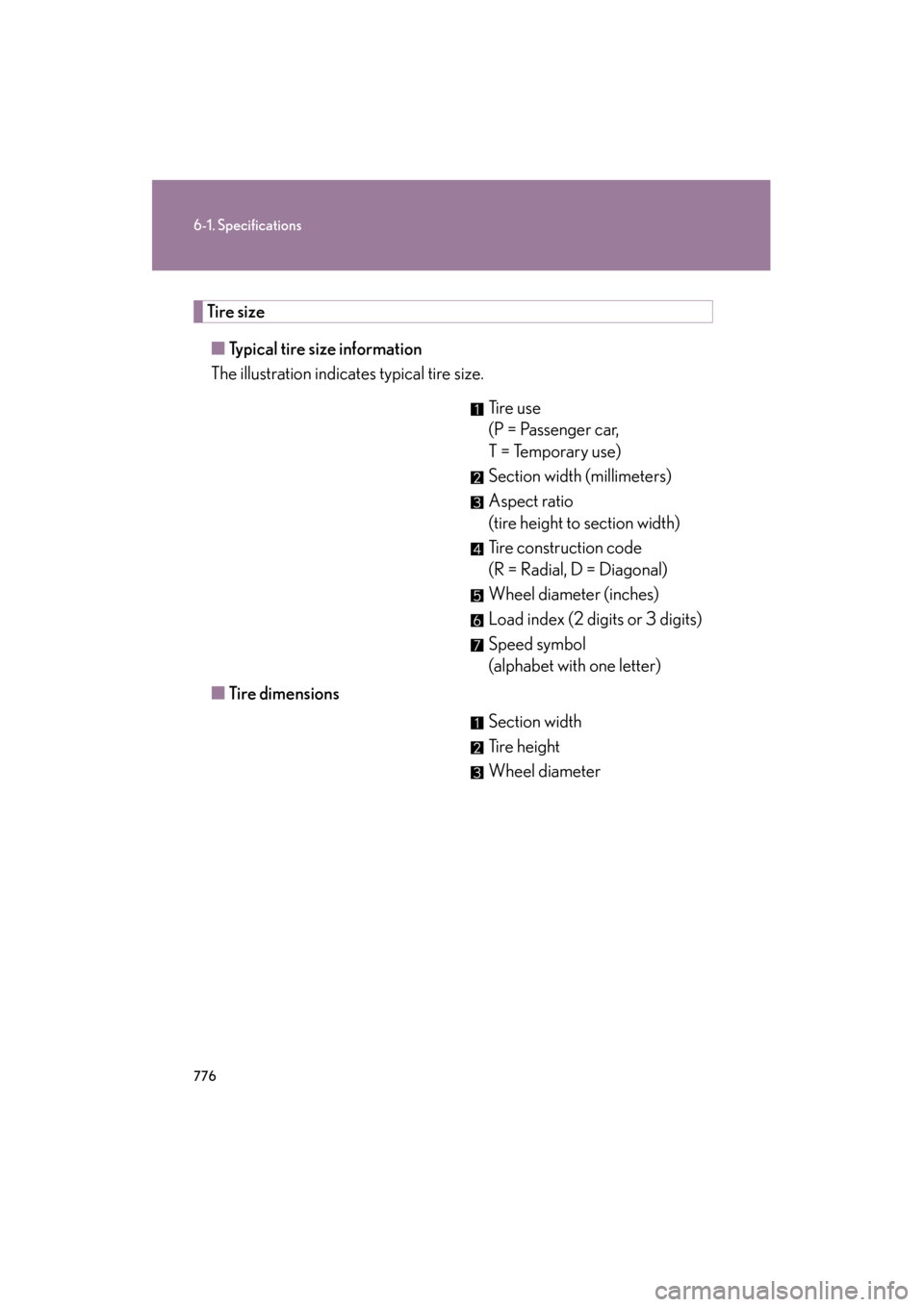
■ Typical tire size information
The illustration indicates typical tire size.
Ti r e u s e
(P = Passenger car,
T = Temporary use)
Section width (millimeters)
Aspect ratio
(tire height to section width)
Tire construction code
(R = Radial, D = Diagonal)
Wheel diameter (inches)
Load index (2 digits or 3 digits)
Speed symbol
(alphabet with one letter)
■ Tire dimensions
Section width
Ti r e h e i g h t
Wheel diameter
GX460_OM_OM60J63U_(U).book Page 776 Thursday, March 29, 2012 9:10 AM
Page 780 of 846
779
6-1. Specifications
6
Vehicle specifications
GX460_OM_OM60J63U_(U)■
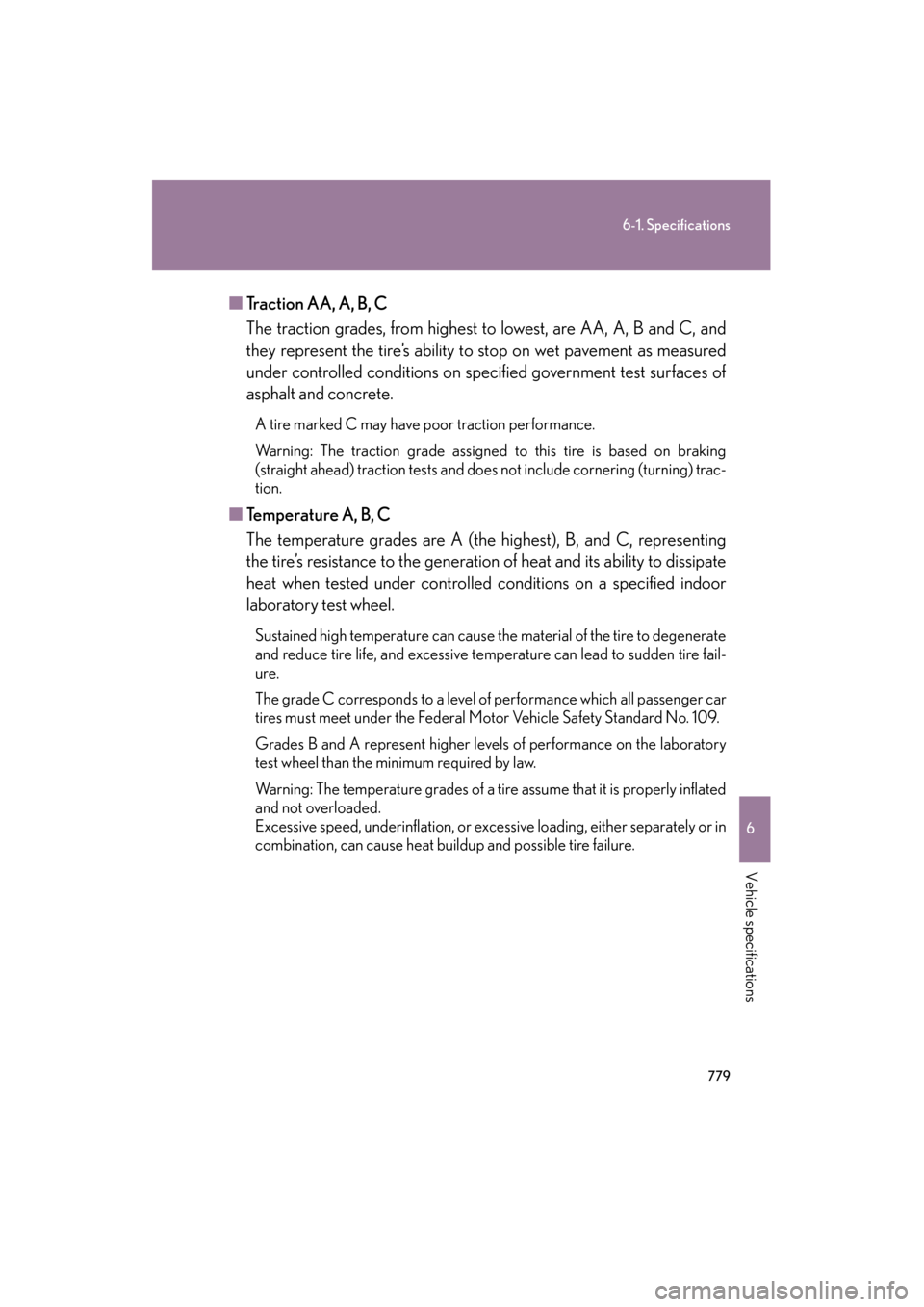
Traction AA, A, B, C
The traction grades, from highest to lowest, are AA, A, B and C, and
they represent the tire’s ability to stop on wet pavement as measured
under controlled conditions on specified government test surfaces of
asphalt and concrete.
A tire marked C may have poor traction performance.
Warning: The traction grade assigned to this tire is based on braking
(straight ahead) traction tests and does not include cornering (turning) trac-
tion.
■Temperature A, B, C
The temperature grades are A (the highest), B, and C, representing
the tire’s resistance to the generation of heat and its ability to dissipate
heat when tested under controlled conditions on a specified indoor
laboratory test wheel.
Sustained high temperature can cause the material of the tire to degenerate
and reduce tire life, and excessive temperature can lead to sudden tire fail-
ure.
The grade C corresponds to a level of performance which all passenger car
tires must meet under the Federal Motor Vehicle Safety Standard No. 109.
Grades B and A represent higher levels of performance on the laboratory
test wheel than the minimum required by law.
Warning: The temperature grades of a tire assume that it is properly inflated
and not overloaded.
Excessive speed, underinflation, or excessive loading, either separately or in
combination, can cause heat buildup and possible tire failure.
GX460_OM_OM60J63U_(U).book Page 779 Thursday, March 29, 2012 9:10 AM
Page 782 of 846
781
6-1. Specifications
6
Vehicle specifications
GX460_OM_OM60J63U_(U)
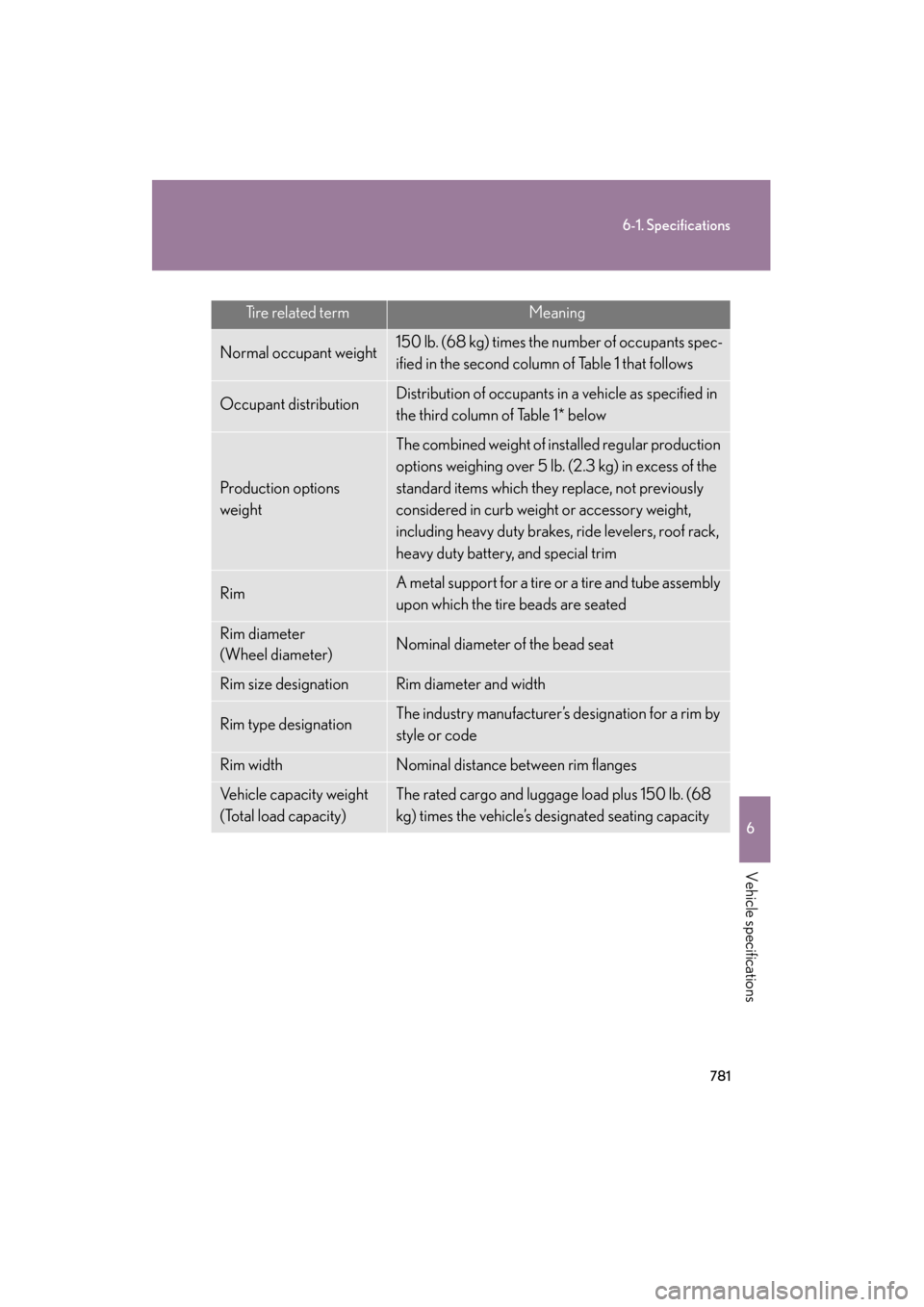
Tire related termMeaning
Normal occupant weight150 lb. (68 kg) times the number of occupants spec-
ified in the second column of Table 1 that follows
Occupant distributionDistribution of occupants in a vehicle as specified in
the third column of Table 1* below
Production options
weight
The combined weight of installed regular production
options weighing over 5 lb. (2.3 kg) in excess of the
standard items which they replace, not previously
considered in curb weight or accessory weight,
including heavy duty brakes, ride levelers, roof rack,
heavy duty battery, and special trim
RimA metal support for a tire or a tire and tube assembly
upon which the tire beads are seated
Rim diameter
(Wheel diameter)Nominal diameter of the bead seat
Rim size designationRim diameter and width
Rim type designationThe industry manufacturer’s designation for a rim by
style or code
Rim widthNominal distance between rim flanges
Vehicle capacity weight
(Total load capacity)The rated cargo and luggage load plus 150 lb. (68
kg) times the vehicle’s designated seating capacity
GX460_OM_OM60J63U_(U).book Page 781 Thursday, March 29, 2012 9:10 AM
Page 786 of 846
785
6-1. Specifications
6
Vehicle specifications
GX460_OM_OM60J63U_(U)
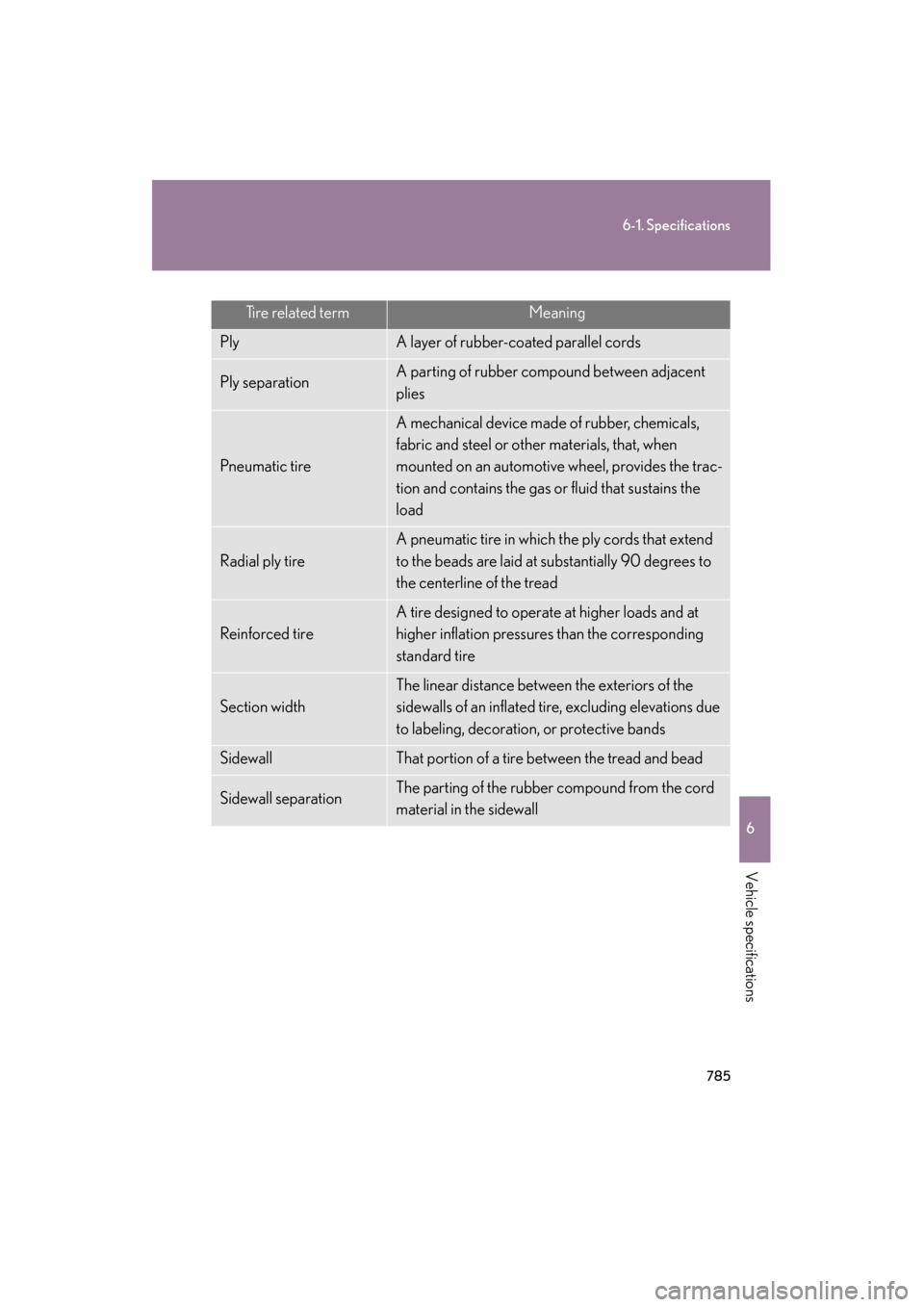
Tire related termMeaning
PlyA layer of rubber-coated parallel cords
Ply separationA parting of rubber compound between adjacent
plies
Pneumatic tire
A mechanical device made of rubber, chemicals,
fabric and steel or other materials, that, when
mounted on an automotive wheel, provides the trac-
tion and contains the gas or fluid that sustains the
load
Radial ply tire
A pneumatic tire in which the ply cords that extend
to the beads are laid at substantially 90 degrees to
the centerline of the tread
Reinforced tire
A tire designed to operate at higher loads and at
higher inflation pressures than the corresponding
standard tire
Section width
The linear distance between the exteriors of the
sidewalls of an inflated tire, excluding elevations due
to labeling, decoration, or protective bands
SidewallThat portion of a tire between the tread and bead
Sidewall separationThe parting of the rubber compound from the cord
material in the sidewall
GX460_OM_OM60J63U_(U).book Page 785 Thursday, March 29, 2012 9:10 AM