parking brake Lexus GX460 2013 Specifications /
[x] Cancel search | Manufacturer: LEXUS, Model Year: 2013, Model line: GX460, Model: Lexus GX460 2013Pages: 844, PDF Size: 10.42 MB
Page 183 of 844

183
2-1. Driving procedures
2
When driving
GX460_OM_OM60J63U_(U)
Engine (ignition) switch
Performing the following operations when carrying the electronic key on
your person starts the engine or changes “ENGINE START STOP” switch
modes.
■Starting the engine
Check that the parking brake is set.
Check that the shift lever is set in P.
Firmly depress the brake pedal.
The “ENGINE START STOP” switch indicator will turn green. If the
indicator does not turn green, the engine cannot be started.
Press the “ENGINE START
STOP” switch.
The engine will crank until it
starts or for up to 25 seconds,
whichever is less.
Continue depressing the brake
pedal until the engine is com-
pletely started.
The engine can be started from
any “ENGINE START STOP”
switch mode.
STEP1
STEP2
STEP3
STEP4
Page 184 of 844
184
2-1. Driving procedures
GX460_OM_OM60J63U_(U)
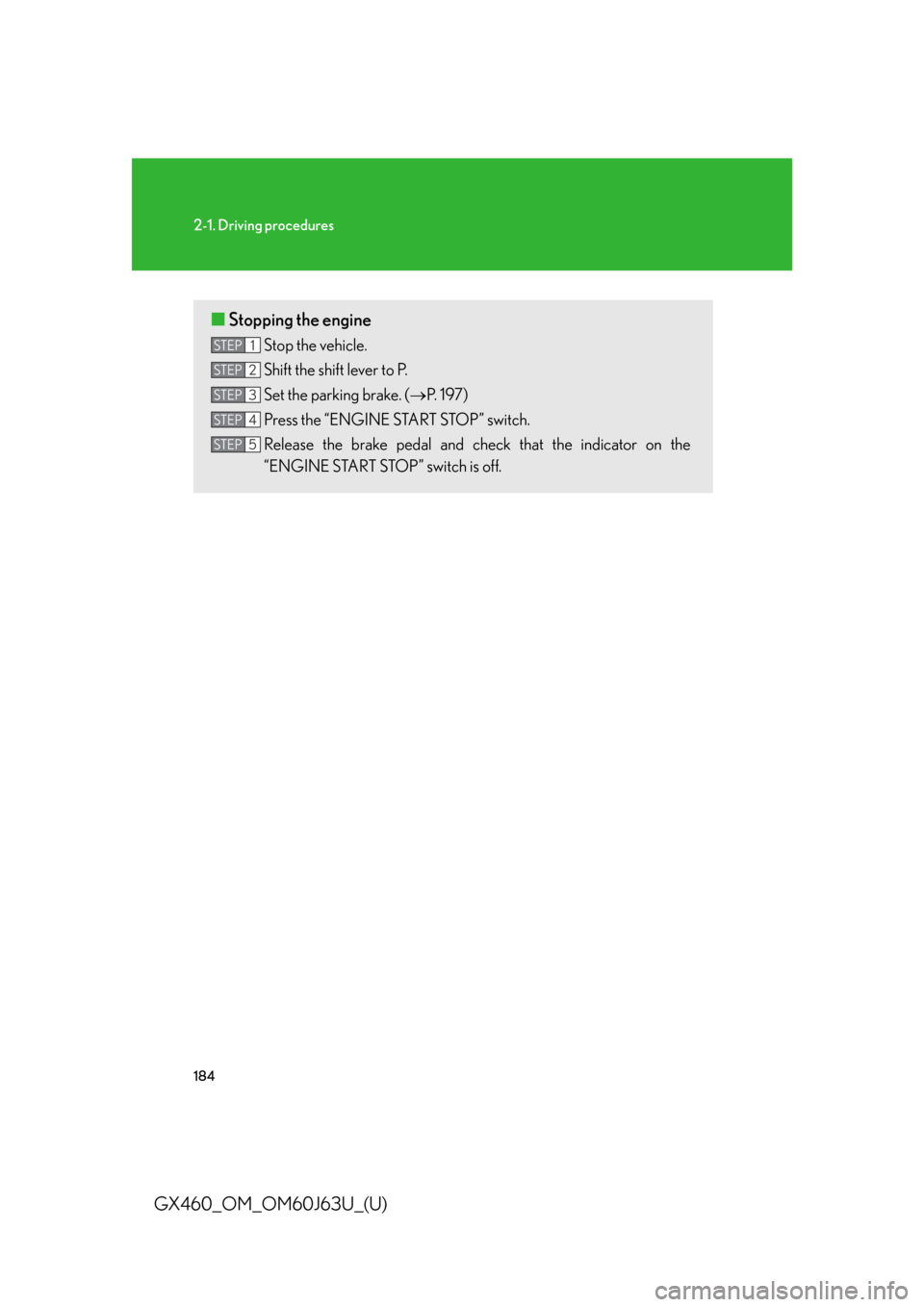
■Stopping the engine
Stop the vehicle.
Shift the shift lever to P.
Set the parking brake. ( P. 1 9 7 )
Press the “ENGINE START STOP” switch.
Release the brake pedal and check that the indicator on the
“ENGINE START STOP” switch is off.STEP1
STEP2
STEP3
STEP4
STEP5
Page 186 of 844

186
2-1. Driving procedures
GX460_OM_OM60J63U_(U)
When stopping the engine with the shift lever in a position other than PIf the engine is stopped with the shift lever in a position other than P, the
“ENGINE START STOP” switch will not be turned off but instead be
turned to ACCESSORY mode. Perfor m the following procedure to turn
the switch off:
Check that the parking brake is set.
Shift the shift lever to P.
Check that the indicator on the “ENGINE START STOP” switch
is illuminated in amber and then press the “ENGINE START
STOP” switch once.
Check that the indicator on the “ENGINE START STOP” switch
is off.
■Auto power off function
When the shift lever is in P, if the vehicle is left in ACCESSORY or IGNITION ON
mode with the engine not running for more than 20 minutes (ACCESSORY mode)
or one hour (IGNITION ON mode), the “ENGINE START STOP” switch will auto-
matically turn off. However, this function cannot entirely prevent battery discharge.
Do not leave the vehicle with the “ENGINE START STOP” switch in ACCESSORY
or IGNITION ON mode for lo ng periods of time when the engine is not running.
■Operation of the “ENGINE START STOP” switch
When operating the “ENGINE START STOP” switch, one short, firm press is
enough. If the switch is pressed improperly, the engine may not start or the
“ENGINE START STOP” switch mode may not change. It is not necessary to press
and hold the switch.
STEP1
STEP2
STEP3
STEP4
Page 197 of 844

197
2-1. Driving procedures
2
When driving
GX460_OM_OM60J63U_(U)
Parking brake
■Usage in winter time
See “Winter driving tips” for parking brake usage in winter time. (P. 3 7 1 )
NOTICE
■Before driving
Fully release the parking brake.
Driving the vehicle with the parking brake set will lead to brake components over-
heating, which may affect braking performance and increase brake wear.
To set the parking brake, fully
depress the parking brake pedal
with your left foot while
depressing the brake pedal with
your right foot.
(Depressing the pedal again
releases the parking brake.)
U.S.A. Canada
Page 228 of 844

228
2-3. Operating the lights and windshield wipers
GX460_OM_OM60J63U_(U)
■Daytime running light system
●To make your vehicle more visible to other drivers, the headlights turn on auto-
matically (at a reduced intensity) whenever the engine is started and the parking
brake is released. Daytime running lights are not designed for use at night.
For the U.S.A.: Daytime running lights can be turned off by operating the switch.
●Compared to the headlights, the daytime running light system offers greater
durability and consumes less electricity, so it can help fuel economy.
■Headlight control sensor
■Automatic light off system
●When only the tail lights come on: The parking/front side marker, tail, license
plate and fog lights turn off if the “ENGINE START STOP” switch is turned to
ACCESSORY mode or turned off an d the driver’s door is opened.
●When the headlights come on: The headlights, parking/front side marker, tail,
license plate and fog lights turn off 30 seconds after a door or the glass hatch is
opened and closed. (The lights turn off immediately if on the key is
pressed after all the doors are locked.)
To turn the lights on again, turn the “ENGINE START STOP” switch to IGNITION
ON mode, or turn the light switch off once and then back to
or .
The sensor may not function properly if an
object is placed on the sensor, or anything
that blocks the sensor is affixed to the wind-
shield.
Doing so interferes with the sensor detecting
the level of ambient light and may cause the
automatic headlight system to malfunction.
Page 277 of 844

277
2-4. Using other driving systems
2
When driving
GX460_OM_OM60J63U_(U)
■Sensor detection information
●Certain vehicle conditions and the surrounding environment may affect the
ability of a sensor to correctly detect an obstacle. Particular instances where this
may occur are listed below.
• There is dirt, snow or ice on a sensor.
• A sensor is frozen.
• A sensor is covered in any way.
• The vehicle is leaning considerably to one side.
• On an extremely bumpy road, on an incline, on gravel, or on grass.
• The vicinity of the vehicle is noisy due to vehicle horns, motorcycle engines,
air brakes of large vehicles, or other loud noises producing ultrasonic waves.
• There is another vehicle equipped with parking assist sensors in the vicinity.
• A sensor is coated with a sheet of spray or heavy rain.
• The vehicle is equipped with a fender pole or radio antenna.
• Towing eyelets are installed.
• A bumper or sensor receives a strong impact.
• The vehicle is approaching a tall or right-angled curb.
• In harsh sunlight or intense cold weather.
• A non-genuine Lexus suspension (low ered suspension etc.) is installed.
In addition to the examples above, there are instances in which, because of their
shape, signs and other objects may be judg ed by a sensor to be closer than they
are.
●The shape of the obstacle may prevent a sensor from detecting it. Pay particular
attention to the following obstacles:
• Wires, fences, ropes, etc.
• Cotton, snow and other materi als that absorb sound waves
• Sharply-angled objects
•Low obstacles
• Tall obstacles with upper sections projecting outwards in the direction of your vehicle
Page 372 of 844

372
2-5. Driving information
GX460_OM_OM60J63U_(U)
Selecting tire chainsUse the correct tire chain size when mounting the tire chains.
Chain size is regulated for each tire size.
Side chain:Side chain
(0.20 in. [5 mm] in diameter)
Cross chain
(0.25 in. [6.3 mm] in diameter)
Regulations on the use of tire chains
Regulations regarding the use of tire chains vary depending on location
and type of road. Always check local regulations before installing chains.
■ When driving the vehicle
Accelerate the vehicle slowly and dr ive at a reduced speed suitable
to road conditions.
■ When parking the vehicle
Park the vehicle and move the shif t lever to P without setting the
parking brake. The parking brake may freeze up, preventing it from
being released. If necessary, bl ock the wheels to prevent inadvert-
ent sliding or creeping.
Page 388 of 844

388
2-5. Driving information
GX460_OM_OM60J63U_(U)●
Always place wheel bloc ks under both the vehicle’s and the trailer’s
wheels when parking. Apply the pa rking brake firmly, and put the
transmission in P. Avoid parking on a slope, but if unavoidable, do so
only after performing the following:
Apply the brakes and keep them applied.
Have someone place wheel blocks under both the vehicle’s and
trailer’s wheels.
When the wheel blocks are in pl ace, release the brakes slowly
until the blocks absorb the load.
Apply the parking brake firmly.
Shift into P and turn off the engine.
● When restarting after parking on a slope:
With the transmission in P, start th e engine. Be sure to keep the
brake pedal pressed.
Shift into 3, 2, L, or R (if reversing).
Release the parking brake and br ake pedal, and slowly pull or
back away from the wheel blocks. Stop and apply the brakes.
Have someone retrieve the blocks.
STEP1
STEP2
STEP3
STEP4
STEP5
STEP1
STEP2
STEP3
STEP4
Page 551 of 844

551
3-7. Other interior features
3
Interior features
GX460_OM_OM60J63U_(U)
■The power outlet can be used when
The “ENGINE START STOP” switch is in IGNITION ON mode.
■The protection circuit may be activated to cut the power supply if any of the fol-
lowing conditions apply:
●Use of electrical appliances exceeding 100 W is attempted.
A sound may be heard when the protection circuit is activated. This is normal
and does not indicate a malfunction.
●The total power usage by all electrical features (headlights, air conditioning,
etc.) has exceeded the total vehicle maximum for an extended period of time.
■If the protection circuit is activated an d the power supply is cut, conduct the fol-
lowing procedure:
Park the vehicle in a safe place, and then securely apply the parking brake.
Make sure that the power consumption of the electric appliance is within
the maximum capacity of the power ou tlet and the appliance is not bro-
ken.
Turn the “ENGINE START STOP” swit ch to IGNITION ON mode again.
When the cabin temperature is high, open the windows to cool the temperature
down. Once it reaches the normal temperature, turn the “ENGINE START STOP”
switch to IGNITION ON mode again.
If the power supply does not resume even after the above procedure has been per-
formed, have the vehicle inspected by your Lexus dealer.
STEP1STEP1
STEP2STEP2
STEP1STEP3STEP3
Page 609 of 844

609
4-2. Maintenance
4
Maintenance and care
GX460_OM_OM60J63U_(U)
ItemsCheck points
Head restraints• Do the head restraints move smoothly and lock securely?
Indicators/buzzers• Do the indicators and buzzers
function properly?
Lights• Do all the lights come on?
Pa r k i n g b r a ke
• Does the parking brake lever or pedal move smoothly?
• When parked on a slope and the parking brake is on, is the vehicle
securely stopped?
Seat belts
• Do the seat belts operate smoothly?
• The seat belts should not be dam- aged.
Seats• Do the seat controls operate prop-erly?
Steering wheel
• Does the steering wheel rotate smoothly?
• Does the steering wheel have the
correct amount of free play?
• There should not be any strange sounds coming from the steering
wheel.