flat tire Lexus GX460 2018 / LEXUS 2018 GX460 (OM60Q09U) Owner's Guide
[x] Cancel search | Manufacturer: LEXUS, Model Year: 2018, Model line: GX460, Model: Lexus GX460 2018Pages: 640, PDF Size: 11.04 MB
Page 525 of 640
5257-2. Steps to take in an emergency
GX460_OM_OM60Q09U_(U)
7
When trouble arises
CAUTION
■If both the ABS and the brake sy stem warning lights remain on
Stop your vehicle in a safe place immediat ely and contact your Lexus dealer. The vehi-
cle will become extremely unstable during br aking, and the ABS system may fail, which
could cause an accident resultin g in death or serious injury.
■If the tire pressure warning light comes on
Be sure to observe the following precautions. Failure to do so could cause loss of vehi-
cle control and result in death or serious injury.
●Stop your vehicle in a safe place as soon as possible. Adjust the tire inflation pressure
immediately.
●If the tire pressure warning light comes on even after tire inflation pressure adjust-
ment, it is probable that you have a flat tire. Check the tires. If the tire is flat, change to
the spare tire and have the flat tire repaired by the nearest Lexus dealer.
●Avoid abrupt maneuvering and braking. If the vehicle tires deteriorate, you could lose
control of the steering wheel or the brakes.
■If a blowout or sudden air leakage should occur
The tire pressure warning system may not activate immediately.
Page 526 of 640

5267-2. Steps to take in an emergency
GX460_OM_OM60Q09U_(U)
CAUTION
■Maintenance of the tires
Each tire, including the spare (if provided), should be checked monthly when cold and
inflated to the inflation pressure recomm ended by the vehicle manufacturer on the
vehicle placard or tire inflation pressure label (tire and load information label). (If your
vehicle has tires of a different size than the size indicated on the vehicle placard or tire
inflation pressure label [tire and load in formation label], you should determine the
proper tire inflation pressure for those tires.)
As an added safety feature, your vehicle ha s been equipped with a tire pressure moni-
toring system (TPMS-tire pressure warning system) that illuminates a low tire pressure
telltale (tire pressure warning light) when on e or more of your tires is significantly
under-inflated. Accordingly, when the low ti re pressure telltale (tire pressure warning
light) illuminates, you should stop and check your tires as soon as possible, and inflate
them to the proper pressure. Driving on a si gnificantly under-inflated tire causes the
tire to overheat and can lead to tire failure . Under-inflation also reduces fuel efficiency
and tire tread life, and may affect the vehicle’s handling and stopping ability.
Please note that the TPMS (tire pressure wa rning system) is not a substitute for proper
tire maintenance, and it is th e driver’s responsibility to ma intain correct tire pressure,
even if under-inflation has not reached the le vel to trigger illumination of the TPMS low
tire pressure telltale (tir e pressure warning light).
Your vehicle has also been equipped with a TPMS (tire pressure warning system) mal-
function indicator to indicate when the system is not operating properly. The TPMS
(tire pressure warning system) malfunction indi cator is combined with the low tire pres-
sure telltale (tire pressure warning light). When the system detects a malfunction, the
telltale will flash for approximately one mi nute and then remain continuously illumi-
nated. This sequence will cont inue upon subsequent vehicle start-ups as long as the
malfunction exists. When the malfunction in dicator is illuminated, the system may not
be able to detect or signal low tire pressure as intended.
TPMS (tire pressure warning system) malfun ctions may occur for a variety of reasons,
including the installation of replacement or alternate tires or wheels on the vehicle that
prevent the TPMS (tire pressure warning system) from functioning properly. Always
check the TPMS (tire pressure warning system) malfunction telltale after replacing one
or more tires or wheels on your vehicle to ensure that the replacement or alternate
tires and wheels allow the TPMS (tire pressu re warning system) to continue to function
properly.
Page 542 of 640
542
GX460_OM_OM60Q09U_(U)7-2. Steps to take in an emergency
If you have a flat tire
●Stop the vehicle in a safe pl
ace on a hard, flat surface.
●Set the parking brake.
●Shift the shift lever to P.
●Turn off the rear height control air suspension (if equipped). (→P. 337)
●Stop the engine.
●Turn on the emergency flashers. ( →P. 510)
Your vehicle is equipped with a spare tire. The flat tire can be replaced with
the spare tire.
For details about tires: → P. 476
CAUTION
■If you have a flat tire
Do not continue driving with a flat tire.
Driving even a short distance with a flat ti re can damage the tire and the wheel beyond
repair, which could re sult in an accident.
Before jacking up the vehicle
Page 544 of 640
5447-2. Steps to take in an emergency
GX460_OM_OM60Q09U_(U)
CAUTION
■Using the tire jack
Improper use of the tire jack may cause the vehicle to suddenly fall off the jack, leading
to death or serious injury.
●Do not use the tire jack for any purpose ot her than replacing tires or installing and
removing tire chains.
●Only use the tire jack that comes with this vehicle for replacing a flat tire.
Do not use it on other vehicles, and do no t use other tire jacks for replacing tires on
this vehicle.
●Always check that the tire jack is securely set to the jack point.
●Do not put any part of your body under the vehicle while it is supported by the jack.
●Do not start or run the engine while your vehicle is supported by the jack.
●Do not raise the vehicle while someone is inside.
●When raising the vehicle, do not put an object on or under the jack.
●Do not raise the vehicle to a height greater than that required to replace the tire.
●Use a jack stand if it is necessary to get under the vehicle.
●Be sure to turn off the height control and stop the engine.
Take particular care when lowering the ve hicle to ensure that no one working on or
near the vehicle will be injured.
■Using the jack handle
Tighten all the jack handle bo lts securely using a Phillips-head screwdriver, to prevent
the extension parts from co ming apart unexpectedly.
Page 548 of 640
5487-2. Steps to take in an emergency
GX460_OM_OM60Q09U_(U)
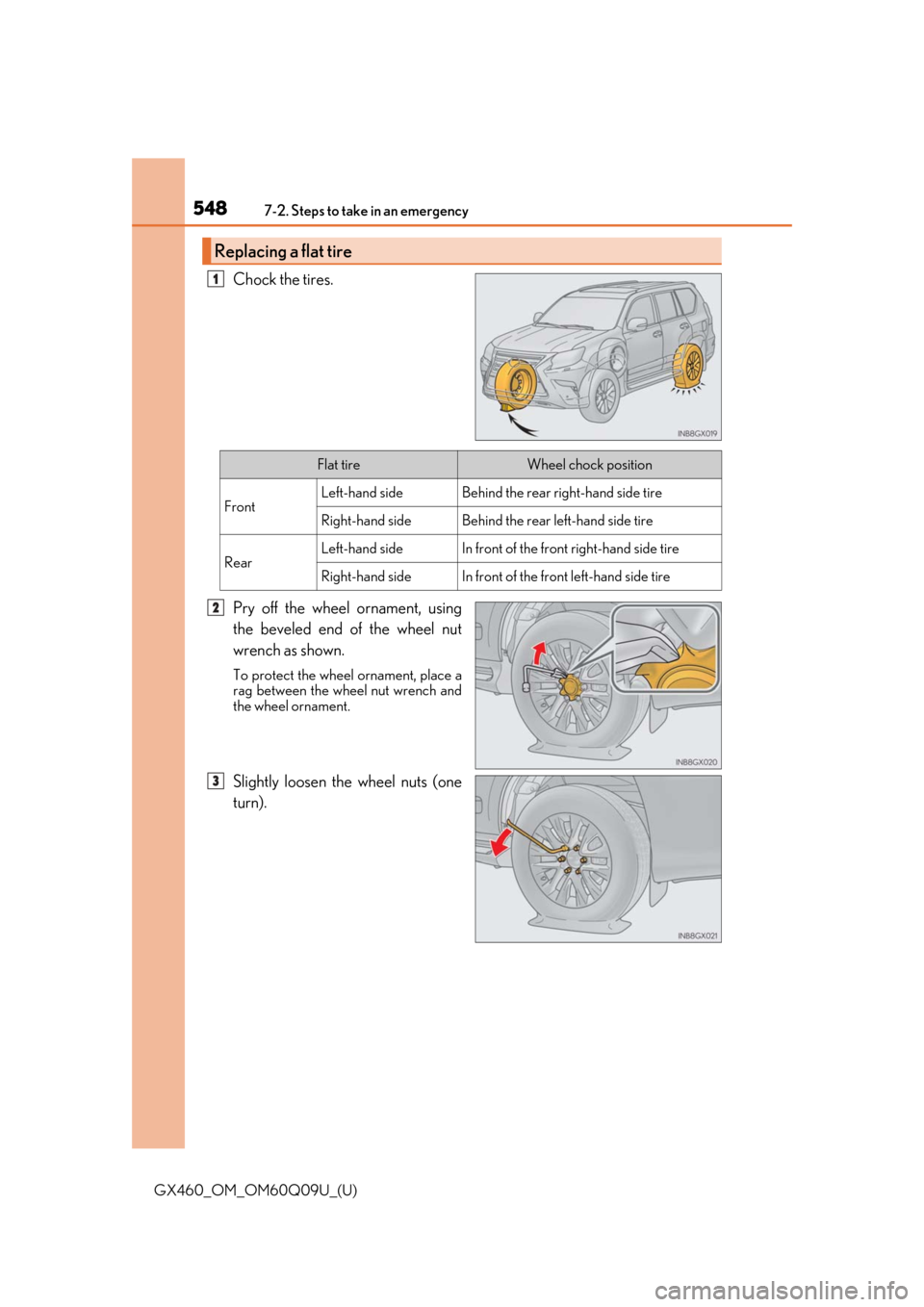
Chock the tires.
Pry off the wheel ornament, using
the beveled end of the wheel nut
wrench as shown.
To protect the wheel ornament, place a
rag between the wheel nut wrench and
the wheel ornament.
Slightly loosen the wheel nuts (one
turn).
Replacing a flat tire
1
Flat tireWheel chock position
FrontLeft-hand sideBehind the rear right-hand side tire
Right-hand sideBehind the rear left-hand side tire
RearLeft-hand sideIn front of the front right-hand side tire
Right-hand sideIn front of the front left-hand side tire
2
3
Page 551 of 640
5517-2. Steps to take in an emergency
GX460_OM_OM60Q09U_(U)
7
When trouble arises
CAUTION
■Replacing a flat tire
●Observe the following precautions.
Failure to do so may result in serious injury:
• Lower the spare tire completely to the ground before removing it from under the vehicle.
• Do not try to remove the wheel ornament by hand. Take due care in handling the ornament to avoid unexpected personal injury.
• Do not touch the disc wheels or the area around the brakes immediately after the vehicle has been driven.
After the vehicle has been driven the disc wheels and the area around the brakes
will be extremely hot. Touching these areas with hands, feet or other body parts
while changing a tire, etc. may result in burns.
●Failure to follow these precautions could cau se the nuts to loosen and the wheel may
fall off, which could lead to an accident causing death or serious injury.
• Never use oil or grease on the wheel bolts or wheel nuts. Oil and grease may cause the wheel nuts to be excessively tightened, leading to
bolt or disc wheel damage. In addition, the oil or grease can cause the wheel nuts
to loosen and the wheel may fall off, causing a serious accident. Remove any oil or
grease from the wheel bolts or wheel nuts.
• Have the wheel nuts tightened with a torque wrench to 76 ft•lbf (103 N•m, 10.5 kgf•m) as soon as possible after changing wheels.
• Do not attach a heavily damaged wheel or nament, as it may fly off the wheel while
the vehicle is moving.
• When installing a tire, only use wheel nuts that have been specifically designed for
that wheel.
• If there are any cracks or deformations in the bolt screws, nut threads or bolt holes
of the wheel, have the vehicle inspected by your Lexus dealer.
Page 553 of 640
5537-2. Steps to take in an emergency
GX460_OM_OM60Q09U_(U)
7
When trouble arises
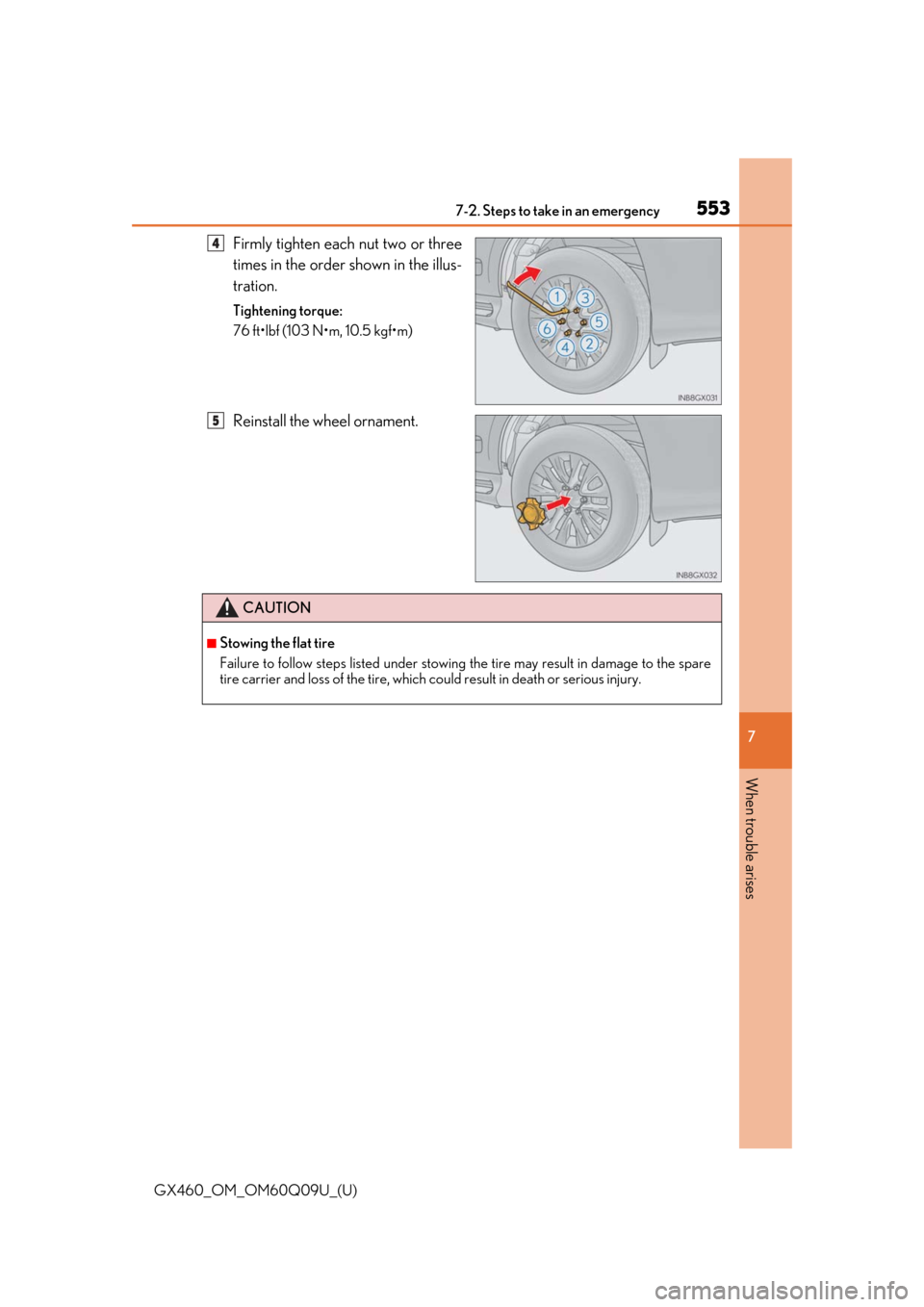
Firmly tighten each nut two or three
times in the order shown in the illus-
tration.
Tightening torque:
76 ft•lbf (103 N•m, 10.5 kgf•m)
Reinstall the wheel ornament.
4
5
CAUTION
■Stowing the flat tire
Failure to follow steps listed under stowing the tire may result in damage to the spare
tire carrier and loss of the tire, which co uld result in death or serious injury.
Page 554 of 640
5547-2. Steps to take in an emergency
GX460_OM_OM60Q09U_(U)
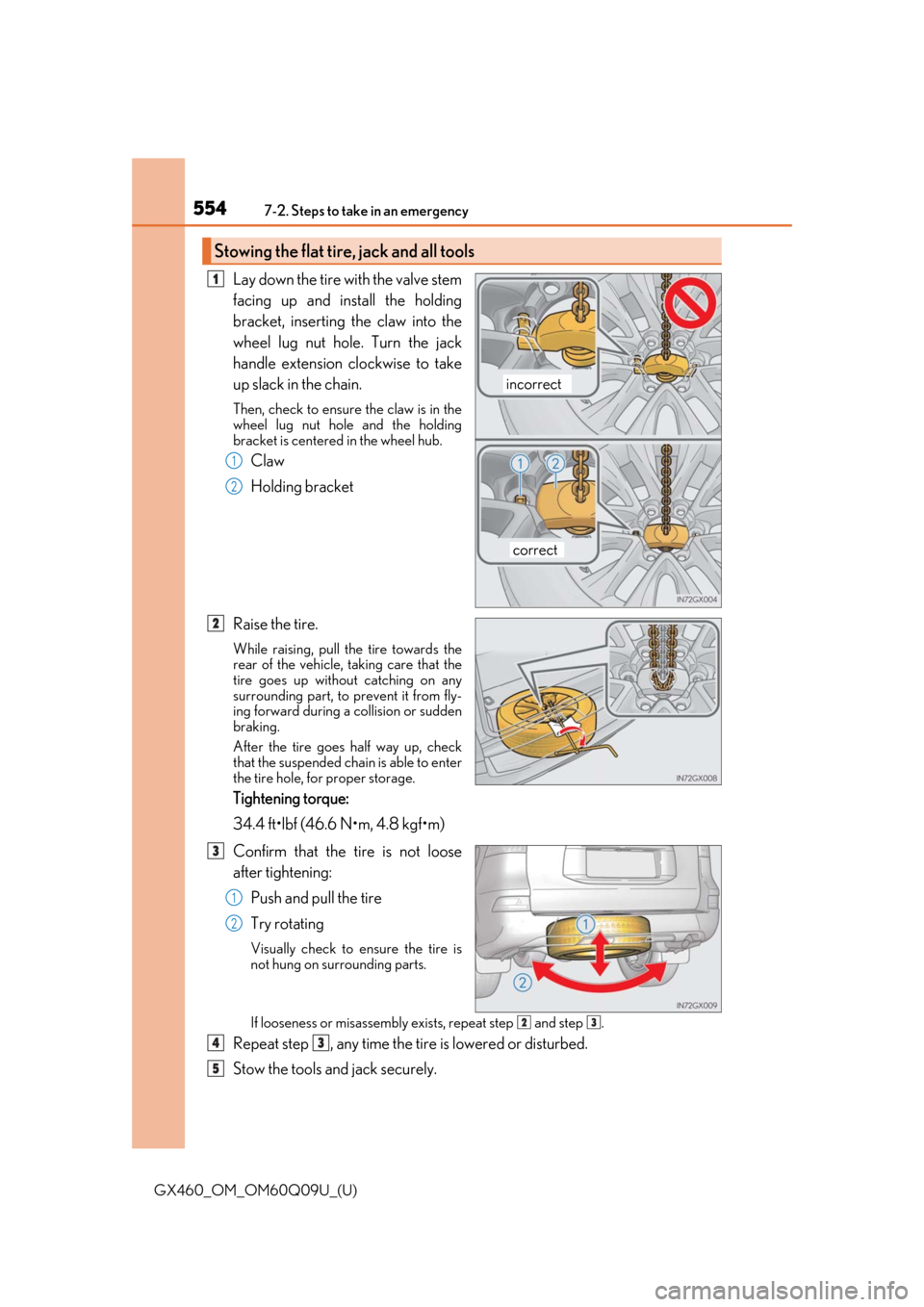
Lay down the tire with the valve stem
facing up and install the holding
bracket, inserting the claw into the
wheel lug nut hole. Turn the jack
handle extension clockwise to take
up slack in the chain.
Then, check to ensure the claw is in the
wheel lug nut hole and the holding
bracket is centered in the wheel hub.
Claw
Holding bracket
Raise the tire.
While raising, pull th e tire towards the
rear of the vehicle, taking care that the
tire goes up without catching on any
surrounding part, to prevent it from fly-
ing forward during a collision or sudden
braking.
After the tire goes half way up, check
that the suspended chain is able to enter
the tire hole, for proper storage.
Tightening torque:
34.4 ft•lbf (46.6 N•m, 4.8 kgf•m)
Confirm that the tire is not loose
after tightening:
Push and pull the tire
Try rotating
Visually check to ensure the tire is
not hung on surrounding parts.
If looseness or misassembly exis ts, repeat step and step .
Repeat step , any time the tire is lowered or disturbed.
Stow the tools and jack securely.
Stowing the flat tire, jack and all tools
incorrect
correct
1
1
2
2
3
1
2
23
43
5
Page 555 of 640
5557-2. Steps to take in an emergency
GX460_OM_OM60Q09U_(U)
7
When trouble arises
CAUTION
■After using the tools and jack
Before driving, make sure all the tools and jack are securely in place in their storage
location to reduce the possibilit y of personal injury during a collision or sudden brak-
ing.
NOTICE
■When stowing the flat tire
Ensure that there is no object caught between the tire and the vehicle underbody.
Page 578 of 640
578
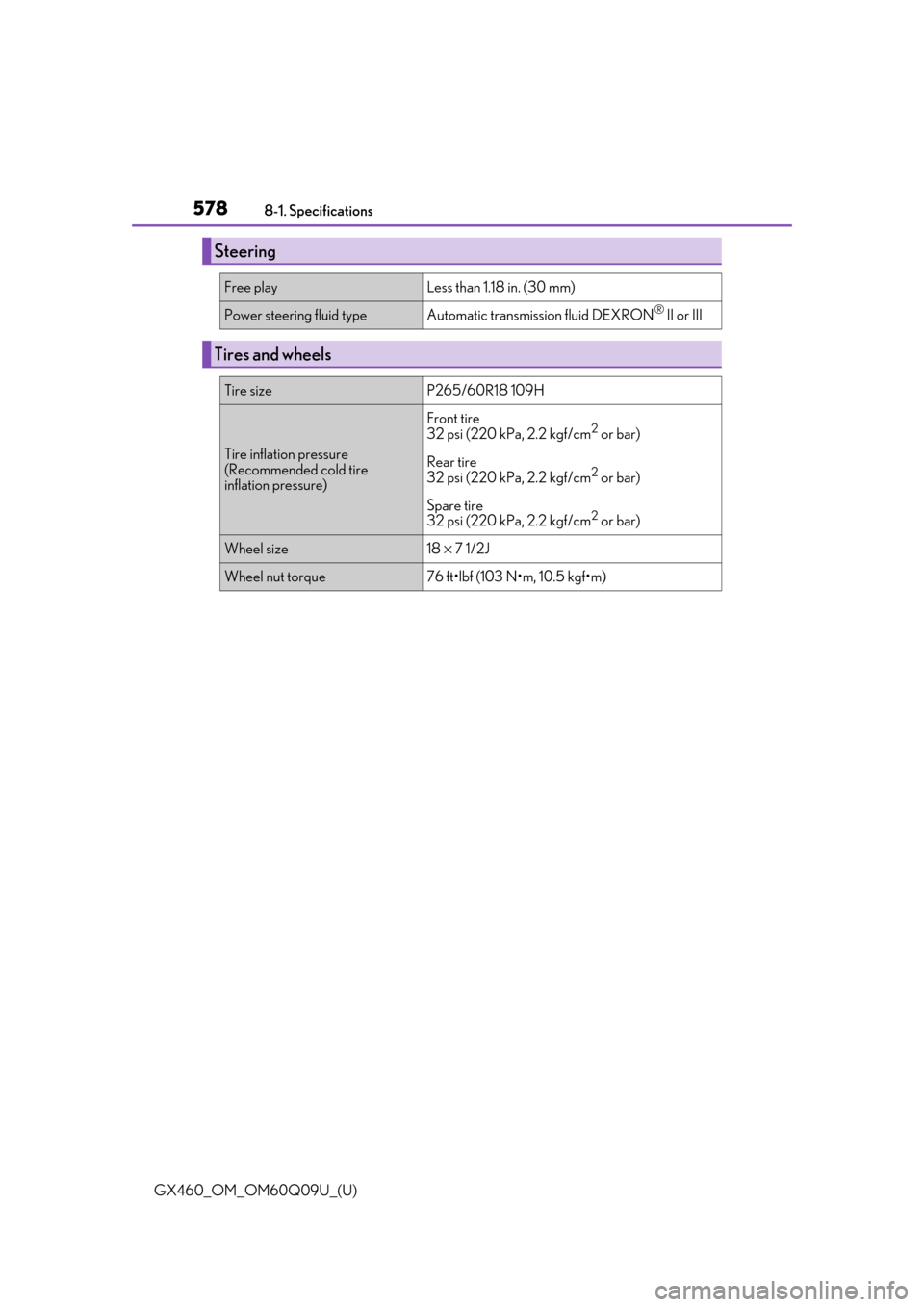
GX460_OM_OM60Q09U_(U)8-1. Specifications
Steering
Free playLess than 1.18 in. (30 mm)
Power steering fluid typeAutomatic transmission fluid DEXRON® II or III
Tires and wheels
Tire sizeP265/60R18 109H
Tire inflation pressure
(Recommended cold tire
inflation pressure)
Front tire
32 psi (220 kPa, 2.2 kgf/cm2 or bar)
Rear tire
32 psi (220 kPa, 2.2 kgf/cm2 or bar)
Spare tire
32 psi (220 kPa, 2.2 kgf/cm2 or bar)
Wheel size18
× 7 1/2J
Wheel nut torque76 ft•lbf (103 N•m, 10.5 kgf•m)