instrument Lexus GX470 2007 Using other driving systems /
[x] Cancel search | Manufacturer: LEXUS, Model Year: 2007, Model line: GX470, Model: Lexus GX470 2007Pages: 436, PDF Size: 11.52 MB
Page 2 of 436

TABLE OF CONTENTSIndex
ii
1-1. Key information .............................. 2Keys ......................................................... 2
1-2. Opening, closing and locking the doors......................................... 4
Wireless remote control ................. 4
Side doors ............................................. 6
Back door .............................................. 11
1-3. Adjustable components ............. 13 Front seats ........................................... 13
Rear seats ............................................ 15
Driving position memory system ............................................... 24
Head restraints................................. 26
Seat belts ............................................ 28
Steering wheel.................................. 35
Inside rear view mirror.................. 36
Outside rear view mirrors ........... 37
Roof luggage carrier ..................... 39
1-4. Opening and closing the windows and moon roof ........... 41
Power windows................................. 41
Moon roof .......................................... 43
1-5. Refueling ........................................ 46 Opening the fuel tank cap........... 46 1-6. Theft deterrent system............... 49
Engine immobilizer system ......... 49
Alarm..................................................... 51
Theft prevention labels (U.S.A.) ............................................. 53
1-7. Safety information ....................... 54 Correct driving posture ............... 54
SRS airbags ....................................... 56
Front passenger occupant classification system .................... 69
Child restraint sy stems ................. 74
Installing child restraints ............... 77
2-1. Driving procedures.................... 88 Driving the vehicle ......................... 88
Starting the engine ......................... 95
Automatic transmission................ 98
Turn signal lever.............................. 101
Parking brake ................................. 102
2-2. Instrument cluster ..................... 103 Gauges and meters ..................... 103
Indicators and warning lights................................................. 105
Trip information display .............. 108
1Before driving
2When driving
Page 12 of 436

xii
Pictorial indexInstrument panel
Gauges and meters P. 103
Ignition switch P. 95
Windshield wiper and
washer switch
P. 114
Headlight switch
Turn signal switch
Fog light switch P. 111
P. 101
P. 113
Cruise control switch P. 118
Emergency flashersGlove box
P. 228
Page 14 of 436

xiv
C
Pictorial indexInstrument panel
With navigation systemTrip-information display P. 108
Air conditioning
system
Without navigation system
Navigation system*
Audio system
P. 171
Trip-information display P. 108
Air conditioning
system
P. 162
Audio system
P. 171
Page 15 of 436

xv
D
*: Refer to “Navigation System Owner's Manual”.
“RSCA OFF” switch P. 68
Outside rear view mirrorheater switch
P. 169
Hood lock release lever P. 286
Fuel filler door lever P. 46
Power outlet switch P. 239
Outside rear view mirror switches P. 37
Instrument panel light control P. 104
Center differential lock switch P. 121
Tilt and telescopic steering control switch
P. 35
Page 83 of 436

63
1-7. Safety information
1
Before driving
CAUTION
■SRS airbag precautions
Observe the following precautions regarding the airbags. Failure to do so may
cause death or serious injury.
●The driver and all passengers in the vehicle must wear their seat belts properly.
The SRS airbags are supplemental devices to be used with the seat belts.
●The SRS driver airbag deploys with considerable force, and can cause death or
serious injury especially if the driver is very close to the airbag. The National
Highway Traffic Safety Administration (“NHTSA”) advises:
Since the risk zone for driver airbag is th e first 2 - 3 in. (50 - 75 mm) of inflation,
placing yourself 10 in. (250 mm) from your driver airbag provides you with a
clear margin of safety. This distance is measured from the center of the steering
wheel to your breastbone. If you sit less than 10 in. (250 mm) away now, you can
change your driving position in several ways:
• Move your seat to the rear as far as you can while still reaching the pedals
comfortably.
• Slightly recline the back of the seat. Al though vehicle designs vary, many driv-
ers can achieve the 10 in. (250 mm) distance, even with the driver seat all the
way forward, simply by reclining the back of the seat somewhat. If reclining
the back of your seat makes it hard to see the road, raise yourself by using a
firm, non-slippery cushion, or raise the seat if your vehicle has that feature.
• If your steering wheel is adjustable, ti lt it downward. This points the airbag
toward your chest instead of your head and neck.
The seat should be adjusted as recommended by NHTSA above, while still main-
taining control of the foot pedals, steering wheel, and your view of the instrument
panel controls.
Page 86 of 436

66
1-7. Safety information
CAUTION
■SRS airbag precautions
●Do not use seat accessories which cover the parts where the SRS side airbags
inflate as they may interfere with inflation of the airbags.
●Do not strike or apply significant levels of force to the area of the SRS airbag
components shown on P. 57. Doing so ca n cause the SRS airbags to malfunction.
●Do not touch any of the component parts immediately after the SRS airbags have
deployed (inflated) as they may be hot.
●If breathing becomes difficult after the SRS airbag has deployed, open a door or
window to allow fresh air in, or leave the vehicle if it is safe to do so. Wash off any
residue as soon as possible to prevent skin irritation.
●If the areas where the SRS airbags are stored, such as the steering wheel pad and
front pillar garnish, are damaged or cracked, have them replaced by your Lexus
dealer.
●Do not attach anything to or lean anything
against areas such as the dashboard or
steering wheel pad of the instrument panel.
These items can become projectiles when
the SRS driver and front passenger airbags
deploy.
●Do not attach anything to areas such as the
door, windshield glass, side door glass,
front and rear pillars, roof side rail or assist
grip.
●Do not hang coat hangers or other hard
objects on the coat hooks. All of these
items could become projectiles and seri-
ously injure or kill you, should the SRS cur-
tain shield airbag deploy.
Page 87 of 436

67
1-7. Safety information
1
Before driving
CAUTION
■Modification and disposal of SRS airbag system components
Do not dispose of your vehicle or perform any of the following modifications with-
out consulting your Lexus dealer. The SRS airbag may malfunction or deploy
(inflate) accidentally, causing death or serious injury.
●Installation, removal, disassembly and repair of the SRS airbags
●Repairs, modifications, removal or replace ment of the steering wheel, instrument
panel, dashboard, seats or seat upholstery, front, side and rear pillars or roof side
rail
●Repairs or modifications of the front fend er, front bumper, or side of the occupant
compartment
●Installation of snow plows, winches, etc. to the front grille (bull bars, kangaroo bar
etc.)
●Modifications to the vehi cle's suspension system
●Installation of electronic devices such as mobile two-way radios or CD players
●Modifications to your vehicle for a person with a physical disability
Page 107 of 436

When driving2
87
2-1. Driving procedures ................. 88Driving the vehicle ...................... 88
Starting the engine ...................... 95
Automatic transmission ............. 98
Turn signal lever ........................... 101
Parking brake ............................... 102
2-2. Instrument cluster................... 103 Gauges and meters .................. 103
Indicators and warning lights.............................................. 105
Trip information display............ 108 2-3. Operating the lights and
windshield wipers.................... 111
Headlight switch............................ 111
Fog light switch ............................. 113
Windshield wipers and washer ........................................... 114
Rear window wiper and washer ........................................... 117
2-4. Using other driving systems ..................................... 118
Cruise control ............................... 118
Four-wheel drive system ........... 121
Rear height control air suspension ................................ 123
Electronic modulated suspension .................................. 129
DAC (Downhill Assist Control system) ....................... 130
Driving assist systems............... 132
2-5. Driving information................ 135 Off-road precautions ............... 135
Cargo and luggage................... 140
Vehicle load limits ...................... 144
Winter driving tips ..................... 146
Trailer towing................................ 150
Dinghy towing ............................. 160
Page 123 of 436
103
2
When driving
2-2. Instrument cluster
Gauges and meters
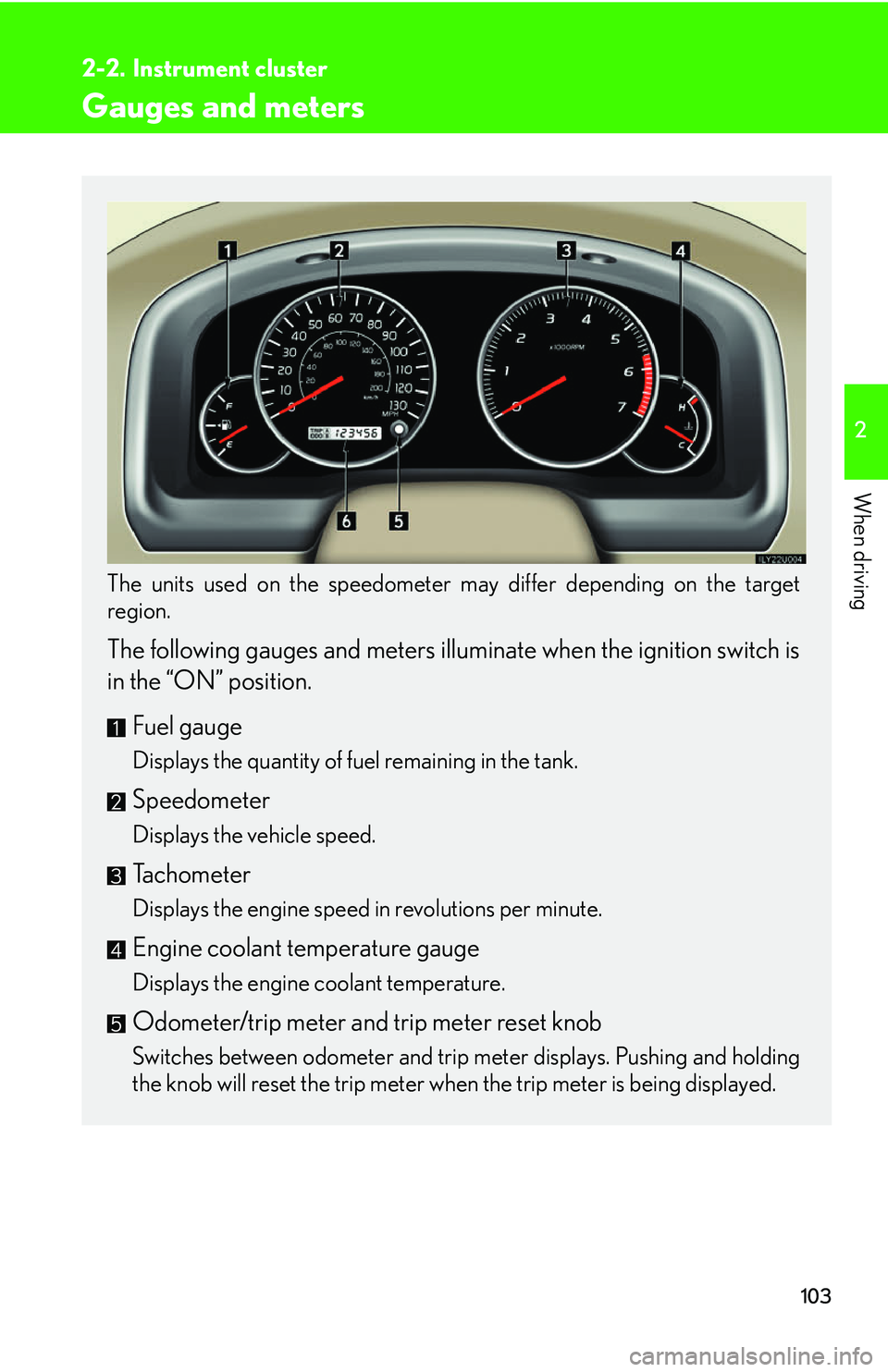
The units used on the speedometer may differ depending on the target
region.
The following gauges and meters illuminate when the ignition switch is
in the “ON” position.
Fuel gauge
Displays the quantity of fuel remaining in the tank.
Speedometer
Displays the vehicle speed.
Tachometer
Displays the engine speed in revolutions per minute.
Engine coolant temperature gauge
Displays the engine coolant temperature.
Odometer/trip meter and trip meter reset knob
Switches between odometer and trip meter displays. Pushing and holding
the knob will reset the trip meter when the trip meter is being displayed.
Page 124 of 436

104
2-2. Instrument cluster
Instrument panel light controlThe brightness of the instrument panel lights can be adjusted. Brighter
Darker
Odometer
Displays the total distance the vehicle has been driven.
Trip meter
Displays the distance the vehicle has been driven since the meter was last
reset. Trip meters A and B can be used to record and display different dis-
tances independently.
NOTICE
■To prevent damage to the engine and its components
●Do not let the indicator needle of the ta chometer enter the red zone, which indi-
cates the maximum engine speed.
●The engine may be overheating if the engine coolant temperature gauge is in the
red zone (“H”). In this case, immediately stop the vehicle in a safe place. Check
the engine after it has cooled completely. ( P. 3 7 3 )