power steering Lexus HS250h 2011 Hybrid system / LEXUS 2011 HS250H (OM75037U) User Guide
[x] Cancel search | Manufacturer: LEXUS, Model Year: 2011, Model line: HS250h, Model: Lexus HS250h 2011Pages: 628, PDF Size: 10.69 MB
Page 85 of 628

85
1-4. Adjustable components (seats, mirrors, steering wheel)
1
Before driving
■Mirror angle can be adjusted when
The “POWER” switch is in ACCESSORY or ON mode.
■Linked mirror function when reversing (vehicles with driving position memory)
The outside rear view mirrors will automatically angle downwards when the vehicle
is reversing in order to give a better view of the ground. However, this function will
not operate when the mirror select switch is in the neutral position (between “L” and
“R”).
■Rain clearing mirrors (if equipped)
When water droplets collects on the mirror surface, for example when it rains, the
rain clearing (hydrophilic) effect of the mirrors causes the droplets to be spread out
into a film making the rear view clearer. In the following cases, the rain clearing
effect will be reduced temporarily, but wi ll return after 1 or 2 days’ exposure to
direct sunlight.
●After wiping dirt off the mirrors
●When the mirrors fog up
●After waxing your vehicle in an automatic car wash
●After your vehicle has been parked for a long period in underground parking
lots etc. where there is no direct sunlight
■When the mirrors are fogged up
Turn on the mirror defoggers to defog the mirrors. ( P. 2 6 4 )
■Automatic adjustment of the mirror angl e (vehicles with driving position mem-
ory)
A desired mirror face angle can be entered to memory and recalled automatically
by the driving position memory. ( P. 6 9 )
■Auto anti-glare function (if equipped)
When the anti-glare inside rear view mirr or is set to automatic mode, the outside
rear view mirrors will activate in conjunction with the anti-glare inside rear view mir-
ror to reduce reflected light. ( P. 8 2 )
Page 142 of 628

142
2-1. Driving procedures
CAUTION
●Do not select shift position R when the vehicle is rolling forward, do not select D
when moving in reverse, and do not press the P position switch before the vehicle
stops fully. Doing so will cause the buzzer to sound and the shift position to
change to N. In addition, excessive forc e will be applied to the powertrain and
damage may result.
●Do not change the shift position to N while the vehicle is moving.
Doing so may cause insufficient engine braking, resulting in an accident.
●Do not turn the hybrid system off while driving.
The power steering and brake actuator will not operate properly if the hybrid sys-
tem is off.
●Use engine braking (shift position B) to maintain a safe speed when driving down
a steep hill.
Using the brakes continuously may cause the brakes to overheat and lose effec-
tiveness. ( P. 1 5 5 )
●Do not adjust the positions of the steering wheel, the seat, or the inside or outside
rear view mirrors while driving.
Doing so may result in a loss of vehicle control that can cause accidents, resulting
in death or serious injury.
●Always check that all passengers' arms, heads or other parts of their body are not
outside the vehicle, as this may result in death or serious injury.
●Do not drive in excess of the speed limit. Even if the legal speed limit permits it, do
not drive over 85 mph (140 km/h) unless your vehicle has high-speed capability
tires. Driving over 85 mph (140 km/h) may result in tire failure, loss of control and
possible injury. Be sure to consult a tire dealer to determine whether the tires on
your vehicle are high-speed capability tires or not before driving at such speeds.
■When driving on slippery road surfaces
●Sudden braking, acceleration and steer ing may cause tire slippage and reduce
your ability to control the vehi cle, resulting in an accident.
●Abrupt changes from shift position D to B and rapid changes in the engine speed
could cause the vehicle to skid, resulting in an accident.
●After driving through a pudd le, lightly depress the brake pedal to make sure that
the brakes are functioning properly. Wet brake pads may prevent the brakes from
functioning properly. If the brakes on on ly one side are wet and not functioning
properly, steering control may be af fected, resulting in an accident.
Page 146 of 628

146
2-1. Driving procedures
NOTICE
■Avoiding damage to vehicle parts
●Do not turn the steering wheel fully in either direction and hold it there for an
extended period of time.
Doing so may damage the power steering motor.
●When driving over bumps in the road, drive as slowly as possible to avoid damag-
ing the wheels, underside of the vehicle, etc.
■If you get a flat tire while driving
A flat or damaged tire may cause the following situations. Hold the steering wheel
firmly and gradually depress the brak e pedal to slow down the vehicle.
●It may be difficult to control your vehicle.
●The vehicle will make abnormal sounds or vibrations.
●The vehicle will lean abnormally.
Information on what to do in case of a flat tire. ( P. 5 2 7 )
■When encountering flooded roads
Do not drive on a road that has flooded after heavy rain etc. Doing so may cause the
following serious damage to the vehicle:
●Engine stalling
●Short in electrical components
●Engine damage caused by water immersion
In the event that you drive on a flooded road and the vehicle is flooded, be sure to
have your Lexus dealer check the following:
●Brake function
●Changes in quantity and quality of engine oil, transaxle fluid for the hybrid system
etc.
●Lubricant condition for the bearings and suspension joints (where possible), and
the function of all joints, bearings, etc.
As flooding may damage components involv ed in P position control, the parking
lock may jam in the locked position.
■If the vehicle will not shift out of the P position
There is a possibility that the 12-volt batt ery is discharged. Check the 12-volt battery
in this situation.
Page 229 of 628
229
2-4. Using other driving systems
2
When driving
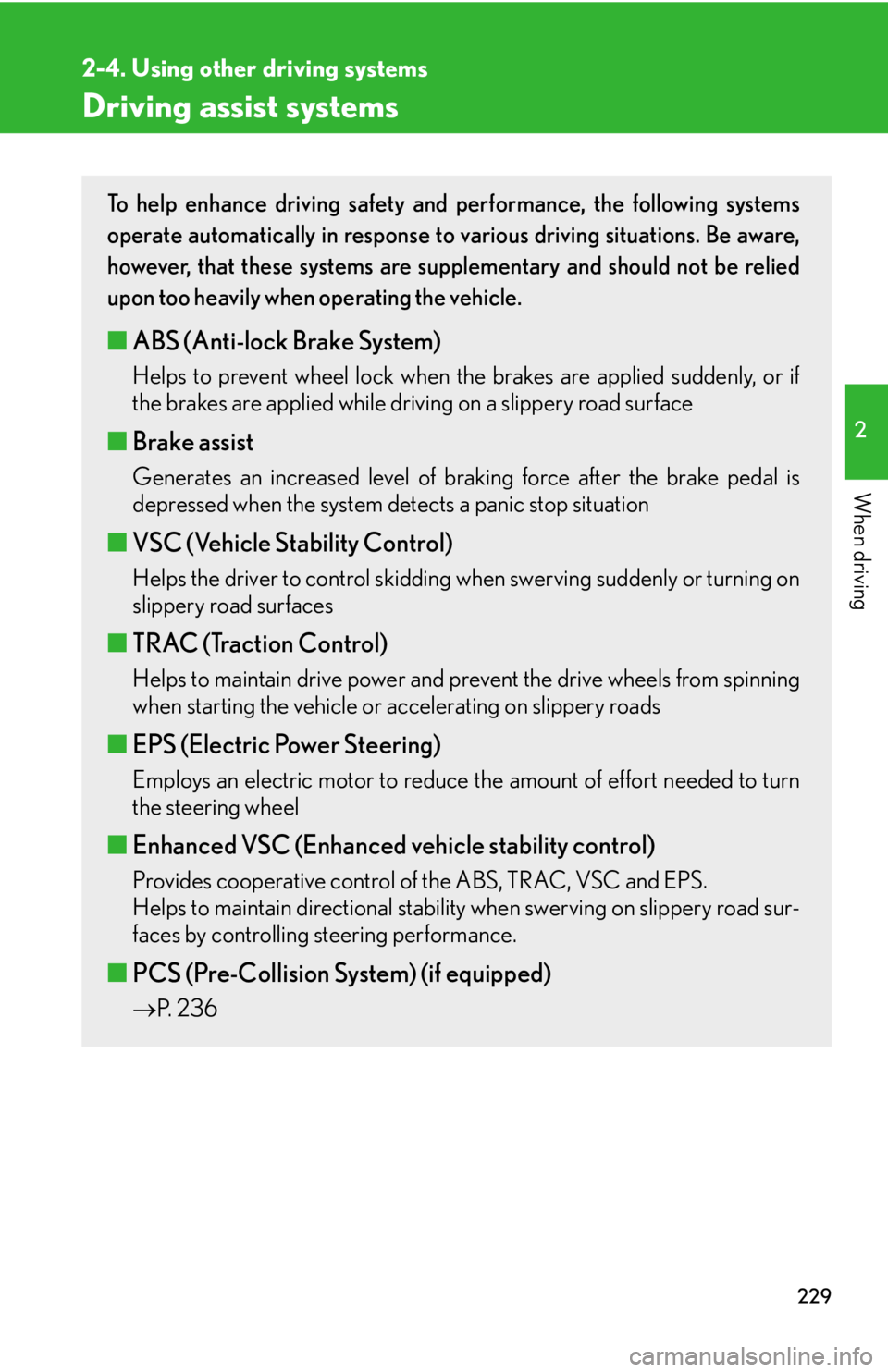
Driving assist systems
To help enhance driving safety and performance, the following systems
operate automatically in response to various driving situations. Be aware,
however, that these systems are supplementary and should not be relied
upon too heavily when operating the vehicle.
■ABS (Anti-lock Brake System)
Helps to prevent wheel lock when the brakes are applied suddenly, or if
the brakes are applied while driving on a slippery road surface
■Brake assist
Generates an increased level of braking force after the brake pedal is
depressed when the system detects a panic stop situation
■VSC (Vehicle Stability Control)
Helps the driver to control skidding when swerving suddenly or turning on
slippery road surfaces
■ TRAC (Traction Control)
Helps to maintain drive power and prevent the drive wheels from spinning
when starting the vehicle or accelerating on slippery roads
■EPS (Electric Power Steering)
Employs an electric motor to reduce the amount of effort needed to turn
the steering wheel
■Enhanced VSC (Enhanced vehicle stability control)
Provides cooperative control of the ABS, TRAC, VSC and EPS.
Helps to maintain directional stability when swerving on slippery road sur-
faces by controlling steering performance.
■PCS (Pre-Collision System) (if equipped)
P. 2 3 6
Page 232 of 628
232
2-4. Using other driving systems
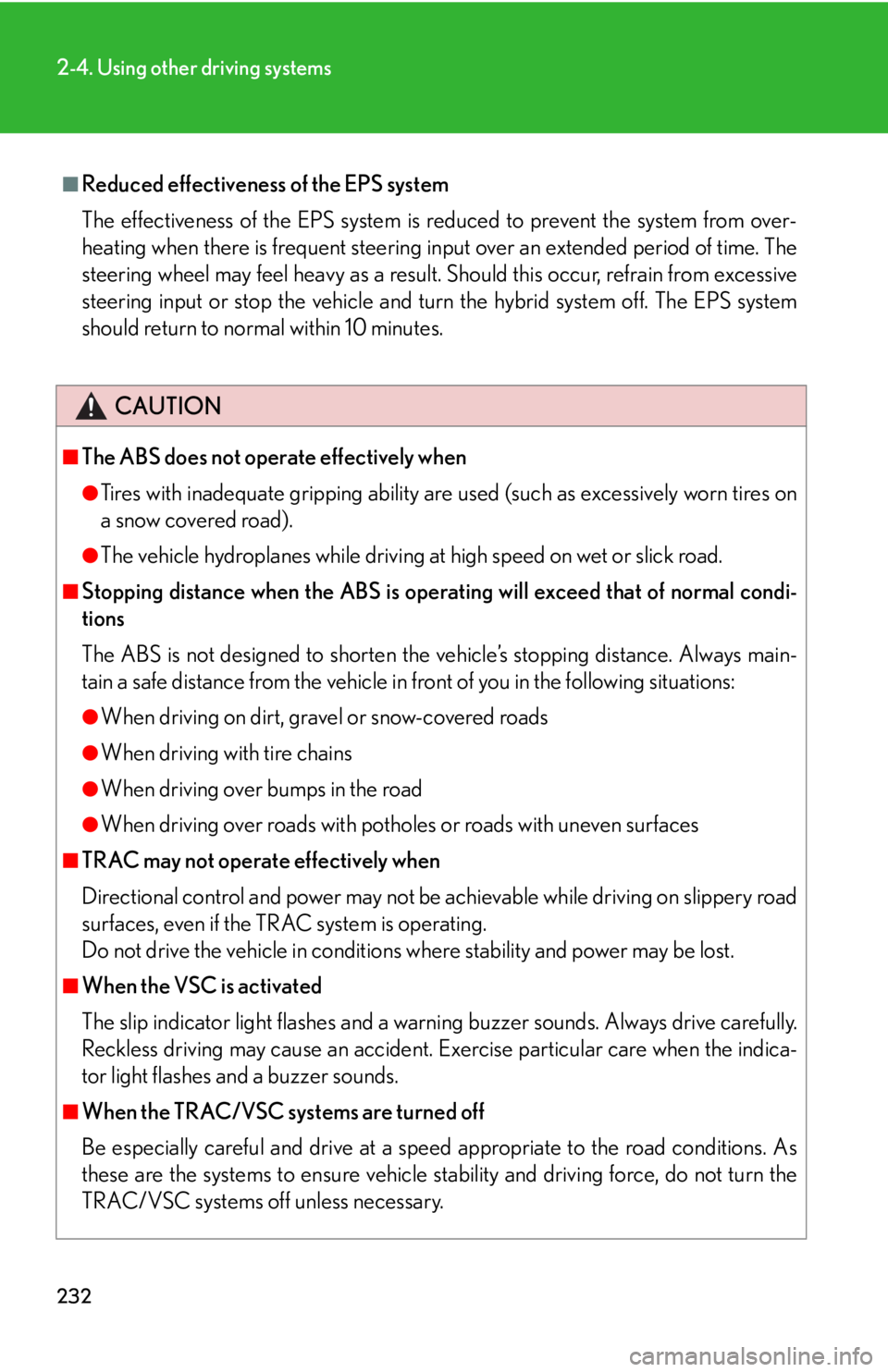
■Reduced effectiveness of the EPS system
The effectiveness of the EPS system is reduced to prevent the system from over-
heating when there is frequent steering input over an extended period of time. The
steering wheel may feel heavy as a result. Should this occur, refrain from excessive
steering input or stop the vehicle and turn the hybrid system off. The EPS system
should return to normal within 10 minutes.
CAUTION
■The ABS does not operate effectively when
●Tires with inadequate gripping ability ar e used (such as excessively worn tires on
a snow covered road).
●The vehicle hydroplanes while driving at high speed on wet or slick road.
■Stopping distance when the ABS is operating will exceed that of normal condi-
tions
The ABS is not designed to shorten the vehicle’s stopping dist ance. Always main-
tain a safe distance from the vehicle in front of you in the following situations:
●When driving on dirt, gravel or snow-covered roads
●When driving with tire chains
●When driving over bumps in the road
●When driving over roads with potholes or roads with uneven surfaces
■TRAC may not operate effectively when
Directional control and power may not be ac hievable while driving on slippery road
surfaces, even if the TRAC system is operating.
Do not drive the vehicle in conditions where stability and power may be lost.
■When the VSC is activated
The slip indicator light flashes and a warning buzzer sounds. Always drive carefully.
Reckless driving may cause an accident. Exercise particular care when the indica-
tor light flashes and a buzzer sounds.
■When the TRAC/VSC systems are turned off
Be especially careful and drive at a speed appropriate to the road conditions. As
these are the systems to ensure vehicle stability and driving force, do not turn the
TRAC/VSC systems off unless necessary.
Page 312 of 628
312
3-2. Using the audio system
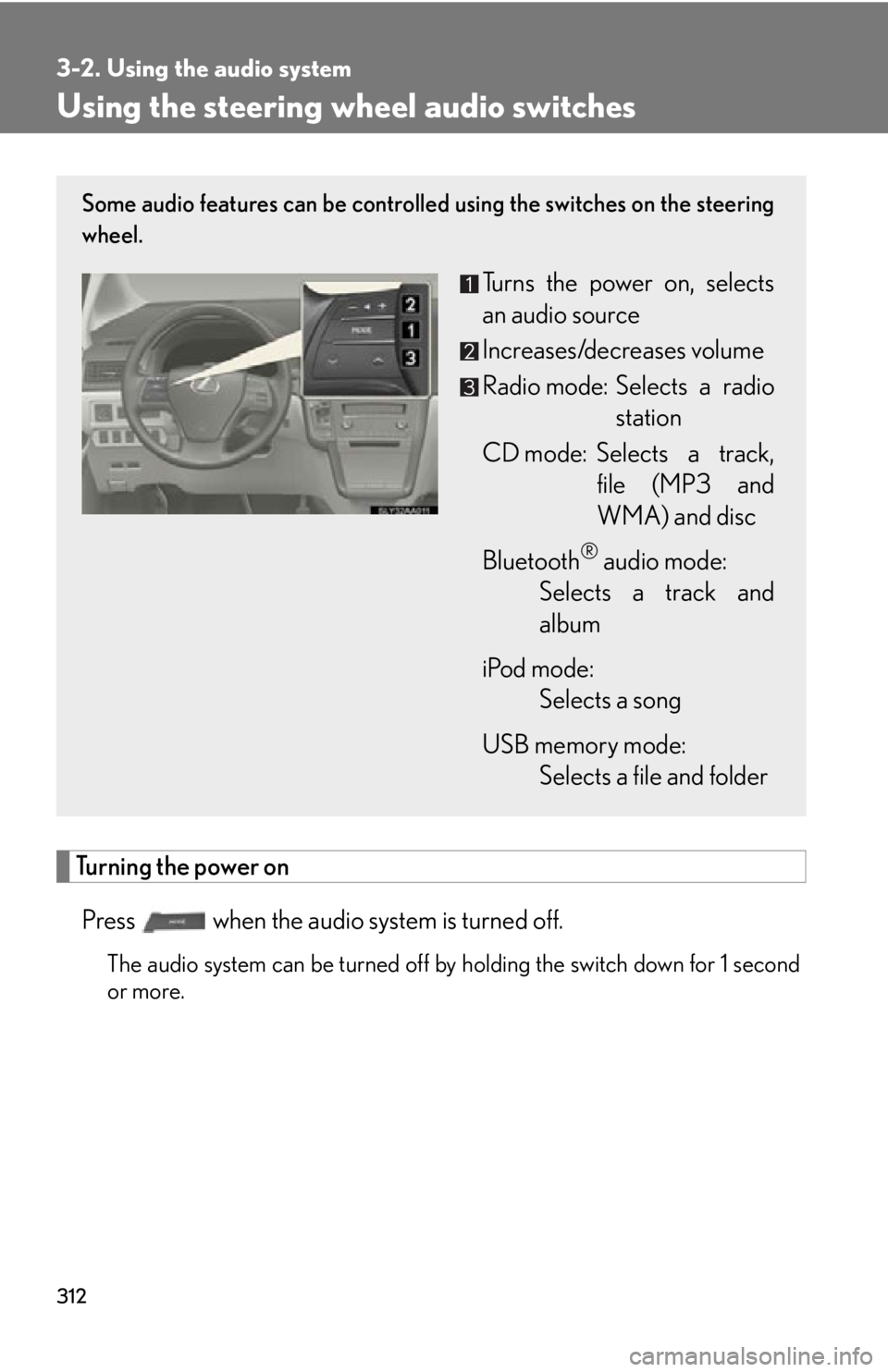
Using the steering wheel audio switches
Turning the power on
Press when the audio system is turned off.
The audio system can be turned off by holding the switch down for 1 second
or more.
Some audio features can be controlled using the switches on the steering
wheel.
Turns the power on, selects
an audio source
Increases/decreases volume
Radio mode: Selects a radio
station
CD mode: Selects a track, file (MP3 and
WMA) and disc
Bluetooth
® audio mode:
Selects a track and
album
iPod mode: Selects a song
USB memory mode: Selects a file and folder
Page 466 of 628
466
4-3. Do-it-yourself maintenance
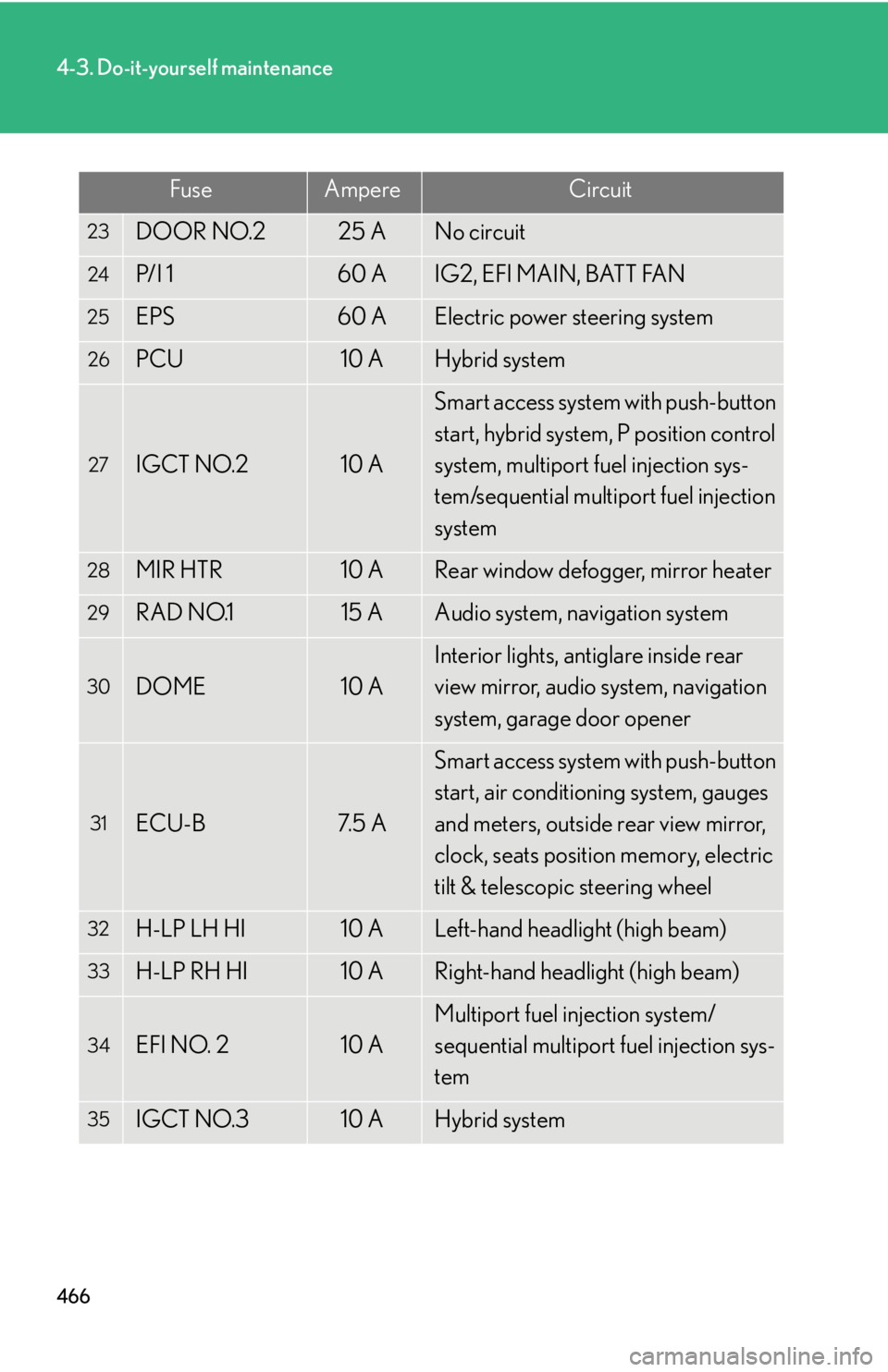
23DOOR NO.225 ANo circuit
24P/I 160 AIG2, EFI MAIN, BATT FAN
25EPS60 AElectric power steering system
26PCU10 AHybrid system
27IGCT NO.210 A
Smart access system with push-button
start, hybrid system, P position control
system, multiport fuel injection sys-
tem/sequential multiport fuel injection
system
28MIR HTR10 ARear window defogger, mirror heater
29RAD NO.115 AAudio system, navigation system
30DOME10 A
Interior lights, antiglare inside rear
view mirror, audio system, navigation
system, garage door opener
31ECU-B7. 5 A
Smart access system with push-button
start, air conditioning system, gauges
and meters, outside rear view mirror,
clock, seats position memory, electric
tilt & telescopic steering wheel
32H-LP LH HI10 ALeft-hand headlight (high beam)
33H-LP RH HI10 ARight-hand headlight (high beam)
34EFI NO. 210 A
Multiport fuel injection system/
sequential multiport fuel injection sys-
tem
35IGCT NO.310 AHybrid system
FuseAmpereCircuit
Page 470 of 628
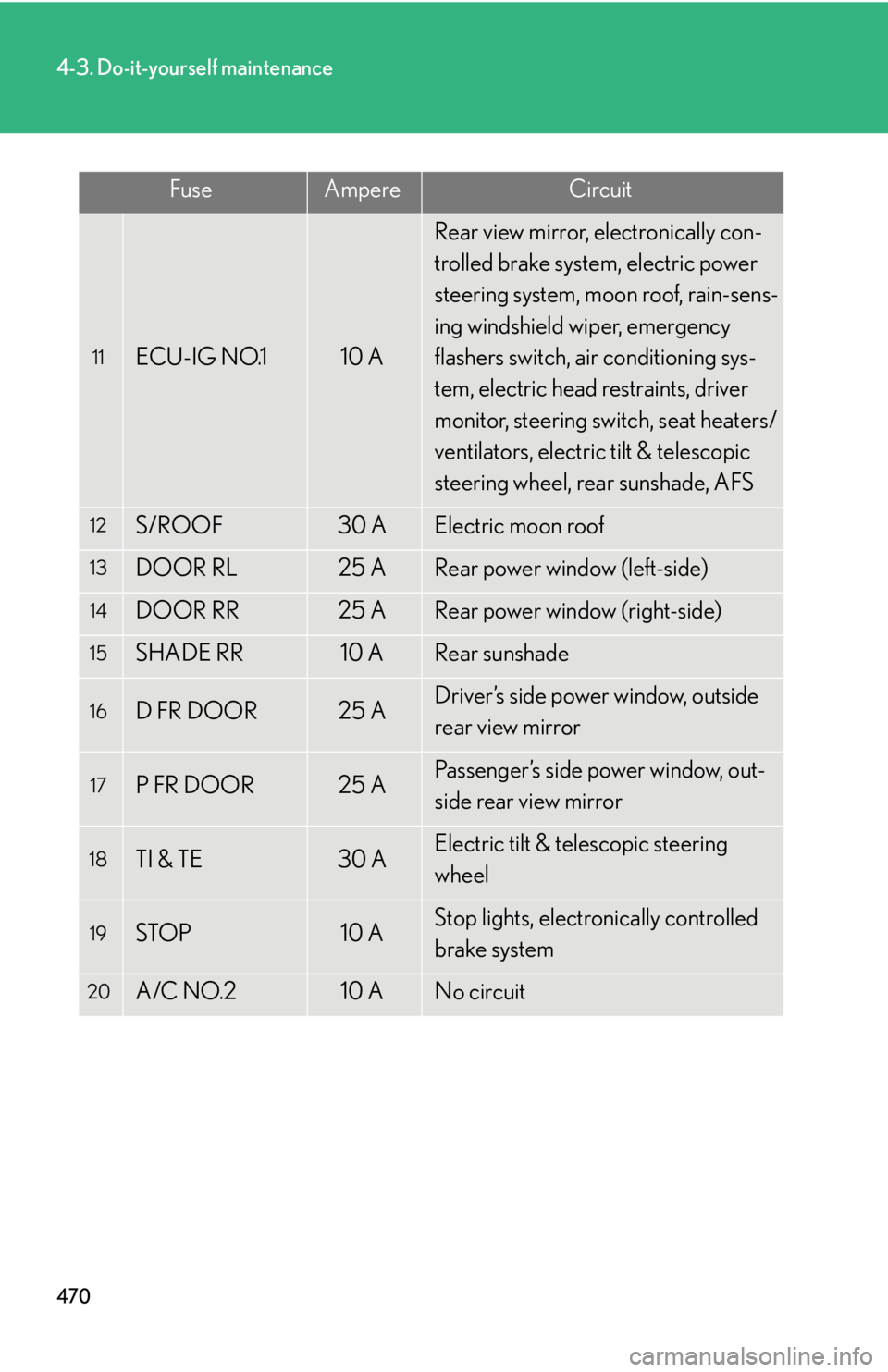
470
4-3. Do-it-yourself maintenance
11ECU-IG NO.110 A
Rear view mirror, electronically con-
trolled brake system, electric power
steering system, moon roof, rain-sens-
ing windshield wiper, emergency
flashers switch, air conditioning sys-
tem, electric head restraints, driver
monitor, steering switch, seat heaters/
ventilators, electric tilt & telescopic
steering wheel, rear sunshade, AFS
12S/ROOF30 AElectric moon roof
13DOOR RL25 ARear power window (left-side)
14DOOR RR25 ARear power window (right-side)
15SHADE RR10 ARear sunshade
16D FR DOOR25 ADriver’s side power window, outside
rear view mirror
17P FR DOOR25 APassenger’s side power window, out-
side rear view mirror
18TI & TE30 AElectric tilt & telescopic steering
wheel
19STOP10 AStop lights, electronically controlled
brake system
20A/C NO.210 ANo circuit
FuseAmpereCircuit
Page 493 of 628
5
When trouble arises
493
5-1. Essential information
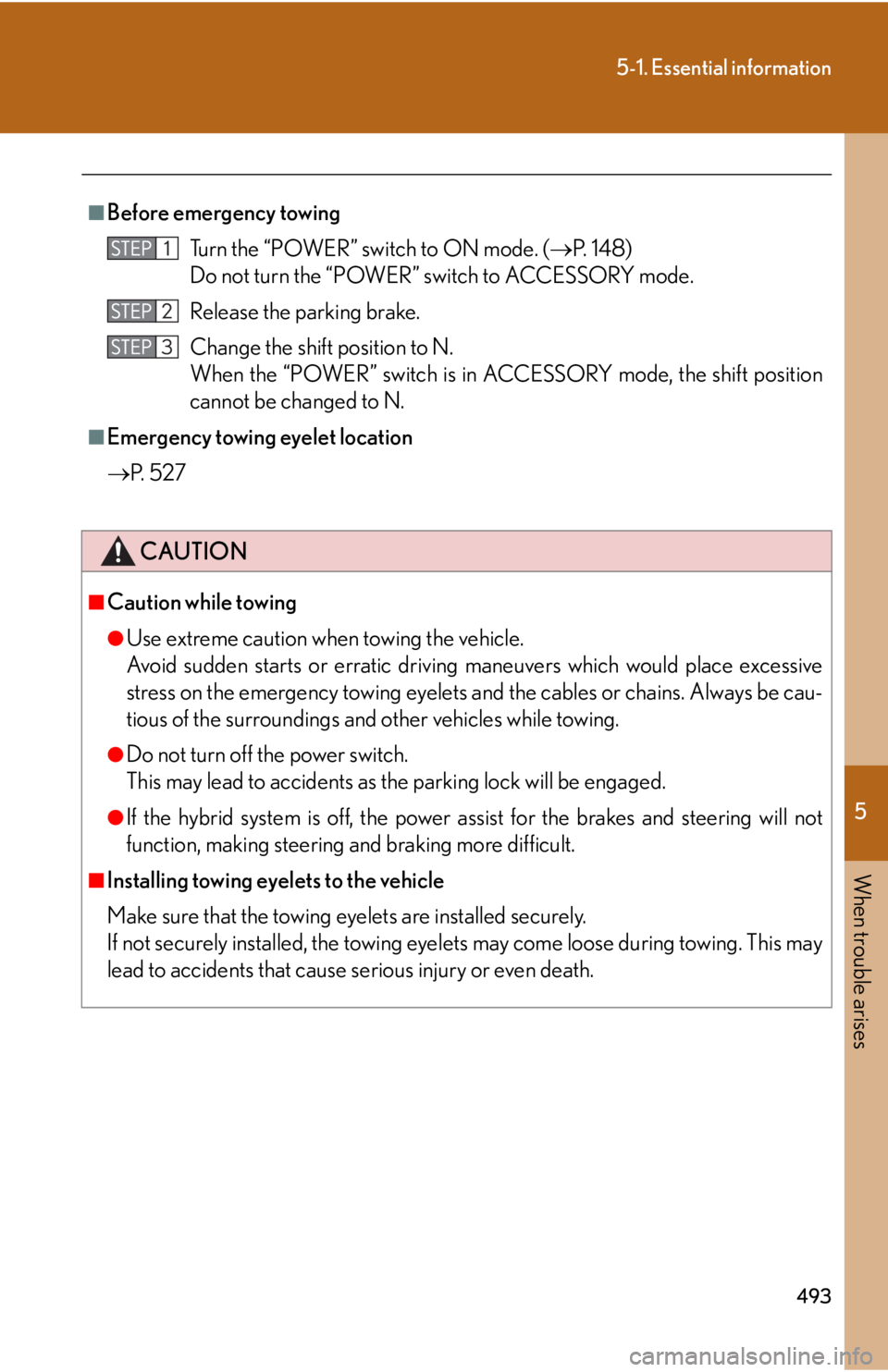
■Before emergency towingTurn the “POWER” switch to ON mode. ( P. 1 4 8 )
Do not turn the “POWER” switch to ACCESSORY mode.
Release the parking brake.
Change the shift position to N.
When the “POWER” switch is in ACCESSORY mode, the shift position
cannot be changed to N.
■Emergency towing eyelet location
P. 5 2 7
CAUTION
■Caution while towing
●Use extreme caution when towing the vehicle.
Avoid sudden starts or erratic driving maneuvers which would place excessive
stress on the emergency towing eyelets and the cables or chains. Always be cau-
tious of the surroundings and other vehicles while towing.
●Do not turn off the power switch.
This may lead to accidents as th e parking lock will be engaged.
●If the hybrid system is off, the power assist for the brakes and steering will not
function, making steering and braking more difficult.
■Installing towing eyelets to the vehicle
Make sure that the towing eyelets are installed securely.
If not securely installed, the towing eyel ets may come loose during towing. This may
lead to accidents that cause serious injury or even death.
Page 500 of 628
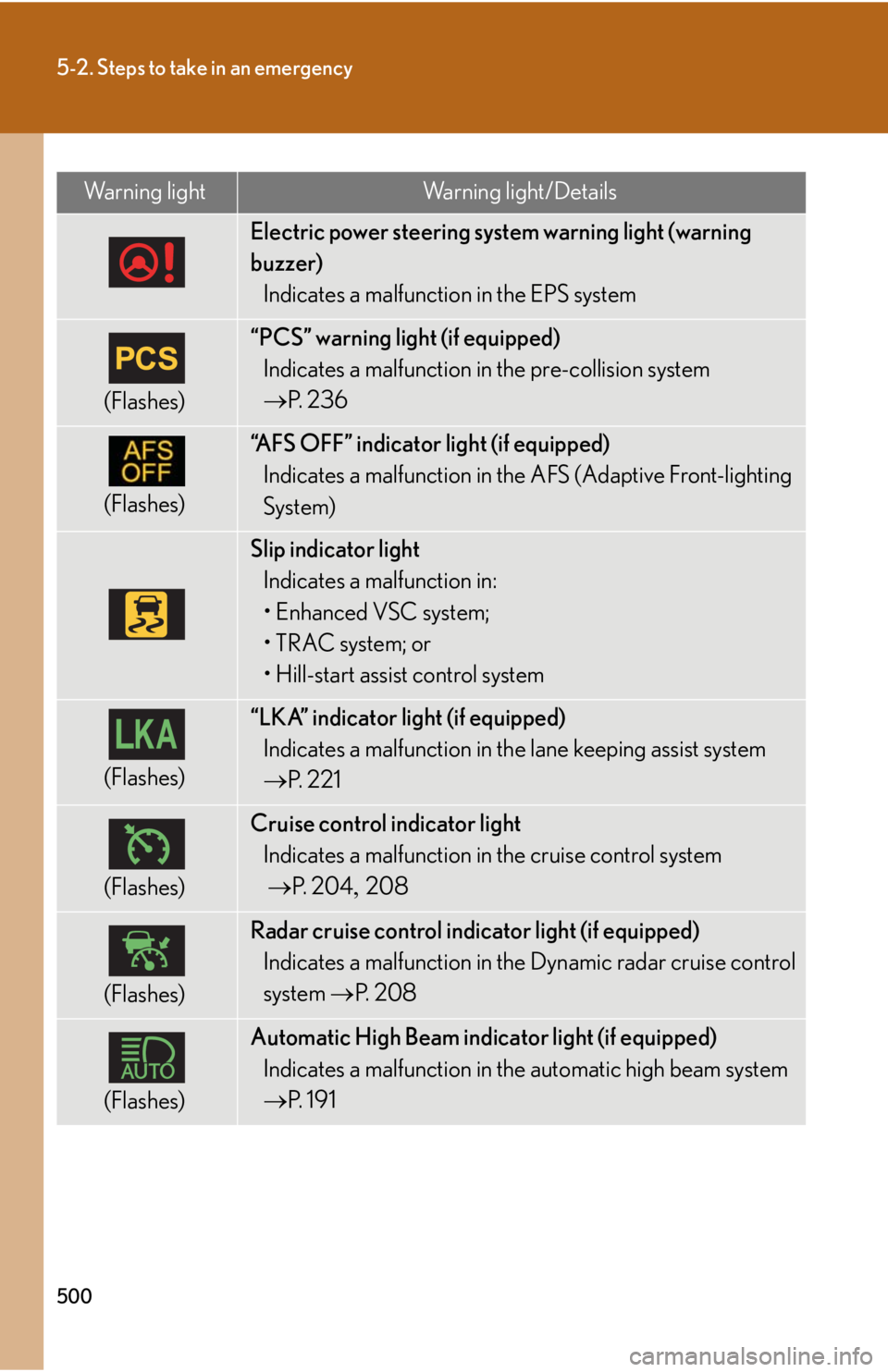
500
5-2. Steps to take in an emergency
Electric power steering system warning light (warning
buzzer)Indicates a malfunction in the EPS system
(Flashes)
“PCS” warning light (if equipped)Indicates a malfunction in the pre-collision system
P. 2 3 6
(Flashes)
“AFS OFF” indicator light (if equipped)
Indicates a malfunction in the AFS (Adaptive Front-lighting
System)
Slip indicator lightIndicates a malfunction in:
• Enhanced VSC system;
•TRAC system; or
• Hill-start assist control system
(Flashes)
“LKA” indicator light (if equipped)Indicates a malfunction in the lane keeping assist system
P. 221
(Flashes)
Cruise control indicator light
Indicates a malfunction in the cruise control system
P. 2 0 4 208
(Flashes)
Radar cruise control indicator light (if equipped)
Indicates a malfunction in the Dynamic radar cruise control
system P. 2 0 8
(Flashes)
Automatic High Beam indicator light (if equipped)
Indicates a malfunction in the automatic high beam system
P. 1 9 1
Warning lightWarning light/Details