brake light Lexus IS F 2011 Owner's Manual
[x] Cancel search | Manufacturer: LEXUS, Model Year: 2011, Model line: IS F, Model: Lexus IS F 2011Pages: 529, PDF Size: 13.89 MB
Page 3 of 529

1
2
3
4
5
6
IS F_EE
3
2-1. Driving procedures
Driving the vehicle ............. 136
Engine (ignition) switch ..... 145
Automatic transmission...... 149
Turn signal lever ................ 158
Parking brake ..................... 159
Horn ................................... 160
2-2. Instrument cluster
Gauges and meters ............. 161
Indicators and warning
lights................................. 164
Multi-information display .. 167
2-3. Operating the lights and
windshield wipers
Headlight switch ................ 172
Fog light switch.................. 175
Windshield wipers and
washer .............................. 176
Headlight cleaner switch .... 1792-4. Using other driving systems
Cruise control ..................... 180
Dynamic radar cruise
control .............................. 184
Lexus parking assist-sensor 199
Driving assist systems ........ 205
PCS (Pre-Crash Safety
system) ............................. 211
2-5. Driving information
Cargo and luggage ............. 220
Winter driving tips ............. 222
Trailer towing..................... 225
3-1. Using the air conditioning
system and defogger
Automatic air conditioning
system .............................. 228
Rear window and outside rear
view mirror defoggers ...... 236
Windshield wiper de-icer ... 237
2When driving
3Interior features
Page 14 of 529
IS F_EE
14
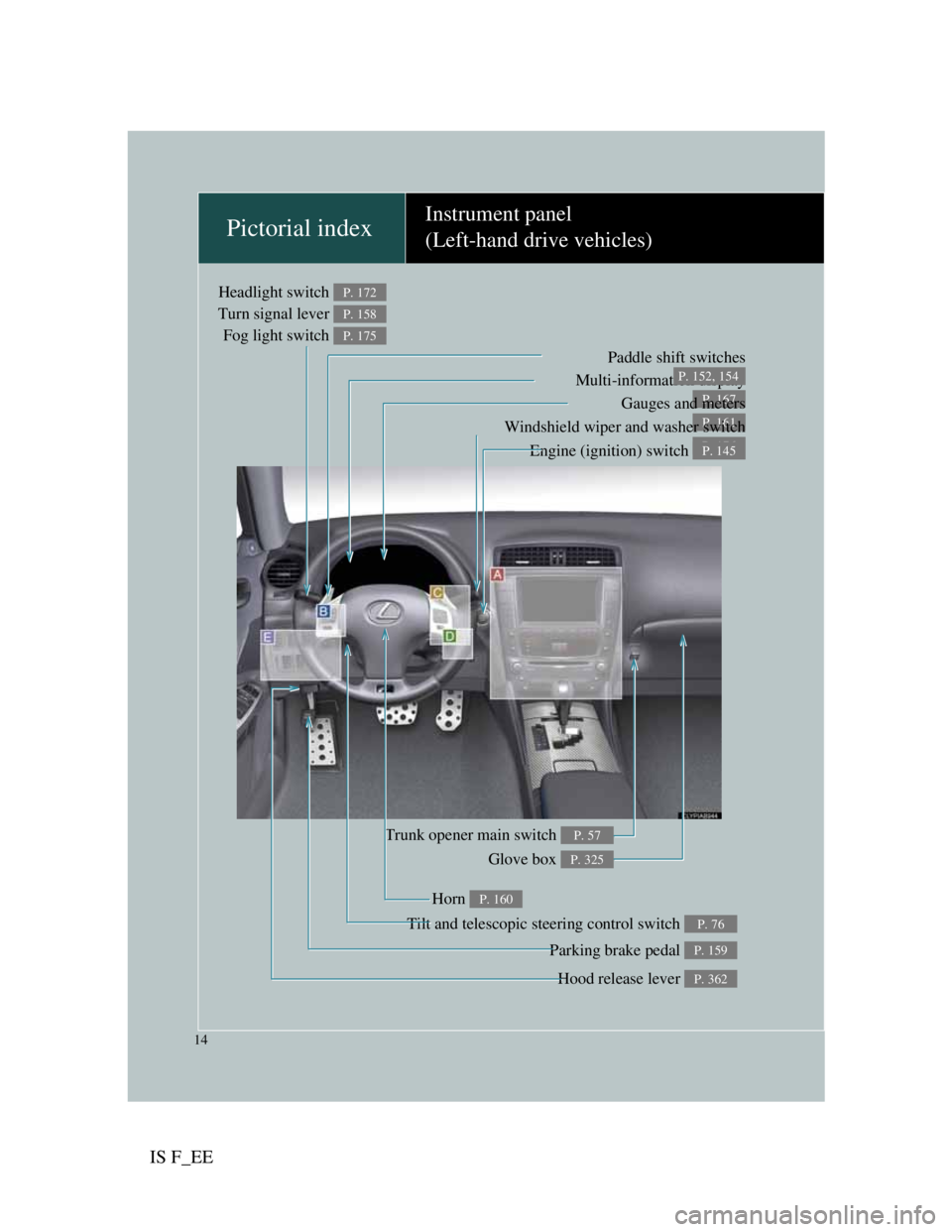
Multi-information display
P. 167
Pictorial indexInstrument panel
(Left-hand drive vehicles)
Headlight switch
Turn signal lever
Fog light switch P. 172
P. 158
P. 175
Paddle shift switches
P. 152, 154
Gauges and meters
P. 161Windshield wiper and washer switch
P. 176
Trunk opener main switch P. 57
Glove box P. 325
Tilt and telescopic steering control switch P. 76
Parking brake pedal P. 159
Engine (ignition) switch P. 145
Hood release lever P. 362
Horn P. 160
Page 22 of 529
IS F_EE
22
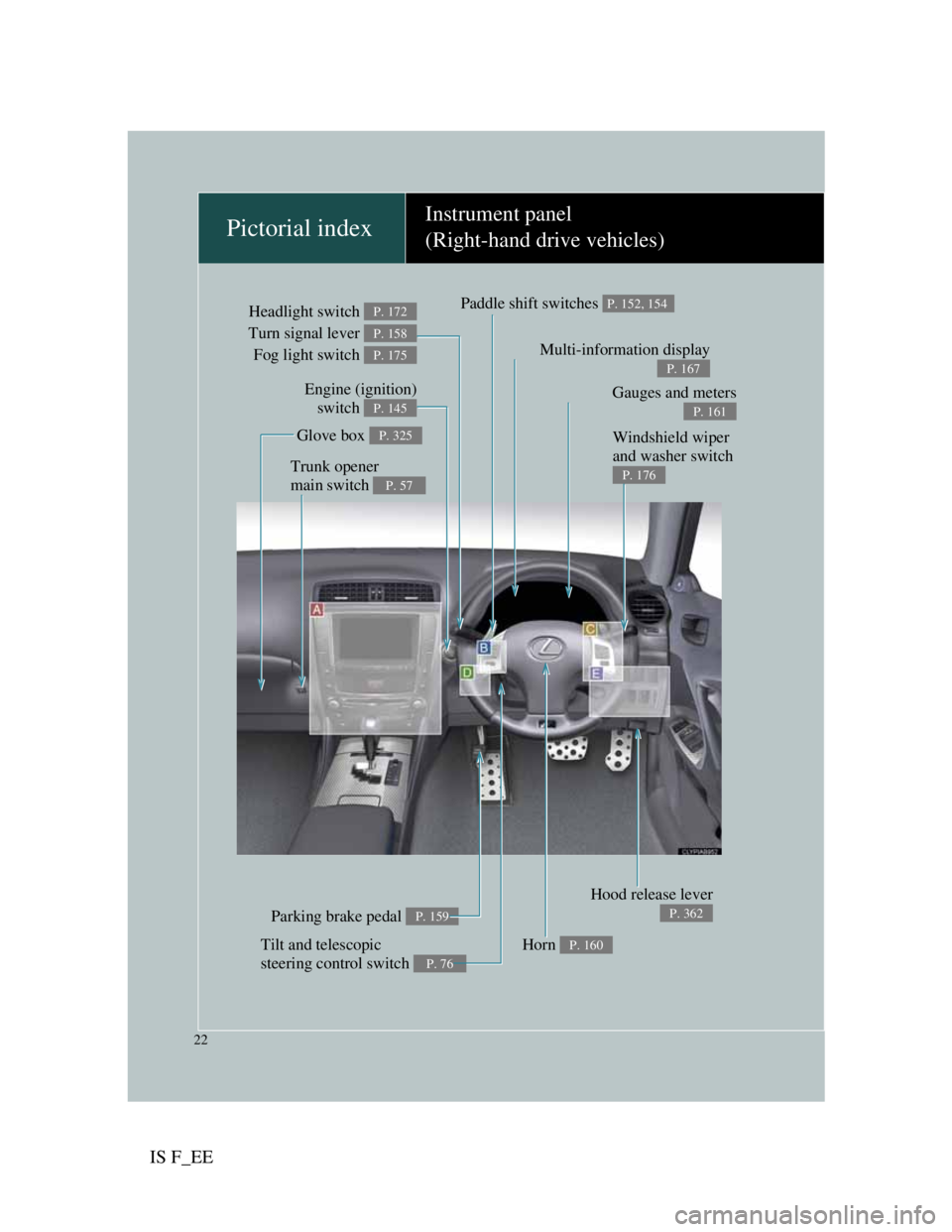
Pictorial indexInstrument panel
(Right-hand drive vehicles)
Headlight switch
Turn signal lever
Fog light switch P. 172
P. 158
P. 175
Paddle shift switches P. 152, 154
Gauges and meters
P. 161
Multi-information display
P. 167
Windshield wiper
and washer switch
P. 176
Engine (ignition)
switch
P. 145
Trunk opener
main switch
P. 57
Glove box P. 325
Tilt and telescopic
steering control switch
P. 76
Parking brake pedal P. 159
Hood release lever
P. 362
Horn P. 160
Page 145 of 529
2When driving
135
IS F_EE
2-1. Driving procedures
Driving the vehicle........... 136
Engine (ignition) switch... 145
Automatic transmission ... 149
Turn signal lever .............. 158
Parking brake ................... 159
Horn ................................. 160
2-2. Instrument cluster
Gauges and meters ........... 161
Indicators and warning
lights .............................. 164
Multi-information display 167
2-3. Operating the lights and
windshield wipers
Headlight switch.............. 172
Fog light switch ............... 175
Windshield wipers and
washer ............................ 176
Headlight cleaner switch .. 1792-4. Using other driving
systems
Cruise control .................. 180
Dynamic radar cruise
control ............................ 184
Lexus parking
assist-sensor ................... 199
Driving assist systems ..... 205
PCS (Pre-Crash Safety
system)............................ 211
2-5. Driving information
Cargo and luggage ........... 220
Winter driving tips ........... 222
Trailer towing .................. 225
Page 150 of 529

140
2-1. Driving procedures
IS F_EE
When starting off
To prevent the vehicle from creeping forward, keep the brake pedal firmly
depressed when shifting the shift lever.
When driving the vehicle
Do not drive if you are unfamiliar with the location of the brake and accel-
erator pedals to avoid depressing the wrong pedal.
• Accidentally depressing the accelerator pedal instead of the brake
pedal will result in sudden acceleration that may lead to an accident
that could result in death or serious injury.
• When backing up, you may twist your body around, leading to a diffi-
culty in operating the pedals. Make sure to operate the pedals properly.
• Make sure to keep a correct driving posture even when moving the
vehicle only slightly, allowing you to depress the brake and accelerator
pedals properly.
• Depress the brake pedal using your right foot. Depressing the brake
pedal using your left foot may delay response in an emergency, result-
ing in an accident.
Do not drive the vehicle over or stop the vehicle near flammable materi-
als.
Do not let the vehicle roll backwards while the shift lever is in a driving
position, or roll forward while the shift lever is in R.
Doing so may cause the engine to stall or lead to poor brake and steering
performance, resulting in an accident or damage to the vehicle.
If the smell of exhaust is noticed inside the vehicle, open the windows and
check that the trunk is closed. Large amounts of exhaust in the vehicle can
cause driver drowsiness and an accident, resulting in death or a serious
health hazard. Have the vehicle inspected by any authorized Lexus dealer
or repairer, or another duly qualified and equipped professional, immedi-
ately.
Do not shift the shift lever to P while the vehicle is moving.
Doing so can damage the transmission and may result in a loss of vehicle
control.
Do not shift the shift lever to R while the vehicle is moving forward.
Doing so can damage the transmission and may result in a loss of vehicle
control.
Do not shift the shift lever to D while the vehicle is moving backward.
Doing so can damage the transmission and may result in a loss of vehicle
control.
Page 151 of 529
141
2-1. Driving procedures
2
When driving
IS F_EE
CAUTION
Moving the shift lever to N while the vehicle is moving will disengage the
engine from the transmission. Engine braking is not available when N is
selected.
During normal driving, do not turn off the engine. Turning the engine off
while driving will not cause loss of steering or braking control, but the
power assist to these systems will be lost. This will make it more difficult
to steer and brake, so you should pull over and stop the vehicle as soon as
it is safe to do so.
However, in the event of an emergency, such as if it becomes impossible
to stop the vehicle in the normal way: P. 4 6 9
Use engine braking (downshift) to maintain a safe speed when driving
down a steep hill.
Using the brakes continuously may cause the brakes to overheat and lose
effectiveness. (P. 153, 155)
When stopped on an inclined surface, use the brake pedal and parking
brake to prevent the vehicle from rolling backward or forward and causing
an accident.
Do not adjust the position of the steering wheel, the seat, or the inside or
outside rear view mirrors while driving.
Doing so may result in a loss of vehicle control that can cause accidents
that may result in death or serious injury.
Always check that all passengers' arms, heads or other parts of their bod-
ies are not outside the vehicle, as this may result in death or serious injury.
When driving on slippery road surfaces
Sudden braking, acceleration and steering may cause tire slippage and
reduce your ability to control the vehicle, resulting in an accident.
Sudden changes in engine speed, such as engine braking caused by up-
shifting or down-shifting, may cause the vehicle to skid, resulting in an
accident.
After driving through a puddle, lightly depress the brake pedal to make
sure that the brakes are functioning properly. Wet brake pads may prevent
the brakes from functioning properly. If the brakes on only one side are
wet and not functioning properly, steering control may be affected, result-
ing in an accident.
Page 153 of 529

143
2-1. Driving procedures
2
When driving
IS F_EE
CAUTION
When the vehicle is parked
Do not leave glasses, cigarette lighters, spray cans, or soft drink cans in
the vehicle when it is in the sun.
Doing so may result in the following.
• Gas may leak from a cigarette lighter or spray can, and may lead to a
fire.
• The temperature inside the vehicle may cause the plastic lenses and
plastic material of eye glasses to deform or crack.
• Soft drink cans may fracture, causing the contents to spray over the
interior of the vehicle, and may also cause a short circuit in the vehi-
cle's electrical components.
Always apply the parking brake, shift the shift lever to P, stop the engine
and lock the vehicle.
Do not leave the vehicle unattended while the engine is running.
Do not touch the exhaust pipes or rear bumper exhaust diffusers while the
engine is running or immediately after turning the engine off.
Doing so may cause burns.
Do not leave the engine running in an area with snow build-up, or where it
is snowing. If snowbanks build up around the vehicle while the engine is
running, exhaust gases may collect and enter the vehicle. This may lead to
death or a serious health hazard.
Exhaust gases
Exhaust gases include harmful carbon monoxide (CO) that is colorless and
odorless. Inhaling exhaust gases may lead to death or a serious health haz-
ard.
If the vehicle is in a poorly ventilated area, stop the engine. In a closed
area, such as a garage, exhaust gases may collect and enter the vehicle.
This may lead to death or a serious health hazard.
The exhaust should be checked occasionally. If there is a hole or crack
caused by corrosion, damage to a joint or abnormal exhaust noise, be sure
to have the vehicle inspected and repaired by any authorized Lexus dealer
or repairer, or another duly qualified and equipped professional. Failure to
do so may allow exhaust gases to enter the vehicle, resulting in death or a
serious health hazard.
Page 209 of 529

198
2-4. Using other driving systems
IS F_EE
CAUTION
Conditions under which the vehicle-to-vehicle distance control may not
function correctly
Apply the brakes as necessary in the following conditions as the radar sen-
sor may not be able to correctly detect vehicles ahead, and a fatal or serious
accident may result:
When water or snow thrown up by the surrounding vehicles hinders the
functioning of the sensor
When your vehicle is pointing upwards (caused by a heavy load in the
trunk etc.)
When the road curves or when the lanes are narrow
When steering wheel operation or your position in the lane is unstable
When the vehicle ahead of you decelerates suddenly
Handling the radar sensor
Observe the following to ensure the cruise control system can function
effectively.
Otherwise, the system may not function correctly and could result in an
accident.
Keep the sensor and front grille cover clean at all times.
Clean the sensor and front grille cover with a soft cloth so you do not
mark or damage them.
Do not subject the sensor or surrounding area to a strong impact.
If the sensor moves even slightly off position, the system may malfunc-
tion. If the sensor or surrounding area is subject to a strong impact, always
have the area inspected and adjusted by any authorized Lexus dealer or
repairer, or another duly qualified and equipped professional.
Do not disassemble the sensor.
Do not attach accessories or stickers to the sensor, grille cover or sur-
rounding area.
Do not modify or paint the sensor and grille cover.
Do not replace them with non-genuine parts.
Page 215 of 529

204
2-4. Using other driving systems
IS F_EE
Sensor detection information
Certain vehicle conditions and the surrounding environment may affect
the ability of the sensor to correctly detect obstacles. Particular instances
where this may occur are listed below.
• There is dirt, snow or ice on the sensor.
• The sensor is frozen.
• The sensor is covered in any way.
• The vehicle is leaning considerably to one side.
• On an extremely bumpy road, on an incline, on gravel, or on grass
• The vicinity of the vehicle is noisy due to vehicle horns, motorcycle
engines, air brakes of large vehicles, or other loud noises producing
ultrasonic waves.
• There is another vehicle equipped with parking assist sensors in the
vicinity.
• The sensor is coated with a sheet of spray or heavy rain.
• The vehicle is equipped with a fender pole or wireless antenna.
• A towing eyelet is installed.
• The bumper or sensor receives a strong impact.
• The vehicle is approaching a tall or curved curb.
• In harsh sunlight or intense cold weather
In addition to the examples above, there are instances in which, because of
their shapes, signs and other objects may be judged by the sensor to be
closer than they are.
The shape of the obstacle may prevent the sensor from detecting it. Pay
particular attention to the following obstacles.
• Wires, fences, ropes etc.
• Cotton, snow and other materials that absorb radio waves
• Sharply-angled objects
•Low obstacles
• Tall obstacles with upper sections projecting outwards in the direction
of your vehicle
If the display flashes and a message is displayed
P. 4 3 1
Customization that can be configured at any authorized Lexus dealer or
repairer, or another duly qualified and equipped professional
Settings (e.g. buzzer volume) can be changed. (Customizable features P.
484)
Page 221 of 529

210
2-4. Using other driving systems
IS F_EE
When the “TRC OFF” indicator light comes on even if the VSC off switch
has not been pressed
TRC and hill-start assist control cannot be operated. Contact any authorized
Lexus dealer or repairer, or another duly qualified and equipped profes-
sional.
Automatic reactivation of the TRC/VSC systems
If the TRC/VSC systems are turned off, re-starting the engine will automati-
cally reactivate them.
Automatic TRC reactivation
If only the TRC system is turned off, the TRC system will turn on when
vehicle speed increases.
Automatic TRC and VSC reactivation
If the TRC and VSC systems are turned off, the systems will not turn on
even when vehicle speed increases.
Sounds and vibrations caused by the ABS, brake assist, VSC, TRC and hill-
start assist control systems
A sound may be heard from the engine compartment if the brake pedal is
depressed repeatedly when the engine is started or just after the vehicle
begins to move. This sound does not indicate that a malfunction has
occurred in any of these systems.
Any of the following conditions may occur when the above systems are
operating. None of these indicates that a malfunction has occurred.
• Vibrations may be felt through the vehicle body and steering.
• A motor sound may be heard after the vehicle comes to a stop.
• The brake pedal may pulsate slightly when the ABS is activated.
• The brake pedal may move down slightly after the ABS is activated.
Hill-start assist control is operational when
The shift lever is in the D or M position.
The brake pedal is not depressed.
The vehicle rolls backward.
EPS operation sound
When the steering wheel is operated, a motor sound (whirring sound) may
be heard. This does not indicate a malfunction.