tires Lexus IS F 2012 Owner's Manual
[x] Cancel search | Manufacturer: LEXUS, Model Year: 2012, Model line: IS F, Model: Lexus IS F 2012Pages: 578, PDF Size: 7.07 MB
Page 6 of 578
1
2
3
4
5
6
7
5
IS F_U
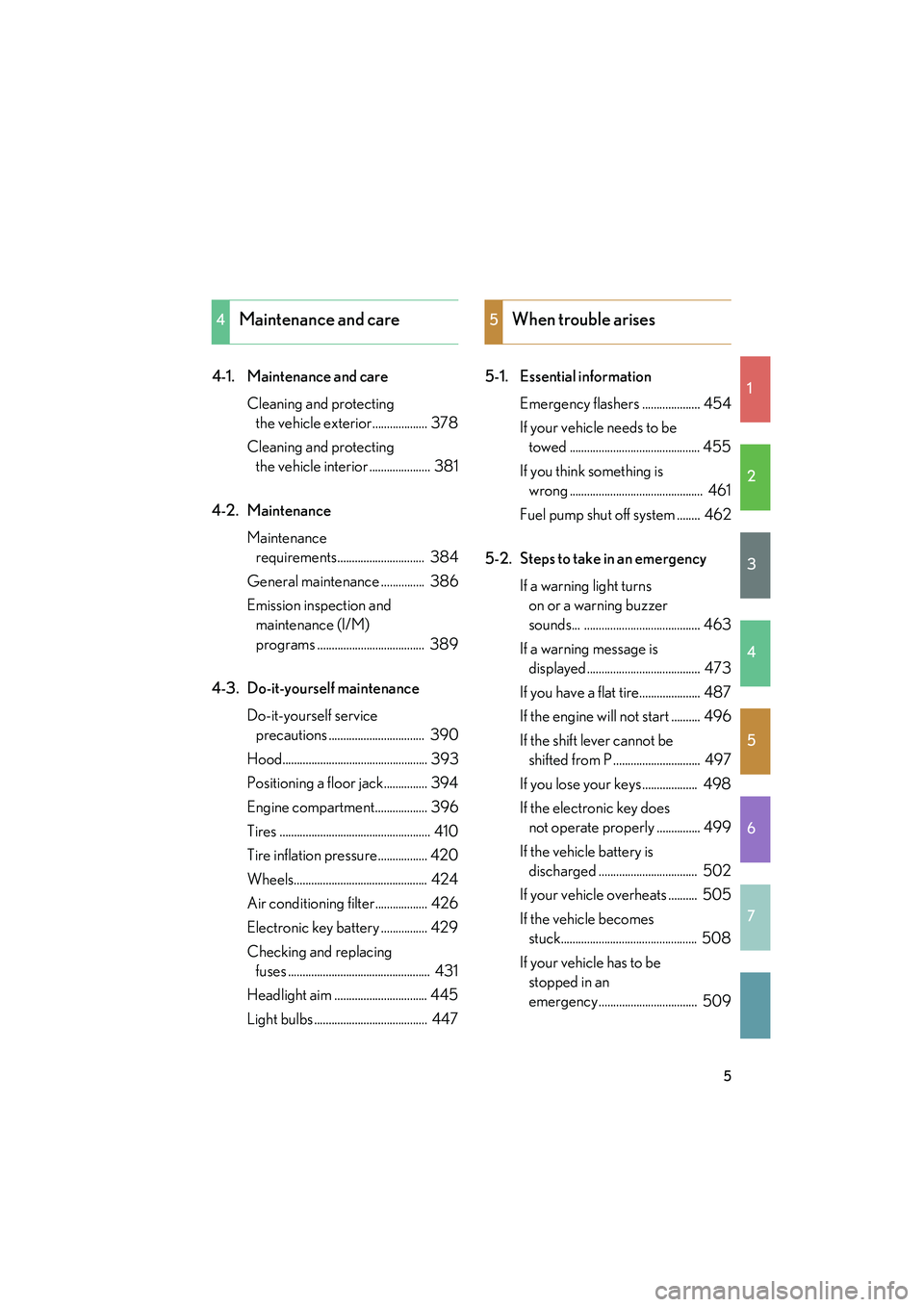
4-1. Maintenance and careCleaning and protecting the vehicle exterior................... 378
Cleaning and protecting the vehicle interior ..................... 381
4-2. Maintenance Maintenance requirements.............................. 384
General maintenance ............... 386
Emission inspection and maintenance (I/M)
programs ..................................... 389
4-3. Do-it-yourself maintenance Do-it-yourself service precautions ................................. 390
Hood.................................................. 393
Positioning a floor jack............... 394
Engine compartment.................. 396
Tires .................................................... 410
Tire inflation pressure................. 420
Wheels.............................................. 424
Air conditioning filter.................. 426
Electronic key battery ................ 429
Checking and replacing fuses ................................................. 431
Headlight aim ................................ 445
Light bulbs ....................................... 447 5-1. Essential information
Emergency flashers .................... 454
If your vehicle needs to be towed ............................................. 455
If you think something is wrong .............................................. 461
Fuel pump shut off system ........ 462
5-2. Steps to take in an emergency If a warning light turns on or a warning buzzer
sounds... ........................................ 463
If a warning message is displayed....................................... 473
If you have a flat tire..................... 487
If the engine will not start .......... 496
If the shift lever cannot be shifted from P .............................. 497
If you lose your keys ................... 498
If the electronic key does not operate properly ............... 499
If the vehicle battery is discharged .................................. 502
If your vehicle overheats .......... 505
If the vehicle becomes stuck............................................... 508
If your vehicle has to be stopped in an
emergency .................................. 509
4Maintenance and care5When trouble arises
Page 10 of 578
IS F_U
9
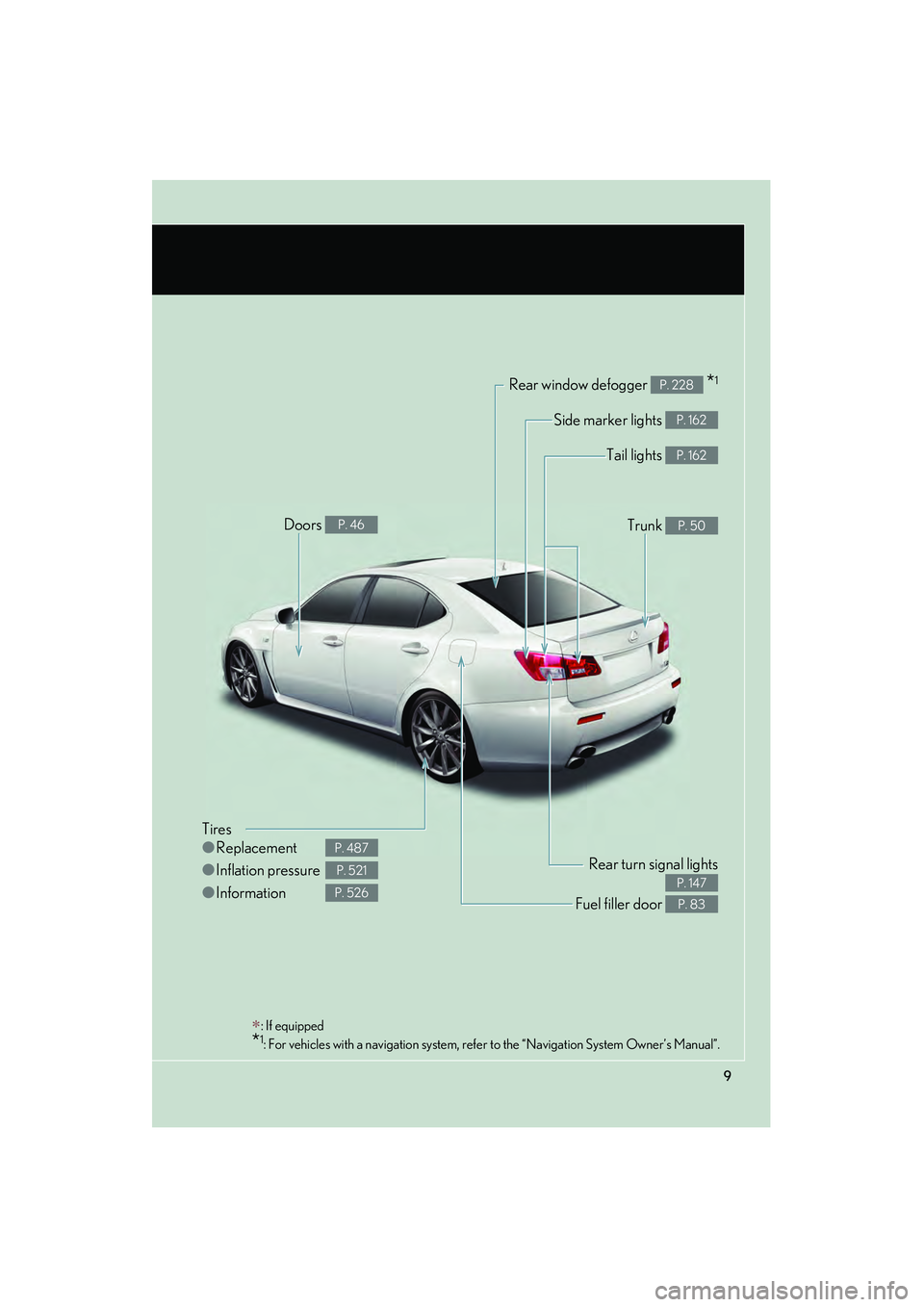
Rear window defogger *1P. 228
Tires
●Replacement
● Inflation pressure
● Information
P. 487
P. 521
P. 526
Tail lights P. 162
Side marker lights P. 162
Trunk P. 50Doors P. 46
Fuel filler door P. 83
Rear turn signal lights
P. 147
∗: If equipped
*1: For vehicles with a navigation system, refe r to the “Navigation System Owner’s Manual”.
Page 128 of 578
127
2-1. Driving procedures
2
When driving
IS F_U
■Driving in the rain
●Drive carefully when it is raining, because visibility will be reduced, the windows
may become fogged-up, and the road will be slippery.
●Drive carefully when it starts to rain, because the road surface will be especially
slippery.
●Refrain from high speeds when driving on an expressway in the rain, because
there may be a layer of water between the tires and the road surface, preventing
the steering and brakes from operating properly.
■Engine speed while driving
In the following conditions, the engine speed may become high while driving. This is
due to automatic up-shifting control or down-shifting implementation to meet driv-
ing conditions. It does not indicate sudden acceleration.
●The vehicle is judged to be driving uphill or downhill
●When the accelerator pedal is released
■Breaking in your new Lexus
To extend the life of the vehicle, the following precautions are recommended to
observe:
●For the first 186 miles (300 km):
Avoid sudden stops.
●For the first 621 miles (1000 km):
• Do not drive at extremely high speeds.
• Avoid sudden acceleration.
• Do not drive continuously in the low gears.
• Do not drive at a constant speed for extended periods.
■Drum-in-disc type parking brake system
Your vehicle has a drum-in-disc type parking brake system. This type of brake sys-
tem needs bedding-down of the brake shoes periodically or whenever the parking
brake shoes and/or drum are replaced. Have your Lexus dealer perform the bed-
ding down.
■Operating your vehicle in a foreign country
Comply with the relevant vehicle registration laws and confirm the availability of the
correct fuel. (→P. 515)
Page 130 of 578
129
2-1. Driving procedures
2
When driving
IS F_U
CAUTION
●Moving the shift lever to N while the vehicle is moving will disengage the engine
from the transmission. Engine braking is not available when N is selected.
●During normal driving, do not turn off the engine. Turning the engine off while
driving will not cause loss of steering or braking control, but the power assist to
these systems will be lost. This will make it more difficult to steer and brake, so you
should pull over and stop the vehicle as soon as it is safe to do so.
However, in the event of an emergency, such as if it becomes impossible to stop
the vehicle in the normal way: → P. 5 0 9
●Use engine braking (downshift) to maintain a safe speed when driving down a
steep hill.
Using the brakes continuously may cause the brakes to overheat and lose effec-
tiveness. (→P. 141, 143)
●When stopped on an inclined surface, use the brake pedal and parking brake to
prevent the vehicle from rolling backward or forward and causing an accident.
●Do not adjust the position of the steering wheel, the seat, or the inside or outside
rear view mirrors while driving.
Doing so may result in a loss of vehicle control that can cause accidents that may
result in death or serious injury.
●Always check that all passengers' arms, heads or other parts of their bodies are
not outside the vehicle, as this may result in death or serious injury.
●Do not drive in excess of the speed limit. Even if the legal speed limit permits it, do
not drive over 85 mph (140 km/h) unless your vehicle has high-speed capability
tires. Driving over 85 mph (140 km/h) may result in tire failure, loss of control and
possible injury. Be sure to consult a tire dealer to determine whether the tires on
your vehicle are high-speed capability tires or not before driving at such speeds.
■When driving on slippery road surfaces
●Sudden braking, acceleration and steering may cause tire slippage and reduce
your ability to control the vehicle, resulting in an accident.
●Sudden changes in engine speed, such as engine braking caused by up-shifting
or down-shifting, may cause the vehicle to skid, resulting in an accident.
●After driving through a puddle, lightly depress the brake pedal to make sure that
the brakes are functioning properly. Wet brake pads may prevent the brakes from
functioning properly. If the brakes on only one side are wet and not functioning
properly, steering control may be affected, resulting in an accident.
Page 203 of 578

202
2-4. Using other driving systems
IS F_U
CAUTION
■If the hill-start assist control does not operate effectively
Do not overly rely on the hill-start assist control. The hill-start assist control may not
operate effectively on steep inclines and roads covered in ice.
■When the VSC is activated
The slip indicator light flashes. Always drive carefully. Reckless driving may cause
an accident, resulting in death or serious injury. Exercise particular care when the
indicator light flashes.
■When TRAC and VSC are off
Be especially careful and drive at a speed appropriate to the road conditions. As
these are systems to help enhance vehicle stability and driving force, do not turn off
TRAC and VSC unless necessary.
■Replacing tires
Make sure that all tires are of the designated size and total load capacity, and of the
same brand and tread pattern. In addition, make sure that the tires are inflated to the
recommended tire pressure level.
The ABS, VSC and TRAC systems will not function correctly if different tires are fit-
ted on the vehicle.
Contact your Lexus dealer for further information when replacing tires or wheels.
■Handling of tires and suspension
Using tires with any kind of problem or modifying the suspension will affect the driv-
ing assist systems, and may cause the system to malfunction.
Page 213 of 578

212
2-5. Driving information
IS F_U
CAUTION
■Things that must not be carried in the trunk
The following things may cause a fire if loaded in the trunk.
●Receptacles containing gasoline
●Aerosol cans
■Storage precautions
Observe the following precautions.
Failing to do so may result in death or serious injury.
●Do not place cargo or luggage in or on the following locations as the item may
get under the brake or accelerator pedal and prevent pedals from being
depressed properly, block the driver's vision, or hit the driver or passengers,
causing an accident.
• At the feet of the driver
• On the front passenger or rear seats (when stacking items)
• Package tray (behind the rear seatback)
• Instrument panel
•Dashboard
●Secure all items in the occupant compartment, as they may shift and injure some-
one during sudden braking, sudden swerving or an accident.
■Luggage capacity and distribution
Observe the following precautions. Failure to do so will not only put load on the
tires, but also reduce steering and braking performance. This could lead to an acci-
dent resulting in serious injury or even death.
●Do not overload the vehicle.
●Do not apply load to the vehicle unevenly.
Page 214 of 578

213
2-5. Driving information
2
When driving
IS F_U
Vehicle load limits
■Total load capacity and seating capacity
These details are also described on the tire and loading information label.
(→ P. 4 2 0 )
CAUTION
■Overloading the vehicle
Do not overload the vehicle.
It may not only cause damage to the tires, but also degrade steering and braking
ability, resulting in an accident.
Vehicle load limits include total load capacity, seating capacity, towing
capacity and cargo capacity.
■Total load capacity: 660 lb. (300 kg)
Total load capacity means the combined weight of occupants, cargo and
luggage.
■Seating capacity: 4 occupants (Front 2, Rear 2)
Seating capacity means the maximum number of occupants whose esti-
mated average weight is 150 lb. (68 kg) per person.
■Towing capacity
Lexus does not recommend towing a trailer with your vehicle.
■Cargo capacity
Cargo capacity may increase or decrease depending on the weight and
the number of occupants.
Page 215 of 578

214
2-5. Driving information
IS F_U
Winter driving tips
Carry out the necessary preparations and inspections before driving the
vehicle in winter. Always drive the vehicle in a manner appropriate to the
prevailing weather conditions.
■Pre-winter preparations
● Use fluids that are appropriate to the prevailing outside tempera-
tures.
• Engine oil
• Engine coolant
• Washer fluid
● Have a service technician inspect the level and specific gravity of
battery electrolyte.
● Have the vehicle fitted with four snow tires.
Ensure that all tires are the specified size and the same brand.
■Before driving the vehicle
Perform the following according to the driving conditions.
● Do not try to forcibly open a window or move a wiper that is fro-
zen. Pour warm water over the frozen area to melt the ice. Wipe
away the water immediately to prevent it from freezing.
● To ensure proper operation of the climate control system fan,
remove any snow that has accumulated on the air inlet vents in
front of the windshield.
● Remove any ice that has accumulated on the vehicle chassis.
● Periodically check for and remove any excess ice or snow that
may have accumulated in the wheel well or on the brakes.
Page 216 of 578

215
2-5. Driving information
2
When driving
IS F_U
CAUTION
■Driving with snow tires
Observe the following precautions to reduce the risk of accidents.
Failing to do so may result in a loss of vehicle control and cause death or serious
injury.
●Use tires of the size specified for your vehicle.
●Maintain the recommended level of air pressure.
●Do not drive in excess of 75 mph (120 km/h), regardless of the type of snow tires
being used.
●Use snow tires on all, not just some wheels.
NOTICE
■Driving with tire chains
Do not fit tire chains. Tire chains may damage the vehicle body and adversely affect
driving performance.
■Repairing or replacing snow tires
Request repairs of and obtain replacement snow tires from Lexus dealers or legiti-
mate tire retailers.
This is because the removal and attachment of snow tires affects the operation of
the tire pressure warning system.
■When driving the vehicle
Accelerate the vehicle slowly and drive at a reduced speed suitable
to road conditions.
■ When parking the vehicle
Park the vehicle and move the shift lever to P without setting the
parking brake. The parking brake may freeze up, preventing it from
being released. If necessary, block the wheels to prevent inadvert-
ent sliding or creeping.
Page 378 of 578
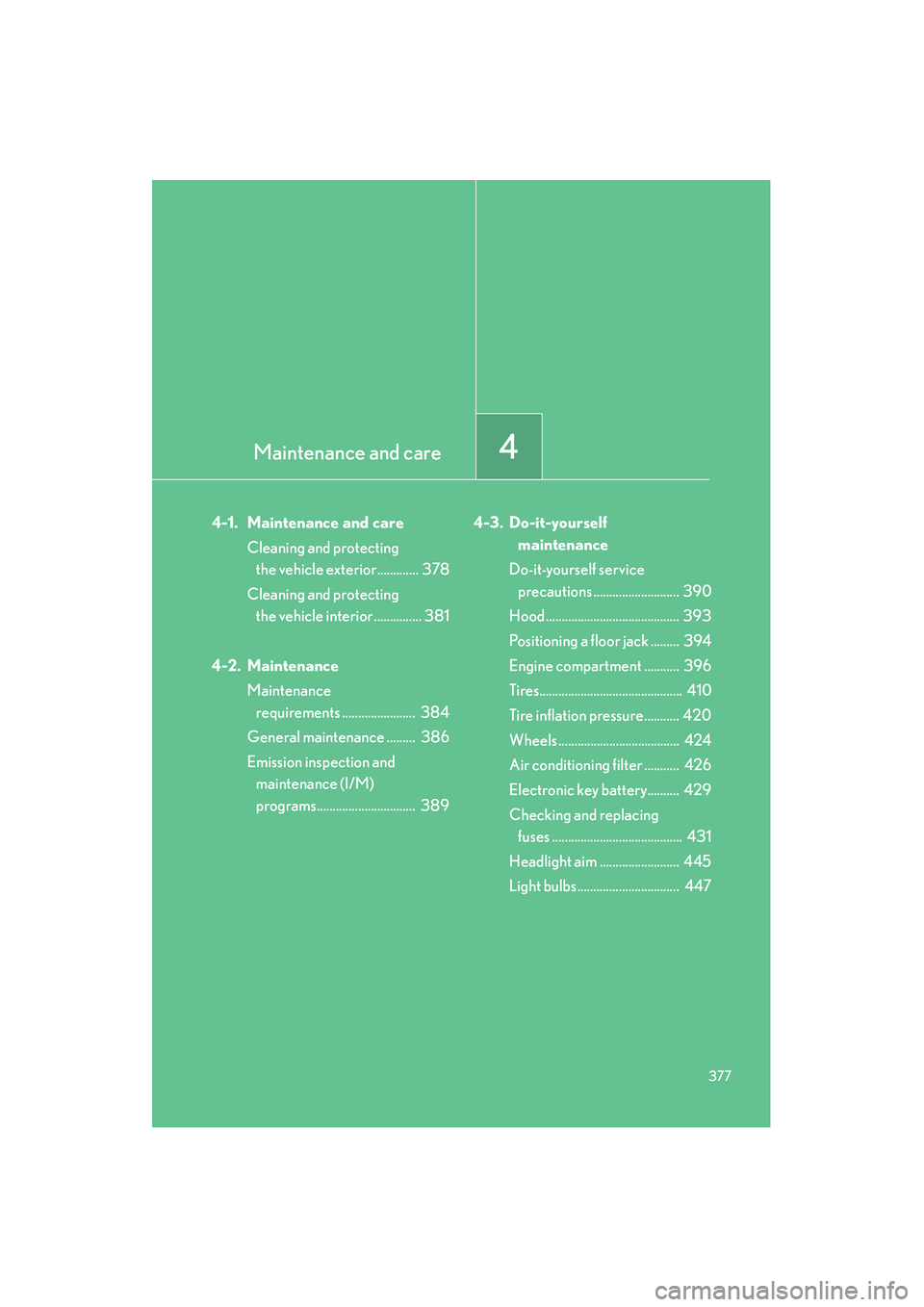
Maintenance and care4
377
IS F_U
4-1. Maintenance and careCleaning and protecting the vehicle exterior............. 378
Cleaning and protecting the vehicle interior ............... 381
4-2. Maintenance Maintenance requirements ....................... 384
General maintenance ......... 386
Emission inspection and maintenance (I/M)
programs............................... 389 4-3. Do-it-yourself
maintenance
Do-it-yourself service precautions ........................... 390
Hood .......................................... 393
Positioning a floor jack ......... 394
Engine compartment ........... 396
Tires............................................. 410
Tire inflation pressure........... 420
Wheels ...................................... 424
Air conditioning filter ........... 426
Electronic key battery.......... 429
Checking and replacing fuses ......................................... 431
Headlight aim ......................... 445
Light bulbs................................ 447