air condition Lexus IS200t 2015 User Guide
[x] Cancel search | Manufacturer: LEXUS, Model Year: 2015, Model line: IS200t, Model: Lexus IS200t 2015Pages: 612, PDF Size: 132.21 MB
Page 185 of 612
1854-1. Before driving
4
Driving
IS200t_EE(OM53D19E)
NOTICE
■When driving the vehicle
●Do not depress the accelerator and brake pedals at the same time during driving, as
this may restrain the engine output.
●Do not use the accelerator pedal or depress the accelerator and brake pedals at the
same time to hold the vehicle on a hill.
■When parking the vehicle
Always shift the shift lever to P. Failure to do so may cause the vehicle to move or the
vehicle may accelerate suddenly if the accelerator pedal is accidentally depressed.
■Avoiding damage to vehicle parts
●Do not turn the steering wheel fully in either direction and hold it there for an
extended period of time.
Doing so may damage the power steering motor.
●When driving over bumps in the road, drive as slowly as possible to avoid damaging
the wheels, underside of the vehicle, etc.
●Make sure to idle the engine immediately after high speed driving or hill climbing.
Stop the engine only after the turbocharger has cooled down.
Failure to do so may cause damage to the turbocharger.
■If you get a flat tire while driving
A flat or damaged tire may cause the following situations. Hold the steering wheel
firmly and gradually depress the brake pedal to slow down the vehicle.
●It may be difficult to control your vehicle.
●The vehicle will make abnormal sounds or vibrations.
●The vehicle will lean abnormally.
Information on what to do in case of a flat tire ( →P. 5 2 2 , 5 3 3 )
■When encountering flooded roads
Do not drive on a road that has flooded after heavy rain etc. Doing so may cause the
following serious damage to the vehicle:
●Engine stalling
●Short in electrical components
●Engine damage caused by water immersion
In the event that you drive on a flooded road and the vehicle is flooded, be sure to have
any authorized Lexus dealer or repairer, or another duly qualified and equipped pro-
fessional check the following:
●Brake function
●Changes in quantity and quality of oil and fluid used for the engine, transmission, dif-
ferentials, etc.
●Lubricant condition for the propeller shaft, bearings and suspension joints (where
possible), and the function of all joints, bearings, etc.
Page 194 of 612
1944-1. Before driving
IS200t_EE(OM53D19E)
■Important points regarding stability
Vehicle movement resulting from uneven road surfaces and strong cross-
winds will affect handling. The vehicle may also be rocked by passing buses or
large trucks. Frequently check behind when moving alongside such vehicles.
As soon as such vehicle movement occurs, immediately start to decelerate
smoothly by slowly applying the brakes. Always steer the vehicle straight
ahead while braking.
■Passing other vehicles
Consider the total combined length of your vehicle and trailer and ensure that
the vehicle-to-vehicle distance is sufficient before executing lane changes.
■Transmission information
To maintain engine braking efficiency, when using engine braking when driv-
ing on a long steep downward grade, do not use the transmission in D. The
vehicle must be driven in gear shift position “4” in M mode. ( →P. 2 0 4 )
■If the engine overheats
Towing a loaded trailer up a long, steep incline in temperatures exceeding
30 °C (85 °F) may result in the engine overheating. If the engine coolant tem-
perature gauge indicates that the engine is overheating, turn the air condition-
ing off immediately, leave the road and stop the vehicle in a safe place.
( → P. 5 5 7 )
■When parking the vehicle
Always place wheel chocks under the whee ls of both the vehicle and trailer.
Firmly set the parking brake and shift the shift lever to P.
Page 198 of 612
1984-2. Driving procedures
IS200t_EE(OM53D19E)
■Auto power off function
If the vehicle is left in ACCESSORY mode for more than 20 minutes or IGNITION ON
mode (the engine is not running) for more than an hour with the shift lever in P, the engine
switch will automatically turn off. However, this function cannot entirely prevent battery
discharge. Do not leave the vehicle with the engine switch in ACCESSORY or IGNI-
TION ON mode for long periods of time when the engine is not running.
■Electronic key battery depletion
→P. 1 1 9
■Conditions affecting operation
→P. 1 3 6
■Notes for the entry function
→P. 1 3 7
■If the engine does not start
●Check that the shift lever is securely set in P. The engine may not start if the shift lever is
displaced out of P.
●The engine immobilizer system may not have been deactivated. ( →P. 77)
Contact any authorized Lexus dealer or repairer, or another duly qualified and
equipped professional.
■Steering lock
After turning the engine switch off and opening and closing the doors, the steering wheel
will be locked due to the steering lock functi on. Operating the engine switch again auto-
matically cancels the steering lock.
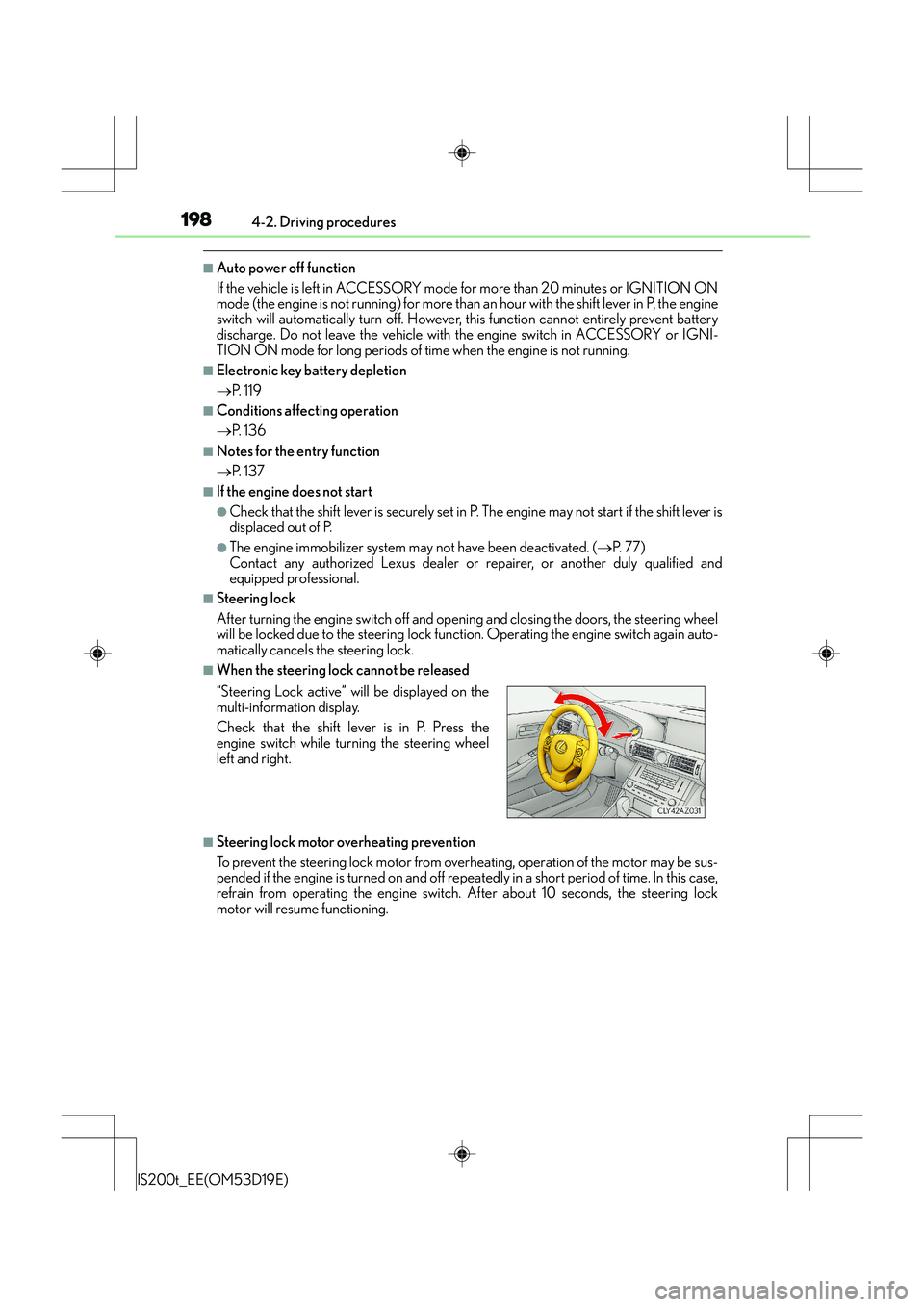
■When the steering lock cannot be released
■Steering lock motor overheating prevention
To prevent the steering lock motor from overheating, operation of the motor may be sus-
pended if the engine is turned on and off repeat edly in a short period of time. In this case,
refrain from operating the engine switch. After about 10 seconds, the steering lock
motor will resume functioning. “Steering Lock active” w ill be displayed on the
multi-information display.
Check that the shift lever is in P. Press the
engine switch while tu rning the steering wheel
left and right.
Page 205 of 612
2054-2. Driving procedures
4
Driving
IS200t_EE(OM53D19E)
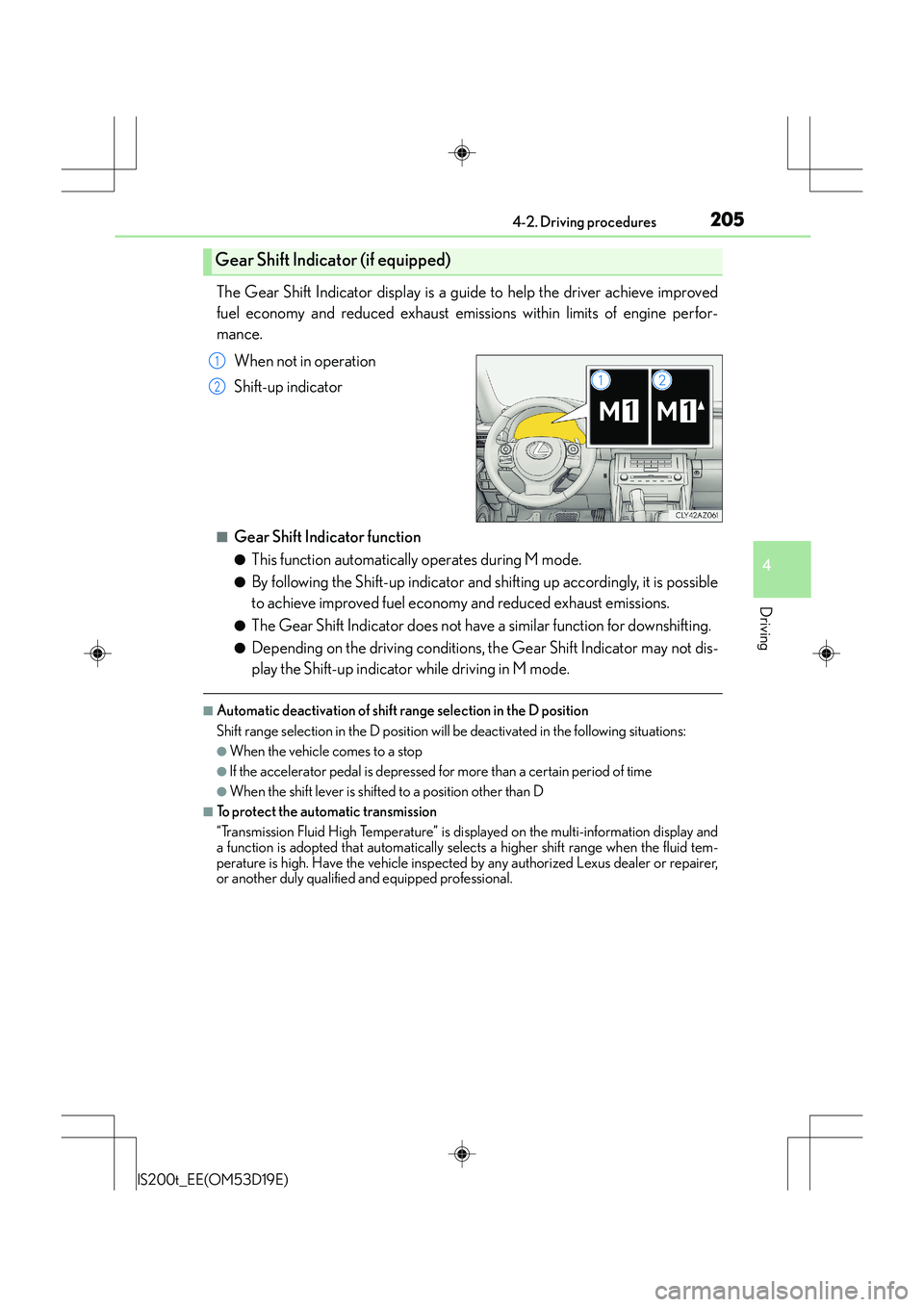
The Gear Shift Indicator display is a guide to help the driver achieve improved
fuel economy and reduced exhaust emissions within limits of engine perfor-
mance.When not in operation
Shift-up indicator
■Gear Shift Indicator function
●This function automatically operates during M mode.
●By following the Shift-up indicator and shifting up accordingly, it is possible
to achieve improved fuel economy and reduced exhaust emissions.
●The Gear Shift Indicator does not have a similar function for downshifting.
●Depending on the driving conditions, the Gear Shift Indicator may not dis-
play the Shift-up indicator while driving in M mode.
■Automatic deactivation of shift range selection in the D position
Shift range selection in the D position will be deactivated in the following situations:
●When the vehicle comes to a stop
●If the accelerator pedal is depressed for more than a certain period of time
●When the shift lever is shifted to a position other than D
■To protect the automatic transmission
“Transmission Fluid High Temperature” is di splayed on the multi-information display and
a function is adopted that automatically selects a higher shift range when the fluid tem-
perature is high. Have the vehicle inspected by any authorized Lexus dealer or repairer,
or another duly qualified and equipped professional.
Gear Shift Indicator (if equipped)
1
2
Page 234 of 612
2344-5. Using the driving support systems
IS200t_EE(OM53D19E)
After the engine is stopped by the Stop & Start system when the vehicle is on an
incline, brake force is temporarily maintained to prevent rolling backwards until
the engine is restarted and drive force is generated.
When drive force is generated, the maintained brake force is automatically
canceled.
●This function operates on flat surfaces as well as steep inclines.
●Sound may be generated from the brakes, but this is not a malfunction.
●Brake pedal response may change and vibration may occur, but these are not
malfunctions.
■Operating conditions
●The Stop & Start system is operational when all of the following conditions are met:
• The brake pedal is being depressed firmly.
• The shift lever is in D or P.
• Normal mode or Eco drive mode is selected as the driving mode.
• is off.
• The driver’s seat belt is fastened.
• The engine is adequately warmed up.
• The driver’s door is closed.
• The accelerator pedal is not being depressed.
• The outside temperature is -5°C (23°F) or higher.
• The hood is closed.
●In the following situations the engine may not be stopped by the Stop & Start system.
This is not a malfunction of the Stop & Start system.
• The air conditioning system is being used when the ambient temperature is high orlow.
• The battery is not sufficiently charged or is undergoing a periodic recharge.
• The brake booster vacuum is low.
• The vehicle is stopped on a steep incline.
• The steering wheel is being operated.
• Due to traffic or other circumstances the vehicle is stopped repeatedly.
• The vehicle is being driven in a high altitude area.
• Engine coolant temperature or transmission fluid temperature is extremely low or high.
• The battery fluid temperature is extremely low or high.
• For a while after the battery terminals have been disconnected reconnected.
• For a while after the battery replacement.
• Vehicles with a power heater: The power heater is being used.
Hill-start assist control
Page 235 of 612
2354-5. Using the driving support systems
4
Driving
IS200t_EE(OM53D19E)
●In the following situations, the engine will restart automatically if the engine is stopped
by the Stop & Start system. (To enable stopping of the engine by the Stop & Start sys-
tem, drive the vehicle.)
• The air conditioning system is turned on.
• is turned on.
• The steering wheel is operated.
• The shift lever is shifted to M, N or R from D.
• The shift lever is shifted from P.
• Sport mode or snow mode is selected as the driving mode.
• The driver’s seat belt is unfastened.
• The driver’s door is opened.
• The accelerator pedal is depressed.
• The Stop & Start cancel switch is pressed.
• The vehicle starts to roll on an incline.
• Vehicles with a power heater: The power heater is turned on.
●In the following situations, the engine may re start automatically if the engine is stopped
by the Stop & Start system. (To enable stopping of the engine by the Stop & Start sys-
tem, drive the vehicle.)
• The brake pedal is pumped or strongly depressed.
• The air conditioning system is being used.
• The battery is not sufficiently charged.
■Hood
●If the hood is opened while the engine is stopped by the Stop & Start system with the
shift lever in D, the engine will stall and will not be able to be restarted by the automatic
engine start function. In this case, restart the engine using the normal engine starting
procedure. ( →P. 1 9 6 )
●If the hood is opened while the engine is stopped by the Stop & Start system with the
shift lever in P, the engine will be restarted automatically.
●If the hood is closed after the engine is st arted with the hood open, the Stop & Start sys-
tem will not operate. Close the hood, turn th e engine switch off, wait 30 seconds or
more, and then start the engine.
■When to use the Stop & Start system
●Use the Stop & Start system when stopping the vehicle temporarily at red lights, inter-
sections, etc. When stopping the vehicle for a longer period of time, stop the engine
completely.
●When the system does not operate, is canceled, or is malfunctioning, warning mes-
sages and a warning buzzer are used to inform the driver. ( →P. 2 3 7 )
●If the engine switch is pressed when the engine is stopped by the Stop & Start system,
the engine will stall and will not be able to be restarted by the automatic engine start
function. In this case, restart the engine using the normal engine starting procedure.
( → P. 1 9 6 )
●When the engine is restarted by the Stop & Start system, the power outlet may be tem-
porarily unusable, but this is not a malfunction.
●Installation and removal of electrical components and wireless devices may affect the
Stop & Start system. Contact any authorized Lexus dealer or repairer, or another duly
qualified and equipped professional for details.
Page 236 of 612
2364-5. Using the driving support systems
IS200t_EE(OM53D19E)
■If the windshield is fogged up while the engine is stopped by the Stop & Start system
Turn on. (The engine will start due to the automatic engine start function.):
→P. 4 0 4
If the windshield fogs up frequently, press the Stop & Start cancel switch to disable the
system.
■Air conditioning system while the engine is stopped by the Stop & Start system
While the engine is stopped by the Stop & Start system, the air conditioning system
(cooling, heating and dehumidifying functions) is canceled and will only blow air or will
stop blowing air. In order to prevent the air conditioning system from being canceled, dis-
able the Stop & Start system by pressing the Stop & Start cancel switch.
■Changing the idling stop time with the air conditioning system on
The length of time the Stop & Start system will operate when the air conditioning system
is on can be changed by performing the followi ng operation. (The length of time the Stop
& Start system will operate when the air cond itioning system is off cannot be changed.)
●Setting by pressing and holding the Stop & Start cancel switch
Each time the Stop & Start cancel switch is pressed and held for 3 seconds or more, the
system changes between standard and extend ed. The system status can be confirmed
on the multi-information display screen. ( →P. 1 0 0 )
●Settings from the multi-information display
Press the < or > meter control switch ( →P. 101) and select .
Press the meter control switch to display the Stop & Start settings screen.
Press the ∧ or ∨ meter control switch to select Time Setting and then press .
Press the ∧ or ∨ meter control switch to select Standard or Extended and then press
.
■The Stop & Start system protection function
●When the volume of the audio system is excessively high, sound output from the audio
system may suddenly be cut off in order to reduce battery consumption. To prevent the
audio system from being cut off, keep the vo lume of audio system at a moderate level.
If the audio system has been cut off, turn the engine switch off, wait for 3 seconds or
more and then turn it to ACCESSORY mode or IGNITION ON mode to re-enable
the audio system.
●The audio system may not be activated if the battery terminals are disconnected and
then reconnected. If this occurs, turn the engine switch off and then turn it to IGNI-
TION ON mode and then off twice to activate the audio system.
■To prevent damage to the turbocharger
Allow the engine to idle immediately after driv ing at high speeds or long periods of uphill
driving. To allow the engine idle when the vehicle is stopped, disable the Stop & Start sys-
tem by pressing the Stop & Start cancel switch. ( →P. 233)
■Replacing the battery
→P. 5 5 5
■Displaying the Stop & Start system status
→P. 1 0 6
1
2
3
4
Page 237 of 612
2374-5. Using the driving support systems
4
Driving
IS200t_EE(OM53D19E)
■Multi-information display messages
If the following situations, and a message may be displayed on the multi-informa-
tion display.
●When the engine cannot be stopped by the Stop & Start system
MessageDetails
“Depress Brake
Firmly to Activate.”
The brake pedal is not depressed enough. If the brake pedal is depressed further, the sys-
tem will operate.
“For Climate Con-
trol.”
• The air conditioning system is being used when the ambient temperature is high or low.
If the difference between the set temperature
and cabin temperature is small, the system will be
enabled.
• is ON.
“Battery Charging.”
• The battery charge amount may be low. Engine stop is temporarily prohibited to priori-
tize charging of the battery, but if the engine is
operated for a short while, engine stop is
allowed.
• A refresh charge may be occurring (Examples: A short time after replacing the battery, remov-
ing battery terminals, etc.)
After a refresh charge of approximately 30 to
60 minutes completes, the system can be oper-
ated.
• The engine may have been started with the hood opened.
Close the hood, turn the engine switch off, wait
for a short while, and then start the engine.
• The battery may be cold. Operating the engine for a short while allows the
system to recover due to the temperature
increase in the engine compartment.
• The battery may be extremely hot.
If the engine is stopped and the engine compart-
ment is allowed to cool sufficiently, the system
recovers.
“For Brake System.”
• The vehicle is being driven in a high altitude area.
• The brake booster vacuum is low. When the brake booster vacuum reaches a pre-
determined level, the system will be enabled.
“Driver Seat Belt
Unbuckled.”
The driver seat belt is not fastened.
Page 238 of 612
2384-5. Using the driving support systems
IS200t_EE(OM53D19E)
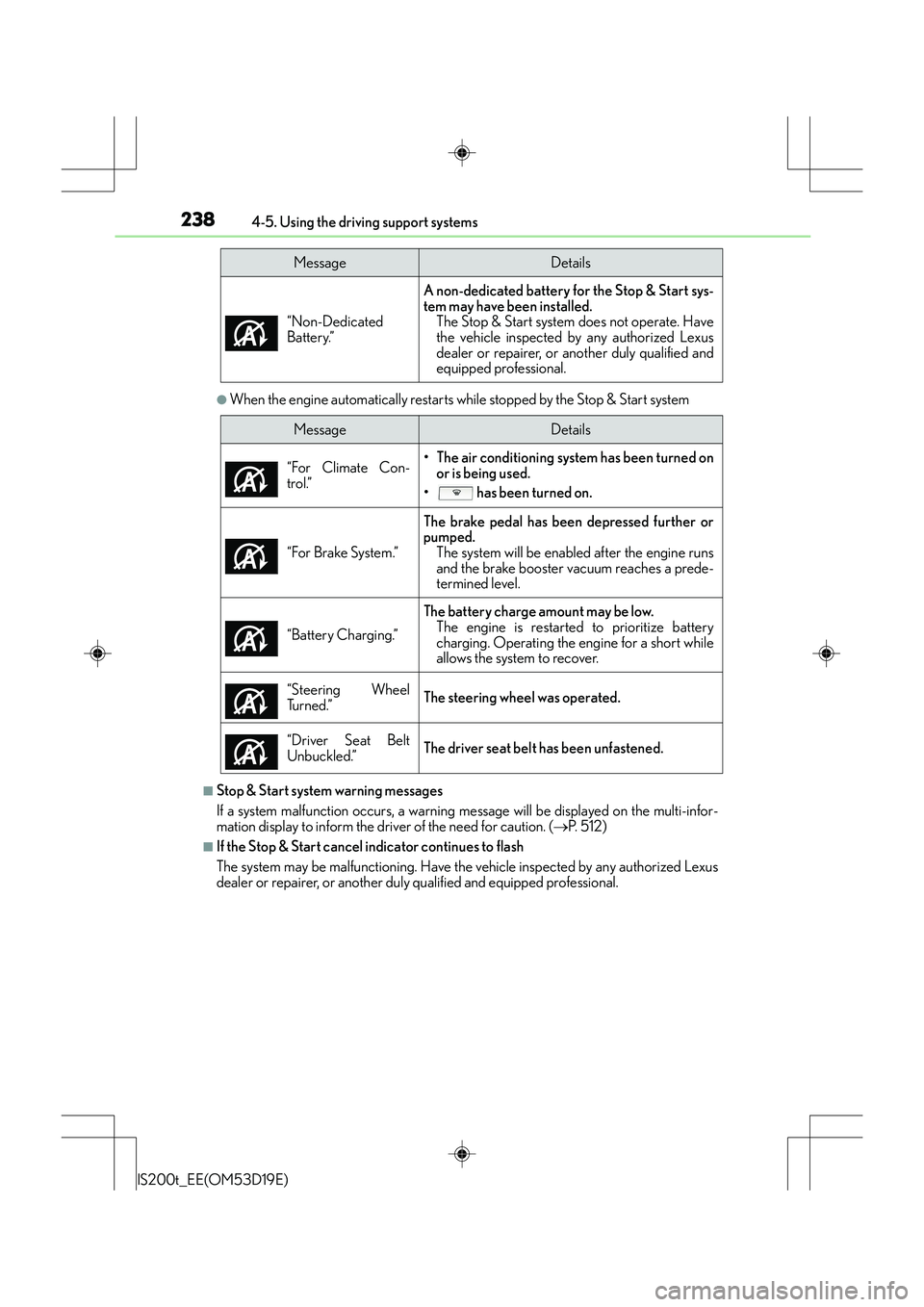
●When the engine automatically restarts while stopped by the Stop & Start system
■Stop & Start system warning messages
If a system malfunction occurs, a warning message will be displayed on the multi-infor-
mation display to inform the driver of the need for caution. ( →P. 5 1 2 )
■If the Stop & Start cancel indicator continues to flash
The system may be malfunctioning. Have the vehicle inspected by any authorized Lexus
dealer or repairer, or another duly qualified and equipped professional. “Non-Dedicated
Battery.”
A non-dedicated battery for the Stop & Start sys-
tem may have been installed.
The Stop & Start system does not operate. Have
the vehicle inspected by any authorized Lexus
dealer or repairer, or another duly qualified and
equipped professional.
MessageDetails
MessageDetails
“For Climate Con-
trol.”
• The air conditioning system has been turned on or is being used.
• has been turned on.
“For Brake System.”
The brake pedal has been depressed further or
pumped. The system will be enabled after the engine runs
and the brake booster vacuum reaches a prede-
termined level.
“Battery Charging.”
The battery charge amount may be low. The engine is restarted to prioritize battery
charging. Operating the engine for a short while
allows the system to recover.
“Steering Wheel
Tu r n e d . ”
The steering wheel was operated.
“Driver Seat Belt
Unbuckled.”
The driver seat belt has been unfastened.
Page 263 of 612
2634-5. Using the driving support systems
4
Driving
IS200t_EE(OM53D19E)
■Temporary cancelation of the LDA system functions
If any of the following occurs, the LDA system functions will be temporarily canceled. The
functions will resume after the necessary operating conditions have returned.
●The turn signal lever is operated.
●The vehicle speed deviates from the operating range of the LDA system functions.
●When the lane lines cannot be recognized while driving.
●When the lane departure warning sounds.
The lane departure warning function will not operate again for a several seconds after it
has been activated, even if the vehicle leaves the lane again.
■The lane departure warning
Depending on the audio system sound level or air conditioning fan noise while the audio
system or air conditioning system is in use, it may be difficult to hear the warning sound.
■After the vehicle has been parked in the sun
The LDA system may not be available and a warning message ( →P. 511) will be displayed
for a while after driving has started. When the temperature in the cabin decreases and
the temperature around the camera sensor ( →P. 260) becomes suitable for its opera-
tion, the functions will begin to operate.
■If there are lane markers on only one side of the vehicle
The lane departure warning will not operate fo r the side on which lane markers could not
be recognized.
■Conditions in which the function may not operate correctly
In the following situations, the camera sensor may be unable to recognize lane markers
causing the lane departure warning function to operate incorrectly. However, this does
not indicate a malfunction.
●When driving through an area with no lane markers, such as a tollbooth, a crossing or
before a ticket checkpoint
●When driving on a sharp curve
●When lane markers are extremely narrow or extremely wide
●When the vehicle leans to one side an unusual amount due to a heavy load or improper
tire inflation pressure
●When the following distance between your vehicle and the vehicle ahead is extremely
short
●When the lane markers are yellow (These may be more difficult for the system to rec-
ognize compared to white markers.)
●When the lane markers are broken, Botts’ dots (raised pavement markers) or stones
●When the lane markers are on a curb etc.
●When lane markers are obscured or partially obscured by sand, dirt, etc.
●When there are shadows on the road running parallel with lane markers, or if a shadow
covers the lane markers
●When driving on a particularly brig ht road surface, such as concrete
●When driving on a road surface that is bright due to reflected light
●When driving in a location where the light level changes rapidly, such as the entrance to
or exit from a tunnel