manual transmission Lexus IS220d 2012 User Guide
[x] Cancel search | Manufacturer: LEXUS, Model Year: 2012, Model line: IS220d, Model: Lexus IS220d 2012Pages: 609, PDF Size: 14.63 MB
Page 167 of 609
158
2-1. Driving procedures
IS250/220d/200d_EE
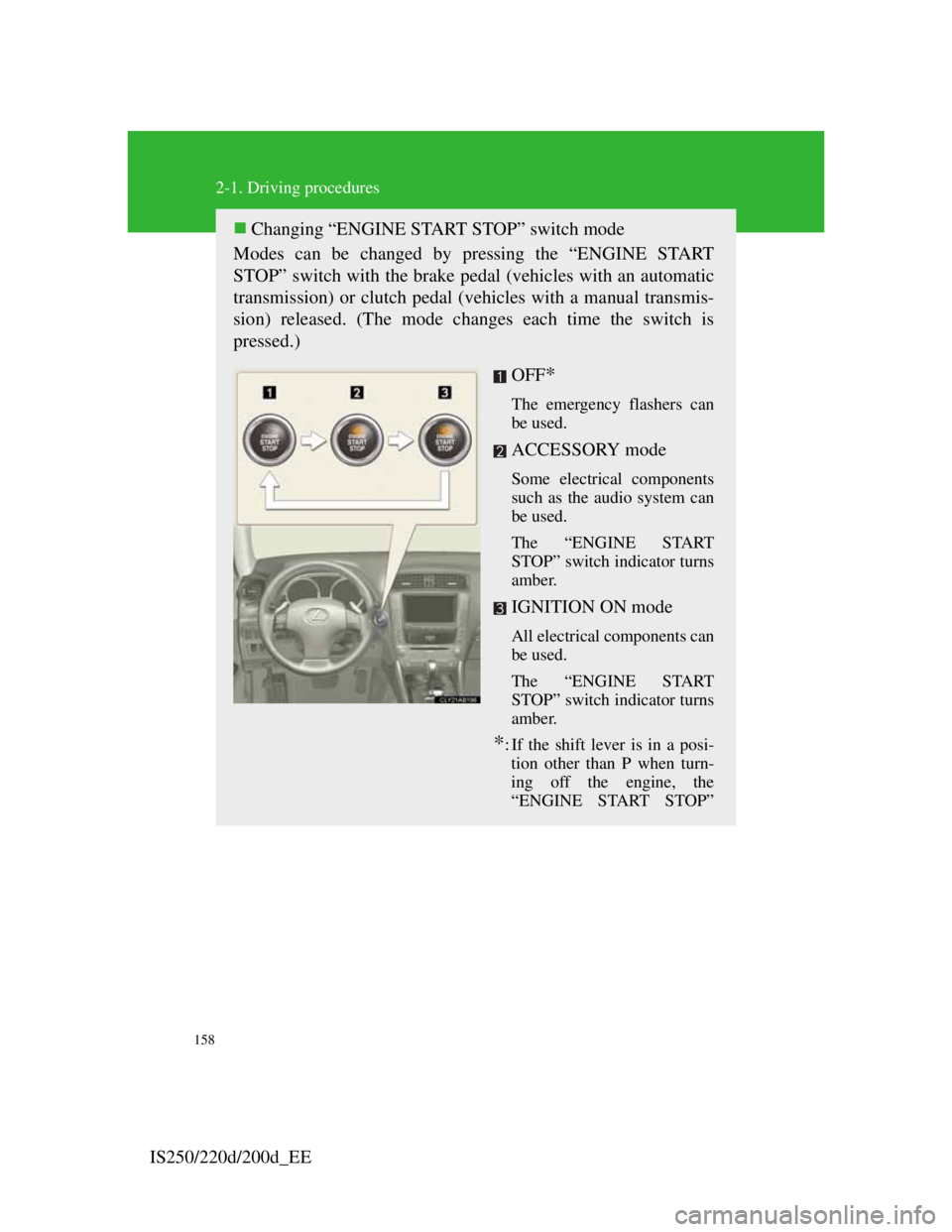
Changing “ENGINE START STOP” switch mode
Modes can be changed by pressing the “ENGINE START
STOP” switch with the brake pedal (vehicles with an automatic
transmission) or clutch pedal (vehicles with a manual transmis-
sion) released. (The mode changes each time the switch is
pressed.)
OFF
*
The emergency flashers can
be used.
ACCESSORY mode
Some electrical components
such as the audio system can
be used.
The “ENGINE START
STOP” switch indicator turns
amber.
IGNITION ON mode
All electrical components can
be used.
The “ENGINE START
STOP” switch indicator turns
amber.
*: If the shift lever is in a posi-
tion other than P when turn-
ing off the engine, the
“ENGINE START STOP”
Page 177 of 609
168
2-1. Driving procedures
IS250/220d/200d_EE
Manual transmission
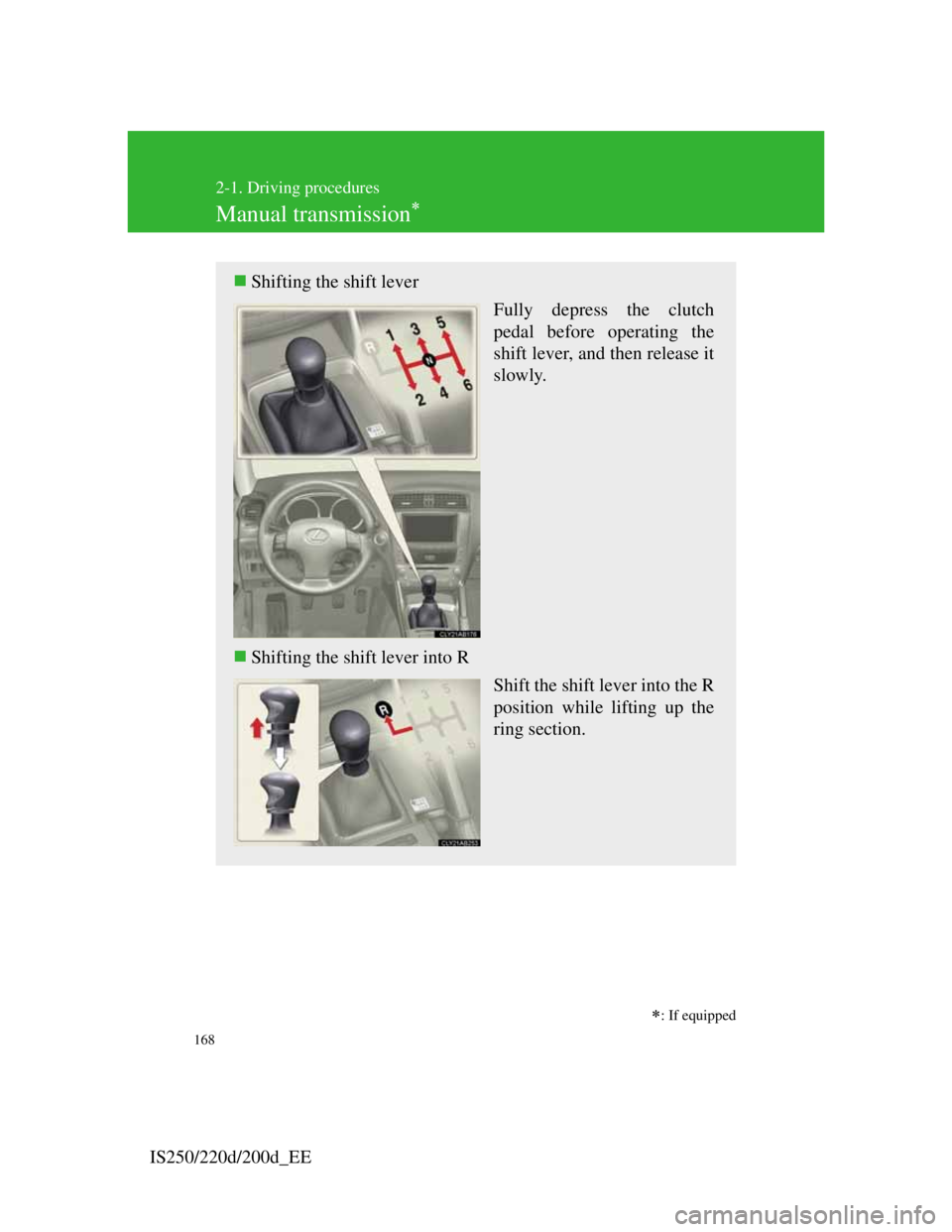
Shifting the shift lever
Fully depress the clutch
pedal before operating the
shift lever, and then release it
slowly.
Shifting the shift lever into R
Shift the shift lever into the R
position while lifting up the
ring section.
: If equipped
Page 180 of 609
171
2-1. Driving procedures
2
When driving
IS250/220d/200d_EE
Parking brake
Usage in winter time
See “Winter driving tips” for parking brake usage in winter time. (P. 2 3 9 )
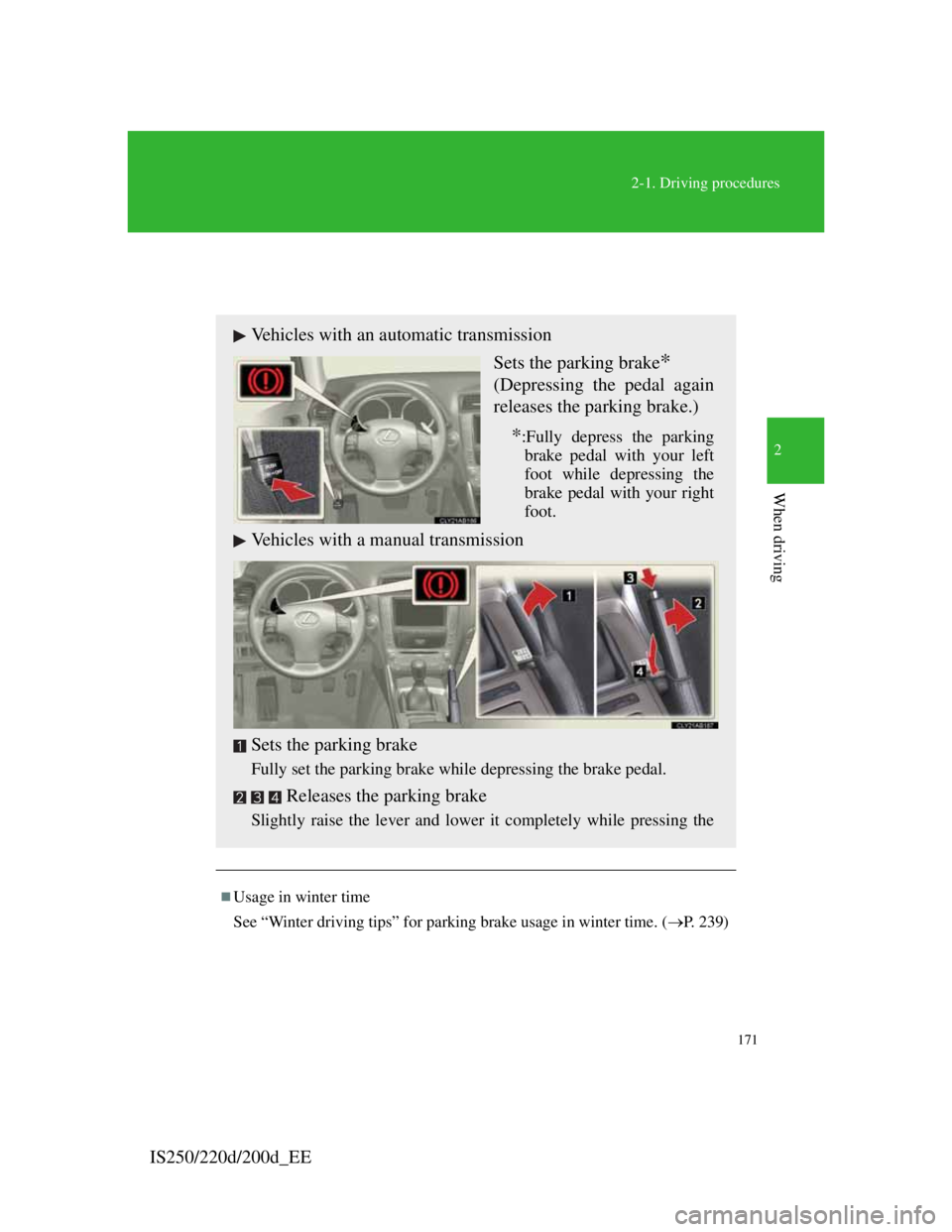
Vehicles with an automatic transmission
Sets the parking brake
*
(Depressing the pedal again
releases the parking brake.)
*:Fully depress the parking
brake pedal with your left
foot while depressing the
brake pedal with your right
foot.
Vehicles with a manual transmission
Sets the parking brake
Fully set the parking brake while depressing the brake pedal.
Releases the parking brake
Slightly raise the lever and lower it completely while pressing the
Page 211 of 609
199
2-4. Using other driving systems
2
When driving
IS250/220d/200d_EE
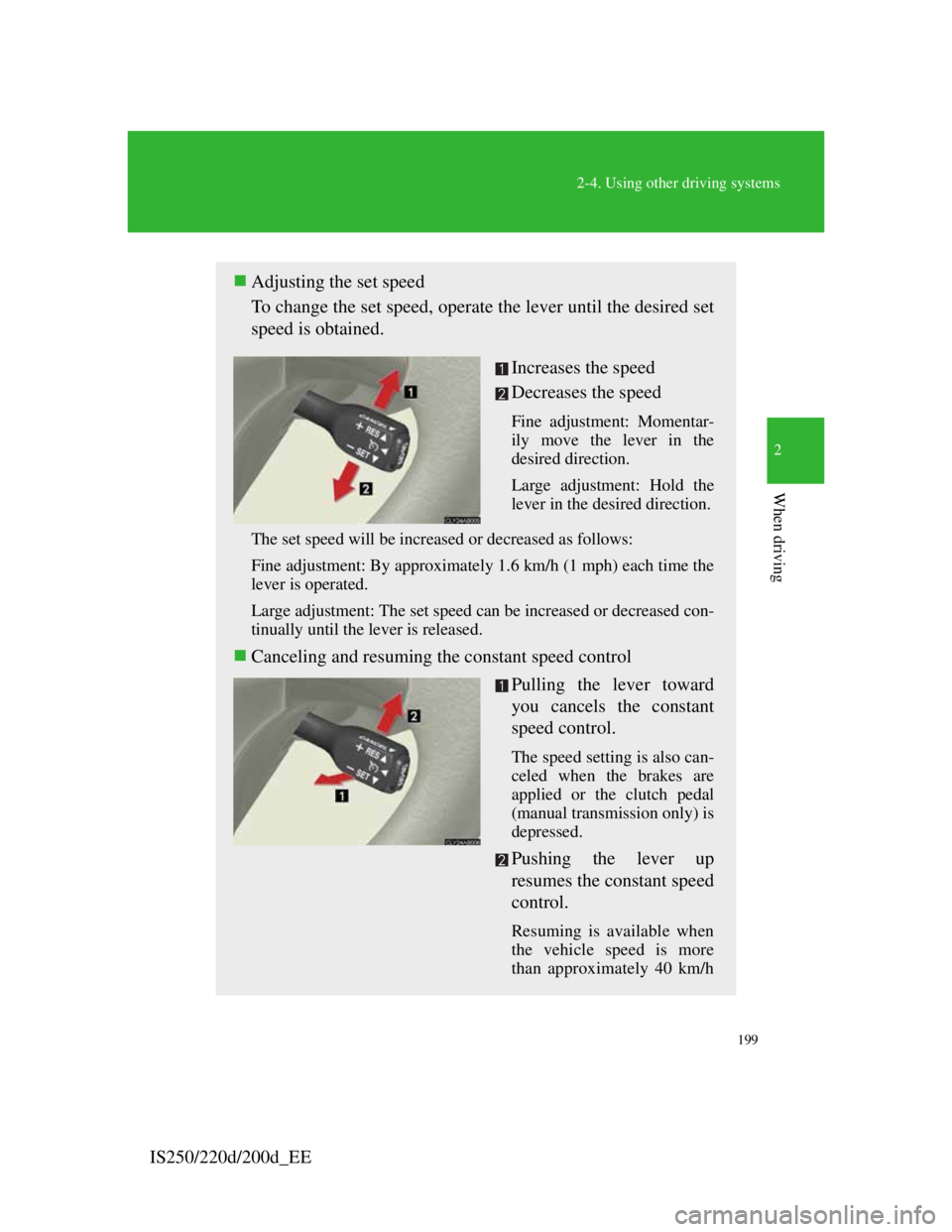
Adjusting the set speed
To change the set speed, operate the lever until the desired set
speed is obtained.
Increases the speed
Decreases the speed
Fine adjustment: Momentar-
ily move the lever in the
desired direction.
Large adjustment: Hold the
lever in the desired direction.
The set speed will be increased or decreased as follows:
Fine adjustment: By approximately 1.6 km/h (1 mph) each time the
lever is operated.
Large adjustment: The set speed can be increased or decreased con-
tinually until the lever is released.
Canceling and resuming the constant speed control
Pulling the lever toward
you cancels the constant
speed control.
The speed setting is also can-
celed when the brakes are
applied or the clutch pedal
(manual transmission only) is
depressed.
Pushing the lever up
resumes the constant speed
control.
Resuming is available when
the vehicle speed is more
than approximately 40 km/h
Page 254 of 609
240
2-5. Driving information
IS250/220d/200d_EE
Selecting tire chains
Tire chains can be mounted on 16- and 17-inch tires. They cannot
be mounted on 18-inch tires. Use the correct tire chain size when
mounting the tire chains.
Chain size is regulated for each tire size.
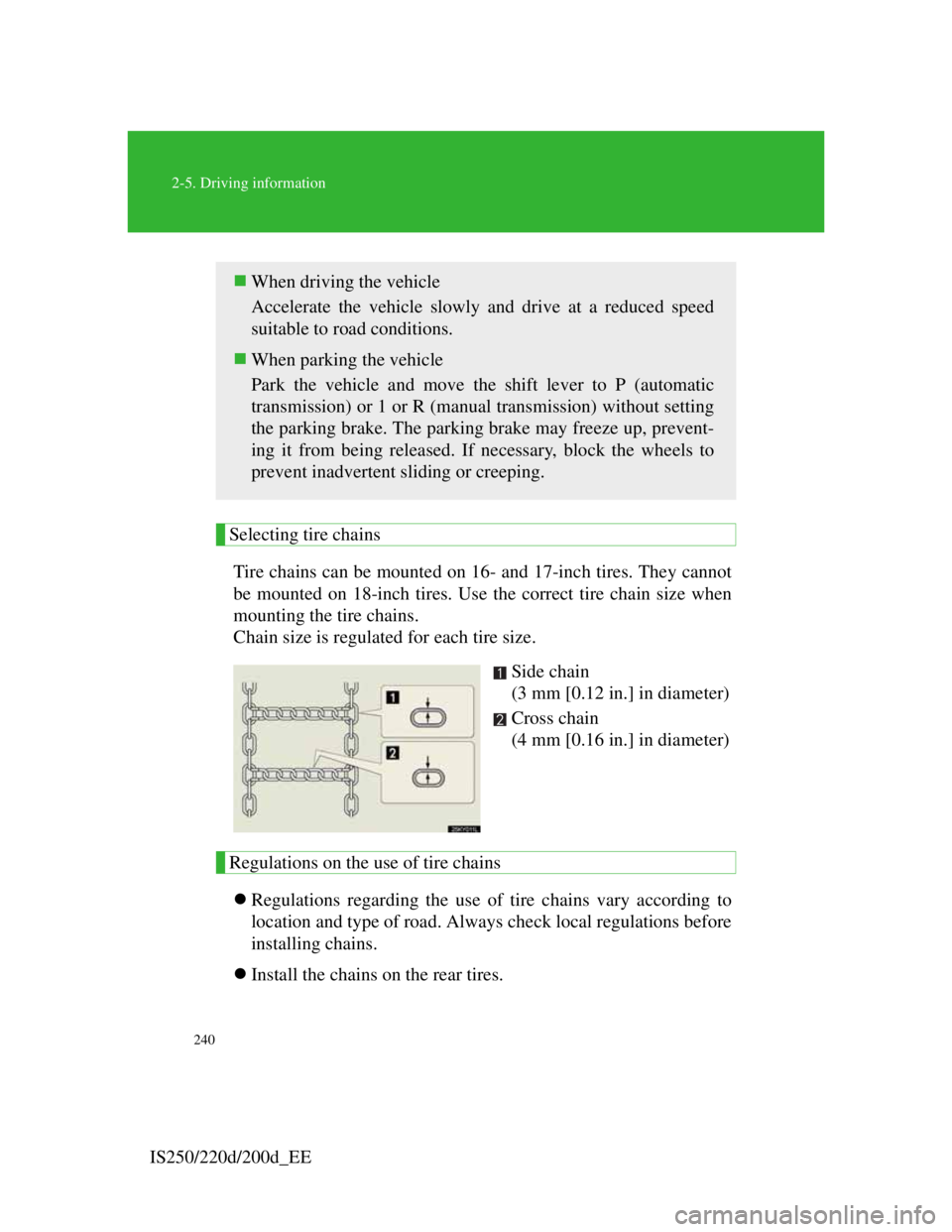
Side chain
(3 mm [0.12 in.] in diameter)
Cross chain
(4 mm [0.16 in.] in diameter)
Regulations on the use of tire chains
Regulations regarding the use of tire chains vary according to
location and type of road. Always check local regulations before
installing chains.
Install the chains on the rear tires.
When driving the vehicle
Accelerate the vehicle slowly and drive at a reduced speed
suitable to road conditions.
When parking the vehicle
Park the vehicle and move the shift lever to P (automatic
transmission) or 1 or R (manual transmission) without setting
the parking brake. The parking brake may freeze up, prevent-
ing it from being released. If necessary, block the wheels to
prevent inadvertent sliding or creeping.
Page 263 of 609

249
2-5. Driving information
2
When driving
IS250/220d/200d_EEImportant points regarding turning
The wheels of the trailer will travel closer to the inside of the
curve than the wheels of the vehicle. To make allowance for this,
take the turns wider than you would normally.
Important points regarding stability
Vehicle movement resulting from uneven road surfaces and
strong crosswinds will affect handling. The vehicle may also be
rocked by passing buses or large trucks. Frequently check
behind when moving alongside such vehicles. As soon as such
vehicle movement occurs, immediately start to decelerate
smoothly by slowly applying the brakes. Always steer the vehi-
cle straight ahead while braking.
Passing other vehicles
Consider the total combined length of your vehicle and trailer
and ensure that the vehicle-to-vehicle distance is sufficient
before executing lane changes.
Transmission information
Refrain from driving in 6 (manual transmission) or 4 range in S
mode (automatic transmission) to maintain the effectiveness of
the engine brake and the charge performance of electrical com-
ponents.
If the engine overheats...
Towing a loaded trailer up a long steep incline in temperatures
exceeding 30C (85F) may result in the engine overheating. If
the engine coolant temperature gauge indicates that the engine is
overheating, turn the air conditioning off immediately, leave the
road and stop the vehicle in a safe place. (P. 525)
When parking the vehicle
Always place wheel chocks under the wheels of both the vehicle
and trailer. Firmly set the parking brake and shift the shift lever
to P for automatic transmissions, and 1 or R for manual trans-
missions.
Page 391 of 609

372
3-7. Other interior features
IS250/220d/200d_EE
The seat heaters can be used when
The “ENGINE START STOP” switch is in IGNITION ON mode.
When not in use
Set the dial to “0”. The indicator light turns off.
Vehicles with a manual transmission
Heats the seats
The indicator light comes on.
The higher the number, the
warmer the seats become.
Left frontRight front
Page 394 of 609

375
3-7. Other interior features
3
Interior features
IS250/220d/200d_EE
The seat heaters and ventilators can be used when
The “ENGINE START STOP” switch is in IGNITION ON mode.
When not in use
Set the dial to “0”. The indicator light turns off.
Vehicles with a manual transmission
Heats the seats
The indicator light (amber)
comes on.
The higher the number, the
warmer the seats become.
Blows air from the seats
The indicator light (green)
comes on.
The higher the number, the
stronger the airflow becomes.
Left frontRight front
Page 402 of 609

383
3-7. Other interior features
3
Interior features
IS250/220d/200d_EE
CAUTION
Observe the following precautions.
Failure to do so may cause the driver's floor mat to slip, possibly interfering
with the pedals while driving. An unexpectedly high speed may result or it
may become difficult to stop the vehicle, leading to a serious accident.
When installing the driver's floor mat
Do not use floor mats designed for other models or different model year
vehicles, even if they are Lexus Genuine floor mats.
Only use floor mats designed for the driver's seat.
Always install the floor mat securely using the retaining hooks (clips) pro-
vided.
Do not use two or more floor mats on top of each other.
Do not place the floor mat bottom-side up or upside-down.
Before driving
Check that the floor mat is securely
fixed in the correct place with all the
provided retaining hooks (clips). Be
especially careful to perform this check
after cleaning the floor.
With the engine stopped and the shift
lever in P (automatic transmission) or
N (manual transmission), fully depress
each pedal to the floor to make sure it
does not interfere with the floor mat.
Page 425 of 609
404
4-3. Do-it-yourself maintenance
IS250/220d/200d_EE
CAUTION
When raising your vehicle
Make sure to observe the following to reduce the possibility of death or seri-
ous injury.
When using a floor jack, follow the instructions of the manual provided
with the jack.
Do not use the jack that was supplied with your vehicle.
Do not put any part of your body or get underneath the vehicle supported
only by the floor jack.
Always use floor jack and/or automotive jack stands on a solid, flat, level
surface.
Do not start the engine while the vehicle is supported by the floor jack.
Stop the vehicle on level firm ground, firmly set the parking brake and put
the shift lever in P (automatic transmission) or R (manual transmission).
Make sure to set the floor jack properly at the jack point.
Raising the vehicle with an improperly positioned floor jack will damage
the vehicle and may cause the vehicle to fall off the floor jack.
Do not raise the vehicle while someone is in the vehicle.
When raising the vehicle, do not place any objects on top of or underneath
the floor jack.
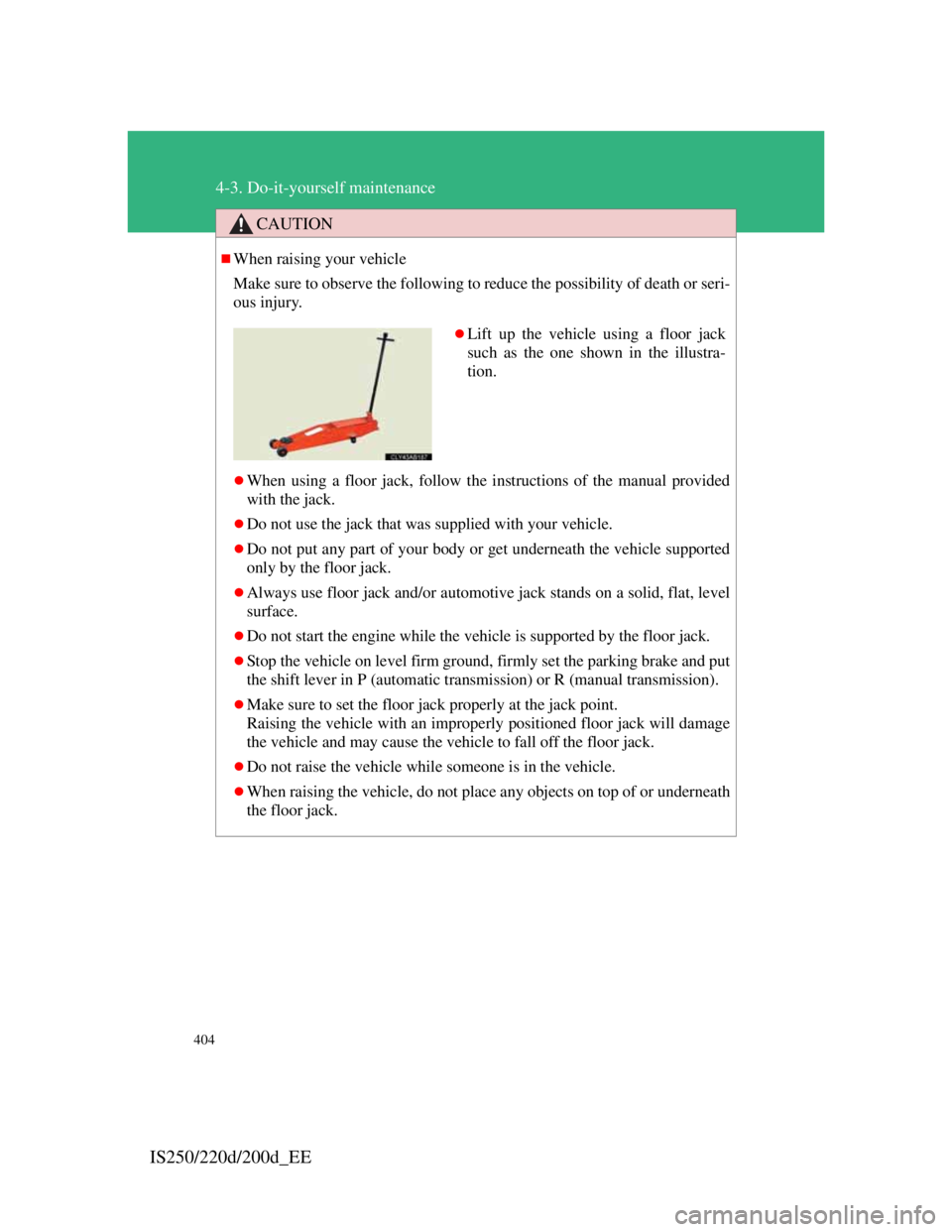
Lift up the vehicle using a floor jack
such as the one shown in the illustra-
tion.