manual transmission Lexus IS220d 2012 Owner's Guide
[x] Cancel search | Manufacturer: LEXUS, Model Year: 2012, Model line: IS220d, Model: Lexus IS220d 2012Pages: 609, PDF Size: 14.63 MB
Page 439 of 609

418
4-3. Do-it-yourself maintenance
IS250/220d/200d_EE
Before recharging
When recharging, the battery produces hydrogen gas which is flammable
and explosive. Therefore, before recharging:
If recharging with the battery installed on the vehicle, be sure to discon-
nect the ground cable.
Make sure the power switch on the charger is off when connecting and
disconnecting the charger cables to the battery.
After recharging/reconnecting the battery
In some cases, the engine may not start. Follow the procedure below to ini-
tialize the system.
Shift the shift lever to P (automatic transmission) or depress the
brake pedal with the shift lever in N (manual transmission), and
turn the “ENGINE START STOP” switch OFF.
Open and close any of the doors.
Start the engine. (If the engine does not start first time, repeat the
procedure.)
If the engine will not start even after multiple attempts at the above method,
contact any authorized Lexus dealer or repairer, or another duly qualified
and equipped professional.
STEP1
STEP2
STEP3
Page 486 of 609

460
5-1. Essential information
IS250/220d/200d_EETowing eyelets
Emergency towing procedure
Release the parking brake.
Shift the shift lever to N.
Put the “ENGINE START STOP” switch in ACCESSORY mode
or IGNITION ON mode.
CAUTION
Caution while towing
Use extreme caution when towing the vehicle.
Avoid sudden starts or erratic driving maneuvers which place excessive
stress on the emergency towing eyelets and the cables or chains. Always
be cautious of the surroundings and other vehicles while towing.
If the engine is not running, the power assist for the brakes and steering
will not function, making steering and braking more difficult.
NOTICE
To prevent causing serious damage to the transmission
(vehicles with an automatic transmission)
Never tow this vehicle from the front with the rear wheels on the ground.
This may cause serious damage to the transmission.
When towing a vehicle without using a towing dolly
(vehicles with a manual transmission)
The “ENGINE START STOP” switch must not be OFF.
STEP1
STEP2
STEP3
Page 489 of 609

5
463
5-1. Essential information
When trouble arises
IS250/220d/200d_EE
Towing with a wheel lift-type truck
From the front
Vehicles with an automatic
transmission: Use a towing
dolly under the rear wheels.
Vehicles with a manual trans-
mission: We recommend to use
a towing dolly under the rear
wheels.
When not using a towing dolly,
release the parking brake and
shift the shift lever to N.
From the rear
Switch to ACCESSORY mode
so that the steering wheel is
unlocked.
NOTICE
To prevent causing serious damage to the transmission
(vehicles with an automatic transmission)
Never tow this vehicle from the front with the rear wheels on the ground.
Page 513 of 609
5
487
5-2. Steps to take in an emergency
When trouble arises
IS250/220d/200d_EE
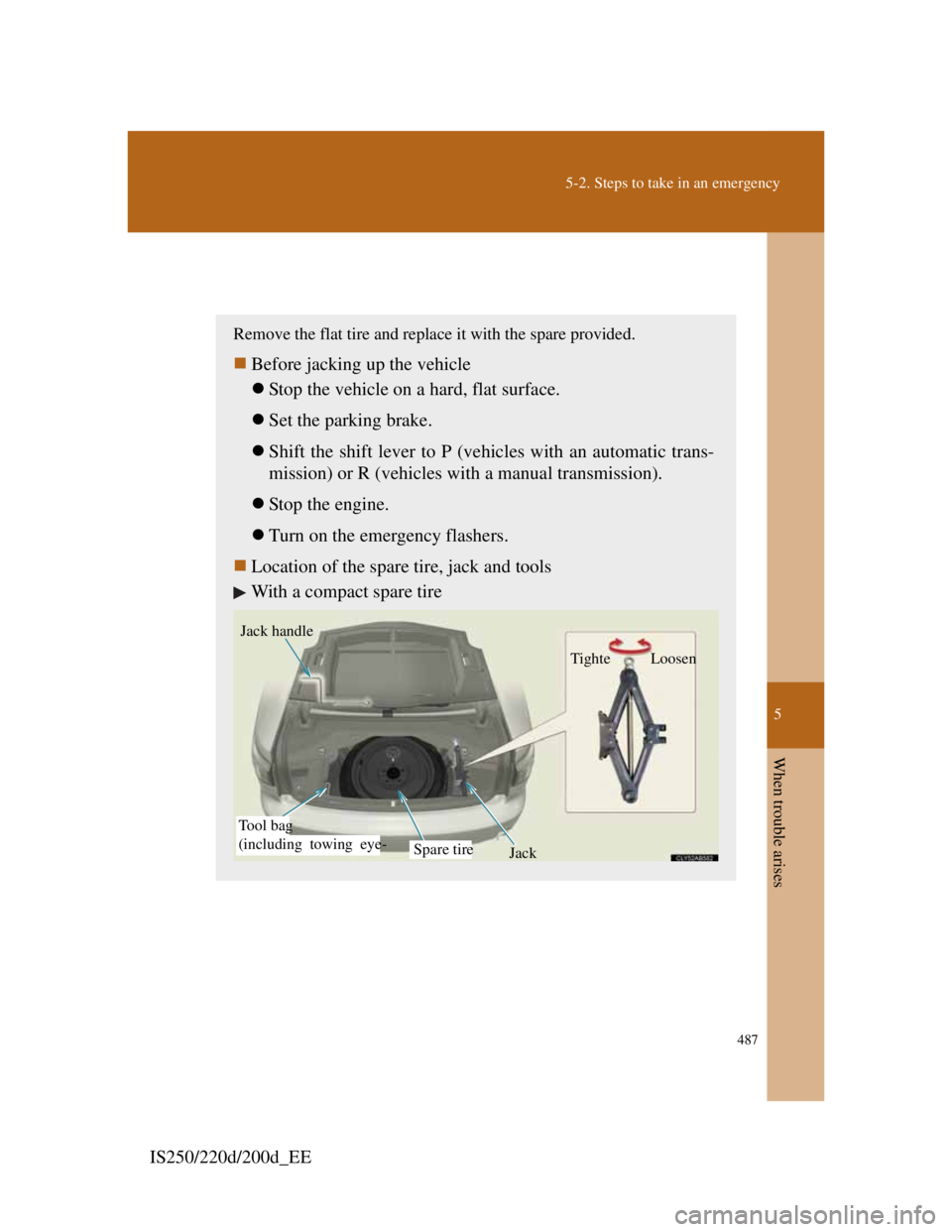
If you have a flat tire (vehicles with a spare tire)
Remove the flat tire and replace it with the spare provided.
Before jacking up the vehicle
Stop the vehicle on a hard, flat surface.
Set the parking brake.
Shift the shift lever to P (vehicles with an automatic trans-
mission) or R (vehicles with a manual transmission).
Stop the engine.
Turn on the emergency flashers.
Location of the spare tire, jack and tools
With a compact spare tire
Jack
Jack handle
Tighte Loosen
Spare tire
Tool bag
(including towing eye-
Page 525 of 609

5
499
5-2. Steps to take in an emergency
When trouble arises
IS250/220d/200d_EE
If you have a flat tire (vehicles with an emergency tire puncture repair kit)
A puncture caused by a nail or screw passing through the tire tread can
be repaired temporarily using the emergency tire puncture repair kit.
(The kit contains a bottle of sealant. The sealant can be used only once
to temporarily repair one tire without removing the nail or screw from
the tire.) After temporarily repairing the tire with the kit, have the tire
repaired or replaced by any authorized Lexus dealer, tire dealer or
repairer, or another duly qualified and equipped professional.
Before repairing the tire
Stop the vehicle in a safe place on a hard, flat surface.
Set the parking brake.
Shift the shift lever to P (automatic transmission) or N
(manual transmission).
Stop the engine.
Turn on the emergency flashers.
Page 542 of 609

516
5-2. Steps to take in an emergency
IS250/220d/200d_EE
Emergency start function
When the engine does not start, the following steps can be used as
an interim measure to start the engine if the “ENGINE START
STOP” switch is functioning normally:
Vehicles with an automatic transmission
Set the parking brake.
Put the shift lever in P.
Set the “ENGINE START STOP” switch to ACCESSORY
mode.
Press and hold the “ENGINE START STOP” switch for
about 15 seconds while depressing the brake pedal firmly.
Vehicles with a manual transmission
Set the parking brake.
Put the shift lever in N.
Set the “ENGINE START STOP” switch to the ACCES-
SORY mode.
Push and hold the “ENGINE START STOP” switch for
about 15 seconds while depressing the brake pedal and
clutch pedal firmly.
Even if the engine can be started using the above steps, the system
may be malfunctioning. Have the vehicle checked by any autho-
rized Lexus dealer or repairer, or another duly qualified and
equipped professional.
STEP1
STEP2
STEP3
STEP4
STEP1
STEP2
STEP3
STEP4
Page 548 of 609
522
5-2. Steps to take in an emergency
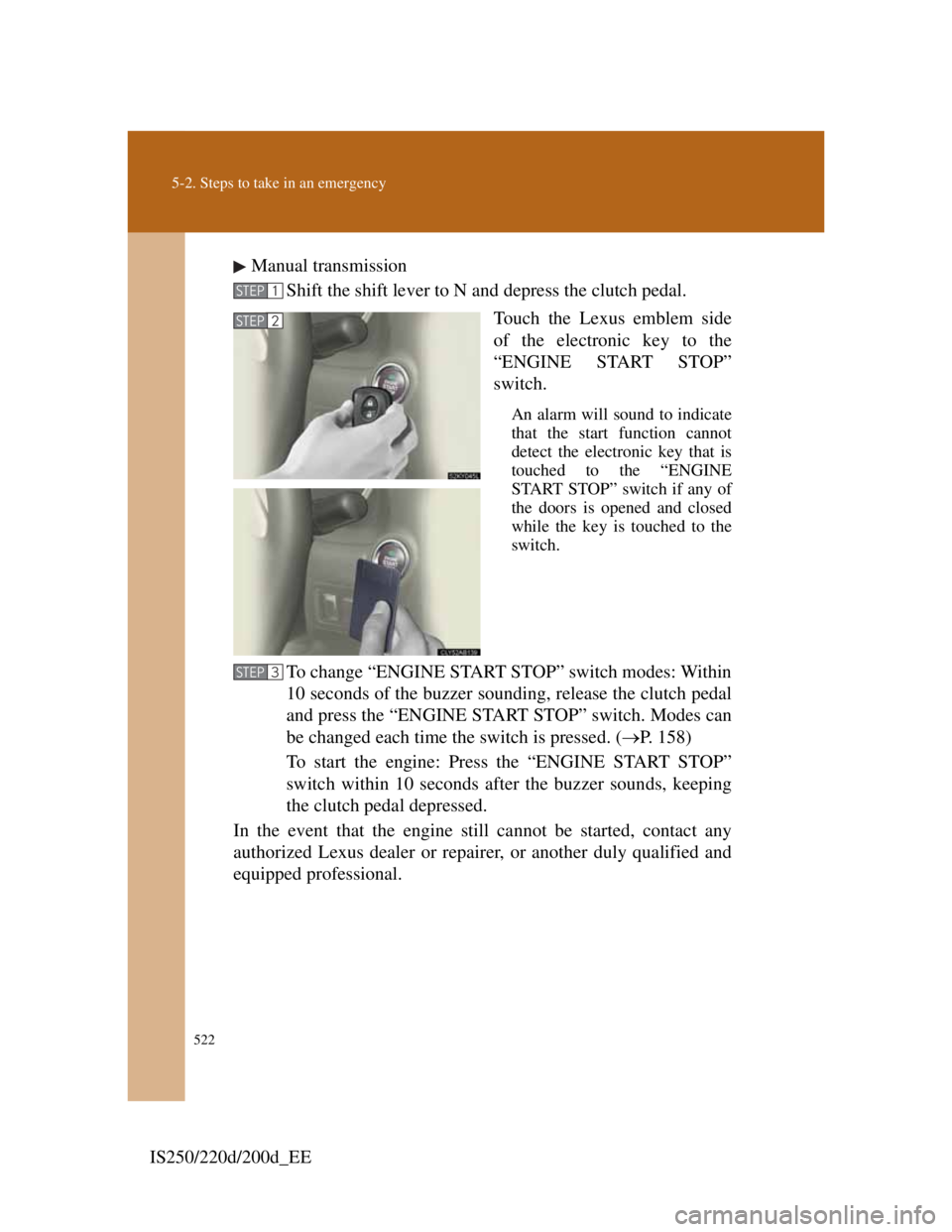
IS250/220d/200d_EEManual transmission
Shift the shift lever to N and depress the clutch pedal.
Touch the Lexus emblem side
of the electronic key to the
“ENGINE START STOP”
switch.
An alarm will sound to indicate
that the start function cannot
detect the electronic key that is
touched to the “ENGINE
START STOP” switch if any of
the doors is opened and closed
while the key is touched to the
switch.
To change “ENGINE START STOP” switch modes: Within
10 seconds of the buzzer sounding, release the clutch pedal
and press the “ENGINE START STOP” switch. Modes can
be changed each time the switch is pressed. (P. 158)
To start the engine: Press the “ENGINE START STOP”
switch within 10 seconds after the buzzer sounds, keeping
the clutch pedal depressed.
In the event that the engine still cannot be started, contact any
authorized Lexus dealer or repairer, or another duly qualified and
equipped professional.
STEP1
STEP2
STEP3
Page 549 of 609

5
523
5-2. Steps to take in an emergency
When trouble arises
IS250/220d/200d_EE
Stopping the engine
For vehicles with an automatic transmission: Shift the shift lever to P and
press the “ENGINE START STOP” switch as you normally do when stop-
ping the engine.
For vehicles with a manual transmission: Shift the shift lever to N position
and press the “ENGINE START STOP” switch as you normally do when
stopping the engine.
Replacing the key battery
As the above procedure is a temporary measure, it is recommended that the
electronic key battery be replaced immediately when the battery depletes.
(P. 435)
Alarm
Using the mechanical key to lock the doors will not set the alarm system.
If a door is unlocked using the mechanical key when the alarm system is set,
the alarm may be triggered.
Page 558 of 609
532
5-2. Steps to take in an emergency
IS250/220d/200d_EE
If the vehicle becomes stuck
CAUTION
When attempting to free a stuck vehicle
If you choose to rock the vehicle back and forth to free it, make sure the sur-
rounding area is clear, to avoid striking other vehicles, objects or persons.
The vehicle may also lunge forward or lunge back suddenly as it becomes
free. Use extreme caution.
When shifting the shift lever
With automatic transmission vehicles, be careful not to shift the shift lever
with the accelerator pedal depressed.
This may lead to unexpected rapid acceleration of the vehicle that may
cause an accident and result in death or serious injury.
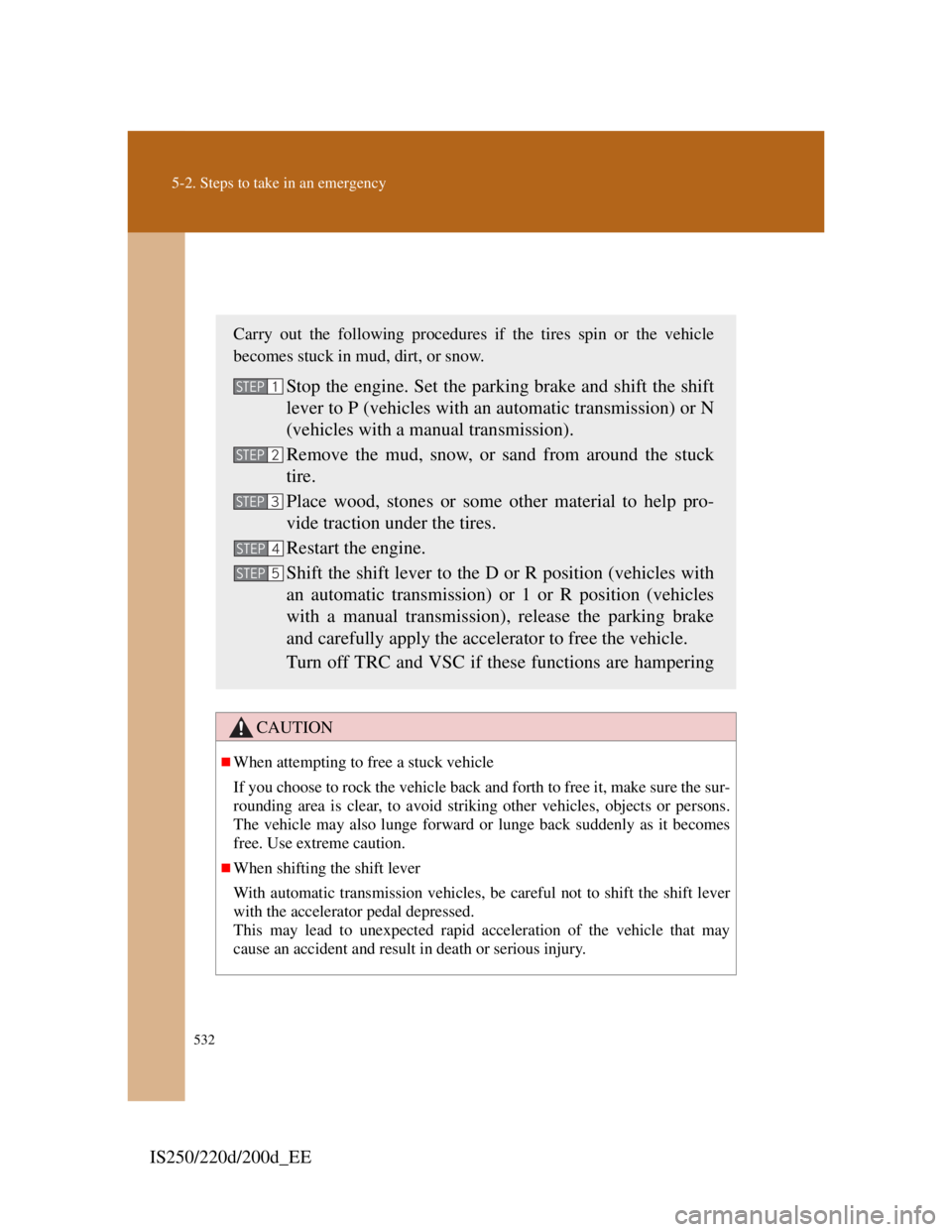
Carry out the following procedures if the tires spin or the vehicle
becomes stuck in mud, dirt, or snow.
Stop the engine. Set the parking brake and shift the shift
lever to P (vehicles with an automatic transmission) or N
(vehicles with a manual transmission).
Remove the mud, snow, or sand from around the stuck
tire.
Place wood, stones or some other material to help pro-
vide traction under the tires.
Restart the engine.
Shift the shift lever to the D or R position (vehicles with
an automatic transmission) or 1 or R position (vehicles
with a manual transmission), release the parking brake
and carefully apply the accelerator to free the vehicle.
Turn off TRC and VSC if these functions are hampering
fhhil()STEP1
STEP2
STEP3
STEP4
STEP5
Page 576 of 609
546
6-1. Specifications
IS250/220d/200d_EE
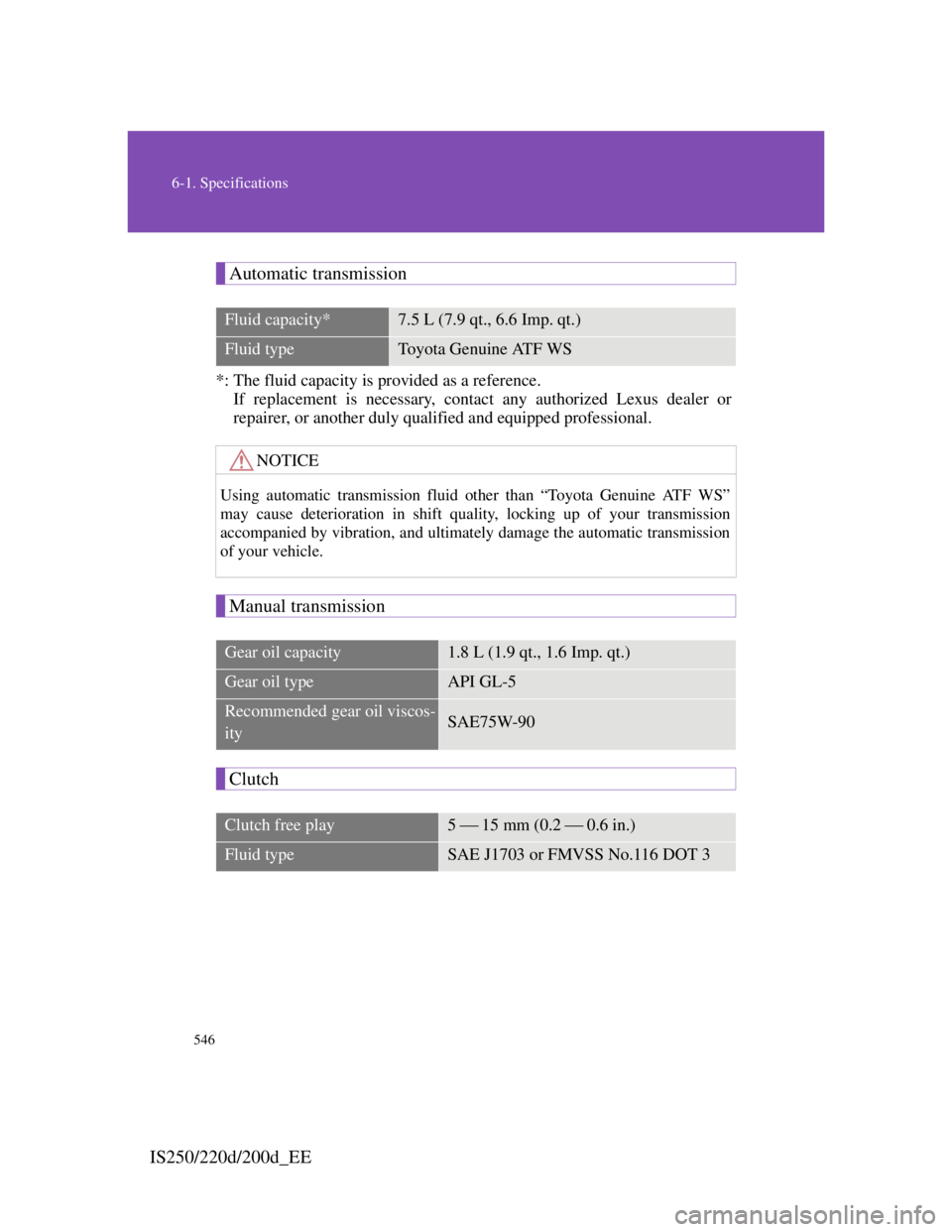
Automatic transmission
*: The fluid capacity is provided as a reference.
If replacement is necessary, contact any authorized Lexus dealer or
repairer, or another duly qualified and equipped professional.
Manual transmission
Clutch
Fluid capacity*7.5 L (7.9 qt., 6.6 Imp. qt.)
Fluid typeToyota Genuine ATF WS
NOTICE
Using automatic transmission fluid other than “Toyota Genuine ATF WS”
may cause deterioration in shift quality, locking up of your transmission
accompanied by vibration, and ultimately damage the automatic transmission
of your vehicle.
Gear oil capacity1.8 L (1.9 qt., 1.6 Imp. qt.)
Gear oil typeAPI GL-5
Recommended gear oil viscos-
itySAE75W-90
Clutch free play5 15 mm (0.2 0.6 in.)
Fluid typeSAE J1703 or FMVSS No.116 DOT 3