parking brake Lexus IS220d 2012 Owner's Guide
[x] Cancel search | Manufacturer: LEXUS, Model Year: 2012, Model line: IS220d, Model: Lexus IS220d 2012Pages: 609, PDF Size: 14.63 MB
Page 254 of 609
240
2-5. Driving information
IS250/220d/200d_EE
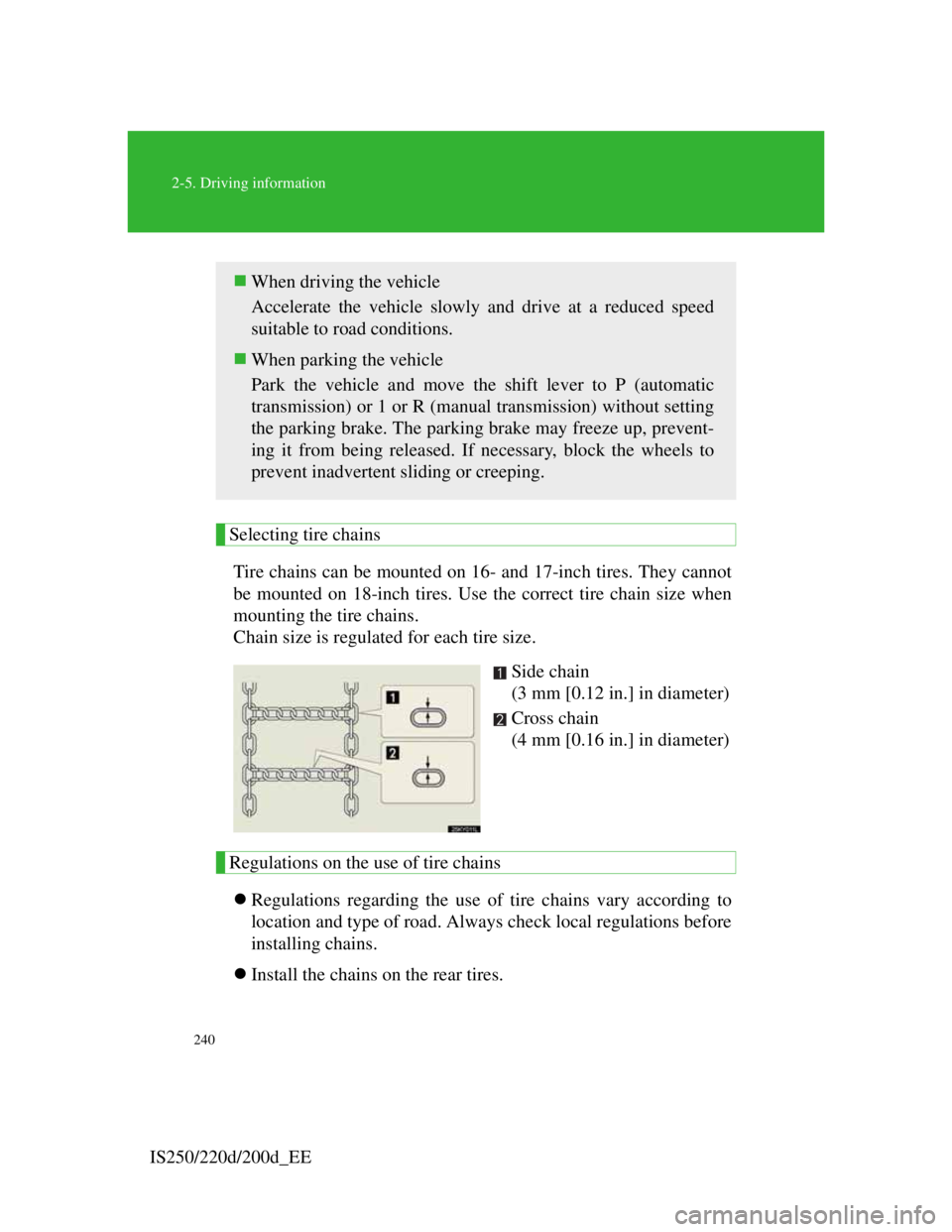
Selecting tire chains
Tire chains can be mounted on 16- and 17-inch tires. They cannot
be mounted on 18-inch tires. Use the correct tire chain size when
mounting the tire chains.
Chain size is regulated for each tire size.
Side chain
(3 mm [0.12 in.] in diameter)
Cross chain
(4 mm [0.16 in.] in diameter)
Regulations on the use of tire chains
Regulations regarding the use of tire chains vary according to
location and type of road. Always check local regulations before
installing chains.
Install the chains on the rear tires.
When driving the vehicle
Accelerate the vehicle slowly and drive at a reduced speed
suitable to road conditions.
When parking the vehicle
Park the vehicle and move the shift lever to P (automatic
transmission) or 1 or R (manual transmission) without setting
the parking brake. The parking brake may freeze up, prevent-
ing it from being released. If necessary, block the wheels to
prevent inadvertent sliding or creeping.
Page 263 of 609

249
2-5. Driving information
2
When driving
IS250/220d/200d_EEImportant points regarding turning
The wheels of the trailer will travel closer to the inside of the
curve than the wheels of the vehicle. To make allowance for this,
take the turns wider than you would normally.
Important points regarding stability
Vehicle movement resulting from uneven road surfaces and
strong crosswinds will affect handling. The vehicle may also be
rocked by passing buses or large trucks. Frequently check
behind when moving alongside such vehicles. As soon as such
vehicle movement occurs, immediately start to decelerate
smoothly by slowly applying the brakes. Always steer the vehi-
cle straight ahead while braking.
Passing other vehicles
Consider the total combined length of your vehicle and trailer
and ensure that the vehicle-to-vehicle distance is sufficient
before executing lane changes.
Transmission information
Refrain from driving in 6 (manual transmission) or 4 range in S
mode (automatic transmission) to maintain the effectiveness of
the engine brake and the charge performance of electrical com-
ponents.
If the engine overheats...
Towing a loaded trailer up a long steep incline in temperatures
exceeding 30C (85F) may result in the engine overheating. If
the engine coolant temperature gauge indicates that the engine is
overheating, turn the air conditioning off immediately, leave the
road and stop the vehicle in a safe place. (P. 525)
When parking the vehicle
Always place wheel chocks under the wheels of both the vehicle
and trailer. Firmly set the parking brake and shift the shift lever
to P for automatic transmissions, and 1 or R for manual trans-
missions.
Page 425 of 609
404
4-3. Do-it-yourself maintenance
IS250/220d/200d_EE
CAUTION
When raising your vehicle
Make sure to observe the following to reduce the possibility of death or seri-
ous injury.
When using a floor jack, follow the instructions of the manual provided
with the jack.
Do not use the jack that was supplied with your vehicle.
Do not put any part of your body or get underneath the vehicle supported
only by the floor jack.
Always use floor jack and/or automotive jack stands on a solid, flat, level
surface.
Do not start the engine while the vehicle is supported by the floor jack.
Stop the vehicle on level firm ground, firmly set the parking brake and put
the shift lever in P (automatic transmission) or R (manual transmission).
Make sure to set the floor jack properly at the jack point.
Raising the vehicle with an improperly positioned floor jack will damage
the vehicle and may cause the vehicle to fall off the floor jack.
Do not raise the vehicle while someone is in the vehicle.
When raising the vehicle, do not place any objects on top of or underneath
the floor jack.
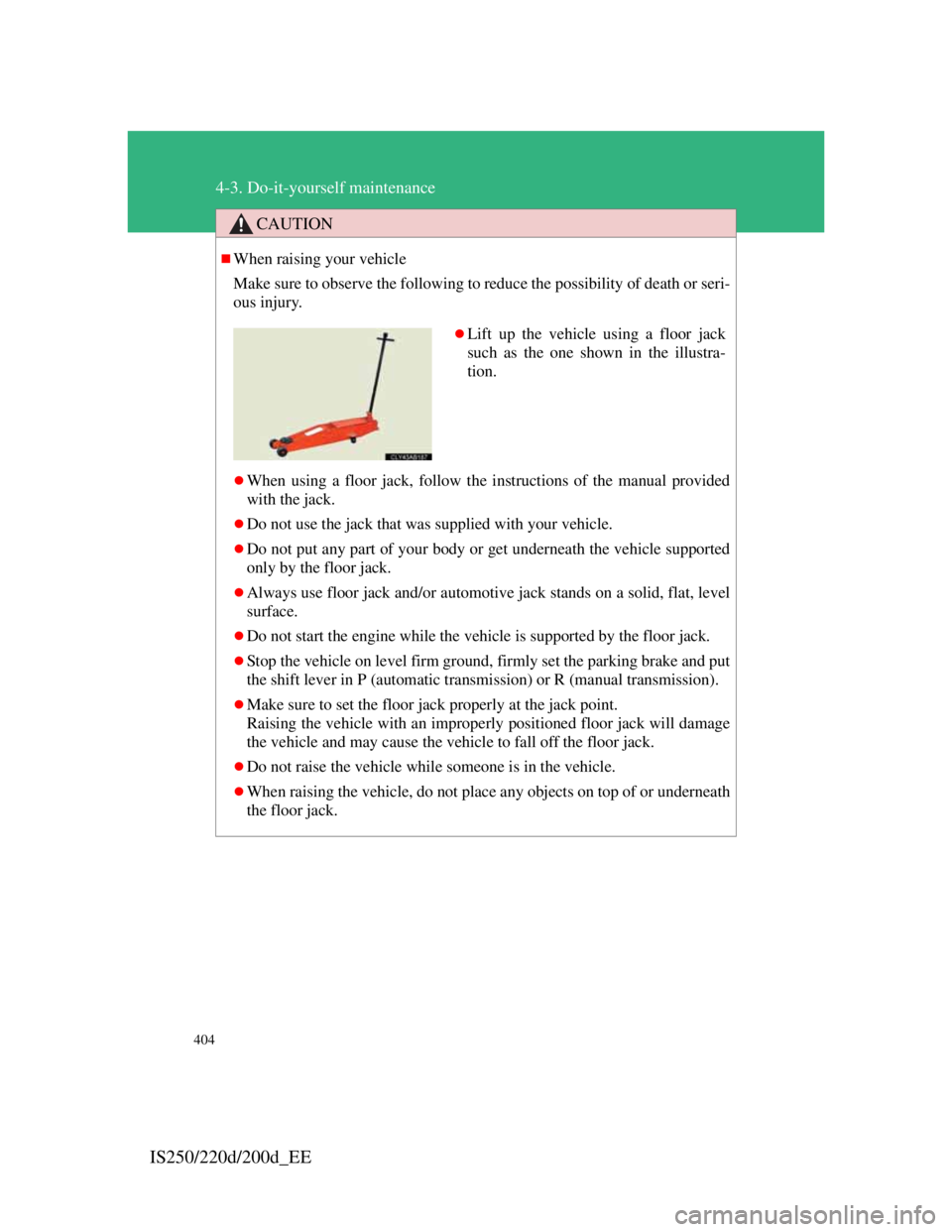
Lift up the vehicle using a floor jack
such as the one shown in the illustra-
tion.
Page 486 of 609

460
5-1. Essential information
IS250/220d/200d_EETowing eyelets
Emergency towing procedure
Release the parking brake.
Shift the shift lever to N.
Put the “ENGINE START STOP” switch in ACCESSORY mode
or IGNITION ON mode.
CAUTION
Caution while towing
Use extreme caution when towing the vehicle.
Avoid sudden starts or erratic driving maneuvers which place excessive
stress on the emergency towing eyelets and the cables or chains. Always
be cautious of the surroundings and other vehicles while towing.
If the engine is not running, the power assist for the brakes and steering
will not function, making steering and braking more difficult.
NOTICE
To prevent causing serious damage to the transmission
(vehicles with an automatic transmission)
Never tow this vehicle from the front with the rear wheels on the ground.
This may cause serious damage to the transmission.
When towing a vehicle without using a towing dolly
(vehicles with a manual transmission)
The “ENGINE START STOP” switch must not be OFF.
STEP1
STEP2
STEP3
Page 489 of 609

5
463
5-1. Essential information
When trouble arises
IS250/220d/200d_EE
Towing with a wheel lift-type truck
From the front
Vehicles with an automatic
transmission: Use a towing
dolly under the rear wheels.
Vehicles with a manual trans-
mission: We recommend to use
a towing dolly under the rear
wheels.
When not using a towing dolly,
release the parking brake and
shift the shift lever to N.
From the rear
Switch to ACCESSORY mode
so that the steering wheel is
unlocked.
NOTICE
To prevent causing serious damage to the transmission
(vehicles with an automatic transmission)
Never tow this vehicle from the front with the rear wheels on the ground.
Page 493 of 609
5
467
When trouble arises
IS250/220d/200d_EE
5-2. Steps to take in an emergency
If a warning light turns on or a warning buzzer sounds...
Stop the vehicle immediately. Continuing to drive the vehicle may be danger-
ous.
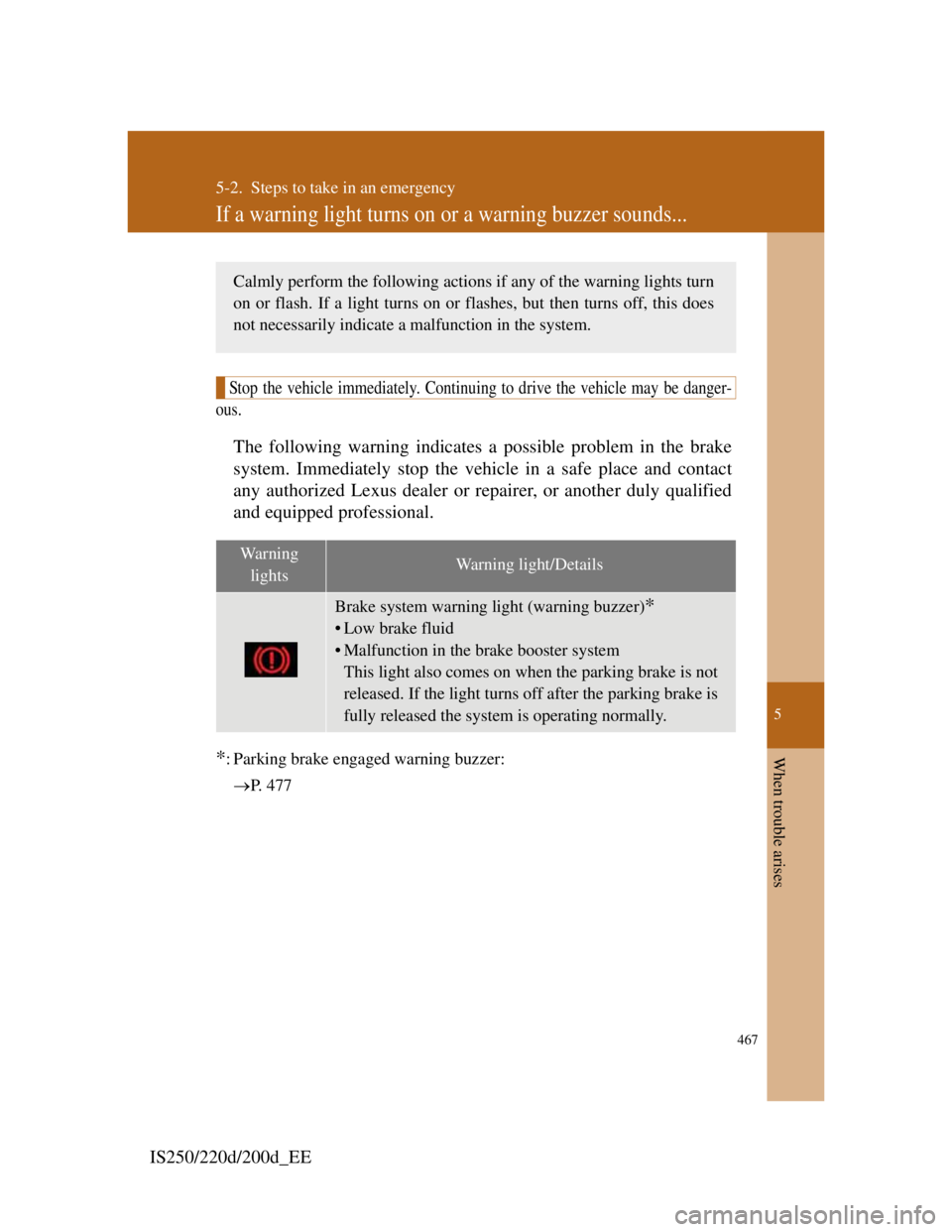
The following warning indicates a possible problem in the brake
system. Immediately stop the vehicle in a safe place and contact
any authorized Lexus dealer or repairer, or another duly qualified
and equipped professional.
*: Parking brake engaged warning buzzer:
P. 4 7 7
Wa r n i n g
lightsWarning light/Details
Brake system warning light (warning buzzer)*
• Low brake fluid
• Malfunction in the brake booster system
This light also comes on when the parking brake is not
released. If the light turns off after the parking brake is
fully released the system is operating normally.
Calmly perform the following actions if any of the warning lights turn
on or flash. If a light turns on or flashes, but then turns off, this does
not necessarily indicate a malfunction in the system.
Page 504 of 609
478
5-2. Steps to take in an emergency
IS250/220d/200d_EE
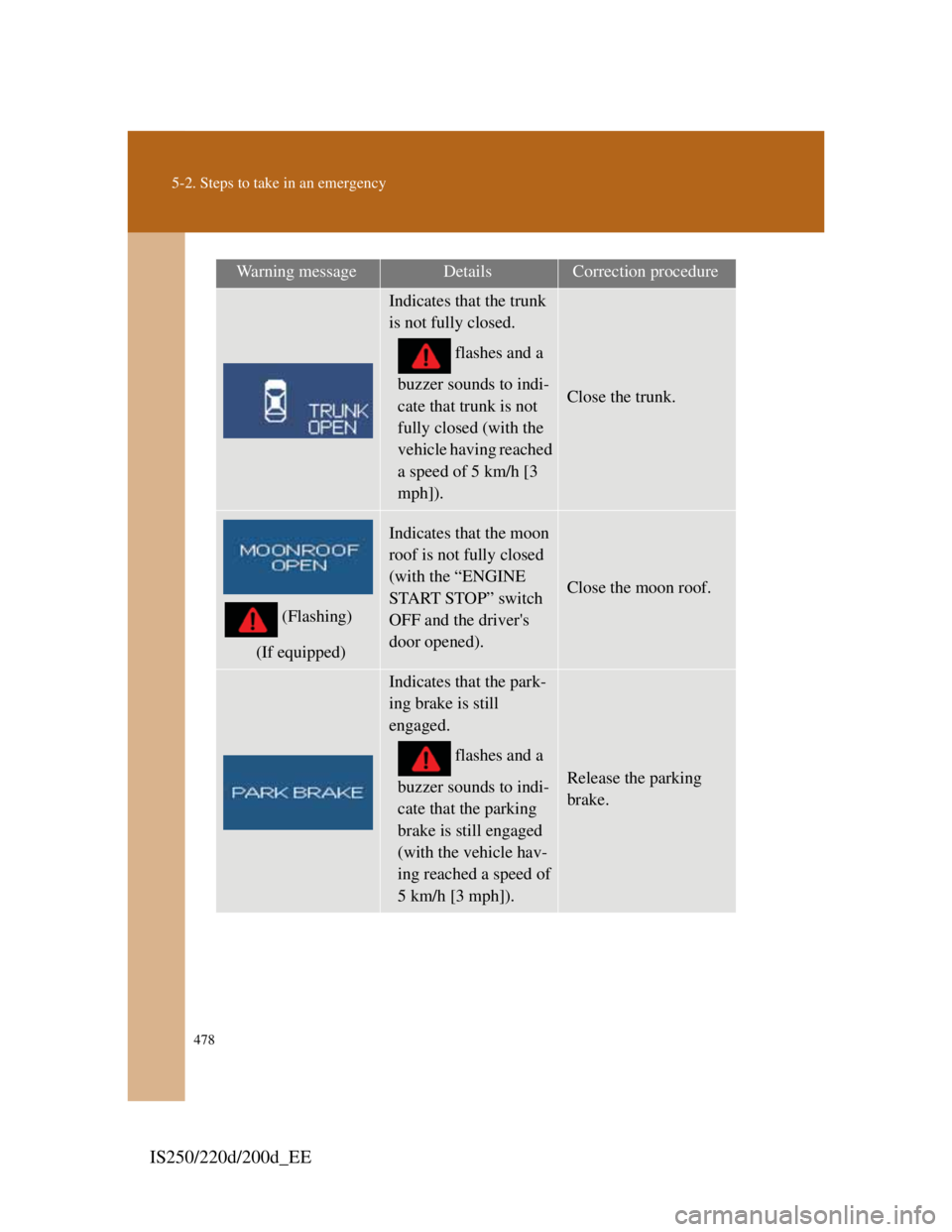
Indicates that the trunk
is not fully closed.
flashes and a
buzzer sounds to indi-
cate that trunk is not
fully closed (with the
vehicle having reached
a speed of 5 km/h [3
mph]).
Close the trunk.
(Flashing)
(If equipped)
Indicates that the moon
roof is not fully closed
(with the “ENGINE
START STOP” switch
OFF and the driver's
door opened).
Close the moon roof.
Indicates that the park-
ing brake is still
engaged.
flashes and a
buzzer sounds to indi-
cate that the parking
brake is still engaged
(with the vehicle hav-
ing reached a speed of
5 km/h [3 mph]).
Release the parking
brake.
Warning messageDetailsCorrection procedure
Page 506 of 609
480
5-2. Steps to take in an emergency
IS250/220d/200d_EE
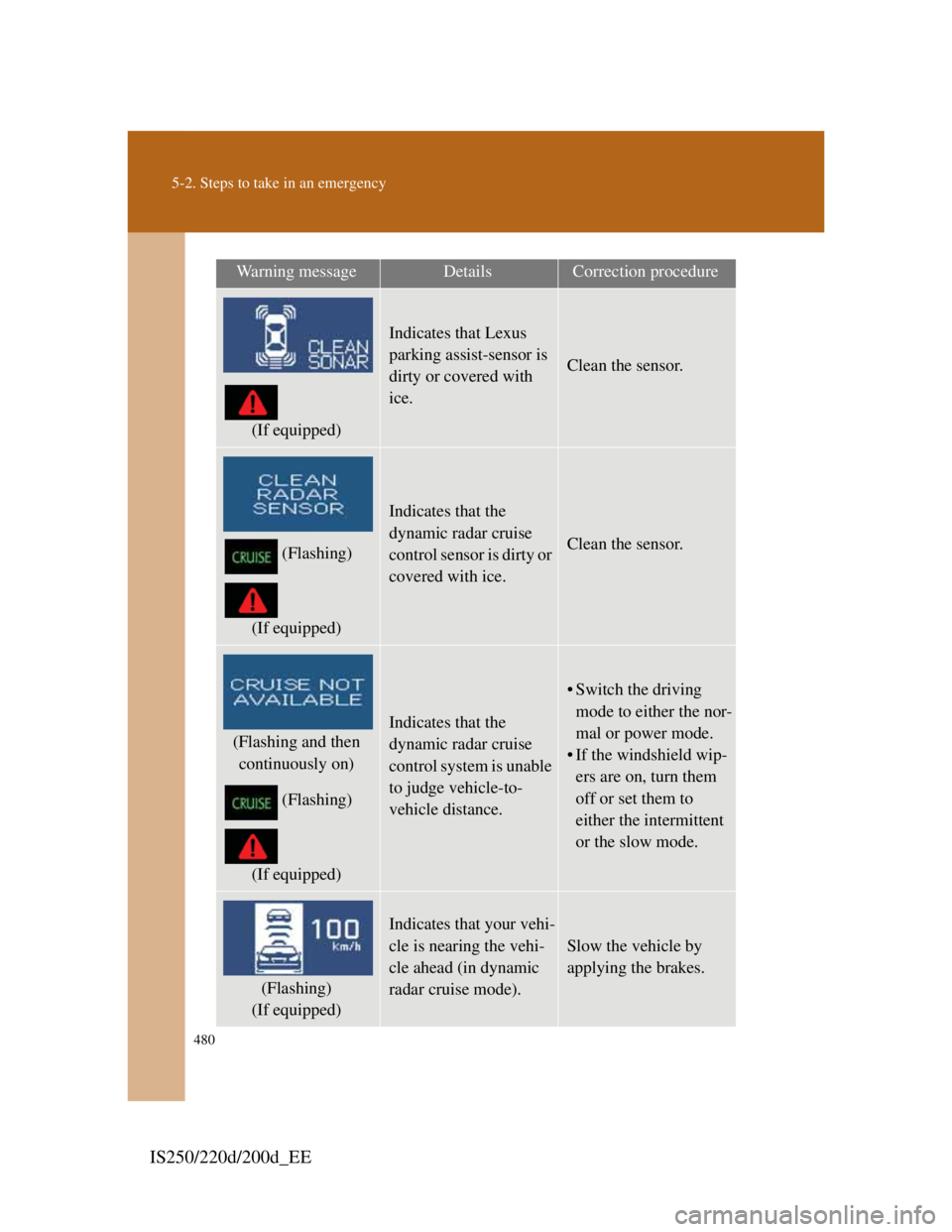
(If equipped)
Indicates that Lexus
parking assist-sensor is
dirty or covered with
ice.
Clean the sensor.
(Flashing)
(If equipped)
Indicates that the
dynamic radar cruise
control sensor is dirty or
covered with ice.
Clean the sensor.
(Flashing and then
continuously on)
(Flashing)
(If equipped)
Indicates that the
dynamic radar cruise
control system is unable
to judge vehicle-to-
vehicle distance.
• Switch the driving
mode to either the nor-
mal or power mode.
• If the windshield wip-
ers are on, turn them
off or set them to
either the intermittent
or the slow mode.
(Flashing)
(If equipped)
Indicates that your vehi-
cle is nearing the vehi-
cle ahead (in dynamic
radar cruise mode).
Slow the vehicle by
applying the brakes.
Warning messageDetailsCorrection procedure
Page 513 of 609
5
487
5-2. Steps to take in an emergency
When trouble arises
IS250/220d/200d_EE
If you have a flat tire (vehicles with a spare tire)
Remove the flat tire and replace it with the spare provided.
Before jacking up the vehicle
Stop the vehicle on a hard, flat surface.
Set the parking brake.
Shift the shift lever to P (vehicles with an automatic trans-
mission) or R (vehicles with a manual transmission).
Stop the engine.
Turn on the emergency flashers.
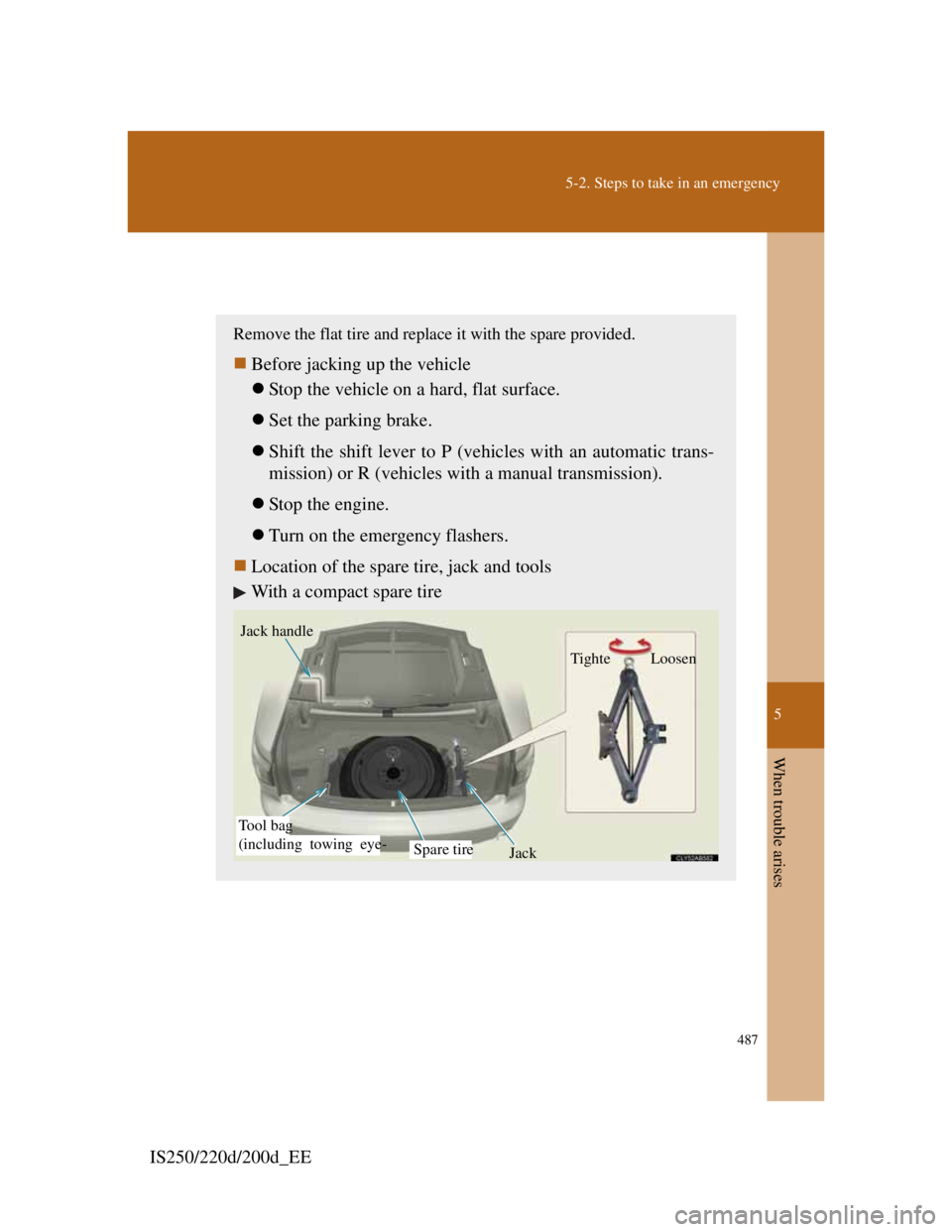
Location of the spare tire, jack and tools
With a compact spare tire
Jack
Jack handle
Tighte Loosen
Spare tire
Tool bag
(including towing eye-
Page 524 of 609

498
5-2. Steps to take in an emergency
IS250/220d/200d_EE
CAUTION
When the compact spare tire is attached
The vehicle speed may not be correctly detected, and the following systems
may not operate correctly:
ABS & Brake assist
VSC
TRC
EPS
VDIM
Navigation system (if equipped)
Lexus parking assist-sensor (if equipped)
Dynamic radar cruise control (if equipped)
Cruise control (if equipped)
PCS (if equipped)
NOTICE
Do not drive the vehicle with a flat tire.
Do not continue driving with a flat tire.
Driving even a short distance with a flat tire can damage the tire and the
wheel beyond repair.
Be careful when driving over bumps with the compact spare tire installed on
the vehicle.
The vehicle becomes lower when driving with the compact spare tire com-
pared to when driving with standard tires. Be careful when driving over
uneven road surfaces.
Driving with tire chains and the compact spare tire
Do not fit tire chains to the compact spare tire.
Tire chains may damage the vehicle body and adversely affect driving per-
formance.