info Lexus IS250 2008 User Guide
[x] Cancel search | Manufacturer: LEXUS, Model Year: 2008, Model line: IS250, Model: Lexus IS250 2008Pages: 462, PDF Size: 25.52 MB
Page 22 of 462

21
1-1. Key information
1
Before driving
08_IS350/250_U_(L/O_0708)
■When required to leave a key to the vehicle with a parking attendant
Turn the trunk opener main switch off and lock the glove box as circumstances
demand. (→P. 4 1 , 2 3 6 )
Remove the mechanical key for your own use and provide the attendant with the
electronic key only.
■Key number plate
Keep the plate in a safe place such as your wallet, not in the vehicle. In the event that
a mechanical key is lost, a new key can be made at your Lexus dealer using the key
number plate. (→ P. 393)
NOTICE
■To prevent key damage
●Do not subject the keys to strong shocks, expose them to high temperatures by
placing them in direct sunlight, or get them wet.
●Do not expose the keys to electromagnetic materials or attach any material that
blocks electromagnetic waves to the key surface.
●Do not disassemble the electronic key.
Page 28 of 462
27
1-2. Opening, closing and locking the doors and trunk
1
Before driving
08_IS350/250_U_(L/O_0708)
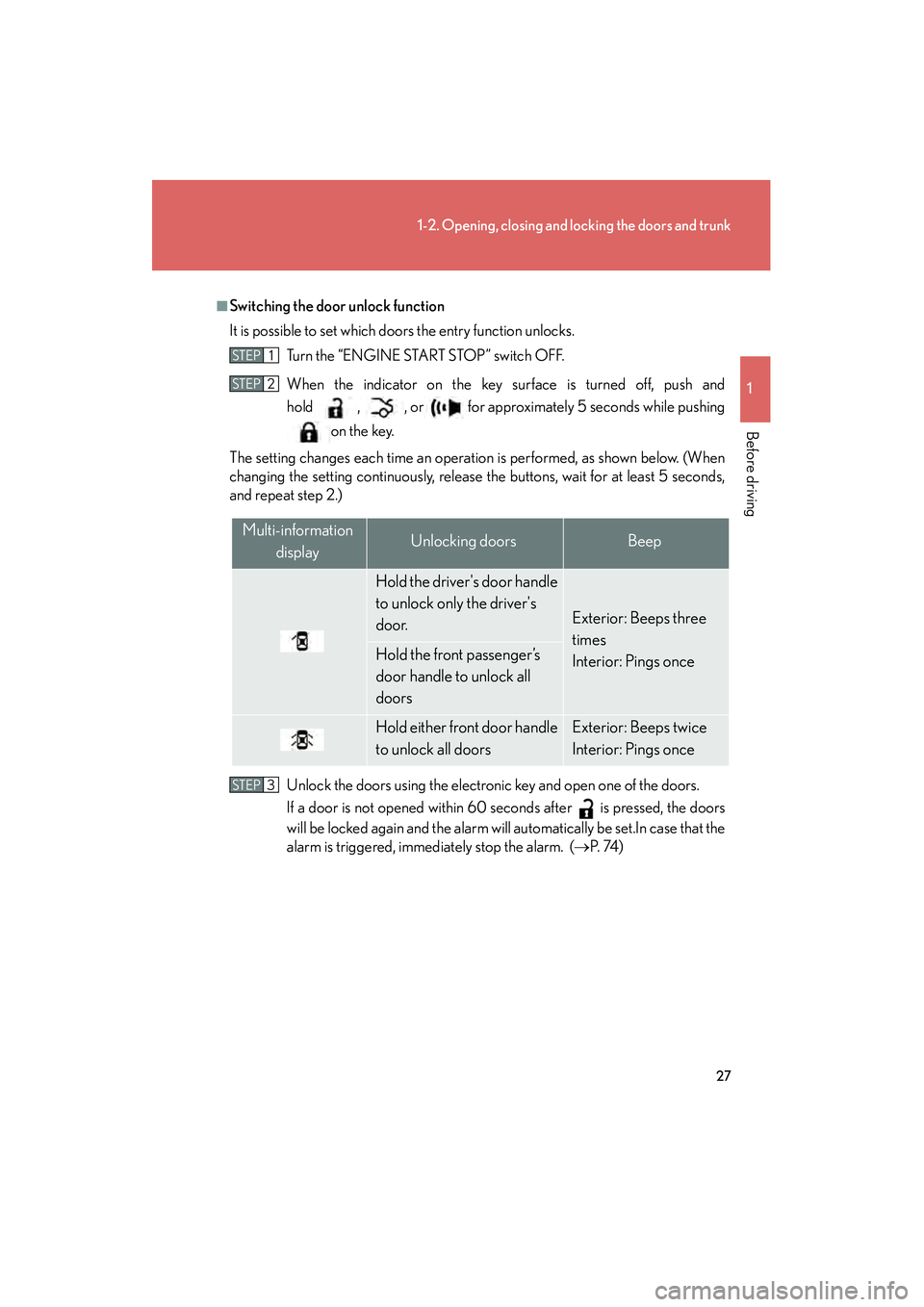
■Switching the door unlock function
It is possible to set which doors the entry function unlocks. Turn the “ENGINE START STOP” switch OFF.
When the indicator on the key surface is turned off, push and
hold , , or for approximately 5 seconds while pushingon the key.
The setting changes each time an operation is performed, as shown below. (When
changing the setting continuously, release the buttons, wait for at least 5 seconds,
and repeat step 2.)
Unlock the doors using the electronic key and open one of the doors.
If a door is not opened within 60 seconds after is pressed, the doors
will be locked again and the alarm will automatically be set.In case that the
alarm is triggered, immediately stop the alarm. ( →P. 74 )
STEP1
STEP2
Multi-information
displayUnlocking doorsBeep
Hold the driver's door handle
to unlock only the driver's
door.
Exterior: Beeps three
times
Interior: Pings once
Hold the front passenger’s
door handle to unlock all
doors
Hold either front door handle
to unlock all doorsExterior: Beeps twice
Interior: Pings once
STEP3
Page 31 of 462
30
1-2. Opening, closing and locking the doors and trunk
08_IS350/250_U_(L/O_0708)
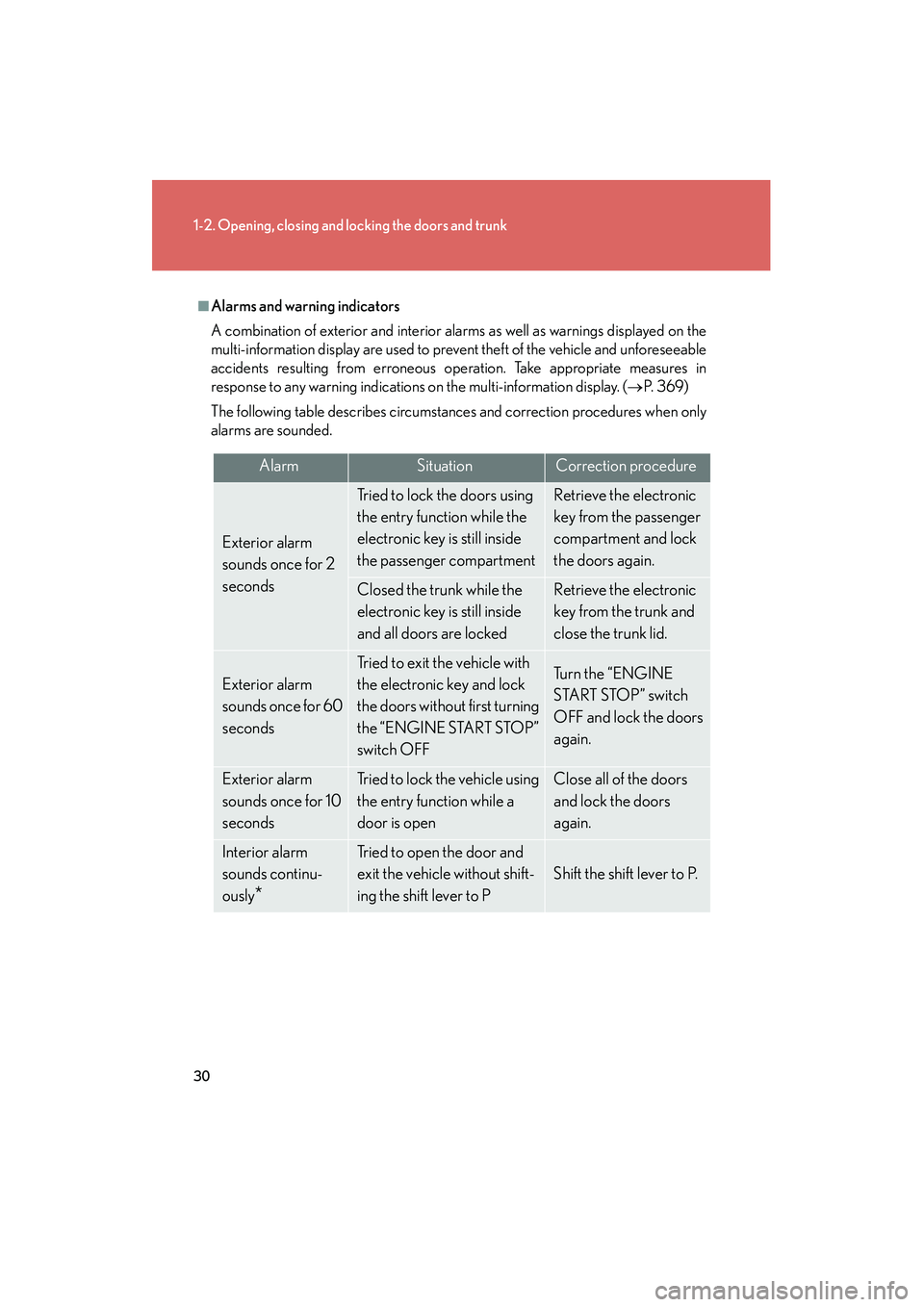
■Alarms and warning indicators
A combination of exterior and interior alarms as well as warnings displayed on the
multi-information display are used to prevent theft of the vehicle and unforeseeable
accidents resulting from erroneous operation. Take appropriate measures in
response to any warning indications on the multi-information display. (
→P. 3 6 9 )
The following table describes circumstances and correction procedures when only
alarms are sounded.
AlarmSituationCorrection procedure
Exterior alarm
sounds once for 2
seconds
Tried to lock the doors using
the entry function while the
electronic key is still inside
the passenger compartmentRetrieve the electronic
key from the passenger
compartment and lock
the doors again.
Closed the trunk while the
electronic key is still inside
and all doors are lockedRetrieve the electronic
key from the trunk and
close the trunk lid.
Exterior alarm
sounds once for 60
seconds
Tried to exit the vehicle with
the electronic key and lock
the doors without first turning
the “ENGINE START STOP”
switch OFFTu r n t h e “ E N G I N E
START STOP” switch
OFF and lock the doors
again.
Exterior alarm
sounds once for 10
secondsTried to lock the vehicle using
the entry function while a
door is openClose all of the doors
and lock the doors
again.
Interior alarm
sounds continu-
ously
*
Tried to open the door and
exit the vehicle without shift-
ing the shift lever to P
Shift the shift lever to P.
Page 34 of 462
33
1-2. Opening, closing and locking the doors and trunk
1
Before driving
08_IS350/250_U_(L/O_0708)
CAUTION
■Caution regarding interference with electronic devices
●People with implanted pacemakers or cardiac defibrillators should keep away
from the smart access system antennas. (
→P. 2 4 )
The radio waves may affect the operation of such devices. If necessary, the entry
function can be disabled. Ask your Lexus dealer for details, such as the frequency
of radio waves and timing of emitting the radio waves. Then, consult your doctor
to see if you should disable the entry function.
●User of any electrical medical device other than implanted pacemakers and
implanted cardiac defibrillators should consult the manufacturer of the device for
information about its operation under the influence of radio waves.
Radio waves could have unexpected effects on the operation of such medical
devices.
Ask your Lexus dealer for details for disabling the entry function.
Page 78 of 462
77
1
Before driving
08_IS350/250_U_(L/O_0708)
1-7. Safety information
Correct driving posture
CAUTION
■While driving
●Do not adjust the position of the driver’s seat while driving.
Doing so could cause the driver to lose control of the vehicle.
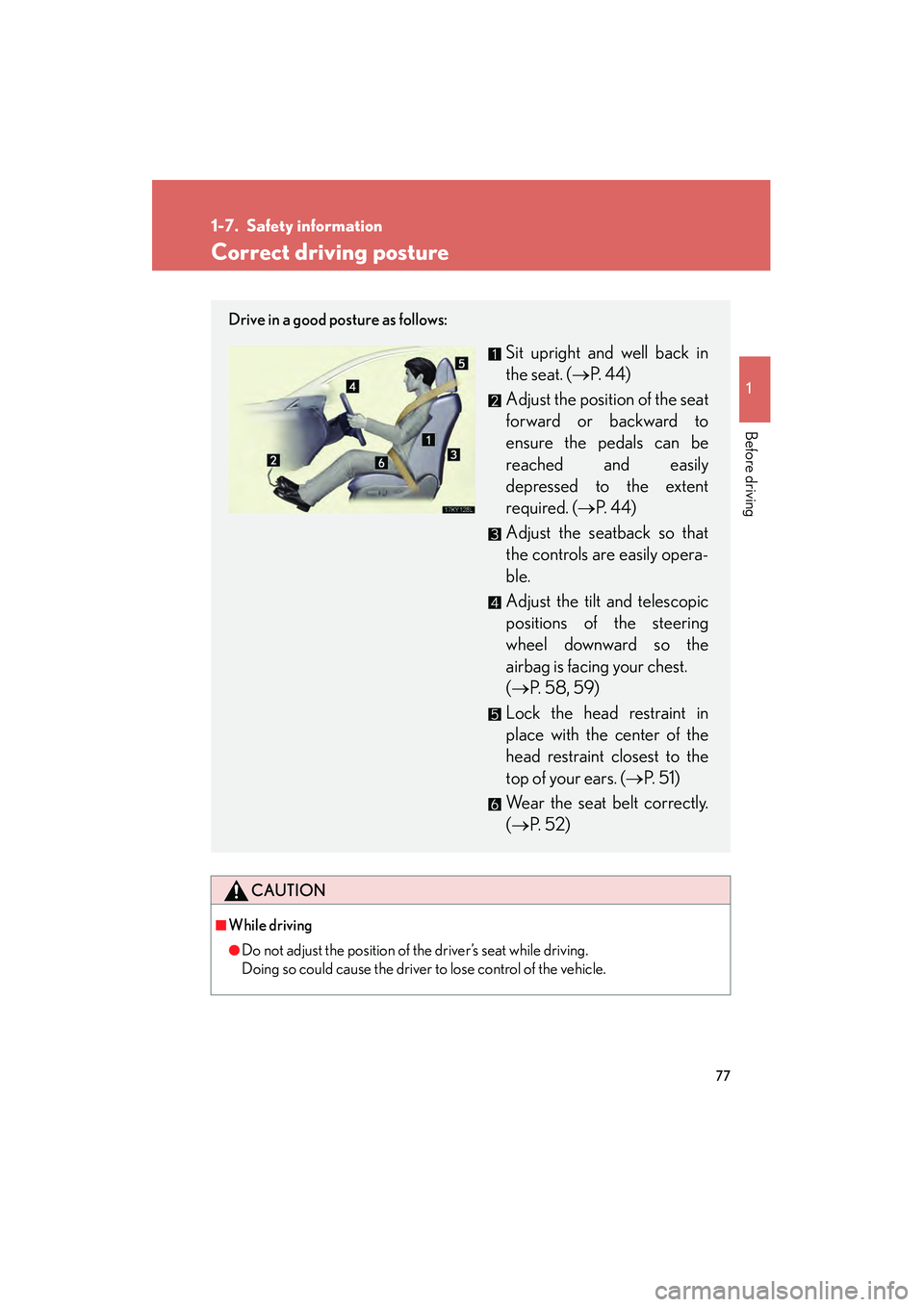
Drive in a good posture as follows:
Sit upright and well back in
the seat. (→P. 44)
Adjust the position of the seat
forward or backward to
ensure the pedals can be
reached and easily
depressed to the extent
required. ( →P. 44)
Adjust the seatback so that
the controls are easily opera-
ble.
Adjust the tilt and telescopic
positions of the steering
wheel downward so the
airbag is facing your chest.
(→P. 58, 59)
Lock the head restraint in
place with the center of the
head restraint closest to the
top of your ears. ( →P. 5 1 )
Wear the seat belt correctly.
(→P. 5 2 )
Page 79 of 462
78
1-7. Safety information
08_IS350/250_U_(L/O_0708)
CAUTION
■While driving
●Do not place a cushion between the driver or passenger and the seatback.
A cushion may prevent correct posture from being achieved, and reduce the
effectiveness of the seat belt and head restraint, increasing the risk of death or
serious injury to the driver or passenger.
●Do not place anything under the front seats.
Objects placed under the front seats may become jammed in the seat tracks and
stop the seat from locking in place. This may lead to an accident. The adjustment
mechanism may also be damaged.
■Adjusting the seat position:
●Take care when adjusting the seat position to ensure that other passengers are
not injured by the moving seat.
●Do not put your hands under the seat or near the moving parts to avoid injury.
Fingers or hands may become jammed in the seat mechanism.
Page 80 of 462
79
1
1-7. Safety information
Before driving
08_IS350/250_U_(L/O_0708)
SRS airbags
The SRS airbags inflate when the vehicle is subjected to certain types of
severe impacts that may cause significant injury to the occupants. They
work together with the seat belts to help reduce the risk of death or serious
injury.
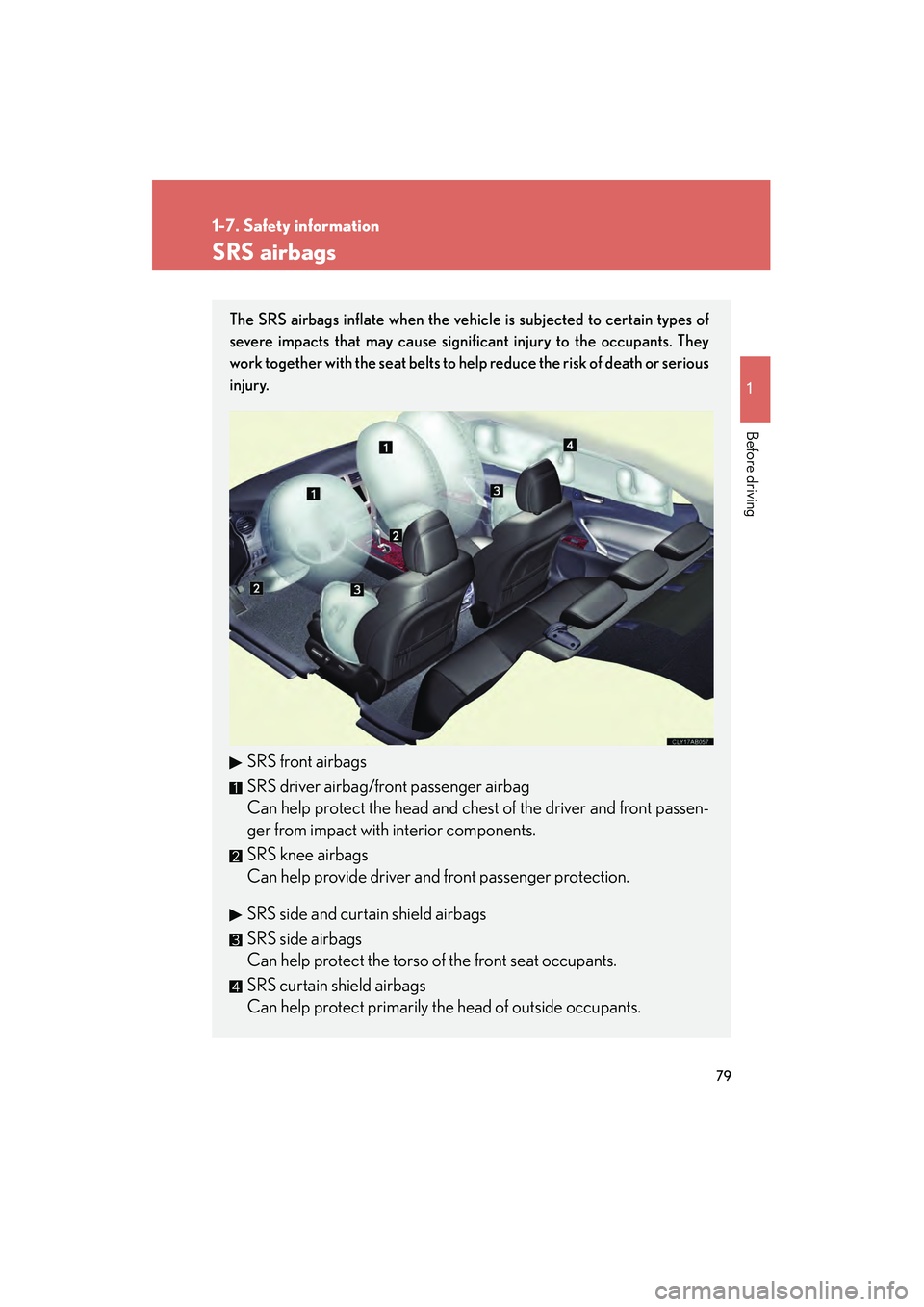
SRS front airbags
SRS driver airbag/front passenger airbag
Can help protect the head and chest of the driver and front passen-
ger from impact with interior components.
SRS knee airbags
Can help provide driver and front passenger protection.
SRS side and curtain shield airbags
SRS side airbags
Can help protect the torso of the front seat occupants.
SRS curtain shield airbags
Can help protect primarily the head of outside occupants.
Page 81 of 462

80
1-7. Safety information
08_IS350/250_U_(L/O_0708)
Airbag system componentsYour vehicle is equipped with ADVANCED AIRBAGS designed based
on US motor vehicle safety standards (FMVSS208). The airbag system
controls airbag deployment power for the driver and front passenger. The
driver airbag system consists of the driver seat’s position sensor etc. The
front passenger’s airbag system consists of the front passenger occupant
classification sensor etc.
The main SRS airbag system components are shown above. The SRS
airbag system is controlled by the airbag sensor assembly. The airbag
sensor assembly consists of a sa fing sensor and an airbag sensor.
Knee airbags
Front passenger airbag
Curtain shield airbags
“A I R B A G O N ” a n d “A I R B A G
OFF” indicator lights
Side airbags
Side and curtain shield airbag
sensors
Curtain shield airbag sensors
SRS warning light
Driver airbag
Driver's seat belt buckle switch
Driver's seat position sensor
Front passenger’s seat belt
buckle switch
Airbag sensor assembly
Occupant detection system
(ECU and sensors)
Front airbag sensors
Page 82 of 462

81
1-7. Safety information
1
Before driving
08_IS350/250_U_(L/O_0708)In certain types of severe frontal or side impacts, the SRS airbag system
triggers the airbag inflators. A chemical reaction in the inflators quickly
fills the airbags with non-toxic gas to help restrain the motion of the occu-
pants.
■SRS warning light
This warning light system monitors the airbag sensor assembly, front airbag sensors,
side and curtain shield airbag sensor assemblies, curtain shield airbag sensor
assemblies, driver's seat position sensor, driver's seat belt buckle switch, seat belt
pretensioner assemblies, inflators, interconnecting wiring and power sources.
(
→P. 3 6 1 )
■If the SRS airbags deploy (inflate)
●Bruising and slight abrasions may result from contact with a deploying (inflating)
SRS airbag.
●A loud noise and white powder will be emitted.
●Parts of the airbag module (steering wheel hub, airbag cover and inflator) as
well as the front seats, and parts of the fr
ont pillar, rear pillar and roof side rail,
may be hot for several minutes. The airbag itself may also be hot.
●The front windshield may crack.
■Operating conditions (front airbags)
●The SRS front airbags will deploy if the severity of the frontal impact is above the
designed threshold level, comparable to an approximate 15 mph (25 km/h) col-
lision when the vehicle impacts straight into a fixed barrier that does not move
or deform.
However, this threshold velocity will be considerably higher if the vehicle strikes
an object, such as a parked vehicle or sign pole, which can move or deform on
impact, or if the vehicle is involved in an underride collision (e.g. a collision in
which the front of the vehicle "underrides", or goes under, the bed of a truck, etc.).
●It is possible that in some collisions where the forward deceleration of the vehi-
cle is very close to the designed threshold level, the SRS front airbags and the
seat belt pretensioners may not activate together.
●The SRS front passenger airbag will not activate if there is no passenger sitting
in the front passenger seat. However, the front passenger airbag may deploy if
luggage is put in the seat, or the seat belt is fastened, even if the seat is unoccu-
pied. (
→P. 9 0 )
Page 83 of 462
82
1-7. Safety information
08_IS350/250_U_(L/O_0708)
■Operating conditions (side and curtain shield airbags)
●The SRS side airbags and curtain shield airbags are designed to inflate when the
passenger compartment is subjected to a severe impact from the side.
●The SRS side airbag on the passenger seat will not activate if there is no passen-
ger sitting in the front passenger seat. However, the side airbag on the passen-
ger seat may deploy if luggage is put in the seat, even if the seat is unoccupied.
(
→P. 9 0 )
■Conditions under which the SRS airbags may deploy (inflate), other than a colli-
sion
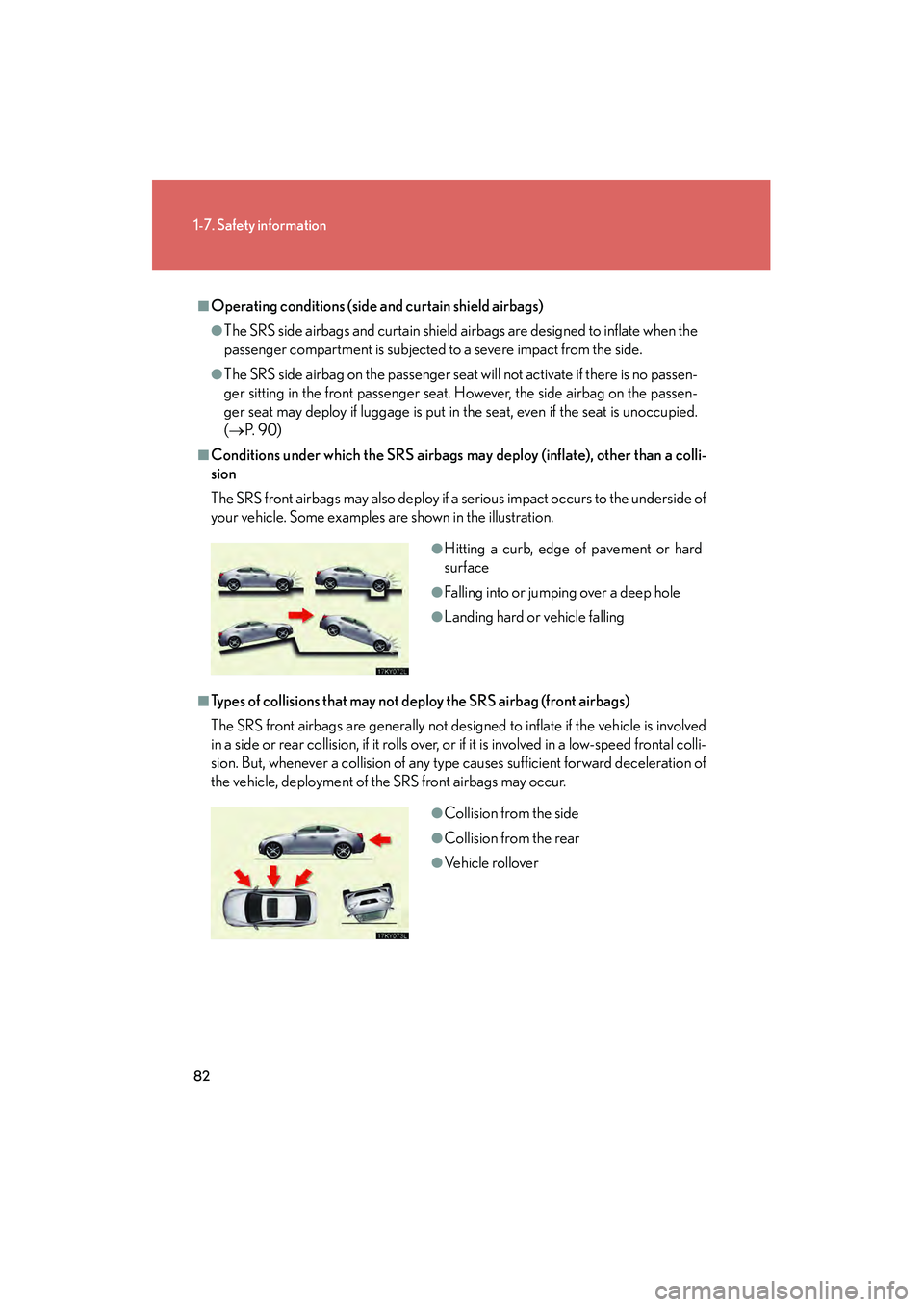
The SRS front airbags may also deploy if a serious impact occurs to the underside of
your vehicle. Some examples are shown in the illustration.
■Types of collisions that may not deploy the SRS airbag (front airbags)
The SRS front airbags are generally not designed to inflate if the vehicle is involved
in a side or rear collision, if it rolls over, or if it is involved in a low-speed frontal colli-
sion. But, whenever a collision of any type causes sufficient forward deceleration of
the vehicle, deployment of the SRS front airbags may occur.
●Hitting a curb, edge of pavement or hard
surface
●Falling into or jumping over a deep hole
●Landing hard or vehicle falling
●Collision from the side
●Collision from the rear
●Vehicle rollover