Automatic Lexus IS250 2011 Owners Manual
[x] Cancel search | Manufacturer: LEXUS, Model Year: 2011, Model line: IS250, Model: Lexus IS250 2011Pages: 578, PDF Size: 31.12 MB
Page 491 of 578
490
5-2. Steps to take in an emergency
IS350/250_U
Emergency start function
When the engine does not start, the following steps can be used as an
interim measure to start the engine if the “ENGINE START STOP” switch
is functioning normally.Vehicles with an automatic transmission Set the parking brake.
Put the shift lever in P.
Set the “ENGINE START STOP” switch to ACCESSORY mode.
Press and hold the “ENGINE START STOP” switch for about 15
seconds while depressing the brake pedal firmly.
Vehicles with a manual transmission Set the parking brake.
Put the shift lever in N.
Set the “ENGINE START STOP” switch to the ACCESSORY
mode.
Push and hold the “ENGINE ST ART STOP” switch for about 15
seconds while depressing the brake pedal and clutch pedal firmly.
Even if the engine can be started using the above steps, the system may
be malfunctioning. Have the vehicle checked by your Lexus dealer.
STEP1
STEP2
STEP3
STEP4
STEP1
STEP2
STEP3
STEP4
Page 496 of 578
5
When trouble arises
495
5-2. Steps to take in an emergency
IS350/250_U
Changing “ENGINE START STOP” switch modes and starting the engine
Automatic transmissionShift the shift lever to P and apply the brakes.
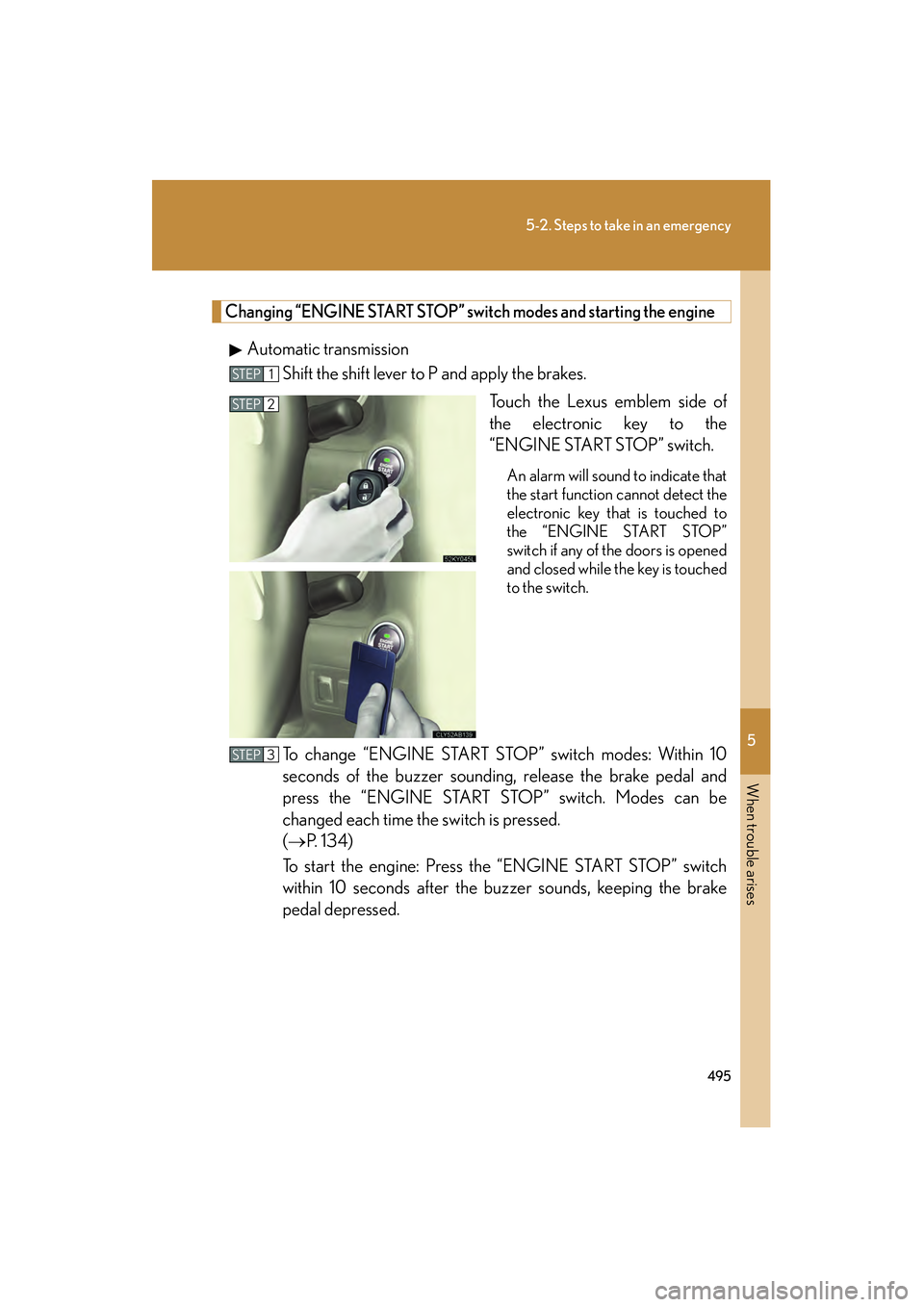
Touch the Lexus emblem side of
the electronic key to the
“ENGINE START STOP” switch.
An alarm will sound to indicate that
the start function cannot detect the
electronic key that is touched to
the “ENGINE START STOP”
switch if any of the doors is opened
and closed while the key is touched
to the switch.
To change “ENGINE START STOP” switch modes: Within 10
seconds of the buzzer sounding, release the brake pedal and
press the “ENGINE START STOP” switch. Modes can be
changed each time the switch is pressed.
(→P. 1 3 4 )
To start the engine: Press the “ENGINE START STOP” switch
within 10 seconds after the buzzer sounds, keeping the brake
pedal depressed.
STEP1
STEP2
STEP3
Page 498 of 578
5
When trouble arises
497
5-2. Steps to take in an emergency
IS350/250_U
■Stopping the engine
For vehicles with an automatic transmission: Shift the shift lever to P and press the
“ENGINE START STOP” switch as you normally do when stopping the engine.
For vehicles with a manual transmission: Shift the shift lever to N position and press
the “ENGINE START STOP” switch as you normally do when stopping the engine.
■Replacing the key battery
As the above procedure is a temporary measure, it is recommended that the elec-
tronic key battery be replaced immediately when the battery depletes.
(→ P. 4 2 1 )
Page 502 of 578

5
When trouble arises
501
5-2. Steps to take in an emergency
IS350/250_U
If your vehicle overheats
If your engine overheats:
Stop the vehicle in a safe place and turn off the automatic air
conditioning system.
Check to see if steam is coming out from under the hood.
If you see steam: Stop the engine. Carefully lift the hood after the steam sub-
sides and then restart the engine.
If you do not see steam: Leave the engine running and carefully lift the hood.
Remove the engine compartment cover. ( →P. 388)
Check to see if the cooling fans are operating.
If the fans are operating: Wait until the temperature of the engine (shown on the
instrument cluster) begins to fall and then stop the engine.
If the fans are not operating: Stop the engine immediately and call your local Lexus
dealer.
After the engine has cooled
down sufficiently, check the
engine coolant level and inspect
the radiator core (radiator) for
any leaks.STEP1
STEP2
STEP3
STEP4
STEP5
Page 505 of 578
504
5-2. Steps to take in an emergency
IS350/250_U
If the vehicle becomes stuck
CAUTION
■When attempting to free a stuck vehicle
If you choose to rock the vehicle back and forth to free it, make sure the surround-
ing area is clear, to avoid striking other vehicles, objects or persons. The vehicle
may also lunge forward or lunge back suddenly as it becomes free. Use extreme
caution.
■When shifting the shift lever
With automatic transmission vehicles, be careful not to shift the shift lever with the
accelerator pedal depressed.
This may lead to unexpected rapid acceleration of the vehicle that may cause an
accident and result in death or serious injury.
Carry out the following procedures if the tires spin or the vehicle becomes
stuck in mud, dirt, or snow.
Stop the engine. Set the parking brake and shift the shift lever
to P (vehicles with an automatic transmission) or N (vehicles
with a manual transmission).
Remove the mud, snow, or sand from around the stuck tire.
Place wood, stones or some other material to help provide
traction under the tires.
Restart the engine.
Shift the shift lever to the D or R position (vehicles with an auto-
matic transmission) or 1 or R position (vehicles with a manual
transmission), release the parking brake and carefully apply
the accelerator to free the vehicle.
Turn off TRAC and VSC if these functions are hampering your
attempts to free the vehicle. (→ P. 1 8 7 )
STEP1
STEP2
STEP3
STEP4
STEP5
Page 512 of 578
511
6-1. Specifications
6
Vehicle specifications
IS350/250_U
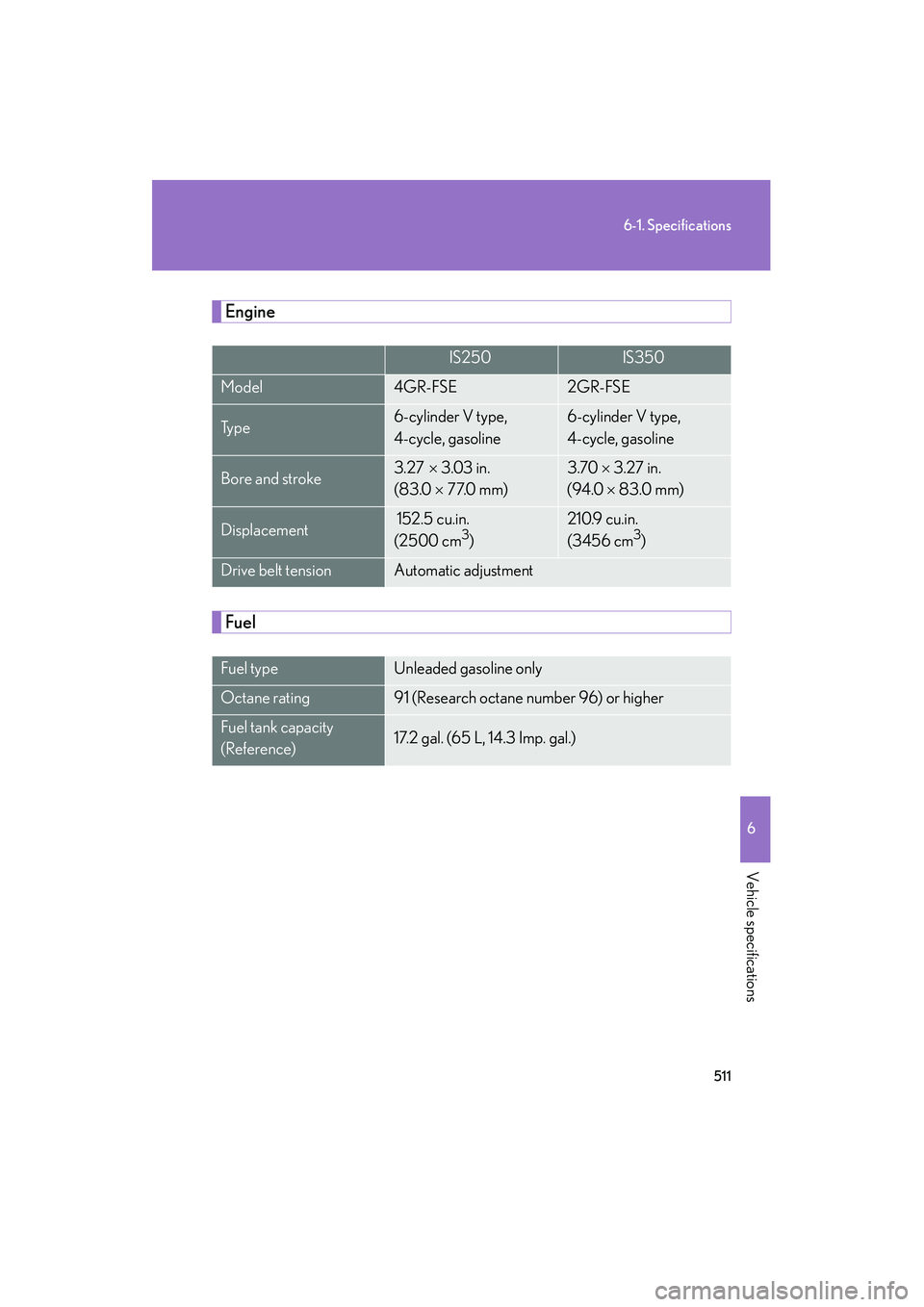
Engine
Fuel
IS250IS350
Model4GR-FSE2GR-FSE
Ty p e6-cylinder V type,
4-cycle, gasoline6-cylinder V type,
4-cycle, gasoline
Bore and stroke3.27 × 3.03 in.
(83.0 × 77.0 mm)3.70 × 3.27 in.
(94.0 × 83.0 mm)
Displacement 152.5 cu.in.
(2500 cm3)
210.9 cu.in.
(3456 cm3)
Drive belt tensionAutomatic adjustment
Fuel typeUnleaded gasoline only
Octane rating91 (Research octane number 96) or higher
Fuel tank capacity
(Reference)17.2 gal. (65 L, 14.3 Imp. gal.)
Page 518 of 578
517
6-1. Specifications
6
Vehicle specifications
IS350/250_U
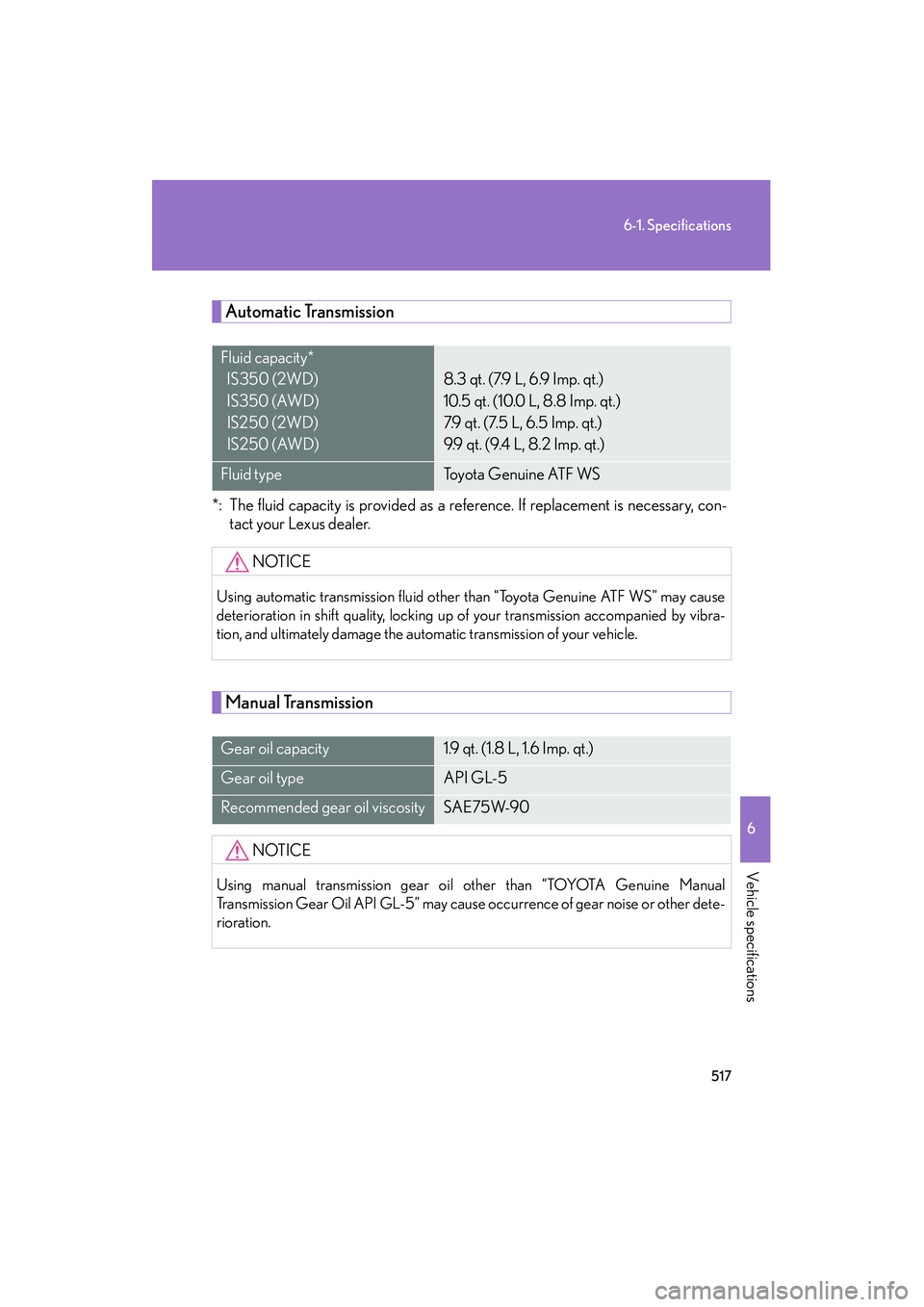
Automatic Transmission
*: The fluid capacity is provided as a reference. If replacement is necessary, con-
tact your Lexus dealer.
Manual Transmission
Fluid capacity*
IS350 (2WD)
IS350 (AWD)
IS250 (2WD)
IS250 (AWD)
8.3 qt. (7.9 L, 6.9 Imp. qt.)
10.5 qt. (10.0 L, 8.8 Imp. qt.)
7.9 qt. (7.5 L, 6.5 Imp. qt.)
9.9 qt. (9.4 L, 8.2 Imp. qt.)
Fluid typeTo y o t a G e n u i n e AT F W S
NOTICE
Using automatic transmission fluid other than “Toyota Genuine ATF WS” may cause
deterioration in shift quality, locking up of your transmission accompanied by vibra-
tion, and ultimately damage the automatic transmission of your vehicle.
Gear oil capacity1.9 qt. (1.8 L, 1.6 Imp. qt.)
Gear oil typeAPI GL-5
Recommended gear oil viscositySAE75W-90
NOTICE
Using manual transmission gear oil other than “TOYOTA Genuine Manual
Transmission Gear Oil API GL-5” may cause occurrence of gear noise or other dete-
rioration.
Page 519 of 578
518
6-1. Specifications
IS350/250_U
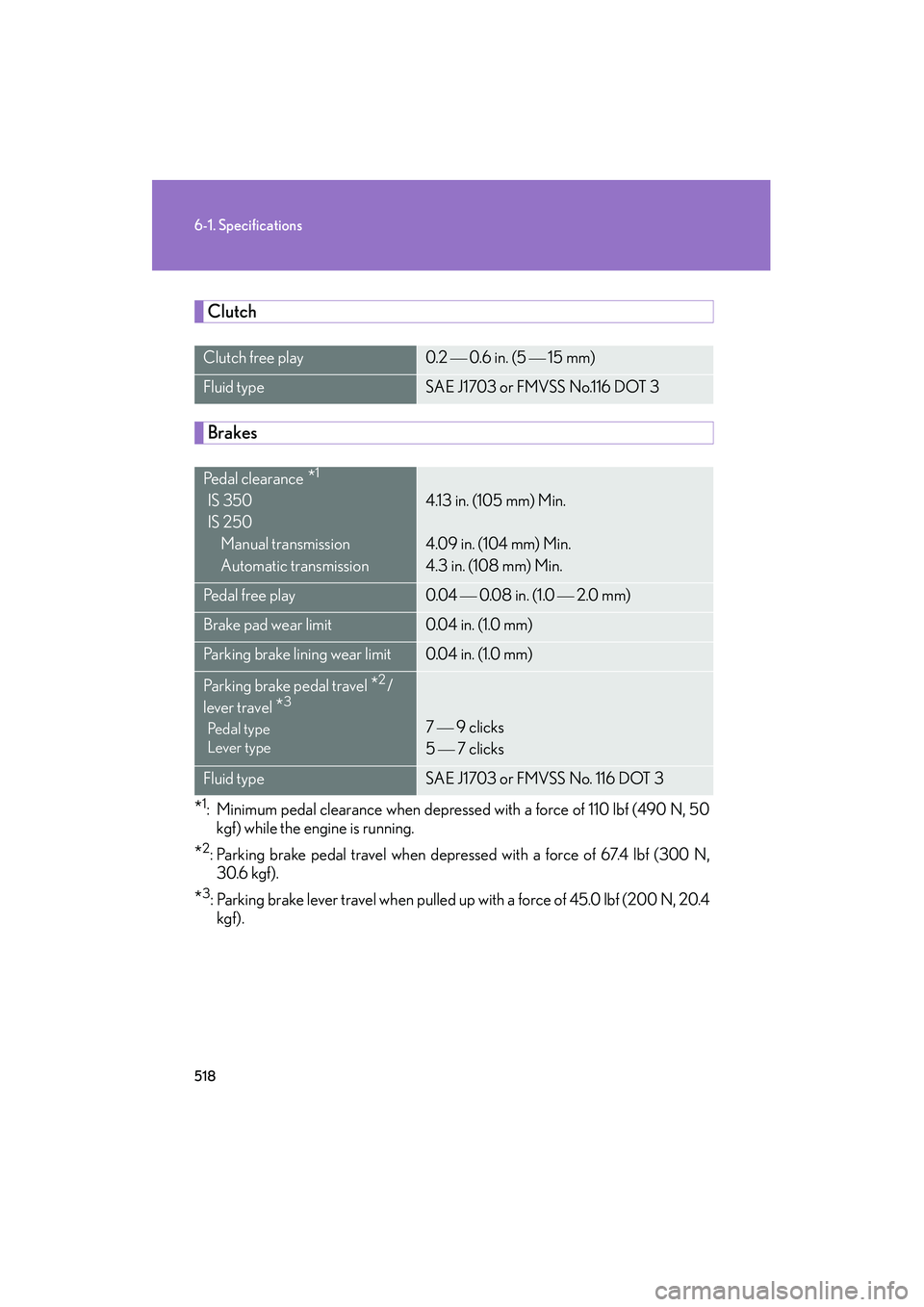
Clutch
Brakes
*1: Minimum pedal clearance when depressed with a force of 110 lbf (490 N, 50
kgf) while the engine is running.
*2: Parking brake pedal travel when depressed with a force of 67.4 lbf (300 N,30.6 kgf).
*3: Parking brake lever travel when pulled up with a force of 45.0 lbf (200 N, 20.4kgf).
Clutch free play0.2 0.6 in. (5 15 mm)
Fluid typeSAE J1703 or FMVSS No.116 DOT 3
Pe d a l c l e a r a n c e *1
IS 350
IS 250
Manual transmission
Automatic transmission4.13 in. (105 mm) Min.
4.09 in. (104 mm) Min.
4.3 in. (108 mm) Min.
Pedal free play0.04 0.08 in. (1.0 2.0 mm)
Brake pad wear limit0.04 in. (1.0 mm)
Parking brake lining wear limit0.04 in. (1.0 mm)
Parking brake pedal travel *2/
lever travel
*3
Pedal type
Lever type7 9 clicks
5
7 clicks
Fluid typeSAE J1703 or FMVSS No. 116 DOT 3
Page 534 of 578

533
6-1. Specifications
6
Vehicle specifications
IS350/250_U■
Temperature A, B, C
The temperature grades are A (the highest), B, and C, representing
the tire's resistance to the generation of heat and its ability to dissipate
heat when tested under controlled conditions on a specified indoor
laboratory test wheel.
Sustained high temperature can cause the material of the tire to degenerate
and reduce tire life, and excessive temperature can lead to sudden tire fail-
ure.
The grade C corresponds to a level of performance which all passenger car
tires must meet under the Federal Motor Vehicle Safety Standard No. 109.
Grades B and A represent higher levels of performance on the laboratory
test wheel than the minimum required by law.
Warning: The temperature grades for this tire are established for a tire that
is properly inflated and not overloaded.
Excessive speed, underinflation, or excessive loading, either separately or in
combination, can cause heat buildup and possible tire failure.
Glossary of tire terminology
Tire related termMeaning
Accessory weight
The combined weight (in excess of those standard
items which may be replaced) of automatic transmis-
sion, power steering, power brakes, power windows,
power seats, radio and heater, to the extent that these
items are available as factory-installed equipment
(whether installed or not)
Cold tire inflation pres-
sureTire pressure when the vehicle has been parked for
three hours or more, or has not been driven more
than 1 mile or 1.5 km under that condition
Curb weight
The weight of a motor vehicle with standard equip-
ment, including the maximum capacity of fuel, oil and
coolant, and if so equipped, air conditioning and
additional weight optional engine
Page 541 of 578
540
IS350/250_U
6-2. Customization
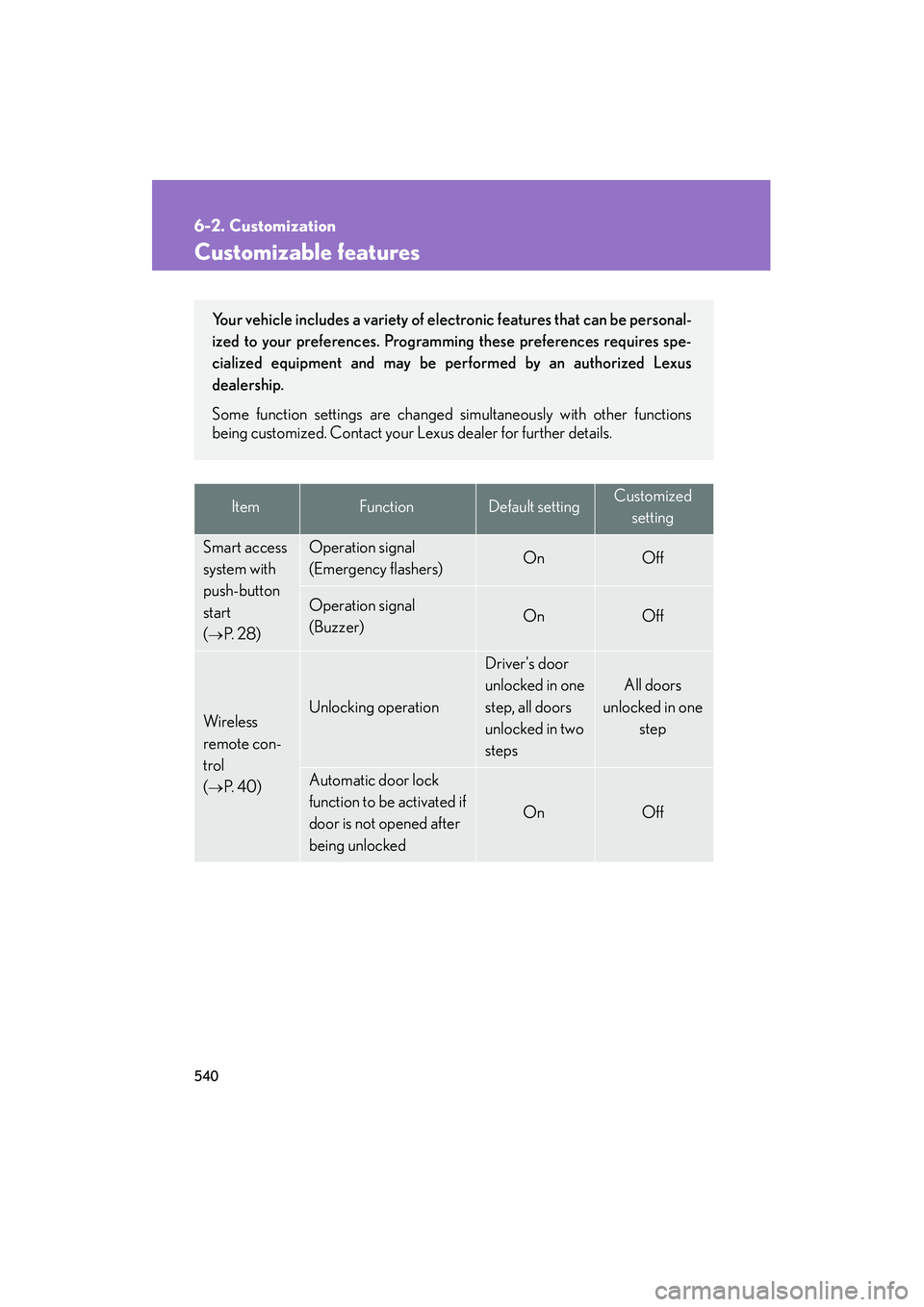
Customizable features
ItemFunctionDefault settingCustomizedsetting
Smart access
system with
push-button
start
(
→P. 2 8 )
Operation signal
(Emergency flashers)OnOff
Operation signal
(Buzzer)OnOff
Wi re le ss
remote con-
trol
(
→P. 4 0 )
Unlocking operation
Driver's door
unlocked in one
step, all doors
unlocked in two
steps
All doors
unlocked in one step
Automatic door lock
function to be activated if
door is not opened after
being unlocked
OnOff
Your vehicle includes a variety of electr onic features that can be personal-
ized to your preferences. Programming these preferences requires spe-
cialized equipment and may be performed by an authorized Lexus
dealership.
Some function settings are changed simultaneously with other functions
being customized. Contact your Lexus dealer for further details.