distance Lexus IS250 2012 User Guide
[x] Cancel search | Manufacturer: LEXUS, Model Year: 2012, Model line: IS250, Model: Lexus IS250 2012Pages: 594, PDF Size: 7.2 MB
Page 464 of 594
5
When trouble arises
463
5-1. Essential information
IS350/250_U
If your vehicle needs to be towed
Before towingThe following may indicate a problem with your transmission. Contact
your Lexus dealer before towing.
● The engine is running, but the vehicle will not move.
● The vehicle makes an abnormal sound.
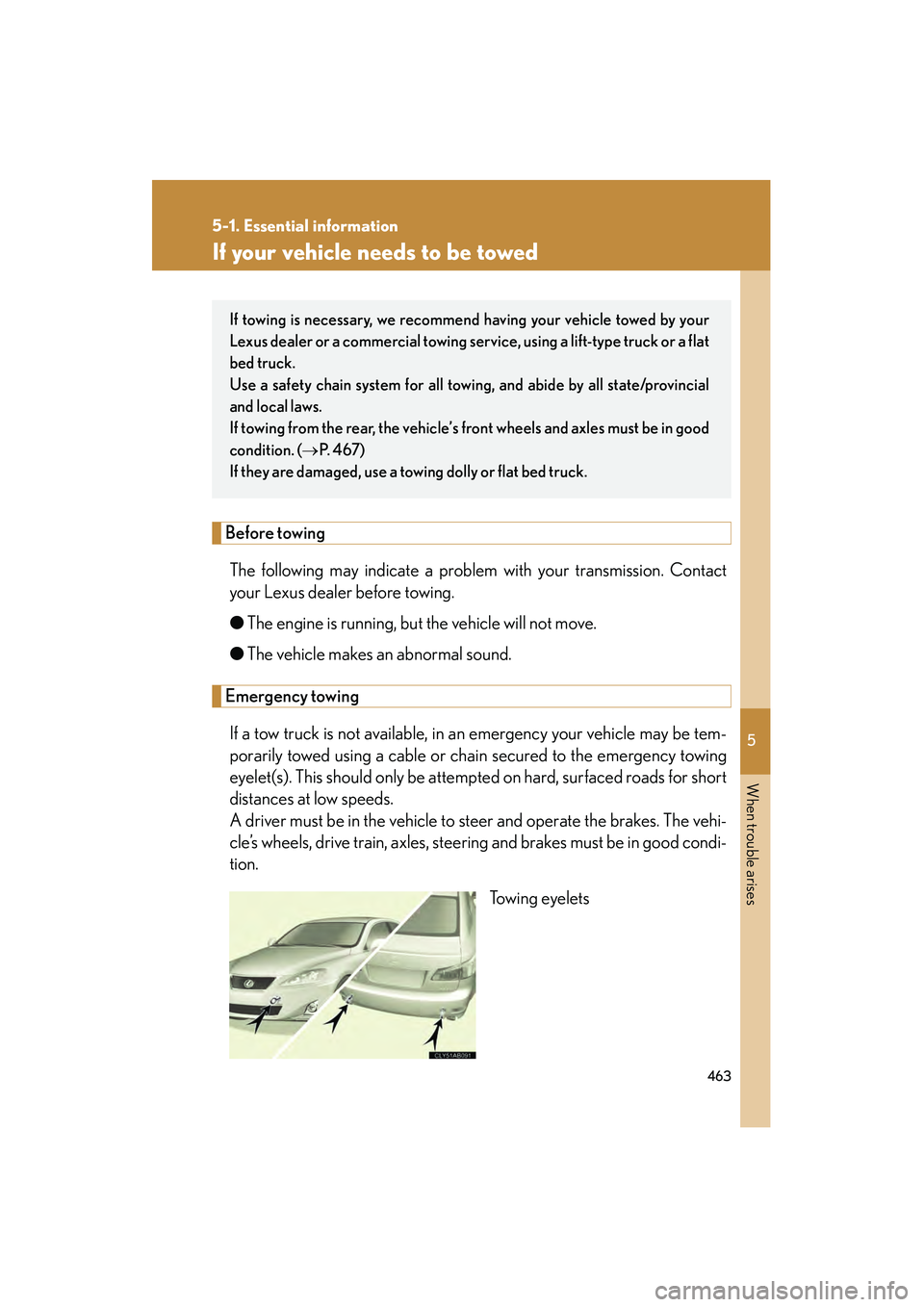
Emergency towing
If a tow truck is not available, in an emergency your vehicle may be tem-
porarily towed using a cable or chain secured to the emergency towing
eyelet(s). This should only be attempted on hard, surfaced roads for short
distances at low speeds.
A driver must be in the vehicle to steer and operate the brakes. The vehi-
cle’s wheels, drive train, axles, steering and brakes must be in good condi-
tion. Towing eyelets
If towing is necessary, we recommend having your vehicle towed by your
Lexus dealer or a commercial towing se rvice, using a lift-type truck or a flat
bed truck.
Use a safety chain system for all towing, and abide by all state/provincial
and local laws.
If towing from the rear, the vehicle’s front wheels and axles must be in good
condition. ( →P. 4 6 7 )
If they are damaged, use a towing dolly or flat bed truck.
Page 487 of 594
486
5-2. Steps to take in an emergency
IS350/250_U
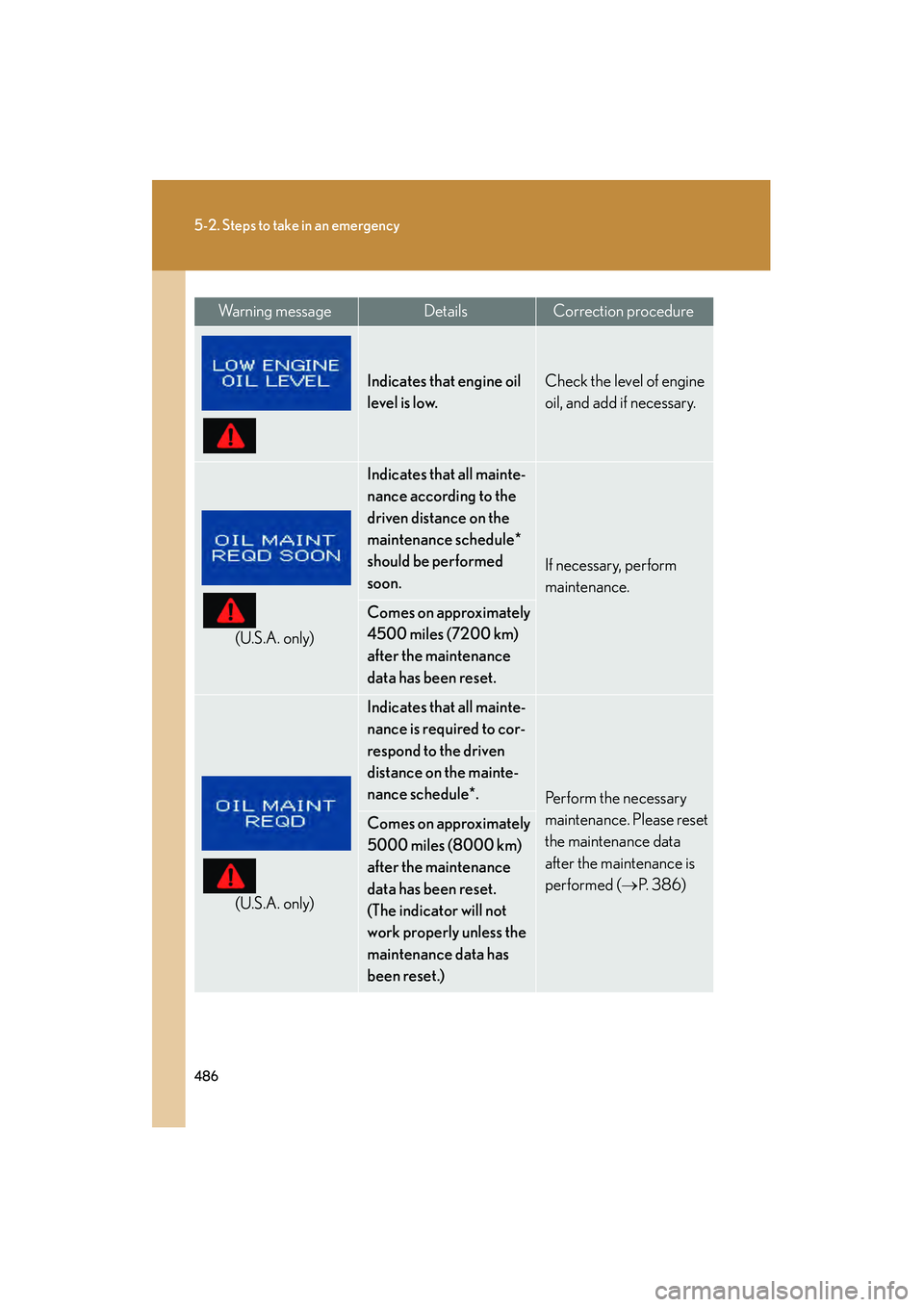
Indicates that engine oil
level is low.Check the level of engine
oil, and add if necessary.
(U.S.A. only)
Indicates that all mainte-
nance according to the
driven distance on the
maintenance schedule*
should be performed
soon.
If necessary, perform
maintenance.
Comes on approximately
4500 miles (7200 km)
after the maintenance
data has been reset.
(U.S.A. only)
Indicates that all mainte-
nance is required to cor-
respond to the driven
distance on the mainte-
nance schedule*.
Pe r f o r m t h e n e c e s s a r y
maintenance. Please reset
the maintenance data
after the maintenance is
performed (→P. 386)
Comes on approximately
5000 miles (8000 km)
after the maintenance
data has been reset.
(The indicator will not
work properly unless the
maintenance data has
been reset.)
Wa r n i n g m e s s a g eDetailsCorrection procedure
Page 501 of 594
500
5-2. Steps to take in an emergency
IS350/250_U
NOTICE
■Do not drive the vehicle with a flat tire.
Do not continue driving with a flat tire.
Driving even a short distance with a flat tire can damage the tire and the wheel
beyond repair.
■Be careful when driving over bumps with the compact spare tire installed on the
vehicle.
The vehicle becomes lower when driving with the compact spare tire compared to
when driving with standard tires. Be careful when driving over uneven road sur-
faces.
■Driving with tire chains and the compact spare tire
Do not fit tire chains to the compact spare tire.
Tire chains may damage the vehicle body and adversely affect driving performance.
■When replacing the tires
When removing or fitting the wheels, tires or the tire pressure warning valve and
transmitter, contact your Lexus dealer as the tire pressure warning valve and trans-
mitter may be damaged if not handled correctly.
■To avoid damage to the tire pressure warning valves and transmitters
When a tire is repaired with liquid sealants, the tire pressure warning valve and
transmitter may not operate properly. If a liquid sealant is used, contact your Lexus
dealer or other qualified service shop as soon as possible. Make sure to replace the
tire pressure warning valve and transmitter when replacing the tire. ( →P. 414)
Page 549 of 594
548
6-1. Specifications
IS350/250_U
Rim widthNominal distance between rim flanges
Vehicle maximum load on
the tireThe load on an individual tire that is determined by
distributing to each axle its share of the maximum
loaded vehicle weight, and dividing by two
Vehicle normal load on
the tire
The load on an individual tire that is determined by
distributing to each axle its share of curb weight,
accessory weight, and normal occupant weight (dis-
tributed in accordance with Table 1
* below), and
dividing by two
We a t h e r s i d eThe surface area of the rim not covered by the
inflated tire
Tire related termMeaning
Page 551 of 594
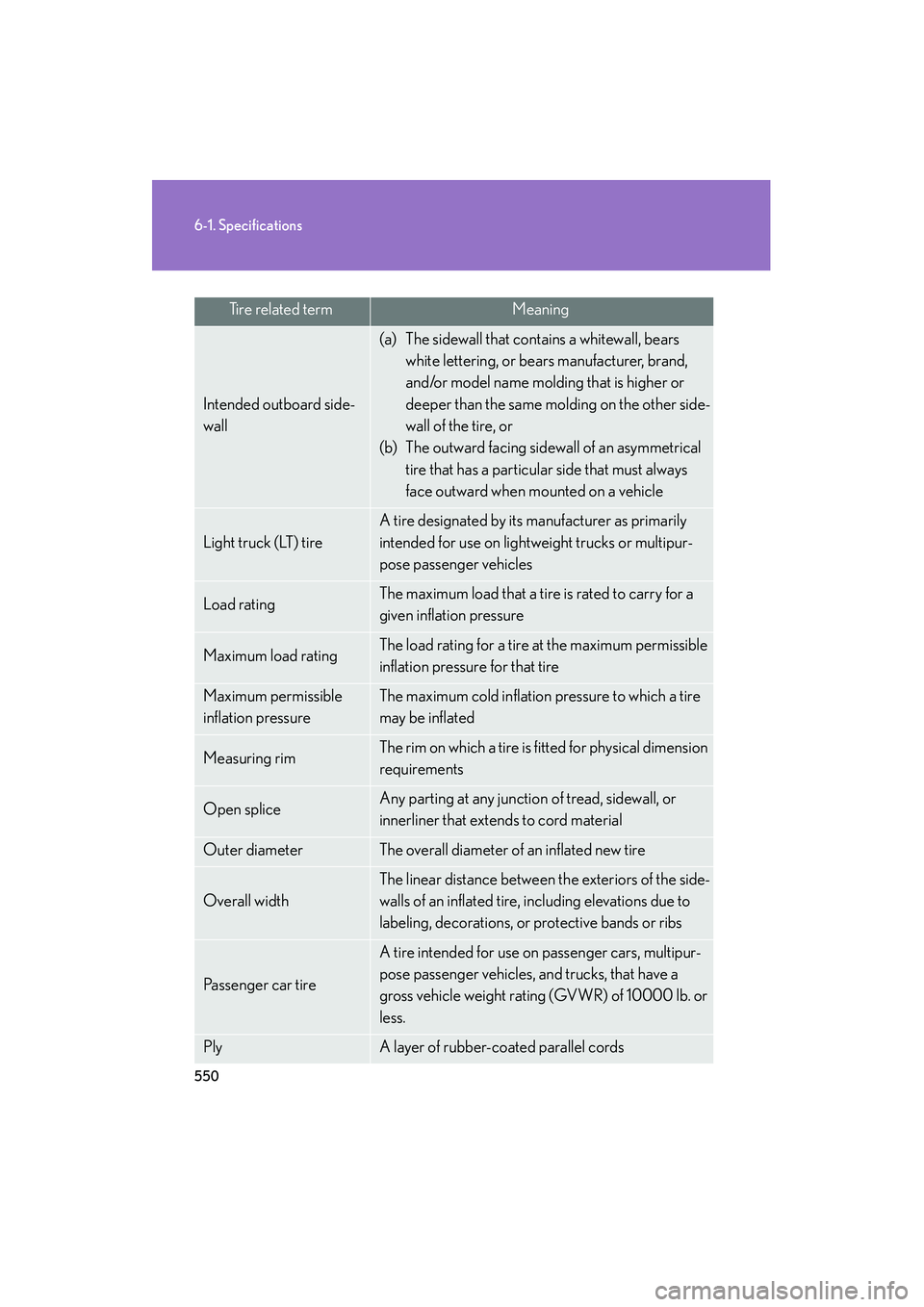
550
6-1. Specifications
IS350/250_U
Intended outboard side-
wall
(a) The sidewall that contains a whitewall, bears
white lettering, or bears manufacturer, brand,
and/or model name molding that is higher or
deeper than the same molding on the other side-
wall of the tire, or
(b) The outward facing sidewall of an asymmetrical
tire that has a particular side that must always
face outward when mounted on a vehicle
Light truck (LT) tire
A tire designated by its manufacturer as primarily
intended for use on lightweight trucks or multipur-
pose passenger vehicles
Load ratingThe maximum load that a tire is rated to carry for a
given inflation pressure
Maximum load ratingThe load rating for a tire at the maximum permissible
inflation pressure for that tire
Maximum permissible
inflation pressureThe maximum cold inflation pressure to which a tire
may be inflated
Measuring rimThe rim on which a tire is fitted for physical dimension
requirements
Open spliceAny parting at any junction of tread, sidewall, or
innerliner that extends to cord material
Outer diameterThe overall diameter of an inflated new tire
Overall width
The linear distance between the exteriors of the side-
walls of an inflated tire, including elevations due to
labeling, decorations, or protective bands or ribs
Passenger car tire
A tire intended for use on passenger cars, multipur-
pose passenger vehicles, and trucks, that have a
gross vehicle weight rating (GVWR) of 10000 lb. or
less.
PlyA layer of rubber-coated parallel cords
Tire related termMeaning
Page 552 of 594

551
6-1. Specifications
6
Vehicle specifications
IS350/250_U
Ply separationA parting of rubber compound between adjacent
plies
Pneumatic tire
A mechanical device made of rubber, chemicals, fab-
ric and steel or other materials, that, when mounted
on an automotive wheel, provides the traction and
contains the gas or fluid that sustains the load
Radial ply tire
A pneumatic tire in which the ply cords that extend to
the beads are laid at substantially 90 degrees to the
centerline of the tread
Reinforced tire
A tire designed to operate at higher loads and at
higher inflation pressures than the corresponding
standard tire
Section width
The linear distance between the exteriors of the side-
walls of an inflated tire, excluding elevations due to
labeling, decoration, or protective bands
SidewallThat portion of a tire between the tread and bead
Sidewall separationThe parting of the rubber compound from the cord
material in the sidewall
Snow tire
A tire that attains a traction index equal to or greater
than 110, compared to the ASTM E-1136 Standard
Reference Test Tire, when using the snow traction test
as described in ASTM F-1805-00, Standard Test
Method for Single Wheel Driving Traction in a
Straight Line on Snow-and Ice-Covered Surfaces,
and which is marked with an Alpine Symbol (
)
on at least one sidewall
Te s t r i mThe rim on which a tire is fitted for testing, and may be
any rim listed as appropriate for use with that tire
Tr e a dThat portion of a tire that comes into contact with the
road
Tire related termMeaning
Page 558 of 594

557
6-2. Customization
6
Vehicle specifications
IS350/250_U
Windshield
wipers and
washer
(
→P. 1 7 8 )
Switching operation when
the vehicle is stationaryOnOff
Drip prevention functionOnOff
Time elapsed before the
drip prevention function
operatesVa r i a b l e
depending on
the vehicle
speed
3 seconds
Intuitive park-
ing assist
(
→P. 1 9 0 )
Back sensor operation
display and buzzerOnOff
Buzzer volumeLevel 3Level 1 to 5
Distance which a sensor
detects4.9 ft. (150 cm)2.0 ft. (60 cm)
Illumination
(
→P. 3 2 5 )
Time elapsed before lights
turn off15 seconds7. 5 s e c o n d s
30 seconds
Operation when the
doors are unlockedOnOff
Operation after the
“ENGINE START STOP”
switch is turned OFF
OnOff
Front footwell lightsOnOff
Shift lever lightOnOff
Outer foot lightOnOff
Seat belt
reminder
(
→P. 4 7 3 )
Vehicle speed linked seat
belt reminder buzzerOnOff
ItemFunctionDefault settingCustomizedsetting
Page 570 of 594

569
7
IS350/250_U
For owners
ATTENTION
■Précautions avec les sacs de sécurité gonflables SRS
Respectez les précautions suivantes avec les sacs de sécurité gonflables.
À défaut, des blessures graves, voire mortelles, pourraient s'ensuivre.
●Le conducteur et tous les passagers à bord du véhicule doivent porter leur
ceinture de sécurité correctement.
Les sacs de sécurité gonflables SRS sont des dispositifs de protection
complémentaires aux ceintures de sécurité.
●Le sac de sécurité gonflable SRS conducteur se déploie avec une violence
considérable, qui peut être très dangereuse voire mortelle si le conducteur se
trouve très près du sac de sécurité gonflable. L'autorité fédérale chargée de la
sécurité routière aux États-Unis, la NHTSA (National Highway Traffic Safety
Administration) conseille:
La zone à risque du sac de sécurité gonflable conducteur se situant dans les
premiers 2 à 3 in. (50 - 75 mm) de déploiement, vous disposez d'une marge de
sécurité confortable en vous plaçant à 10 in. (250 mm) de votre sac de sécurité
gonflable conducteur. Cette distance est à mesurer entre le moyeu du volant de
direction et le sternum. Si vous êtes assis à moins de 10 in. (250 mm), vous
pouvez changer votre position de conduite de plusieurs façons:
Reculez votre siège le plus possible, tout en continuant à pouvoir atteindreconfortablement les pédales.
Inclinez légèrement le dossier du siège. Bien que les véhicules puissent être différents les uns des autres, la plupart
des conducteurs peuvent s'asseoir à une distance de 10 in. (250 mm), même
avec le siège conducteur complètement avancé, simplement en inclinant un
peu le dossier de siège. Si vous avez des difficultés à voir la route après avoir
incliné votre siège, utilisez un coussin ferme et antidérapant pour vous
rehausser ou, si votre véhicule est équipé du réglage en hauteur du siège,
remontez-le.
Si votre volant de direction est réglable, inclinez-le vers le bas. Cela a pour effet d'orienter le sac de sécurité gonflable en direction de votre poitrine
plutôt que de votre tête et de votre cou.
Réglez votre siège selon ces recommandations de la NHTSA, tout en conservant le
contrôle des pédales, du volant de direction et la vue des commandes du tableau
de bord.