Drive Lexus IS250 2014 Owner's Manual
[x] Cancel search | Manufacturer: LEXUS, Model Year: 2014, Model line: IS250, Model: Lexus IS250 2014Pages: 588, PDF Size: 98.77 MB
Page 516 of 588
5168-2. Steps to take in an emergency
IS250_EE(OM53C51E)
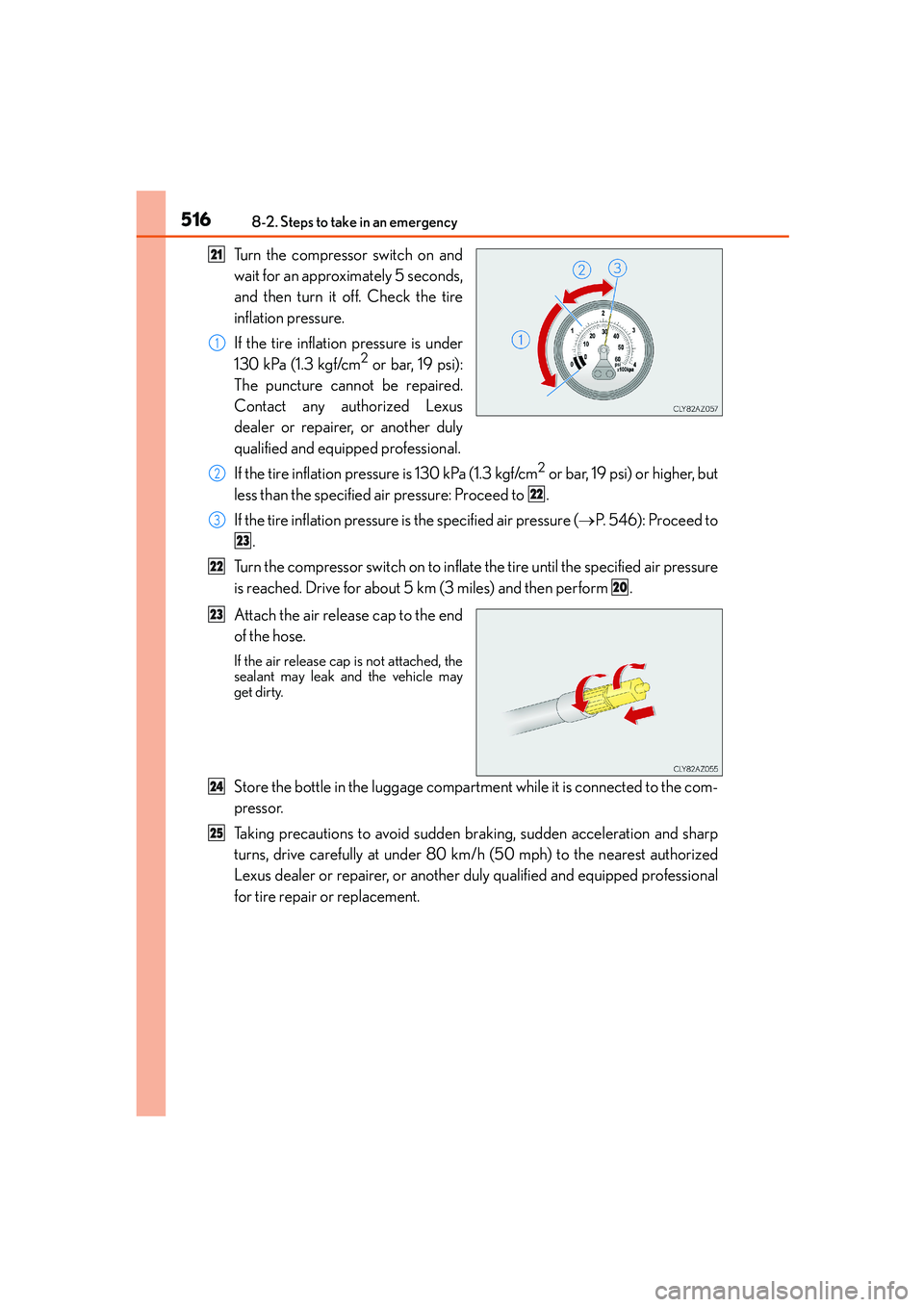
Turn the compressor switch on and
wait for an approximately 5 seconds,
and then turn it off. Check the tire
inflation pressure.
If the tire inflation pressure is under
130 kPa (1.3 kgf/cm
2 or bar, 19 psi):
The puncture cannot be repaired.
Contact any authorized Lexus
dealer or repairer, or another duly
qualified and equipped professional.
If the tire inflation pressure is 130 kPa (1.3 kgf/cm
2 or bar, 19 psi) or higher, but
less than the specified air pressure: Proceed to .
If the tire inflation pressure is the specified air pressure (→P. 5 4 6 ) : P r o c e e d t o
.
Turn the compressor switch on to inflate the tire until the specified air pressure
is reached. Drive for about 5 km (3 miles) and then perform .
Attach the air release cap to the end
of the hose.
If the air release cap is not attached, the
sealant may leak and the vehicle may
get dirty.
Store the bottle in the luggage compartment while it is connected to the com-
pressor.
Taking precautions to avoid sudden braking, sudden acceleration and sharp
turns, drive carefully at under 80 km/h (50 mph) to the nearest authorized
Lexus dealer or repairer, or another duly qualified and equipped professional
for tire repair or replacement.
21
1
2
22
3
23
22
20
23
24
25
Page 519 of 588
5198-2. Steps to take in an emergency
8
When trouble arises
IS250_EE(OM53C51E)
CAUTION
■When fixing the flat tire
●Stop your vehicle in a safe and flat area.
●Do not touch the wheels or the area around the brakes immediately after the vehicle
has been driven.
After the vehicle has been driven, the wheels and the area around the brakes may be
extremely hot. Touching these areas with hands, feet or other body parts may result in
burns.
●Connect the valve and hose securely with the tire installed on the vehicle.
●If the hose is not properly connected to the valve, air leakage may occur or sealant
may be sprayed out.
●If the hose comes off the valve while inflating the tire, there is a risk that the hose will
move abruptly due to air pressure.
●After inflation of the tire has completed, the sealant may splatter when the hose is dis-
connected or some air is let out of the tire.
●Follow the operation procedure to repair the tire. If the procedure is not followed, the
sealant may spray out.
●Keep back from the tire while it is being repaired, as there is a chance of it bursting
while the repair operation is being performed. If you notice any cracks or deforma-
tion of the tire, turn off the compressor switch and stop the repair operation immedi-
ately.
●The kit may overheat if operated for a long period of time. Do not operate the com-
pressor continuously for more than 10 minutes.
●Parts of the kit become hot during operation. Be careful handling the kit during and
after operation.
●Do not attach the vehicle speed warning sticker to an area other than the one indi-
cated. If the sticker is attached to an area where an SRS airbag is located, such as the
pad of the steering wheel, it may prevent the SRS air bag from operating properly.
■Driving to spread the liquid sealant evenly
●Drive the vehicle carefully at a low speed. Be especially careful when turning and cor-
nering.
●If the vehicle does not drive straight or you feel a pull through the steering wheel, stop
the vehicle and check the following:
• Tire condition. The tire may have separated from the wheel.
• Tire inflation pressure. If tire inflation pressure is 130 kPa (1.3 kgf/cm
2 or bar, 19 psi)
or below, this may indicate severe tire damage.
Page 523 of 588
5238-2. Steps to take in an emergency
8
When trouble arises
IS250_EE(OM53C51E)
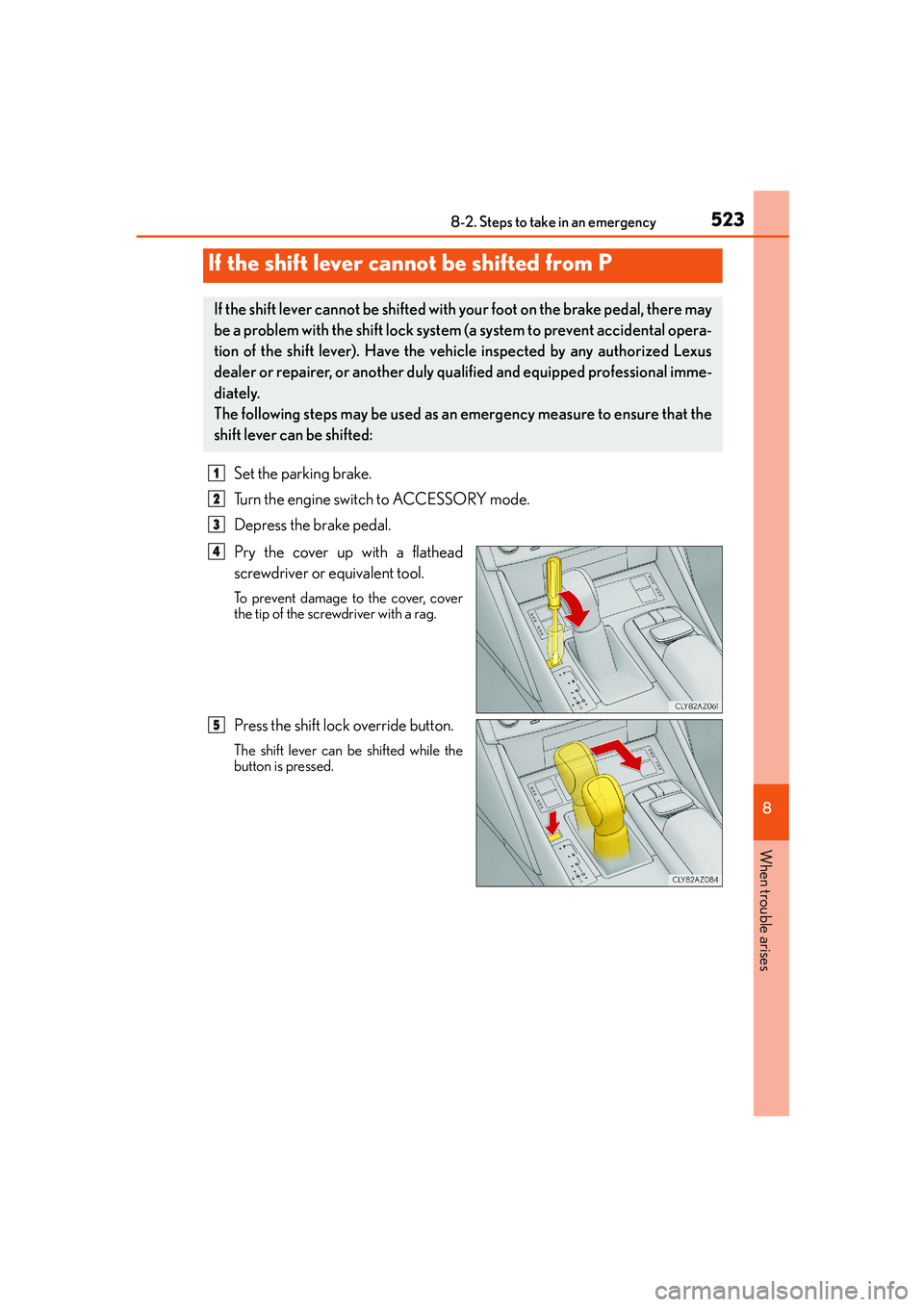
Set the parking brake.
Turn the engine switch to ACCESSORY mode.
Depress the brake pedal.
Pry the cover up with a flathead
screwdriver or equivalent tool.
To prevent damage to the cover, cover
the tip of the screwdriver with a rag.
Press the shift lock override button.
The shift lever can be shifted while the
button is pressed.
If the shift lever cannot be shifted from P
If the shift lever cannot be shifted with your foot on the brake pedal, there may
be a problem with the shift lock system (a system to prevent accidental opera-
tion of the shift lever). Have the vehicle inspected by any authorized Lexus
dealer or repairer, or another duly qualified and equipped professional imme-
diately.
The following steps may be used as an emergency measure to ensure that the
shift lever can be shifted:
1
2
3
4
5
Page 528 of 588
5288-2. Steps to take in an emergency
IS250_EE(OM53C51E)
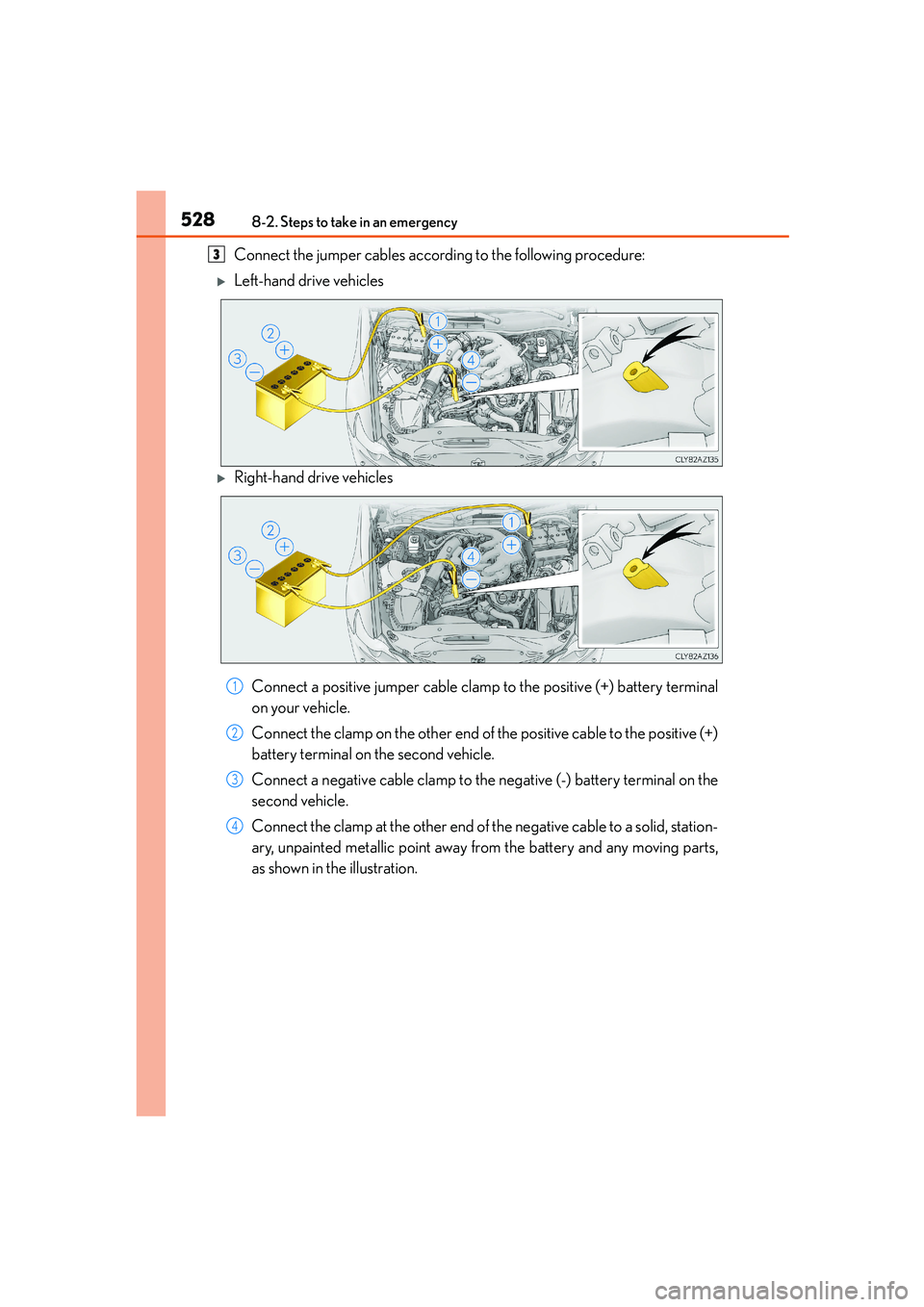
Connect the jumper cables according to the following procedure:
XLeft-hand drive vehicles
XRight-hand drive vehicles
Connect a positive jumper cable clamp to the positive (+) battery terminal
on your vehicle.
Connect the clamp on the other end of the positive cable to the positive (+)
battery terminal on the second vehicle.
Connect a negative cable clamp to the negative (-) battery terminal on the
second vehicle.
Connect the clamp at the other end of the negative cable to a solid, station-
ary, unpainted metallic point away from the battery and any moving parts,
as shown in the illustration.
3
1
2
3
4
Page 530 of 588
5308-2. Steps to take in an emergency
IS250_EE(OM53C51E)
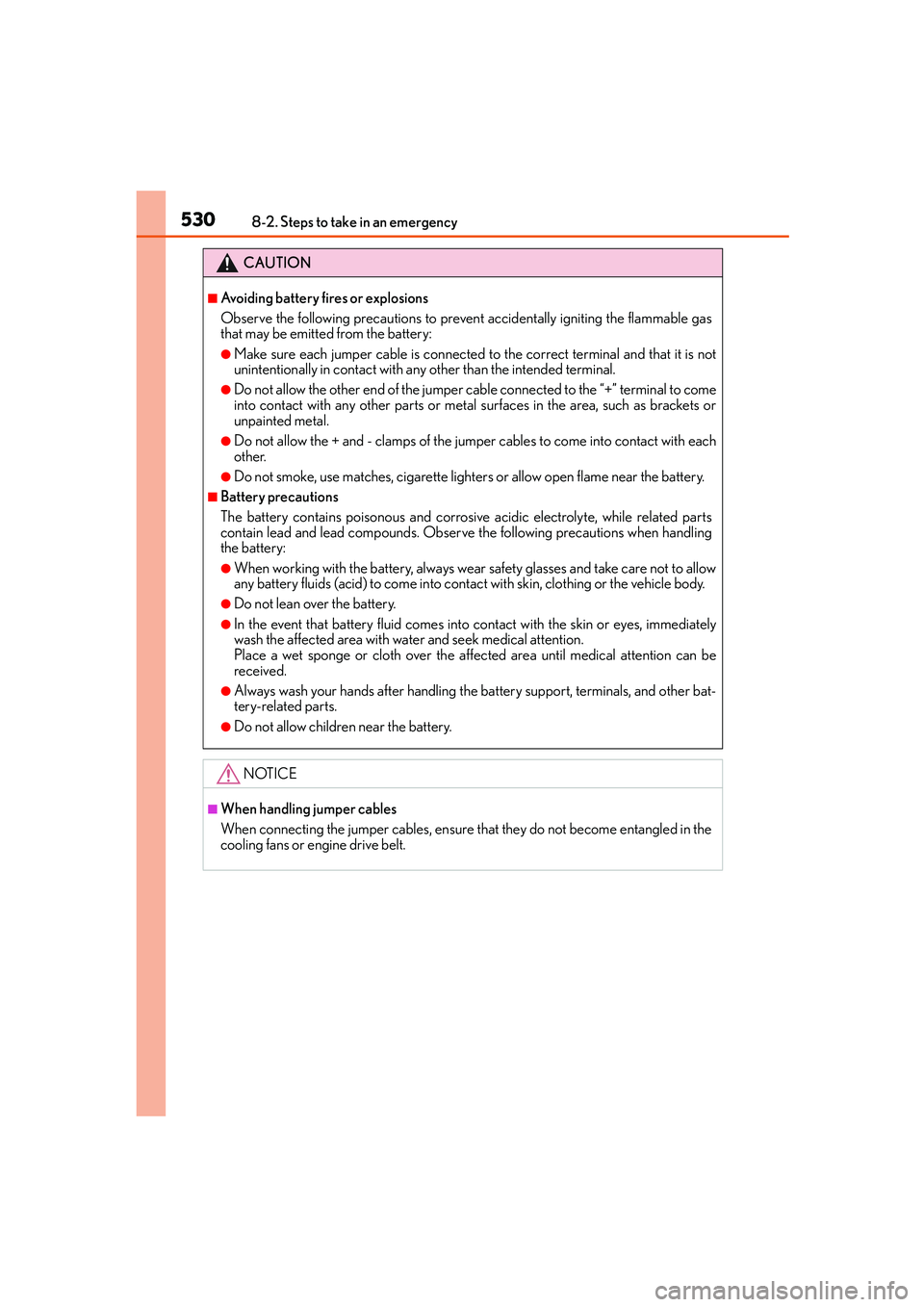
CAUTION
■Avoiding battery fires or explosions
Observe the following precautions to prevent accidentally igniting the flammable gas
that may be emitted from the battery:
●Make sure each jumper cable is connected to the correct terminal and that it is not
unintentionally in contact with any other than the intended terminal.
●Do not allow the other end of the jumper cable connected to the “+” terminal to come
into contact with any other parts or metal surfaces in the area, such as brackets or
unpainted metal.
●Do not allow the + and - clamps of the jumper cables to come into contact with each
other.
●Do not smoke, use matches, cigarette lighters or allow open flame near the battery.
■Battery precautions
The battery contains poisonous and corrosive acidic electrolyte, while related parts
contain lead and lead compounds. Observe the following precautions when handling
the battery:
●When working with the battery, always wear safety glasses and take care not to allow
any battery fluids (acid) to come into contact with skin, clothing or the vehicle body.
●Do not lean over the battery.
●In the event that battery fluid comes into contact with the skin or eyes, immediately
wash the affected area with water and seek medical attention.
Place a wet sponge or cloth over the affected area until medical attention can be
received.
●Always wash your hands after handling the battery support, terminals, and other bat-
tery-related parts.
●Do not allow children near the battery.
NOTICE
■When handling jumper cables
When connecting the jumper cables, ensure that they do not become entangled in the
cooling fans or engine drive belt.
Page 540 of 588
5409-1. Specifications
IS250_EE(OM53C51E)
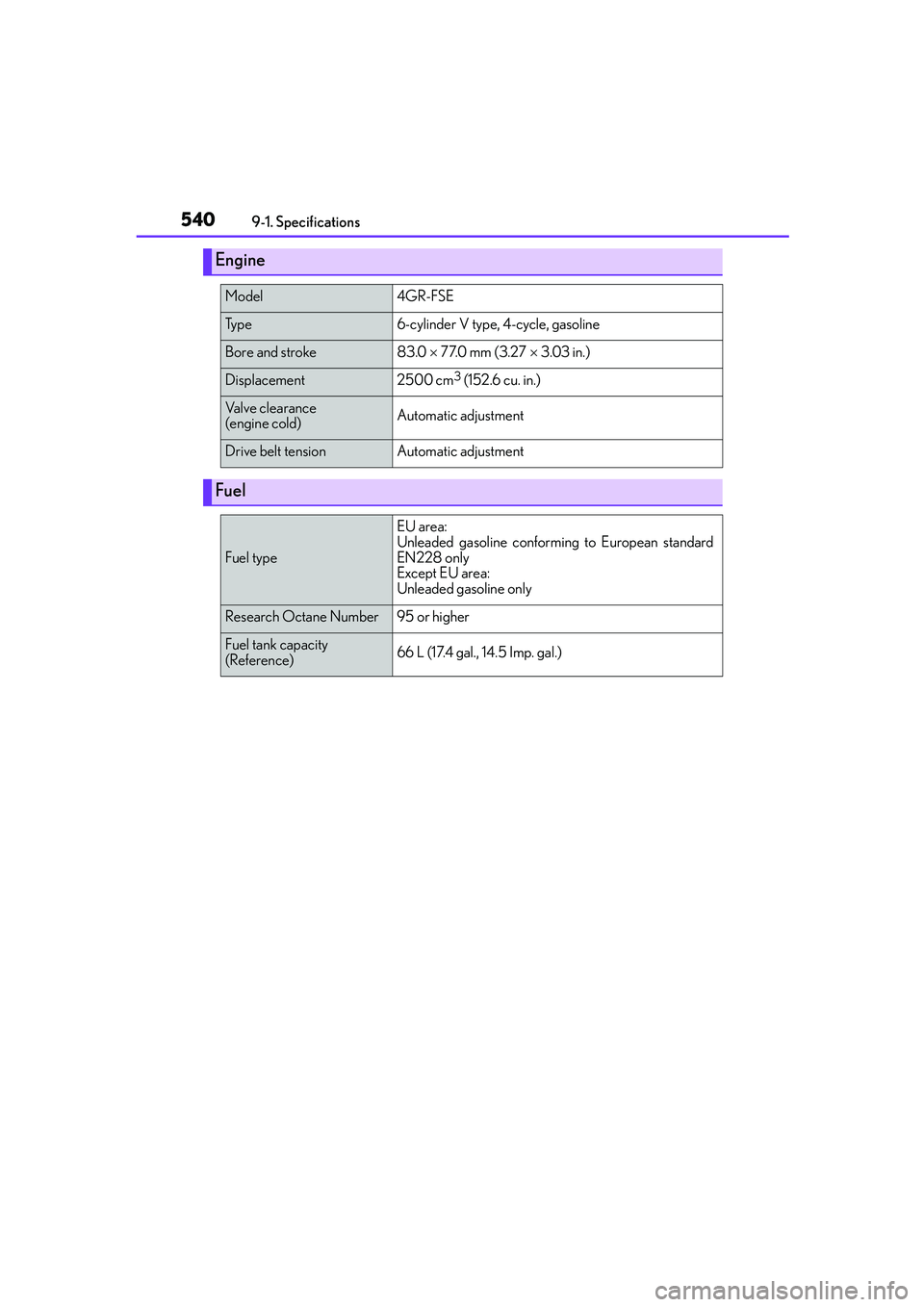
Engine
Model4GR-FSE
Ty p e6-cylinder V type, 4-cycle, gasoline
Bore and stroke83.0 × 77.0 mm (3.27 × 3.03 in.)
Displacement2500 cm3 (152.6 cu. in.)
Va l v e c l e a r a n c e
(engine cold)Automatic adjustment
Drive belt tensionAutomatic adjustment
Fuel
Fuel type
EU area:
Unleaded gasoline conforming to European standard
EN228 only
Except EU area:
Unleaded gasoline only
Research Octane Number95 or higher
Fuel tank capacity
(Reference)66 L (17.4 gal., 14.5 Imp. gal.)
Page 547 of 588
547
9 9-1. Specifications
Vehicle specifications
IS250_EE(OM53C51E)
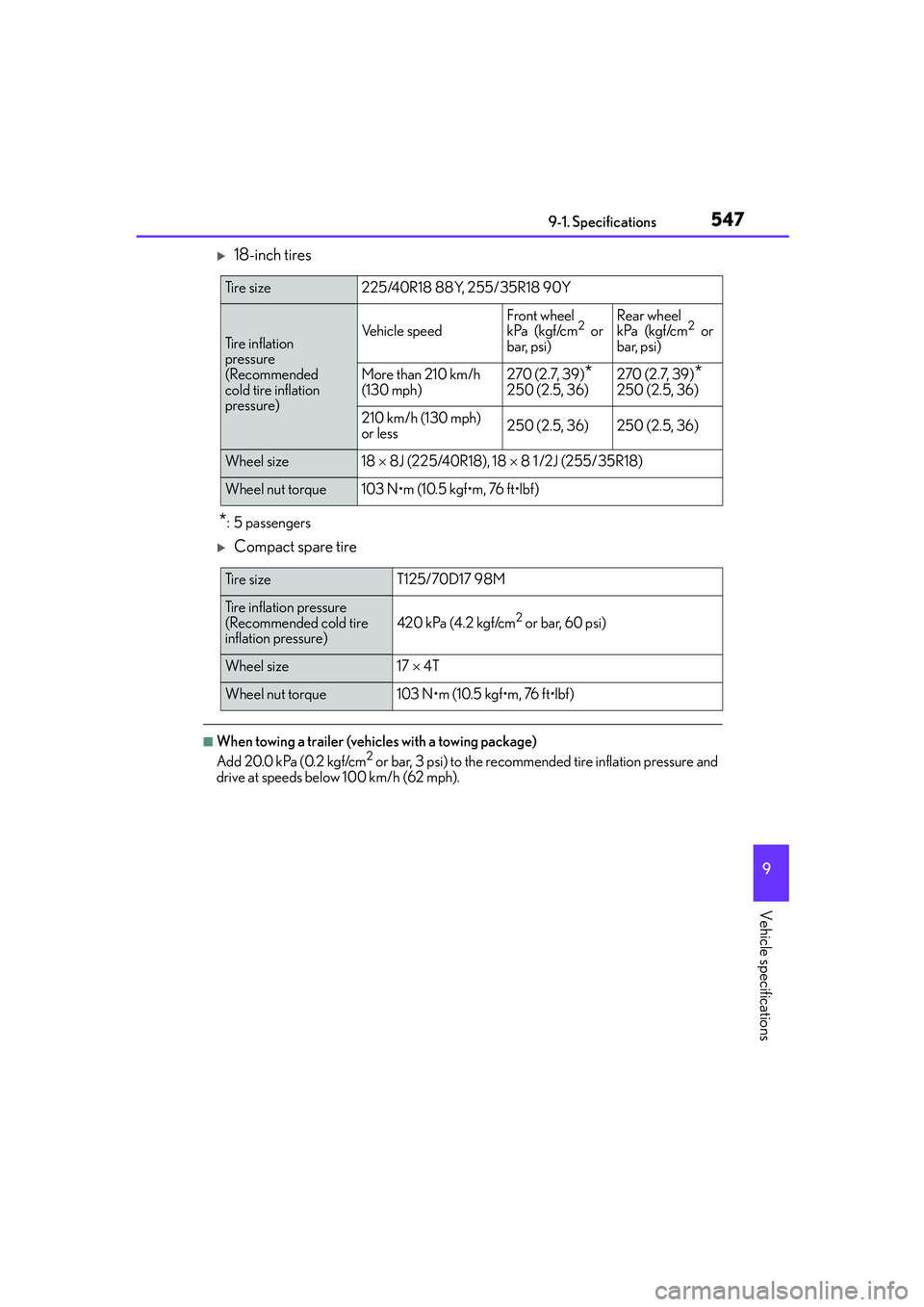
X18-inch tires
*: 5 passengers
XCompact spare tire
■When towing a trailer (vehicles with a towing package)
Add 20.0 kPa (0.2 kgf/cm2 or bar, 3 psi) to the recommended tire inflation pressure and
drive at speeds below 100 km/h (62 mph).
Ti r e s i z e225/40R18 88Y, 255/35R18 90Y
Tire inflation
pressure
(Recommended
cold tire inflation
pressure)Vehicle speedFront wheel
kPa (kgf/cm2 or
bar, psi)Rear wheel
kPa (kgf/cm2 or
bar, psi)
More than 210 km/h
(130 mph)270 (2.7, 39)*250 (2.5, 36)270 (2.7, 39)*250 (2.5, 36)
210 km/h (130 mph)
or less250 (2.5, 36)250 (2.5, 36)
Wheel size18 × 8J (225/40R18), 18 × 8 1 /2J (255/35R18)
Wheel nut torque103 N•m (10.5 kgf•m, 76 ft•lbf)
Ti r e s i z eT125/70D17 98M
Tire inflation pressure
(Recommended cold tire
inflation pressure)420 kPa (4.2 kgf/cm2 or bar, 60 psi)
Wheel size17 × 4T
Wheel nut torque103 N•m (10.5 kgf•m, 76 ft•lbf)
Page 552 of 588

5529-2. Customization
IS250_EE(OM53C51E)
Some function settings are changed simultaneously with other functions being
customized. Contact any authorized Lexus dealer or repairer, or another duly
qualified and equipped professional.
Settings that can be changed using the Remote Touch or Lexus Display Audio
controller
Settings that can be changed using the meter control switches
Settings that can be changed by any authorized Lexus dealer or repairer, or
another duly qualified and equipped professional
Definition of symbols: O = Available, — = Not available
■Gauges, meters and multi-information display (→P. 9 0 , 9 5 , 1 0 0 )
Customizable features
1
2
3
Function*1Default settingCustomized setting
Language*2English
French
—O—
German
Spanish
Italian
Russian
Units*2km (L/100 km)km (km/L)—O—miles (MPG)
Eco Driving Indicator LightON
(Self-lighting)OFF—O—
switch settings*3Drive
information 1Desired status
screen
*4—O—
Drive information 1
Current fuel
economy
*5—O—Average fuel
economy
(after reset)
Drive information 2
Distance
(range)
*5—O—Average speed
(after reset)
Pop-up displayONOFF—O—
123
Page 554 of 588

5549-2. Customization
IS250_EE(OM53C51E)
■Door lock (→P. 118, 125, 524)
■Smart entry & start system and wireless remote control (→P. 118, 125)
FunctionDefault settingCustomized setting
Unlocking using a mechanical
keyAll doors
unlocked in
one stepDriver’s door
unlocked in one
step, all doors
unlocked in two
steps
——O
Speed-detecting automatic door
lock functionOnOffO—O
Shifting gears to position other
than P locks all doorsOffOnO—O
Shifting gears to P unlocks all
doorsOffOnO—O
Opening driver's door unlocks
all doorsOnOffO—O
Locking/unlocking of the trunk
when all doors are locked/
unlocked
OnOff——O
123
FunctionDefault settingCustomized setting
Operation signal
(Emergency flashers)OnOffO—O
Time elapsed before automatic
door lock function is activated if
door is not opened after being
unlocked
30 seconds
60 seconds
——O120 seconds
Open door warning buzzerOnOff——O
123
Page 555 of 588
555
9 9-2. Customization
Vehicle specifications
IS250_EE(OM53C51E)
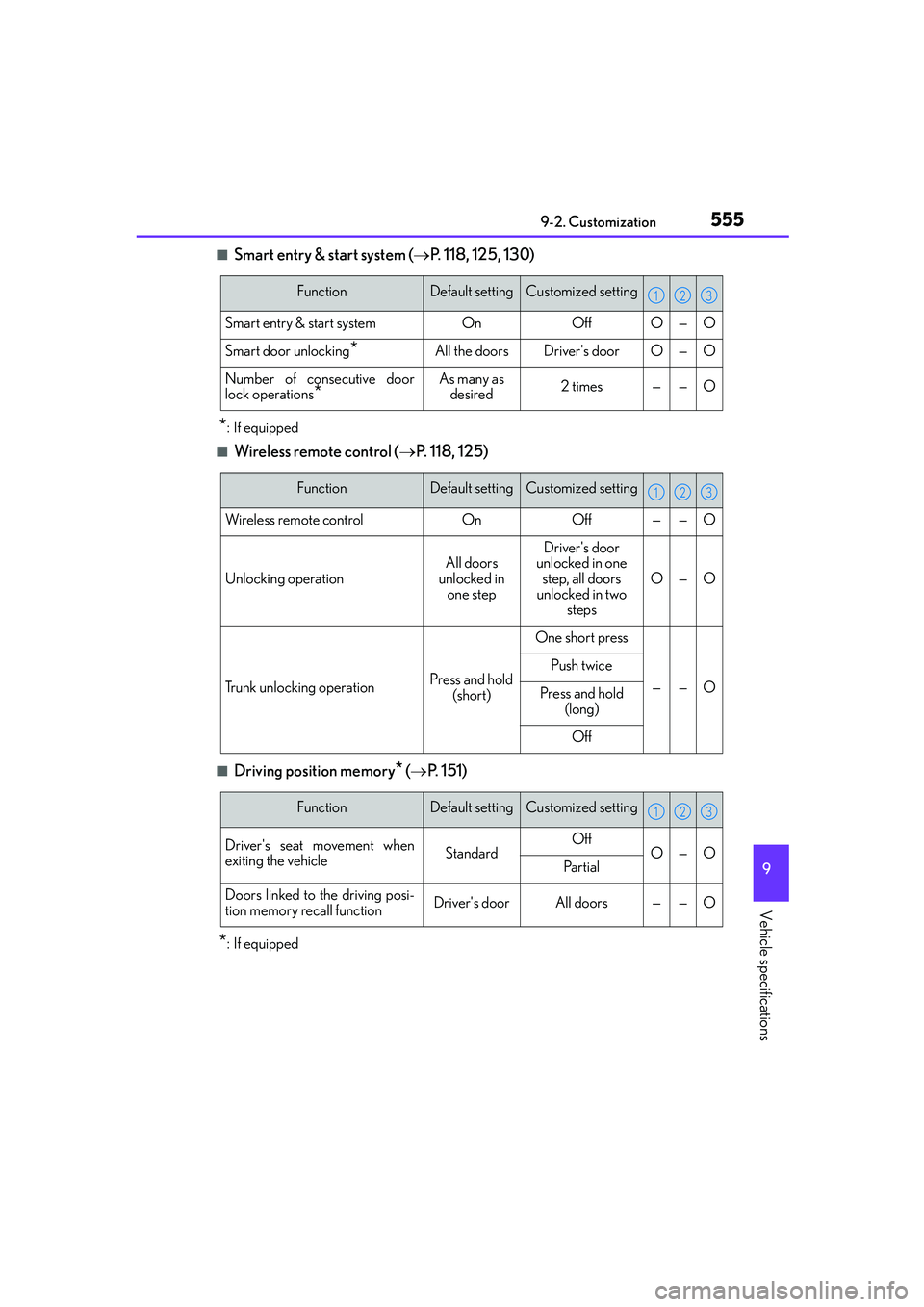
■Smart entry & start system (→P. 118, 125, 130)
*: If equipped
■Wireless remote control (→P. 118, 125)
■Driving position memory* (→P. 1 5 1 )
*: If equipped
FunctionDefault settingCustomized setting
Smart entry & start systemOnOffO—O
Smart door unlocking*All the doorsDriver's doorO—O
Number of consecutive door
lock operations*As many as
desired2 times——O
123
FunctionDefault settingCustomized setting
Wireless remote controlOnOff——O
Unlocking operation
All doors
unlocked in
one stepDriver's door
unlocked in one
step, all doors
unlocked in two
steps
O—O
Trunk unlocking operationPress and hold
(short)
One short press
——O
Push twice
Press and hold
(long)
Off
123
FunctionDefault settingCustomized setting
Driver's seat movement when
exiting the vehicleStandardOffO—OPa r t i a l
Doors linked to the driving posi-
tion memory recall functionDriver's doorAll doors——O
123