spare wheel Lexus IS250 2014 Owner's Manual
[x] Cancel search | Manufacturer: LEXUS, Model Year: 2014, Model line: IS250, Model: Lexus IS250 2014Pages: 588, PDF Size: 98.77 MB
Page 6 of 588
TABLE OF CONTENTS6
IS250_EE(OM53C51E)
7-1. Maintenance and care
Cleaning and protecting
the vehicle exterior .................404
Cleaning and protecting
the vehicle interior ................. 408
7-2. Maintenance
Maintenance
requirements................................ 411
7-3. Do-it-yourself maintenance
Do-it-yourself service
precautions ................................. 413
Hood ................................................ 415
Positioning a floor jack .............. 416
Engine compartment..................417
Tires .................................................. 427
Tire inflation pressure................436
Wheels........................................... 438
Air conditioning filter................440
Electronic key battery .............. 442
Checking and replacing
fuses .............................................. 445
Light bulbs ..................................... 4498-1. Essential information
Emergency flashers................... 466
If your vehicle has to
be stopped in an
emergency ................................. 467
8-2. Steps to take in an
emergency
If your vehicle needs to
be towed .....................................468
If you think something is
wrong ............................................ 474
Fuel pump shut off system ...... 475
If a warning light turns
on or a warning buzzer
sounds...........................................476
If a warning message is
displayed.....................................482
If you have a flat tire (vehicles
with a spare tire) ...................... 496
If you have a flat tire
(vehicles without a
spare tire) ................................... 507
If the engine will not start ......... 521
If the shift lever cannot
be shifted from P ..................... 523
If the electronic key does
not operate properly ............. 524
If the vehicle battery is
discharged ................................. 527
If your vehicle overheats .......... 531
If the vehicle becomes
stuck.................................................534
7Maintenance and care8When trouble arises
Page 245 of 588
2454-5. Using the driving support systems
4
Driving
IS250_EE(OM53C51E)
●When sunlight or the headlights of oncoming vehicles are shining directly into the cam-
era lens
●When driving on roads that are branching or merging
●When driving on a road surface that is wet due to rain, previous rainfall, standing water,
etc.
●When the vehicle experiences strong up-and-down motion such as when driving on an
extremely rough road or on a seam in the pavement
●When headlight brightness at nighttime is reduced due to dirt on the lenses, or when
the headlights are misaligned
●When driving on winding roads or roads that are uneven
●When driving on rough or unpaved roads
■When changing the tires
Depending on the tires used, sufficient performance may not be maintainable.
■Warning messages for the LDA system
Warning messages are used to indicate a system malfunction or to inform the driver of
the need for caution while driving. (→P. 4 8 6 )
CAUTION
■Before using the LDA system
Do not rely solely on the LDA system. The LDA system does not drive the vehicle auto-
matically, nor does it reduce the amount of care you need to take. As such, the driver
must always assume full responsibility for understanding his/her surroundings, for
operating the steering wheel to correct the driving line, and for driving safely.
Inappropriate or negligent driving could lead to an accident.
■To avoid operating the LDA by mistake
Switch the LDA system off using the LDA switch when not in use.
■Situations unsuitable for LDA system
Do not use the LDA system in any of the following situations.
Otherwise, the system may not function correctly and could result in an accident.
●When driving with tire chains, a spare tire, or similar equipment
●When there are objects or structures along the roadside that might be misinterpreted
as lane markers (such as guardrails, a curb, reflector posts, etc.)
●When driving on snowy roads
●When pavement lane markers are difficult to see due to rain, snow, fog, sand dust etc.
●When there are visible lines on the pavement from road repairs, or if the remains of
old lane markers are still visible on the road
●When driving on a road with lane closures due to maintenance, or when driving in a
temporary lane
Page 261 of 588
2614-5. Using the driving support systems
4
Driving
IS250_EE(OM53C51E)
CAUTION
■When using the rear view monitor system
The rear view monitor system is a supplemental device intended to assist the driver
when backing up. When backing up, be sure to check visually behind and all around
the vehicle before proceeding.
Observe the following precautions to avoid an accident that could result in death or
serious injuries.
●Never depend on the rear view monitor system entirely when backing up. The image
and the position of the guide lines displayed on the screen may differ from the actual
state.
Use caution, just as you would when backing up any vehicle.
●Be sure to back up slowly, depressing the brake pedal to control vehicle speed.
●The instructions given are only guidelines.
When and how much to turn the steering wheel will vary according to traffic condi-
tions, road surface conditions, vehicle condition, etc. when parking. It is necessary to
be fully aware of this before using the rear view monitor system.
●When parking, be sure to check that the parking space will accommodate your vehi-
cle before maneuvering into it.
●Do not use the rear view monitor system in the following cases:
• On icy or slick road surfaces, or in snow
• When using tire chains or the compact spare tire
• When the trunk lid is not closed completely
• On roads that are not flat or straight, such as curves or slopes.
●In low temperatures, the screen may darken or the image may become faint. The
image could distort when the vehicle is moving, or you may become unable to see the
image on the screen. Be sure to check direct visually and with the mirrors all around
the vehicle before proceeding.
●If the tire sizes are changed, the position of the fixed guide lines displayed on the
screen may change.
●The camera uses a special lens. The distances between objects and pedestrians that
appear in the image displayed on the screen will differ from the actual distances.
(→P. 2 5 6 )
Page 480 of 588

4808-2. Steps to take in an emergency
IS250_EE(OM53C51E)
■If the tire pressure warning light frequently comes on after blinking for 1 minute (if
equipped)
If the tire pressure warning light frequently comes on after blinking for 1 minute when the
engine switch is turned to IGNITION ON mode, have it checked by any authorized
Lexus dealer or repairer, or another duly qualified and equipped professional.
■Warning buzzer
In some cases, the buzzer may not be heard due to being in a noisy location or audio
sound.
CAUTION
■If both the ABS and the brake system warning lights remain on
Stop your vehicle in a safe place immediately and contact any authorized Lexus dealer
or repairer, or another duly qualified and equipped professional. The vehicle will
become extremely unstable during braking, and the ABS system may fail, which could
cause an accident resulting in death or serious injury.
■When the electric power steering system warning light comes on
The steering wheel may become extremely heavy.
If the steering wheel becomes heavier than usual when operating, hold firmly and oper-
ate using more force than usual.
■If the tire pressure warning light comes on (if equipped)
Be sure to observe the following precautions. Failure to do so could cause a loss of
vehicle control and result in death or serious injury.
XVehicles with a compact spare tire
●Stop your vehicle in a safe place as soon as possible. Adjust the tire inflation pressure
immediately.
●If the tire pressure warning light comes on even after tire inflation pressure adjust-
ment, it is probable that you have a flat tire. Check the tires. If a tire is flat, change it
with the spare tire and have the flat tire repaired by the nearest authorized Lexus
dealer or repairer, or another duly qualified and equipped professional.
●Avoid abrupt maneuvering and braking. If the vehicle tires deteriorate, you could lose
control of the steering wheel or the brakes.
XVehicles with an emergency tire puncture repair kit
●Stop your vehicle in a safe place as soon as possible. Adjust the tire inflation pressure
immediately.
●If the tire pressure warning light comes on even after tire inflation pressure adjust-
ment, it is probable that you have a flat tire. Check the tires. If a tire is flat, repair the
flat tire by using emergency tire puncture repair kit.
●Avoid abrupt maneuvering and braking. If the vehicle tires deteriorate, you could lose
control of the steering wheel or the brakes.
■If a blowout or sudden air leakage should occur
The tire pressure warning system may not activate immediately.
Page 496 of 588
4968-2. Steps to take in an emergency
IS250_EE(OM53C51E)
●Stop the vehicle on a hard, flat surface.
●Set the parking brake.
●Shift the shift lever to P.
●Stop the engine.
●Turn on the emergency flashers. (→P. 466)
If you have a flat tire (vehicles with a spare tire)
Your vehicle is equipped with a spare tire. The flat tire can be replaced with
the spare tire.
For details about tires: →P. 4 2 7
CAUTION
■If you have a flat tire
Do not continue driving with a flat tire.
Driving even a short distance with a flat tire can damage the tire and the wheel beyond
repair, which could result in an accident.
Before jacking up the vehicle
Page 497 of 588
4978-2. Steps to take in an emergency
8
When trouble arises
IS250_EE(OM53C51E)
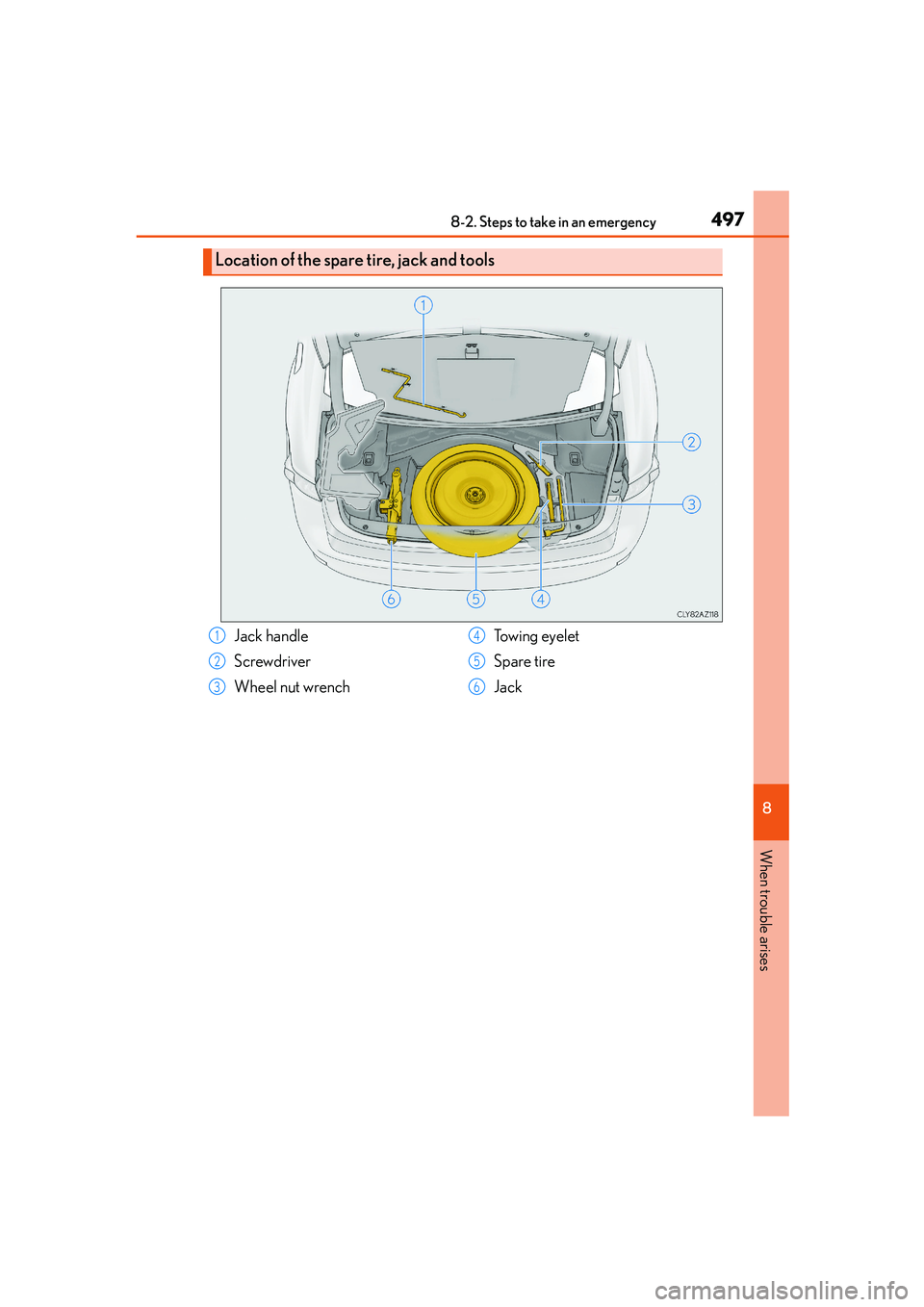
Location of the spare tire, jack and tools
Jack handle
Screwdriver
Wheel nut wrenchTowing eyelet
Spare tire
Jack1
2
3
4
5
6
Page 500 of 588
5008-2. Steps to take in an emergency
IS250_EE(OM53C51E)
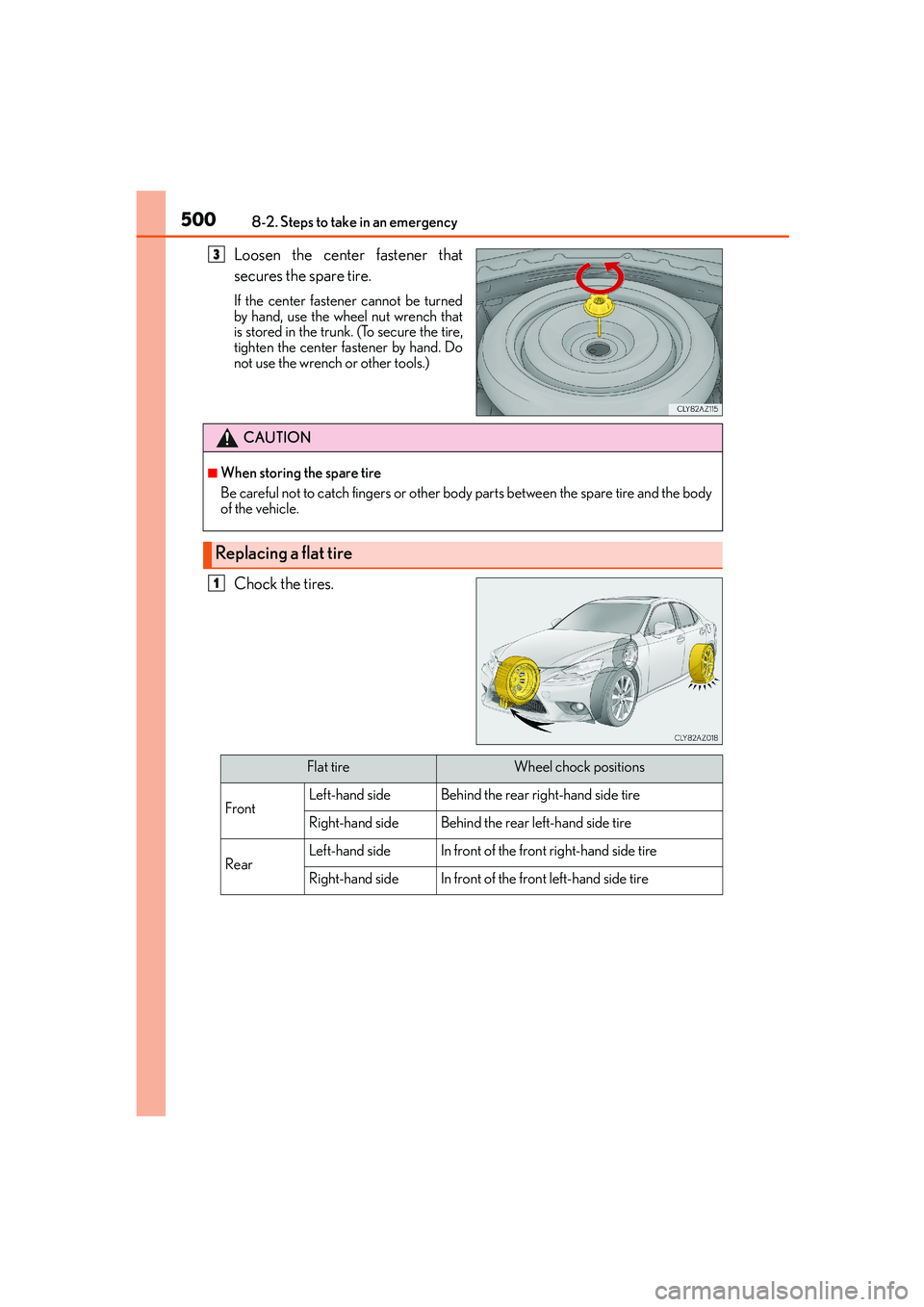
Loosen the center fastener that
secures the spare tire.
If the center fastener cannot be turned
by hand, use the wheel nut wrench that
is stored in the trunk. (To secure the tire,
tighten the center fastener by hand. Do
not use the wrench or other tools.)
Chock the tires.
3
CAUTION
■When storing the spare tire
Be careful not to catch fingers or other body parts between the spare tire and the body
of the vehicle.
Replacing a flat tire
1
Flat tireWheel chock positions
FrontLeft-hand sideBehind the rear right-hand side tire
Right-hand sideBehind the rear left-hand side tire
RearLeft-hand sideIn front of the front right-hand side tire
Right-hand sideIn front of the front left-hand side tire
Page 503 of 588

5038-2. Steps to take in an emergency
8
When trouble arises
IS250_EE(OM53C51E)
Remove any dirt or foreign matter
from the wheel contact surface.
If foreign matter is on the wheel contact
surface, the wheel nuts may loosen
while the vehicle is in motion, causing
the tire to come off.
Install the tire and loosely tighten each wheel nut by hand by approximately
the same amount.
When replacing an aluminum wheel
with a steel wheel, tighten the wheel
nuts until the tapered portion comes
into loose contact with the disc
wheel seat.
Lower the vehicle.
Firmly tighten each wheel nut two or
three times in the order shown in the
illustration.
Tightening torque:
103 N•m (10.5 kgf•m, 76 ft•lbf)
Stow the flat tire, tire jack and all tools.
Installing the spare tire
1
2
Disc wheel
seat
Tapered portion
3
4
5
Page 504 of 588
5048-2. Steps to take in an emergency
IS250_EE(OM53C51E)
■The compact spare tire
●The compact spare tire is identified by the label “TEMPORARY USE ONLY” on the
tire sidewall.
Use the compact spare tire temporarily, and only in an emergency.
●Make sure to check the tire inflation pressure of the compact spare tire. (→P. 5 4 6 )
■When using the compact spare tire (vehicles with a tire pressure warning system)
As the compact spare tire is not equipped with a tire pressure warning valve and trans-
mitter, low inflation pressure of the spare tire will not be indicated by the tire pressure
warning system. Also, if you replace the compact spare tire after the tire pressure warn-
ing light comes on, the light remains on.
■When the compact spare tire is equipped
The vehicle becomes lower when driving with the compact spare tire compared to when
driving with standard tires.
■If you have a flat rear tire on a road covered with snow or ice (vehicles with front and
rear tires of the same size and compact spare tire only)
Install the compact spare tire on one of the front wheels of the vehicle. Perform the fol-
lowing steps and fit tire chains to the rear tires:
Replace a front tire with the compact spare tire.
Replace the flat rear tire with the tire removed from the front of the vehicle.
Fit tire chains to the rear tires.
1
2
3
Page 506 of 588

5068-2. Steps to take in an emergency
IS250_EE(OM53C51E)
CAUTION
■When using the compact spare tire
●Remember that the compact spare tire provided is specifically designed for use with
your vehicle. Do not use your compact spare tire on another vehicle.
●Do not use more than one compact spare tires simultaneously.
●Replace the compact spare tire with a standard tire as soon as possible.
●Avoid sudden acceleration, abrupt steering, sudden braking and shifting operations
that cause sudden engine braking.
■When the compact spare tire is attached
The vehicle speed may not be correctly detected, and the following systems may not
operate correctly:
■Speed limit when using the compact spare tire
Do not drive at speeds in excess of 80 km/h (50 mph) when a compact spare tire is
installed on the vehicle.
The compact spare tire is not designed for driving at high speeds. Failure to observe
this precaution may lead to an accident causing death or serious injury.
■After using the tools and jack
Before driving, make sure all the tools and jack are securely in place in their storage
location to reduce the possibility of personal injury during a collision or sudden brak-
ing.
NOTICE
■Driving with tire chains and the compact spare tire
Do not fit tire chains to the compact spare tire.
Tire chains may damage the vehicle body and adversely affect driving performance.
■When replacing the tires (vehicles with a tire pressure warning system)
When removing or fitting the wheels, tires or the tire pressure warning valve and trans-
mitter, contact any authorized Lexus dealer or repairer, or another duly qualified and
equipped professional as the tire pressure warning valve and transmitter may be dam-
aged if not handled correctly.
• ABS & Brake assist
•VSC
•TRC
• Cruise control (if equipped)
• Dynamic radar cruise control
(if equipped)
•PCS (if equipped)
•EPS• LDA (Lane departure alert)
(if equipped)
• Rear view monitor system
(if equipped)
• Lexus parking assist monitor
(if equipped)
• Lexus parking assist-sensor
(if equipped)
• Navigation system (if equipped)