air condition Lexus IS250 2014 Service Manual
[x] Cancel search | Manufacturer: LEXUS, Model Year: 2014, Model line: IS250, Model: Lexus IS250 2014Pages: 588, PDF Size: 98.77 MB
Page 413 of 588
413
7
Maintenance and care
IS250_EE(OM53C51E)7-3. Do-it-yourself maintenance
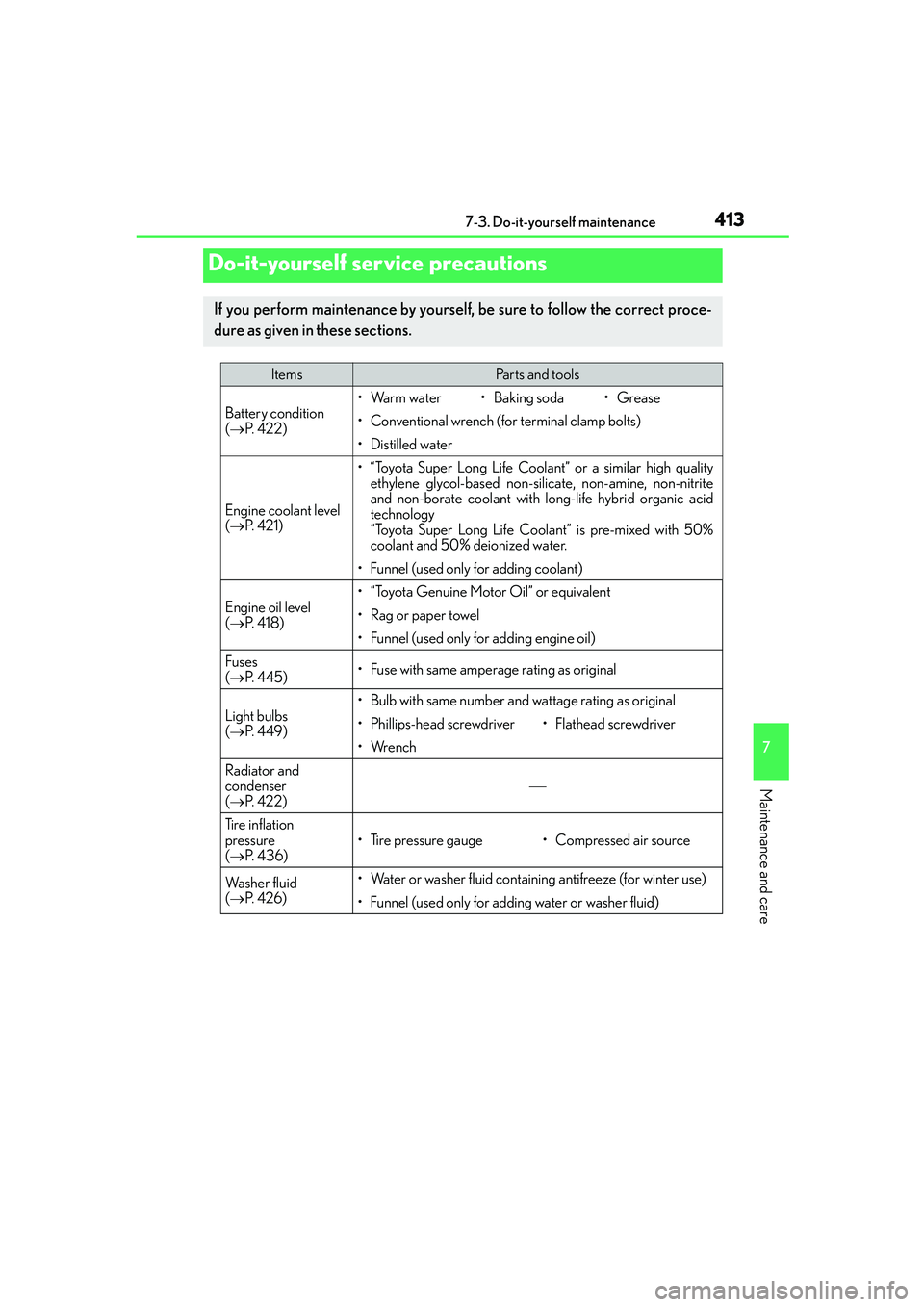
Do-it-yourself service precautions
If you perform maintenance by yourself, be sure to follow the correct proce-
dure as given in these sections.
ItemsParts and tools
Battery condition
(→P. 4 2 2 )•Warm water• Baking soda•Grease
• Conventional wrench (for terminal clamp bolts)
• Distilled water
Engine coolant level
(→P. 4 2 1 )
• “Toyota Super Long Life Coolant” or a similar high quality
ethylene glycol-based non-silicate, non-amine, non-nitrite
and non-borate coolant with long-life hybrid organic acid
technology
“Toyota Super Long Life Coolant” is pre-mixed with 50%
coolant and 50% deionized water.
• Funnel (used only for adding coolant)
Engine oil level
(→P. 4 1 8 )
• “Toyota Genuine Motor Oil” or equivalent
• Rag or paper towel
• Funnel (used only for adding engine oil)
Fuses
(→P. 4 4 5 )• Fuse with same amperage rating as original
Light bulbs
(→P. 4 4 9 )• Bulb with same number and wattage rating as original
• Phillips-head screwdriver•Flathead screwdriver
•Wrench
Radiator and
condenser
(→P. 4 2 2 )
Tire inflation
pressure
(→P. 4 3 6 )
• Tire pressure gauge• Compressed air source
Wa s h e r f l u i d
(→P. 4 2 6 )• Water or washer fluid containing antifreeze (for winter use)
• Funnel (used only for adding water or washer fluid)
Page 414 of 588
4147-3. Do-it-yourself maintenance
IS250_EE(OM53C51E)
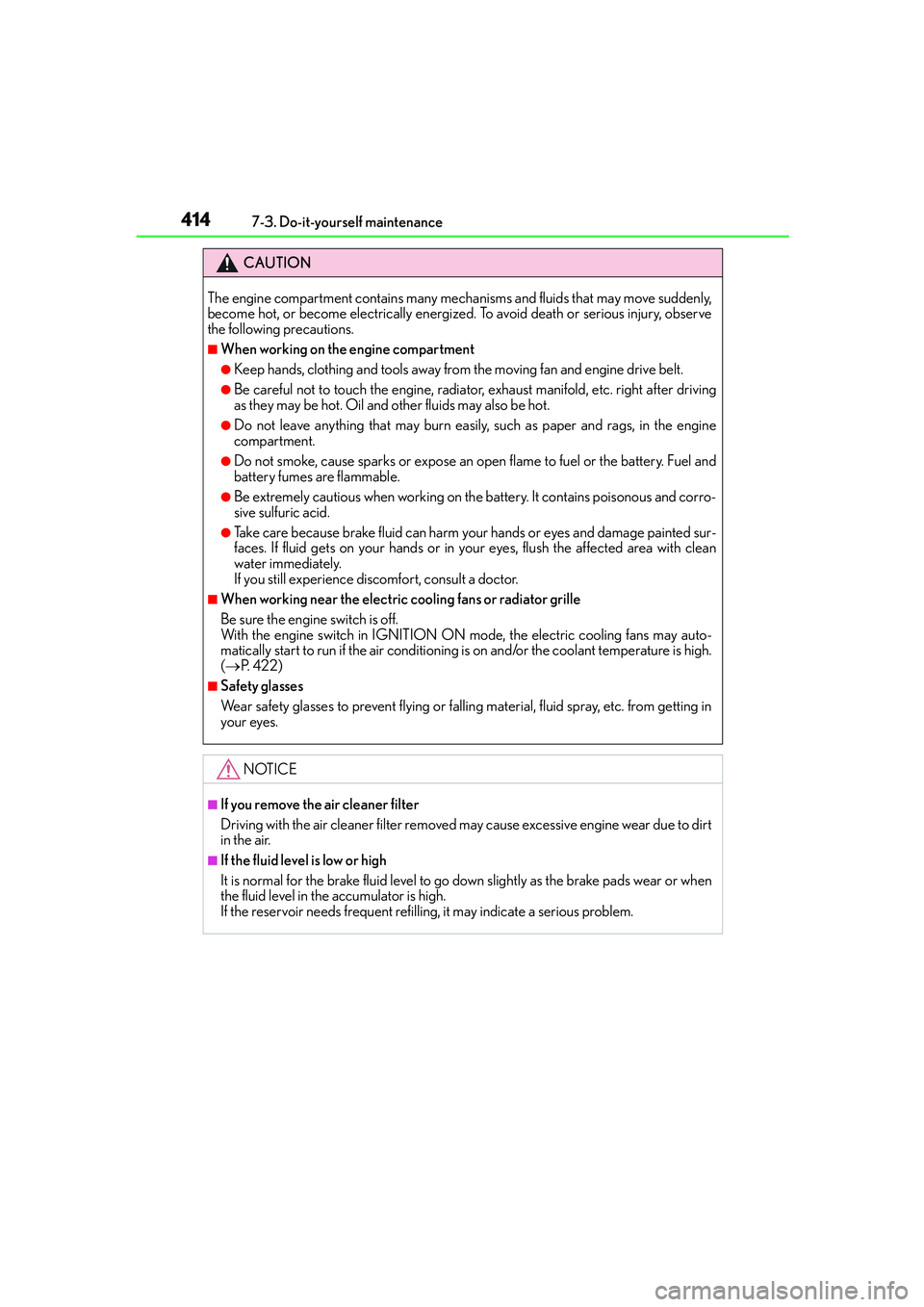
CAUTION
The engine compartment contains many mechanisms and fluids that may move suddenly,
become hot, or become electrically energized. To avoid death or serious injury, observe
the following precautions.
■When working on the engine compartment
●Keep hands, clothing and tools away from the moving fan and engine drive belt.
●Be careful not to touch the engine, radiator, exhaust manifold, etc. right after driving
as they may be hot. Oil and other fluids may also be hot.
●Do not leave anything that may burn easily, such as paper and rags, in the engine
compartment.
●Do not smoke, cause sparks or expose an open flame to fuel or the battery. Fuel and
battery fumes are flammable.
●Be extremely cautious when working on the battery. It contains poisonous and corro-
sive sulfuric acid.
●Take care because brake fluid can harm your hands or eyes and damage painted sur-
faces. If fluid gets on your hands or in your eyes, flush the affected area with clean
water immediately.
If you still experience discomfort, consult a doctor.
■When working near the electric cooling fans or radiator grille
Be sure the engine switch is off.
With the engine switch in IGNITION ON mode, the electric cooling fans may auto-
matically start to run if the air conditioning is on and/or the coolant temperature is high.
(→P. 4 2 2 )
■Safety glasses
Wear safety glasses to prevent flying or falling material, fluid spray, etc. from getting in
your eyes.
NOTICE
■If you remove the air cleaner filter
Driving with the air cleaner filter removed may cause excessive engine wear due to dirt
in the air.
■If the fluid level is low or high
It is normal for the brake fluid level to go down slightly as the brake pads wear or when
the fluid level in the accumulator is high.
If the reservoir needs frequent refilling, it may indicate a serious problem.
Page 430 of 588
4307-3. Do-it-yourself maintenance
IS250_EE(OM53C51E)
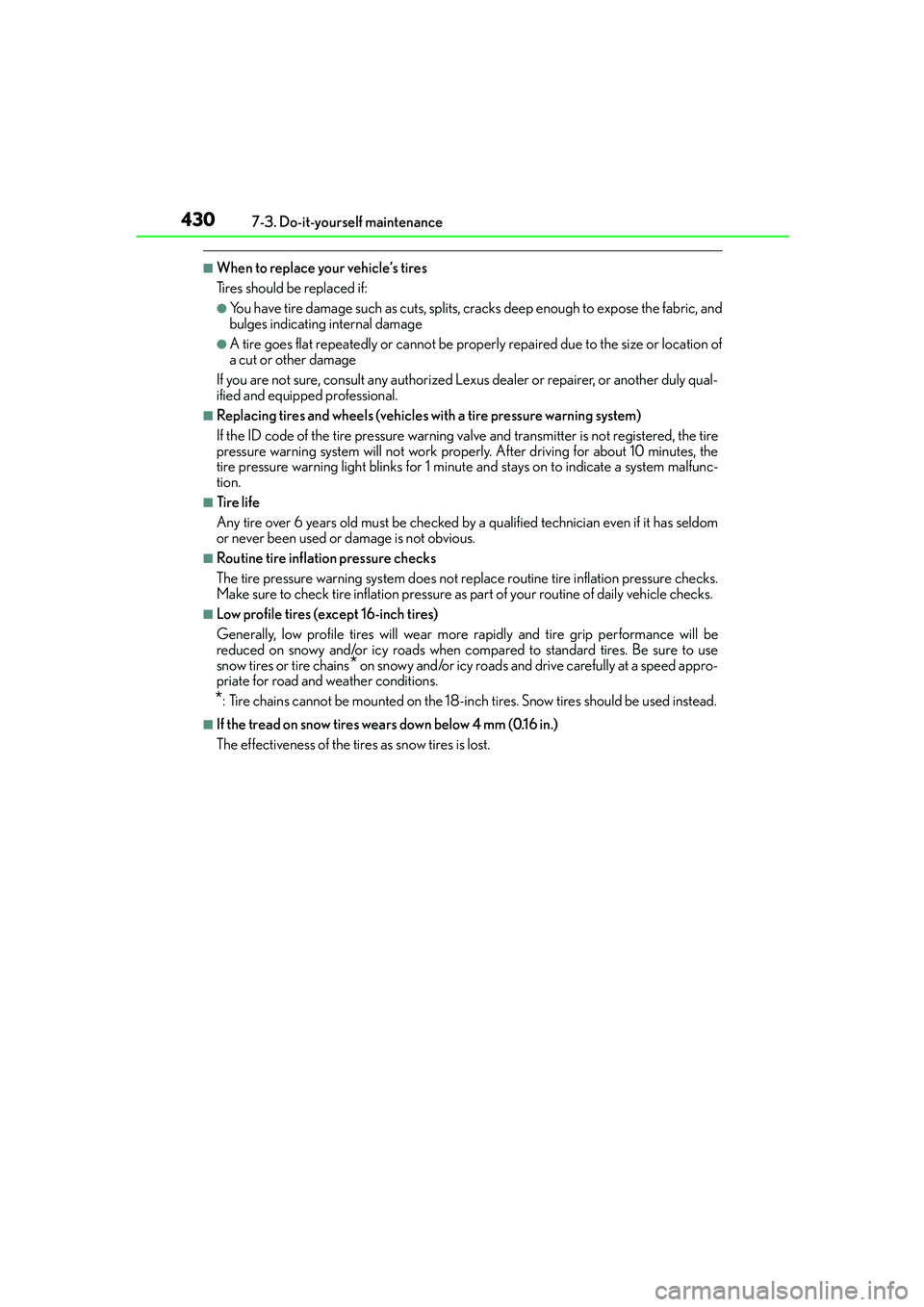
■When to replace your vehicle’s tires
Tires should be replaced if:
●You have tire damage such as cuts, splits, cracks deep enough to expose the fabric, and
bulges indicating internal damage
●A tire goes flat repeatedly or cannot be properly repaired due to the size or location of
a cut or other damage
If you are not sure, consult any authorized Lexus dealer or repairer, or another duly qual-
ified and equipped professional.
■Replacing tires and wheels (vehicles with a tire pressure warning system)
If the ID code of the tire pressure warning valve and transmitter is not registered, the tire
pressure warning system will not work properly. After driving for about 10 minutes, the
tire pressure warning light blinks for 1 minute and stays on to indicate a system malfunc-
tion.
■Tire life
Any tire over 6 years old must be checked by a qualified technician even if it has seldom
or never been used or damage is not obvious.
■Routine tire inflation pressure checks
The tire pressure warning system does not replace routine tire inflation pressure checks.
Make sure to check tire inflation pressure as part of your routine of daily vehicle checks.
■Low profile tires (except 16-inch tires)
Generally, low profile tires will wear more rapidly and tire grip performance will be
reduced on snowy and/or icy roads when compared to standard tires. Be sure to use
snow tires or tire chains
* on snowy and/or icy roads and drive carefully at a speed appro-
priate for road and weather conditions.
*: Tire chains cannot be mounted on the 18-inch tires. Snow tires should be used instead.
■If the tread on snow tires wears down below 4 mm (0.16 in.)
The effectiveness of the tires as snow tires is lost.
Page 435 of 588
4357-3. Do-it-yourself maintenance
7
Maintenance and care
IS250_EE(OM53C51E)
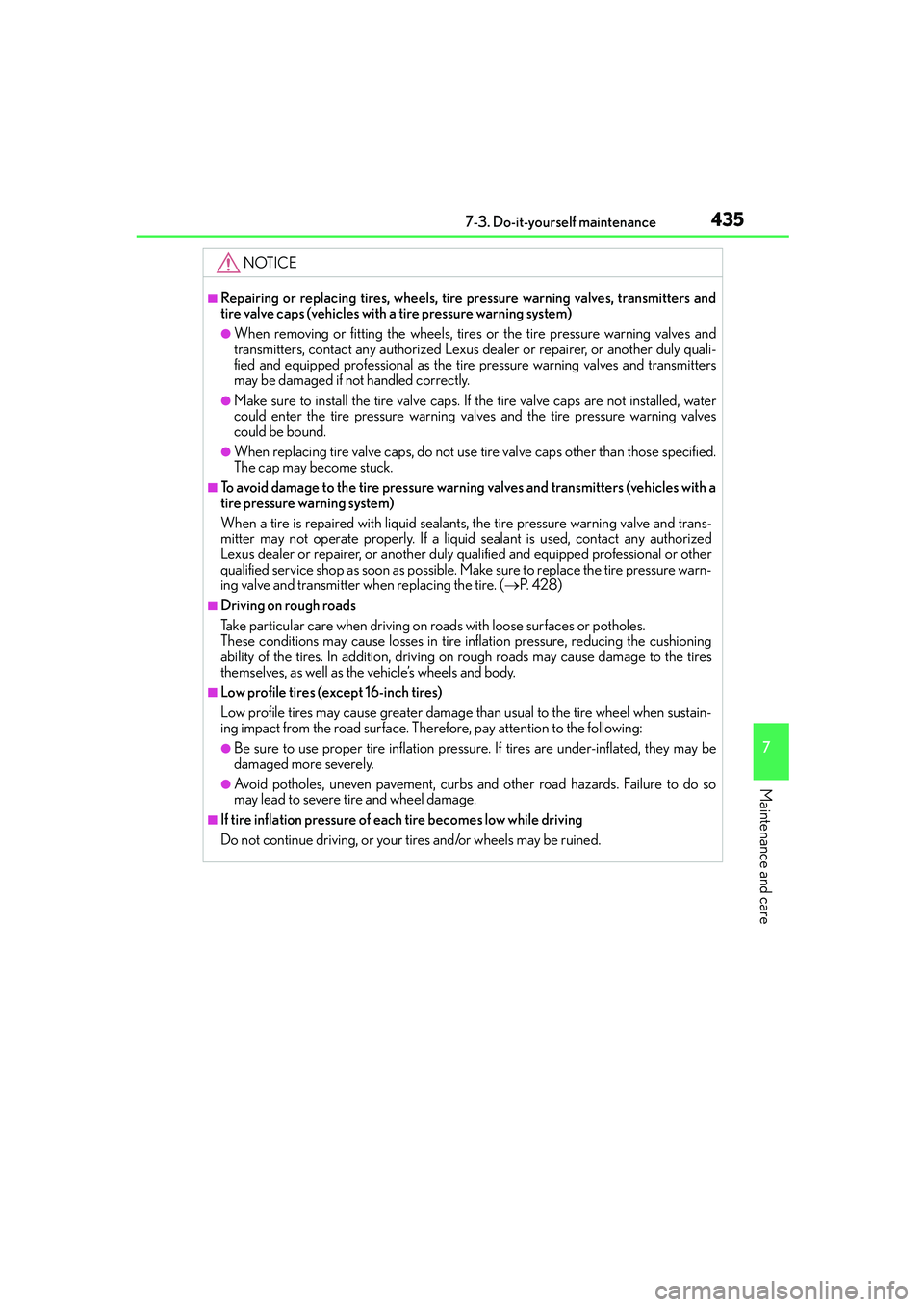
NOTICE
■Repairing or replacing tires, wheels, tire pressure warning valves, transmitters and
tire valve caps (vehicles with a tire pressure warning system)
●When removing or fitting the wheels, tires or the tire pressure warning valves and
transmitters, contact any authorized Lexus dealer or repairer, or another duly quali-
fied and equipped professional as the tire pressure warning valves and transmitters
may be damaged if not handled correctly.
●Make sure to install the tire valve caps. If the tire valve caps are not installed, water
could enter the tire pressure warning valves and the tire pressure warning valves
could be bound.
●When replacing tire valve caps, do not use tire valve caps other than those specified.
The cap may become stuck.
■To avoid damage to the tire pressure warning valves and transmitters (vehicles with a
tire pressure warning system)
When a tire is repaired with liquid sealants, the tire pressure warning valve and trans-
mitter may not operate properly. If a liquid sealant is used, contact any authorized
Lexus dealer or repairer, or another duly qualified and equipped professional or other
qualified service shop as soon as possible. Make sure to replace the tire pressure warn-
ing valve and transmitter when replacing the tire. (→P. 4 2 8 )
■Driving on rough roads
Take particular care when driving on roads with loose surfaces or potholes.
These conditions may cause losses in tire inflation pressure, reducing the cushioning
ability of the tires. In addition, driving on rough roads may cause damage to the tires
themselves, as well as the vehicle’s wheels and body.
■Low profile tires (except 16-inch tires)
Low profile tires may cause greater damage than usual to the tire wheel when sustain-
ing impact from the road surface. Therefore, pay attention to the following:
●Be sure to use proper tire inflation pressure. If tires are under-inflated, they may be
damaged more severely.
●Avoid potholes, uneven pavement, curbs and other road hazards. Failure to do so
may lead to severe tire and wheel damage.
■If tire inflation pressure of each tire becomes low while driving
Do not continue driving, or your tires and/or wheels may be ruined.
Page 437 of 588
4377-3. Do-it-yourself maintenance
7
Maintenance and care
IS250_EE(OM53C51E)
CAUTION
■Proper inflation is critical to save tire performance
Keep your tires properly inflated.
If the tires are not properly inflated, the following conditions may occur which could
lead to an accident resulting in death or serious injury:
●Excessive wear
●Uneven wear
●Poor handling
●Possibility of blowouts resulting from overheated tires
●Air leaking from between tire and wheel
●Wheel deformation and/or tire damage
●Greater possibility of tire damage while driving (due to road hazards, expansion
joints, sharp edges in the road, etc.)
NOTICE
■When inspecting and adjusting tire inflation pressure
Be sure to put the tire valve caps back on.
If the valve caps are not installed, dirt or moisture may get into the valve and cause air
leakage, which could result in a flat tire.
Page 440 of 588

4407-3. Do-it-yourself maintenance
IS250_EE(OM53C51E)
Turn the engine switch off.
Open the glove box. Lift up the side
with the stay, disconnect the stay
tabs and remove the partition by
pulling horizontally.
Press the tabs and remove the filter
cover.
Press the tabs and remove the filter
case.
Air conditioning filter
The air conditioning filter must be changed regularly to maintain air condi-
tioning efficiency.
Removal method
1
2
3
4
Page 441 of 588

4417-3. Do-it-yourself maintenance
7
Maintenance and care
IS250_EE(OM53C51E)
Remove the air conditioning filter
from the filter case and replace it
with a new one.
The “↑UP” marks shown on the filter
and the filter case should be pointing up.
■Checking interval
Inspect and replace the air conditioning filter according to the maintenance schedule. In
dusty areas or areas with heavy traffic flow, early replacement may be required. (For
scheduled maintenance information, please refer to the “Lexus Service Booklet” or
“Lexus Warranty Booklet”.)
■If air flow from the vents decreases dramatically
The filter may be clogged. Check the filter and replace if necessary.
5
NOTICE
■When using the air conditioning system
Make sure that a filter is always installed.
Using the air conditioning system without a filter may cause damage to the system.
Page 474 of 588

4748-2. Steps to take in an emergency
IS250_EE(OM53C51E)
●Fluid leaks under the vehicle.
(Water dripping from the air conditioning after use is normal.)
●Flat-looking tires or uneven tire wear
●Engine coolant temperature gauge needle continually points higher than nor-
mal.
●Changes in exhaust sound
●Excessive tire squeal when cornering
●Strange noises related to the suspension system
●Pinging or other noises related to the engine
●Engine missing, stumbling or running roughly
●Appreciable loss of power
●Vehicle pulls heavily to one side when braking
●Vehicle pulls heavily to one side when driving on a level road
●Loss of brake effectiveness, spongy feeling, pedal almost touches the floor
If you think something is wrong
If you notice any of the following symptoms, your vehicle probably needs
adjustment or repair. Contact any authorized Lexus dealer or repairer, or
another duly qualified and equipped professional as soon as possible.
Visible s ymp toms
Audible symptoms
Operational symptoms
Page 479 of 588
4798-2. Steps to take in an emergency
8
When trouble arises
IS250_EE(OM53C51E)
*3: Seat belt warning buzzer:
The seat belt warning buzzer sounds to alert the driver, front passenger and rear pas-
sengers that his or her seat belt is not fastened. The buzzer sounds for 30 seconds
after the vehicle reaches a speed of 20 km/h (12 mph). Then, if the seat belt is still
unfastened, the buzzer will sound in a different tone for 90 more seconds.
■Passenger detection sensor, seat belt reminder and warning buzzer
●If luggage is placed on a passenger seat, the passenger detection sensor may cause the
warning light to flash and the warning buzzer to sound even if a passenger is not sitting
in the seat.
●If a cushion is placed on the seat, the sensor may not detect a passenger, and the warn-
ing light may not operate properly.
■If the malfunction indicator lamp comes on while driving
The malfunction indicator lamp will come on if the fuel tank becomes completely empty.
If the fuel tank is empty, refuel the vehicle immediately. The malfunction indicator lamp
will go off after several trips.
If the malfunction indicator lamp does not go off, contact any authorized Lexus dealer or
repairer, or another duly qualified and equipped professional as soon as possible.
■Electric power steering system warning light (warning buzzer)
When the battery charge becomes insufficient of the voltage temporarily drops, the
electric power steering system warning light may come on and the warning buzzer may
sound.
■When the tire pressure warning light comes on (if equipped)
Carry out the following procedure after the tire temperature has lowered sufficiently.
●Check the tire inflation pressure and adjust to the appropriate level.
●If the warning light does not go out even after several minutes, check that the tire infla-
tion pressure is at the specified level and carry out initialization.
The warning light may come on again if the above operations are conducted without first
allowing the tire temperature to lower sufficiently.
■The tire pressure warning light may come on due to natural causes (if equipped)
The tire pressure warning light may come on due to natural causes such as natural air
leaks and tire inflation pressure changes caused by temperature. In this case, adjusting
the tire inflation pressure will turn off the warning light (after a few minutes).
■When a tire is replaced with the spare tire (if equipped)
The compact spare tire is not equipped with a tire pressure warning valve and transmit-
ter. If a tire goes flat, the tire pressure warning light will not turn off even though the flat
tire has been replaced with the spare tire.
■Conditions that the tire pressure warning system may not function properly (if
equipped)
→P. 4 3 1
Page 490 of 588

4908-2. Steps to take in an emergency
IS250_EE(OM53C51E)
■Warning messages
The warning message illustrations used are intended as examples, and may differ from
the image that is actually displayed on the multi-information display.
■Warning message in radar cruise mode (if equipped)
In the following situations, the warning message may not be displayed even if vehicle-to-
vehicle distance decreases:
●When your vehicle and the vehicle ahead are traveling at the same speed or the vehicle
ahead is traveling more quickly than your vehicle
●When the vehicle ahead is traveling at a very low speed
●Immediately after cruise control speed is set
●At the instant the accelerator pedal is depressed
■The LDA (Lane Departure Alert) lane departure warning function (if equipped)
In the following situations, the warning message will not be displayed even if a lane line is
crossed.
●When the vehicle speed deviates from the operating range of the LDA system func-
tions
●When the lane lines cannot be recognized
■Conditions that the tire pressure warning system may not function properly (if
equipped)
→P. 4 3 1
■Warning buzzer
→P. 4 8 0
(If equipped)
Indicates that the PCS (Pre-Crash Safety system) is not
currently functional because the grille cover or the sen-
sor is dirty
→Check the grille cover and the sensor and clean
them if they are dirty.
Indicates that operation of large electricity consuming
systems such as the air conditioning system are sus-
pended
→Stop using unnecessary electric components to
reduce electricity consumption. Wait a while until
the electric power supply is restored.
(If equipped)
Indicates that the LDA (Lane Departure Alert) system
cannot be used because the vehicle speed is lower than
approximately 50 km/h (32 mph)
→Drive the vehicle at 50 km/h (32 mph) or higher.
Wa r n i n g m e s s a g eDetails/Actions
(Flashes)