ESP LEXUS IS250 2016 Owner's Manual
[x] Cancel search | Manufacturer: LEXUS, Model Year: 2016, Model line: IS250, Model: LEXUS IS250 2016Pages: 542, PDF Size: 9.65 MB
Page 331 of 542

333
4-3. Do-it-yourself maintenance
4
Maintenance and care
nRoutine tire inflation pressure checks
The tire pressure warning system does not replace routine tire inflation pressure
checks. Make sure to check tire inflation pressure as part of your routine of daily
vehicle checks.
nTire pressure warning system certification
MODEL/FCC IDs:
Transmitter: PAXPMV107J
Receiver: HYQ13BCE
IC (Canada) IDs:
Transmitter: 3729A-PMV107J
Receiver: 1551A-13BCE
For vehicles sold in the U.S.A.
This device complies with Part 15 of the FCC Rules. Operation is subject to the fol-
lowing two conditions: (1) this device may not cause harmful interference, and (2)
this device must accept any interference received, including interference that may
cause undesired operation.
FCC WARNING:
Changes or modifications not expressly approved by the party responsible for
compliance could void the user's authority to operate the equipment.
For vehicles sold in Canada
Operation is subject to the following two conditions: (1) this device may not cause
interference, and (2) this device must accept any interference, including interfer-
ence that may cause undesired operation of the device.
Page 387 of 542

390
5-2. Steps to take in an emergency
CAUTION
nMaintenance of the tires
Each tire, including the spare (if provided), should be checked monthly when cold
and inflated to the inflation pressure recommended by the vehicle manufacturer on
the vehicle placard or tire inflation pressure label (tire and loading information
label). (If your vehicle has tires of a different size than the size indicated on the vehi-
cle placard or tire inflation pressure label [tire and loading information label], you
should determine the proper tire inflation pressure for those tires.)
As an added safety feature, your vehicle has been equipped with a tire pressure
monitoring system (TPMS-tire pressure warning system) that illuminates a low tire
pressure telltale (tire pressure warning light) when one or more of your tires is sig-
nificantly under-inflated. Accordingly, when the low tire pressure telltale (tire pres-
sure warning light) illuminates, you should stop and check your tires as soon as
possible, and inflate them to the proper pressure. Driving on a significantly under-
inflated tire causes the tire to overheat and can lead to tire failure. Under-inflation
also reduces fuel efficiency and tire tread life, and may affect the vehicle's handling
and stopping ability.
Please note that the TPMS (tire pressure warning system) is not a substitute for
proper tire maintenance, and it is the driver's responsibility to maintain correct tire
pressure, even if under-inflation has not reached the level to trigger illumination of
the TPMS low tire pressure telltale (tire pressure warning light).
Your vehicle has also been equipped with a TPMS (tire pressure warning system)
malfunction indicator to indicate when the system is not operating properly. The
TPMS (tire pressure warning system) malfunction indicator is combined with the
low tire pressure telltale (tire pressure warning light). When the system detects a
malfunction, the telltale will flash for approximately one minute and then remain
continuously illuminated. This sequence will continue upon subsequent vehicle
start-ups as long as the malfunction exists. When the malfunction indicator is illumi-
nated, the system may not be able to detect or signal low tire pressure as intended.
TPMS (tire pressure warning system) malfunctions may occur for a variety of rea-
sons, including the installation of replacement or alternate tires or wheels on the
vehicle that prevent the TPMS (tire pressure warning system) from functioning
properly. Always check the TPMS (tire pressure warning system) malfunction tell-
tale after replacing one or more tires or wheels on your vehicle to ensure that the
replacement or alternate tires and wheels allow the TPMS (tire pressure warning
system) to continue to function properly.
Page 450 of 542
454
6-1. Specifications
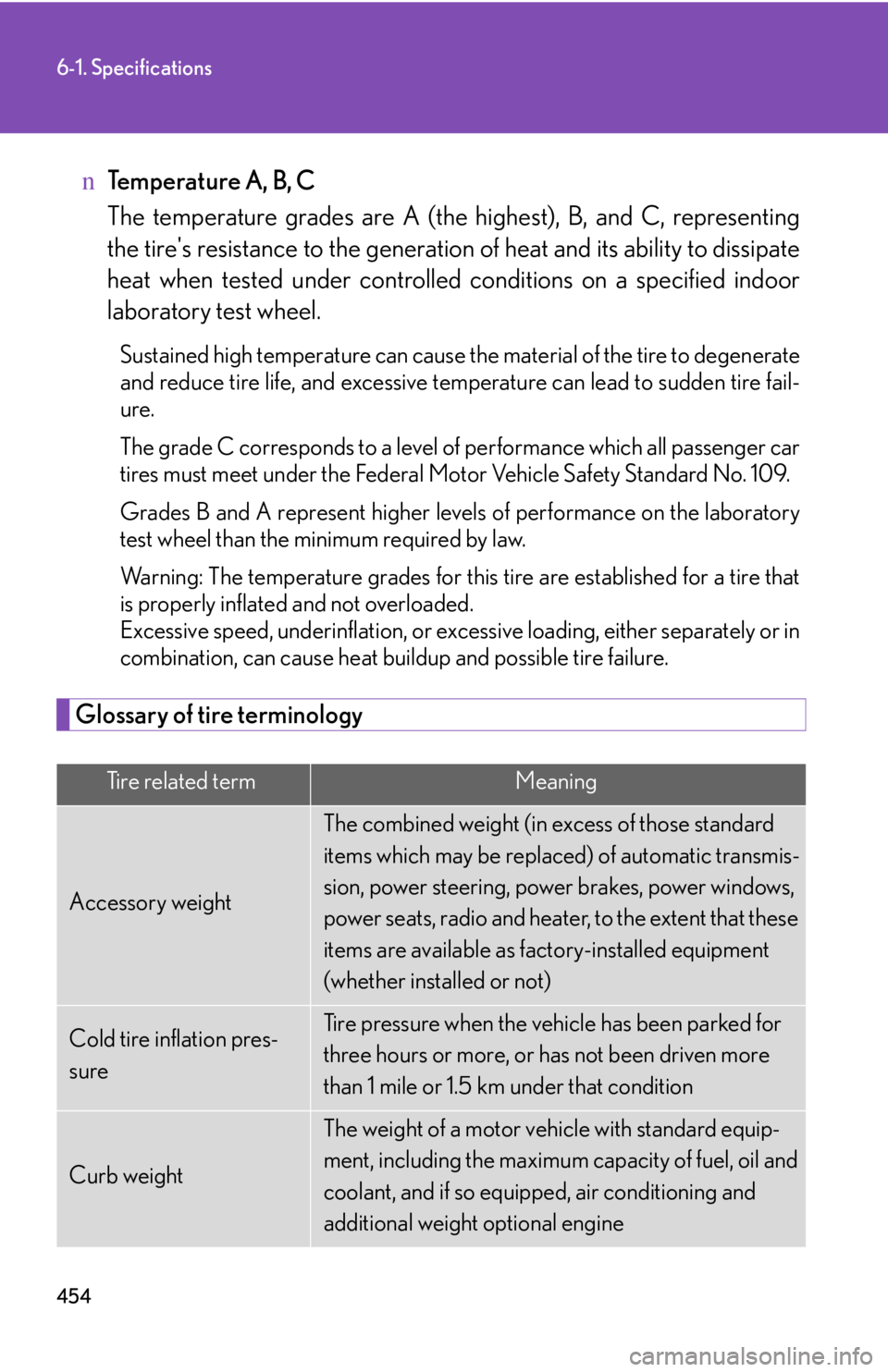
nTemperature A, B, C
The temperature grades are A (the highest), B, and C, representing
the tire's resistance to the generation of heat and its ability to dissipate
heat when tested under controlled conditions on a specified indoor
laboratory test wheel.
Sustained high temperature can cause the material of the tire to degenerate
and reduce tire life, and excessive temperature can lead to sudden tire fail-
ure.
The grade C corresponds to a level of performance which all passenger car
tires must meet under the Federal Motor Vehicle Safety Standard No. 109.
Grades B and A represent higher levels of performance on the laboratory
test wheel than the minimum required by law.
Warning: The temperature grades for this tire are established for a tire that
is properly inflated and not overloaded.
Excessive speed, underinflation, or excessive loading, either separately or in
combination, can cause heat buildup and possible tire failure.
Glossary of tire terminology
Tire related termMeaning
Accessory weight
The combined weight (in excess of those standard
items which may be replaced) of automatic transmis-
sion, power steering, power brakes, power windows,
power seats, radio and heater, to the extent that these
items are available as factory-installed equipment
(whether installed or not)
Cold tire inflation pres-
sure
Tire pressure when the vehicle has been parked for
three hours or more, or has not been driven more
than 1 mile or 1.5 km under that condition
Curb weight
The weight of a motor vehicle with standard equip-
ment, including the maximum capacity of fuel, oil and
coolant, and if so equipped, air conditioning and
additional weight optional engine
Page 453 of 542

457
6-1. Specifications
6
Vehicle specifications
Tire related termMeaning
Bead
The part of the tire that is made of steel wires,
wrapped or reinforced by ply cords and that is
shaped to fit the rim
Bead separationA breakdown of the bond between components in
the bead
Bias ply tire
A pneumatic tire in which the ply cords that extend to
the beads are laid at alternate angles substantially
less than 90 degrees to the centerline of the tread
CarcassThe tire structure, except tread and sidewall rubber
which, when inflated, bears the load
ChunkingThe breaking away of pieces of the tread or sidewall
CordThe strands forming the plies in the tire
Cord separationThe parting of cords from adjacent rubber com-
pounds
CrackingAny parting within the tread, sidewall, or innerliner of
the tire extending to cord material
CT
A pneumatic tire with an inverted flange tire and rim
system in which the rim is designed with rim flanges
pointed radially inward and the tire is designed to fit
on the underside of the rim in a manner that encloses
the rim flanges inside the air cavity of the tire
Extra load tire
A tire designed to operate at higher loads and at
higher inflation pressures than the corresponding
standard tire
GrooveThe space between two adjacent tread ribs
InnerlinerThe layer(s) forming the inside surface of a tubeless
tire that contains the inflating medium within the tire
Innerliner separationThe parting of the innerliner from cord material in the
carcass
Page 455 of 542

459
6-1. Specifications
6
Vehicle specifications
Tire related termMeaning
Ply separationA parting of rubber compound between adjacent
plies
Pneumatic tire
A mechanical device made of rubber, chemicals, fab-
ric and steel or other materials, that, when mounted
on an automotive wheel, provides the traction and
contains the gas or fluid that sustains the load
Radial ply tire
A pneumatic tire in which the ply cords that extend to
the beads are laid at substantially 90 degrees to the
centerline of the tread
Reinforced tire
A tire designed to operate at higher loads and at
higher inflation pressures than the corresponding
standard tire
Section width
The linear distance between the exteriors of the side-
walls of an inflated tire, excluding elevations due to
labeling, decoration, or protective bands
SidewallThat portion of a tire between the tread and bead
Sidewall separationThe parting of the rubber compound from the cord
material in the sidewall
Snow tire
A tire that attains a traction index equal to or greater
than 110, compared to the ASTM E-1136 Standard
Reference Test Tire, when using the snow traction test
as described in ASTM F-1805-00, Standard Test
Method for Single Wheel Driving Traction in a
Straight Line on Snow-and Ice-Covered Surfaces,
and which is marked with an Alpine Symbol ( )
on at least one sidewall
Te s t r i mThe rim on which a tire is fitted for testing, and may be
any rim listed as appropriate for use with that tire
Page 480 of 542
486
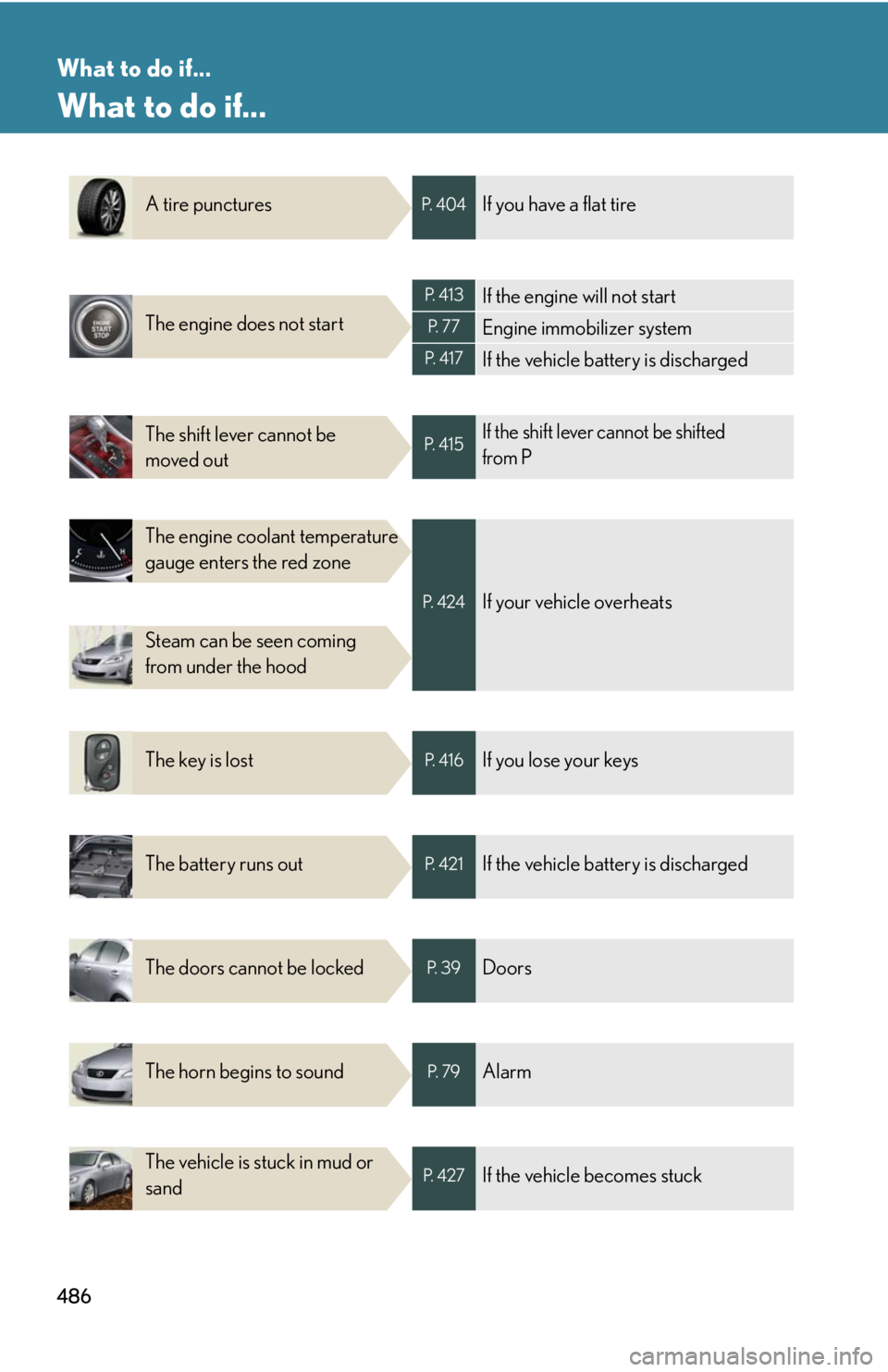
What to do if...
What to do if...
A tire puncturesP. 4 0 4If you have a flat tire
The engine does not start
P. 4 1 3If the engine will not start
P. 7 7Engine immobilizer system
P. 4 1 7If the vehicle battery is discharged
The shift lever cannot be
moved outP. 4 1 5
If the shift lever cannot be shifted
from P
The engine coolant temperature
gauge enters the red zone
Steam can be seen coming
from under the hood
P. 4 2 4If your vehicle overheats
The key is lostP. 4 1 6If you lose your keys
The battery runs outP. 4 2 1If the vehicle battery is discharged
The doors cannot be lockedP. 3 9Doors
The horn begins to soundP. 7 9Alarm
The vehicle is stuck in mud or
sandP. 4 2 7If the vehicle becomes stuck
Page 483 of 542
1
IS_U (L/O_0808)
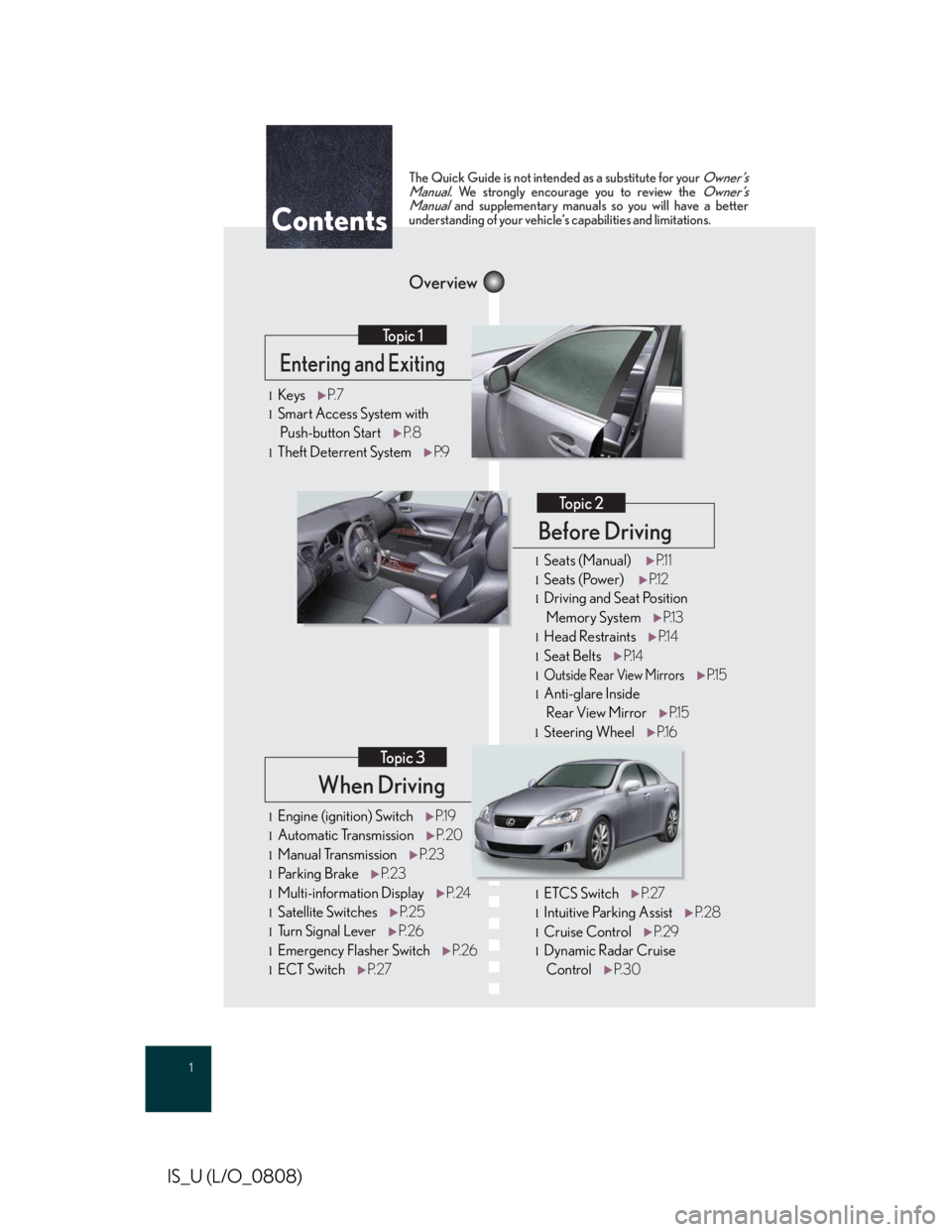
When Driving Topic 3Entering and Exiting Topic 1
Before Driving Topic 2OverviewContents
lEngine (ignition) SwitchP.1 9
lAutomatic TransmissionP. 2 0
lManual TransmissionP. 2 3
lParking BrakeP. 2 3
lMulti-information DisplayP. 2 4
lSatellite SwitchesP. 2 5
lTu r n S i g n a l L e v e rP. 2 6
lEmergency Flasher SwitchP. 2 6
lECT SwitchP. 2 7
lKeysP.7
lSmart Access System with
Push-button StartP. 8
lTheft Deterrent SystemP.9
The Quick Guide is not intended as a substitute for your
Owner’s
Manual
. We strongly encourage you to review the
Owner’s
Manual
and supplementary manuals so you will have a betterunderstanding of your vehicle’s capabilities and limitations.
lETCS SwitchP.2 7
lIntuitive Parking AssistP. 2 8
lCruise ControlP. 2 9
lDynamic Radar Cruise
ControlP. 3 0
lSeats (Manual) P.1 1
lSeats (Power) P.1 2
lDriving and Seat Position
Memory SystemP.1 3
lHead RestraintsP.1 4
lSeat BeltsP.1 4
l
Outside Rear View Mirrors
P.1 5
lAnti-glare Inside
Rear View MirrorP.1 5
lSteering WheelP.1 6
Page 484 of 542
Entering and Exiting
Before Driving
When Driving
Rain and
Night Driving
Driving Comfort
Opening and Closing
What to do if ...
Customizing
Yo u r L e x u s
2
IS_U (L/O_0808)
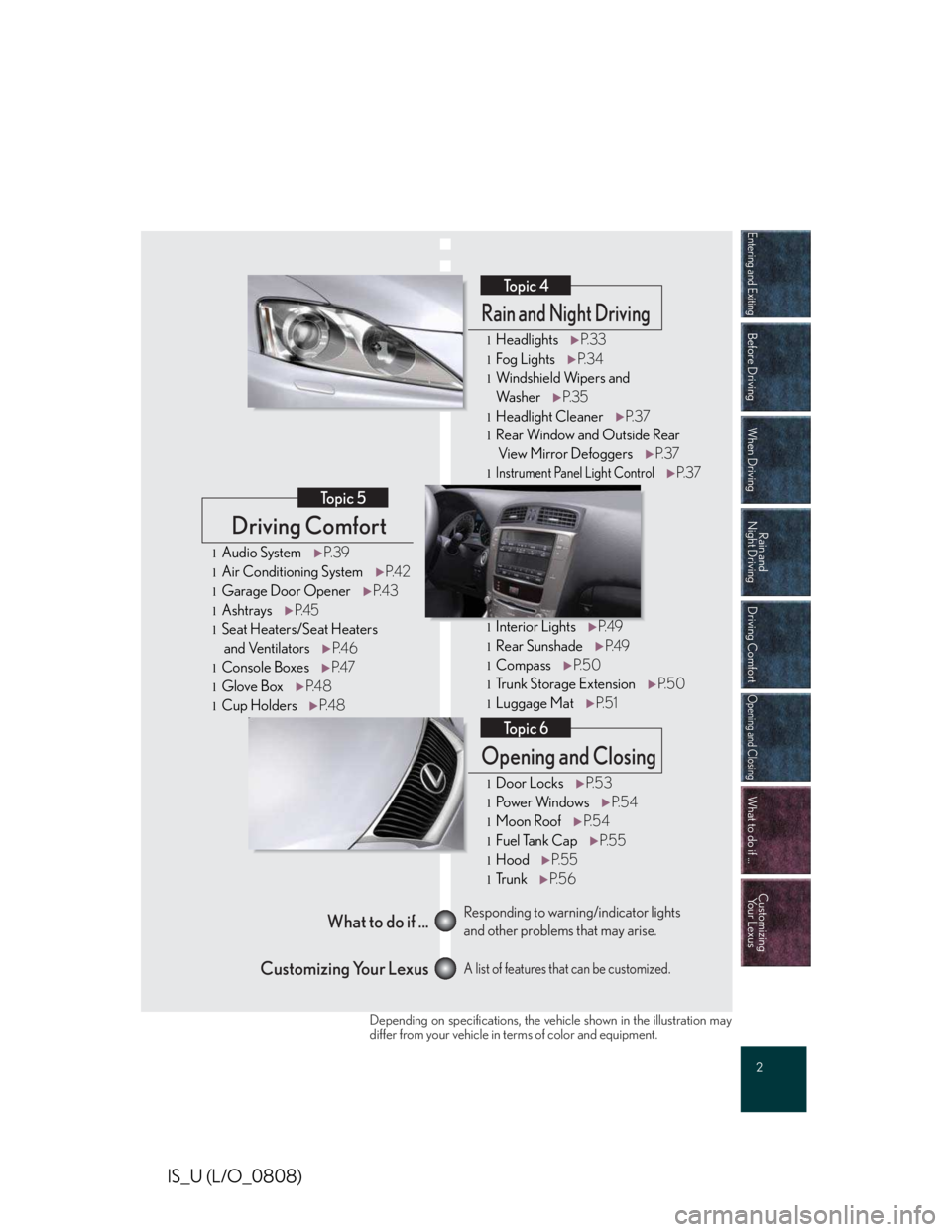
Driving Comfort Topic 5
Opening and ClosingTopic 6
What to do if ...
Customizing Your Lexus Responding to warning/indicator lights
and other problems that may arise.
A list of features that can be customized. Rain and Night DrivingTopic 4
lHeadlightsP. 33
lFog LightsP. 3 4
lWindshield Wipers and
Wa s h e rP. 3 5
lHeadlight CleanerP. 3 7
lRear Window and Outside Rear
View Mirror DefoggersP. 3 7
l
Instrument Panel Light Control
P. 3 7
lInterior LightsP.4 9
lRear SunshadeP. 4 9
lCompassP. 5 0
lTrunk Storage ExtensionP. 5 0
lLuggage MatP. 5 1
lDoor LocksP.5 3
lPo w e r Wi n d o w sP. 5 4
lMoon RoofP. 5 4
lFuel Tank CapP. 5 5
lHoodP. 5 5
lTr u n kP. 5 6
lAudio SystemP.3 9
lAir Conditioning SystemP. 4 2
lGarage Door OpenerP. 4 3
lAshtraysP. 4 5
lSeat Heaters/Seat Heaters
and VentilatorsP. 4 6
lConsole BoxesP. 4 7
lGlove BoxP. 4 8
lCup HoldersP. 4 8
Depending on specifications, the vehicle shown in the illustration maydiffer from your vehicle in terms of color and equipment.
Page 538 of 542
62
Entering and Exiting
Before Driving
When Driving
Rain and
Night Driving
Driving Comfort
Opening and Closing
What to do if ...
Customizing
Yo u r L e x u s
IS_U (L/O_0808)
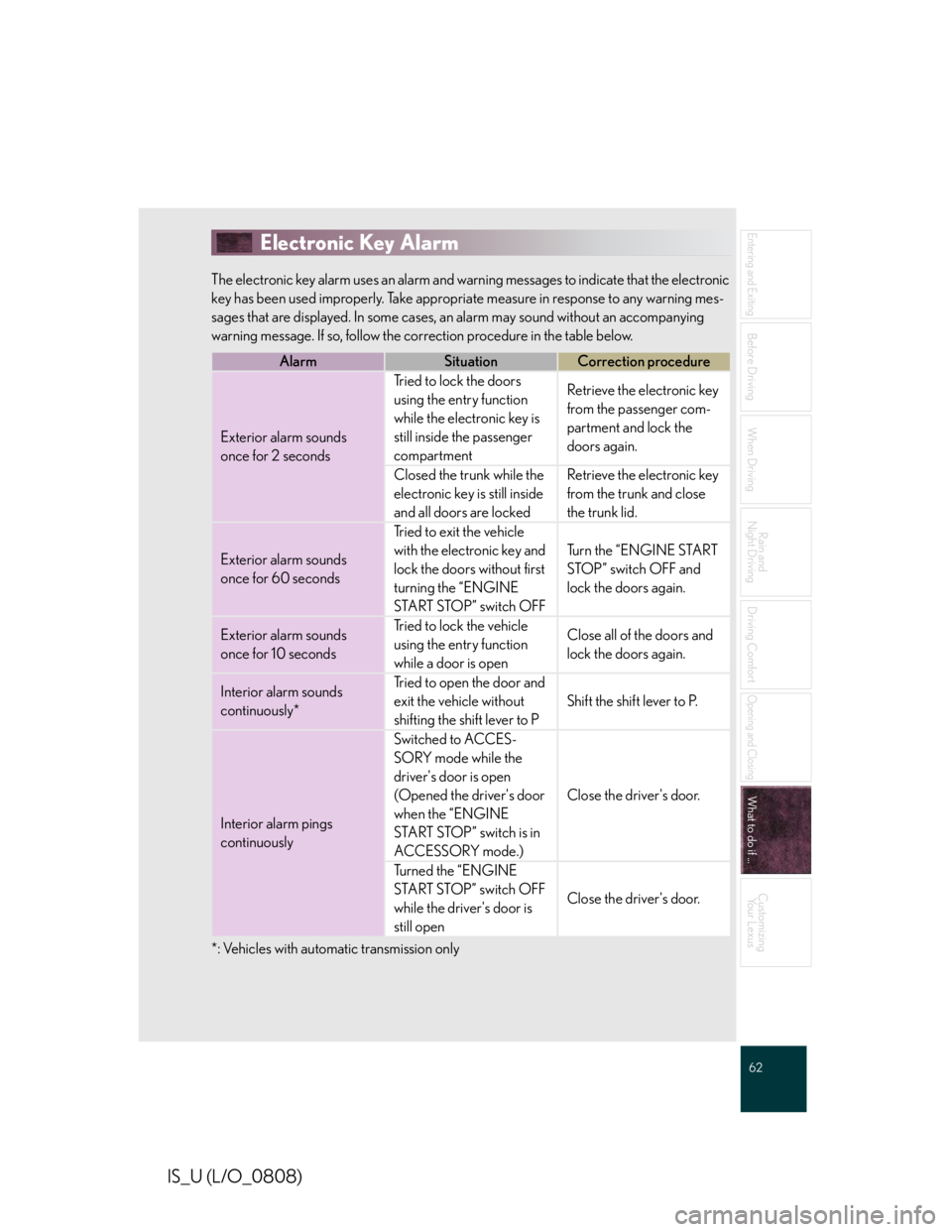
Electronic Key Alarm
The electronic key alarm uses an alarm and warning messages to indicate that the electronic
key has been used improperly. Take appropriate measure in response to any warning mes-
sages that are displayed. In some cases, an alarm may sound without an accompanying
warning message. If so, follow the correction procedure in the table below.
*: Vehicles with automatic transmission only
AlarmSituationCorrection procedure
Exterior alarm sounds
once for 2 seconds
Tried to lock the doors
using the entry function
while the electronic key is
still inside the passenger
compartment
Retrieve the electronic key
from the passenger com-
partment and lock the
doors again.
Closed the trunk while the
electronic key is still inside
and all doors are locked
Retrieve the electronic key
from the trunk and close
the trunk lid.
Exterior alarm sounds
once for 60 seconds
Tried to exit the vehicle
with the electronic key and
lock the doors without first
turning the “ENGINE
START STOP” switch OFF
Turn the “ENGINE START
STOP” switch OFF and
lock the doors again.
Exterior alarm sounds
once for 10 seconds
Tried to lock the vehicle
using the entry function
while a door is open
Close all of the doors and
lock the doors again.
Interior alarm sounds
continuously*
Tried to open the door and
exit the vehicle without
shifting the shift lever to P
Shift the shift lever to P.
Interior alarm pings
continuously
Switched to ACCES-
SORY mode while the
driver's door is open
(Opened the driver's door
when the “ENGINE
START STOP” switch is in
ACCESSORY mode.)
Close the driver's door.
Tu r n e d t h e “ E N G I N E
START STOP” switch OFF
while the driver's door is
still open
Close the driver's door.