wheel LEXUS IS250 2016 Owner's Guide
[x] Cancel search | Manufacturer: LEXUS, Model Year: 2016, Model line: IS250, Model: LEXUS IS250 2016Pages: 542, PDF Size: 9.65 MB
Page 94 of 542

94
1-7. Safety information
CAUTION
nModification and disposal of SRS airbag system components
Do not dispose of your vehicle or perform any of the following modifications with-
out consulting your Lexus dealer.
The SRS airbag may malfunction or deploy (inflate) accidentally, causing death or
serious injury.
lInstallation, removal, disassembly and repair of the SRS airbags
lRepairs, modifications, removal or replacement of the steering wheel, instrument
panel, dashboard, seats or seat upholstery, front, side and rear pillars or roof side
rails
lRepairs or modifications of the front fender, front bumper, or side of the occupant
compartment
lInstallation of snow plows, winches, etc. to the front grille (bull bars, kangaroo bar
etc.)
lModifications to the vehicle's suspension system
lInstallation of electronic devices such as mobile two-way radios or CD players
lModifications to your vehicle for a person with a physical disability
Page 120 of 542

120
2-1. Driving procedures
CAUTION
lDo not turn the engine off while driving.
The power steering and brake booster system will not operate properly if the
engine is not running.
lUse engine braking (downshift) to maintain a safe speed when driving down a
steep hill.
Using the brakes continuously may cause the brakes to overheat and lose effec-
tiveness. (→P. 1 3 2 )
lWhen stopped on an inclined surface, use the brake pedal and parking brake to
prevent the vehicle from rolling backward or forward and causing an accident.
lDo not adjust the position of the steering wheel, the seat, or the inside or outside
rear view mirrors while driving.
Doing so may result in a loss of vehicle control that can cause accidents that may
result in death or serious injury.
lAlways check that all passengers' arms, heads or other parts of their bodies are
not outside the vehicle, as this may result in death or serious injury.
lDo not drive the vehicle off-road.
This is not a AWD vehicle designed for real off-road driving. Proceed with all due
caution if it becomes unavoidable to drive off-road.
lDo not drive across river crossings or through other bodies of water.
This may cause electric/electronic components to short circuit, damage the
engine or cause other serious damage to the vehicle.
lDo not drive in excess of the speed limit. Even if the legal speed limit permits it, do
not drive over 85 mph (140 km/h) unless your vehicle has high-speed capability
tires. Driving over 85 mph (140 km/h) may result in tire failure, loss of control and
possible injury. Be sure to consult a tire dealer to determine whether the tires on
your vehicle are high-speed capability tires or not before driving at such speeds.
Page 123 of 542

123
2-1. Driving procedures
2
When driving
CAUTION
nWhen taking a nap in the vehicle
Always turn the engine off. Otherwise, you may accidentally move the shift lever or
depress the accelerator pedal, which could cause an accident or fire due to engine
overheating. Additionally, if the vehicle is parked in a poorly ventilated area, exhaust
gases may collect and enter the vehicle, leading to death or a serious health hazard.
nWhen braking the vehicle
lWhen the brakes are wet, drive more cautiously.
Braking distance increases when the brakes are wet, and may cause one side of
the vehicle to brake differently than the other side. Also the parking brake may
not securely hold the vehicle.
lIf the power brake assist function does not operate, do not follow other vehicles
closely and avoid downhills or sharp turns that require braking.
In this case, braking is still possible, but it will require more force on the pedal than
usual. Braking distance may also increase.
lDo not pump the brake pedal if the engine stalls.
Each push on the brake pedal uses up the reserve for the power-assisted brakes.
lThe brake system consists of 2 individual hydraulic systems: if one of the systems
fails, the other will still operate. In this case, the brake pedal should be depressed
more firmly than usual and braking distance becomes longer.
Do not drive your vehicle with only a single brake system. Have your brakes fixed
immediately.
nIf the vehicle becomes stuck or bogged (AWD models)
Do not spin the wheels recklessly when any of the tires is up in the air, or stuck in
sand or mud, etc. This may damage the drive system components or propel the
vehicle forward (or in another direction) and cause an accident.
Page 124 of 542

124
2-1. Driving procedures
NOTICE
nWhen driving the vehicle
With automatic transmission vehicles
lDo not use the accelerator pedal or depress accelerator and brake pedals
together to hold the vehicle on a hill.
With manual transmission vehicles
lDo not rest your foot on the clutch pedal while driving.
Doing so may cause clutch trouble.
lDo not use any gears other than the first gear when starting off and moving for-
ward.
Doing so may damage the clutch.
lDo not use the clutch to hold the vehicle when stopping on an uphill grade.
nWhen parking the vehicle
With automatic transmission vehicles, always put the shift lever in P. Failure to do so
may cause the vehicle to move or the vehicle may accelerate suddenly if the accel-
erator pedal is accidentally depressed.
nAvoiding damage to vehicle parts
lDo not turn the steering wheel fully in either direction and hold it there for a long
time.
Doing so may damage the power steering motor.
lWhen driving over bumps in the road, drive as slowly as possible to avoid damag-
ing the wheels, underside of the vehicle, etc.
Page 125 of 542

125
2-1. Driving procedures
2
When driving
NOTICE
nIf you hear a squealing or scraping noise (brake pad wear limit indicators)
Have your Lexus dealer check and replace the brake pads as soon as possible.
The rotor damage can result if the pads are not replaced when needed.
Front brake only: Moderate levels of the brake pad and disc wear allow enhanced
front braking power. As a result, the discs may wear more quickly than conventional
brake discs. Therefore, when replacing the brake pads, Lexus recommends that you
also have the thickness of the discs measured.
It is dangerous to drive the vehicle when the wear limits of the brake pads and/or
that of the brake discs are exceeded.
nIf you get a flat tire while driving
A flat or damaged tire may cause the following situations. Hold the steering wheel
firmly and gradually press the brake pedal to slow down the vehicle.
lIt may be difficult to control your vehicle.
lThe vehicle will make abnormal sounds.
lThe vehicle will behave abnormally.
Replace a flat tire with a new one. (→P. 4 0 6 )
nWhen encountering flooded roads
Do not drive on a road that has flooded after heavy rain etc. Doing so may cause the
following serious damage to the vehicle.
lEngine stalling
lShort in electrical components
lEngine damage caused by water immersion
In the event that you drive on a flooded road and the vehicle is flooded, be sure to
have your Lexus dealer check the following.
lBrake function
lChanges in quantity and quality of oil and fluid used for the engine, transmission,
transfer (AWD vehicles), differential, etc.
lLubricant condition for the propeller shaft (AWD vehicles), bearings and suspen-
sion joints (where possible) and the function of all joints, bearings, etc.
Page 129 of 542

129
2-1. Driving procedures
2
When driving
nIf the engine does not start
The engine immobilizer system may not have been deactivated. (→P. 7 7 )
nWhen the steering lock cannot be released
nWhen the “ENGINE START STOP” switch indicator flashes in amber
The system may be malfunctioning. Have the vehicle inspected by your Lexus
dealer immediately.
nAuto power off function
If the vehicle is left in ACCESSORY mode for more than an hour with the shift lever
in P (vehicles with an automatic transmission), the “ENGINE START STOP” switch
will automatically turn OFF.
nElectronic key battery depletion
→P. 30
nWhen the electronic key battery is fully discharged
→P. 34 5
nConditions affecting operation
→P. 28
nNote for the entry function
→P. 31
The “ENGINE START STOP” switch indica-
tor will flash in green and a message will be
shown on the multi-information display. Press
the “ENGINE START STOP” switch again
while turning the steering wheel left and right.
Page 141 of 542
141
2-1. Driving procedures
2
When driving
Horn
nAfter adjusting the steering wheel (vehicles with manually adjustable type steer-
ing wheel)
Make sure that the steering wheel is securely locked.
The horn may not sound if the steering wheel is not securely locked. (→P. 6 2 )
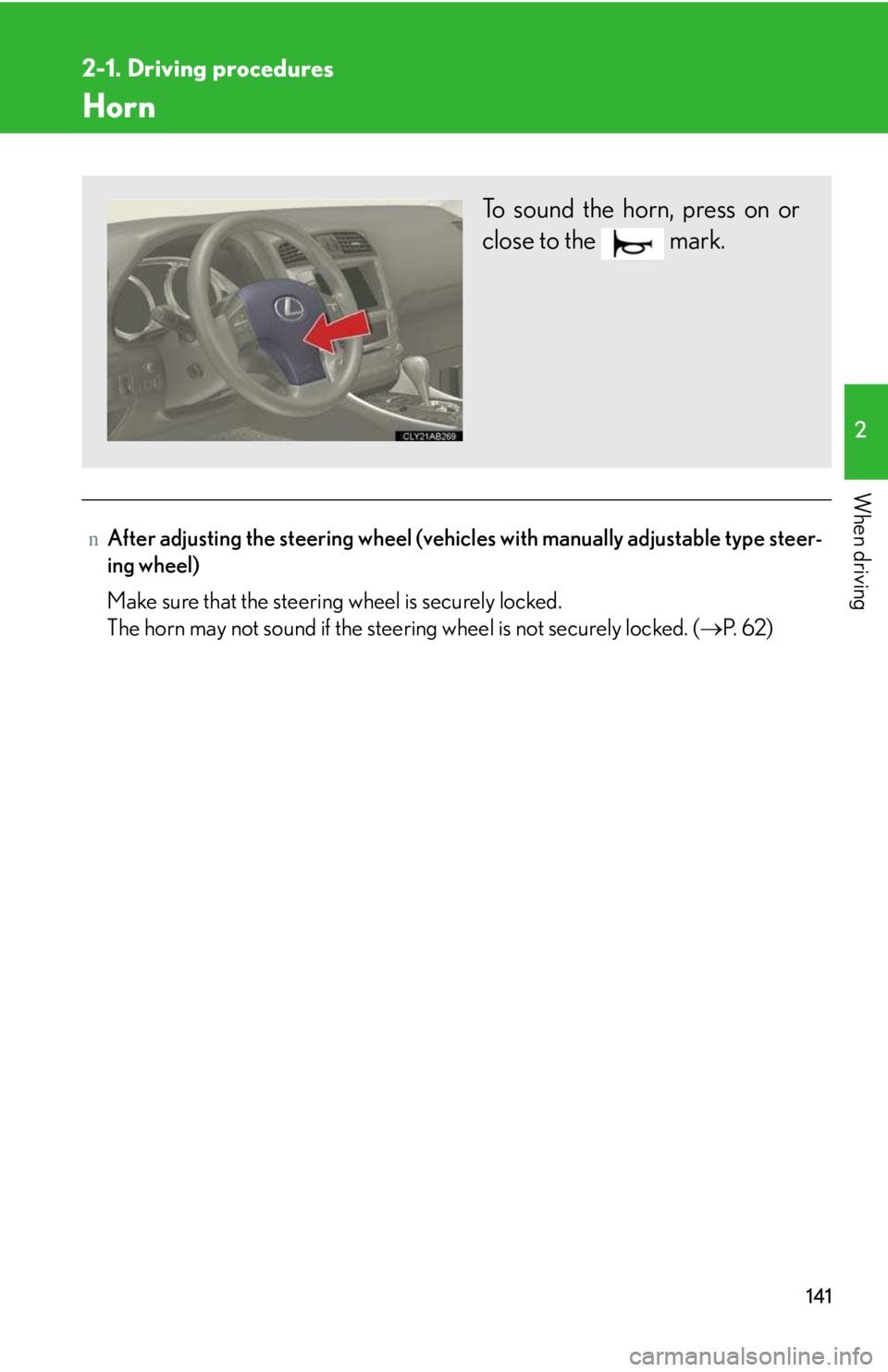
To sound the horn, press on or
close to the mark.
Page 179 of 542

179
2-4. Using other driving systems
2
When driving
CAUTION
nConditions under which the vehicle-to-vehicle distance control may not function
correctly
Apply the brakes as necessary in the following conditions as the radar sensor may
not be able to correctly detect vehicles ahead, and an accident may result.
lWhen water or snow thrown up by the surrounding vehicles hinders the function-
ing of the sensor
lWhen your vehicle is pointing upwards (caused by a heavy load in the trunk, etc.)
lWhen the road curves or when the lanes are narrow
lWhen steering wheel operation or your position in the lane is unstable
lWhen the vehicle ahead of you decelerates suddenly
nHandling the radar sensor
Observe the following to ensure the cruise control system can function effectively:
lKeep the sensor and front grille clean at all times.
Clean the sensor and front grille with a soft cloth so you do not mark or damage
them.
lDo not subject the sensor or surrounding area to a strong impact.
If the sensor moves even slightly off position, the system may malfunction. If the
sensor or surrounding area is subject to a strong impact, always have the area
inspected and adjusted by a Lexus dealer.
lDo not disassemble the sensor.
lDo not attach accessories or stickers to the sensor, grille or surrounding area.
lDo not modify or paint the sensor and grille.
nTo ensure the radar sensor functions correctly
Do not do the following to the sensor or grille cover as doing so may cause the sen-
sor not to function correctly and could result in an accident.
lStick or attach anything to them
lLeave them dirty
lDisassemble, subject them to strong shocks
lModify or paint them
lReplace them with non-genuine parts
Page 186 of 542
186
2-4. Using other driving systems
Driving assist systems
To help enhance driving safety and performance, the following systems
operate automatically in response to various driving situations. Be aware,
however, that these systems are supplementary and should not be relied
upon too heavily when operating the vehicle.
nABS (Anti-lock Brake System)
Helps to prevent wheel lock when the brakes are applied suddenly, or if
the brakes are applied while driving on a slippery road surface.
nBrake assist
Generates an increased level of braking force after the brake pedal is
depressed, when the system detects a panic stop situation.
nVSC (Vehicle Stability Control)
Helps the driver to control skidding when swerving suddenly or turning on
slippery road surfaces.
nTRAC (Traction Control)
Maintains drive power and prevents the rear wheels (2WD models) or all
wheels (AWD models) from spinning when starting the vehicle or acceler-
ating on slippery roads.
nHill-start assist control (vehicles with an automatic transmission)
Prevents the vehicle from rolling backwards when starting on an incline or
slippery slope.
nEPS (Electric Power Steering)
Employs an electric motor to reduce the amount of effort needed to turn
the steering wheel.
Page 187 of 542
187
2-4. Using other driving systems
2
When driving
When the VSC/TRAC/hill-start assist control systems are operating
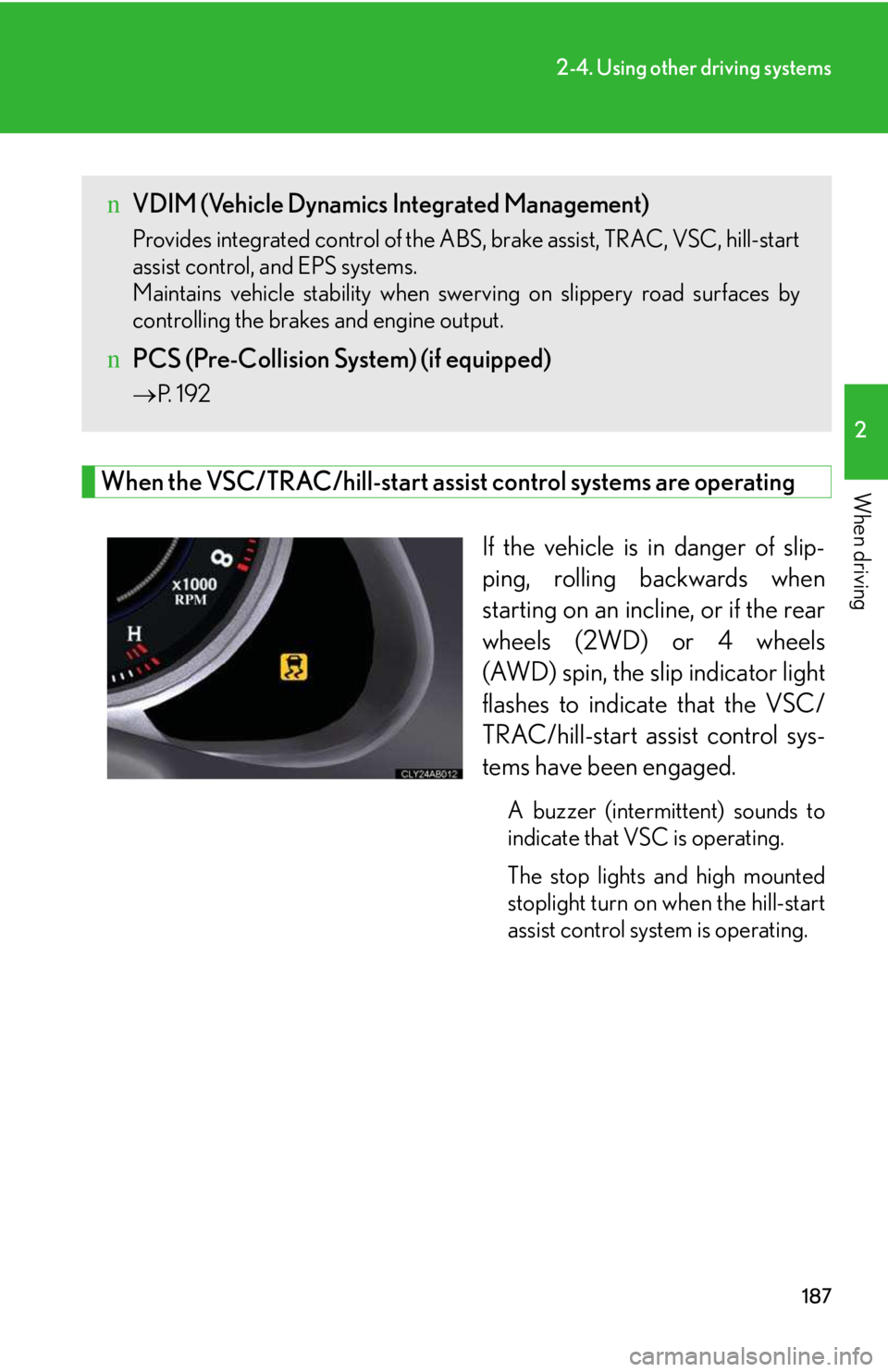
If the vehicle is in danger of slip-
ping, rolling backwards when
starting on an incline, or if the rear
wheels (2WD) or 4 wheels
(AWD) spin, the slip indicator light
flashes to indicate that the VSC/
TRAC/hill-start assist control sys-
tems have been engaged.
A buzzer (intermittent) sounds to
indicate that VSC is operating.
The stop lights and high mounted
stoplight turn on when the hill-start
assist control system is operating.
n VDIM (Vehicle Dynamics Integrated Management)
Provides integrated control of the ABS, brake assist, TRAC, VSC, hill-start
assist control, and EPS systems.
Maintains vehicle stability when swerving on slippery road surfaces by
controlling the brakes and engine output.
nPCS (Pre-Collision System) (if equipped)
→P. 19 2